Category Archives: Aerospace & Defence

The Early History of the Airplane

"The Early History of the Airplane", by Orville and Wilbur Wright (The Project Gutenberg).

“The Early History of the Airplane”, by Orville and Wilbur Wright.

Few weeks ago I read “The Early History of the Airplane”, by Orville and Wilbur Wright (find it in The Project Gutenberg). It is a short book or rather a compilation of 3 articles by the brothers (30 pages in the e-reader version I used). The 3 articles are:

  1. The Wright Brothers’ Aeroplane, by Orville and Wilbur Wright.
  2. How We Made the First Flight, by Orville Wright.
  3. Some Aeronautical Experiments, by Wilbur Wright.

In these articles they provide some insight into how they became attracted to the problem of heavier-than-air self-powered controlled flight, what were the difficulties they faced, what schools of thought there were at the moment (1), who influenced them, what results and experiments from others they relied upon, the experiments they performed, the results at which they arrived… and, yes, they describe their first and subsequent flights.

I would recommend the book to anyone interested in the field or the historic event, with the sole warning that the book sometimes goes a bit on the technical side (though nothing that cannot be endured for just 30 pages!).

Let me share some passages of the book to offer some insight into the quest:

“[…] yet we saw that the calculations upon which all flying machines had been based were unreliable, and that all were simply groping in the dark. Having set out with absolute faith in the existing scientific data, we were driven to doubt one thing after another, till finally, after two years of experiment, we cast it all aside, and decided to rely entirely upon our own investigations. Truth and error were everywhere so intimately mixed as to be undistinguishable. Nevertheless, the time expended in preliminary study of books was not misspent, for they gave us a good general understanding of the subject, and enabled us at the outset to avoid effort in many directions in which results would have been hopeless.”

We have to bear in mind that the problem was yet to be solved, they were exploring uncharted territory… what route to take?

“To work intelligently, one needs to know the effects of a multitude of variations that could be incorporated in the surfaces of flying machines. The pressures on squares are different from those on rectangles, circles, triangles, or ellipses; arched surfaces differ from planes, and vary among themselves according to the depth of curvature; true arcs differ from parabolas, and the latter differ among themselves; thick surfaces differ from thin, and surfaces thicker in one place than another vary in pressure when the positions of maximum thickness are different; some surfaces are most efficient at one angle, others at other angles. The shape of the edge also makes a difference, so that thousands of combinations are possible in so simple a thing as a wing.

We had taken up aeronautics merely as a sport. We reluctantly entered upon the scientific side of it. But we soon found the work so fascinating that we were drawn into it deeper and deeper. […]”

On the other hand, one may think that after all combustion engines were already in use in cars, propellers were used in ships…

We had thought of getting the theory of the screw-propeller from the marine engineers, and then, by applying our tables of air-pressures to their formulas, of designing air-propellers suitable for our purpose. But so far as we could learn, the marine engineers possessed only empirical formulas, and the exact action of the screw-propeller, after a century of use, was still very obscure. As we were not in a position to undertake a long series of practical experiments to discover a propeller suitable for our machine, it seemed necessary to obtain such a thorough understanding of the theory of its reactions as would enable us to design them from calculations alone. What at first seemed a problem became more complex the longer we studied it. With the machine moving forward, the air flying backward, the propellers turning sidewise, and nothing standing still, it seemed impossible to find a starting-point from which to trace the various simultaneous reactions. Contemplation of it was confusing. After long arguments we often found ourselves in the ludicrous position of each having been converted to the other’s side, with no more agreement than when the discussion began.”

Nevertheless, they managed to overcome all those difficulties in just 2 years…

“The first flights with the power machine were made on December 17, 1903. Only five persons besides ourselves were present. These were Messrs. John T. Daniels, W. S. Dough, and A. D. Etheridge, of the Kill Devil Life-Saving Station; Mr. W. C. Brinkley, of Manteo; and Mr. John Ward, of Naghead. Although a general invitation had been extended to the people living within five or six miles, not many were willing to face the rigors of a cold December wind in order to see, as they no doubt thought, another flying machine not fly. […]”

… but it flew!

These are all excerpts from only the first of the three articles included in the book. There are many more things for you to discover in the book about the engine constraints, the control and stability of the machine, the position of the pilot, the rail system used for the take-off run

(1) The two schools being distinguished by at which side of the problem they dedicated the attention: power flight (Langley, Maxim) versus soaring flight (Lilienthal, Mouillard and Chanute).

NOTE: For enthusiasts of aviation history, some other books or studies the brothers went through:

  • “Bird Flight the Basis of the Flying Art” and articles by Otto Lilienthal.
  • “Empire of the Air”, Louis Pierre Mouillard.
  • “Progress in Flying Machines”, Octave Chanute.
  • “Experiments in Aerodynamics”, by Samuel Pierpont Langley.

2 Comments

Filed under Aerospace & Defence, Books

Boeing 787 orders, cancellations, deliveries & backlog through 2013

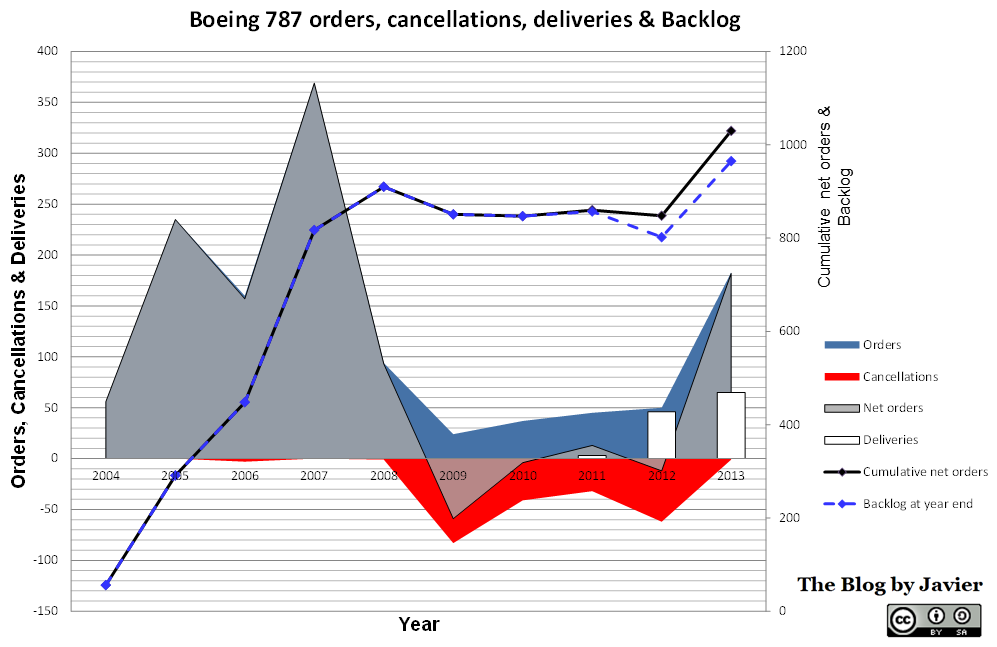
At first sight the year 2013 may seem to have been an annus horribilis for the Boeing 787 program with the months-long grounding of the fleet due to the lithium-ion batteries heat runaway issue, the fires that some of the aircraft in the operating fleet suffered, etc. On the other hand, after 4 years of sales impasse (from 2009 to 2012, inclusive), in which the cumulative net orders of those 4 years stood at a negative 62 aircraft cancelled, in 2013 Boeing recorded 183 new orders against just a single cancellation. Thus, 182 net orders. That is the 3rd best year in sales since the program was launched in 2004.

Last year, I wrote a post wondering whether the grounding of the fleet could be translated into some cancellations. Well, it didn’t so far. Quite the contrary, it got some big contracts from American Airlines, Singapore Airlines, Etihad, British Airways and GECAS.

In last year’s post I included a graphic that I have updated for this post, in order to reflect this recovery and have in one snapshot a view of the orders, cancellations, (net orders), deliveries and backlog.

787 orders, cancellations, deliveries and backlog through 2013.

787 orders, cancellations, deliveries and backlog through 2013.

Leave a comment

Filed under Aerospace & Defence

A380 sales compared to 747 sales at program start (update 2013)

In the previous post I briefly discussed aviation analyst Richard Aboulafia’s assertion “Airbus will be paying the price for the A380 for many years to come” (see original article) from a purely financial and accounting point of view. In this post I wanted to look at it from the market point of view. To do that I will update with 2013 figures a couple of tables and graphics I built last year comparing A380 and 747 orders at each programme start (see last year’s post here).

First see in the graphic below A380 orders since the programme launch (2001) in comparison to those of the 747 (1966):

A380 and 747 orders referenced to the year of launch of each programme (up to 2013).

A380 and 747 orders referenced to the year of launch of each programme (up to 2013).

Both programmes show an initial sales rush at the time of programme launch. In both cases the rhythm of sales slowed down after the second year. In the first 13 years of program, each had managed:

  • 747: 433 orders.
  • A380: 304 orders (30% less).

Thus, we can see that the Boeing 747 was selling better already from the beginning of the programme.

I include again yet another comparison: aircraft orders taking as reference the year of first delivery, having heard so often the industry mantra that some potential customers would wait to see the aircraft in operation before placing orders. See below this second comparison:

A380 and 747 orders referenced to the year the 1st aircraft delivery of each programme (up to 2013).

A380 and 747 orders referenced to the year the 1st aircraft delivery of each programme (up to 2013).

In this case, and due to the shorter time to develop the Boeing 747 since program launch (1966), the difference in sales is narrowed:

  •  747: 301 orders.
  • A380: 304 orders (about the same).

You can see that, 6 years after the 1st delivery of each aircraft (2007 for the A380 and 1969 for the 747) the A380 and the 747 have sold about the same number of aircraft (thanks, no doubt, to the large recurring order placed at the fall by Emirates).

Boeing 747. The Boeing 747 was the first wide-body in commercial aircraft history and still is the twin-aisle with the highest amount of aircraft sold (1,537 a/c as of today, probably to be soon overtaken by the 777) and delivered (1,482 a/c as of today). However, it has taken over 40 years to reach those numbers. The 1,000th unit sold was reached after 25 years of sales in 1990. The 1,000th unit delivered was also reached after 25 years of aircraft deliveries, in 1993.

Thus, in my opinion, when we want to measure the success of the A380 we cannot be distracted by the figures of other commercial aviation segments (single-aisle and small / intermediate twin-aisle) but we have to check what the 20-year forecasts for the Very Large Aircraft say:

  • ~1,300 aircraft according to Airbus GMF,
  • ~600 aircraft according to Boeing CMO,

and then see what could be expected market share for the A380 against those forecasts and whether it is getting the orders to reach it or not.

Finally, as a reader (Matt B.) of the blog pointed in the comment section in last year’s post:  wide-body market has evolved from the 1970s till today, when there are several competitors and other programmes such as the A330 or the 777 deliver close to 100 airplanes per year.

You can find orders and deliveries figures in both manufacturers websites or summarized here: A380 and 747.

1 Comment

Filed under Aerospace & Defence

A380: “one-off items” versus “accounting block”

Aviation analyst Richard Aboulafia recently published an opinion article at Aviation Week & Space Technology magazine, Airbus Twin-Aisles—Big Needs, Limited Means, in which he discussed strategic product portfolio options for Airbus. He was particularly critical to the A380. Let me bring a couple of passages from the article:

Historically, Airbus has spent more than Boeing on development as a percent of sales than. But during the past 15 years, the bulk of this heavy spending was squandered on the A380. Today, development spending is set to fall in line with the company’s new direction. Last year, it fell below 6% for the first time since the company was established (see graph). Given the requirements of funding the A350XWB and A320neo, Airbus isn’t likely to have the resources to fund both an A330neo and A380neo and a new large twin, too. Tough choices will need to be made. […]

In short, Airbus will be paying the price for the A380 for many years to come.

From these 2 paragraphs, the first assertions are factual: Airbus spends more on research and development than Boeing Commercial Airplanes and during the last years most of that spending was dedicated to the A380. In my opinion the last sentence overstates the issue of the current burden of A380 over the company’s future. If the A380 did not derail EADS during 2006-2010 it will not do so in the coming years. As numbers show and top management has indicated at investors events the A380 programme is expected “to emerge from the red by 2015“.

A380 MSN4 (credit: A. Doumenjou).

Today the A380 is a recurring cost issue, not more. The situation would be entirely different had Airbus (or rather EADS, now Airbus Group) applied the same accounting system that Boeing does (since the merger with McDonnell Douglas). EADS has passed in the profit and loss accounts in the previous years several one-off items related to the A380 valued in billions of euros (refer to yearly financial reports). What is left are R&D (mainly D) expenses to bring down unitary recurring costs and producing enough numbers of aircraft so that learning curve effects can be benefited from.

On the other hand, Boeing accounting system spreads the capital expenditures and research and development costs along what they refer to as an accounting block, which for example for the 787 now takes 1,300 airplanes to amortize those costs (previously were 1,100, see here a post on the 787 break even).

2 Comments

Filed under Aerospace & Defence

Boeing list prices increases vs. discounts increases…

In a previous post I updated the estimate of what is the average discount Boeing applies when selling its commercial airplanes using 2013 data of list prices, deliveries and reported revenues. The figure I came up with was a 47% discount. I included the following graphic showing the discount evolution:

Boeing Average Discount Evolution, 2013.

Boeing Average Discount Evolution, 2013.

Seeing the increasing trend of average discount together with knowing the fact that Boeing regularly increases list prices triggered the following question: Have Boeing airplane real prices increased, decreased or stayed constant in the recent years? I set out to answer this question using the estimated average discount of each year (1) from the graphic above.

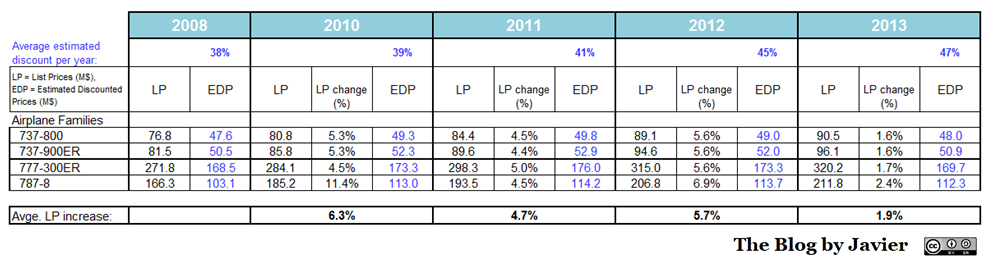
The Boeing list prices (LP) can be found here. I have been recording those prices for years and thus have a table with the evolution of list prices for each model year by year. The following step is to apply the average discount estimated for each year to then-year list prices, to get the estimated discounted prices (EDP) per model. Thus, a table can be built for the last 5 years.

You can find below the result for the best-selling aircraft during previous years: 737-800, 737-900ER, 777-300ER and 787-8. Together these 4 models amounted 560 deliveries in 2013 or over 86% of the total 648 airplanes Boeing delivered in 2013.

Boeing List and discount Prices evolution table, 2008-2013.

Boeing List and discount Prices evolution table, 2008-2013.

In the table above I included in black figures what have been Boeing list prices of these models in the past years (as reported in their website) while I marked in blue the figures which are estimated, using as a departure point the calculated averages discounts per year (also included in blue in the table). I included as well the list prices year-on-year change as a % of the previous year list prices, per model.

The average list price increase included at the bottom line is computed with the information of all Boeing models (19 in 2008 and 18 in 2013, though different ones, a total of 24 different models along this period), not only the 4 included in this table.

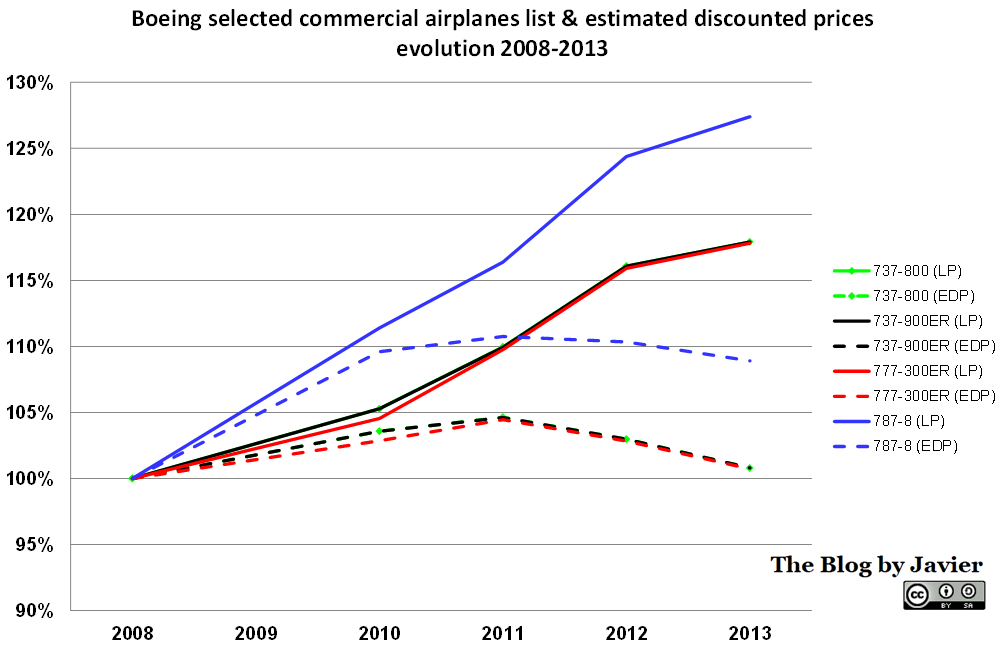
You may see in the table above that after not increasing prices in 2009, Boeing has steadily increased them in 2010 (6.3%), 2011 (4.7%), 2012 (6.7%) and 2013 (1.9%). However, if you take a look at the blue figures in the same table you will notice that prices of 2013 are between 2008 and 2010 price levels for all 4 models! That is, the widely announced yearly list prices increase has been yearly offset by a discreet (not-announced) increase in the discounts applied to sales of airplanes. Thus, the pricing power of Boeing has remained barely constant during the last 5 years. You may see it better in the graphic below:

Boeing List and discount Prices evolution graphic, 2008-2013.

Boeing List and discount Prices evolution graphic, 2008-2013.

The graphic shows the price evolution for each of the 4 airplane models selected, taking as a reference their list and estimated discounted prices in 2008 (indicated as 100%) . List prices are shown with straight lines, versus dashed lines used for estimated prices. Each pair of prices for each aircraft is presented in the same color for easier identification. Some comments to the graphic:

  • Through continuous increases, 2013 list prices were between 18% (737 and 777) and 27% (for the 787) higher than in 2008.
  • However, due to increasing discounts from 38% in 2008 to 47% in 2013, the increase in list prices is almost entirely offset.
  • 2013 discounted prices are below 2010 discounted prices for all models.
  • 2013 discounted prices are almost back at 2008 levels for the 737 and 777, only the 787 seems to have stayed at 2010 levels.

(1) There is no way to know the real price and discount that Boeing applies in each sale, as it will depend from customer to customer (American Airlines -AMR- or Fedex) and from model to model (737-800 or 787-8). There where competition is tougher, discounts will be higher. However, the estimates I have made are an average of all Boeing aircraft sold in a given year.

3 Comments

Filed under Aerospace & Defence

Boeing commercial aircraft discounts (update for 2013)

Few days ago, Boeing released 2013 results [PDF, 841KB]. The company reported revenues of over 86.6bn$648 commercial deliveries and 1,355 net orders for its commercial aircraft. All these were widely reported by the media and mean a great year 2013 for Boeing (with increases in these metrics from 6 to 8%).

Last years, I wrote in some posts (1) what was my estimate of Boeing discounts: the relation between what is announced by the press, what appears in its list prices and sometimes as backlogs and what it is indeed computed into the profit and loss account. In this post I wanted to update, if necessary, the figure I calculated for the average discount of Boeing.

Most of the necessary information can be found in its website. Boeing list prices can be found here.

The number of gross and net orders (after cancellations) year by year can be found here.

Last year deliveries can be found in the report of financial results (or here). From there we can also deduce the figure of Boeing Commercial’s sales of services. That is not directly reported but can be deduced (all Boeing services-related sales are reported as well as Boeing Capital Corporation division and Boeing Defense’s “Global Services & Support” unit)

As in the previous years’ post:

  • I needed to make one assumption: new orders come with a 3% down payment in the year of the booking, while the remaining cost I assumed that was paid on the year of delivery (for simplicity I didn’t consider more intermediate revenue recognition milestones linked to payments, the 3% figure was taken from the AIAA paper “A Hierarchical Aircraft Life Cycle Cost Analysis Model” by William J. Marx et al.). (2)

Having put all the figures together, the calculation is immediate. Boeing Commercial Aircraft revenues in 2013 (52.98bn$) are the sum of:

  • the discounted prices times the delivered aircraft in the year (including possible penalties from delays),
  • less the down payment of the current year delivered aircraft, as the down payment was included in previous years results,
  • plus the down payment of current year net orders (this year’s calculation has been again a bit tricky as it included 737NG deliveries and 737 MAX orders),
  • plus services revenues (less than 0.3bn$ from the commercial aircraft unit – calculated, not reported).

The discount figure that minimized errors last year was 45%. Using this figure, the error obtained this year in relation to Boeing Commercial Aircraft reported revenues is 3.9%, much too high. The best estimate for last years average discounts were: 45% for 2012, 41% for 2011, 39% for 2010 and 38% for 2009.

The updated figure (which minimize errors for 2013 down to 0.2%) for the discount for Boeing commercial aircraft is 47% (3).

Boeing Average Discount Evolution, 2013.

Boeing Average Discount Evolution, 2013.

The explanation I can find for that increase shall be linked the built-in penalties for 787 plus the introduction of the new 787-10 with increased discounts for the launch customers.

(1) Find here what is becoming a “body of knowledge” on Boeing discounts: estimates calculated for 2012, 2011, 2010 and 2009; a review of the French portal Challenges.fr of aircraft discounts prior to Le Bourget airshow of 2013; a Bombardier’s CEO statement on what is known in the market as the Boeing discount; Boeing Commercial Airplanes president Ray Conner speaking about the more aggressive pricing they are being forced to offer.

(2) Two years ago, I received a comment from the analyst Scott Hamilton on the level of downpayments. He mentioned they could reach up to 30%. I tried this time to compute the calculation using that input, though the figures of discounts to be applied each year to minimize errors would have to be even higher, over 50% (!), thus I stayed with the 3% used in the above-mentioned published paper to stay on the conservative side.

(3) I find this trend of continuous increases in Boeing discounts in line with both Challenges.fr report and Ray Conner’s mentions of aggressive pricing last year, both referred to in note (1).

10 Comments

Filed under Aerospace & Defence

The NSA, the Use of Spies and The Art of War (Sun Tzu)

I reviewed yesterday the book The Art of War (by Sun Tzu) from the point of view teamwork, communication and leadership as that was the interest I had when I have read it this second time. However, there was another chapter that called my attention given the ongoing NSA spying scandal (PRISM surveillance programme) disclosed by The Guardian and The Washington Post in 2013, that was the last on of the book “The Use of Spies“:

Raising a host of a hundred thousand men and marching them great distances entails heavy loss on the people and a drain on the resources of the State. […] There will be commotion at home and abroad, and men will drop down exhausted on the highways. […] Hostile armies may face each other for years, striving for the victory which is decided in a single day. This being so, to remain in ignorance of the enemy’s condition simply because one grudges the outlay of a hundred ounces of silver in honors and emoluments, is the height of inhumanity. One who acts thus is no leader of men, no present help to his sovereign, no master of victory. Thus, what enables the wise sovereign and the good general to strike and conquer, and achieve things beyond the reach of ordinary men, is foreknowledge. Now this foreknowledge cannot be elicited from spirits; it cannot be obtained inductively from experience, nor by any deductive calculation. Knowledge of the enemy’s dispositions can only be obtained from other men.

Hence the use of spies, of whom there are five classes: (1) Local spies; (2) inward spies; (3) converted spies; (4) doomed spies; (5) surviving spies. When these five kinds of spy are all at work, none can discover the secret system. This is called “divine manipulation of the threads.” It is the sovereign’s most precious faculty. Having local spies means employing the services of the inhabitants of a district. Having inward spies, making use of officials of the enemy. Having converted spies, getting hold of the enemy’s spies and using them for our own purposes. Having doomed spies, doing certain things openly for purposes of deception, and allowing our spies to know of them and report them to the enemy. Surviving spies, finally, are those who bring back news from the enemy’s camp.

Hence it is that which none in the whole army are more intimate relations to be maintained than with spies. None should be more liberally rewarded. In no other business should greater secrecy be preserved. Spies cannot be usefully employed without a certain intuitive sagacity. They cannot be properly managed without benevolence and straightforwardness. Without subtle ingenuity of mind, one cannot make certain of the truth of their reports. Be subtle! be subtle! and use your spies for every kind of business. If a secret piece of news is divulged by a spy before the time is ripe, he must be put to death together with the man to whom the secret was told.

Whether the object be to crush an army, to storm a city, or to assassinate an individual, it is always necessary to begin by finding out the names of the attendants, the aides-de-camp, and door-keepers and sentries of the general in command. Our spies must be commissioned to ascertain these. The enemy’s spies who have come to spy on us must be sought out, tempted with bribes, led away and comfortably housed. Thus they will become converted spies and available for our service. It is through the information brought by the converted spy that we are able to acquire and employ local and inward spies. It is owing to his information, again, that we can cause the doomed spy to carry false tidings to the enemy. Lastly, it is by his information that the surviving spy can be used on appointed occasions. The end and aim of spying in all its five varieties is knowledge of the enemy; and this knowledge can only be derived, in the first instance, from the converted spy. Hence it is essential that the converted spy be treated with the utmost liberality.

[…] Hence it is only the enlightened ruler and the wise general who will use the highest intelligence of the army for purposes of spying and thereby they achieve great results. Spies are a most important element in war, because on them depends an army’s ability to move.

And then comes the scandal, the reaction of global leaders subjected to espionage, of private companies, etc.

2 Comments

Filed under Aerospace & Defence, Books

Drones

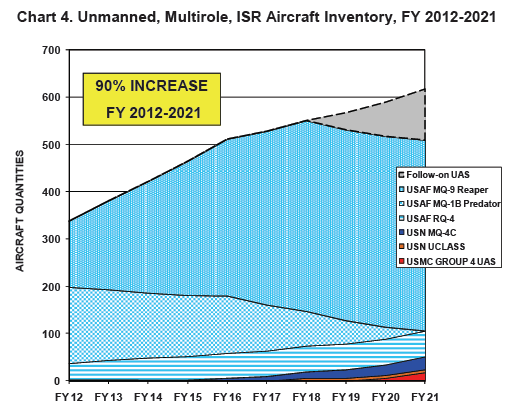
The use of drones (how unmanned aerial vehicles, UAVs, are commonly called) in military operations has been very criticized in the past years, partly due to the collateral civilian casualties from such operations (close to 300 just in Pakistan in the past years). Nevertheless, the use of drones is here to stay. The US Department of Defense includes as part of its budgetary information an “Aircraft Procurement Plan FY2012-2041” [PDF, 332KB], see in the graphic below how it is planned to almost duplicate the drones in the fleet along the next decade:

xxx

Unammned aerial vehicles in DoD inventory.

The civilian use of drones has been lagging behind these years mainly due to its integration in the air space. To that respect, the Federal Aviation Administration (FAA) announced last month an initial plan for integrating unmanned aircraft  into U.S. airspace by September 2015.

There are plenty of possible civilian applications that have been raised; from monitoring crops, to pipelines, oil rigs, forest fires, photography… to the dispatching of personal packages being announced recently by Amazon (Prime Air). The Economist issue of this week includes an article, Game of drones, which estimates that by 2017 there could be up to 10,000 drones flying in the USA and by 2025 the civilian drone market could have a size of up to 82bn$ per year, according to the Association for Unmanned Vehicle Systems International (AUVSI).

In this general picture Europe has been left behind.

European air forces are still relying on US and Israeli drones (just this week France has received its first 2 MQ-9 Reaper from the USA). That is why I hope that the conclusion at the recent EU Council  (see here a post I wrote about it) in relation to the launching of a European Medium Altitude Long Endurance (MALE) drone programme helps to put an end to that situation and enables Europe and its industry to bridge the gap:

[…] the development of Remotely Piloted Aircraft Systems (RPAS) in the 2020-2025 timeframe: preparations for a programme of a next-generation European Medium Altitude Long Endurance RPAS; the establishment of an RPAS user community among the participating Member States owning and operating these RPAS; close synergies with the European Commission on regulation (for an initial RPAS integration into the European Aviation System by 2016); appropriate funding from 2014 for R&D activities; […]

The bridging of that gap would not only ensure the security of supply of such drones for Europe but would help develop critical technologies to maintain the industrial base, its growth and employment; apart from the fact of being many of such technologies of dual use (as recognised in the EU Council conclusions) they would help Europe to access the market for civilian use of drones.

Leave a comment

Filed under Aerospace & Defence

Common Security and Defence Policy (CSDP)

Security and Defence is a topic which only makes it to the front pages of the media when there are actual war operations. Rarely a debate is centered on whether the country needs to foster its capabilities, invest in new defence technologies, or protect a certain industry base. I cannot recall a single electoral programme calling for such initiatives. The defence is not popular in today’s (European) society.

“The supreme art of war is to subdue the enemy without fighting.” Sun Tzu

Despite of that, and even if some Europeans take them today for granted, defence and security are no less crucial than many other public services which we expect States to provide us. As Javier Solana (former EU High Representative for Foreign and Security Policy, Secretary-General of NATO and Foreign Minister of Spain) put it few days ago in an article titled “Globalizing European Security“:

Global security – a safe and peaceful environment free of conflict – is a public good. In other words, all of the world’s citizens and countries benefit from it, regardless of whether they contribute to supplying it. Given this, free riders (those who enjoy the benefits of the good without investing in its provision) are likely to be plentiful. But, when it comes to global stability, the world simply cannot afford a free-riding Europe.

This obviously includes Europe: Europe cannot afford a free-riding Europe. As Anders Fogh Rasmussen (current Secretary-General of NATO and former Prime Minister of Denmark) put it yesterday:

I truly believe that we should do much more to educate society in the importance of peace, security and defence as goods to be protected and spread, so they can be better valued and supported.

EUCO Conclusions Defence, December 19, 2013 [PDF, 118KB]

EUCO conclusions on Defence, December 19, 2013 [PDF, 118KB]

Having said that, yesterday took place the first session of a 2-day EU Council in which one of the main topics to be dealt with was Security and Defence. Apart from the one cited above, there have been plenty of interesting articles in days prior to the meeting calling for decisions and actions to be taken by the council. To name a few:

In this post I just want to bring the European Council conclusions [PDF, 118KB] as already published and outline some of the passages.

2. The EU and its Member States must exercise greater responsibilities in response to those challenges if they want to contribute to maintaining peace and security through CSDP […]. The European Council calls on the Member States to deepen defence cooperation by improving the capacity to conduct missions and operations and by making full use of synergies in order to improve the development and availability of the required civilian and military capabilities, supported by a more integrated, sustainable, innovative and competitive European Defence Technological and Industrial Base (EDTIB). This will also bring benefits in terms of growth, jobs and innovation to the broader European industrial sector.

4. […] the European Council has identified a number of priority actions built around three axes: increasing the effectiveness, visibility and impact of CSDP; enhancing the development of capabilities and strengthening Europe’s defence industry.

5. […] The European Union and its Member States can bring to the international stage the unique ability to combine, in a consistent manner, policies and tools ranging from diplomacy, security and defence to finance, trade, development and justice. […]

8. […] The European Council emphasises the need to improve the EU rapid response capabilities, including through more flexible and deployable EU Battle groups […]

9. New security challenges continue to emerge. […] the European Council calls for:

  • an EU Cyber Defence Policy Framework in 2014 […]
  • an EU Maritime Security Strategy by June 2014 […]
  • increased synergies between CSDP and Freedom/Security/Justice actors […]
  • progress in developing CSDP support for third states and regions […]
  • further strengthening cooperation to tackle energy security challenges.

10. Cooperation in the area of military capability development is crucial to maintaining key capabilities, remedying shortfalls and avoiding redundancies. Pooling demand, consolidating requirements and realising economies of scale will allow Member States to enhance the efficient use of resources and ensure interoperability, […]

11. The European Council remains committed to delivering key capabilities […]. Bearing in mind that the capacities are owned and operated by the Member States, it welcomes:

  • the development of Remotely Piloted Aircraft Systems (RPAS) in the 2020-2025 timeframe: preparations for a programme of a next-generation European Medium Altitude Long Endurance RPAS; the establishment of an RPAS user community among the participating Member States owning and operating these RPAS; close synergies with the European Commission on regulation (for an initial RPAS integration into the European Aviation System by 2016); appropriate funding from 2014 for R&D activities;
  • the development of Air-to-Air refuelling capacity: progress towards increasing overall capacity and reducing fragmentation, especially as regards the establishment of a Multi-Role Tanker Transport capacity, with synergies in the field of certification, qualification, in-service support and training;
  • Satellite Communication […]
  • Cyber: developing a roadmap and concrete projects […]

13. The European Council welcomes the existing cooperative models, such as the European Air Transport Command (EATC), and encourages Member States to explore ways to replicate the EATC model in other areas.
14. […] It encourages the further development of incentives for and innovative approaches to such cooperation, including by investigating non market-distorting fiscal measures in accordance with existing European law. […]

16. Europe needs a more integrated, sustainable, innovative and competitive defence technological and industrial base (EDTIB) to develop and sustain defence capabilities. This can also enhance its strategic autonomy and its ability to act with partners. The EDTIB should be strengthened to ensure operational effectiveness and security of supply, while remaining globally competitive and stimulating jobs, innovation and growth across the EU. These efforts should be inclusive with opportunities for defence industry in the EU, […]

17. A well-functioning defence market based on openness, equal treatment and opportunities, and transparency for all European suppliers is crucial. […] with a view to opening up the market for subcontractors from all over Europe, ensuring economies of scale and allowing a better circulation of defence products.

18. To ensure the long-term competitiveness of the European defence industry and secure the modern capabilities needed, it is essential to retain defence Research & Technology (R&T) expertise, especially in critical defence technologies. The European Council invites the Member States to increase investment in cooperative research programmes, […]. Civilian and defence research reinforce each other, including in key enabling technologies and on energy efficiency technology. The European Council therefore welcomes the Commission’s intention to evaluate how the results under Horizon 2020 could also benefit defence and security industrial capabilities. […] to develop proposals to stimulate further dual use research. […]

1 Comment

Filed under Aerospace & Defence

Hudson Miracle Approach

Most of you probably heard about the US Airways flight 1549 which on January 15th, 2009, had to land on the river Hudson (New York, USA) due to the loss of engine thrust right after bird strikes in the climb path.

Despite of the recognized initial denial reported by the Captain in the interview below, crucial decisions were taken within the 1st minute after the event. See the captain’s explanations [10 minutes]:

If you want to “re-live” what happened, see the 3-D animation of the flight with the real recorded voices of the conversation between the airplane and air traffic controllers:

This accident had a happy ending thanks to the several layers of safety that exist today in commercial aviation, just to name a few: contained engine failure, pilot training, clear communication protocols and phraseology, etc.

Today we can remember that episode with the following chart I found in Twitter via a work colleague:

Jeppesen KLGA/LGA chart, or "Hudson Miracle Approach".

Jeppesen KLGA/LGA chart, or “Hudson Miracle Approach”.

Leave a comment

Filed under Aerospace & Defence