Category Archives: Aerospace & Defence

B-36 Peacemaker

In a previous post about the Pima Air & Space Museum, I mentioned that I viewed the (Consolidated) Convair B-36 Peacemaker bomber as one of the highlights of the museum.

The B-36 was a strategic bomber which operated at the beginning of the cold war. The design of the aircraft started prior to the entry of USA in the WWII. The US Army Air Corps was seeking a bomber with an un-refueled intercontinental range, that is, that could fly from the US East Coast to Europe, drop bombs and fly back to the USA without being refueled. That mission was out of the range of the bombers being used at the time, the Boeing B-17 Flying Fortress and the Consolidated B-24 Liberator.

A bit less than 400 aircraft were built and it was retired from service at the beginning of the 1950s, when the B-47 and B-52 started to take over its role.

XB-36 prototype with single-tyre landing gear legs (and without jet engines).

The development of the aircraft showed some pitfalls that are curious to reflect on. For example, initially the main landing gear consisted of two legs with a single (huge) tyre each (see picture in the right). That caused significant pressure to be stood by the runway resulting in it being able to operate only from 3 runways in the USA (!). In the pictures below you can see that the series production has 4 wheels per leg.

Another interesting point is that of the engines. The B-36 initially had six 28-cylinder Pratt & Whitney R-4360 “Wasp Major” radial engines (see the internal movement of a piston radial engine in this post, with a video taken at National Air and Space Museum in Dulles, DC). Each engine drove a three-bladed propeller, 5.8m of diameter (for comparison, A400M propellers have a 5.3m diameter), mounted in the pusher configuration. This configuration led to some engine fires due to engine-overheating. The aircraft also was very slow in taking off and thus from the version B-36D Convair added 4 General Electric J47-19 jet engines, two in each outer part of the wings. This improved take-off performance, however in normal cruise, to reduce fuel consumption the jet engines were shut off, and some louvers covered the air intakes to reduce drag (see pictures below). This made the B-36 have in the end 10 (!) engines: 6 piston engines and 4 jet engines (“six turnin’ and four burnin’ “, as described by Airmen Magazine, the official US Air Force magazine).

See some of the pictures of the Convair B-36 Peacemaker that I took at Pima in the slide show below:

This slideshow requires JavaScript.


To put things into perspective, some of the technical specifications:

  • Length: 49.42m >> A380 length is 72.73m (much longer)
  • Wingspan: 70.12m >> A380 wingspan is 79.75m (~)
  • Wing area: 443.5m2 >> A380 wing area is 845m2 (almost 2x)
  • Empty Weight: 75,530kg >> A400M empty weight is 76,500kg (~)
  • Maximum Take Off Weight: 186,000kg >> A400M MTOW is 141,000kg (lower)
  • Combat radius: 3,465nm >> B-52 combat radius is 3,890nm, or 787 range of ~8,000nm (note radius vs. range) (~)
  • Armament: 39,000kg of bombs >> B-52 carries ~31,500kg of bombs (lower)

Finally, you may see below the first part of a 30-minute documentary about the B-36, the requirement behind it, its prototypes, development, etc.:

4 Comments

Filed under Aerospace & Defence

Lowell Observatory

I believe that the first time I heard about Percival Lowell was reading the book “Marte y Vida, ciencia y ficción” (in Spanish; by Bartolomé Luque Serrano and Álvaro Marquéz González, the former being a teacher I had while at the university – “Mars and Life, science and fiction”). The reference to Lowell in the book was due to his drawings of the canals of Mars which promoted the idea of intelligent life in the planet. Thus, I mistakenly did not take the person very seriously at first.

Percival Lowell observing through Alvan Clark telescope at Lowell Observatory (public domain image).

Percival Lowell descended from a wealthy family from Boston (1), graduated from Harvard and dedicated a great part of his life to astronomy. Lowell founded the Lowell Observatory in 1894 in the city of Flagstaff (AZ). He made several observations of Mars, Venus, searched for Planet X and set out the non-profit which operates the observatory till today.

Even if not by Lowell, Pluto was discovered in his observatory in 1930 by  Clyde Tombaugh near the location expected for Planet X. The name and monogram for Pluto are partly a recognition to Lowell.

Today the observatory counts with several telescopes in different locations and employs about 20 full-time researches (PhD students included). It can be visited daily (12$ / adult) and with the visit some guided tours performed by the researchers are included. I definitely recommend the visit to the observatory for the science and history behind it.

The picture above is quite famous and shows Lowell in the Alvan Clark telescope located at Mars Hill. This telescope is part of the visit. There you will be able to see that chair, the wheels moving the dome, etc. The staff of the museum will operate some of the systems to move the telescope for the delight of the visitors. See some pictures below:

This slideshow requires JavaScript.

Observing the sun.

Observing the sun.

During our visit it was possible to observe the sun through a telescope (see picture at the right) during the day and more observations were to be organized during the evening. Thus, even if we did not do it like that I recommend planning the visit to the museum in the afternoon or at least staying over at Flagstaff the day you visit the museum (you can leave the museum and return in the evening with the same ticket for the observations).

Comparing pictures to detect planets (at Rotunda Museum).

Comparing pictures to detect planets (at Rotunda Museum).

The tour we joined ended up with a visit to the Rotunda Museum (within the Observatory) where we were given more explanations and we were shown artifacts from Lowell’s time.

There is an area in the museum used for temporary exhibitions, which in the days we visited it was dedicated to the evolution of space suits used by astronauts.

Finally, we found it funny this humourous touch we found at the museum: at the time of asking for support for the observatory, 4 different boxes are presented to the visitor enabling her to vote with the wallet on “What should Pluto be called?” (2):

IMG_2764

I do recommend the visit to the museum whenever you happen to be in Flagstaff (good stop over when visiting the Grand Canyon).

***

(1) As per the “Boston Toast” by Harvard alumnus John Collins Bossidy:

“And this is good old Boston,
The home of the bean and the cod,
Where the Lowells talk only to Cabots,
And the Cabots talk only to God.”

(2) Recall that in 2006 the International Astronomical Union established some conditions for an object to be considered a “planet” and Pluto failed the test and was “downgraded” to “dwarf planet”.

2 Comments

Filed under Aerospace & Defence, Travelling

Pima Air and Space Museum

Pima is a county in the South of Arizona, where the city of Tucson is located. Tucson is home of the Davis-Monthan Air Force Base, where the US Air Force’s 309th Aerospace Maintenance and Regeneration Group (AMARG), known as “The Boneyard”, is located. I wrote about the Boneyard in a previous postIn order to visit the Boneyard, you need to visit the Pima Air & Space Museum and that is how I got to know about the museum.

The description of the museum from their website states (the emphasis is mine):

“The Pima Air & Space Museum is one of the largest aviation Museums in the world, and the largest non-government funded aviation Museum in the United States. You’ll see more than 300 aircraft and spacecraft including many of the most historically significant and technically advanced craft ever produced, both from the United States and throughout the world.”

Pimar Air & Space Musem (Tucson, AZ).

Pima Air & Space Museum (Tucson, AZ).

The museum has 6 hangars and one space gallery, plus an impressive exhibit outdoors, which can be visited with a tram or on foot (or both). You can see in the map below the arrangement of the museum:

Pima Air and Space Museum map.

Pima Air and Space Museum map.

Together with the plan the visitor is handed an inventory of the aircraft on exhibit and where are they located (in which hangars):

Pimar Air and Space Museum inventory.

Pima Air and Space Museum inventory.

As you can see from the inventory above, the list of aircraft exhibited at the museum is simply impressive, overwhelming. Add to that, that in this museum you can get as close to the aircraft as you wish.

In the website of the museum you can find brief explanations of each of the aircraft on exhibit (here). This aircraft index can be surfed very handily ordering the aircraft by different criteria. The information about them includes some technical specifications, a brief historical explanation and a picture of the aircraft (I would almost say that it makes up for a visit of the museum). A very good job on the part of the museum curators.

Some of the highlights (in my opinion) of the museum:

Find some pictures I took of some of these aircraft and others in the slide show below:

This slideshow requires JavaScript.

The Pima Air & Space Museum has also facilities to restore the aircraft they get and bring them to a decent status to be put on exhibition. Some of the aircraft are on loan from the US Air Force Museum.

Within the museum there are plenty of US armed forces veterans willing to share with you detailed explanations or anecdotes from any of the aircraft. The tram visit of the outdoor exhibit is guided by one of these veterans… no need to say that the experience is fantastic.

It goes without saying it, that I strongly recommend to visit this museum as it is one of the best aerospace museums that I have ever visited. Couple that with the visit to the Boneyard and it is definitely a must for aerospace aficionados.

Finally, some tips to visit the museum:

  • plan your visit as early as possible (doors open at 9am),
  • allow yourself no less than 5 hours to comfortably visit the museum,
  • if the visit is in summertime, bring a bottle of water with you (which can be refilled in any of the many sources inside the museum),
  • plan to have lunch in the museum,
  • book yourself a place both in the tram to visit the outdoor exhibit and in the bus to visit the Boneyard (for this a photo ID will be necessary), as tickets sell out, be there at 9am.

6 Comments

Filed under Aerospace & Defence, Travelling

Hiroshima and the Enola Gay

Today, August 6th, in 1945 the Boeing B-29 Superfortress “Enola Gay” dropped over Hiroshima (Japan) the first nuclear bomb, “Little Boy“, used in combat. I guess you have had the chance to read about it in several places along the day. However, I thought of writing this post in order to connect several points related to the story, some of which I have only discovered quite recently…

Hiroshima

Luca and I, together with some friends visited Japan during the summer of 2008. A mandatory stop was Hiroshima. There we visited the Hiroshima Peace Site, museum and park.

You can spend several hours in the museum: from reading about the life in Hiroshima prior to the war, during the war and before the bombing, about the Manhattan Project, learning from specific cases of victims of the bomb, several testimonies, replicas from wounded people, etc. Some parts of the museum are truly shocking.

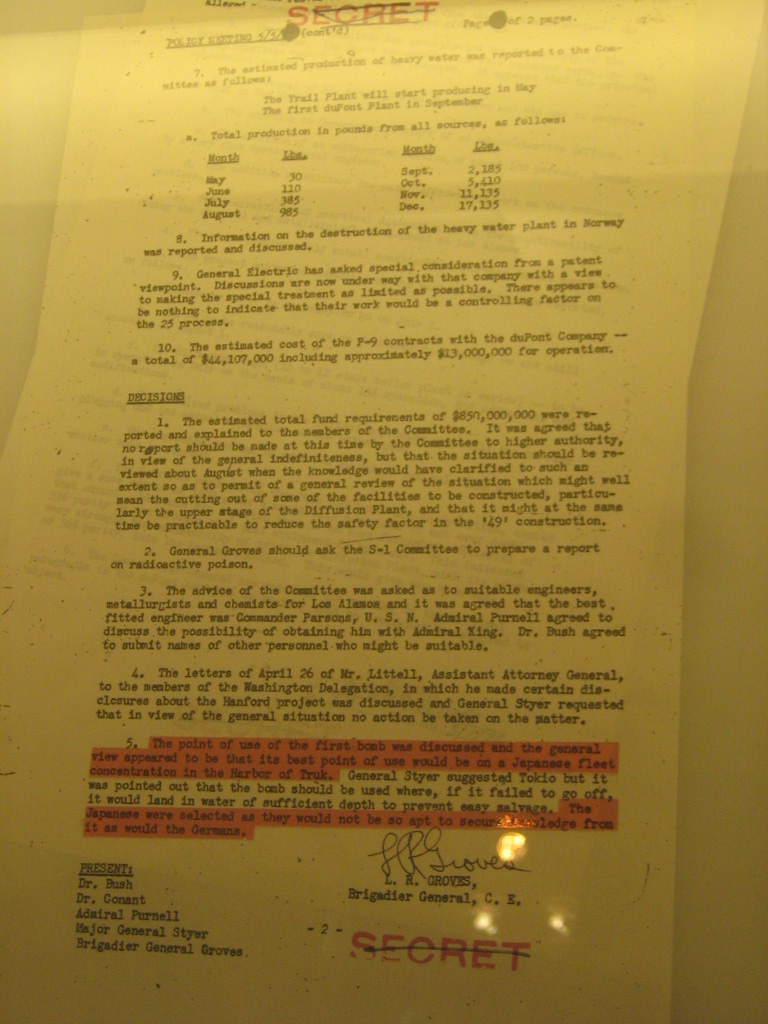
In the museum you could read several letters related to the Manhattan Project, for example these two from brigadier general Leslie Groves (in charge of the project) and Albert Einstein:
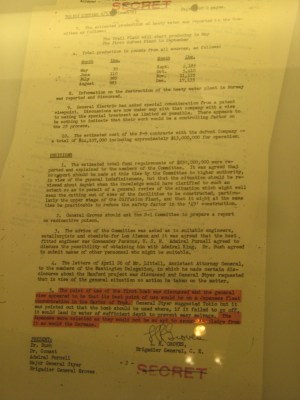
Letter from general Leslie Groves (Peace)

Letter from brigadier general Leslie Groves (Hiroshima Peace Memorial Museum).

Einstein’s letter to F.D. Roosevelt (Hiroshima Peace Memorial).

Some years ago, I read the book “The World as I see it“, from Albert Einstein in which he explained retrospectively his thoughts at the time of supporting the Manhattan Project. I already wrote a post about that book and recommend the reading of it.

In the Memorial Park, two things caught my attention: Genbaku Dome and the story of Sadako Sasaki.

Genbaku Dome

The dome (also called “A-dome”) was the only structure in the area which was left standing. This is because the explosion of the bomb happened at about 600m above the dome and about 150m away horizontally enabling the structure to stand the nearly vertical compression it suffered due to the blast.

The dome was initially scheduled to be demolished, but finally it was preserved, being today UNESCO World Heritage Site.

Genbaku Dome, Hiroshima.

Genbaku Dome, Hiroshima.

Sadako Sasaki

As I did in a post I wrote 3 years ago, in order to explain her story I will paste below an excerpt from Wikipedia‘s article on the history of origami (paper birds):

Legend says that anyone who folds one thousand paper cranes will have their heart’s desire come true. The origami crane has become a symbol of peace because of this legend, and because of a young Japanese girl namedSadako Sasaki. Sadako was exposed to the radiation of the atomic bombing of Hiroshima as an infant, and it took its inevitable toll on her health. She was then a hibakusha — an atom bomb survivor. By the time she was twelve in 1955, she was dying of leukemia. Hearing the legend, she decided to fold one thousand origami cranes so that she could live. However, when she saw that the other children in her ward were dying, she realized that she would not survive and wished instead for world peace and an end to suffering.   

A popular version of the tale is that Sadako folded 644 cranes before she died; her classmates then continued folding cranes in honor of their friend. She was buried with a wreath of 1,000 cranes to honor her dream. While her effort could not extend her life, it moved her friends to make a granite statue of Sadako in the Hiroshima Peace Park: a young girl standing with her hand outstretched, a paper crane flying from her fingertips. Every year the statue is adorned with thousands of wreaths of a thousand origami cranes.   

The tale of Sadako has been dramatized in many books and movies. In one version, Sadako wrote a haiku that translates into English as:   

I shall write peace upon your wings, and you shall fly around the world so that children will no longer have to die this way.

Hiroshima Peace Memorial park paper cranes.

In previous posts in the blog I explained how I have repeatedly encountered these paper birds around the world: in NY Saint Paul’s Chapel (close to World Trade Center zone zero), in Manzanar War Relocation Center (where Americans of Japanese origin were kept captive during WWII)…

Enola Gay

The “Enola Gay“, the Boeing B-29 Superfortress (named after the mother of the pilot Paul Tibbets) that dropped the bomb has become known worldwide. You can see the actual plane at the National Air and Space Museum in Dulles (Washington DC), where it is on exhibit. I wrote about that museum in this post, and you can see the airplane in the image below:

Boeing B-29 Superfortress “Enola Gay” at National Air and Space Museum (Washington DC).

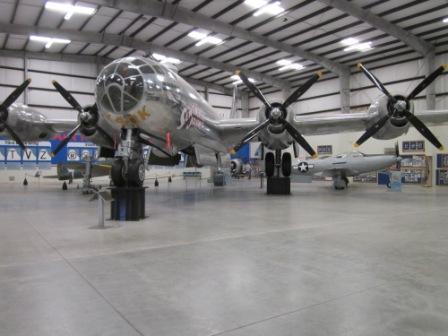
However, there are other aerospace museums where you can get closer to B-29 Superfortress aircraft, for example, the Pima Air and Space Museum in Tucson, Arizona, which we visited some months ago. There they had one B-29 on exhibit in one of its hangars:

Boeing B-29 Superfortress at Pima Air and Space Museum.

Boeing B-29 Superfortress at Pima Air and Space Museum (Tucson, AZ).

In the Pima museum, you could get really up close (not so in the NASM in Dulles) and you could get your head inside the bomb bay of the aircraft, the same bomb bay from which “Little Boy” was dropped from the “Enola Gay”:

Bomb bay of a B-29 Superfortress (at Pima Air and Space Museum, Tucson, AZ).

Bomb bay of a B-29 Superfortress (at Pima Air and Space Museum, Tucson, AZ).

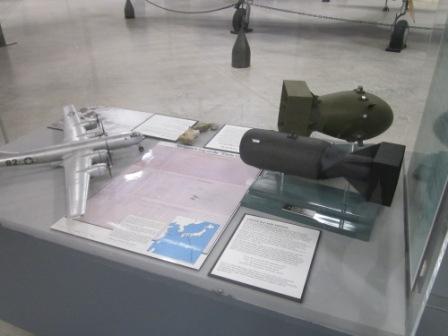
Close to this B-29, they displayed two replicas of the Enola Gay and the bomb, “Little Boy”:
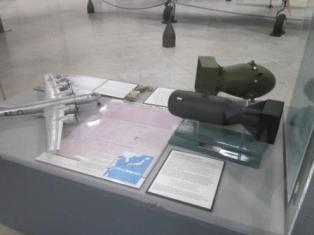
B-29 "Enola Gay" replica and "Little Boy" bomb replica (at Pima Air and Space Museum).

B-29 “Enola Gay” replica and “Little Boy” bomb replica (at Pima Air and Space Museum, Tucson, AZ).

And finally, you could see a replica of the Enola Gay’s Navigator’s Log. I was caught by surprise to find all this material at the museum. The original log, written by the navigator that day, Theodore “Dutch” Van Kirk, was sold in a public auction some years ago for over 350k$.

While at the museum, I took some minutes to watch the replica, the route the plane followed, the points of reference it used, the notes he made… and especially, the line in which Theodore, at 9:15am, noted “Bomb Away” (the 10th line of the second box) just before turning back over the port of the island of Omishima (which is wrongly reported in the log as “Mishima”).

Replica of Navigator's Log of the "Enola Gay" (at Pima Air and Space Museum).

Replica of Navigator’s Log of the “Enola Gay” (at Pima Air and Space Museum).

The picture above hasn’t got very good quality, but you can read an account of those moments in the following passage from the book “Japan 1945: From Operation Downfall to Hiroshima and Nagasaki” (by Clayton Chun):

Excerpt from "xxx" by Chun,

Excerpt from “Japan 1945: From Operation Downfall to Hiroshima and Nagasaki” by Clayton Chun.

***

It was a long post this time, but I think it was worthwhile to touch the story from the several points of view I have “experienced” it throughout these last years.

4 Comments

Filed under Aerospace & Defence, Travelling

A380 sales compared to 747 sales at program start

Some weeks ago, in a discussion with a colleague we tried to put into context whether the A380 sales were such a dismal or not.

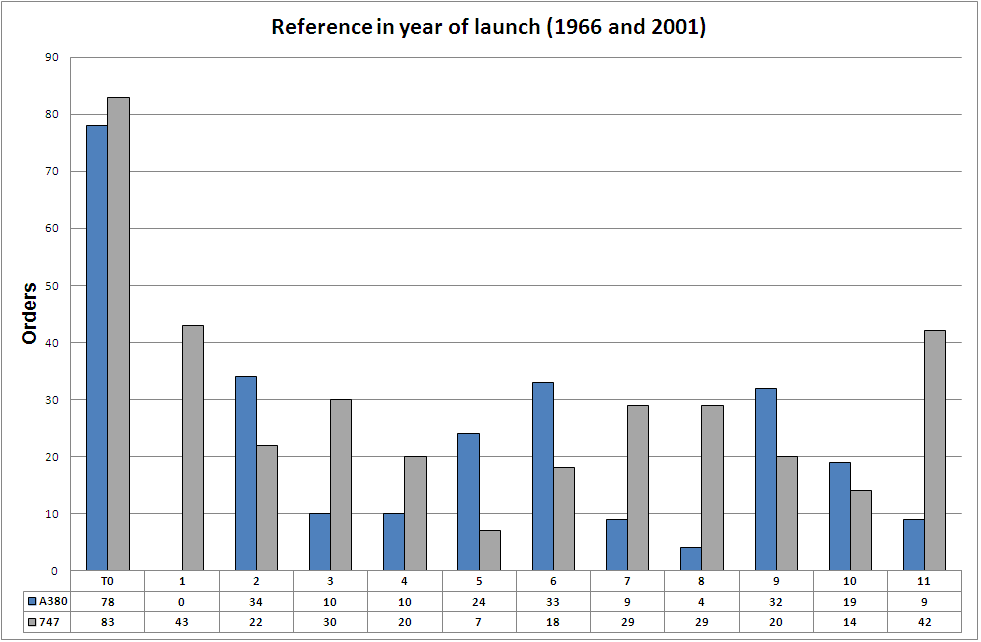
My colleague first plotted A380 orders since the program launch (2001) in comparison to those of the 747 (1966). I show below the result:

A380 and 747 orders referenced to the year of launch of each program.

A380 and 747 orders referenced to the year of launch of each program.

Both programs show an initial sales rush at the time of program launch. In both cases the rhythm of sales slowed down after the second year. In the first 11 years of program, each had managed:

  • A380: 262 orders.
  • 747: 357 orders.

Thus, we can see that the Boeing 747 was selling better already from the beginning of the program.

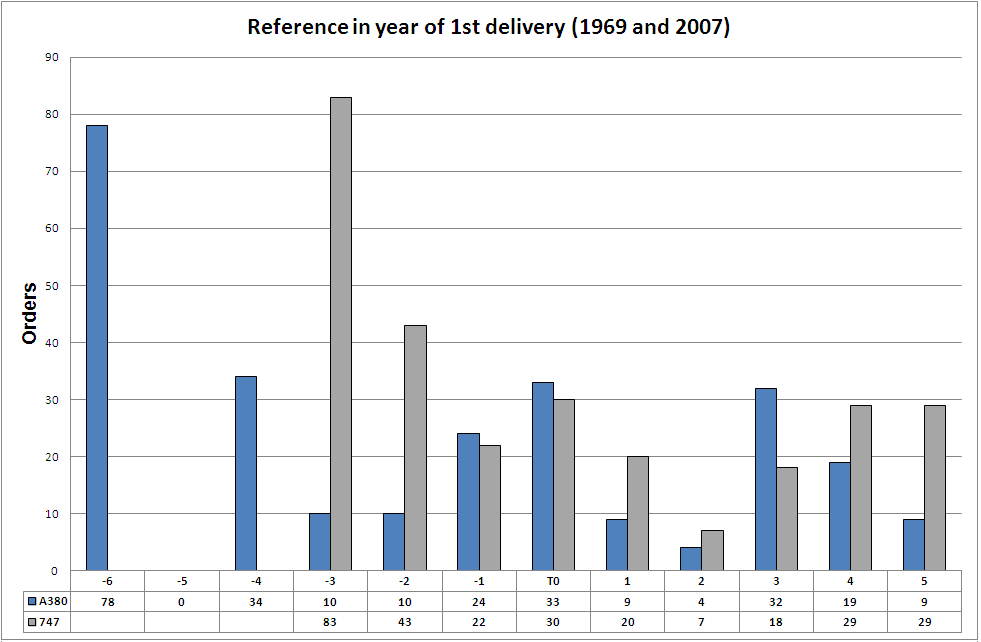
However, I wanted to make yet another comparison: aircraft orders taking as reference the year of first delivery, having heard so often the industry mantra that some potential customers would want to wait to see the aircraft in operation before placing orders. See below this second comparison:

A380 and 747 orders referenced to the year the 1st aircraft delivery of each program.

A380 and 747 orders referenced to the year the 1st aircraft delivery of each program.

In this case, and due to the shorter time to develop the Boeing 747 since program launch (1966), the difference in sales is narrowed:

  •  A380: 262 orders.
  • 747: 281 orders.

You can see that still, 5 years after the 1st delivery of each aircraft (2007 for the A380 and 1969 for the 747) Boeing had sold more aircraft, but with this reference the margin is lower, 19 aircraft.

Boeing 747. The Boeing 747 was the first wide-body in commercial aircraft history and still is the twin-aisle with the highest amount of aircraft sold (1,528 a/c as of today, probably to be soon overtaken by the 777) and delivered (1,464 a/c as of today). However, it has taken over 40 years to reach those numbers. The 1,000th unit sold was reached after 25 years of sales in 1990. The 1,000th unit delivered was also reached after 25 years of aircraft deliveries, in 1993.

Thus, in my opinion, when we want to measure the success of the A380 we cannot be distracted by the figures of other commercial aviation segments (single-aisle and small / intermediate twin-aisle) but we have to check what the 20-year forecasts for the Very Large Aircraft say:

  • ~1,300 aircraft according to Airbus GMF,
  • ~600 aircraft according to Boeing CMO,

and then see what could be expected market share for the A380 against those forecasts and whether it is getting the orders to reach it or not.

You can find orders and deliveries figures in both manufacturers websites or summarized here: A380 and 747.

5 Comments

Filed under Aerospace & Defence

Twin-aisle aircraft deliveries 20-year forecast

I read in the following article “Airbus seeks to increase Washington State supply business; aims for 13 A350s/mo” (from Leeham News) how from a presentation of a A350 supplier (ElectroImpact) at an aerospace suppliers event in Washington State, it was concluded that the Airbus aimed at building 13 A350s per month, as the mentioned supplier had built its factory with capacity to extend production rates up to those 13 aircraft.

This would be news because in its presentations Airbus talks about a production ramp-up up to 10 a/c per month (as does Boeing for the 787, which 10 aircraft/month should be reached by the end of 2013).

Having analyzed several times Airbus’ Global Market Forecast (GMF) and Boeing’s Current Market Outlook (CMO), I believe that those production rates of above 10 aircraft per month should be expected by industry followers just by seeing the numbers included in those forecasts.

In 2012, the GMF forecasted about 6,500 twin-aisle to be delivered in the next 20 years. The CMO indicated 7,210 aircraft. In 2013, Boeing CMO slightly reduced the figure to 7,130 a/c.

Comparison of Airbus GMF and Boeing CMO 2012-2031.

Thus, both companies expect between 6,500 to 7,200 twin-aisle passenger aircraft to be delivered in the following 20 years (excluding freighters, 747 and A380 – these 2 considered as Very Large Aircraft in the studies).

1st approach. If we were to take the mid-point of both forecasts, about 6,850 a/c, and simply divided by 20 years, we would reach to an average figure of 343 twin-aisle aircraft to be delivered per year between the 2 manufacturers, or 28 a/c per month. If Airbus wanted to maintain the long-term 50% market share, it would have to aim at delivering 14 a/c per month between all its twin-aisle products, which soon will be A330 and A350.

2nd approach. However, current twin-aisle production levels are in no way close to those 343 a/c per year. In 2012 there were 258 deliveries thanks to the introduction of 787s, but in the previous decade the average was about ~165 a/c per year. Thus, manufacturers must have a deliveries’ ramp up to accommodate those 6,850 in the next 20 years. Not knowing what that ramp-up is, I just linearized from where we are today and what is to be delivered.

I plotted in the graphic below all the deliveries of twin-aisle (excluding Very Large Aircraft) from the 1970s to 2012, and then what a forecast could be departing from 2012 deliveries’ figure to accommodate ~6,850 a/c in the next 20 years.

Taking a look at the graphic, one can already understand that if we take the GMF and CMO forecasts as good ones, the manufacturing rhythm will have to accelerate in the following years, especially in the second decade. In the late 2020s, over 400 twin-aisle would have to be delivered per year (over 33 per month), thus manufacturers will have to churn above 16 a/c per month each, that is the double of what they produced during the last decade.

Twin-aisle deliveries: historic series (1970s-2012) and forecast (excludes VLA -A380  & 747).

Twin-aisle deliveries: historic series (1970s-2012) and forecast (excludes VLA -A380 & 747).

Market shares. One could wonder whether this growth will favour more one company or the other. I compared market shares (excluding VLA):

  • in 2012: Boeing delivered 155 twin-aisle (26 767s, 83 777s, 46 787s) vs. Airbus 103 a/c (101 A330s, 2 A340s)… 60% / 40%.
  • in 2003-2012: Boeing delivered 839 twin aisle (148 767s, 642 777s, 49 787s) vs. Airbus 880 a/c (44 A300s, 687 A330s, 149 A340s)… 48% / 51%.
  • in 1993-2012: Boeing delivered 1,687 twin aisle (572 767s, 1,066 777s, 49 787s) vs. Airbus 1,521 a/c (175 A300s, 31 A310s, 938 A330s, 377 A340s)… 50% / 45%.

[The shares in the past decades include marginal deliveries from Ilyushin models and McDonnell Douglas models, which share I kept out of Boeing even after the merger in august 1997, these are ~30 a/c to be added to the 1,687]

Seeing that market shares have been fluctuating but always around 40-60% for each company, they could expect to have to at least deliver 40% of those 6,850 a/c in 20 years, or of those above 400 a/c in the late 2020s.

Backlog. Finally, just to see how the twin-aisle mix for each company is going to be, let’s look at the aircraft on order (backlog) that each company has as of today (end June 2013):

  • Airbus (43%):
    • A330: 260 a/c to be delivered.
    • A350: 678 a/c to be delivered.
  • Boeing (57%):
    • 767: 56 a/c to be delivered.
    • 777: 339 a/c to be delivered.
    • 787: 864 a/c to be delivered.

Thus, of the 6,850 twin-aisle to be delivered in the next 20 years, about 2,200 are already contracted as of today (plus the above 130 a/c delivered within the first half of 2013), thus 33% of those 6,850 a/c is more or less secured and among those the split is 57 / 43 for Boeing.

2 Comments

Filed under Aerospace & Defence

Boeing 787s parked in Paine Field

During our visit to Boeing wide-bodies final assembly lines in Everett, one thing was striking to the eye: the amount of Boeing 787s that were parked all around Paine Field. This is a view I was expecting to see since (a) at the time we travelled there (May 2013) the final fix to the 787’s batteries problem had not yet been approved by the Federal Aviation Administration (FAA) nor implemented in the already built aircraft, and (b) Boeing had kept churning 787s out of the assembly line thus provoking the mounting of them around the place.

See some of the pictures I took of them (not many pictures, nor very good ones as within the factory limits photo cameras were prohibited):

This slideshow requires JavaScript.

A collector’s gallery of a (luckily) rare event.

Leave a comment

Filed under Aerospace & Defence, Travelling

Dear Congressman, send the C-27Js to The Boneyard

I read yesterday the following article from Aviation Week & Space Technology: “U.S. Coast Guard Patrol Aircraft May Fall To Cuts“. Part of the article stated the obvious, that the Coast Guard modernization programs may fall also victims of the budgetary pressures faced elsewhere in the Department of Defense or Department of Homeland Security. However, the following passage caught my attention:

“While the results of the portfolio review, started in April, remain to be seen, the Coast Guard has not given up on gaining new equipment. Obama administration officials are looking at transferring at least 14 newly built Finmeccanica C-27J transports from the Air Force, which has controversially declared them “excess” to its needs. As CRS reported, if the Coast Guard were to receive 14 or more C-27s, it could stop procurement of EADS HC-144A maritime patrol aircraft (MPA) at the halfway point, with 18 aircraft, saving $887 million.”

I was amazed, since:

The rationale behind was the potential saving of up to 800M$ in acquisition costs (not buying the remaining 18 out of 36 aircraft which originally made up the Deepwater program) and getting some 14 C-27J instead…

If I were an US Congressman looking for savings across the US Armed Services, I would have it clear: instead of interfering with sound acquisition programs, I would simply get those C-27Js already acquired, send a couple of them to museums and the rest to The Boneyard in Davis-Monthan Air Force Base, to lay there forever close to their older brothers the C-27As and avoid any cost-ineffective operating and maintenance expenses on them…

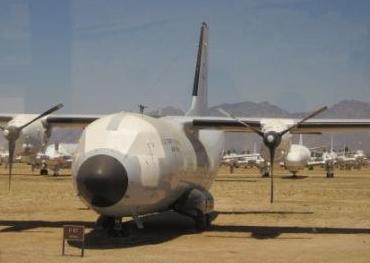
The only cost-effective C-27s are in the desert (or already scrapped).

The only cost-effective C-27s are in the desert (or already scrapped).

2 Comments

Filed under Aerospace & Defence

Spraylat

Some of you may have wondered why all aircraft windows and so many other parts in the pictures I showed in previous blog posts about The Boneyard are covered with white paint?

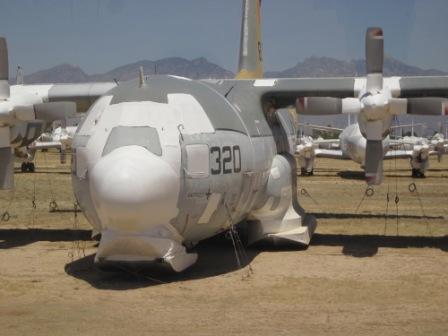
C-130 Hercules covered with spraylat (note that it is fitted with skis for Artic and Antartic operations).

C-130 Hercules covered with spraylat (note that it is fitted with skis for Arctic and Antarctic operations).

To protect heat-sensitive parts from the desert high temperatures these parts are covered with two different coatings: the first layer being a dark paint while the second layer is the characteristic white one, reflecting sunlight and heat. The paint is a vinyl plastic called spraylat after the company that produces it, Spraylat Corporation.

You may check the detail of Aerospace Maintenance and Regeneration Group (AMARG) storage processes in the following two links from the Wikipedia and “AMARC experience” (“AMARC” being the previous name for AMARG).

Leave a comment

Filed under Aerospace & Defence

Commercial airplanes discounts review

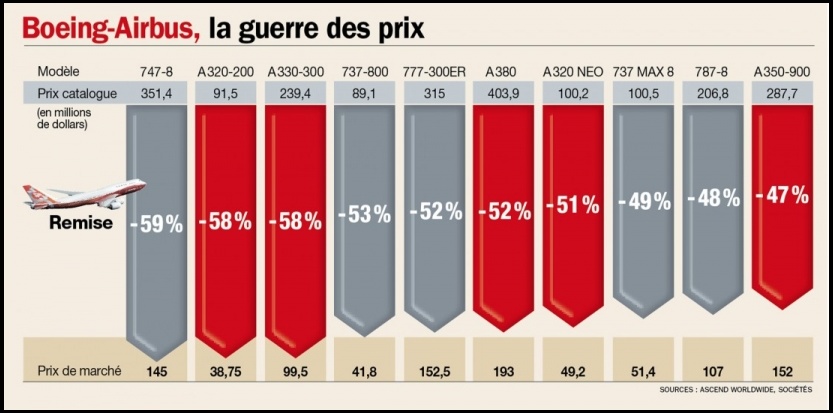
Last week, ahead of the start of the Le Bourget air show, the French portal Challenges.fr, published an article “Le vrai prix des avions d’Airbus et de Boeing” with an interesting graphic showing a comparison of the prices after discounts of commercial aircraft both of Boeing and Airbus.

Find the graphic below:

Commercial aircraft discounts according to "Challenges".

Commercial aircraft discounts according to “Challenges”.

In order to make the graphic, Challenges quotes as sources the consultants of “ASCEND Worldwide” (which has the industry-reference database of world commercial aircraft fleets) and unnamed companies (airlines such as American, Delta or Southwest, as per declaration of analysts quoted in the article).

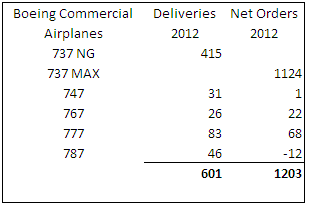
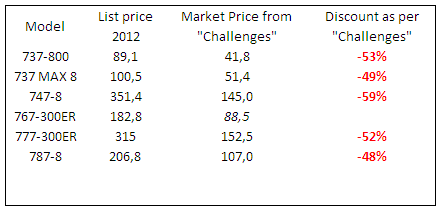
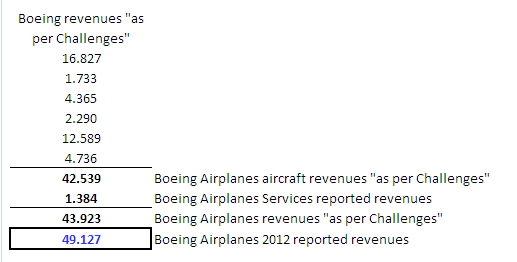
I have published in this blog yearly estimates for the average discount that Boeing applies to its aircraft. Find here the latest of that blog posts. In that post I arrived to an estimated average discount of 45%. Thus, when I read the article by Challenges I first thought “too high, to be average prices”. I thus run the reverse calculation: departing from Challengesmarket prices” I calculated what would have been Boeing Commercial’s 2012 revenues (1).

Boeing 2012 deliveries and net orders.

Boeing 2012 deliveries and net orders.

Boeing prices as per Challenges (767 added with the same discount as the 777-300ER).

Boeing prices as per Challenges (767 added with the same discount as the 777-300ER).

Boeing Airplanes revenues "as per Challenges".

Boeing Airplanes revenues “as per Challenges“.

Having run the numbers, I find the estimated value of 2012 revenues for Boeing Airplanes as too low (44bn$ vs. the reported 49bn$) using aircraft “market prices” as published by Challenges, as I first thought. I guess that the figures that Challenges published refer to the higher discounts having recently been applied, to the biggest customers making the biggest orders, such as those mentioned in the article (American, Delta or Southwest).

Thus, I would not take them as average or market price, those are the prices that a few can get.

(1) A couple of considerations must be made: Challenges does not publish any market price for 767s (the same discount of the 777-300ER was used), and does publish only one price of 737NGs or 777s; thus the result will not be very accurate.

4 Comments

Filed under Aerospace & Defence