Category Archives: Aerospace & Defence

Airbus backlog at end 2014 into perspective

Last Friday, Airbus Group announced its 2014 full year financial results at a press conference in Munich (Germany). You can find here [PDF, 785KB] the presentation used at the conference. In general, the results have been very positive in most metrics. There is one that in my opinion especially deserves attention, see it bellow:

AIRBUS 2014 results - backlog.

AIRBUS 2014 results – backlog.

Airbus has a record backlog of 6,386 civil aircraft.

In 2014, Airbus delivered 629 commercial aircraft. That is why, in the presentation it is stated “> 10 years of deliveries”. In essence, one may see it as if Airbus airplanes were sold out for the next 10 years! Of course, that is not the case for all product lines (think A330, A380) and will not be the case as a production ramp-up is announced in the A320ceo line.

Nevertheless, to put it into perspective, I wanted to compare this backlog to the historical aircraft deliveries of Airbus (which can be found here). Since its first delivery, an A300B2 back in May 1974, through the end of January 2015, Airbus had delivered 8,921 aircraft. With the information of yearly deliveries I compiled the graphic below, yearly per model and cumulative deliveries for all models combined.

AIRBUS deliveries through January 2015.

AIRBUS deliveries through January 2015.

Take a look at the cumulative deliveries.

On the occasion of the 8,000th delivery, on August 2013 (an A320 for AirAsia) Airbus published an article making a review of all the main delivery landmarks.

  • the 1st delivery, in May 1974, an A300B2.
  • the 1,000th delivery, in March 1993, an A340-300,
  • the 2,000th handover, in May 1999, an A340-300,
  • the 3,000th delivery, in July 2002, an A320,
  • the 4,000th delivery, in September 2005, an A330-300,
  • the 5,000th delivery, in December 2007, an A330-200,
  • the 6,000th delivery, in January 2010, an A380,
  • the 7,000th handover, in December 2011, an A321,
  • the 8,000th delivery, in August 2013, an A320 featuring Sharklets,
  • the 9,000th delivery… somewhere in the Spring 2015.

You can see that since the first delivery in 1974, it took Airbus almost 19 years to deliver the first 1,000 aircraft.

It took over 35 years to deliver the first 6,000 aircraft. That is what today it has as backlog…

Leave a comment

Filed under Aerospace & Defence

Boeing 787 recurring costs vs. recurring income

Few days ago I was discussing with some commenters on the blog of aviation analyst Scott Hamilton (Leeham News and Comment) about the recurring costs Boeing may be experiencing in the 787 program at the moment.

I used in the discussion the analysis I had made of the learning curve Boeing has experienced in the last 2 years according to cost reductions reported by its CFO, Greg Smith. See a post I wrote about it here. The result I reached is that lately they achieved a 87%. With information disclosed last year, the figure I arrived for 2013 was ~84%, see the post here. However, in the calculation to obtain the learning curve experience the actual costs are not needed, it is sufficient to know cost reductions achieved (reported) between given units.

However, when in 2011 I wrote a series of posts (1) about Boeing 787 break even, I did try to estimate what the cost of the first production units were using published information at the time. At that time it was disclosed that Boeing had about 18bn$ of work in process (WIP) and a number of aircraft in different stages of production. Reported average costs ranged from 250m$ to 400m$. I made some simple assumptions and arrived at an average cost of 310m$ for the first ~60 units.

The next step is to accommodate those average costs into a learning curve profile. The steeper the curve (75%) the more expensive the first unit would have been. Since in 2013 the calculated curve was a 84%, I obtain that the first must have been around 650m$ (2). From then on, I apply the mentioned 84% through end 2013. Then I switch to a 87% curve (slower learning) following the reported figures from Greg Smith.

This discussion so far gives an idea of how to estimate the recurring costs. At the end of 2014 this figure is estimated around 180m$.

In order to know by when Boeing will turn the production of 787s into something profitable, we first need to know by when the recurring costs will be lower than the recurring income. The latter is estimated from the information about prices (published by Boeing here) and discounts applied (estimated in other blog posts, see the last update for 2014).

Boeing list price for the 787-8 in 2014 was 218.3M$.

These list prices are, however, increased almost on a yearly basis by Boeing. Sometimes very steeply (+11.4% in 2010, from 2008) and other times more moderately (+2.4% in 2013 vs. 2012). Going into the future I assumed this increase to be constant and about equal to 2014′ increase, 3%.

On the other hand, Boeing applies some discounts to its customers. These are never disclosed. Some are reported by some sources. What I do is to try to estimate an average discount from reported information. See a detailed calculation here. The latest figure that I arrived at was about 47%. Going into the future I assumed this discount to remain constant. You can see here the recent evolution of discounted 787-8 prices.

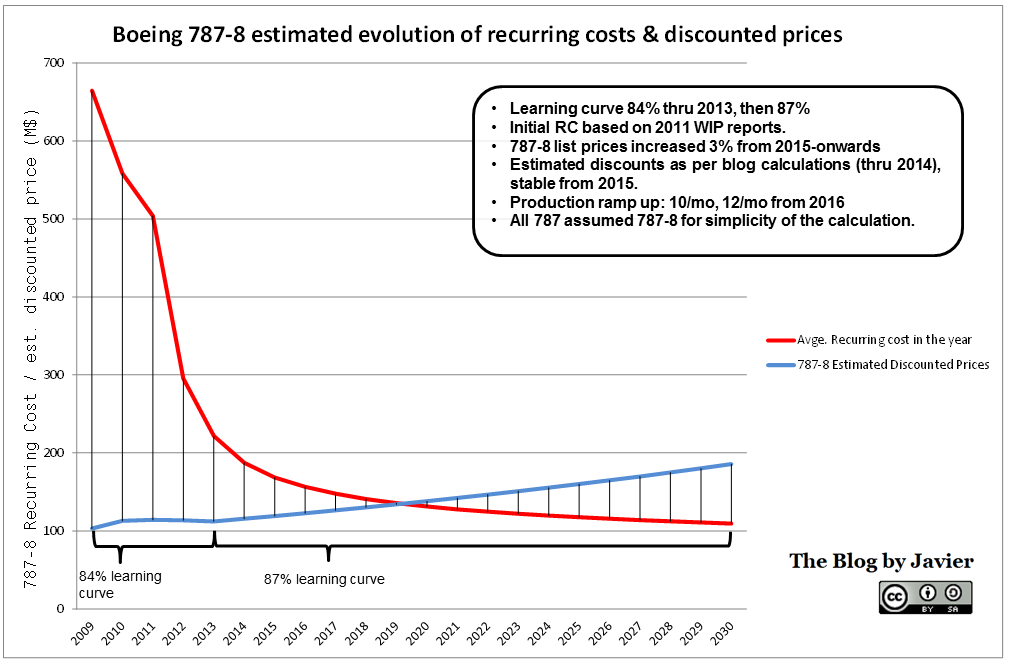
With all these ingredients, the only thing left is to plot together the recurring costs and recurring income:

787 recurring cost vs. recurring income evolution.

787 recurring cost vs. recurring income evolution.

As you can see recurring costs may be lower than recurring income at the end of 2019.

This will truly depend on the learning curve achieved, the number of units produced (3) and the pricing power Boeing manages to have. If the learning is steeper, the date will be sooner. If the ramp up is higher, the date will be sooner. If the discounts are lower or the list prices increased more, the date will be sooner. In any other case, either 2019 or beyond.

(1) See the complete series here: “Will Boeing 787 ever break-even?“, “More on Boeing 787 break even” and “787 Break Even for Dummies“.

(2) We will never know that figure. I wonder whether this is even known or registered (if not deleted and forgotten) within Boeing.

(3) For the numbers of units built I based the model in reported information that the ramp up to 12 aircraft per month is expected for 2016. I assumed that in 2015 they are at somewhere between 10 and 12 aircraft per month.

Leave a comment

Filed under Aerospace & Defence

Boeing list prices increases vs. discounts increases (update for 2014)

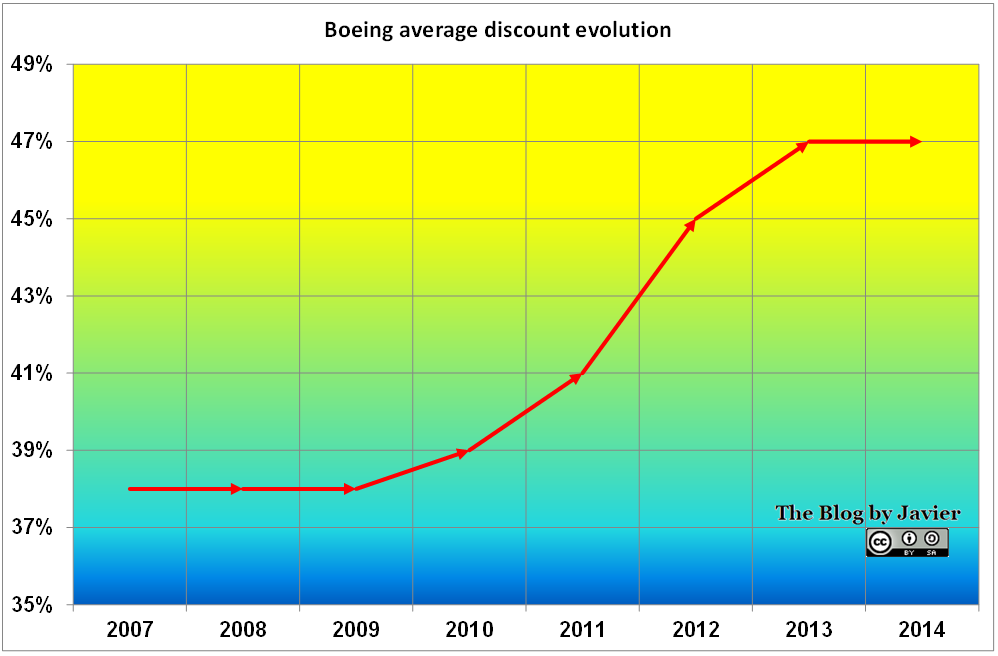
In a previous post I updated the estimate of what is the average discount Boeing applies when selling its commercial airplanes using 2014 data of list prices, deliveries and reported revenues. The figure I came up with was a 47% discount. I included the following graphic showing the discount evolution:

Boeing Average Discount Evolution, through 2014.

Boeing Average Discount Evolution, through 2014.

Last year, seeing the increasing trend of average discount together with knowing the fact that Boeing regularly increases list prices triggered the following question: Have Boeing airplane discounted prices increased, decreased or stayed constant in the recent years? I set out to answer this question using the estimated average discount of each year (1) from the graphic above.

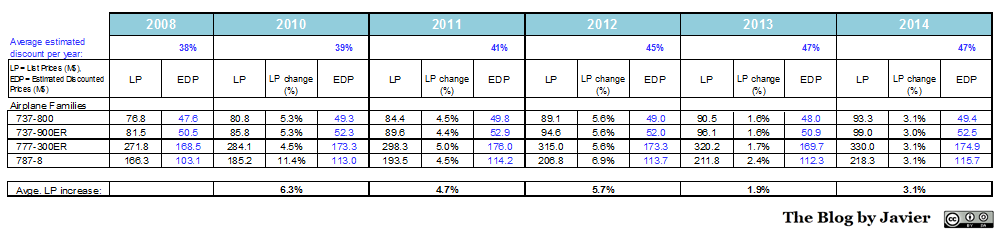
The Boeing list prices (LP) (2) can be found here. I have been recording those prices for years and thus have a table with the evolution of list prices for each model year by year. The following step is to apply the average discount estimated for each year to then-year list prices, to get the estimated discounted prices (EDP) (2) per model. Thus, a table can be built for the last 6 years.

You can find below the result for the best-selling aircraft during previous years: 737-800, 737-900ER, 777-300ER and 787-8. Together these 4 models amounted to over 640 deliveries in 2014 or 89% of the total 723 airplanes Boeing delivered in 2014.

Boeing List and discount Prices evolution table, 2008-2014.

Boeing List and discount Prices evolution table, 2008-2014.

In the table above I included in black figures what have been Boeing list prices of these models in the past years (as reported in their website) while I marked in blue the figures which are estimated, using as a departure point the calculated averages discounts per year (also included in blue in the table). I included as well the list prices year-on-year change as a % of the previous year list prices, per model.

The average list price increase included at the bottom line is computed with the information of all Boeing models (19 in 2008 and 20 in 2014, though different ones (e.g. last year addition of 777-8X and 777-9X), a total of 26 different models along this period), not only the 4 included in this table.

You may see in the table above that after not increasing prices in 2009, Boeing has steadily increased them in 2010 (6.3%), 2011 (4.7%), 2012 (6.7%), 2013 (1.9%) and 2014 (3.1%). However, if you take a look at the blue figures in the same table you will notice that prices of 2014 are between 2010 and 2011 price levels for all 4 models! That is, the widely announced yearly list prices increase has been yearly offset by a discreet (not-announced) increase in the discounts applied to the sales of airplanes. Thus, the pricing power of Boeing has remained barely constant during the last 5 years. You may see it better in the graphic below:

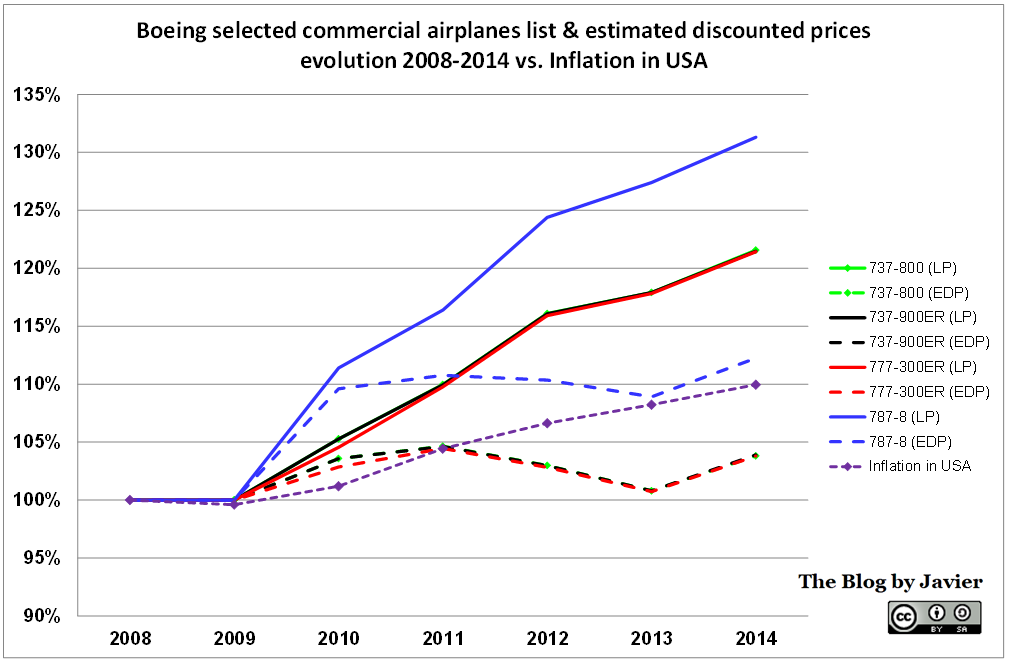
Boeing List & discount Prices evolution graphic vs. inflation in USA (through 2014).

Boeing List & discount Prices evolution graphic vs. inflation in USA (through 2014).

The graphic shows the price evolution for each of the 4 airplane models selected, taking as a reference their list and estimated discounted prices in 2008 (indicated as 100%) and also the evolution of inflation in the USA (3) in purple, to reflect the evolution of real prices (i.e. accounting for inflation). List prices are shown with straight lines, versus dashed lines used for estimated prices. Each pair of prices for each aircraft is presented in the same color for easier identification. Some comments to the graphic:

  • Through continuous increases, 2014 list prices were between 21% (737 and 777) and 31% (for the 787) higher than in 2008.
  • However, due to increasing discounts from 38% in 2008 to 47% in 2014, the increase in list prices is almost entirely offset (especially for 737 and 777, just 4% above 2008 levels).
  • 2014 discounted prices are below 2011 discounted prices for all models except 787.
  • If compare the evolution of prices vs. the US inflation (general prices in 2014 being 10% higher than in 2008), we see that:
    • Boeing actually lost pricing power in both the 737 and 777, which are cheaper in real (inflation-adjusted) discounted terms in 2014 than they were in 2008 (about 6% cheaper).
    • Only the 787 has been able to keep up the pace of discount escalation and inflation.

(1) There is no way to know the real price and discount that Boeing applies in each sale, as it will depend from customer to customer (American Airlines -AMR- or Fedex) and from model to model (737-800 or 787-8). There where competition is tougher, discounts will be higher. However, the estimates I have made are an average of all Boeing aircraft sold in a given year.

(2) Both list prices (LP) and estimated discounted prices (EDP) are expressed in then-year dollars.

(3) US inflation series since 2008: -0.4% (2009), 1.6% (2010), 3.2% (2011), 2.1% (2012), 1.5% (2013) and 1.6% (2014).

1 Comment

Filed under Aerospace & Defence

Boeing discounts detailed calculation, 2014 vs. 2013

Last years I have published in the blog  some posts (1) dedicated to show what was my estimate of the average discount Boeing applies to its commercial airplanes. I included in those posts the rationale used for the calculation. Find here the post related to the calculation of the discount based on 2014 data of Boeing Commercial Airplanes revenues, deliveries and list prices.

In 2014, I included in another post a simplified table (2) with the calculation comparing 2013 simplified result versus 2012. In this post I wanted to update that table with 2014 figures in comparison to those of 2013:

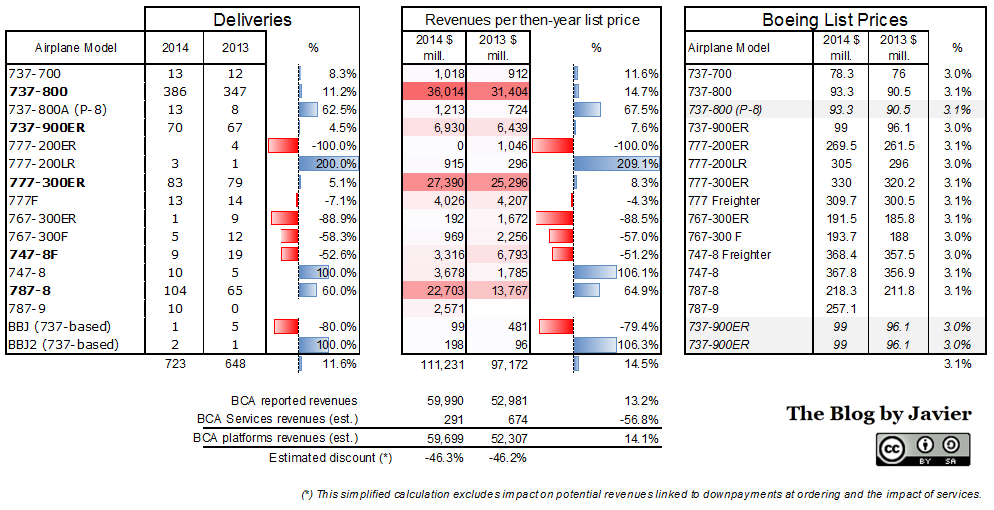
Boeing discount detailed simplified calculation: 2014 vs. 2013.

Boeing discount detailed simplified calculation: 2014 vs. 2013.

In the table above, you may find for both 2014 and 2013 Boeing reported deliveries per model and Boeing published list prices per model (3) and Boeing Commercial Airplanes reported revenues.

What is then estimated? Boeing Commercial Airplanes services revenues (these are deduced from financial reports reported information), Boeing Commercial Airplanes platforms revenues (derived from the previous figure) and the average discount; this is calculated from the difference between estimated BCA platforms revenues and what should have been that figure had the airplanes been sold at list prices.

Results: average discounts of 46.3% in 2014 and above 46.2% in 2013, though nearly the same.

(1) Find here what is becoming a “body of knowledge” on Boeing discounts: estimates calculated for 20142013201220112010 and 2009; a review of the French portal Challenges.fr of aircraft discounts prior to Le Bourget airshow of 2013; aBombardier’s CEO statement on what is known in the market as the Boeing discount; Boeing Commercial Airplanes president Ray Conner speaking about the more aggressive pricing they are being forced to offer.

(2) I refer to this table as “simplified” as it excludes from the calculation the potential influence on yearly revenues (note, not cash flow) of down payments linked to orders received in then-year versus orders received in previous years for aircraft delivered in then-year.

(3) Two assumptions are needed: 737-800A transfer prices from BCA to Boeing Defense Space & Security for the P-8 (for simplicity assumed to be the same as the 737-800 price) and for the 737-based business jets (for simplicity assumed to be the same as the 737-900ER).

Leave a comment

Filed under Aerospace & Defence

Boeing commercial aircraft discounts (update for 2014)

Few days ago, Boeing released 2014 results [PDF, 838KB]. The company reported revenues of over 90.7bn$ (59.99bn$ for the Commercial Airplanes unit), 723 commercial deliveries and 1,432 net orders for its commercial aircraft. All these were widely reported by the media and mean a great year 2014 for Boeing (with increases in these metrics from 6 to 12%).

Last years, I wrote in some posts (1) what was my estimate of Boeing discounts: the relation between what is announced by the press, what appears in its list prices and sometimes as backlogs and what it is indeed computed into the profit and loss account. In this post I wanted to update, if necessary, the figure I calculated for the average discount of Boeing.

Most of the necessary information can be found in its website. Boeing list prices can be found here.

The number of gross and net orders (after cancellations) year by year can be found here.

Last year deliveries can be found in the report of financial results (or here). From there we can also deduce the figure of Boeing Commercial’s sales of services. That is not directly reported but can be deduced (all Boeing services-related sales are reported as well as Boeing Capital Corporation division and Boeing Defense’s “Global Services & Support” unit)

As in the previous years’ post:

  • I needed to make one assumption: new orders come with a 3% down payment in the year of the booking, while the remaining cost I assumed that was paid on the year of delivery (for simplicity I didn’t consider more intermediate revenue recognition milestones linked to payments, the 3% figure was taken from the AIAA paper “A Hierarchical Aircraft Life Cycle Cost Analysis Model” by William J. Marx et al.). (2)

Having put all the figures together, the calculation is immediate. Boeing Commercial Aircraft revenues in 2014 (59.99bn$) are the sum of:

  • the discounted prices times the delivered aircraft in the year (including possible penalties from delays),
  • less the down payment of the current year delivered aircraft, as the down payment was included in previous years results,
  • plus the down payment of current year net orders (this year’s calculation includes 737 MAX and 777X orders),
  • plus services revenues (about 0.7bn$ from the commercial aircraft unit – calculated, not reported).

The discount figure that minimized errors last year was 47%. Using this figure, the error obtained this year in relation to Boeing Commercial Aircraft reported revenues is -0.2%. The best estimate for last years average discounts were: 47% for 2013, 45% for 2012, 41% for 2011, 39% for 2010 and 38% for 2009.

The updated figure (which minimize errors for 2014 down to -0.2%) for the discount for Boeing commercial aircraft is 47% (3).

Boeing Average Discount Evolution, through 2014.

Boeing Average Discount Evolution, through 2014.

The discounts seem to be stabilized around 45-47%.

This discount figures and their evolution reflect that Boeing’s list prices and their continuous increases cannot be enforced in the contracts nor in escalation formulas.

Final note: I received a comment suggesting to review whether the discounts are in effect on Boeing side or in the engine manufacturers side. Unless we had the information of actual contracts, there is no way to calculate that from published information. Nevertheless, whether Boeing or engine manufacturers, the fact is that there is discrepancy of up to 47% between what Boeing announces as their list prices for commercial aircraft and backlog figures (in volume) and what it actually receives as income (revenue).

(1) Find here what is becoming a “body of knowledge” on Boeing discounts: estimates calculated for 20132012, 2011, 2010 and 2009; a review of the French portal Challenges.fr of aircraft discounts prior to Le Bourget airshow of 2013; a Bombardier’s CEO statement on what is known in the market as the Boeing discount; Boeing Commercial Airplanes president Ray Conner speaking about the more aggressive pricing they are being forced to offer.

(2) Three years ago, I received a comment from the analyst Scott Hamilton on the level of downpayments. He mentioned they could reach up to 30%. I tried this time to compute the calculation using that input, though the figures of discounts to be applied each year to minimize errors would have to be even higher, close to 60% (!), thus I stayed with the 3% used in the above-mentioned published paper to stay on the conservative side. On the contrary, if we assume that downpayments have no influence in the revenue recognition (as another comment indicated last year), but only in the cash flow, the discount figure would slightly decrease (about 1%). The issue is not so much the size of the downpayments, whereas how much of those, if any, are recognised as revenues.

(3) I find this trend of continuous increases in Boeing discounts in line with bothChallenges.fr report and Ray Conner’s mentions of aggressive pricing last year, both referred to in note (1).

2 Comments

Filed under Aerospace & Defence

Boeing 787 orders, cancellations, deliveries & backlog through 2014

The year 2014 seems to have been another complex for the Boeing 787 program.

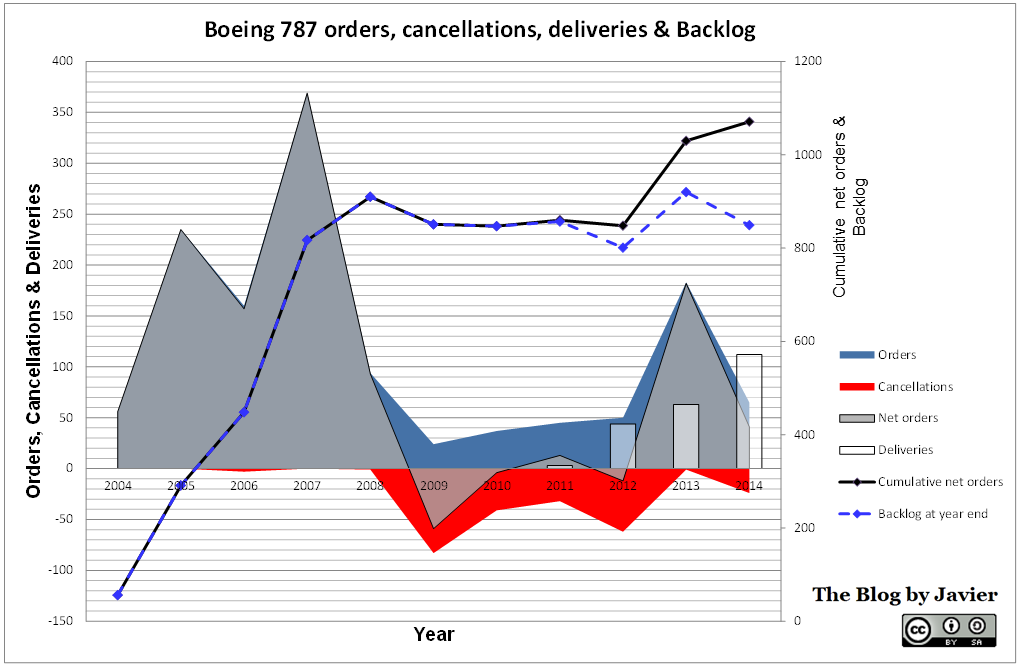
There were no major operational hick-ups such as the 2013 grounding of the fleet due to the lithium-ion batteries heat runaway issues, but commercially just 65 new orders were received (main ones from Air Europa and ANA) with up to 24 cancellations. Production ramped up to 112 deliveries (almost double than 2013’s 63). This increase is positive in relation to revenue recognition and cash inflow, however the cost per unit enjoyed a lower improvement than expected. As a result of previous figures, the so-called book-to-bill on the program was below 0.6, making the backlog to shrink slightly (leaving it practically at the same level since 2007).

An image is worth a thousands words:

787 orders, cancellations, deliveries and backlog through 2014.

787 orders, cancellations, deliveries and backlog through 2014.

1 Comment

Filed under Aerospace & Defence

Theoretical exam for PPL(A) under Part FCL in France

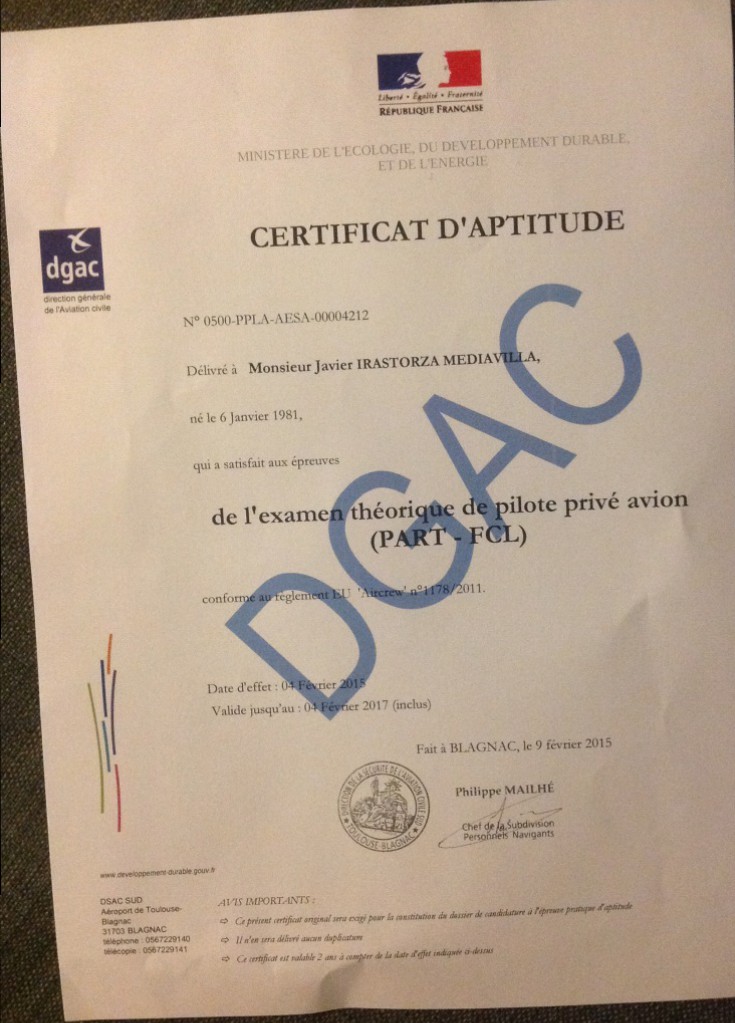
Certificat d'aptitude.

Certificat d’aptitude.

Today I received the letter informing me that I had passed the épreuve spécifique of the exam for obtaining the PPL(A) under Part FCL.

It was the second attempt I took for this part. I got 68 multiple-choice questions right out of 72; the minimum required to pass being 54 (75%), whereas in the previous attempt I had gotten right 51, short of 3. Sure, this time I studied a bit more and practiced more with tests. However, I wanted to share in this post, as a tip, what I understand it was the key difference: Chez Gigli.

For the first exams I took, back in November I based my study in the manual edited by Cepadues and a book including 700 exam questions with the explanations of the correct responses. This worked relatively well. However, the version of the book I had dated from before Part FCL was introduced (replacing JAR FCL) and thus the topics are organized in 5 exams (vs. the current two).

PPL exam questions book by Cepadues.

PPL exam questions book by Cepadues.

For the second attempt I bought a 1-month access to Chez Gigli as my instructor had recommended years ago and my friend Rapha had mentioned, too. The cost of the book from Cepadues is ~25€, whereas the 1-month access to Chez Gigli costs 20€, for longer time more, though there are discounts (life-long access being 90€).

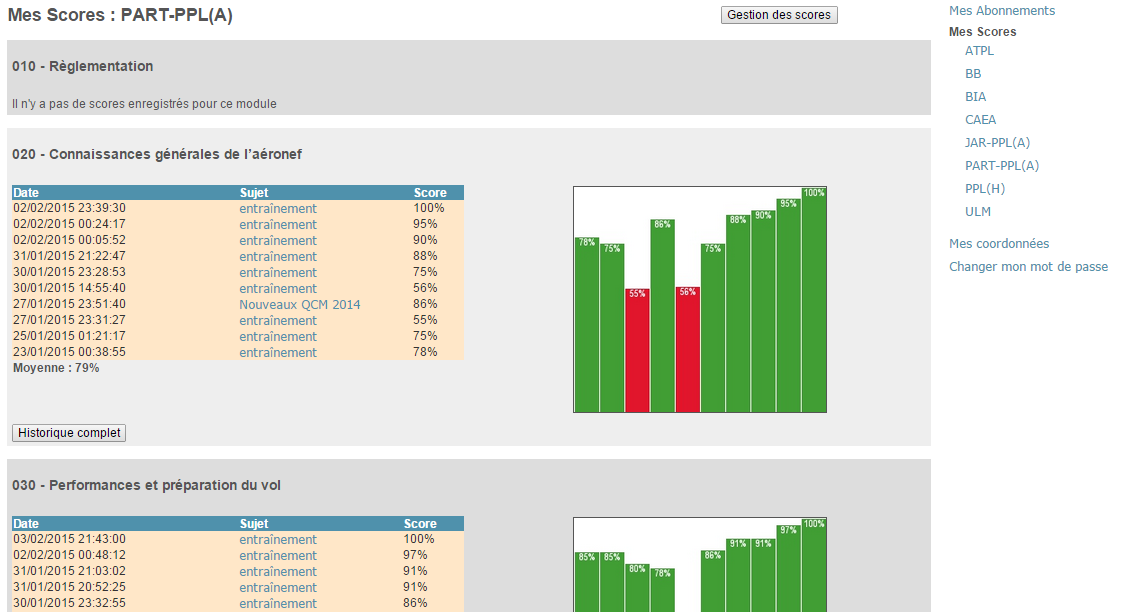
However, the way Chez Gigli is organized is terrific. You can record your previous results, focus on and review the questions you got wrong, practice only among questions you never saw before, focus on actual exam questions, last year questions, etc. You can see the progress of your scores per topic. Your tests are timed. Explanations of the correct answers are very good and there is a forum per each question so students can ask doubts or further clarifications. It is way more powerful than a book. And you notice it as long as you get to see all the questions, focus on your mistakes and correct them. You get in a matter of days from scores of 70% to 95-100%.

Scores' dashboard in Chez Gigli website.

Scores’ dashboard in Chez Gigli website.

While I was doing the last exam I felt way more comfortable. In most of the questions I didn’t even need to think. Just in a few of them I had some doubts between a couple of answers. I completed the exam way faster than needed, more relaxed and the result, 94.4%, was a success, as the practice had gone. Thus, if you are in France preparing to get your PPL, do not give it a thought: sign for a subscription to the website.

Leave a comment

Filed under Aerospace & Defence

Learning Curves: Boeing 787 case (from Dec 2012 to Dec 2014)

Last year, I wrote in a couple of posts an introduction to the concept of the learning curve and provided a the case of the Boeing 787 in 2013 (based on figures disclosed by Boeing CFO, Greg Smith). In the first of those posts, I discussed that:

Boeing does not disclose outright what is the actual learning curve it is achieving in its program. Nevertheless, in its investor relations conferences it provides information here and there of cost savings achieved, etc. This can be interpreted as derived from learning curve effects, and would permit to build a model, even if based on scarce information.

This year again, let me quote again one of those excerpts from Boeing executives in order to update the exercise:

On the 787-8, we’ve seen a decline in unit cost of approximately 30% over the last 175 deliveries and on 787-9, we’ve seen declines of 20% since the first delivery. Based on this progress, our production schedule and planned productivity investments, we continue to expect the 787 to be cash positive during 2015 and we still anticipate deferred production to decline shortly after we’ve achieved the 12 per month production rate in 2016. No change to these fundamental milestones.” Greg Smith, Boeing EVP – CFO at Q4 2014 Earnings Conference

As I mentioned last year, to the avid reader, and knowledgeable and savvy analyst, this paragraph is enough to deduce an actual learning curve achieved by the 787 for each aircraft model, provided that information reported by Boeing CFO, Greg Smith, was accurate.

Through the end of 2014, Boeing had delivered 212 787-8 and 10 787-9. The 787-9 were all delivered in 2014. The 212 787-8 were delivered as follows:

  • 2011: 3 aircraft.
  • 2012: 44 a/c.
  • 2013: 63 a/c.
  • 2014: 102 a/c.

Greg Smith is mentioning a cost reduction of 30% over the last 175 deliveries. As he was talking at the 2014 earnings call, we can safely assume that the figures were put up for him using deliveries and costs only through the end 2014 (and not counting info from January 2015 deliveries). That means that the cost improvements are measured theoretically from the aircraft 37th through the 212th (175). You can extract a report from Boeing website of the complete 787 deliveries here. I did it. Analysing it you see that between the beginning of December 2012 and the end of December 2014 176 787-8 were delivered (1).

Thus, the exercise to find out what learning curve Boeing achieved during that time span is as simple as to see what learning curve yields an “approximately 30% unit cost improvement” from the unit 36th (2) to the unit 212th. The beauty is that we do not even need to know the initial unit cost to perform the calculation, as the relative improvements in terms of percentages are independent of the starting point. All the information has indeed been provided by Boeing.

As I did in the blog post of the last year, in this first graph below I just plotted some generic learning curves, from 95% to 75%. This form of representation provides a good view of how learning is intense at the beginning of the production process and it stabilizes later on. It also shows well how learning is more intense and cost reductions are bigger for a 75% curve than for a 95% curve.

Generic learning curves.

Generic learning curves.

However, in the previous curves it is difficult to distinguish the 36th and the 212th units which are needed for the calculation. Thus, I plotted the same curves in a log scale for the numbers of units produced in the graphic below:
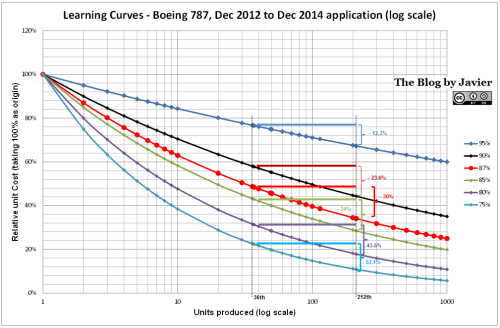
Boeing 787 learning curve over 176 units through Dec 2014 calculation, delta unit cost between 36th & 212th units.

Boeing 787 learning curve over 176 units through Dec 2014 calculation, delta unit cost between 36th & 212th units.

In this second graphic I added the information of what relative cost reduction is achieved between the 36th and the 212th units for each of the curves (3).

To make sure that readers are not lost, let’s take the 87% curve (in red). Following that curve, the unit cost of the 36th unit produced is a 48.7% of the 1st unit cost, whereas the unit cost for the 212th unit produced is a 34.1% of the 1st unit cost. The difference is then 48.7% – 34.1% = 14.6%, which represents a 30.0% cost reduction from the 36th unit cost. If you follow the same calculation for each of the curves, you will obtain the following unit cost improvements between 36th and 212th units:

  • 95% curve: -12.3% unit cost improvement
  • 90% curve: -23.6% unit cost improvement
  • 87% curve: -30.0% unit cost improvement
  • 85% curve: -34.0% unit cost improvement
  • 80% curve: -43.5% unit cost improvement
  • 75% curve: -52.1% unit cost improvement

Thus, from the information provided by Boeing of units delivered and unit cost improvement (“approximately 30%″, Greg Smith) we can deduce that from December 2012 through December 2014 the average learning curve that the 787 program has achieved is about 87%. Thus, in line with aerospace average indicated by NASA (85%), or in line with the reported 84% achieved in the 777. Though a bit lower than that calculated for 2013 (see here last year’s post). We can interpret that mismatch as either as a minimum error inherent of these estimates (85% vs. 87%) or that indeed the rate of improvement has somehow slowed down in 2014 in comparison to 2013.

Had Boeing been able to achieve effectively a 85% curve in the last 175 deliveries, bear no doubt that the message from Greg Smith would have been along the lines of an approximate 35% cost reduction (being the mathematical result 34%), instead of the reported 30%.

All these numbers refer to the 787-8. Now, remember that Boeing CFO also indicated that “on 787-9, we’ve seen declines of 20% since the first delivery”. 

Here, the calculation that needs to be done is the same. 787-9 deliveries started in 2014. If we assume that Greg’s comment referred only to 2014 deliveries (not 2015 ones), then the calculation must be made on 10 787-9 delivered between June and December 2014.  Here the learning curve obtained is a 93.5% ~87-88% (5) (6).

(1) I guess Greg Smith rounded to 175, but his “decline in unit cost of approximately 30% over the last 175 deliveries” refers to actually some fixed internal monthly reports and is based on 176 deliveries (not 175). (4)

(2) Taking into account the note (1), I will use 176 aircraft and deliveries from the 36th aircraft through the 212th.

(3) Bear in mind what a relative cost reduction is in contrast to the fact of relative costs represented in the vertical axis as percentages of the initial cost (100%).

(4) The taking of 175 instead of 176 aircraft practically does not change the result. For the same 87% curve the calculated cost reduction in one case is 30% and in the other 29.6%.

(5) This is in line with the slow down of the learning curve for the 787-8 comparing 2013 result with the result along the time span December 2012-December 2014.

(6) I initially calculated 93.5% as a result of a 20% cost reduction between the 1st and 10th units produced. However, as Matt B pointed, the first 3 787-9 have not been delivered (though they are units produced from which there was a learning effect). When you calculate what is the result for a 20% cost reduction between units 4th and 13th (the first 10 delivered), you get a curve between 87-88%, more or less the same one than for 787-8. Thus, it seems than at the beginning of the 787-8 production they went along a 85% curve that has slowed to a 87% for both models.

7 Comments

Filed under Aerospace & Defence

XB-36 tires

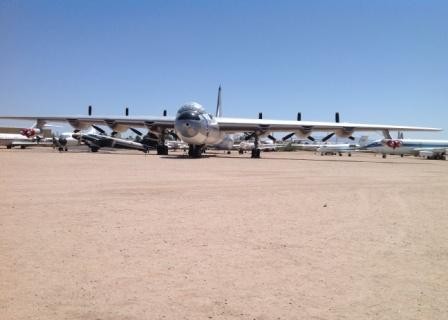
Two years ago, in 2013, I visited the Pima Air and Space Museum near Tucson, Arizona. One of the airplanes that really catches your attention in it is the bomber Convair B-36 Peacemaker, with its 10 engines: six turnin’ and four burnin’ (I wrote a post about it here).

Ten engines: "six turnin' and four burnin' ".

Ten engines: “six turnin’ and four burnin’ “.

When I wrote that post, I received the following comment from a reader, Ian C.

If you are ever back on this side of the pond, the National Museum of the Air Force has an XB-36 tire. It is just ridiculously large.

Last year, in 2014, we travelled again to the USA and this time we visited the National Museum of the Air Force (1) in Dayton, Ohio.

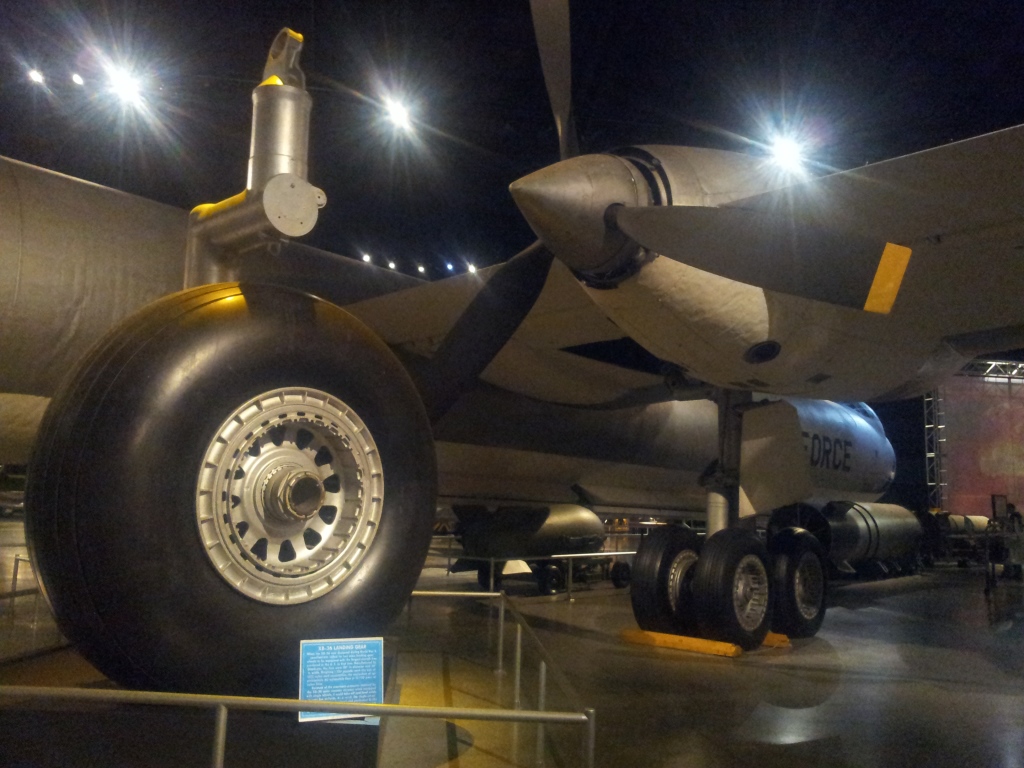
Let me close the loop by showing you this famous tire accompanied by some facts about it.

XB-36 tire

From the Wikipedia:

The XB-36 featured a single-wheel main landing gear whose tires were the largest ever manufactured up to that time, 9 feet 2 inches (2.79 m) tall, 3 feet (91 cm) wide, and weighing 1,320 pounds (600 kg), with enough rubber for 60 automobile tires. These tires placed so much pressure on runways, the XB-36 was restricted to the Fort Worth airfield adjacent to the plant of manufacture, and to a mere two USAF bases beyond that. At the suggestion of General Henry H. Arnold, the single-wheel gear was soon replaced by a four-wheel bogie. At one point, a tank-like tracked landing gear was also tried on the XB-36, but proved heavy and noisy and was quickly abandoned. (2)

(1) See here the post my brother Jaime wrote about our visit to it.

(2) This is not the post to do so, but it triggers the need to write one day about the California Bearing Ratio, doesn’t it?

2 Comments

Filed under Aerospace & Defence

Dayton Aviation Heritage

It is well-known that the first ever flight (1) was made by Orville Wright on December 17, 1903, over 120 feet during 12 seconds at a field in Kitty Hawk, North Carolina. It is less known that Orville was born in Dayton, Ohio (August 19, 1871), and that it was in Dayton where the Wright brothers had their different businesses, where they studied the physics of flight, made several tests, and prepared for the few weeks a year they would spend in the windier Kitty Hawk.

That makes Dayton deserve an Aviation Heritage National Historical Park and a visit from truly yours (and family), in a regular pilgrimage to aviation sites.

The Historical Park is composed by different buildings and sites at different locations in and around Dayton, among them:

  • The Wright Cycle Company and visitor center. The company is located at the original place, however the interior has been renovated and now shows replicas of what could be expected to be found in such a shop. The visitor centre is a museum dedicated to the Wright brothers (their family, their careers, other businesses they had) and the principles of flight and to the understanding of the Dayton at the time (a rather ingenious place measured by the different patents and business the flourished there those days). In the centre you may watch as well a 37′ documentary about the Wright Brothers (2).

  • The Wright Brothers Aviation Center, at the Carillon Historical Park, hosts an original 1905 Wright Flyer III that Orville himself helped to restore.
  • The Huffman Prairie Flying Field and interpretive center. These are located in an open-to-the-public area of the Wright-Patterson Air Force Base (3). The interpretive center houses some displays and the same documentary that at the visitor center. In front of it there is the Wright Memorial, in Wright Brothers Hill. A few kilometres from it there is the Huffman Prairie. There the brothers made hundreds of tests. They began using it in 1904 to make their initial airplane a practical invention. It is there where they trained the first pilots (the first ever flying training school). There you will see both a replica of the hangar they used at the time and of the catapult they used for the take-offs.

Before visiting the prairie go by the interpretive center to make sure it is open. You may also get a ranger to give you some tour. The same goes for the Cycle company, which you will need to ask a ranger at the visitor center to open it for you. All these places can be visited for free, though you will be more than delighted to contribute to their preservation.

I leave here some of the pictures we took.

This slideshow requires JavaScript.

(1) In a heavier than air powered and controlled airplane.

(2) The documentary, Wright Brothers: On Great White Wings, is narrated by Martin Sheen and produced by Finley Holiday Films, which produces documentaries for several national heritage parks. It can be found here (20$).

(3) This Air Force Base hosts the National Museum of the US Air Force, pay a visit to the great account of our visit in my brother’s blog.

Note: Bear no doubt that some pilgrimage will bring me some day to Kitty Hawk…


Leave a comment

Filed under Aerospace & Defence