Category Archives: Investing

Gains with a negative performance?

I wrote some months ago a post in the blog where I showed how you lose money with swings in the market of the same percentage (e.g. -10% followed by +10% or vice versa).

In another post I explained how mutual open-ended funds define and calculate their performance based on the changes in net asset value per share.

In this post I wanted to point at some fine detail: a mutual fund may have a negative performance in a period of time (e.g. a year) yet have gained positive results during the same period. How is that possible?

As I mentioned in that previous post, the net asset value per share of a mutual fund rises and decreases as the aggregate share prices of the stocks in the portfolio rise or decrease. However, each time that there is an addition of capital, it is treated as an issue of new shares at the current price. It doesn’t matter whether those shares are issued to new or old “shareholders”. Depending on whether the net asset value has increased or decreased they are acquiring the new shares at a higher or lower price than they acquired the previous ones.

If it was the case of a company, we would say that shareholders would see their share diluted. In the case of a fund, the share of the ownership is also diluted, but that doesn’t mean a reduction in the net asset value per share, since with the new investment there is an increase of the assets of the fund (and the funds will be invested). Now, let’s see it the case with one example.

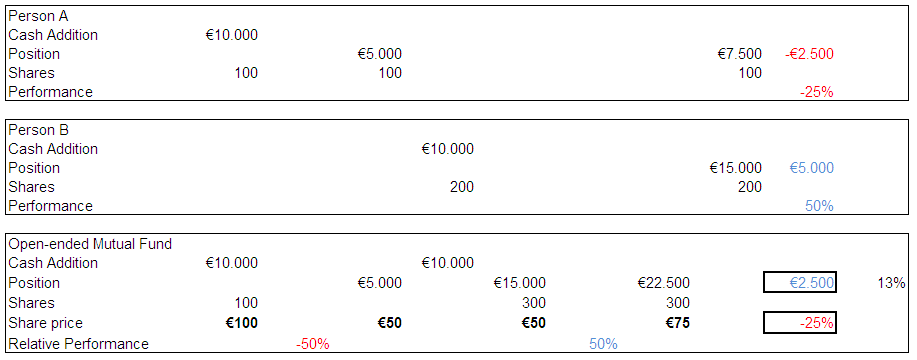
Take a fund with only one investor, A, who at the beginning of the year invested 10k€. That would be the assets of the fund at that moment. The net asset value per share could be defined as 100€, meaning that at that point there were 100 shares.

During the next months the market goes down and, along with the market, the fund’s assets. Let’s say that the reduction in value has been of 50% at half-way through the year. This means the assets of the fund would be 5,000€ (belonging to the sole investor, A). Since there were 100 shares, now the net asset value per share would be 50€.

At this low point, another investor, B, invests another 10k€ in the fund. Now, the 10,000€ would buy not 100 shares, but 200 at a price of 50€. The net asset value per share would remain unchanged at that moment, 50€. However, the assets of the fund would now be 15,000€. The total number of shares would be 300.

Imagine that during the second half of the year the performance of the fund is +50%. As I mentioned in the previous post, with consecutive market swings, -50% and then +50%, you lose. However, in this case there as been an investment in the low point and we’ll see what that means to the fund and each of the investors.

The +50% performance means to the fund an increase of its total assets up to 22,500€, or a net asset value per share of 75€ (for the same 300 shares). This is a +50% since mid-year, but a -25% from the beginning of the year. Quite a negative performance. However, the fund has received inflows of 20k€ along the year and has ended the year with +2,500€ of net gains!

For investor A: the year has meant the same -25% in both net assets and performance as he has lived through the whole period the big destruction of value in the first semester and the creation of value in the second, but, with the market swings of equal percentage value, he lost.

For investor B: the second semester has been great, as she has only lived the +50%, meaning a net gain of 5,000€.
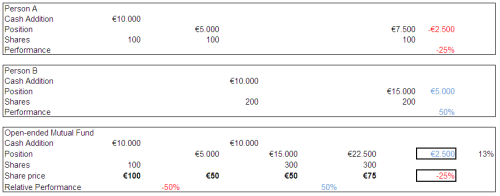
Performance of an investment fund.

The asset manager of the fund hasn’t been in the whole a better performer allocating assets than the market, and that is what the net asset value shows. The fund has only gained in absolute terms because there was an investment at the low point.

This is nothing more than one of the points the proponents of the technique Dollar Cost Averaging defend: to invest regularly the same amounts of money to take benefit of bear markets, when the fixed amount of money may afford more shares of a given stock. In that way you don’t need to time the market to benefit of low points.

Or in another way: “Be fearful when others are greedy, be greedy when others are fearful”, Warren Buffett.

Leave a comment

Filed under Investing

The Republic of Poyais

While I was in primary and high school, History never caught much my attention. And today is not otherwise in a broad sense, but I enjoy reading some historical notes on certain subjects.

I am reading these days the book “This Time is Different” (published in 2009), by Carmen Reinhart and Kenneth Rogoff (both Economics professors, the latter former economist at the IMF and member of the board of the Federal Reserve). As the description in Amazon says, the book is:

“[…] a comprehensive look at the varieties of financial crises, and guides us through eight astonishing centuries of government defaults, banking panics, and inflationary spikes–from medieval currency debasements to today’s subprime catastrophe. […]”

Being half way through it, I have had much fun with some anecdotes. I may write more about them in other posts, but in this one I want to focus in one I came across while reading the book (I have already shared it with some of you).

Let me take some excerpts from the Wikipedia:

Gregor MacGregor (24 December 1786 – 4 December 1845) was a Scottish soldier, adventurer, land speculator, and colonizer who fought in the South American struggle for independence. Upon his return to England in 1820, he claimed to be cacique of Poyais (also known as Principality of Poyais, Territory of Poyais, Republic of Poyais). Poyais was a fictional Central American country that MacGregor had invented which, with his help, drew investors and eventually colonists. […]

Gregor MacGregor went from Latin America to London, England, in 1820 and announced that he had been created cacique (highest authority or prince) of the Principality of Poyais, an independent nation on the Bay of Honduras. He claimed that native chieftan King George Frederic Augustus I of the Mosquito Shore and Nation had given him the territory of Poyais, 12,500 mile² (32,400 km²) of fertile land with untapped resources, a small number of settlers of British origin, and cooperative natives eager to please. He had created the beginnings of a country with civil service, army and democratic government. Now he needed settlers and investment and had come back to the United Kingdom to give people the opportunity.

At the time, British merchants were all too eager to enter the South American market that Spain had denied to them. The region had already become more promising in the wake of wars of South American independence, when the new governments of Colombia, Chile and Peru had issued bonds in London Royal Exchange to raise money. […]

In Edinburgh, MacGregor began to sell land rights for 3 shillings and 3 pence per acre (£0.16/acre or £40.15/km²). The average worker’s weekly wage at the time was about £1, which meant that the price was very generous. […] On 23 October 1822 MacGregor raised a loan with the total of £200,000 on behalf of the Poyais government. It was in the form of 2,000 bearer bonds worth £100 each. […]

You may read the rest of the story in the Wikipedia, but you can imagine it. Of course, Poyais defaulted on the debt issued, about 70 would-be settlers were sent to Latin America only to find that the wonderful Poyais did not exist. The group decided to come back to London. About 20 of them died in the trip and when they arrived to London about a year after departing MacGregor had already fled to France to proceed with similar schemes…

The Ponzi scheme of Madoff pales in the comparison to the one prepared by MacGregor. Beware when someone presents you with an opportunity too good to be true

2 Comments

Filed under Economy, Investing

Our investment fund in 2011

Luca and I have been investing together for 3 years. Last year I wrote a post in which I explained how we had adopted for our personal investments the same approach mutual open-ended funds have.

As I explained last year, we had to define a net asset value per share (valor liquidativo de la participación) at the beginning of the period. This net asset value per share rises and decreases as the aggregate share prices of the stocks in the portfolio rise or decrease. When an investment fund informs about its yearly results it is referring to the performance of this net asset value per share.

Each time that there is an addition of capital (new investments, in this case by Luca or me) it is treated as an issue of new shares to ourselves. It doesn’t matter that we are the only “shareholders”. Depending on whether the net asset value has increased or decreased we are acquiring the new shares at a higher or lower price than we acquired the previous ones. Exactly as it works in a fund.

And why do we go through all this hassle? So we can now handily compare how our investments fare in relation to broad market indexes or specific investment funds.

How did the year 2011 go?

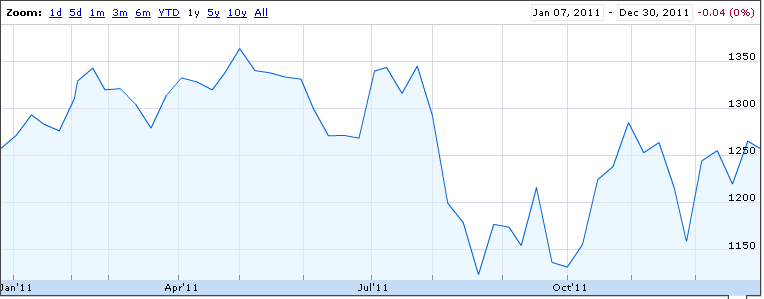
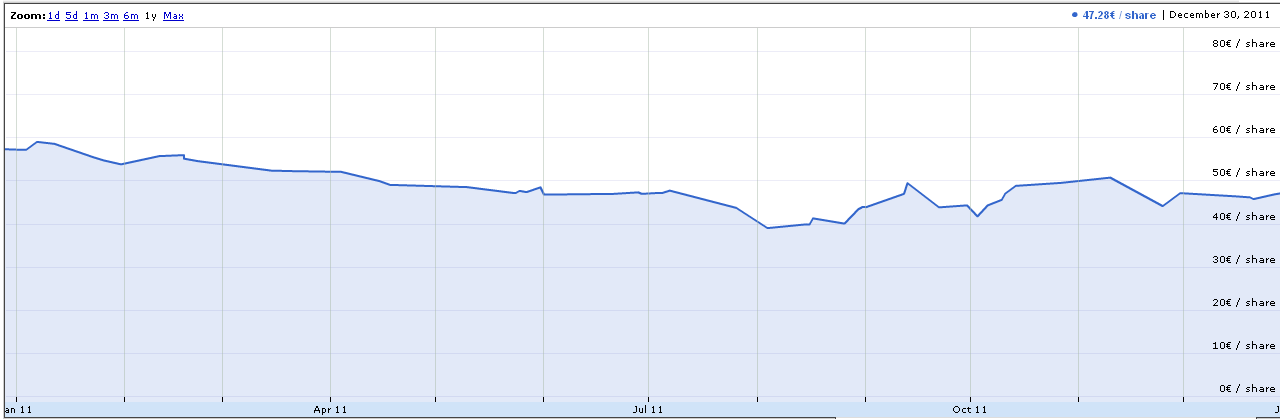
Let’s start with the humbling exercise :-). I had taken along the year above 50 samples, so we could get an idea of how the fund evolved. As you may see in the graphic below, the net asset value per share at the beginning of 2011 was 57.19€ while at the end it fell to 47.28€, that is -17.3%. This was the performance of the fund in 2011 (not good enough to sell subscriptions to the fund! :-)).

"J&L" investment fund 2011 performance (built in Google spreadsheet linked to Google Finance data, thanks to a friend's invaluable suggestion).

How does it compare with the main indexes?

  • S&P 500 ~ +0.07% (this is the target index)
  • Dow Jones ~ +5.5%
  • NASDAQ ~ -2.3%
  • IBEX 35 ~ -13.1% 
  • Euro Stoxx 50 ~ -18%

The gains of the fund since its creation in January 2009 have been+57.8%, with a compounded annual gain of +16.6% (remember this always refers to the net asset value per share – I will come back to this point in a future post, as cash gains or losses cannot be directly derived from the net asset value performance).

 Last year I introduced the comparison with the leading Spanish value investing fund, Bestinver (*). Let’s do the exercise again:

  • Bestinfond ~ -10.3%;
  • Bestinver Internacional ~ -10.1%;
  • Bestinver Bolsa ~ -12.7%.

All in all, 2011 hasn’t been a good year to present general results (for us, Bestinver or some indexes) however from the value investing perspective it hasn’t been that bad for buying (we performed 18 buy operations, while we only sold shares of 4 companies).

As any investment fund would do, prior to buying shares of a specific company we calculate the range in which we believe the target price shall be for us to sell the stock (and if the margin of safety is wide enough we buy). Taking the conservative values for each of the shares in our portfolio, we believe the target net asset value per share should be around 159€, thus having an estimated potential upside of about x3.3.

The latest factsheet of Bestinfond [PDF, November  2011] informed about a potential upside of x2.3. We may be optimistic; time will tell. And precisely that, time, being long-term value investors, we have plenty of :-).

I’ll keep you informed next year of this year’s results.

(*) Disclaimer: Since sometime in 2011, we have also positions in Bestinver, though I don’t get any fees for promoting it in the blog. (Our positions with Bestinver are excluded from the calculations of “J&L” fund to allow for clean comparisons).

NOTE: “J&L fund” numbers are pre-tax of capital gains realized, include dividends (twice taxed) and are net of transaction costs & brokerage commissions.

3 Comments

Filed under Investing

The Unwritten Laws of Finance & Investment

The Unwritten Laws of Finance and Investment, by Robert Cole.

I believe I have already mentioned at some point in the blog the ritual I have almost every time I get into an airport of going to one of the book shops to check whether I can find something to take with me.

I found “The Unwritten Laws of Finance & Investment”, by Robert Cole, at Frankfurt’s airport some months ago during a scale from Amsterdam to Toulouse.

The book is a collection of investment and finance maxims, advice, quotations, etc. It can be read in one shot (159 light pages).

If you are to read this book probably nothing of what you may find in it will be completely new to you, but the compilation and the witty style in which the “laws” are written make it an entertaining read and serve as repository where to find well established ideas.

Let me finish by quoting some passages from the laws that I enjoyed the most:

  • “I don’t want a lot of good investments; I want a few outstanding ones”, Philip Fisher.
  • It is impossible for investors to get their timing precisely right always. [I will come back to this in the future].
  • “In this business, if you’re good, you’re right six times out of ten. You’re never going to be right nine times out of ten”, Peter Lynch.
  • Before you go in, look for the way out. – This one is beautifully explained with a story from Winnie-the-Pooh. [I will come back to this in the future].
  • “Bull markets are born on pessimism, grow on scepticism, mature on optimism and die one euphoria”, Sir John Templeton. – This one reminds us to that of Warren Buffett “Be fearful when others are greedy and greedy when others are fearful”.
  • “There are huge mathematical advantages to doing nothing”, Warren Buffett (on compounding interest).
  • “The rich rules over the poor, and the borrower becomes the lender’s slave”, the Book of Proverbs 22:7, The Bible.
  • “The practice of contracting debt will almost infallibly be abused in every government. It would scarcely be more imprudent to give a prodigal son a credit in every banker’s shop in London, than to empower a statesman to draw bills, in this manner, upon posterity”, David Hume.
  • “The four most expensive words in English language are ‘This time is different'”, Sir John Templeton. [I will come to this in the future].
  • “Investment is most intelligent when it is most businesslike”, Warren Buffett.


Leave a comment

Filed under Books, Investing

El Cosmonauta

Hace algo más de un año acudí con un amigo a la conferencia TEDxMadrid. Allí fue donde por primera vez escuché hablar de la película “El Cosmonauta”, por voz de su director, Nicolás Alcalá.

Desde entonces he escuchado y leído varias veces hablar sobre la película. Lo novedoso de la misma radica en su planteamiento como proyecto de crowdfunding. No me quiero extender sobre ello, ya que se ha escrito mucho sobre el asunto y podéis encontrar mejores explicaciones (por ejemplo aquí – PDF). En definitiva, como las palabras indican en inglés, el crowdfunding se trata de financiarse a través de muchos pequeños inversores que realizan pequeñas aportaciones y reciben contrapartidas en proporción a su inversión.

En aquel primer momento no invertí ninguna cantidad. Sin embargo, ya hace algo más de un año escribí en este blog también acerca de este proyecto, del crowdfunding y de otras iniciativas que había encontrado en internet (Kickstarter y GrowVC).

Desde hace meses le tenía perdida la pista al proyecto, pero ayer, por casualidad, vi un tweet donde se enlazaba el tráiler de la película.

No sé qué os parece a vosotros, pero a mí me causó una muy buena impresión. Volví a leer en su web acerca de la situación actual del proyecto, de la financiación que les queda por conseguir y de las formas que había de colaborar.

Esta vez no tuve que pensármelo mucho: me hice inversor y productor de la película aportando 132€.

De esta forma colaboro con una nueva forma de hacer cine, me inicio en el crowdfunding (aunque la experiencia de Kiva también es crowdfunding, aunque sin ánimo de lucro), me mantengo al corriente de una forma más directa con el proyecto, me acerco a un sueño de la infancia y cumplo uno de mis numerosos objetivos anuales (invertir en algún proyecto de crowdfunding – esta vez también con ánimo de lucro).

¿Os animáis a colaborar?

2 Comments

Filed under Investing, Movies, Twitter & Media

What actually happens when there is a default?

A couple of friends of mine used to point to me some months ago, jokingly or seriously, who knows,  whether it was a good time to buy Greek bonds due to the hight yield they had.

My response was always the same, I prefer not to meddle with state bonds, a lesson learnt from various sources and which I wrote about some weeks ago (“Inflation and assets” and “Hyperinflation and defaults in Europe”).

I guess that with all the recent turmoil in the markets and the news, one would feel less appetite for such bonds, but I still had a question: What actually happens when there is a debt default? Is the state not giving you a monthly coupon but re-starts paying the next month? Is the payment along a year postponed and re-started the coming year? Is the principal recovered?

Last week, while flying to Amsterdam I read an insightful article from The Economist about last Argentina’s debt default. The article is an eye-opener. It gives detailed account of the different difficulties and steps that creditors are going through to recover part of their money.

But as a point of reference, take the following passage:

“Argentina’s default, after a severe economic crisis, sparked social unrest and runs on banks. It subsequently presented creditors with a take-it-or-leave-it offer of 35 cents on the dollar. They considered this derisory: previously, delinquent countries had typically paid 50-60 cents. But the government stood firm and roughly three-quarters of the bondholders took part in a debt exchange in 2005. More joined in 2010, bringing the total to 93%.”

Then, what typically happens is that monthly coupon payments are stopped and creditors are presented with a take-it-or-leave-it offer of paying them back about 50-60% of what they had invested…

The 7% who didn’t join that deal are still going through legal battles. For you and I, that most probably are not going to enter into any legal dispute with a country, we are much better off far away from state debt bonds.

Leave a comment

Filed under Economy, Investing

With the Market’s swings, you lose

Stock markets have been very volatile recently. Mr. Market’s got a very fragile mood. One day is up, the next is down.

In this post, I just wanted to make an obvious remark for most of you but a small insight for those who are not very acquainted with numbers.

Whenever the market moves up and down in consecutive moves of the same percentage, no matter which move comes first, you lose.

Imagine you have 100$ in the stock market. One day your stock moves up 2%, so you end having 102$. If the following day your stock goes down again by the same 2%, you’ll end up with 99.96$. Less than what you had before day one.

Then take the reverse case. If your stock went down 2% in the first place, you’d have 98$. If the following day it went up again 2%, you’d end up with the same 99.96$ (nothing more than the commutative property of the product).

Anyway, with those consecutive moves you would end losing some cash. You may believe that 4 cents are not worth the comment.

Think then about your savings (e.g. 10,000$) and about possible yearly performances (e.g. +/- 20%)… now you will see that at the end of the second year instead of 10,000$, you would have 9,600$, down 4% from the beginning (about -2% per year).

I just wanted to leave this small note here in the blog, obvious for some and not so for others, as I will come to it at a later point in time.

1 Comment

Filed under Investing

Active investment fund managers

In a previous post I showed the evolution of stock price for EADS and the target price calculated by an investment bank along 34 months. I already stated the misguided recommendations that they provided. A truly “Buy high and sell low”, the quickest way to lose all your savings.

There are many advertisements of investment funds using the term “active” (active management). That’s truly dangerous regarding investing. It not only implies more expenses paid in commissions, but also implies a manager who is acting more.

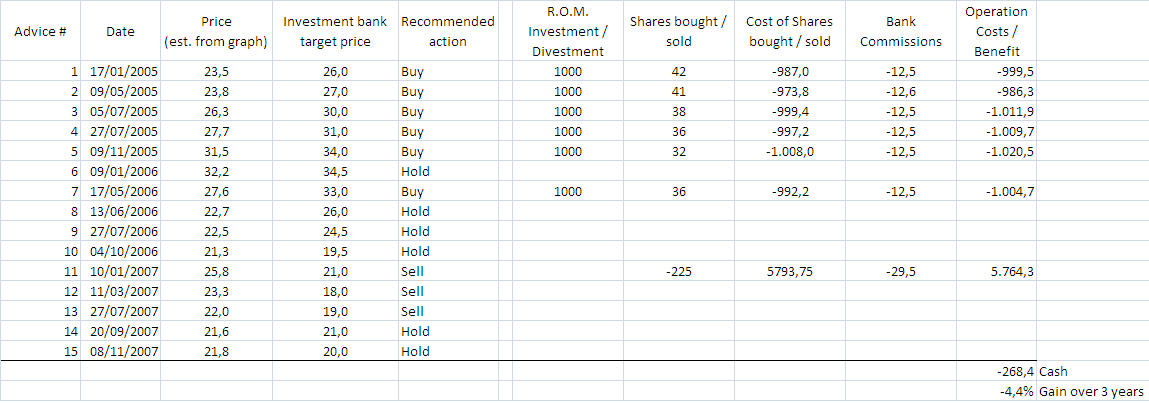
Imagine that the active fund manager was the same person who had produced the investment bank’s report of EADS that I showed in my previous post. If he had been as active as he recommended his clients to be, he would have bought shares in 6 different moments between 2005 and 2006 and sold them at the beginning of 2007 (*).

As an example, I made the calculation using around 1,000€ as the amount invested in each of those points in time (using the technique called “Dollar cost averaging“). You may see in the table below how many shares those 1,000€ afforded to. You may also see the amount it could cost in commissions (of course, professional brokerage firms would get lower fees – nevertheless, if you omit that commissions, the net result at the end would have been negative as well).

Quick way to lose your savings: follow the advice of an investment bank.

As you can see, after the 7 operations along 2 years, the manager would have lost 268€ on an investment of almost 6,000€, that is losing 4,4% or about 2% a year… It is much better then to leave your money in a savings account.

Nevertheless, what is more worrisome is the fact that in the period of 34 months, the bank produced 15 different target prices, changing its recommendation (i.e., from “buy” to “hold”, etc.) up to 5 times. This urge to produce new figures and even worse, to act upon those new figures is what makes most of professional investment fund managers a truly dangerous species. As Charlie T. Munger wisely says “Resist the natural human bias to act”.

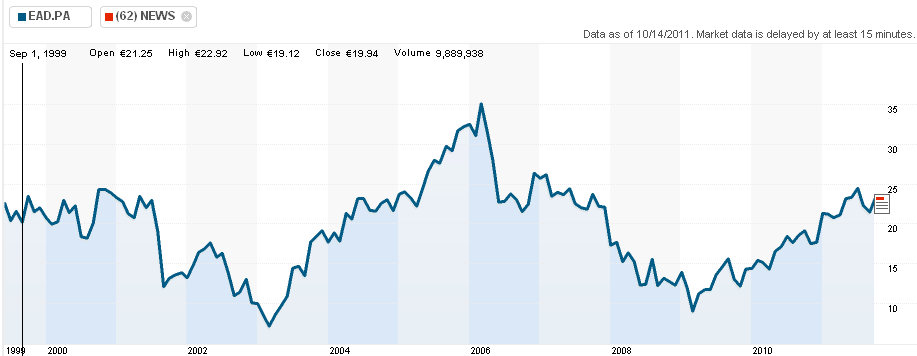
(*) I would have loved to have performed the same analysis with a newer report, as the price of EADS stock went even below 9€ in the years that followed to reach over 24€ again in 2011… but the last report of EADS (or any other company) that I had with such detailed explanation of target prices was this one (and I’d never pay for such a paper).

EADS share price since its creation.

Note 1: You may think that the negative figures reached with this example are due to the case selected. If you think that is the case, I invite you to take another example and share it with us. I do not have many such reports available, and as I already stated, such a report is not something I would be willing to pay for, I can find many more useful ways to spend money.

Note 2: If you think I was biased by using frequent buys of 1,000€ each one and selling everything at once, I made the same calculation imposing that the manager used the technique “dollar cost averaging” also at the time of selling, that is selling about 1,000€ each time the recommendation was “sell”. The result: at the end of the period he would have 2,962.5€ in cash and 2,114.6€ in stock, having lost this time nearly 16% of the invested amount, even worse than in the first case.

Leave a comment

Filed under Investing

Buy high, sell low

If I tell you that investment banks way of making you rich is advising you to “Buy high and sell low”, you’d call me stupid, you’d think I got the sentence wrong (obviously the way to become rich is “buying low and selling high”).

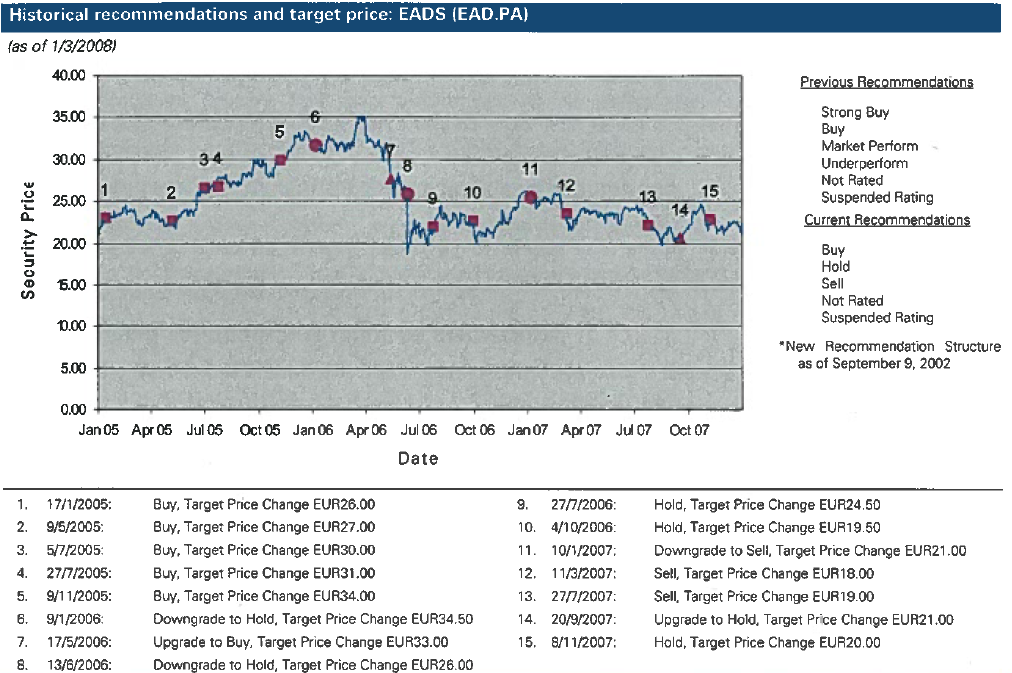
Take a look at the chart below. It’s taken from an investment bank report of EADS at the end of 2007 (let me omit the name of the bank out of courtesy… nevertheless, all banks incur in the same vices).

EADS historical prices from 2005 to end 2007 and investment bank's target prices and recommendations.

Along almost 3 years time, the bank recommends you to buy at 6 different points in time with prices ranging from 26€ to 34€. In the same period it recommends selling 3 times with prices ranging from 18€ to 21€. That is indeed buying high and selling low.

Margin of Safety

Each time that the bank recommended “Buy” the stock actual price was just between 7-16% below the bank’s estimated target price (e.g. 31.5€ vs 34€, -7%). Benjamin Graham concept of “margin of safety” advises you to invest only when the margin between the price you’ve estimated as the stock’s intrinsic value and its current price is above 30%, otherwise possible errors in your judging of the price will eat away possible gains.

That means, that if the intrinsic value of EADS had been well estimated at 34€, and the price was 31.5€, still the recommendation should have been “hold” or “sell”, never “buy”. A “buy” should have come only when price was below 23.8€ for a target of 34€…

That was regarding the margin of safety… was the intrinsic value of EADS really 34€? I have checked statements of EADS several times since its creation. I have never come to that figure as its intrinsic value. Even discarding all the one-offs that have occurred in the last years, the conservative price I reached never went upper than 24€ (a price reached at some point in 2011 – when I sold my stock). That means that the stock would have been a “buy”, had I been the banker, only when its price was under 17€ (which was never the case in the period shown in the report – but for a long period afterwards).

4 Comments

Filed under Investing

Risk

Few days ago I wrote a post about what was supposedly my risk profile as an investor. I mentioned in that post that the mainstream perception of risk is quite different to the one I had. Which is the perception I have?

My perception of risk is 100% shaped by that of Benjamin Graham, and so well described by Warren Buffett several times. I looked for a good example in the internet that I could quote and refer you to, here it is:

Finance departments believe that volatility equals risk. They want to measure risk, and they don’t know how to do it, basically. So they said volatility measures risk. I’ve often used the example of the Washington Post’s stock. When I first bought it in 1973 it had gone down almost 50%, from a valuation of the whole company of close to $170 million down to $80 million. Because it happened pretty fast, the beta of the stock had actually increased, and a professor would have told you that the company was more risky if you bought it for $80 million than if you bought it for $170 million. That’s something I’ve thought about ever since they told me that 25 years ago and I still haven’t figured it out.

If you want to read more about it and other related issues, take a look at the website from which I got this quote, Buffett FAQ.

1 Comment

Filed under Investing