Category Archives: Personal development

Master in common sense

What is the main thing you learn from studying an MBA? When I have been asked this question I always answer that the learning process is different: Most of the subjects present you with situations / cases that once solved you said to yourself “well, it was applied common sense, wasn’t it?” Yes, applied common sense to some situations you never encountered or reflected on before. This is one way you learn, the other is hearing from first hand hundreds of real stories experienced by your teachers.

It is not like learning to solve fluid dynamics or differential equations exercises… it is not that before you didn’t how to solve a problem and then you know it, at least this is how I felt at EOI. The learning process during the MBA is more like encouraging you to apply common sense to many issues, making you reflect on new topics from those that entertained you at university.

I tell this because after reading “How to win friends & influence people”, by Dale Carnegie, I felt the same.

I found that Dale Carnegie is a great story-teller and nothing is better to learn or reflect on different issues than seeing the application of solutions, skills or techniques in stories, real stories. Some of the ones in the book came from Abraham Lincoln, Benjamin Franklin, Roosevelt, Rockefeller, several American generals… and many others were stories from lay people like you and me.

I remember that one of my teachers in the MBA used to say “70% of your work within a company is just human relationships; and precisely that is not taught anywhere”.

The skill to deal with other humans effectively is so important that, as Dale Carnegie tells in the book, Charles Schwab was the first person to earn a million dollars a year (when 2.500$ a year was considered a good salary), when he was picked by Andrew Carnegie (no relation) to become the first president of United States Steel company in 1921… Why? As Charles put it: “I consider my ability to arouse enthusiasm among my people the greatest asset I possess, and the way to develop the best that is in a person is by appreciation and encouragement”. (We may argue whether he indeed deserved a salary hundreds of times higher than the average… I already discussed this when I commented other book in this blog).

Now, I leave you the different principles that Carnegie offers to improve your effectiveness when dealing with people (a rare animal indeed!), reflect on them:

Fundamental techniques in handling people:

  1. Don’t criticize, condemn or complain.
  2. Give honest and sincere appreciation.
  3. Arouse in the other person an eager want.

Six ways to make people like you:

  1. Become genuinely interested in other people.
  2. Smile.
  3. Remember that a person’s name is to that person the sweetest and most important sound in any language.
  4. Be a good listener. Encourage others to talk about themselves.
  5. Talk in terms of the other person’s interests.
  6. Make the other person feel important – and do it sincerely.

Win people to your way of thinking:

  1. The only way to get the best of an argument is to avoid it.
  2. Show respect for the other person’s opinions. Never say “You’re wrong”.
  3. If you are wrong, admit it quickly and emphatically.
  4. Begin in a friendly way.
  5. Get the other person saying “yes, yes” immediately.
  6. Let the other person do a great deal of the talking.
  7. Let the other person feel that the idea is his or hers.
  8. Try honestly to see things from the other person’s point of view.
  9. Be sympathetic with the other person’s ideas and desires.
  10. Appeal to the nobler motives.
  11. Dramatize your ideas.
  12. Throw down a challenge.

Be a leader:

  1. Begin with praise and hones appreciation.
  2. Call attention to people’s mistakes indirectly.
  3. Talk about your own mistakes before criticizing the other person.
  4. Ask questions instead of giving direct orders.
  5. Let the other person save face.
  6. Praise the slightest improvement and praise every improvement. Be “hearty in your approbation and lavish in your praise”.
  7. Give the other person a fine reputation to live up to.
  8. Use encouragement. Make the fault seem easy to correct.
  9. Make the other person happy about doing the thing you suggest.

“Obvious…” This is one thought that may come to our mind when reading some of these statements. However, we’re not acting in that way every day, being as obvious as they may be – thus getting the results we get…

I encourage you to read the book (~260 pgs.) and see in those stories many examples applicable to yourself; daily situations in which to apply those principles.

5 Comments

Filed under Books, Education, Personal development

Is talent really worth it? (Book review)

I am subscribed to The Economist since about 3 years ago. It not only provides with very interesting articles every week and lots of new ideas, but from time to time I am asked to take part in surveys. As a way to show appreciation they normally offer a study, a book, etc…

The latest book that I received from them and read is “Pay check. Are top earners really worth it?”, by David Bolchover.

The book is ferocious critique of CEO’s and finance workers’ pay. The average CEO in the USA earned in 1980 42 times the average blue-collar salary, while by 2000 this multiple increased to 531 times!

The book makes a clear difference between entrepreneurs, true generators of wealth, and the top management of multinational companies. He argues that there are three necessary conditions to award a high pay to the CEO:

  • Enough revenues available.
  • The CEO should have a measurable and substantially positive impact in the company (e.g. like one could defend the impact of a sports star within a team).
  • We would need to demonstrate beyond reasonable doubt that his abilities are extremely rare making him difficult to replace (could Jordan be replaced in Chicago Bulls?).

More often than not, this is not the case.

The favourite excuse being used to award exorbitant salaries is the scarcity of “talent”. The origin of the “talent” ideology seems to be the 1998 article from McKinsey “The War for Talent”.

Some of the extreme cases cited in the book…

  • Lehman Brothers CEO at the time of bankruptcy, Dick Fuld, who in his 15 years as CEO pocketed $466 million ($34M in 2007) before filing the largest bankruptcy in history (with $613 billion in debts), placing him as the worst CEO in American history according to Portfolio magazine.
  • Oil companies BP and Shell which both CEOs missed the objectives in 2008 yet still managed to be handed the undeserved bonus by the compensation committee from each company!

The author states that today, the main enemy of capital is… “talent”, those undeservingly taking the money away from shareholders and calls for shareholder activism to revert this situation and bring the money to whom it belongs (us, the shareholders… either directly or through investment and pension funds…).

I do recommend this book (~125 pgs.).

3 Comments

Filed under Books, Economy, Investing, Personal development

Learning while investing

During last days I had some fun learning different terms used in the shipping industry while investigating some possible investments. Let me share some of these examples:

Panamax”: this is a term for the size limits for ships traveling through the Panama Canal.

“Panamax is determined principally by the dimensions of the canal’s lock chambers, each of which is 110 ft (33.53 m) wide by 1,050 ft (320.04 m) long, and 85 ft (25.91 m) deep. The usable length of each lock chamber is 1,000 ft (304.8 m). The available water depth in the lock chambers varies, but the shallowest depth is at the south sill of the Pedro Miguel Locks and is 41.2 ft (12.56 m) at a Miraflores Lake level of 54 ft 6 in (16.61 m). The height of the Bridge of the Americas at Balboa is the limiting factor on a vessel’s overall height.”

(Did you ever have such an idea of the size of the Panama Canal?)

The two ships seen here seem almost to be touching the walls of the Miraflores Locks.

The same applies to the term “Suezmax”.

Another curious term is “Capesize“… which meaning by now you may already guess: “Capesize ships are cargo ships originally too large to transit the Suez Canal (i.e., larger than both Panamax and Suezmax vessels). To travel between oceans, such vessels used to have to pass either the Cape of Good Hope or Cape Horn. [I especially liked this last clarification] In effect Capesize reads as “unlimited”.” (Sure, once you have to travel around in the open ocean… you put the limit).

Lastly, “Deadweight tonnage”: this is “the sum of the weights of cargo, fuel, fresh water, ballast water, provisions, passengers, and crew.” It is curious that in the shipping industry this is also called “payload” according to the Wikipedia, while in the air cargo industry we refer by payload to just the weight of cargo / passengers…

Leave a comment

Filed under Education, Investing, Personal development

Most common letters in English and Spanish are…

While reading a book last summer, one curiosity came into my mind: what was the frequency in which different letters appeared in a text.

So I decided to count them… not only that, but I also wanted to compare the results between Spanish and English language.

The texts I used are both from this blog, the latest one in English from yesterday’s post and one about housing in Spanish from four months ago.

Here is the graphic with the results:

Frequency of letters in English and Spanish.

Even though these are just two posts of my blog and thus not a statistically relevant sample to allow for any definite conclusion, these are the results that I got:

  • In English the most common letter is “e” (13.5%), while in Spanish is “a” (12.5%) closely followed by “e” (12.2%).
  • In Spanish vowels account for 46.3% of the speech while in English they are 39.9%; more consonants in English.
  • In English the most common consonant is “t” (9.8%… from “the”?) followed by “s”, while in Spanish is “s” (7.4%… “ser”?) followed by “n”.
  • The most striking differences I found were:
    • In Spanish we use “a” over 50% more often than in English.
    • Some of the consonants we use way more in Spanish than in English are “d” (“de”?), “l” (“la”, “el”?) and “q” (“que”?).
    • Some of the consonants that are used more in English than in Spanish: “h” (5 times more!… “the”?), “t” and “w” (practically not used in Spanish).

12 Comments

Filed under Personal development

TEDxMadrid 2010

Last Saturday, a friend and I attended TEDxMadrid, an independently organized TED event in which several speakers presented some “ideas worth spreading” as the TED slogan goes.

The event took place in HUB Madrid, a “unique ecosystem designed to enable individuals ranging from corporate executives to community leaders, from policy-makers to entrepreneurs and freelance professionals to thrive. It is an office and events space where you can access social business ideas, innovation, knowledge, market opportunities, inspiration and experience” as they put it.

The event was streamed and the videos so far are available here. It was also funny to see the twitting activity that took place among the people being at the meeting (check #tedxmad, #tedxmadrid…).

A summary of each talk was made in the form of sketch boards by Puño & Gorriti that are available in flicker.

At the end of the event there was a short performance of impromptu theatre by “Impromadrid Teatro”, it was a funny experience. I have a friend who also has an impromptu theatre company in Madrid, “Impronta Compañía de Teatro Espontáneo”, I must go to one of their performances!

I still have to mentally “re-work” many of the things we heard and saw, and look for the many webs, books and ideas that were raised. Nevertheless, in this post I already wanted to share some thoughts that I took with me:

  • Slavery. It was commented by Antonella that in the last TED she learnt about “Free the Slaves”, an organization that liberates slaves around the world… slaves in the XXI century? We hear about women obliged to work as prostitutes or children working in some hidden factories… but when I heard the figure 27 million of them, I was shocked.
  • To be exponential in our thoughts. Alberto Dubois showed in his talk how evolution is exponential (human evolution, computing evolution, genome decoding evolution…) but we are normally linear in our thinking. We may apply the “exponential” way of thinking to many other fields, think of it.
  • BRINKs. We all have heard about the BRICs (the term coined by Goldman Sachs to refer to Brazil, Russia, India and China) or the PIGS (the term coined by Anglo-Saxon economists, used by FT, to refer to Portugal, Italy, Greece and Spain – lately Ireland and Great Britain as well), Alexander van de Putte introduced the BRINKs. This term refers to Brazil, Russia, Iraq, Nigeria and Kazakhstan, the countries which increased oil production will defer (once again) the estimates for the peak oil.

Finally, I wanted to thank C. Todd, Javier, Derek and Antonella for the great effort they have put into this event.

For those of you who could not attend this event but would have wished to do so, be aware that a similar event will take place in a month from now in Madrid, TEDxSol, on October 5th.

7 Comments

Filed under Education, Personal development, Twitter & Media

EVM in 40 minutes

Two years ago, I found an excellent free online 40-minute course about Earned Value Management. It was in the website of the UK Ministry of Defence (MOD) Acquisition Operating Framework (AOF).

Some days ago, I wanted to check it again and it was still available. If you are interested in the topic, check it.

Earned Value Management course at UK MoD AOF.

I have never seen an EVM course as good as this one, no matter how beautiful the name the consultancy training company gives it.

Some time ago I also read a well-structured book on project management, “Guide to Project Management“, by Paul Roberts. I recommend this one too.

Leave a comment

Filed under Aerospace & Defence, Education, Personal development

Management Gurus (book review)

According to the Wikipedia a guru is someone “regarded as having great knowledge, wisdom and authority in a certain area, and who uses it to guide others”. The term comes from Sanskrit (गुरु), where gu means darkness & ru means light.

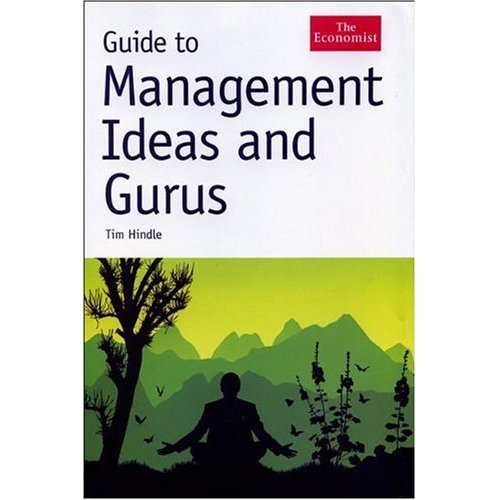
I mention this because during these last holidays I read a book about gurus, “Guide to Management Ideas and Gurus“, by Tim Hindle (322 pgs.).

Guide to Management Ideas and Gurus, Tim Hindle.

About two years ago The Economist used to send within a weekly alert a profile about a management idea and one guru, all of them coming from this book. Since then I had wanted to buy this book, which I found last June at a Schiphol airport book shop.

The book first reviews about a hundred management ideas, e.g., benchmarking, core competence, kaizen, lean production, SWOT analysis… Later it provides a short profile of over 50 authors or gurus, from Taylor and McGregor to Peter Drucker, Tom Peters, C.K. Prahalad… From each idea and author you get two pages. It is a good refresher of different concepts you may have studied and also helps relating some ideas and authors to others, interlinking them.

Along the book there is also bibliography related to each idea and from each author. In total I guess there are over 200 books and papers suggested. Also, it is very handy that from each author the book gives two or three notable quotations, from which you can get a quick idea of what is going to come. So now, after reading it I have a book with lots of marked pages, underlined parts and books and papers to look for.

I wanted to extract some ideas from three of those “gurus”:

  • C. Northcote Parkinson a naval historian famous for his book “Parkinson’s Law“, which can be stated as “Work expands to fill the time available for its completion”.
  • Laurence Peter a Canadian teacher famous for his book “The Peter Principle“, which can be phrased as “In a hierarchy, every employee tends to rise to his level of incompetence”.
  • Robert Townsend a former director of American Express famous for his book “Up the Organisation” with a more clarifying subtitle “How to Stop the Corporation from Stifling People and Strangling Profits”, where he is harsh on the vanity and stupidity of executive leaders.
  • Though not a “guru” from the ones profiled in the book, Scott Adams “Dilbert” comic strip is cited in at least a couple of times, take a moment to check it.

You can be sure that I have marked these three books in the to-read list.

4 Comments

Filed under Books, Personal development

The Best Advice I Ever Received…

Although probably the best pieces of advice I have ever received came from my parents and they were many, I am going to quote two others:

The one that changed viewpoint the most: “Within the work in a company, 70% of it is human relationships” (given by a teacher of an MBA I took at EOI in Seville).

The one I like to quote often: “The pats on the back, rather in cash” (given by a colleague, former teacher in the same MBA).

Side note: “Plinky” is a service I found one day proposed by WordPress. They suggest daily topics to write about in your blog, in case you lack ideas. I find some of the suggestions interesting and this is why you will see this kind of posts from time to time.

Powered by Plinky

1 Comment

Filed under Personal development

District 59 Conference: a Learning experience

Two weeks ago I attended the Toastmasters District 59 Conference, “Springtime at the Beach”, in The Hague. This was the first time I attended such a conference, and I was impressed at the level of the speakers and the organization of the conference itself.

Being an Area Governor, for me the event lasted two days and half, starting on Friday June 4th afternoon with an executive committee meeting, following with the start of the conference, later the evaluation contest and a party with divisions showcase. That wasn’t a slow start.

On Saturday we had some workshops, the elections of new officers and the international speech contest. The way the conference, workshops and elections are held reminded me very much of my time at AEGEE and how there the Agorae were held; even some of the topics covered are similar, the way sometimes the focus is put on the procedure and not on listening at length to what the candidates plan to do if elected, etc…

On Sunday we had more workshops and the training for the new district officers (namely Division and Area Governors).

International Speech Contest. This is the main attraction of the event. We could say that we paid the 135€ fee of it to attend this contest. We had 10 speeches, one representing each division. As I wrote above, the level was very high. I couldn’t see a clear winner; a prove of that is that only one of my 3 favourites came among the 3 first ones. The winner, Na Elom Amouh, told us about his journey from Togo to Munich and how we should never give up in the pursuit of our dreams. A motivational speech. In general, most speeches in these competitions tend to call the audience for noble purposes, inspire good behaviours, etc. I must admit that some of those speeches do get to move you.

Evaluation Contest. Here, the participants had to evaluate a very good speech from former District Gov Christopher Magyar. This is not an easy task, as it is always more difficult to find points of improvement. Even though in this contest the level was very high as well, with very analytical and encouraging evaluations, this time my 3 favourites came in the first 3 positions, the winner being Tara Majumdar.

Miscellanea. There are many small details, side happenings, different situations that contribute to enlarge the baggage the one takes from the conference.

  • The landscape surrounding the conference letting members to relax.
  • The music being played in the plenary sessions, especially the banners parade bringing up the spirits of all attendees.
  • The chance to have meals in the terrace.
  • The wonderful garden for the gala party and the party at the beach.
  • The attentive organisers… the continuous availability of stroop waffles, coffees, etc.
  • The counting of votes behind the scenes… when each one is coming up with a different number!
  • The entertaining way in which chairs conducted the contests.
  • The experience of tweeting the event (from @TM_Madrid and @javierirastorza)…

This slideshow requires JavaScript.

Learning experience. Overall, the conference is an intense learning experience. You learn how others organise officers’ trainings, set up clubs, give recognition to members, set up workshops, and use different techniques and skills in public speaking… To end this post I wanted to remark two workshops that I attended and especially liked:

  • Pecha Kucha: this is a presentation technique originally from Japan that consists of preparing a presentation that consists of 20 slides, each one lasting 20 seconds and that will run automatically. You, the presenter, can’t stop it so you need to time yourself to precisely convey your different messages when each slide is being shown. It was very dynamic and I think it’s a nice challenge to try it one day. Check out the calendar of Pecha Kucha nights in different cities around the World.

  • Youth Leadership Program: this is Toastmasters program for youngsters. A couple of Toastmasters explained how they have carried it in a school with teenagers. From what I saw, it must be a very rewarding experience, a way to give back something to society and at the same time a way to help young students improve their skills. This is also another challenge I might try one day.

Next District conference… in Barcelona; I’ve already booked my place there!

1 Comment

Filed under Education, Personal development, Toastmasters, Travelling, Twitter & Media

Toastmasters Division H Conference

I have already mentioned Toastmasters quite a few times in the blog. From the Toastmasters International site:

“[…] Toastmasters International has grown to become a world leader in helping people become more competent and comfortable in front of an audience. The nonprofit organization now has nearly 250,000 members in more than 12,500 clubs in106 countries, offering a proven – and enjoyable! – way to practice and hone communication and leadership skills.

Most Toastmasters meetings are comprised of approximately 20 people who meet weekly for an hour or two. Participants practice and learn skills by filling a meeting role, ranging from giving a prepared speech or an impromptu one to serving as timer, evaluator or grammarian.

There is no instructor; instead, each speech and meeting is critiqued by a member in a positive manner, focusing on what was done right and what could be improved.

Good communicators tend to be good leaders.”

There are 15 Toastmasters clubs in Spain in Portugal (3 of them in Madrid!), with over 400 members. Next weekend (April 24th), we will gather in Porto for the Division conference. There, we will have several workshops, lectures and presentations delivered by prominent speakers; among them Ed Tate, World Champion of Public Speaking in 2000, and John Zimmer, four times European Champion of Public Speaking.

Even more interesting will be the contests that will take place there: Evaluation and International Speech contests. From our Area (Madrid and South of Spain) there will be four participants taking part in them: Jane Kinnear, Ruben Navarro, Damian Alcolea and Alexander Hristov.

I am sure they will make a great performance and above all they’ll learn a lot just by participating in the contest. The rest of us attending will enjoy two great contests in a memorable weekend!

Good luck!!

1 Comment

Filed under Personal development, Toastmasters, Travelling