Category Archives: Travelling

Καλημέρα, Marathon!

Καλημέρα, Marathon!

(Good morning, Marathon!)

At the time this post is being published, two friends (Jose and Juan), my brother and I are starting the Athens Classic Marathon; the marathon starting in the town of Marathon, in the East of Attica region, and finishing in Athens.

Today, there are hundreds of marathon-distance (and longer) races organized around the globe all along the year. The trend is growing. The numbers of people running such races is increasing year by year. But it all started here, in Attica.

Pheidippides, the legend

The basic traces of the legend are widely known: a courier named Pheidippides ran from Marathon to Athens to announce the result of the battle and perished after the arrival. However, there are some confusions in relation to the legend, as it is well explained in the respective Wikipedia article.

The first record from the legend comes in a text from Lucian:

… The modern use of the word dates back to Philippides the dispatch-runner. Bringing the news of Marathon, he found the archons seated, in suspense regarding the issue of the battle. ‘Joy, we win!’ he said, and died upon his message, breathing his last in the word Joy … – Lucian Pro lapsu inter salutandum (translated by F.G. and H.W. Fowler, 1905) 

Statue of Pheidippides along the Marathon Road (picture by Hammer of the Gods27).

What is less known is that according to the story Pheidippides (530 BC–490 BC) was first sent to Sparta to request help from the Spartans when the Persians landed at Marathon. Thus, he already had run 240km to Sparta (and back). Right afterwards, he was sent from Marathon to Athens (another 40km) to announce the victory in the battle.

To the ones having completed a marathon race this makes sense, as: how it can be that it all started with the one supposed gifted runner collapsing after completing the 40km if thousands (about half a million) people each year complete a marathon? The catch is that Pheidippides had come from twice running what today is known as the Spartathlon, a 246km ultramarathon race which is also organized yearly in Greece, between Athens and Sparta.

Thus, the feats of Pheidippides have yielded two modern running race distances and hundreds of events.

The Olympic Games

Spyridon Louis entering the Panathinaiko stadium at the end of the marathon (public domain image, author Albert Meyer).

More than two thousand years passed until the sport of marathon was established on the occasion of the first modern Olympic Games held in 1896 in Athens.

The idea of including such a race in the programme of sport events was from Michel Bréal, a friend of Pierre de Coubertin. The proposal was accepted by the Olympic committee and that first marathon race had a distance of 40,000m (the current 42,195 distance for marathons was established years later, in 1924 , based on the distance of the 1908 London Games).

That first marathon was run on April 10th of 1986.  Only 17 runners took part in that race; of which only 9 of them finished, one being disqualified after his arrival (as he had completed part of the race on a carriage) and the other 8 retired at different points of the route. The race was won by the Greek Spyridon Louis with a time of  2:58:50.

Athens Classic Marathon

From 1972, the Athens Classic Marathon is organized yearly following the route of that first marathon race in 1896 and the legend of Pheidippides (490 BC).

Today in 2013, 117 years after those first 17 runners and 2503 years after Pheidippides, the 4 of us will try to cover the distance between Marathon and Athens, to say ‘Joy, we win!’ at our arrival and this time, not to collapse.
3 Comments

Filed under Sports, Travelling

The Museum of Flight (Seattle)

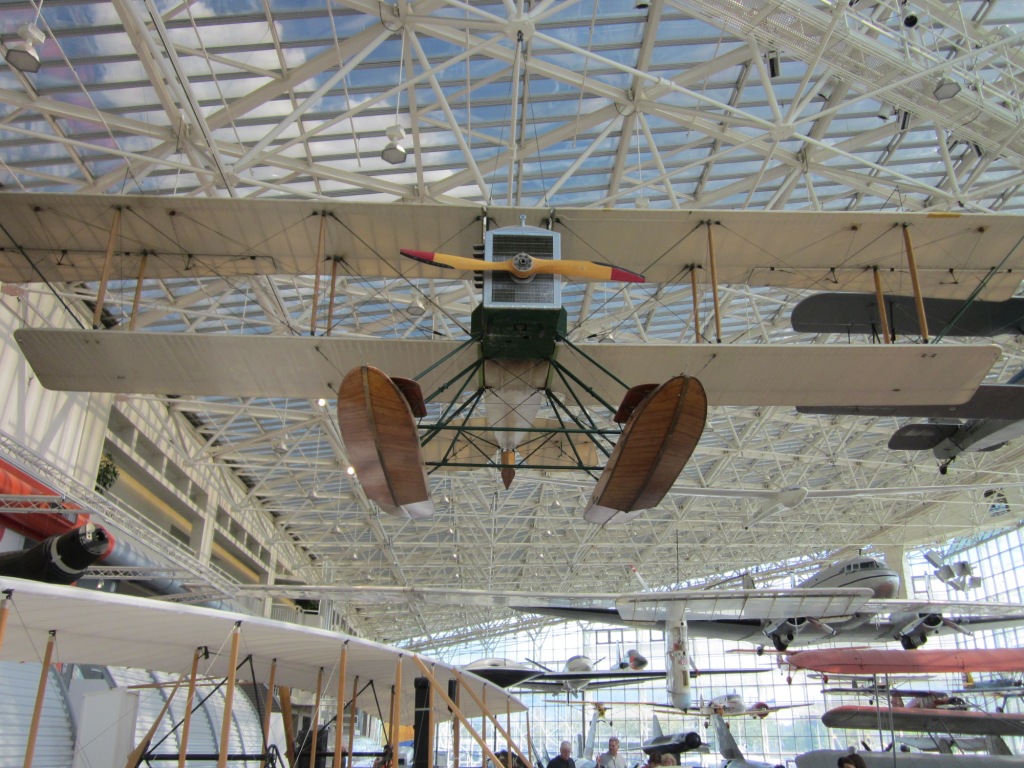
The Museum of Flight, in Seattle, is yet another great aerospace museum. It reminded me very much to the National Air and Space Museum in DC both because of the wealth of aircraft and artifacts in display and the variety of explanations provided (videos, sounds, readings, gadgets to play with…).

The museum is divided in the following areas:

  • Boeing Model 1.

    Boeing Model 1.

    T. A. Wilson Great Gallery (named after Boeing CEO from 1969-1986): this is the first gallery you face when you enter the museum. It hosts:

    • a replica of Boeing Model 1 (first Boeing airplane),
    • a Lockheed SR-71 Blackbird plus a cockpit for visitors to enter in it,
    • a 737 converted into a theater with movies being played inside,
    • an exhibition of the bush pilots of Alaska and the development of air mail,
    • some flight simulators,
    • a DC-3, a Bell “Huey” UH-1H Iroquois, etc.
  • Bill & Moya Lear Gallery (Space Exhibit, named after the founder of Lear Jet Corporation): located at the side of the Great Gallery it has a diorama of the Apollo 17 landing site, with rover included, a replica of the International Space Station Destiny Research Laboratory, etc.
  • The Tower: with direct view over the runway.
  • William E. Boeing Red Barn (named after Boeing founder): in my point of view this is “the” highlight of the museum (allow yourself over an hour for this part alone). It explains both:
    • the birth of aviation: with models and panels explaining the contributions of many of the aviation pioneers (see this blog post in which I went through some of them), and,
    • the history of Boeing: from the moment in which the timber businessman, Bill Boeing founds the company, the first Boeing Model 1 (see replica in the picture above), the tools, materials and processes used at the time, how did the factory look, the great aircraft programmes which meant different breakthroughs for the company and the great engineers behind them…
  • Charles Simonyi Space Gallery (named after the Microsoft executive who became in 2007 the 5th space tourist and who in 2009 travelled to the International Space Station): which highlight is the Space Shuttle Trainer used to train Space Shuttle astronauts at Johnson Space Center in Houston.
  • Airpark: with the Boeing 747 “City of Everett” (first ever 747, first ever wide-body aircraft), a Boeing 707 Air Force One, a Concorde, a Lockheed Constellation…
  • J. Elroy McCaw WWI and WWII galleries (named after a broadcasting magnate): unfortunately I did not have time to properly visit these galleries before the closing of the museum… a reason to come back again.

See some of the pictures I took at the museum:

This slideshow requires JavaScript.

I definitely recommend to visit this museum if you happen to be in Seattle. It is located in the South of Seattle at Boeing Field / King County airport. I would suggest to take no less than 5 hours to visit the museum and to arrive before noon, otherwise there will be some parts that you will not be able to visit properly (as it happened to me with the WWI and WWII galleries).

2 Comments

Filed under Aerospace & Defence, Travelling

Lowell Observatory

I believe that the first time I heard about Percival Lowell was reading the book “Marte y Vida, ciencia y ficción” (in Spanish; by Bartolomé Luque Serrano and Álvaro Marquéz González, the former being a teacher I had while at the university – “Mars and Life, science and fiction”). The reference to Lowell in the book was due to his drawings of the canals of Mars which promoted the idea of intelligent life in the planet. Thus, I mistakenly did not take the person very seriously at first.

Percival Lowell observing through Alvan Clark telescope at Lowell Observatory (public domain image).

Percival Lowell descended from a wealthy family from Boston (1), graduated from Harvard and dedicated a great part of his life to astronomy. Lowell founded the Lowell Observatory in 1894 in the city of Flagstaff (AZ). He made several observations of Mars, Venus, searched for Planet X and set out the non-profit which operates the observatory till today.

Even if not by Lowell, Pluto was discovered in his observatory in 1930 by  Clyde Tombaugh near the location expected for Planet X. The name and monogram for Pluto are partly a recognition to Lowell.

Today the observatory counts with several telescopes in different locations and employs about 20 full-time researches (PhD students included). It can be visited daily (12$ / adult) and with the visit some guided tours performed by the researchers are included. I definitely recommend the visit to the observatory for the science and history behind it.

The picture above is quite famous and shows Lowell in the Alvan Clark telescope located at Mars Hill. This telescope is part of the visit. There you will be able to see that chair, the wheels moving the dome, etc. The staff of the museum will operate some of the systems to move the telescope for the delight of the visitors. See some pictures below:

This slideshow requires JavaScript.

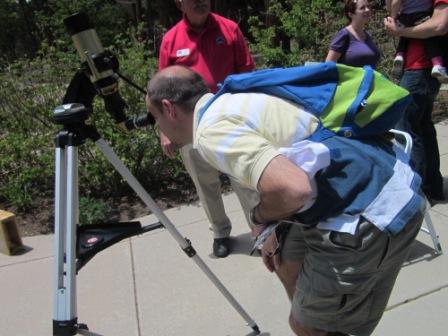
Observing the sun.

Observing the sun.

During our visit it was possible to observe the sun through a telescope (see picture at the right) during the day and more observations were to be organized during the evening. Thus, even if we did not do it like that I recommend planning the visit to the museum in the afternoon or at least staying over at Flagstaff the day you visit the museum (you can leave the museum and return in the evening with the same ticket for the observations).

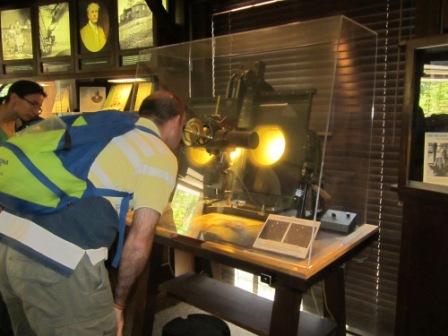
Comparing pictures to detect planets (at Rotunda Museum).

Comparing pictures to detect planets (at Rotunda Museum).

The tour we joined ended up with a visit to the Rotunda Museum (within the Observatory) where we were given more explanations and we were shown artifacts from Lowell’s time.

There is an area in the museum used for temporary exhibitions, which in the days we visited it was dedicated to the evolution of space suits used by astronauts.

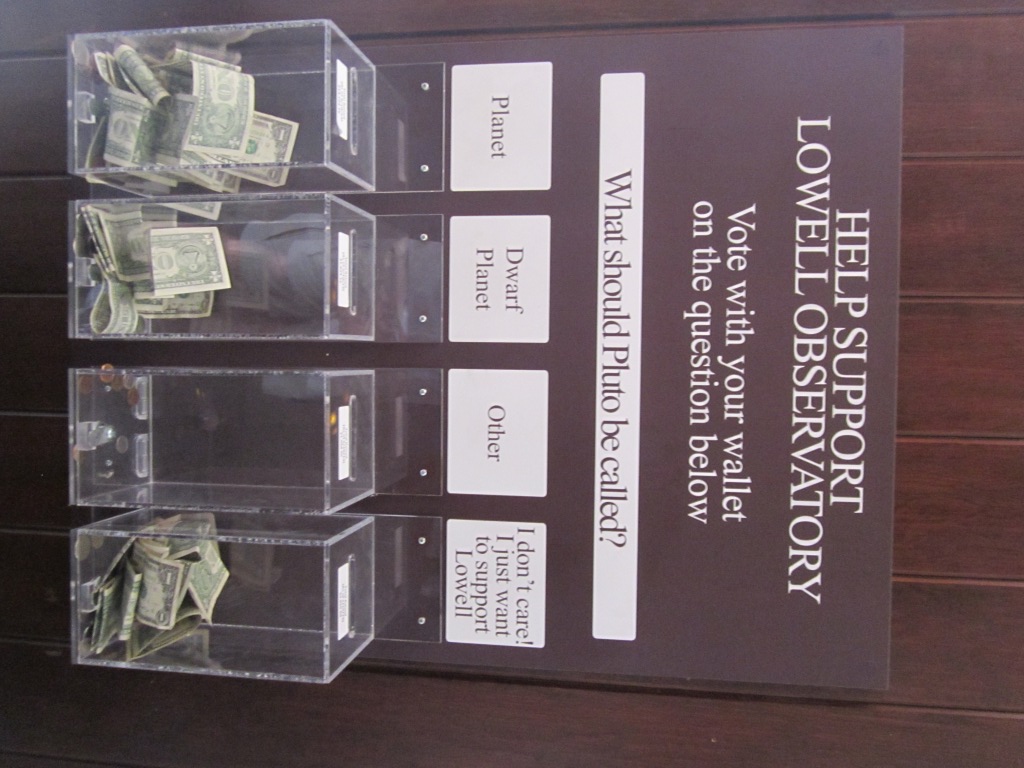
Finally, we found it funny this humourous touch we found at the museum: at the time of asking for support for the observatory, 4 different boxes are presented to the visitor enabling her to vote with the wallet on “What should Pluto be called?” (2):

IMG_2764

I do recommend the visit to the museum whenever you happen to be in Flagstaff (good stop over when visiting the Grand Canyon).

***

(1) As per the “Boston Toast” by Harvard alumnus John Collins Bossidy:

“And this is good old Boston,
The home of the bean and the cod,
Where the Lowells talk only to Cabots,
And the Cabots talk only to God.”

(2) Recall that in 2006 the International Astronomical Union established some conditions for an object to be considered a “planet” and Pluto failed the test and was “downgraded” to “dwarf planet”.

2 Comments

Filed under Aerospace & Defence, Travelling

Pima Air and Space Museum

Pima is a county in the South of Arizona, where the city of Tucson is located. Tucson is home of the Davis-Monthan Air Force Base, where the US Air Force’s 309th Aerospace Maintenance and Regeneration Group (AMARG), known as “The Boneyard”, is located. I wrote about the Boneyard in a previous postIn order to visit the Boneyard, you need to visit the Pima Air & Space Museum and that is how I got to know about the museum.

The description of the museum from their website states (the emphasis is mine):

“The Pima Air & Space Museum is one of the largest aviation Museums in the world, and the largest non-government funded aviation Museum in the United States. You’ll see more than 300 aircraft and spacecraft including many of the most historically significant and technically advanced craft ever produced, both from the United States and throughout the world.”

Pimar Air & Space Musem (Tucson, AZ).

Pima Air & Space Museum (Tucson, AZ).

The museum has 6 hangars and one space gallery, plus an impressive exhibit outdoors, which can be visited with a tram or on foot (or both). You can see in the map below the arrangement of the museum:

Pima Air and Space Museum map.

Pima Air and Space Museum map.

Together with the plan the visitor is handed an inventory of the aircraft on exhibit and where are they located (in which hangars):

Pimar Air and Space Museum inventory.

Pima Air and Space Museum inventory.

As you can see from the inventory above, the list of aircraft exhibited at the museum is simply impressive, overwhelming. Add to that, that in this museum you can get as close to the aircraft as you wish.

In the website of the museum you can find brief explanations of each of the aircraft on exhibit (here). This aircraft index can be surfed very handily ordering the aircraft by different criteria. The information about them includes some technical specifications, a brief historical explanation and a picture of the aircraft (I would almost say that it makes up for a visit of the museum). A very good job on the part of the museum curators.

Some of the highlights (in my opinion) of the museum:

Find some pictures I took of some of these aircraft and others in the slide show below:

This slideshow requires JavaScript.

The Pima Air & Space Museum has also facilities to restore the aircraft they get and bring them to a decent status to be put on exhibition. Some of the aircraft are on loan from the US Air Force Museum.

Within the museum there are plenty of US armed forces veterans willing to share with you detailed explanations or anecdotes from any of the aircraft. The tram visit of the outdoor exhibit is guided by one of these veterans… no need to say that the experience is fantastic.

It goes without saying it, that I strongly recommend to visit this museum as it is one of the best aerospace museums that I have ever visited. Couple that with the visit to the Boneyard and it is definitely a must for aerospace aficionados.

Finally, some tips to visit the museum:

  • plan your visit as early as possible (doors open at 9am),
  • allow yourself no less than 5 hours to comfortably visit the museum,
  • if the visit is in summertime, bring a bottle of water with you (which can be refilled in any of the many sources inside the museum),
  • plan to have lunch in the museum,
  • book yourself a place both in the tram to visit the outdoor exhibit and in the bus to visit the Boneyard (for this a photo ID will be necessary), as tickets sell out, be there at 9am.

6 Comments

Filed under Aerospace & Defence, Travelling

Hiroshima and the Enola Gay

Today, August 6th, in 1945 the Boeing B-29 Superfortress “Enola Gay” dropped over Hiroshima (Japan) the first nuclear bomb, “Little Boy“, used in combat. I guess you have had the chance to read about it in several places along the day. However, I thought of writing this post in order to connect several points related to the story, some of which I have only discovered quite recently…

Hiroshima

Luca and I, together with some friends visited Japan during the summer of 2008. A mandatory stop was Hiroshima. There we visited the Hiroshima Peace Site, museum and park.

You can spend several hours in the museum: from reading about the life in Hiroshima prior to the war, during the war and before the bombing, about the Manhattan Project, learning from specific cases of victims of the bomb, several testimonies, replicas from wounded people, etc. Some parts of the museum are truly shocking.

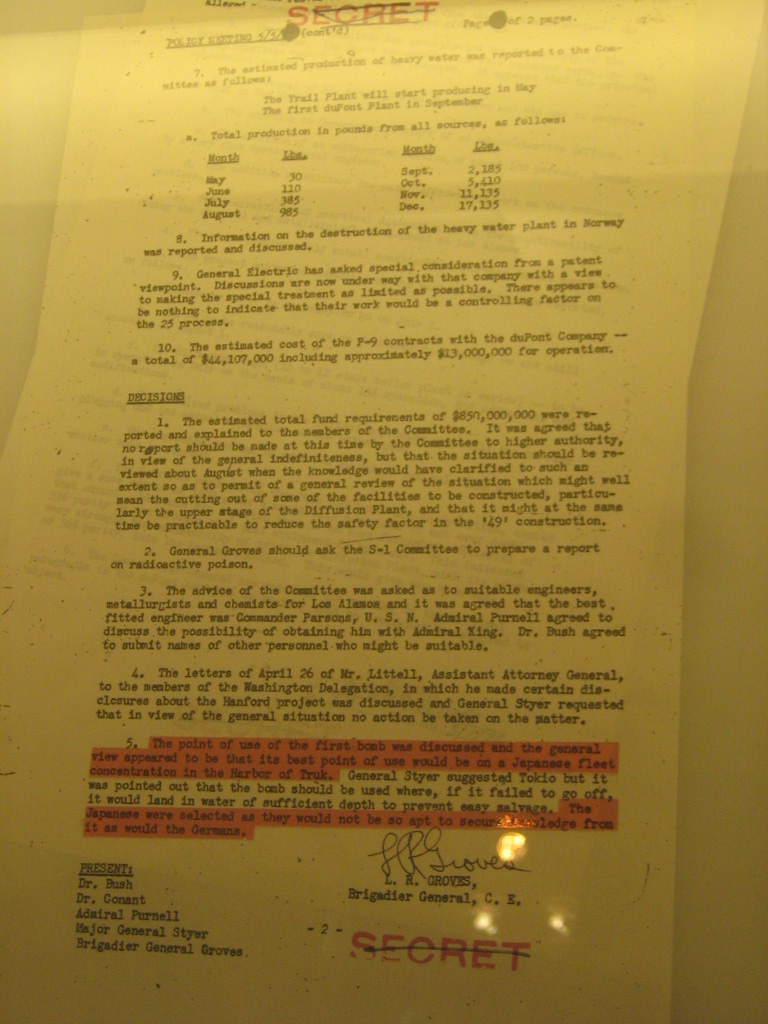
In the museum you could read several letters related to the Manhattan Project, for example these two from brigadier general Leslie Groves (in charge of the project) and Albert Einstein:

Letter from general Leslie Groves (Peace)

Letter from brigadier general Leslie Groves (Hiroshima Peace Memorial Museum).

Einstein’s letter to F.D. Roosevelt (Hiroshima Peace Memorial).

Some years ago, I read the book “The World as I see it“, from Albert Einstein in which he explained retrospectively his thoughts at the time of supporting the Manhattan Project. I already wrote a post about that book and recommend the reading of it.

In the Memorial Park, two things caught my attention: Genbaku Dome and the story of Sadako Sasaki.

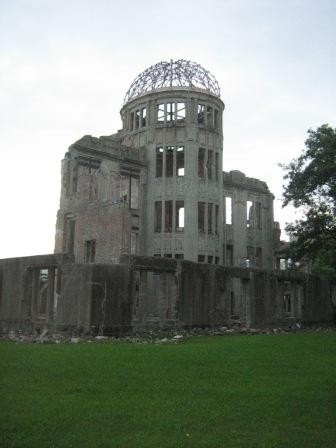
Genbaku Dome

The dome (also called “A-dome”) was the only structure in the area which was left standing. This is because the explosion of the bomb happened at about 600m above the dome and about 150m away horizontally enabling the structure to stand the nearly vertical compression it suffered due to the blast.

The dome was initially scheduled to be demolished, but finally it was preserved, being today UNESCO World Heritage Site.

Genbaku Dome, Hiroshima.

Genbaku Dome, Hiroshima.

Sadako Sasaki

As I did in a post I wrote 3 years ago, in order to explain her story I will paste below an excerpt from Wikipedia‘s article on the history of origami (paper birds):

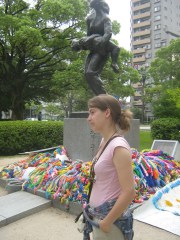
Legend says that anyone who folds one thousand paper cranes will have their heart’s desire come true. The origami crane has become a symbol of peace because of this legend, and because of a young Japanese girl namedSadako Sasaki. Sadako was exposed to the radiation of the atomic bombing of Hiroshima as an infant, and it took its inevitable toll on her health. She was then a hibakusha — an atom bomb survivor. By the time she was twelve in 1955, she was dying of leukemia. Hearing the legend, she decided to fold one thousand origami cranes so that she could live. However, when she saw that the other children in her ward were dying, she realized that she would not survive and wished instead for world peace and an end to suffering.   

A popular version of the tale is that Sadako folded 644 cranes before she died; her classmates then continued folding cranes in honor of their friend. She was buried with a wreath of 1,000 cranes to honor her dream. While her effort could not extend her life, it moved her friends to make a granite statue of Sadako in the Hiroshima Peace Park: a young girl standing with her hand outstretched, a paper crane flying from her fingertips. Every year the statue is adorned with thousands of wreaths of a thousand origami cranes.   

The tale of Sadako has been dramatized in many books and movies. In one version, Sadako wrote a haiku that translates into English as:   

I shall write peace upon your wings, and you shall fly around the world so that children will no longer have to die this way.

Hiroshima Peace Memorial park paper cranes.

In previous posts in the blog I explained how I have repeatedly encountered these paper birds around the world: in NY Saint Paul’s Chapel (close to World Trade Center zone zero), in Manzanar War Relocation Center (where Americans of Japanese origin were kept captive during WWII)…

Enola Gay

The “Enola Gay“, the Boeing B-29 Superfortress (named after the mother of the pilot Paul Tibbets) that dropped the bomb has become known worldwide. You can see the actual plane at the National Air and Space Museum in Dulles (Washington DC), where it is on exhibit. I wrote about that museum in this post, and you can see the airplane in the image below:

Boeing B-29 Superfortress “Enola Gay” at National Air and Space Museum (Washington DC).

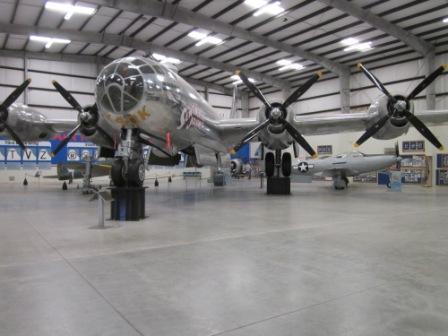
However, there are other aerospace museums where you can get closer to B-29 Superfortress aircraft, for example, the Pima Air and Space Museum in Tucson, Arizona, which we visited some months ago. There they had one B-29 on exhibit in one of its hangars:

Boeing B-29 Superfortress at Pima Air and Space Museum.

Boeing B-29 Superfortress at Pima Air and Space Museum (Tucson, AZ).

In the Pima museum, you could get really up close (not so in the NASM in Dulles) and you could get your head inside the bomb bay of the aircraft, the same bomb bay from which “Little Boy” was dropped from the “Enola Gay”:

Bomb bay of a B-29 Superfortress (at Pima Air and Space Museum, Tucson, AZ).

Bomb bay of a B-29 Superfortress (at Pima Air and Space Museum, Tucson, AZ).

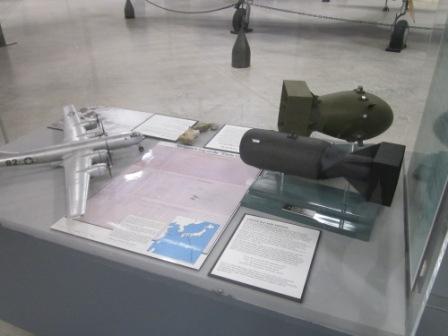
Close to this B-29, they displayed two replicas of the Enola Gay and the bomb, “Little Boy”:

B-29 "Enola Gay" replica and "Little Boy" bomb replica (at Pima Air and Space Museum).

B-29 “Enola Gay” replica and “Little Boy” bomb replica (at Pima Air and Space Museum, Tucson, AZ).

And finally, you could see a replica of the Enola Gay’s Navigator’s Log. I was caught by surprise to find all this material at the museum. The original log, written by the navigator that day, Theodore “Dutch” Van Kirk, was sold in a public auction some years ago for over 350k$.

While at the museum, I took some minutes to watch the replica, the route the plane followed, the points of reference it used, the notes he made… and especially, the line in which Theodore, at 9:15am, noted “Bomb Away” (the 10th line of the second box) just before turning back over the port of the island of Omishima (which is wrongly reported in the log as “Mishima”).

Replica of Navigator's Log of the "Enola Gay" (at Pima Air and Space Museum).

Replica of Navigator’s Log of the “Enola Gay” (at Pima Air and Space Museum).

The picture above hasn’t got very good quality, but you can read an account of those moments in the following passage from the book “Japan 1945: From Operation Downfall to Hiroshima and Nagasaki” (by Clayton Chun):

Excerpt from "xxx" by Chun,

Excerpt from “Japan 1945: From Operation Downfall to Hiroshima and Nagasaki” by Clayton Chun.

***

It was a long post this time, but I think it was worthwhile to touch the story from the several points of view I have “experienced” it throughout these last years.

4 Comments

Filed under Aerospace & Defence, Travelling

Bay to Breakers

While reading the tourist guide about California in preparation of our honeymoon, Luca discovered the race “Bay to Breakers” in San Francisco. We checked the website, the dates, we saw it was going to take place during our stay and so I subscribed to it.

For those who haven’t heard about it, Bay to Breakers is more than just a race. It is a city event. A party that has been going in San Francisco since it was first celebrated in the year 1912, partly to boost the city’s morale after 1906 earthquake. This year they celebrated 102nd edition. Bay to Breakers obtained the Guinness World Record as the largest footrace in 1986 with over 110,000 runners, while today they count with between 60 to 80 thousands. Another fun fact: it is the longest consecutively race in the world (not having changed length nor course along these 100 years).

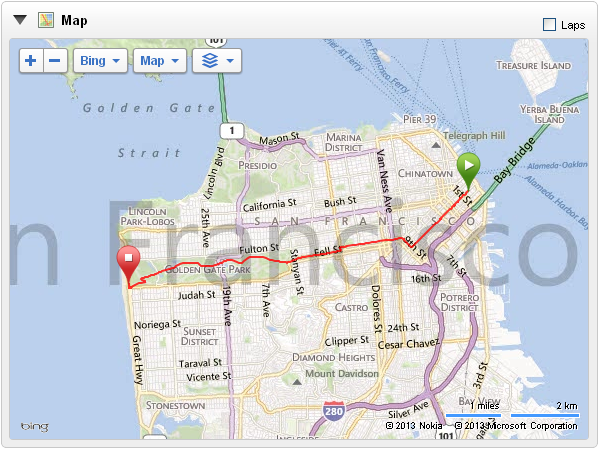
The race is a kind of carnival, very much like the San Silvestre Vallecana in Madrid in New Year’s Eve. It goes from one side of San Francisco, Embarcadero (in Howard street), to the other by the Pacific Ocean, after 12 kilometres (see the map here, PDF).

The atmosphere was great, despite of the bombing in the Boston marathon having taken place just a month beforehand, for which we observed a minute of silence prior to the race in memory of the victims.

Most of the participants were wearing some costumes, perhaps more than in the San Silvestre in Madrid, as the weather is milder at this time of the year.

Not knowing the circuit nor the streets, my intention was just to run the 12 kilometres in less than 1 hour, that was the time I had indicated in order to start from one of the front corrals. In the end, I felt quite good running, even during the climb up in Hayes Street Hill I kept up running (I only needed to make a quick stop by some urinary at the 4 km :-)).

Bay to Breakers circuit.

Bay to Breakers circuit.

The views of the race were especially good at the beginning while running along the civic center area, where most of the cheering crowd was, and then at the Golden Gate Park, which was also the longest part of the race. However, in the final kilometres there weren’t many people cheering, which is the only weak point that I see of this race in the comparison to the San Silvestre Vallecana in Madrid.

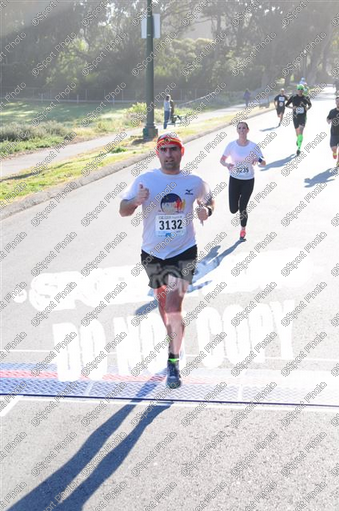
Having pushed hard in the last 4 kilometres where the profile was descending to the sea-shore, finishing with a sprint after a turn by the Dutch mills of the park, I finished in 58 minutes, two minutes below my initial target. A very good experience for my first race in the USA.

Finishing.

Finishing. 

One final fun fact: at some points in the race I encountered groups of runners that were somehow chained to one another. I found it strange but not so much, as I have seen runners pulling a chariot, dressing in all kinds of costumes in coordination with other runners, etc. Only after having finished, I learnt that these were centipedes!

There is a special classification for centipedes, which are teams of 13 runners attached to one another. In fact the record of the Centipedes category (LinkedIn 2012) is 36’44”, which is over 1 minute faster than the best ever women time and way faster than I would ever dream to accomplish!

P.S.: For the San Silvestre team: shall we go for centipede team next time?

3 Comments

Filed under Sports, Travelling

Boeing 787s parked in Paine Field

During our visit to Boeing wide-bodies final assembly lines in Everett, one thing was striking to the eye: the amount of Boeing 787s that were parked all around Paine Field. This is a view I was expecting to see since (a) at the time we travelled there (May 2013) the final fix to the 787’s batteries problem had not yet been approved by the Federal Aviation Administration (FAA) nor implemented in the already built aircraft, and (b) Boeing had kept churning 787s out of the assembly line thus provoking the mounting of them around the place.

See some of the pictures I took of them (not many pictures, nor very good ones as within the factory limits photo cameras were prohibited):

This slideshow requires JavaScript.

A collector’s gallery of a (luckily) rare event.

Leave a comment

Filed under Aerospace & Defence, Travelling

Santa Monica Track Club

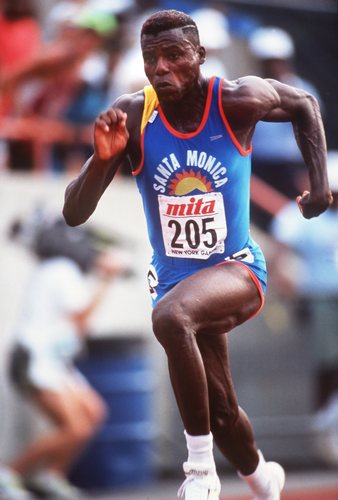
To some of you the initials SMTC or the name Santa Monica Track Club won’t ring any bell. Some others will immediately recognize the name of the athletics or “track and field” club in which some of the all time best athletes ran, such as Carl Lewis, Leroy Burrell, Michael Marsh, and many others.

When preparing the planning of our honeymoon, and since I was going to be running some days throughout it due to the preparation for San Diego marathon, I thought it would be nice to go and check SMTC and see where did they train and do a training session there myself.

I checked the website of the club but it did not help much. However, searching in different forums in the web, I found out that the club is not going through the best of the times struggling to find sponsors. The coach, Joe Douglas, is still the same one who prepared Carl Lewis. They normally trained in either in the Santa Monica College track (in the “Corsair Stadium”) and in Ocean Avenue, at a park by the beach, and they seemed to keep training in those places.

Then, I contacted the Santa Monica College faculty members in charge of the sports installations to see if I could use the track for training. Given the hours in which I planned to train (between 6 and 8 am) I obtained permission.

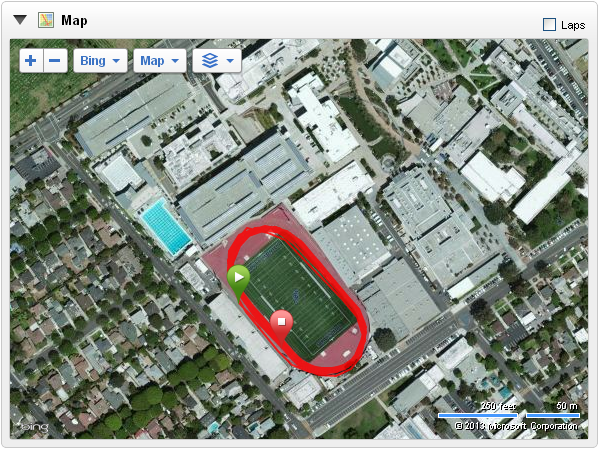
On May 15, Luca and I set out early in the morning for the track, where I did a 10 kilometre training surrounded by several other people running, walking or warming up to practice other sports.

Training session at SMC.

Training session at SMC.

It was a good experience and I am happy to have checked it out. However, it was a bit disappointing to see no memory, no sign, no trace of what glory that place lived not so long ago (ok, between 25 to 30 years ago). When I think of the legend that Carl Lewis is in athletics, I am puzzled that they do not show any pride of him.

This slideshow requires JavaScript.

Another thing that I missed was finding a t-shirt of the SMTC. I searched in various local shops but I didn’t find any. I learnt in some of them that Nike is selling a cotton replica (not a technical t-shirt) to commemorate it, however I didn’t find it in the stores, only in the online shop. I may buy it at some point as my personal and private homage to the SMTC of the ’80s.

Carl Lewis with SMTC t'shirt.

Carl Lewis with SMTC t-shirt.

3 Comments

Filed under Sports, Travelling

West of here

Some years ago, I watched a TED talk in which the case of the topic of how language influenced the way we think was discussed. In particular I remembered that it was given as an example how the Guugu Yimithirr people, Australian aborigines, had a very developed sense of orientation because in their language there were not such words as “left”, “right”, “in front of” or “behind”, but they have to give relative positions or directions with words like “North”, “South”, “East” and “West”. That example was kept deep in my mind.

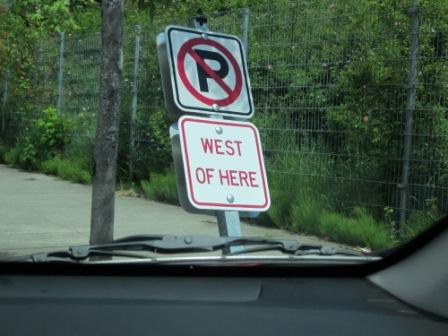
I would comfortably reckon myself as someone who has a good sense of orientation, and when visiting Seattle about 2 months ago I was quickly reminded of the example described above when seeing this kind of signs:

"Parking prohibited West of here".

“Parking prohibited West of here”.

We saw several of such signs, either giving instructions in relation to North/South or East/West. As in Seattle you have the Ocean coast mainly at the West, I would say that is easy for everyone to interprete these signs, but then again, not using that kind of language priming in English, I guess that some people will be mistaken from time to time.

P.S.: In the picture above, I knew where the West was and where my car was, I just won’t tell…

Leave a comment

Filed under Travelling

Manzanar War Relocation Center

During our honeymoon, on the way back from visiting Edwards AF Base, we decided on the spot not to take again highways 58 and 5 to San Francisco, but to go North by the Eastern part of Sierra Nevada and cross the whole of Yosemite National Park the following morning. With this new route we would drive more miles, give away a hotel reservation in Fresno but we were able to see the Red Rock Canyon State Park (famous for scenic rocky formations, featured in several films), Mount Whitney (with 4,421m the highest point of the Lower 48), Mono Lake (a terminal lake famous for its alkaline water) and Manzanar…

Manzanar War Relocation Center

Manzanar is the site where one of the concentration camps where thousands of Japanese and Americans with a Japanese origin were imprisoned during World War II. Manzanar is one black spot in the US history, let me quote from the Wikipedia:

Dr. James Hirabayashi, Professor Emeritus and former Dean of Ethnic Studies at San Francisco State University, wrote an article in 1994 in which he stated that he wonders why euphemistic terms used to describe camps such as Manzanar are still being used.

Let us review the main points of the debate. Over 120,000 residents of the U.S.A., two thirds of whom were American citizens, were incarcerated under armed guard. There were no crimes committed, no trials, and no convictions: the Japanese Americans were political incarcerees. To detain American citizens in a site under armed guard surely constitutes a “concentration camp.” But what were the terms used by the government officials who were involved in the process and who had to justify these actions? Raymond Okamura provides us with a detailed list of terms. Let’s consider three such euphemisms: “evacuation,” “relocation,” and “non-aliens.” Earthquake and flood victims are evacuated and relocated. The words refer to moving people in order to rescue and protect them from danger. The official government policy makers consistently used “evacuation” to refer to the forced removal of the Japanese Americans and the sites were called “relocation centers.” These are euphemisms (Webster: “the substitution of an inoffensive term for one considered offensively explicit”) as the terms do not imply forced removal nor incarceration in enclosures patrolled by armed guards. The masking was intentional.

I didn’t know about the imprisonment of Japanese Americans in American soil during the war until I came to Manzanar. During the same trip, we also had the chance to learn more about that topic in those times in Seattle at Pike Place Market, from where many Japanese Americans were first dispossessed from their shops and assets and then sent to concentration camps like Manzanar. 

After learning about this, I guess that the months after the bombing of Pearl Harbor (December 7, 1941) surely must have been very dramatic in the USA, and that political upheaval felt in DC must have been tremendous. Not only how to respond to that attack but to which extent were they safe in American soil, the suspicions or paranoia that people must have felt, the man haunts that must have happened, the incomprehension felt by those Americans…

On February 19, 1942, President Franklin D. Roosevelt signed Executive Order 9066, which authorized the Secretary of War to designate military commanders to prescribe military areas and to exclude “any or all persons” from such areas. The order also authorized the construction of what would later be called “relocation centers” by the War Relocation Authority (WRA) to house those who were to be excluded. This order resulted in the forced relocation of over 120,000 Japanese Americans, two-thirds of whom were native-born American citizens. 

Today is a National Historic Site that can be visited from dawn to sunset, on foot or by car, following a defined route which guides you through where the different parts of the camp were located, of which only a handful are standing or have been re-constructed.

This slideshow requires JavaScript.

See also some pictures from the other spots that I mentioned we saw during that day:

This slideshow requires JavaScript.

1 Comment

Filed under Travelling