If I tell you that investment banks way of making you rich is advising you to “Buy high and sell low”, you’d call me stupid, you’d think I got the sentence wrong (obviously the way to become rich is “buying low and selling high”).
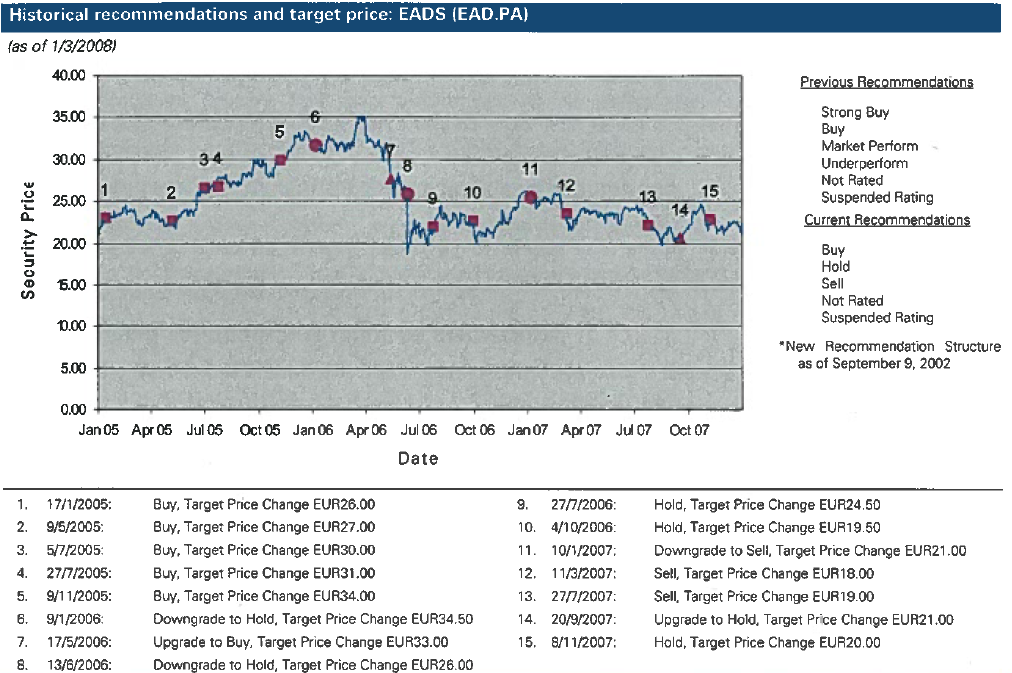
Take a look at the chart below. It’s taken from an investment bank report of EADS at the end of 2007 (let me omit the name of the bank out of courtesy… nevertheless, all banks incur in the same vices).
EADS historical prices from 2005 to end 2007 and investment bank's target prices and recommendations.
Along almost 3 years time, the bank recommends you to buy at 6 different points in time with prices ranging from 26€ to 34€. In the same period it recommends selling 3 times with prices ranging from 18€ to 21€. That is indeed buying high and selling low.
Margin of Safety
Each time that the bank recommended “Buy” the stock actual price was just between 7-16% below the bank’s estimated target price (e.g. 31.5€ vs 34€, -7%). Benjamin Graham concept of “margin of safety” advises you to invest only when the margin between the price you’ve estimated as the stock’s intrinsic value and its current price is above 30%, otherwise possible errors in your judging of the price will eat away possible gains.
That means, that if the intrinsic value of EADS had been well estimated at 34€, and the price was 31.5€, still the recommendation should have been “hold” or “sell”, never “buy”. A “buy” should have come only when price was below 23.8€ for a target of 34€…
That was regarding the margin of safety… was the intrinsic value of EADS really 34€? I have checked statements of EADS several times since its creation. I have never come to that figure as its intrinsic value. Even discarding all the one-offs that have occurred in the last years, the conservative price I reached never went upper than 24€ (a price reached at some point in 2011 – when I sold my stock). That means that the stock would have been a “buy”, had I been the banker, only when its price was under 17€ (which was never the case in the period shown in the report – but for a long period afterwards).
Finally the 23rd of October came and with it the marathon of Toulouse, an event I planned to run as much as 8 months ago. An event I wrote about twice before in this blog, when I announced that I would run it and on the 23rd of October to publish the funds we raised for the charity I ran for, “Vaincre la mucoviscidose”.
To set the stage, I must say that in January I only had the objective of running some 10km races along the year and subscribing to a half marathon, not necessarily to be run in 2011. But then, on February I started thinking of actually going for a full marathon before year-end. I locked on the Toulouse marathon.
Time went by, and I took part in many races along the year, went from casual running to running a lot, to engaging myself in a formal training plan for the marathon… and to subscribe myself with a friend for an ultramarathon which we completed back in September, a month ago.
In September I completed the half marathon of Toulouse in 1h42’30”, my personal best time ever in the distance, ending with very good feelings. With that reference in mind, and taking into account a “running calculator” that I had been checking from time to time, I had in mind a marathon pace of 5’08″/km for the marathon… that would make a 3h36′ marathon. 24 minutes down from my best time 10 years ago.
One week after the half marathon, a friend and I took part in the 100km of Millau, more than 15 hours of racing. A great experience as I described in the post about it, but it brought some collateral damage in the form of a peroneal tendonitis that hasn’t been healed a month afterwards. During the last 30 days I only ran 3 days: One test prior to the race “Ronde des foies gras”, that race and short test run prior to the marathon.
Knowing that the injure wasn’t yet healed and that I hadn’t trained in a month, I decided to ease a little with the pace for the race: I set the objective in 5’20″/km, that would make a 3h45′ marathon…
Before leaving my home I put a special surgical bandage to strengthen the ankle that had given trouble in the last month. I put some anti inflammatory cream around and took a couple of analgesic pills. Ready for the race.
The marathon started very close to my place so I went to the starting lane jogging, as a warm up exercise. I got acquainted with the departing blocks by times and left my bag to the organization. I started with the group of 3h45′ as was my objective.
The first ~9km went through the centre of Toulouse, already with lots of people cheering in some parts of the city, especially in my neighbourhood, Saint Cyprien, despite of the early departure time.
After the first 10km, and feeling well, I decided to go a bit faster and I went ahead of the 3h45′ group, running by my own, finding another pack of runners going at about 5’10″/km. Everything went fine until km 19 more or less, then I started feeling some stiffnes in the right leg.
The pain wasn’t anymore restricted to the ankle but went up to the outer part of the knee. I managed to keep pace for about 2 kilometres until km 22. From then on, it proved impossible. The leg was not responding. Time was increasing between one kilometre and the next. 5’30”, then 5’50”, 6’30”, 7’00″… You may see the evolution in the following link with the performance along the race recorded by my Garmin GPS.
From that point around km 22 till the end there were some challenges. The first one was the running itself; it was increasingly difficult to move the right leg, but I knew that if I stopped for a few metres walking to calm down the pain it would only get worse, cool down and would be even harder to start again. Another challenge was to defeat the bad mood coming from the fact of knowing that I wouldn’t make the 3h45′ marathon that I aimed at, but would make a time somewhat worse, probably much worse. A final challenge was to get used to the idea of another 17km of pain while running, making some numbers in my mind at some point and figuring out that “ok, it’ll be at most about 1h40′ more of running with this pain, I can handle it”. If I took something from Millau, it was the mind management and coping with pain while running. This time it was less of a challenge.
At some point between km 25 and 27 I was overtaken by the 3h45′ group. One of the guys who lead it told me to try to follow them at the back of the pack. Impossible. I knew they were running at 5’20”, I was wandering at 5’40” by then and worsening. They were like a plane for me.
Later on, in the kilometre 33 I met my friend Juan, who was visiting me in Toulouse during the weekend. He would run the last kilometres together with me. That proved an invaluable help in the form of cheering, small talk, holding some drinks and finally making lots of pictures and videos that you may see below.
By then we were re-entering the city centre and the streets were filled by people cheering the runners. The bibs we carried had our names printed on them. This made people cheering you by your name “Allez, Javier! Courage!”. That was great. If you just had enough strength to run and look at them to thank for it…
By the kilometre 36 more or less I was overtaken by the 4h00 group. I already knew they would pass me, as I was seeing at every moment the times I was making and I had an idea of what final time I could manage. Again, the 4-hour group was like a plane for me, impossible to jump on it. They came at less than 6’/km while I was running at about 7′ by then. But it was only about 6 km to go, at most 40 more minutes. The marathon was almost finished.
I managed my way through the last kilometres seeing that in the end I wouldn’t be above 4h15′, that cheered me up a bit, and when I crossed the 41km line I made a small calculation: if I increased pace I could still be below 4h10′ official time, so I did.
During the next kilometre I increased the pace but still saving some strength to allow my self a last sprint from Wilson square to Capitol, where the finish lane was placed. By then the crowd was almost carrying you, pain was barely felt, the sight was locked on the “Arrivée” sign and the clock below… 4h09’35″… 36″… 37″…
Few more metres of sprint and crossing the line at 4h09’53” (4h08’31” net time), just below the 3rd objective, 25 minutes more than the original 3h45′, almost 10 minutes more than a sub-4-hour marathon. My second best time in a marathon.
On the plus side: I completed again a marathon, 10 years after the last one. The objective from February was accomplished. I could run the whole of it despite the injure and subsequent pain.
Nevertheless, I finished with a bit of bitterness from not having been able to meet my 3h45′ objective, nor the sub-4h one… This teaches me a lesson for the future: when you run a marathon being injured, far from making personal best times, you’ll most probably end up suffering a lot. A lot. After all a marathon is what it is for a reason, and one should never underestimate it. Lesson learned. Now it’s time to finally fully recover from the injure; 2012 will be another season.
Few days ago I wrote a post about what was supposedly my risk profile as an investor. I mentioned in that post that the mainstream perception of risk is quite different to the one I had. Which is the perception I have?
My perception of risk is 100% shaped by that of Benjamin Graham, and so well described by Warren Buffett several times. I looked for a good example in the internet that I could quote and refer you to, here it is:
Finance departments believe that volatility equals risk. They want to measure risk, and they don’t know how to do it, basically. So they said volatility measures risk. I’ve often used the example of the Washington Post’s stock. When I first bought it in 1973 it had gone down almost 50%, from a valuation of the whole company of close to $170 million down to $80 million. Because it happened pretty fast, the beta of the stock had actually increased, and a professor would have told you that the company was more risky if you bought it for $80 million than if you bought it for $170 million. That’s something I’ve thought about ever since they told me that 25 years ago and I still haven’t figured it out.
If you want to read more about it and other related issues, take a look at the website from which I got this quote, Buffett FAQ.
As I announced back in August, today 23rd October 2011, I’m running my 4th marathon, 10 years after having run the last one. When I wrote that post, I mentioned that I would be raising funds for a charity, “Vaincre la mucoviscidose”.
With this post I wanted to thank those persons who contributed to the cause: Nacho, Jaime and Luca. Thank you for your contributions!! The people affected by the illness and I sincerely thank you for them. Together we have raised 240€ as you can see in the cheque below extended to the charity association.
Check sent to the charity "Vaincre la mucoviscidose".
Finally, in case you wake up early enough, you may follow the race live through this link. My bib number: 2329!
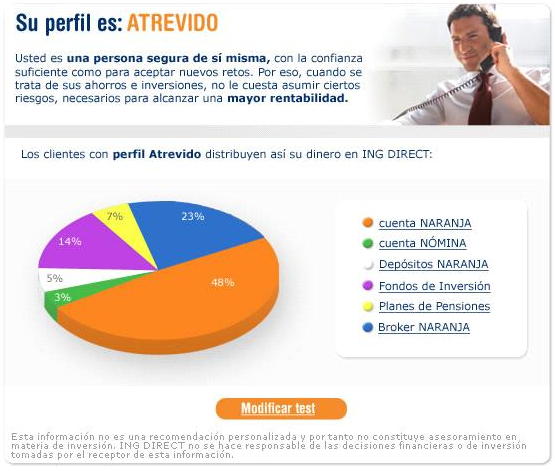
Few days ago I received an email from my bank back in Spain, ING, suggesting me to take a small test in their website to see what my risk profile as an investor was. I was curious about what the result could be so I took it.
The test consisted of 7 questions regarding what kind of financial products you have, how much you save, whether you would take or not some products, etc. The result:
My risk profile: Bold, daring....
Contrary to that statement I consider myself quite conservative in relation with my financial behaviour and that is why I save and invest the way I do. Nevertheless, it seems that the mainstream definition or perception of risk is quite different to the one I have.
Together with the result of the test, ING showed a graphic showing the proportion of different financial products that people with “my” risk profile had… well, at least they got it right regarding the amounts I put in short-term fixed-income deposits, investment mutual funds and current account… the rest of them is quite different.
Some weeks ago, I got an email from a source-of-ideas-for-blogs service called Plinky, from which I have already picked some good ideas to write about in posts in the past (on my dream job, charities…).
The question I liked very much this time from the email was:
“Would you rather have one free trip to space or free international travel for life?”
Having already confessed that my dream job as a child was to be an astronaut and knowing how much I enjoy travelling, this question really posed a dilemma.
But after some seconds, I rationalized it and I started making some numbers (how couldn’t I?).
During the past years I have made about 2 long trips per year with Luca abroad, plus some shorter trips apart from commuting back-and-forth to the Netherlands. I have perfectly recorded how much each of the international trips is costing us, since I already made a budget some months beforehand and played with Luca to see how much my initial budget deviates from reality in the end (from 22% to as low as 7€ on a 2-week trip to Japan). Let’s say we spend about 6,000€ per person a year on international travels.
If now I am 30, and I could expect to continue travelling abroad till let’s say 70, this makes 40 years of international trips. As we grow older our trips will most probably become more expensive. This is a trend we have already experienced in the past 4 years and I expect it to continue to hold true, even more so during the some 25-30 years in the future when we will have to include offspring in the travelling expenses tally (by then I expect we won’t have to commute so much but we will have to do so from time to time to visit grandparents)… Let’s use 8,000€ per person per year to play on the safe side with this calculation… so in 40 years that would make ~320,000€.
On the other hand, how much does it cost space travel? Rich individuals who have travelled in the Russian Soyuz have reportedly spent between 20-35M$, or about 25M€. Taking this figure the conclusion is clear: I would rather receive a free trip to space and I’ll gladly continue to pay for my yearly holidays for the rest of my life.
But then again, Virgin Galactic comes offering suborbital flights at a rate of 200k$, or about 150k€, if that is the case, I would rather receive a free lunch in down-to-earth international travel for a lifetime and pay for my stunt with the SpaceShipTwo.
Finally, given the choice, I’d go for the first and highest value option: an orbital free flight in the Soyuz.
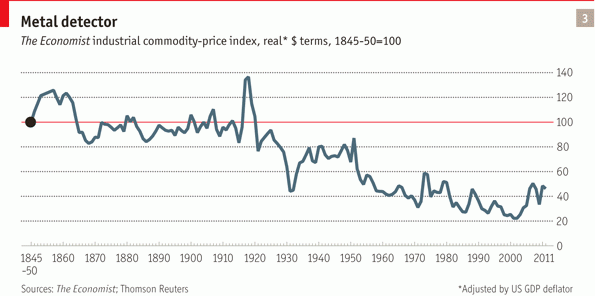
Weeks ago The Economist showed another interesting long-term graphic that I wanted to share and also to leave it here as a note to self as a reminder of the long-term worth of commodities.
Commodity-price index, adjusted by US GDP deflator.
Yesterday, it appeared in Flight International website, an article in which the price of an A380 was unveiled. Generally, aircraft real prices are never disclosed, that is why that was news. What it is normally published is the list prices for the different aircraft (here you may see Boeing’s list).
The article disclosed the price for an A380 acquired by Nimrod Capital LLC, which is to lease it to Emirates. The price: 234m$. Since the list price for the A380 is 375m$, that means it was purchased with a 38% discount, as the article says.
For obvious reasons, I will not comment on Airbus prices (*). Here, I just wanted to mention that, using a quite detailed approach, some time ago, I calculated which were Boeing’s discounts. I explained everything in a post.
I used the number of aircraft delivered per year, the net orders per year, all for a period of three consecutive years, and matched the list prices versus the revenues recognised in the yearly income statement published by the company in each of those years… I figured out which was the discount that minimized errors for the period of three years. Guess what was the result I came up with: 38% for the period 2007-2009 and 39% for the period 2008-2010.
—
(*) Disclaimer: I have never worked in anything related to aircraft pricing, sales or marketing in Airbus. Thus, I have no insider clue about its prices.
If in a previous post, pencils were treated as a supposedly safe haven in case of a recession. In this post I just wanted to mention that I don’t see anything more value in gold or silver than I see in pencils.
That may sound shocking, as we are used to have gold items in great praise. Well, as a commodity, as an asset, I don’t see much difference between gold and other materials. What it is valuable is the company that continues to produce goods out of those commodities, with ever greater productivity and value added to its products.
Gold by itself is just like a pencil, assuming that you continue to find someone in the future willing to pay something for both commodities (certainly not more than it is worth at any given moment).
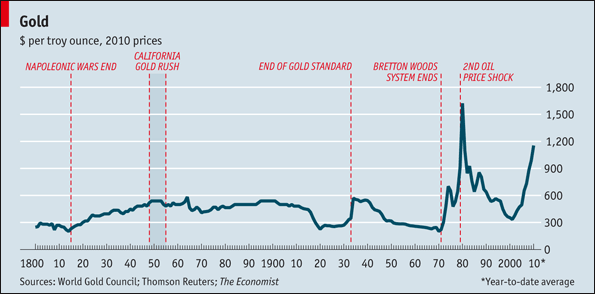
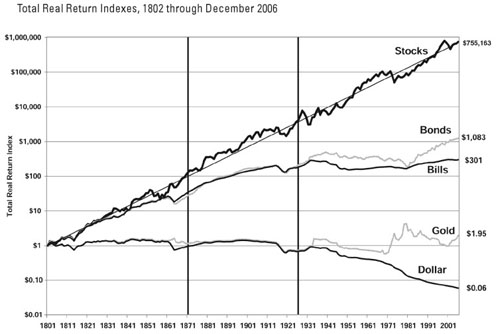
It is easy to say this now that both silver and gold have seen its prices plummet after the summer, but more than using the recent fall as basis for the argument, I have in mind these other long-term (as in centuries’ trend) graphics below:
Gold price fluctuations since 1800. Source: The Economist.
From the previous graphic, gold went up to 1,900 in the summer of 2011 and then fell again to around 1,600$ per ounce, in September. Well, I see no reason why it shouldn’t be around 300-600$ again, as it has always been.
Gold as an "investment"... Source: Jeremy Siegel
In this other graphic you may see how much gold is worth as an investment… well, it is more valuable than cash, but we already discredited cash in a previous post.
And still, you’ll find people running towards gold when there is a crisis… I never understood that. What are the gold price fluctuations based on?
Personally, I prefer to go to the Casino in Torrelodones once a year, lose at most some 50€, if that is the case, and kill altogether the speculative behaviours until the next year.
In my previous post, I purposefully selected Germany as the case of country that would need to be kicked out of the Europe due to its fiscal irresponsibility. Surely, most of you think the situation today is just the reverse and thus it was just a bit of irony…
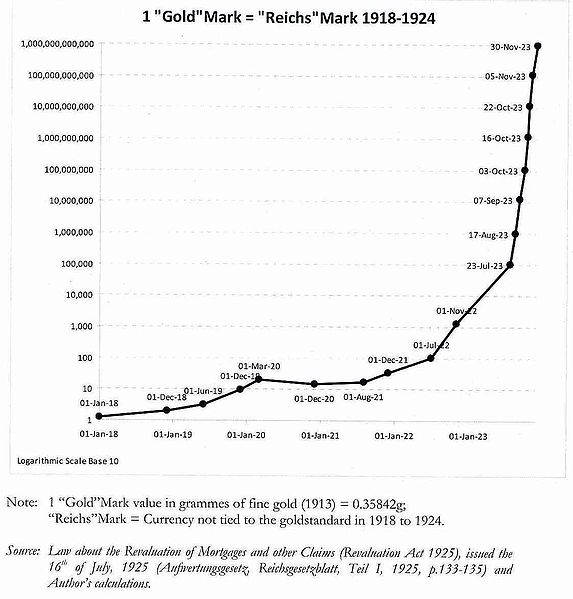
… well, I wanted to come to it at a later point, in this post, to share the following graphic from the Wikipedia in which you can see the hyperinflation lived in Germany’s Weimar Republic between 1921 and 1923:
Weimar Republic hyperinflation. Source: Wolfgang Chr. Fischer
The explanation in the Wikipedia is astonishing, I recommend that reading.
The situation only stabilized when the Retenmark indexed to gold bonds was introduced at the end of 1923, by then there were notes of 1,000,000,000,000 marks (and even so there were two other cases of higher hyperinflations in History, in Hungary and Zimbabwe!).
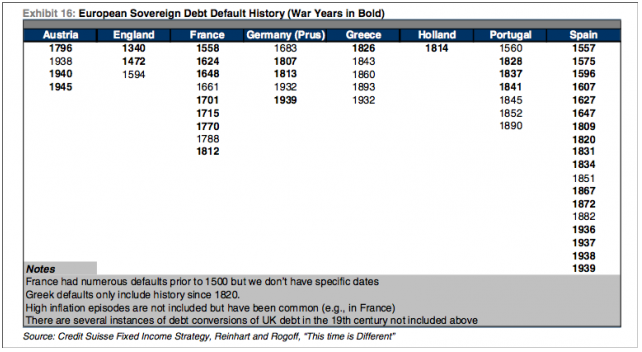
Even though during those hyperinflationary years the Weimar Republic Germany did not default, Germany did so in 1932 and 1939, being those of the latest defaults in Western Europe… later than the latest from Greece or Portugal, as can be seen in the following table.
Sovereign Defaults in Europe. Source: Reinhart and Rogoff, “This time is different”, via Credit Suisse.
Finally, you may also see in the table that now, after 72 years since the end of the Spanish Civil War, we are living the longest period since 1800 (and second longest since 1500) that Spain has not defaulted on its debt! I am not sure whether this should be a source of calmness or worry.



 The Blog by Javier