Course des Rois

Villemur-sur-Tarn is a small village by the river Tarn, about 40km North from Toulouse. Last Sunday I went there early in the morning to take part in the Course des Rois, a 10km race that was organized there.

Last time I ran a race in January it was in 2002, in Torrelodones, another “King’s Race”. I remember that a week before I had missed the 2001 San Silvestre due to a sprain in the ankle. By the time the race in Torrelodones came I could not rest anymore and I ran it with the bandage still on.

Villemur-sur-Tarn is close to the wine-region of Fronton, another village about 10km South from it. The first runners that were subscribed to the race received a bottle of red win. Yeah, I won something at a race! Even before starting!

After several pains in the Autumn, I went to the doctor and got an x-ray of the waist. It showed a difference in the length of the legs of ~7mm. Then I went to a podologue who made a couple of orthopedic soles for me. They partly correct that difference in length plus improve my stepping (I tend to supinate or under-pronate).

I started using the soles about two weeks ago. The podologue told me “start using them little by little, don’t go and run on them 15km at the first trial”. Well, I ran 7km. Then other 7km, etc… These days I am having pain in the left knee. I guess that it was not used to the level of effort it is required now. While it gets used to it, it hurts as hell every time I start running.

On Sunday, when I arrived to Villemur, I started warming up about 20 minutes before the start of the race. I almost couldn’t bend the knee. Then I was jogging very softly, and the pain was that that my body wanted me not to take part in the race. I felt like crying. Luckily I was alone in the race and didn’t have to talk to anyone in those moments. Only in my head I was thinking “it’s ok, some minutes of pain while warming up and then it’ll get better”.

It got better. During the 1st kilometre I could stand it so I continued with the same rhythm until km 2.5, when my body broke into sweating and I stopped feeling cold. From then on, feeling warm and more comfortable, I looked at the rest of the race with a more positive look.

I went along with some groups of runners until feeling comfortable with them and going ahead to catch another group. I repeated this process about 3-4 times, with a final increase in the pace at about km 7.5, when I tried to make it below 47′. In the end, I did 47’09”.

I’m very happy with the time. Had I launched the pace increase before I might have made it. This is nearly 1 minute faster than in Brax 6 months ago and some 20 seconds faster than the end of the half marathon of Toulouse last September. I’m training with more difficulty these days, but it seems that I haven’t lost punch for the races. This race also helps me to measure the level of fitness with the McMillan calculator I use, in order to estimate training paces.

You may want to see performance of the race measured by Garmin and the following pics:
This slideshow requires JavaScript.

10 Comments

Filed under Sports

San Silvestre 2011

Running the popular San Silvestre Vallecana is, no doubt, the best possible farewell event for the year.

Some of you may think that it is too cold, that running is too hard, that you are not prepared, that you would have a hard time running, etc. All that may be true and still you would enjoy it, laugh in it and want to come again. I have seen that once and again with family members and friends.

This time we run together with 6 other friends: Jaime, Nacho, Pablo, Kike, Jon and Gonzalo (for the last two I believe it was their first San Silvestre, it won’t be the last one). All of us had been training more or less during the year, and this year even though the pace we run (1h4’30”) was more or less the same as we did last year, we felt much better, we laughed more.

Jaime was running is 13th San Silvestre in a row. Impressive! I was doing my 11th (I missed three along these years). Pablo & Nacho must have done around 3-5, but they’ll complete many more.

Luca wants to spend next Christmas at some hot and sunny island somewhere (obviously Madrid & Vallecas don’t fit in that). I’d better find one island in which a San Silvestre race is organized, I don’t want to miss that :-).

You may find some data about the performance of the race in the Garmin record of it.

Enjoy the pictures:

This slideshow requires JavaScript.

Leave a comment

Filed under Sports

The Republic of Poyais

While I was in primary and high school, History never caught much my attention. And today is not otherwise in a broad sense, but I enjoy reading some historical notes on certain subjects.

I am reading these days the book “This Time is Different” (published in 2009), by Carmen Reinhart and Kenneth Rogoff (both Economics professors, the latter former economist at the IMF and member of the board of the Federal Reserve). As the description in Amazon says, the book is:

“[…] a comprehensive look at the varieties of financial crises, and guides us through eight astonishing centuries of government defaults, banking panics, and inflationary spikes–from medieval currency debasements to today’s subprime catastrophe. […]”

Being half way through it, I have had much fun with some anecdotes. I may write more about them in other posts, but in this one I want to focus in one I came across while reading the book (I have already shared it with some of you).

Let me take some excerpts from the Wikipedia:

Gregor MacGregor (24 December 1786 – 4 December 1845) was a Scottish soldier, adventurer, land speculator, and colonizer who fought in the South American struggle for independence. Upon his return to England in 1820, he claimed to be cacique of Poyais (also known as Principality of Poyais, Territory of Poyais, Republic of Poyais). Poyais was a fictional Central American country that MacGregor had invented which, with his help, drew investors and eventually colonists. […]

Gregor MacGregor went from Latin America to London, England, in 1820 and announced that he had been created cacique (highest authority or prince) of the Principality of Poyais, an independent nation on the Bay of Honduras. He claimed that native chieftan King George Frederic Augustus I of the Mosquito Shore and Nation had given him the territory of Poyais, 12,500 mile² (32,400 km²) of fertile land with untapped resources, a small number of settlers of British origin, and cooperative natives eager to please. He had created the beginnings of a country with civil service, army and democratic government. Now he needed settlers and investment and had come back to the United Kingdom to give people the opportunity.

At the time, British merchants were all too eager to enter the South American market that Spain had denied to them. The region had already become more promising in the wake of wars of South American independence, when the new governments of Colombia, Chile and Peru had issued bonds in London Royal Exchange to raise money. […]

In Edinburgh, MacGregor began to sell land rights for 3 shillings and 3 pence per acre (£0.16/acre or £40.15/km²). The average worker’s weekly wage at the time was about £1, which meant that the price was very generous. […] On 23 October 1822 MacGregor raised a loan with the total of £200,000 on behalf of the Poyais government. It was in the form of 2,000 bearer bonds worth £100 each. […]

You may read the rest of the story in the Wikipedia, but you can imagine it. Of course, Poyais defaulted on the debt issued, about 70 would-be settlers were sent to Latin America only to find that the wonderful Poyais did not exist. The group decided to come back to London. About 20 of them died in the trip and when they arrived to London about a year after departing MacGregor had already fled to France to proceed with similar schemes…

The Ponzi scheme of Madoff pales in the comparison to the one prepared by MacGregor. Beware when someone presents you with an opportunity too good to be true…

2 Comments

Filed under Economy, Investing

Our investment fund in 2011

Luca and I have been investing together for 3 years. Last year I wrote a post in which I explained how we had adopted for our personal investments the same approach mutual open-ended funds have.

As I explained last year, we had to define a net asset value per share (valor liquidativo de la participación) at the beginning of the period. This net asset value per share rises and decreases as the aggregate share prices of the stocks in the portfolio rise or decrease. When an investment fund informs about its yearly results it is referring to the performance of this net asset value per share.

Each time that there is an addition of capital (new investments, in this case by Luca or me) it is treated as an issue of new shares to ourselves. It doesn’t matter that we are the only “shareholders”. Depending on whether the net asset value has increased or decreased we are acquiring the new shares at a higher or lower price than we acquired the previous ones. Exactly as it works in a fund.

And why do we go through all this hassle? So we can now handily compare how our investments fare in relation to broad market indexes or specific investment funds.

How did the year 2011 go?

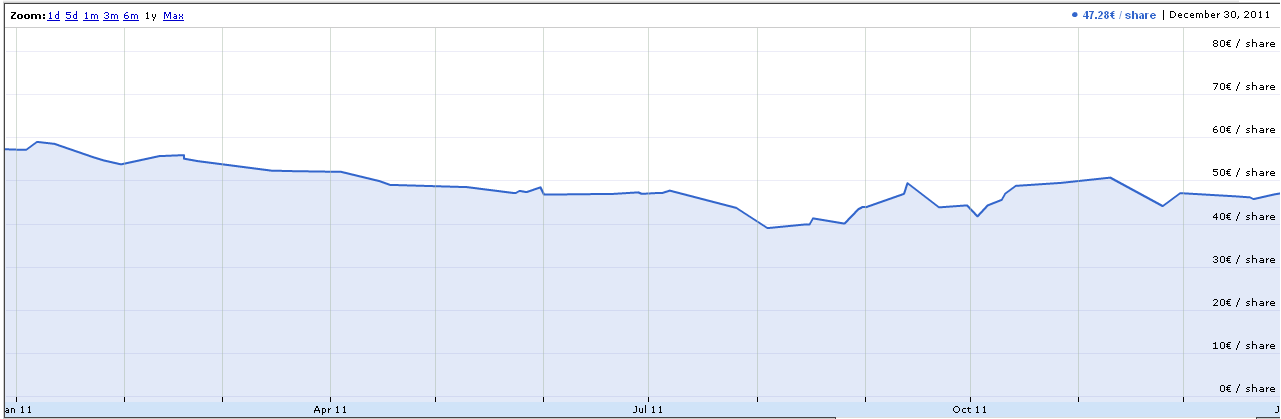
Let’s start with the humbling exercise :-). I had taken along the year above 50 samples, so we could get an idea of how the fund evolved. As you may see in the graphic below, the net asset value per share at the beginning of 2011 was 57.19€ while at the end it fell to 47.28€, that is -17.3%. This was the performance of the fund in 2011 (not good enough to sell subscriptions to the fund! :-)).

"J&L" investment fund 2011 performance (built in Google spreadsheet linked to Google Finance data, thanks to a friend's invaluable suggestion).

How does it compare with the main indexes?

  • S&P 500 ~ +0.07% (this is the target index)
  • Dow Jones ~ +5.5%
  • NASDAQ ~ -2.3%
  • IBEX 35 ~ -13.1% 
  • Euro Stoxx 50 ~ -18%

The gains of the fund since its creation in January 2009 have been+57.8%, with a compounded annual gain of +16.6% (remember this always refers to the net asset value per share – I will come back to this point in a future post, as cash gains or losses cannot be directly derived from the net asset value performance).

 Last year I introduced the comparison with the leading Spanish value investing fund, Bestinver (*). Let’s do the exercise again:

  • Bestinfond ~ -10.3%;
  • Bestinver Internacional ~ -10.1%;
  • Bestinver Bolsa ~ -12.7%.

All in all, 2011 hasn’t been a good year to present general results (for us, Bestinver or some indexes) however from the value investing perspective it hasn’t been that bad for buying (we performed 18 buy operations, while we only sold shares of 4 companies).

As any investment fund would do, prior to buying shares of a specific company we calculate the range in which we believe the target price shall be for us to sell the stock (and if the margin of safety is wide enough we buy). Taking the conservative values for each of the shares in our portfolio, we believe the target net asset value per share should be around 159€, thus having an estimated potential upside of about x3.3.

The latest factsheet of Bestinfond [PDF, November  2011] informed about a potential upside of x2.3. We may be optimistic; time will tell. And precisely that, time, being long-term value investors, we have plenty of :-).

I’ll keep you informed next year of this year’s results.

—

(*) Disclaimer: Since sometime in 2011, we have also positions in Bestinver, though I don’t get any fees for promoting it in the blog. (Our positions with Bestinver are excluded from the calculations of “J&L” fund to allow for clean comparisons).

NOTE: “J&L fund” numbers are pre-tax of capital gains realized, include dividends (twice taxed) and are net of transaction costs & brokerage commissions.

3 Comments

Filed under Investing

Summary of (my) 2011

Let me share with you a brief recap of my 2011 (as I already did last year).

If I then characterized 2010 as a learning year, I would say 2011 was a year on the run.

At the beginning of the year I set out my objectives for 2011, of which I have achieved 71.4% (just above my 70% target!). One of them was only to “become again a frequent runner”, for which I set up some modest steps, e.g., buy new running shoes, run 3 days before mid-January, run a 10k popular race before November, lose some 10kg by June… If there was a yearly objective which I widely met, it was this one:

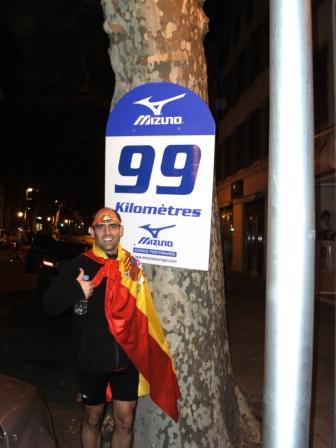
Último kilómetro de los 100km de Millau 2011.

Last kilometre at the ultramarathon "100km de Millau".

  • I ran over 170 days along the year, covering over 1,800 kilometres.
  • I took part in 11 popular races, including 6 of 10km, 2 half marathons, 1 marathon (42km) and 1 ultramarathon (100km). More races and more kilometres than ever before.
  • I found myself running in Granada, Villa del Río, Madrid, Torrelodones, Luarca, Rijswijk, Wijchen, Toulouse, Luz Saint Sauveur, Chicago, Washington DC, Des Moines, Montreal…

Learning. After taking some classes in Madrid, I continued studying French and now I feel more confident when facing shop attendants :-). I had to learn and continue to learn lots of new things every day at the new job where I landed about a year ago.

I still enjoy as learning moments the print weekly issues of The Economist or the monthly issues of Scientific American. I delivered the necessary speeches to become ACB within Toastmasters (though lately I’ve missed more meetings than I should). Finally, I read a dozen books along the year (a bit less than in previous years, though some in the new eReader!), being the ones I liked the most the following: first, second and third.

Investing & helping others. I set myself a high objective of saving and investing: I overachieved it by around 50%. I once mentioned it in Twitter: the best thing behind investing is the discipline of saving that is behind it. I not only dedicated a percentage of personal income to savings but as I announced in a post at the beginning of 2010, I directed a percentage to different charities. I initially set it out to be 0.7% of my income, but after raising some funds and contributing others to charities related to the races in which I am taking part, in the end this percentage has been well over 1% in 2011.

Travelling. We together visited Montreal, Ottawa, DC, Chicago, Omaha, and several places in the south of France and throughout Spain. The moment that I liked the most was attending the Berkshire Hathaway annual shareholders meeting, no doubt.

Javi 2.0. I continued to often write in this blog with some remarkable posts. I admit that my twitter account is one of my biggest sources of information / distraction.

Sports. Apart from the running, I recently re-started playing paddle with colleagues, became a kind of fan of the rugby local team, Stade Toulousain, had to subscribe to Canal + not to miss any of Real Madrid matches while living abroad.

Other reasons for joy have been:

  • our friends Teresa & Alberto, María & Óscar, Isa & Pedro got married,
  • we welcomed the newborns Mar, Hugo, Luis and Eneko, while another of our friends is pregnant today (that we know),
  • my sister Beatriz started working as an intern; my brother Jaime continued to enjoy his job in Airbus and moved to a new apartment; my mother Fidela continued to take several courses (and to give wonderful massages) and my father Juan Bautista finally and happily retired (after working for 43 years!).
  • Luca completed all the requirements to become a full-fledged lawyer, winning some court cases in the process.

To close the year, I started taking flight lessons, pursuing another childhood dream. This will allow me to continue learning and experiencing new things!

Now it’s time to update the objectives setting for 2012. This year the exercise will be easier as I already have the methodology and the habit. If the objectives are well chosen and challenging enough, next year’s account will be even shinier.

I wish you the same: a shinier 2012, enjoy it!

2 Comments

Filed under Personal development

First Take-Off

The 17th of December will always be an important day in the history of aviation for the following 2 reasons:

  1. The 17th of December 1903, Orville Wright performed the first flight aboard their Flyer I,
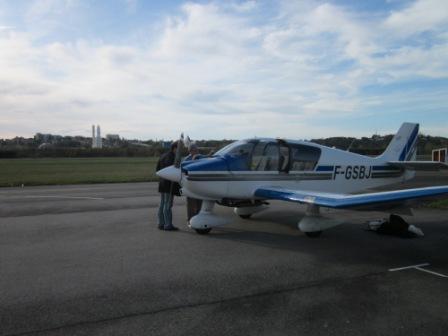
  2. Today, 17th December 2011, I made my first take-off aboard a Robin DR-400-120 :-).

As part of my training towards obtaining the PPL licence, today we performed the 5th flight, the first in which I was fully at the controls during take-off.

My colleague, Miguel, took the following video:

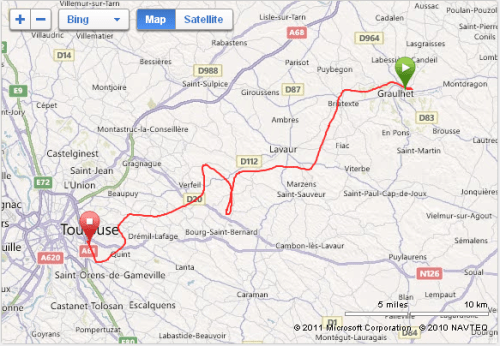
You may see the route we followed from Graulhet (LFCQ) to Toulouse-Lasbordes (LFCL) aboard the Robin DR-42 (F-GORM), as I recorded it with my Garmin GPS:

Flight route: LFCQ - LFCL

4 Comments

Filed under Aerospace & Defence

The British Museum

During the last trip to the United Kingdom I visited for the first time The British Museum (free). The museum itself is without any doubt amazing.

However I had conflicting ideas of whether the breadth of pieces mostly coming from other countries should have been better displayed at a museum in the country of origin or there in London.

I found it curious that the museum has a dedicated brochure explaining why the collection of Elgin Marbles from the Parthenon is hosted in London instead of Athens as the Greek Ministry of Culture claims they should be. The British Museum claims that the pieces were taken with permission of the then authority of those territories: the Ottoman Empire. It also gives account of an internal investigation carried by the Parliament. And even points at other 6 museums around the world hosting sculptures from the Parthenon as if trying to divert the attention.

The museum’s brochure concludes that the taking of the pieces was legal and its location in London is good as it believes the museum is a unique resource for the world, but offers the reader to check the counter opinion at the Greek ministry’s site.

I still haven’t made my mind yet: is it the World’s looting museum or most of the pieces are better off being conserved there that they would be in Greece, Egypt, Syria or elsewhere?

To end the discussion I found it comical that in order to introduce Stonehenge to the museum’s visitors a poster of it was deemed enough. In this case it wasn’t necessary to bring one or two stones from the site, as has been the case with pieces from many other places.

Besides that discussion I enjoyed seeing some items missing in previous trips. Find some pictures of some of the museum highlights below:

This slideshow requires JavaScript.

5 Comments

Filed under Travelling

The best (and the worst) of the first 200 posts

About a year ago, I wrote in the 100th post which were the most and least read of the first 100 posts. Today is another such occasion as this is the 200th post in the blog.

I started the blog in February 2010. Since then the blog has received over 29,000 visits, hundreds of comments while I have enjoyed thinking about what to write and structuring my thoughts to do so.

If a year ago I wasn’t yet sure which kind of posts were better received, now it is much clearer: those related to aviation.

Find below the list of the top 10 and bottom 10 posts:

1. Will Boeing 787 ever break-even?
2. 787 Break Even for Dummies
3. Airbus vs. Boeing, comparison of market forecasts
4. More on Boeing 787 break even
5. FC Barcelona copying Real Madrid
6. Algunas cifras de la industria cultural
7. Mi adiós a Ibercaja
8. An aircraft worth its weight in gold?
9. Boeing commercial aircraft discounts (update for 2010)
10. Beluga vs. Dreamlifter

…

190. Speech about Minifutbol
191. “Playas” in Lima
192. International Day of the Book
193. Bill Clinton endorsing Kiva (video)
194. Three centuries of confusion
195. De Feria en Feria
196. From climbing to merely walking
197. Nothing like a good red wine…
198. Opera with subtitles
199. Book review: Pirate Latitudes

I find it curious that only 3 posts of the 10 most read ones a year ago remain in the top 10 list, however 6 out of the 10 least read ones still remain in that list.

Let’s see what I’ll write in the next 100 posts…

—

NOTE: the box in the right showing “Current Top Posts” shows the most read ones in the last two days, not the all-time most read ones (the ones above).

4 Comments

Filed under Personal development

Wooden aircraft, cloth wings and pressure

Most of you, the readers of this blog, probably know that an airplane flies due to the difference in pressure between the upper (extrados) and lower (intrados) sides of its wing. This difference in pressure is due to the difference velocity of the airflow around both sides of the wing as you may see in the picture below:

Airflow around an airfoil (image from the Wikipedia, by Kraainnest).

As the speed above the wing is much higher, the difference in the pressure is mainly due to the lower pressure in the extrados. This can be seen in the following picture:

Pressure coefficient around an airfoil (by the Aircraft Aerodynamics and Design Group, Stanford University).

However, how could we see that in a real flight?

In commercial planes, of which wing skin is made of aluminium alloys this is not easily seen.

Two weeks ago, after my flight lesson was finished, I sat at the back of the plane to come back to Toulouse while my colleague had his lesson. It was then that I saw the image I captured in the following picture:

Wing extrados on air.

The aircraft we fly in our training lessons is a small Robin DR 400; a wooden aircraft of which wing skins are made of cloth. Not any cloth, but a type of polyester (PET) commonly used to build sailcloth, produced by Dupont and named Dacron. The surface is then lacquered with a polyurethane paint.

Robin DR 400 140

The air within the wing is at a higher pressure than the air in the extrados, and you can see how it expands and pushes up the cloth skin of the wing as you can see in the picture above.

You may see below the same wing on ground. Though the picture is of a lower quality, you can see that in this case the wing doesn’t look “inflated”.

Wing extrados on ground.

9 Comments

Filed under Aerospace & Defence, Education

The Unwritten Laws of Finance & Investment

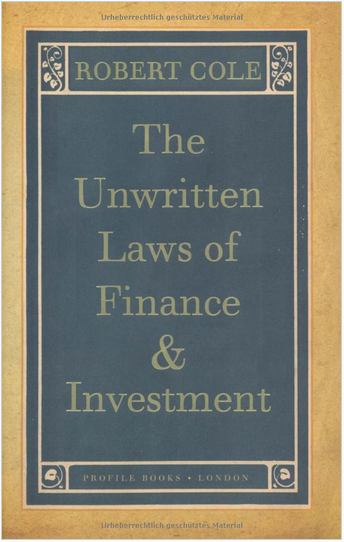
The Unwritten Laws of Finance and Investment, by Robert Cole.

I believe I have already mentioned at some point in the blog the ritual I have almost every time I get into an airport of going to one of the book shops to check whether I can find something to take with me.

I found “The Unwritten Laws of Finance & Investment”, by Robert Cole, at Frankfurt’s airport some months ago during a scale from Amsterdam to Toulouse.

The book is a collection of investment and finance maxims, advice, quotations, etc. It can be read in one shot (159 light pages).

If you are to read this book probably nothing of what you may find in it will be completely new to you, but the compilation and the witty style in which the “laws” are written make it an entertaining read and serve as repository where to find well established ideas.

Let me finish by quoting some passages from the laws that I enjoyed the most:

  • “I don’t want a lot of good investments; I want a few outstanding ones”, Philip Fisher.
  • It is impossible for investors to get their timing precisely right always. [I will come back to this in the future].
  • “In this business, if you’re good, you’re right six times out of ten. You’re never going to be right nine times out of ten”, Peter Lynch.
  • Before you go in, look for the way out. – This one is beautifully explained with a story from Winnie-the-Pooh. [I will come back to this in the future].
  • “Bull markets are born on pessimism, grow on scepticism, mature on optimism and die one euphoria”, Sir John Templeton. – This one reminds us to that of Warren Buffett “Be fearful when others are greedy and greedy when others are fearful”.
  • “There are huge mathematical advantages to doing nothing”, Warren Buffett (on compounding interest).
  • “The rich rules over the poor, and the borrower becomes the lender’s slave”, the Book of Proverbs 22:7, The Bible.
  • “The practice of contracting debt will almost infallibly be abused in every government. It would scarcely be more imprudent to give a prodigal son a credit in every banker’s shop in London, than to empower a statesman to draw bills, in this manner, upon posterity”, David Hume.
  • “The four most expensive words in English language are ‘This time is different'”, Sir John Templeton. [I will come to this in the future].
  • “Investment is most intelligent when it is most businesslike”, Warren Buffett.


Leave a comment

Filed under Books, Investing