Tag Archives: Boeing

Introduction to Learning Curves

Let me introduce the learning curve effect by quoting directly from the Wikipedia:

“The rule used for representing the learning curve effect states that the more times a task has been performed, the less time will be required on each subsequent iteration. This relationship was probably first quantified in 1936 at Wright-Patterson Air Force Base in the United States, where it was determined that every time total aircraft production doubled, the required labour time decreased by 10 to 15 percent.” […]

“Learning curve theory states that as the quantity of items produced doubles, costs decrease at a predictable rate.”

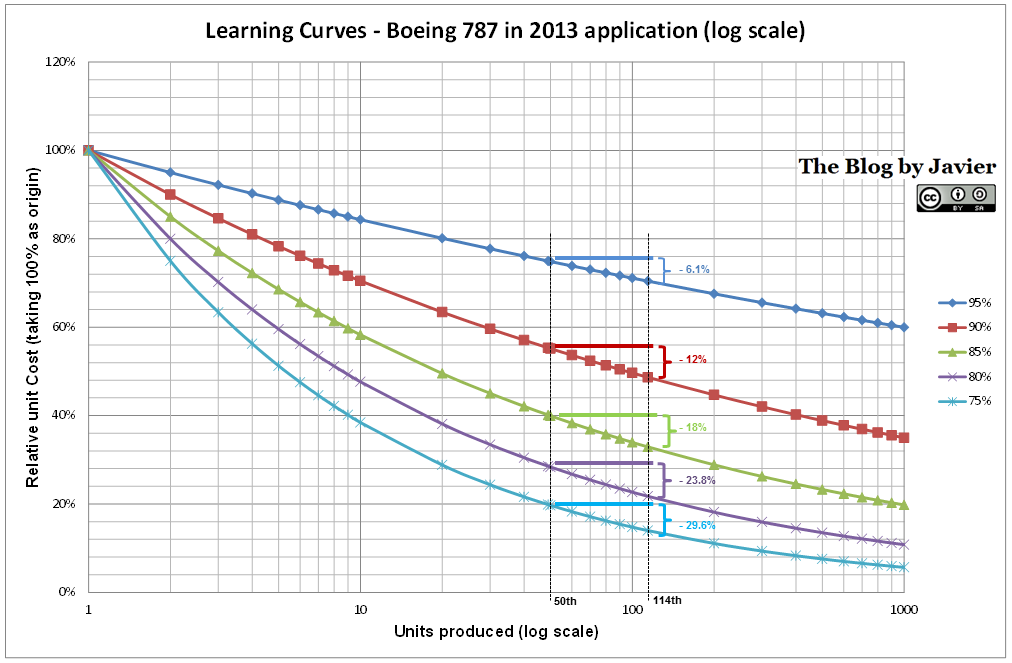
I used the concept of learning curve in a blog post in which I discussed whether and when the Boeing 787 would break even. In that post I referred to Boeing’s target of reaching a 75% learning curve on the 787 program, much more difficult to reach than the 84% that Boeing reportedly achieved in the 777 program.

Why is a curve of 75% more difficult to achieve than a 84% curve? The meaning of the figure “84%” attached to the learning curve is that each time that the number of units produced is doubled, the cost is reduced in 16%, or the 2*nth unit cost is 84% of the unit cost of the nth unit. Thus, a 75% curve would imply that the cost is reduced in 25%, which is a higher cost reduction than 16%, and, thus, more difficult to achieve.

On the other hand, NASA, in its Learning Curve Calculator, offers some guidance on learning curves for different industries and mixes of hand labor and machining work:

  1. Aerospace 85%
  2. Shipbuilding 80-85%
  3. Complex machine tools for new models 75-85%
  4. Repetitive electronics manufacturing 90-95%
  5. Repetitive machining or punch-press operations 90-95%
  6. repetitive electrical operations 75-85%
  7. Repetitive welding operations 90%
  8. Raw materials 93-96%
  9. Purchased Parts 85-88%

How is the concept of learning curve calculated? (from Wikipedia: )

 Now the equation for the unit curve is given by:

Y_x = K x^{\log_2 (b)}

where

  • K is the number of direct labour hours to produce the first unit
  • Yx is the number of direct labour hours to produce the xth unit
  • x is the unit number
  • b is the learning percentage (expressed as a decimal)

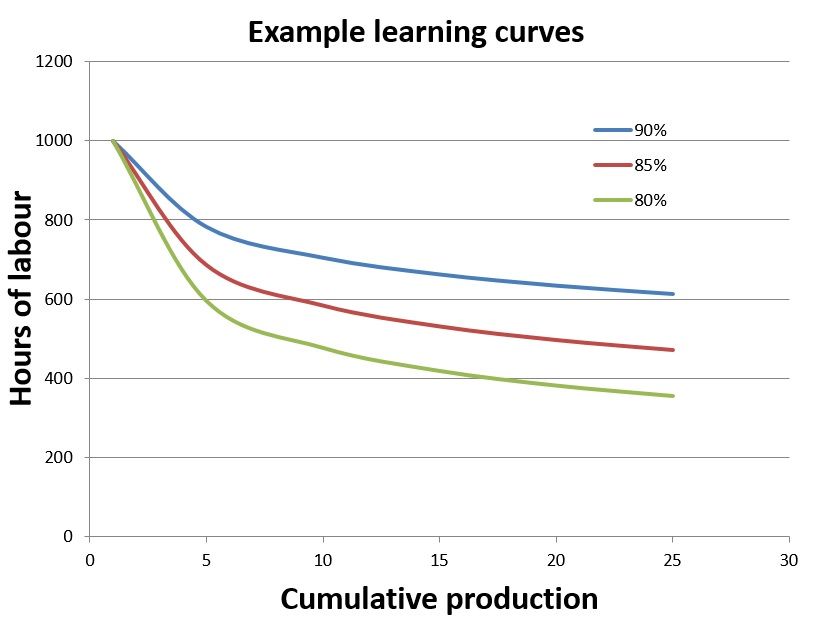
How does a learning curve look like? (from Wikipedia) Actual examples of curves in both linear and logarithmic scales would be:

Experience curve (from Wikimedia, by Apdevries).

The concept of learning curve is indeed used in aerospace, however, coming back to the 787 program, Boeing does not disclose outright what is the actual learning curve it is achieving in its program. Nevertheless, in its investor relations conferences it provides information here and there of cost savings achieved, etc. This can be interpreted as derived from learning curve effects, and would permit to build a model, even if based on scarce information.

See some of the hints that Boeing provides:

“We continue to see progress in key operational performance indicators and unit costs, as we further implement production efficiencies and stabilize the overall production system on the 787 program. Unit cost has improved approximately 20% over the past year on the 787-8 […]”, Greg Smith, Boeing EVP – CFO at Q4 2013 Earnings Conference.

“[…] as we continue to make improvements 787 unit cost […]”Greg Smith, Boeing EVP – CFO at Q4 2013 Earnings Conference.

“when you look at flow-time, you look at unit cost at Charleston whether it’s final, mid, or (aft) it made great progress there. And the team has been very focused on continuing that progress going forward. We have experienced a higher number of jobs behind schedule in the mid-body section, and that’s really due to, if you think about it, you are introducing the Dash-9 at the same time going to 10 a month. […], we’ve applied additional resources. We know how to do this and we’ll get those jobs back to what we view as a more acceptable level. So we got mitigation plans.” Greg Smith, Boeing EVP – CFO at Q4 2013 Earnings Conference.

“This morning we announced plans to increase 787 production beyond the 10 per month we’re on track to achieve this year to 12 per month in 2016 and then 14 per month, before the end of the decade. […], capture productivity and learning improved profitability […]” Jim McNerney, Boeing Chairman, President and CEO at Q3 2013 Earnings Conference.

“We’ve added another line or sorry, a position within the line, where we’re doing the wing, body joint earlier in the process and this is through experience after 134 airplanes, the teams are really coming up with better ideas or improvements on how to increase flow and that’s going to require some upfront investment. But obviously in the units to come after we’ll see that improvement again in flow and productivity.” Greg Smith, Boeing EVP – CFO at Q3 2013 Earnings Conference.

“[…] the flow time reductions, we’ve had in our factories, the hours per unit, the productivity per whatever are increasing significantly on all of our programs.” Jim McNerney, Boeing Chairman, President and CEO at Q3 2013 Earnings Conference.

5 Comments

Filed under Aerospace & Defence

Boeing 787 orders, cancellations, deliveries & backlog through 2013

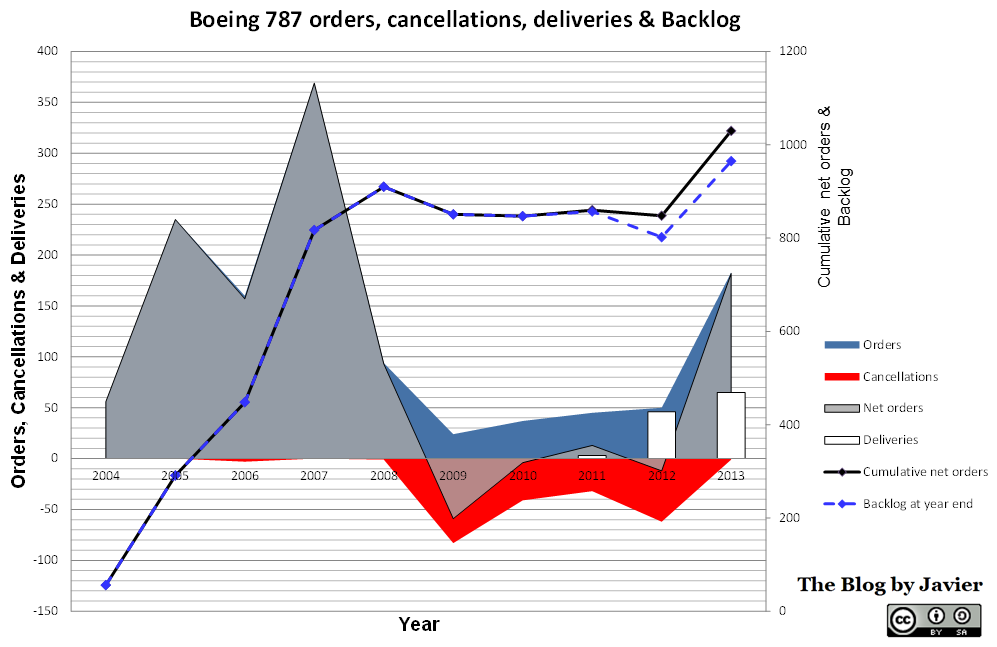
At first sight the year 2013 may seem to have been an annus horribilis for the Boeing 787 program with the months-long grounding of the fleet due to the lithium-ion batteries heat runaway issue, the fires that some of the aircraft in the operating fleet suffered, etc. On the other hand, after 4 years of sales impasse (from 2009 to 2012, inclusive), in which the cumulative net orders of those 4 years stood at a negative 62 aircraft cancelled, in 2013 Boeing recorded 183 new orders against just a single cancellation. Thus, 182 net orders. That is the 3rd best year in sales since the program was launched in 2004.

Last year, I wrote a post wondering whether the grounding of the fleet could be translated into some cancellations. Well, it didn’t so far. Quite the contrary, it got some big contracts from American Airlines, Singapore Airlines, Etihad, British Airways and GECAS.

In last year’s post I included a graphic that I have updated for this post, in order to reflect this recovery and have in one snapshot a view of the orders, cancellations, (net orders), deliveries and backlog.

787 orders, cancellations, deliveries and backlog through 2013.

787 orders, cancellations, deliveries and backlog through 2013.

Leave a comment

Filed under Aerospace & Defence

A380 sales compared to 747 sales at program start (update 2013)

In the previous post I briefly discussed aviation analyst Richard Aboulafia’s assertion “Airbus will be paying the price for the A380 for many years to come” (see original article) from a purely financial and accounting point of view. In this post I wanted to look at it from the market point of view. To do that I will update with 2013 figures a couple of tables and graphics I built last year comparing A380 and 747 orders at each programme start (see last year’s post here).

First see in the graphic below A380 orders since the programme launch (2001) in comparison to those of the 747 (1966):

A380 and 747 orders referenced to the year of launch of each programme (up to 2013).

A380 and 747 orders referenced to the year of launch of each programme (up to 2013).

Both programmes show an initial sales rush at the time of programme launch. In both cases the rhythm of sales slowed down after the second year. In the first 13 years of program, each had managed:

  • 747: 433 orders.
  • A380: 304 orders (30% less).

Thus, we can see that the Boeing 747 was selling better already from the beginning of the programme.

I include again yet another comparison: aircraft orders taking as reference the year of first delivery, having heard so often the industry mantra that some potential customers would wait to see the aircraft in operation before placing orders. See below this second comparison:

A380 and 747 orders referenced to the year the 1st aircraft delivery of each programme (up to 2013).

A380 and 747 orders referenced to the year the 1st aircraft delivery of each programme (up to 2013).

In this case, and due to the shorter time to develop the Boeing 747 since program launch (1966), the difference in sales is narrowed:

  •  747: 301 orders.
  • A380: 304 orders (about the same).

You can see that, 6 years after the 1st delivery of each aircraft (2007 for the A380 and 1969 for the 747) the A380 and the 747 have sold about the same number of aircraft (thanks, no doubt, to the large recurring order placed at the fall by Emirates).

Boeing 747. The Boeing 747 was the first wide-body in commercial aircraft history and still is the twin-aisle with the highest amount of aircraft sold (1,537 a/c as of today, probably to be soon overtaken by the 777) and delivered (1,482 a/c as of today). However, it has taken over 40 years to reach those numbers. The 1,000th unit sold was reached after 25 years of sales in 1990. The 1,000th unit delivered was also reached after 25 years of aircraft deliveries, in 1993.

Thus, in my opinion, when we want to measure the success of the A380 we cannot be distracted by the figures of other commercial aviation segments (single-aisle and small / intermediate twin-aisle) but we have to check what the 20-year forecasts for the Very Large Aircraft say:

  • ~1,300 aircraft according to Airbus GMF,
  • ~600 aircraft according to Boeing CMO,

and then see what could be expected market share for the A380 against those forecasts and whether it is getting the orders to reach it or not.

Finally, as a reader (Matt B.) of the blog pointed in the comment section in last year’s post:  wide-body market has evolved from the 1970s till today, when there are several competitors and other programmes such as the A330 or the 777 deliver close to 100 airplanes per year.

You can find orders and deliveries figures in both manufacturers websites or summarized here: A380 and 747.

1 Comment

Filed under Aerospace & Defence

A380: “one-off items” versus “accounting block”

Aviation analyst Richard Aboulafia recently published an opinion article at Aviation Week & Space Technology magazine, Airbus Twin-Aisles—Big Needs, Limited Means, in which he discussed strategic product portfolio options for Airbus. He was particularly critical to the A380. Let me bring a couple of passages from the article:

Historically, Airbus has spent more than Boeing on development as a percent of sales than. But during the past 15 years, the bulk of this heavy spending was squandered on the A380. Today, development spending is set to fall in line with the company’s new direction. Last year, it fell below 6% for the first time since the company was established (see graph). Given the requirements of funding the A350XWB and A320neo, Airbus isn’t likely to have the resources to fund both an A330neo and A380neo and a new large twin, too. Tough choices will need to be made. […]

In short, Airbus will be paying the price for the A380 for many years to come.

From these 2 paragraphs, the first assertions are factual: Airbus spends more on research and development than Boeing Commercial Airplanes and during the last years most of that spending was dedicated to the A380. In my opinion the last sentence overstates the issue of the current burden of A380 over the company’s future. If the A380 did not derail EADS during 2006-2010 it will not do so in the coming years. As numbers show and top management has indicated at investors events the A380 programme is expected “to emerge from the red by 2015“.

A380 MSN4 (credit: A. Doumenjou).

Today the A380 is a recurring cost issue, not more. The situation would be entirely different had Airbus (or rather EADS, now Airbus Group) applied the same accounting system that Boeing does (since the merger with McDonnell Douglas). EADS has passed in the profit and loss accounts in the previous years several one-off items related to the A380 valued in billions of euros (refer to yearly financial reports). What is left are R&D (mainly D) expenses to bring down unitary recurring costs and producing enough numbers of aircraft so that learning curve effects can be benefited from.

On the other hand, Boeing accounting system spreads the capital expenditures and research and development costs along what they refer to as an accounting block, which for example for the 787 now takes 1,300 airplanes to amortize those costs (previously were 1,100, see here a post on the 787 break even).

2 Comments

Filed under Aerospace & Defence

Boeing list prices increases vs. discounts increases…

In a previous post I updated the estimate of what is the average discount Boeing applies when selling its commercial airplanes using 2013 data of list prices, deliveries and reported revenues. The figure I came up with was a 47% discount. I included the following graphic showing the discount evolution:

Boeing Average Discount Evolution, 2013.

Boeing Average Discount Evolution, 2013.

Seeing the increasing trend of average discount together with knowing the fact that Boeing regularly increases list prices triggered the following question: Have Boeing airplane real prices increased, decreased or stayed constant in the recent years? I set out to answer this question using the estimated average discount of each year (1) from the graphic above.

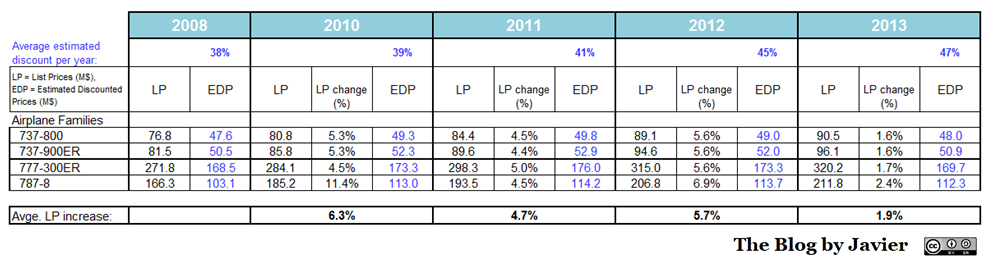
The Boeing list prices (LP) can be found here. I have been recording those prices for years and thus have a table with the evolution of list prices for each model year by year. The following step is to apply the average discount estimated for each year to then-year list prices, to get the estimated discounted prices (EDP) per model. Thus, a table can be built for the last 5 years.

You can find below the result for the best-selling aircraft during previous years: 737-800, 737-900ER, 777-300ER and 787-8. Together these 4 models amounted 560 deliveries in 2013 or over 86% of the total 648 airplanes Boeing delivered in 2013.

Boeing List and discount Prices evolution table, 2008-2013.

Boeing List and discount Prices evolution table, 2008-2013.

In the table above I included in black figures what have been Boeing list prices of these models in the past years (as reported in their website) while I marked in blue the figures which are estimated, using as a departure point the calculated averages discounts per year (also included in blue in the table). I included as well the list prices year-on-year change as a % of the previous year list prices, per model.

The average list price increase included at the bottom line is computed with the information of all Boeing models (19 in 2008 and 18 in 2013, though different ones, a total of 24 different models along this period), not only the 4 included in this table.

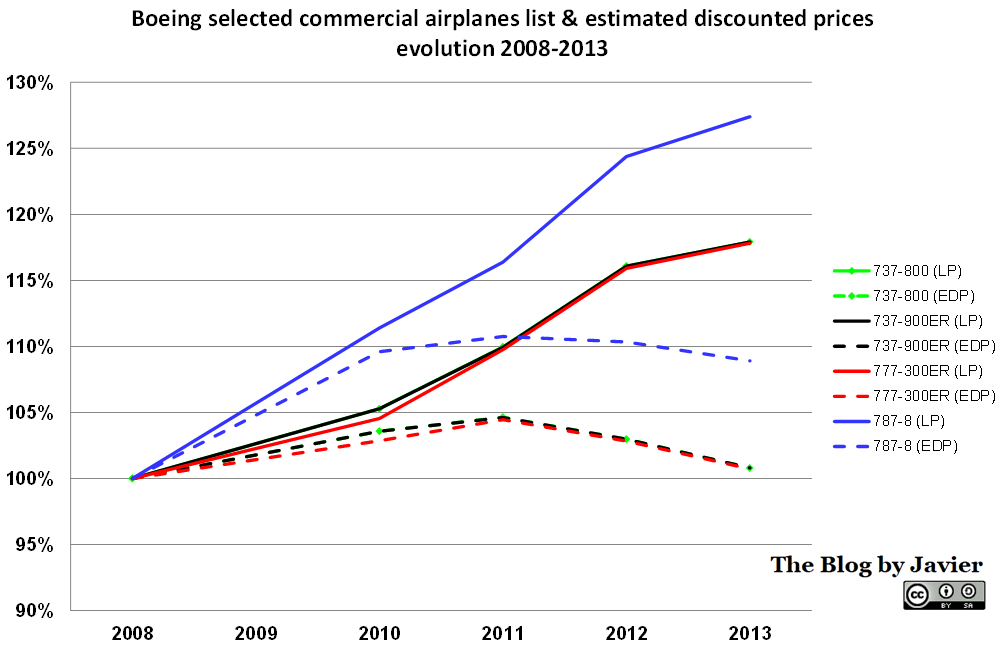
You may see in the table above that after not increasing prices in 2009, Boeing has steadily increased them in 2010 (6.3%), 2011 (4.7%), 2012 (6.7%) and 2013 (1.9%). However, if you take a look at the blue figures in the same table you will notice that prices of 2013 are between 2008 and 2010 price levels for all 4 models! That is, the widely announced yearly list prices increase has been yearly offset by a discreet (not-announced) increase in the discounts applied to sales of airplanes. Thus, the pricing power of Boeing has remained barely constant during the last 5 years. You may see it better in the graphic below:

Boeing List and discount Prices evolution graphic, 2008-2013.

Boeing List and discount Prices evolution graphic, 2008-2013.

The graphic shows the price evolution for each of the 4 airplane models selected, taking as a reference their list and estimated discounted prices in 2008 (indicated as 100%) . List prices are shown with straight lines, versus dashed lines used for estimated prices. Each pair of prices for each aircraft is presented in the same color for easier identification. Some comments to the graphic:

  • Through continuous increases, 2013 list prices were between 18% (737 and 777) and 27% (for the 787) higher than in 2008.
  • However, due to increasing discounts from 38% in 2008 to 47% in 2013, the increase in list prices is almost entirely offset.
  • 2013 discounted prices are below 2010 discounted prices for all models.
  • 2013 discounted prices are almost back at 2008 levels for the 737 and 777, only the 787 seems to have stayed at 2010 levels.

(1) There is no way to know the real price and discount that Boeing applies in each sale, as it will depend from customer to customer (American Airlines -AMR- or Fedex) and from model to model (737-800 or 787-8). There where competition is tougher, discounts will be higher. However, the estimates I have made are an average of all Boeing aircraft sold in a given year.

3 Comments

Filed under Aerospace & Defence

Boeing commercial aircraft discounts (update for 2013)

Few days ago, Boeing released 2013 results [PDF, 841KB]. The company reported revenues of over 86.6bn$648 commercial deliveries and 1,355 net orders for its commercial aircraft. All these were widely reported by the media and mean a great year 2013 for Boeing (with increases in these metrics from 6 to 8%).

Last years, I wrote in some posts (1) what was my estimate of Boeing discounts: the relation between what is announced by the press, what appears in its list prices and sometimes as backlogs and what it is indeed computed into the profit and loss account. In this post I wanted to update, if necessary, the figure I calculated for the average discount of Boeing.

Most of the necessary information can be found in its website. Boeing list prices can be found here.

The number of gross and net orders (after cancellations) year by year can be found here.

Last year deliveries can be found in the report of financial results (or here). From there we can also deduce the figure of Boeing Commercial’s sales of services. That is not directly reported but can be deduced (all Boeing services-related sales are reported as well as Boeing Capital Corporation division and Boeing Defense’s “Global Services & Support” unit)

As in the previous years’ post:

  • I needed to make one assumption: new orders come with a 3% down payment in the year of the booking, while the remaining cost I assumed that was paid on the year of delivery (for simplicity I didn’t consider more intermediate revenue recognition milestones linked to payments, the 3% figure was taken from the AIAA paper “A Hierarchical Aircraft Life Cycle Cost Analysis Model” by William J. Marx et al.). (2)

Having put all the figures together, the calculation is immediate. Boeing Commercial Aircraft revenues in 2013 (52.98bn$) are the sum of:

  • the discounted prices times the delivered aircraft in the year (including possible penalties from delays),
  • less the down payment of the current year delivered aircraft, as the down payment was included in previous years results,
  • plus the down payment of current year net orders (this year’s calculation has been again a bit tricky as it included 737NG deliveries and 737 MAX orders),
  • plus services revenues (less than 0.3bn$ from the commercial aircraft unit – calculated, not reported).

The discount figure that minimized errors last year was 45%. Using this figure, the error obtained this year in relation to Boeing Commercial Aircraft reported revenues is 3.9%, much too high. The best estimate for last years average discounts were: 45% for 2012, 41% for 2011, 39% for 2010 and 38% for 2009.

The updated figure (which minimize errors for 2013 down to 0.2%) for the discount for Boeing commercial aircraft is 47% (3).

Boeing Average Discount Evolution, 2013.

Boeing Average Discount Evolution, 2013.

The explanation I can find for that increase shall be linked the built-in penalties for 787 plus the introduction of the new 787-10 with increased discounts for the launch customers.

(1) Find here what is becoming a “body of knowledge” on Boeing discounts: estimates calculated for 2012, 2011, 2010 and 2009; a review of the French portal Challenges.fr of aircraft discounts prior to Le Bourget airshow of 2013; a Bombardier’s CEO statement on what is known in the market as the Boeing discount; Boeing Commercial Airplanes president Ray Conner speaking about the more aggressive pricing they are being forced to offer.

(2) Two years ago, I received a comment from the analyst Scott Hamilton on the level of downpayments. He mentioned they could reach up to 30%. I tried this time to compute the calculation using that input, though the figures of discounts to be applied each year to minimize errors would have to be even higher, over 50% (!), thus I stayed with the 3% used in the above-mentioned published paper to stay on the conservative side.

(3) I find this trend of continuous increases in Boeing discounts in line with both Challenges.fr report and Ray Conner’s mentions of aggressive pricing last year, both referred to in note (1).

10 Comments

Filed under Aerospace & Defence

Budget uncertainty in the Congress has kept the Boeing C-17 line open for years

Few days ago, I read in the weekly Aviation Week the following article, Boeing Blames Budget Uncertainty For C-17 Line Closure Timing, where Dennis Muilenburg, president of Boeing Defense, Space and Security, is quoted saying:

“… you quickly come to the conclusion that we cannot continue to spend money to keep that line open, given all of the other budget constraints. So, the fact that we are facing sequestration and uncertainty in the budget drove the timing of our decision.”

If anything, I would say the contrary: budget uncertainty in the Congress is what has kept the Boeing C-17 line open for the last years (coupled with international sales).

To understand that, it is important to remember that the C-17 program initially called for the acquisition of 120 aircraft. This number was later increased to 180 aircraft, and that the US Air Force had been requesting in its yearly budget requests zero aircraft per year since long ago. Only maneuvers in the Congress had been including in the final Defense Budget more C-17 units until the final 223 which were delivered (the last one in September 2013).

You can see an explanation of the plays that have taken place for years in the Congress in this article from 2009 in Business Week (“It’s a Bird, It’s a Plane, It’s Pork!“):

The C-17 Globemaster offers one illustration of successful opposition to the Obama-Gates push for control of weapons spending. C-17s are large cargo planes produced by Boeing that cost $250 million apiece. They have been used heavily since 1993 to transport troops, tanks, and supplies. Every year since 2006, the Pentagon has said that it has enough C-17s. And every year, Congress overrules the military and authorizes funds for additional planes. In October the Senate approved $2.5 billion in the 2010 budget for 10 more C-17s, which would bring the fleet to 215.

[…]

But the real reason Congress wants more of them has little to do with military need. Boeing has built the C-17’s industrial base for political survivability.

The company has spread manufacturing across no fewer than 43 states. C-17 production lines employ more than 30,000 workers, many of them relatively well paid by factory-wage standards. Many of those jobs would be at risk if C-17 work ground to a halt.

The White House understands the challenge. “The impulse in Washington is to protect jobs back home, building things we don’t need at a cost we can’t afford,” President Obama said in August in a speech at the Veterans of Foreign Wars Convention in Phoenix. “The special interests, contractors, and entrenched lobbyists—they’re invested in the status quo, and they’re putting up a fight.”

[…]

Bond, Senator Barbara Boxer (D-Calif.), and 16 colleagues began circulating a letter in April urging members of the Senate Appropriations Committee to keep funding the plane despite clearly stated objections from the White House and Pentagon. In California, C-17 production employs 5,000 workers at a final assembly plant in Long Beach.

[…]

These plays by politicians to try to keep the line open despite of the military not needing more aircraft continue to exist, as a few days ago we could read about a new plan: C-17 swap, to exchange older C-17s for new ones! (while the “old” ones have only about 20 years today possibly not having logged more  flight hours than two-thirds of their life).

Leave a comment

Filed under Aerospace & Defence

La última cena de William Perry

La semana pasada, con motivo de la celebración del día de la Hispanidad, el diario ABC publicaba una entrevista al ministro de defensa, Pedro Morenés (“Morenés: “Me preocupa el adiestramiento de las Fuerzas Armadas”“).

El portal InfoDefensa hacía referencia a dicha entrevista en la siguiente entrada, “Morenés: “Vamos a reforzar la industria de Defensa desde Navantia a Indra”“, donde además incluía unas declaraciones que no aparecen en la edición digital de ABC. En ellas el ministro habla de la necesidad de consolidar la industria de la defensa española para competir con las grandes empresas del sector: Lockheed Martin, Boeing, BAE, etc.

En esta entrada me quería centrar en una anécdota que se relata:

La anécdota de Weinberger (sic).

Según el diario, el ministró finalizó este tema mencionando una anécdota del secretario de Defensa de EEUU Caspar Weinberger (1981-1987):

“Cuando el señor Weinberger dijo a las cincuenta y tantas empresas de Defensa que había en EEUU, o más, “el año que viene por estas fechas, cuando yo les invite a cenar en esta mesa en la que hoy hay ciento y pico personas, va a haber doce. Arréglenselas ustedes como puedan”. Les dio un mensaje muy claro. Al final hubo 12.

En esta entrada en el blog solo quería precisar:

  • La cena no fue con Weinberger como secretario de defensa (1981-87), sino con Les Aspin en 1993.
  • No fue el secretario de defensa (entonces Les Aspin) sino William Perry (subsecretario entonces, y que posteriormente fue secretario de defensa) quien dijo aquello.
  • No había ciento y pico personas que luego pasaron a 12; sino 12 en la cena que luego pasaron a 5 (representando a Boeing, Northrop Grumman, General Dynamics, Lockheed Martin, Raytheon); por eso de que a la mesa iban 12 lo llamaron “última cena”.

Esta anécdota se puede leer en numerosas fuentes especializadas en asuntos de defensa y genéricas, como por ejemplo, The New York Times:

The changes now occurring began in the early 1990’s. Industry executives recall the famous ”Last Supper,’‘ a 1993 Pentagon dinner whose host was Les Aspin, then Secretary of Defense, and his deputy, William J. Perry, who succeeded him. At the dinner were executives from a dozen contractors who were told by Mr. Perry that there were twice as many military suppliers as he wanted to see in five years and that the Government was prepared to watch some go out of business. From 1992 to 1997, a total of $55 billion in military-industry mergers took place, according to Securities Data Company, a research concern in Newark.

Quiero pensar que el ministro Pedro Morenés conoce bien la anécdota, y fue el periodista de ABC el que escuchó algo y no se enteró, y más tarde, en la redacción, la reconstruyó como quiso sin comprobar datos en ninguna fuente… raro es que no acabase atribuyendo la anécdota o cita a Wiston Churchill o Mark Twain.

Leave a comment

Filed under Aerospace & Defence

Boeing 747: 51 in backlog, rate of 1.5 per month… 2016?

I read a few days ago an article from Business Week on the launch of the Boeing 777X (“Boeing Unveils Its Jumbo Killer“). In that article, Adam Pilarski, senior vice president at aerospace consultant Avitas is quoted saying “My assumption is the 747 is dead, or will be dead in a year or two”.

Yesterday, Boeing announced that it will cut down the production rate down to 1.5 aircraft per month (see article in Bloomberg).

Boeing has only been able to book 107 orders and has still in backlog 51 of them. Thus, at the new rate the line would last open just a bit below 3 more years, reaching mid 2016.

That is remarkable taking into consideration that the first deliveries took place in 1969, that would be a production streak of almost 50 years.

The dark side of it is that if no orders are booked between now and then, in just about one year two aircraft production lines such as the C-17 and the 747 would be closed.

However, Boeing still sees a future in the 747 and expects to revamp production again in the following years, especially in the freighter market, however in the past 6 years sales have amounted to 22 aircraft, an average of 4 per year… clearly below the needed to maintain the new production rate (18/year).

  • In this post I compared the sales of A380 and 747 at each program start.
  • Review I wrote about the book 747, “747”, by Joe Sutter with Jay Spencer.

Leave a comment

Filed under Aerospace & Defence

Is the average aircraft size decreasing or increasing by 25%?

Last year, I wrote a post (Aircraft average size: Boeing’s forecast in 1990 and following evolution) in which I compared what was Boeing’s prediction in 1990 of what was going to be the commercial aircraft average size evolution in the next 15 years versus the same prediction in 1997 and what had been the actual evolution through 2011, as reflected in Boeing’s 2012 Current Market Outlook (CMO).

See the graphics below:

Average aircraft size forecast made in 1990.

Average aircraft size evolution 1991-2011, according to Boeing 2012 CMO.

As I mentioned above, the information of actual evolution was provided by Boeing in 2012’s CMO.

This year (2013), Airbus seems to have responded by providing the same piece of information in its Global Market Forecast (GMF), see the picture below:

Average aircraft size evolution 1992-2012, according to Airbus.

Average aircraft size evolution 1992-2012, according to Airbus 2013 GMF.

The catch then is: is the average aircraft size decreasing (as Boeing says) or increasing by 25% (as Airbus says)?

The best part of the catch is that both cite the same source of information, OAG (Official Airline Guide).

The reader will obviously reach to the conclusion that both companies cannot be taking the same segmentation and that they are using the reported trend to convey an interested message.

After, having seen the number plays that Boeing has recently done in their CMO with the mix of wide-bodies widely changing from year to year in order to promote 787 or 777 (which explained in this post), I take the stand to take with grain of salt the graphic provided by Boeing, and thus, unless I see the numbers by myself, I will understand that average aircraft size has been growing since the 1990s (1).

(1) The funny thing of understanding that the correct interpretation is the one of Airbus (average size has grown by 25%) is that this would mean that Boeing’s own prediction in 1990 would have been proven correct! 🙂

Leave a comment

Filed under Aerospace & Defence