Some weeks ago I read in the newspaper one of these mistakes that you may find so often with some journalists (apologies for journalist friends who may feel criticized). I checked some weeks later and it hasn’t been corrected, so I’ll let you know.
The article is about a plan to capture Bin Laden. It says that he is hidden in a region of 11.585 square meters up in the mountains… I checked the cables (6) mentioned in the article and in no one it says the size of the region. I haven’t been there in Waziristan, but I know the figure is wrong. I say I know, not I suspect. That’s the problem with some journalists they just don’t know nevertheless they write about it.
11.585sqm is the size of the garden of my parents’ neighbour. It is a square of 107 by 107 meters, a football field so to say. Do you believe that Bin Laden is succeeding in hiding himself in a football field from an army of thousands? Then he could have just titled it “Bin Laden hidden in a football field!”, a much more catchy headline to attract readers.
I am sure that in your respective fields of knowledge you have seen plenty of similar cases that make you doubt about everything you read in papers.
I believe the guy took the info from the Wikipedia. There it says 11.585 square kilometres (a region the size of Madrid region) and he just copied it wrongly… don’t know what is worse: whether copying without understanding or copying without caring about mistakes, you name it.
Hace unos meses escribí un post comentando los pasos que seguí para cerrar una cuenta bancaria en Ibercaja.
Desde hace unos 3 años empecé a usar ING. Al principio solo una cuenta Naranja, luego una cuenta nómina, otra naranja, bróker naranja, depósitos, etc.
Hoy al contrario que en el post sobre Ibercaja quería comentar algunos de los aspectos que me encantan del servicio de ING.
Comisiones: no hay. Por hacer transferencias, ingresos, por la tarjeta, etc. Nada. Los únicos costes que hay son los de operar en bolsa.
A alguna gente le da miedo el no poder ir a una oficina a quejarse, a solucionar un problema. En primer lugar, decir que en determinados sitios sí hay oficinas de ING. En segundo lugar vendría una pregunta ¿acaso en una oficina de un banco uno recibe un buen trato o te solucionan un problema de forma adecuada? Sin embargo, ejemplos de excelente servicio con ING he tenido varios.
Hubo una vez que quise comprar acciones de determinada compañía de la bolsa de Nueva York, y no estaba disponible en el interfaz de la web del banco. Llamé, tomaron nota, se aseguraron de que la compañía cotizaba en el NYSE y en unas horas estaba dada de alta en su sistema. Incluso se disculpan de antemano por si pasa un día hasta que se encuentre disponible en el sistema. Esta operación la he repetido en numerosas ocasiones.
Con ING eso de llegar tarde al trabajo porque “he pasado por el banco”, o salir entre horas, no existe. Para operaciones normales uno puede llamar a cualquier hora. Bueno casi cualquiera. Recuerdo otra ocasión en que llegué a casa sobre las 20h y tenía varias cosas que hacer. Y las fui haciendo una a una y dejé la llamada a ING para el final. Creo que debí llamar sobre las 22:30. Me atendieron y entonces pedí hacer una operación en bolsa, a lo que la comercial me respondió “lo sentimos, desde hace dos semanas los compañeros de bróker naranja dan servicio solo hasta las 22:00”… solo. Ya me había acostumbrado a eso, a que estuviesen 24/7.
Gratuitamente envían un SMS o email con cada operación que hagas, pagos, transferencias, dividendos recibidos, nóminas recibidas, etc. En una ocasión después de recibir tal SMS con un cargo de una operación que yo no había hecho por 60€ en Brasil, semanas después de después de haber vuelto de las vacaciones. Me dio tiempo a rechazar el cargo antes de que me lo pasaran por la cuenta. Cancelé la tarjeta y nunca tuve que pagar ese dinero.
Cuando debo tomar alguna decisión al respecto de si recibir dividendos en cash o en acciones de una compañía me escriben un SMS o me llaman por teléfono… a Francia si es necesario.
A día de hoy la única vez que no quedé muy satisfecho fue cuando intenté comprar acciones de una compañía del NASDAQ y no pude porque no era del NASDAQ 100. Pero aquello era un problema del producto bróker naranja, no del servicio. De hecho estuve hablando un rato con un comercial sobre ello hasta que dejó la sugerencia por escrito (por supuesto, luego me llegó un email diciendo que habían recogido la sugerencia). A día de hoy, creo que todavía no se puede operar en el NASDAQ, solo en NASDAQ 100.
Una pega que se le puede poner es que ofrezcan un teléfono 901… pero bueno, sabiendo que se puede llamar con la tarifa plana a un teléfono fijo de Las Rozas no hay mayor problema (el mismo teléfono que aparece en el dorso de las tarjetas para el caso de que necesites llamar desde el extranjero).
—–
Disclaimer: no soy accionista de ING (todavía 😉 ), solo un cliente satisfecho.
According to Wikipedia: Candomblé is an African-originated or Afro-Brazilian religion, practised chiefly in Brazil by the “povo de santo” (people of saint).
Why do I write about it?
Last year Luca and I went to Brazil during Easter holidays. Some days ago I was looking at some pictures and I remembered that I had wanted to write a post about one experience we lived then. I never wrote it then, so I’ll do it now.
While wandering through Salvador de Bahía last year, we stopped to have some rest plus a drink at a bar. Luca reviewed a little brochure for activities to do in the city. Basically we had to offers for the evening: attending a concert or candomblé. We opted for the latter.
The brochure already warned that some foreigners found it strange that people were asked to pay to attend a religious ceremony. If I remember well we paid about 100R$ between the two of us (~30€), a perfectly payable amount.
For me the best thing of the evening was that with the mind thinking about attending the ceremony we ventured with the group into a part of the city that by ourselves we would have never dared to go. I sometimes make the comment that we don’t dare to go to places just because the noisy media has given us that fearful sense. I guess that if we had checked the guide of Brazil we had, it most probably would have discouraged us to go into the neighbourhood we went.
The room where the ceremony was held could have been any wide room of a building. It wasn’t any kind of special temple. We gathered about 40 people inside; split 50/50 between tourists and candomble practitioners (or performers). The head of the ceremony was an old woman.
Let me take the following passage from the Wikipedia to briefly describe how the ceremony goes:
“In the public part of the ceremony, children-of-saint (mediunic priests) invoke and “incorporate” Orixás, falling into a trance-like state. After having fallen into trance, the priest-spirits perform dances symbolic of the Orixá’s attributes, while the babalorixá or father of saint (leading male priest) leads songs that celebrate the spirit’s deeds. The ceremony ends with a banquet.
Candomblé music, an essential part of the ritual, derives from African music.”
What did I feel?
I think it was all fake. I don’t believe any of what it happened it was actually felt by performers. I risk that you’ll get me wrong, you may think I am not tolerant with other cultures, etc. Not the case.
I just felt that ceremony was a business show much the like flamenco shows in Granada, with the difference that with the flamenco you don’t feel cheated. You know from the beginning that you are attending a show.
The money wasn’t definitely a problem; I love to spend some cash for different experiences. E.g. sometimes we have just paid a guide to explain us a temple not caring about the accuracy of the explanation just about the curious stories he or she might tell, as the rest of the information we will have forgotten in months.
I guess there will be groups of people who do have their candomblé celebrations and believe in it. I don’t think the group we attended was one of those. At least not at that moment. When you saw them entering in trance, five minutes later smoking a cigarette and then entering in trance again it felt strange.
Believe it or not it took me time to make up my mind. Luca is way sharper than I am in those situations… I think she gave me a look of disapproval no later than the first 5 minutes had passed. During one pause, she explained me her view of it, and then, back in the room, during the following minutes of sudden trance-in/trance-out I was making my numbers in my head.
We were about 20 tourists. If each of us had paid about 50R$. The total income then was ~1,000R$. If the band (I avoid the word congregation here) performed a show every night, they would make ~30.000R$ a month. Let’s correct the figure supposing that not every day they may have a performance or that in not all performances they will be able to fill the room… say they make ~20.000R$ a month. As I said, there were about 20 performers, this would mean that each could receive ~1,000R$ (some of this would have to be deducted to pay the transportation of the tourist and the home-made drinks they offered).
The average salary in some parts of Brazil is in that order of magnitude, ~1,000R$. Then take into account that many of the performers were family, so it really makes sense for them, it’s a formidable way of making a living for the family. Probably if I had been born in that neighbourhood and I could have a supplement to my salary of 100% of my salary by faking a trance situation per night I would have been delighted to do so. And it is perfect as a business! It’s just that it leaves you with a bad flavour. It feels like cheating. We wouldn’t recommend it.
Next time we’ll go for the concert, no matter the price.
Let me close the “Toastmasters blogging week” by informing you about a great Toastmasters event in Madrid next May 7th.
We will celebrate the Division Conference in Madrid (this is happening in Madrid only once about every 4 years). It will be open to all kind of participants. You don’t need to be already a member to take part in it.
There will be some very interesting presentations but most important of all, there will be 3 speaking contests: public speaking contest in Spanish and English and evaluation contest. There it will be decided who are the champions for Spain & Portugal, who will compete in the next level. It will be a big show, where you’ll be able to meet many people, learn a lot and put an end to the day with a wonderful gala dinner. There is a wonderful team working to make it a great event.
Even though I am now based in Toulouse, I’ll go to Madrid that day to take part in that event as the contest chairman, in case you hesitate whether to join the event not knowing anyone (you’ll at least know me!).
I realize that I have often talked about Toastmasters in this blog (last days included), shared the script of some of my speeches, etc… but I have not dedicated a post just to explain what Toastmasters is.
I found a video where Lance Miller explains in just 7 minutes the Toastmasters experience. Lance Miller is one member of Toastmasters who after working hard for years and trying several times won the World Championship of public speaking in 2005. I had the chance of attending a conference in Lisbon in 2009 where he gave a presentation; he is a great and a very motivating speaker. You can see it in the video.
If you want to know more about Toastmasters, no matter where you live in the world, most probably there is Toastmasters club nearby, check it out. If you are one of my acquaintances and happen to live in Madrid, please, note that there are 5 clubs in Madrid. Find them here.
Yesterday I posted the speech I gave at Rosemasters club last Saturday. As I mentioned there, on Saturday we celebrated the contests of the club.
This is a special occasion every year. Actually, there are two such special occasions in the year. In the spring we celebrate the speech contest and the evaluation contest, while in the fall we celebrate the humorous speech contest and the table topics contest (this last one is about improvisation).
Normally, in weekly meetings, members do not compete. The contrary, the atmosphere is relaxed and inviting you to speak in front of a friendly audience. As the mission of the clubs reads “The mission of a Toastmasters club is to provide a mutually supportive and positive learning environment in which every individual member has the opportunity to develop oral communication and leadership skills, which in turn foster self-confidence and personal growth.”
Nevertheless, some of our members (~5% of them) like to take the opportunity to compete, to prove themselves how they can improve and enjoy facing new and bigger audiences with every upper step of the competition. The competition also puts you an extra point of stress that it’s very good to learn how to handle it.
I have taken part in such contests, and even though I haven’t won, I can tell it’s a wonderful and unique experience. You really prepare and polish your speeches, paying attention to every detail. Then, the day of the contest is for you to enjoy it.
I remember when I competed in Lisbon in April 2009. It was a big auditorium, filled with about 100 people. They offered us to use a micro. I turned down the offer. I thought: “when am I going to have the chance to try if I can project my voice to the last corner of the room? And with such a friendly audience”. When the contest finished, I went to check with a woman sitting at the very back of the room whether she could hear me well. She could. That was my victory for that day.
I wanted to share with you in this post a speech I gave last Saturday at Rosemasters club contest. I was not contesting but a speech was needed for the evaluation contest, so I volunteered.
Why do I share this speech in particular? Not because it was especially good (nor especially bad), but because it has some insights that could help some of you in case you hadn’t reflected on them or made the numbers yourself.
I titled the speech “Snowball” but a more suitable title would have been “Snowball, or the beauty of compound interest”. Please, note that the metaphor of the snowball it’s not mine, so no need to praise my originality here. I borrowed it from Alison Schroeder’s biography of Warren Buffett “Snowball”, which I reviewed in other post in this blog (I take the opportunity to recommend the book again).
Below you can watch the video uploaded in Youtube (from the second 0:42 some helping hand lifts the camera, please be patient during those first seconds). Below the video I share the script of the speech so you can actually see the formula and the charts I showed. Reflect on it; it may help you a lot a long way down the road.
—–
Script:
“How many of you used to play with snow when you were a child?
Do you remember what the process you followed to build snowballs was? You started by making a small ball with your hands, like this. Then, you left it on the ground and let it roll over itself, so it was gaining more snowflakes and thus getting a bit bigger with every roll… for you it was a small effort, and after some time of rolling and rolling over, you easily could end up with big snowball like this.
It shows what is the future value (FV) of an investment’s present value (PV) that gains a fixed interest rate (i) for n periods.
To put it simple, it means that the interest that we earn over the investment in the first year, will enter the calculation in the second year. In a very similar way that small snowflakes are making the snowball bigger.
The importance of compound interest for our future.
Who is the younger member of the audience today? I will ask you one question, let me see if I get the answer I want.
Are you saving and investing with your retirement in mind? Do you have pension plan or fund?
An extremely important factor in this discussion is that time in the formula appears in the exponent. This means the longer the time period, the better. Or put it in another way, the sooner we start investing or saving, the better.
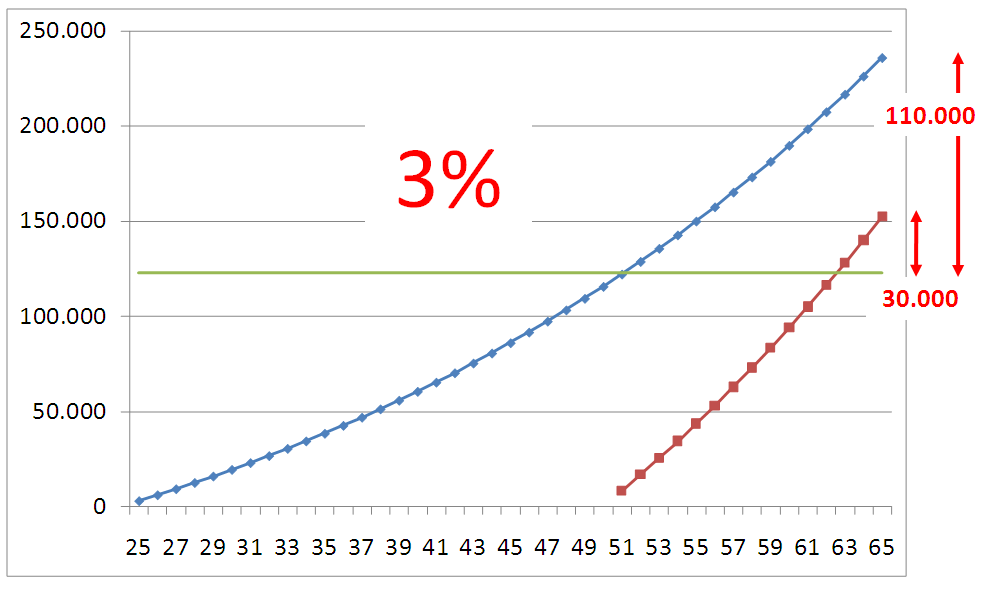
I made two quick calculations to show you. Imagine a 25 year old person who just started working. If he or she is able to save 250 euros per month, that is 3,000 euros per year, and puts it in a conservative fund which earns 3% a year… by the time he is 65 he will have around 230.000€. His yearly contribution would have been 123.000€. So another 110.000€ will have come from the interest. He will practically have doubled his money.
On the other hand, take a 50 year old person who never saved any money beforehand. He will have to save it in only the last 15 years of his working life. To make the comparison, I supposed that he contributed the same 123.000€ in those 15 years, for this he has to save 8.200 per year or 680€ per month… when he is 65 he will have 150.000€, having earned about 30.000€ from the interests, 4 times less!
Effect of a 3% compound interest over 40 years.
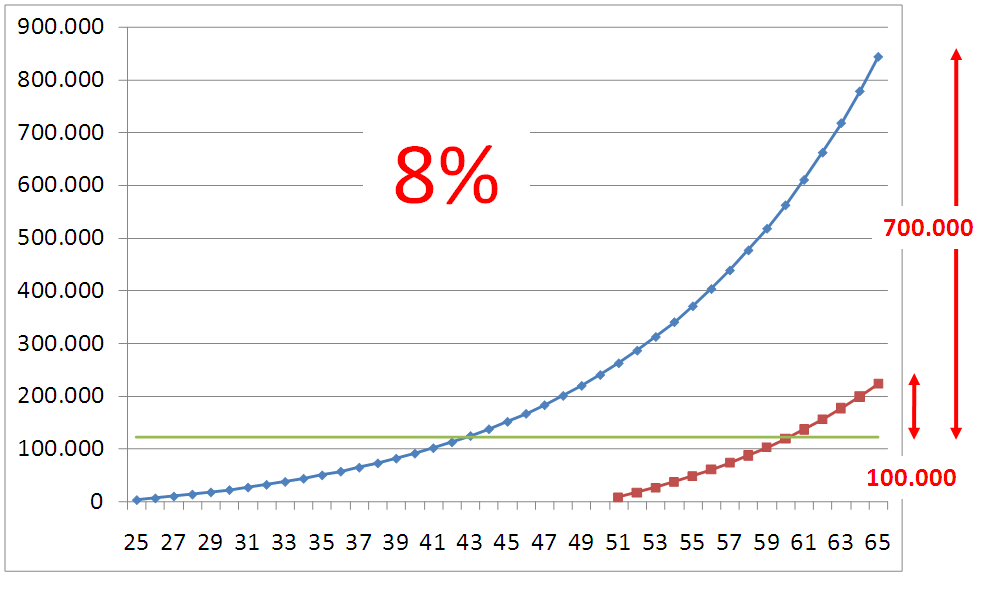
If the young person would invest in more volatile asset, for example the stock market, which historically earns about 8% every year, the new figures would be these ones.
840.000 – earning 720.000 from interests
222.000 – earning 100.000 from interests / 7 times less.
Effect of a 8% compound interest over 40 years.
Finally, with this discussion I wanted to explain little bit the compound interest, how it is making your savings grow, and even though at the beginning the growth seems very slow this is because the growth with time is exponential and we human beings are not very patient, thus it is important to start early saving small amounts, as snowflakes… in the end you will have a big snowball.
Start saving and see you at the retirement age.”
—–
Final comment: as you may have noticed there several passages when what I say differs from the script. I didn’t learn it by heart. During my first speeches in Toastmasters I tried to do so. Now I am departing from that approach. However, I do write the speech to give it a clear structure, to polish some parts, spot words I may have difficulty in pronouncing (so I can replace them for others) and count the amount of words so I am sure it fits in 5 to 7 minutes (often 7’30”… never more or fellow Toastmasters will start clapping).
Some days ago I tweeted about the swings of Mr. Market lately. The consideration of the stock market as Mr. Market is a metaphor that we owe it to Benjamin Graham.
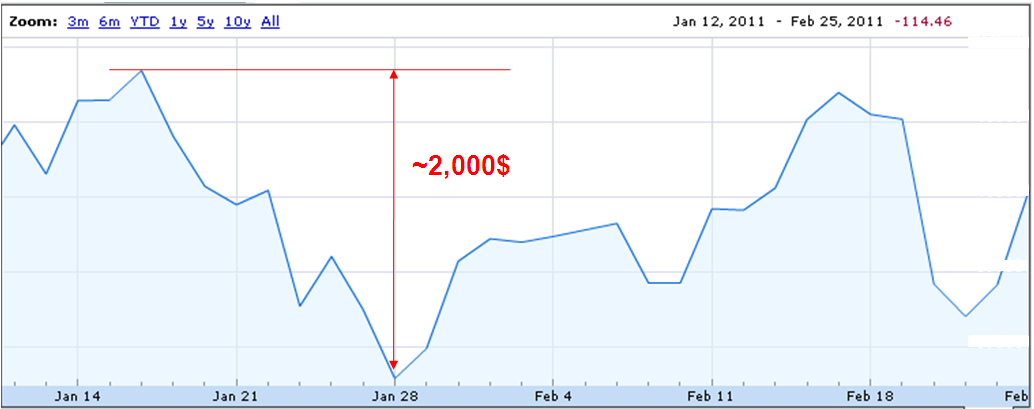
Since a picture is worth a thousand words, I wanted to share a snapshot of the swings of our “J&L” ( 😉 ) portfolio in the past few weeks. One could read the picture as “you have lost 114$ in the past weeks”. That same person on January 28th would have said “you’ve lost 2,000$ in the last 10 days”.
"Resist the human bias to act", Charlie T. Munger
In fact we have not lost a nickel in these weeks, since we haven’t sold any stock. I love a quote from Charlie T. Munger, Berkshire Hathaway vice chairman, which goes: “Resist the natural human bias to act”.
You actually don’t need to buy or sell stock when the market is in the mood. It is as easy as not doing it. You may buy only when you see a margin of safety and sell only when the stock has reached what you considered it to be at its intrinsic value.
You can see that in these 5 weeks we could have lost up to 2,000$ twice; we didn’t. The only tools we counted with: patience and not “listening to Mr. Market”.
Precisely today, it is published the letter of Warren Buffett to Berkshire shareholders. Whether you are planning to invest in stocks or only want to have a fun read, take a look at it.
I had just tweeted the previous day my bet on the competition:
I never get it right...
To reach to that conclusion I had done some numbers for fun on a late Friday afternoon some months ago in a similar fashion than the defence analyst Scott Hamilton showed in his blog. It is clear that I got it completely wrong.
As I have often told to my friends and colleagues, I am extremely bad with these predictions, as I was already mistaken when the JCA and the previous KC-X competitions were decided…
A note of humour: as my brother points out in fact I am very reliable, you just have to bet to the opposite option of my forecast.
Another colleague told us yesterday “you look like economists explaining your miscalculations…”, as someone put it “it is already hard to explain the past, it is even more difficult to predict the future”.
When I was in primary school I used to have a friend who had an impressive train model layout at home. Soon after, my parents gave me some very nice models that I still keep, though I do not play with them anymore and never continued to grow the layout nor purchased more train models.
Since I joined EADS I began collecting a few static models of aircraft: first an A380, then a Beluga, an A340-600, 2 A400M… Each time I stop at Schiphol airport with enough spare time I pay a visit to the model shop over there, so do I to Airbus online shop…
"Static" aircraft model collection at home... as of today.
However, few days ago, I found via Twitter a post in a blog that contained the following video of a model of an airport in Miniatur-Wonderland, Hamburg:
… if I take on this hobby it could be the beginning of my own end! What it’s sure is that whenever I go to Hamburg I’ll pay a visit to the place.



 The Blog by Javier