Author Archives: Javier Irastorza

Master in common sense

What is the main thing you learn from studying an MBA? When I have been asked this question I always answer that the learning process is different: Most of the subjects present you with situations / cases that once solved you said to yourself “well, it was applied common sense, wasn’t it?” Yes, applied common sense to some situations you never encountered or reflected on before. This is one way you learn, the other is hearing from first hand hundreds of real stories experienced by your teachers.

It is not like learning to solve fluid dynamics or differential equations exercises… it is not that before you didn’t how to solve a problem and then you know it, at least this is how I felt at EOI. The learning process during the MBA is more like encouraging you to apply common sense to many issues, making you reflect on new topics from those that entertained you at university.

I tell this because after reading “How to win friends & influence people”, by Dale Carnegie, I felt the same.

I found that Dale Carnegie is a great story-teller and nothing is better to learn or reflect on different issues than seeing the application of solutions, skills or techniques in stories, real stories. Some of the ones in the book came from Abraham Lincoln, Benjamin Franklin, Roosevelt, Rockefeller, several American generals… and many others were stories from lay people like you and me.

I remember that one of my teachers in the MBA used to say “70% of your work within a company is just human relationships; and precisely that is not taught anywhere”.

The skill to deal with other humans effectively is so important that, as Dale Carnegie tells in the book, Charles Schwab was the first person to earn a million dollars a year (when 2.500$ a year was considered a good salary), when he was picked by Andrew Carnegie (no relation) to become the first president of United States Steel company in 1921… Why? As Charles put it: “I consider my ability to arouse enthusiasm among my people the greatest asset I possess, and the way to develop the best that is in a person is by appreciation and encouragement”. (We may argue whether he indeed deserved a salary hundreds of times higher than the average… I already discussed this when I commented other book in this blog).

Now, I leave you the different principles that Carnegie offers to improve your effectiveness when dealing with people (a rare animal indeed!), reflect on them:

Fundamental techniques in handling people:

  1. Don’t criticize, condemn or complain.
  2. Give honest and sincere appreciation.
  3. Arouse in the other person an eager want.

Six ways to make people like you:

  1. Become genuinely interested in other people.
  2. Smile.
  3. Remember that a person’s name is to that person the sweetest and most important sound in any language.
  4. Be a good listener. Encourage others to talk about themselves.
  5. Talk in terms of the other person’s interests.
  6. Make the other person feel important – and do it sincerely.

Win people to your way of thinking:

  1. The only way to get the best of an argument is to avoid it.
  2. Show respect for the other person’s opinions. Never say “You’re wrong”.
  3. If you are wrong, admit it quickly and emphatically.
  4. Begin in a friendly way.
  5. Get the other person saying “yes, yes” immediately.
  6. Let the other person do a great deal of the talking.
  7. Let the other person feel that the idea is his or hers.
  8. Try honestly to see things from the other person’s point of view.
  9. Be sympathetic with the other person’s ideas and desires.
  10. Appeal to the nobler motives.
  11. Dramatize your ideas.
  12. Throw down a challenge.

Be a leader:

  1. Begin with praise and hones appreciation.
  2. Call attention to people’s mistakes indirectly.
  3. Talk about your own mistakes before criticizing the other person.
  4. Ask questions instead of giving direct orders.
  5. Let the other person save face.
  6. Praise the slightest improvement and praise every improvement. Be “hearty in your approbation and lavish in your praise”.
  7. Give the other person a fine reputation to live up to.
  8. Use encouragement. Make the fault seem easy to correct.
  9. Make the other person happy about doing the thing you suggest.

“Obvious…” This is one thought that may come to our mind when reading some of these statements. However, we’re not acting in that way every day, being as obvious as they may be – thus getting the results we get…

I encourage you to read the book (~260 pgs.) and see in those stories many examples applicable to yourself; daily situations in which to apply those principles.

5 Comments

Filed under Books, Education, Personal development

The cost of flying low

Last 12th October, I came from Amsterdam to Madrid by plane. That day there was an air controllers strike in France. While flying, the pilot commented that the company had tried to re-route the flight in order not to lose the slot it had, this proved almost impossible so what they did was to fly at a lower level. The pilot explained that this was very “costly as the engines consume much more” at that lower level.

How much more? How costly was this measure? I wanted to check it out, and some weeks later I have made the numbers that I show here.

We flew in an Airbus A321. Since it was the early flight in the morning I assume it carried maximum fuel and the weight was limited by Maximum Landing Weight (75.5 tonnes, MLW), so the takeoff weight would be the MLW plus the fuel weight we would consume in the flight, in the order of 5,500 kg (an average of 2,400 kg/hour according to some operators). Thus I used a takeoff weight of ~81,000 kg.

When flying at a lower level, the air density is higher and this increases drag. Normally, planes in this route fly at ~ 33,000 ft or ~ 10,000 m. What flight level did we use? This I don’t know, so I took the worst situation: say we flew at FL210, or 21,000 ft (~ 6,400 m). We can find at the chart the Standard Atmosphere and see the difference in density at both altitudes (~ 0.53ρ0 compared to ~ 0.33ρ0).


Flight levels, image from Wikipedia.


Standard Atmosphere, image from Wikipedia.


Using the Breguet range equation, all other things being equal (same distance, same aircraft, same weight at the departure…), we can relate the weights and densities of the initial flight plan the company had and the one used after trying to re-route.


Breguet range equation.


The result I got is that by flying at FL210 instead of FL330 the aircraft would have consumed over 1,400 kg of fuel more, a whole 26% more.

I checked the prices for fuel at IATA (International Air Transport Association) and at the moment is 746$/mt. The 1,400 kg of extra fuel would cost about 1,050$ (~ 760€), or about 4.2€ more per passenger (assuming we were around 180 passengers).

8 Comments

Filed under Aerospace & Defence

Moving to France


My one-way ticket to France.


By now, most of you (family, friends and colleagues) know about it, this is mainly for those who did not.

I am starting there sometime in December.

You are invited to pay a visit.

10 Comments

Filed under France

My first visit to Poland (EADS PZL)

PZL (Państwowe Zakłady Lotnicze – State Aviation Works) was the main aircraft manufacturer in Poland. With the fall of communism, the company was divided and some years ago Airbus Military acquired for EADS part of it, which since then is called EADS PZL.

This week I visited EADS PZL facilities both in Warsaw (where they produce C-295 outer wings, most of Airbus Military electrical harnesses, PZL-130 Orlik trainer airplane…) and Mielec (where the aviation services unit is located) in which was my first visit to Poland ever.

Frankly, I found Warsaw a quite nice place to live even though we could visit the old town only by night. We especially liked the couple of good restaurants we visited: Fukier (apparently the restaurant of choice of Felipe Gonzalez, Madeleine Albright, Naomi Campbell and us, of course) and U Kucharcy (where traditional Polish food is cooked in between the tables where customers are seated).

EADS PZL ZUA, the aviation services unit in the South of Poland (Mielec) operates dozens of aircraft in fire fighting and agriculture missions in places ranging from Sudan, Iran, Egypt, Chile… This unit is made up of a different class of people; adventurous pilots and mechanics that learn a language in few weeks and off they go to their next assignment in another corner of the world living by the aircraft in tents at ad-hoc built “bases” close to forests. Enjoy this video of a PZL M-18 Dromader in a demonstration flight:

I loved this visit. It was impressive to see the tens of Antonov 2 and PZL Dromaders, and we were offered a flight around the skies of Mielec in a Piper Seneca V, which I had the chance of piloting for a while.

To my fellow EADS workers: if you have the chance of spending some time working for PZL, do not doubt it, go for it.

This slideshow requires JavaScript.

6 Comments

Filed under Aerospace & Defence, Travelling

Airbus Military private party

Last time I went to the night disco “Kapital” was some years ago, yesterday I went again as my company, Airbus Military, organized a private party for its engineers (with about 1,000 people attending) to celebrate the recent certifications of the A330 MRTT (multi role tanker transport) and the C-295 anti-submarine warfare (ASW).

“Madam, if a thing is possible, consider it done; the impossible? That will be done”, this quote from Charles Alexandre, vicomte de Calonne, was used by Javier Matallanos, Airbus Military Senior Vice President of Programmes, to describe what it is being done at the company in the last years. As he stated, we, in Airbus Military, have launched recently the first air-to-air refuelling aircraft in the history of Europe  and the only anti-submarine warfare aircraft in the last 40 years in Europe (he quoted the only other European attempt, UK’s Nimrod, which has ended in a cancellation as I posted some months ago, the previous programme is the Breguet Atlantic).

Both Matallanos and Miguel Angel Morell, SVP of Engineering and Technology, thanked families and partners of Airbus Military workers for their continuous support: “be proud of your partners, please, know that they are exceptional people as they are used to do the impossible and these examples (MRTT and ASW) we are celebrating today are only two of the many we could give account”.

Finally, even though at the time of the speeches the presence of the CEO of the company, Domingo Ureña, was excused due to personal reasons (aside of closing the A400M negotiation in the same day), the CEO indeed appeared at about 23:00 as we saw him at the fifth floor.

My kudos to the person who had the idea of organizing this event and to the ones carrying it forward. I look forward to some more initiatives like this in the future.

This slideshow requires JavaScript.

1 Comment

Filed under Aerospace & Defence

Writing without using “e”

About a month ago I said that on occasions you would find a post which original motivation would link to Plinky; a portal that throws away thoughts for blog posts… this is a post of that kind.

Plinky, calls for writing a small story of 100 words without using a non-consonant you saw in an old post that was just most common in this linguistic communication I am using in my blog. Now, I am at about four fifths of finishing this task; I just lack two strings of words to bring this post to a final and assuaging: This was tough!

… off to a following post :-).

3 Comments

Filed under Miscellanea

Fomentar la Mentalidad Analítica vs. Fomentar la Creatividad

Ayer acudí a una jornada de Formación Continua dentro del ciclo “Management para Emprendedores” de la Escuela de Organización Industrial (EOI). La sesión trataba el asunto “Fomentar la Mentalidad Analítica vs. Fomentar la Creatividad”.

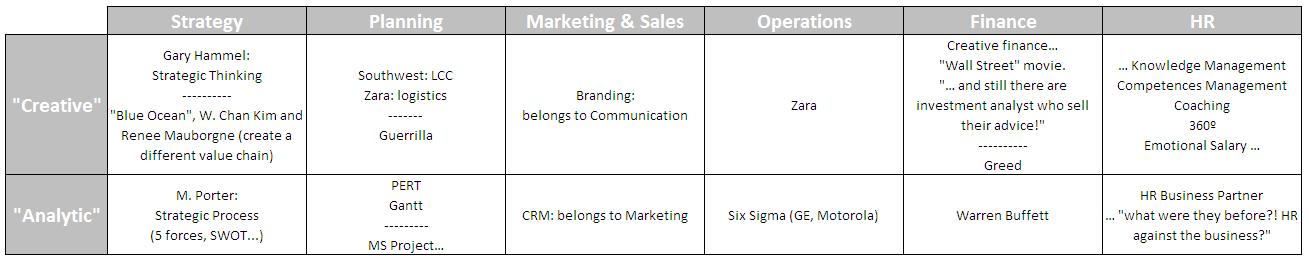
De esta jornada quería destacar el barrido funcional de una empresa que hizo el invitado Carlos Espinosa desde esta perspectiva. Intento aquí recuperar la tabla que expuso él:


Barrido funcional: Creativo vs. Analítico.


Por último, el profesor, Andrés Fernández Romero, terminó la clase explicando la “parálisis ante una respuesta esperada” de una forma apoteósica; usando el ejemplo de cómo medir la altura de un edificio con un barómetro…

Sir Ernest Rutherford, presidente de la Sociedad Real Británica y Premio Nobel de Química en 1908, contaba la siguiente anécdota: Hace algún tiempo, recibí la llamada de un colega. Estaba a punto de poner un cero a un estudiante por la respuesta que había dado en un problema de física, pese a que éste afirmaba con rotundidad que su respuesta era absolutamente acertada.

Profesores y estudiantes acordaron pedir arbitraje de alguien imparcial y fui elegido yo. Leo la pregunta del examen y decía: “Demuestre cómo es posible determinar la altura de un edificio con la ayuda de un barómetro”.

El estudiante había respondido: “Lleva el barómetro a la azotea del edificio y átale una cuerda muy larga. Descuélgalo hasta la base del edificio, marca y mide. La longitud de la cuerda es igual a la longitud del edificio”.

Realmente, el estudiante había planteado un serio problema con la resolución del ejercicio, porque había respondido a la pregunta correcta y completamente. Por otro lado, si se le concedía la máxima puntuación, podría alterar el promedio de sus de estudios, obtener una nota más alta y así certificar su alto nivel en física; pero la respuesta no confirmaba que el estudiante tuviera ese nivel.

Sugerí que se le diera al alumno otra oportunidad. Le concedí seis minutos para que me respondiera la misma pregunta pero esta vez con la advertencia de que en la respuesta debía demostrar sus conocimientos de física. Habían pasado cinco minutos y el estudiante no había escrito nada. Le pregunté si deseaba marcharse, pero me contesto que tenia muchas respuestas al problema. Su dificultad era elegir la mejor de todas. Me excuse por interrumpirle y le rogué que continuara.

En el minuto que le quedaba escribió la siguiente respuesta: “Coge el barometro y déjalo caer al suelo desde la azotea del edificio, calcula el tiempo de caída con un cronómetro. Después se aplica la formula altura = 0,5 por g por T al cuadrado. Y así obtenemos la altura del edificio”. En este punto le pregunté a mi colega si el estudiante se podía retirar. Le dió la nota más alta.

Tras abandonar el despacho, me reencontré con el estudiante y le pedí que me contara sus otras respuestas a la pregunta. Bueno, respondió, hay muchas maneras, por ejemplo, coges el barómetro en un día soleado y mides la altura del barómetro y la longitud de su sombra. Si medimos a continuación la longitud de la sombra del edificio y aplicamos una simple proporción, obtendremos también la altura del edificio.

Perfecto, le dije, ¿y de otra manera? Sí, contestó; éste es un procedimiento muy básico para medir un edificio, pero también sirve. En este método, coges el barómetro y te sitúas en las escaleras del edificio en la planta baja. Según subes las escaleras, vas marcando en la pared la altura del barómetro y cuentas el número de marcas hasta la azotea. Multiplicas al final la altura del barómetro por el número de marcas que has hecho y ya tienes la altura. Éste es un método muy directo. Por supuesto, si lo que quieres es un procedimiento más sofisticado, puedes atar el barómetro a una cuerda y moverlo como si fuera un péndulo. Dado que cuando el barómetro está a la altura de la azotea la velocidad es cero y si tenemos en cuenta la medida de la aceleración de la gravedad, al descender el barómetro en trayectoria circular al pasar por la perpendicular del edificio, de la diferencia de estos valores, y aplicando una sencilla formula trigonométrica, podríamos calcular, sin duda, la altura del edificio.

En este mismo estilo de sistema, atas el barómetro a una cuerda y lo descuelgas desde la azotea a la calle. Usándolo como un péndulo puedes calcular la altura midiendo su período de precesión. En fin, concluyó, existen otras muchas maneras. Probablemente, siguió, la mejor sea coger el barómetro y golpear con él la puerta de la casa del conserje. Cuando abra, decirle: señor conserje, aquí tengo un bonito barómetro. Si usted me dice la altura de este edificio, se lo regalo.

En este momento de la conversación, le pregunté si no conocía la respuesta convencional al problema (la diferencia de presión marcada por un barómetro en dos lugares diferentes nos proporciona la diferencia de altura entre ambos lugares). Evidentemente, dijo que la conocía, pero que durante sus estudios sus profesores habían intentado enseñarle a pensar. El estudiante se llamaba Niels Bohr, físico danés, premio Nobel de Física en 1922, más conocido por ser el primero en proponer el modelo de átomo con protones y neutrones y los electrones que lo rodeaban. Fue fundamentalmente un innovador de la teoría cuántica. Al margen del personaje, lo divertido y curioso de la anécdota, lo esencial de esta historia, es que LE HABÍAN ENSEÑADO A PENSAR.”

4 Comments

Filed under Education

Venture Capital & Crowdfunding

I started giving loans through Kiva almost two years ago. About at the same time, after gathering some savings, I started investing again in the stock market.

Last month, I attended TEDxMadrid, where Nicolás Alcalá explained how a movie he and his team are working on (“El Cosmonauta”) will be financed through crowdfunding. I then discussed with a friend that precisely I was looking for a similar approach, but applied to general businesses: a kind of Kiva for for-profit start-ups.

Subsequently, I first found Kickstarter about a month ago through Fred Wilson (@fredwilson). However, in Kickstarter the funders of projects are not entitled to equity in the venture nor a share of the future profits. The funders get some merchandising or recognition for the helping hand they have given, depending on the amount they have invested.

Then I found GrowVC.

From what I gathered, this is more or less what I was looking for: a way to invest some small amount of cash (~1,000$ a year) together with other funders into a larger pool that will act as a Venture Capital operation, sharing the future profits of the business that was funded.

With this post I wanted to share these initiatives with you and also to explain what I was looking for. Now, let me throw an open question to readers: anyone knows a similar concept that I may be interested in? If so, please, let me know.

(Bear in mind that I haven’t got, yet, hundreds of thousands of Euros to invest following this approach… the larger part is invested in a much more Graham-like defensive approach)

8 Comments

Filed under Investing

My 2009 tax receipt

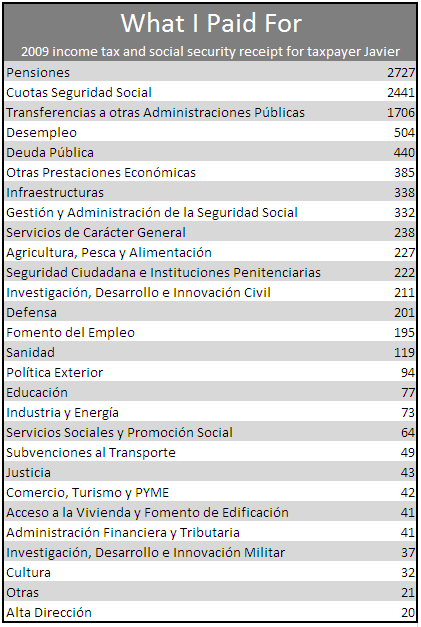
Some days ago, my friend Bruno tweeted a very interesting article about a proposal by the American think tank Third Way to enclose a kind of tax receipt detailing the taxpayer the use the administration had given to her funds (see the original receipt in the previous link).

Therefore, this post is not an original idea but the application of that proposal to the case of Spain and me as the taxpayer.

To build the “tax receipt” I used 2009 figures. The source I used for a detailed breakdown of Spain’s budget is the same one than a I used in a previous post: a good infographic from lainformacion.com.


My 2009 income tax and social security receipt.


Some curiosities:

  • I (and you too) paid more than double for unemployment subsidies (504 €) than to foster employment (195 €),
  • I spent 440 € to pay off public debt,
  • I paid 119 € for health… I consider that cheap; in 2009 I actually went to the doctor couple of times and got some vaccines partially subsidized.
  • I paid 201 € in defence and 37 € in defence-related R&D… taking into account that my salary partially comes from there, I wouldn’t mind more of it to be spent there.

One final remark: the government when decreased functionaries salaries in spring was looking with those measures to cut ~15.000 million € in about 1.5 years… this would mean about 220 € per inhabitant / year… where would you take those 220 € from my 2009 bill?

3 Comments

Filed under Economy

The Snowball, Warren Buffett bio (book review)

Last Christmas, my brother gave me “The Snowball: Warren Buffett and the Business of Life“, by Alice Schroeder. He completely hit on the spot, though I only started reading it during last August holidays (Luca also started reading it to the point that she ended up buying her own Kindle version of it!).

The book is a thorough review of Buffett’s life, including relationships with family & friends and investment decisions. I had previously read other books about Buffett, but they were merely about his investment “strategy” so to say, nothing compared to this one. To complete the book, the author made over 250 interviews, so you can imagine the many insights contained in it.

There are many lessons or just ideas that can be taken from this book. Let me just point the few I can recall at the moment of writing this post:

  • The Inner Scorecard: the idea of acting and valuing yourself according to what you care about and not according to what others’ deem important.
  • The concept of margin of safety: from Benjamin Graham (recommended reading “The Intelligent Investor“).
  • Circle of competence: the idea of looking for simple business that have an enduring competitive advantage (technology companies are not that simple).
  • Cigar butts: companies which are worth more “death than alive” (looking for cheap price to book).
  • Snowball: the idea that compounding interest acts as a snowball falling down the hill, the sooner you start the larger the ball will be down the road (thinking about retirement here).
  • The story of the genie: or that you should invest in your own health as your body is the only one you are going to be given in this life.
  • The Ovarian lottery and the idea that philanthropy achieves more if exercised now and trying to maximize its impact.

Throughout the book you get to learn about many great entrepreneurial characters (e.g. Rose Blumkin, Bill Gates); about the workings of the board of directors of some companies (e.g. Coca Cola, Berkshire Hathaway); about some of the most impressive falls in corporate history (e.g. Solomon Brothers, Long Term Capital Management); about several depressions, recessions and crisis; and above all you learn about what were the thoughts and calculations behind some of Buffett’s investments decisions since the early 1940’s to date.

I definitely recommend this book (700+ pgs.).

5 Comments

Filed under Books, Investing