Category Archives: Aerospace & Defence

Budget uncertainty in the Congress has kept the Boeing C-17 line open for years

Few days ago, I read in the weekly Aviation Week the following article, Boeing Blames Budget Uncertainty For C-17 Line Closure Timing, where Dennis Muilenburg, president of Boeing Defense, Space and Security, is quoted saying:

“… you quickly come to the conclusion that we cannot continue to spend money to keep that line open, given all of the other budget constraints. So, the fact that we are facing sequestration and uncertainty in the budget drove the timing of our decision.”

If anything, I would say the contrary: budget uncertainty in the Congress is what has kept the Boeing C-17 line open for the last years (coupled with international sales).

To understand that, it is important to remember that the C-17 program initially called for the acquisition of 120 aircraft. This number was later increased to 180 aircraft, and that the US Air Force had been requesting in its yearly budget requests zero aircraft per year since long ago. Only maneuvers in the Congress had been including in the final Defense Budget more C-17 units until the final 223 which were delivered (the last one in September 2013).

You can see an explanation of the plays that have taken place for years in the Congress in this article from 2009 in Business Week (“It’s a Bird, It’s a Plane, It’s Pork!“):

The C-17 Globemaster offers one illustration of successful opposition to the Obama-Gates push for control of weapons spending. C-17s are large cargo planes produced by Boeing that cost $250 million apiece. They have been used heavily since 1993 to transport troops, tanks, and supplies. Every year since 2006, the Pentagon has said that it has enough C-17s. And every year, Congress overrules the military and authorizes funds for additional planes. In October the Senate approved $2.5 billion in the 2010 budget for 10 more C-17s, which would bring the fleet to 215.

[…]

But the real reason Congress wants more of them has little to do with military need. Boeing has built the C-17’s industrial base for political survivability.

The company has spread manufacturing across no fewer than 43 states. C-17 production lines employ more than 30,000 workers, many of them relatively well paid by factory-wage standards. Many of those jobs would be at risk if C-17 work ground to a halt.

The White House understands the challenge. “The impulse in Washington is to protect jobs back home, building things we don’t need at a cost we can’t afford,” President Obama said in August in a speech at the Veterans of Foreign Wars Convention in Phoenix. “The special interests, contractors, and entrenched lobbyists—they’re invested in the status quo, and they’re putting up a fight.”

[…]

Bond, Senator Barbara Boxer (D-Calif.), and 16 colleagues began circulating a letter in April urging members of the Senate Appropriations Committee to keep funding the plane despite clearly stated objections from the White House and Pentagon. In California, C-17 production employs 5,000 workers at a final assembly plant in Long Beach.

[…]

These plays by politicians to try to keep the line open despite of the military not needing more aircraft continue to exist, as a few days ago we could read about a new plan: C-17 swap, to exchange older C-17s for new ones! (while the “old” ones have only about 20 years today possibly not having logged more  flight hours than two-thirds of their life).
Leave a comment

Filed under Aerospace & Defence

La última cena de William Perry

La semana pasada, con motivo de la celebración del día de la Hispanidad, el diario ABC publicaba una entrevista al ministro de defensa, Pedro Morenés (“Morenés: “Me preocupa el adiestramiento de las Fuerzas Armadas”“).

El portal InfoDefensa hacía referencia a dicha entrevista en la siguiente entrada, “Morenés: “Vamos a reforzar la industria de Defensa desde Navantia a Indra”“, donde además incluía unas declaraciones que no aparecen en la edición digital de ABC. En ellas el ministro habla de la necesidad de consolidar la industria de la defensa española para competir con las grandes empresas del sector: Lockheed Martin, Boeing, BAE, etc.

En esta entrada me quería centrar en una anécdota que se relata:

La anécdota de Weinberger (sic).

Según el diario, el ministró finalizó este tema mencionando una anécdota del secretario de Defensa de EEUU Caspar Weinberger (1981-1987):

“Cuando el señor Weinberger dijo a las cincuenta y tantas empresas de Defensa que había en EEUU, o más, “el año que viene por estas fechas, cuando yo les invite a cenar en esta mesa en la que hoy hay ciento y pico personas, va a haber doce. Arréglenselas ustedes como puedan”. Les dio un mensaje muy claro. Al final hubo 12.

En esta entrada en el blog solo quería precisar:

  • La cena no fue con Weinberger como secretario de defensa (1981-87), sino con Les Aspin en 1993.
  • No fue el secretario de defensa (entonces Les Aspin) sino William Perry (subsecretario entonces, y que posteriormente fue secretario de defensa) quien dijo aquello.
  • No había ciento y pico personas que luego pasaron a 12; sino 12 en la cena que luego pasaron a 5 (representando a Boeing, Northrop Grumman, General Dynamics, Lockheed Martin, Raytheon); por eso de que a la mesa iban 12 lo llamaron “última cena”.

Esta anécdota se puede leer en numerosas fuentes especializadas en asuntos de defensa y genéricas, como por ejemplo, The New York Times:

The changes now occurring began in the early 1990’s. Industry executives recall the famous ”Last Supper,’‘ a 1993 Pentagon dinner whose host was Les Aspin, then Secretary of Defense, and his deputy, William J. Perry, who succeeded him. At the dinner were executives from a dozen contractors who were told by Mr. Perry that there were twice as many military suppliers as he wanted to see in five years and that the Government was prepared to watch some go out of business. From 1992 to 1997, a total of $55 billion in military-industry mergers took place, according to Securities Data Company, a research concern in Newark.

Quiero pensar que el ministro Pedro Morenés conoce bien la anécdota, y fue el periodista de ABC el que escuchó algo y no se enteró, y más tarde, en la redacción, la reconstruyó como quiso sin comprobar datos en ninguna fuente… raro es que no acabase atribuyendo la anécdota o cita a Wiston Churchill o Mark Twain.

Leave a comment

Filed under Aerospace & Defence

Boeing 747: 51 in backlog, rate of 1.5 per month… 2016?

I read a few days ago an article from Business Week on the launch of the Boeing 777X (“Boeing Unveils Its Jumbo Killer“). In that article, Adam Pilarski, senior vice president at aerospace consultant Avitas is quoted saying “My assumption is the 747 is dead, or will be dead in a year or two”.

Yesterday, Boeing announced that it will cut down the production rate down to 1.5 aircraft per month (see article in Bloomberg).

Boeing has only been able to book 107 orders and has still in backlog 51 of them. Thus, at the new rate the line would last open just a bit below 3 more years, reaching mid 2016.

That is remarkable taking into consideration that the first deliveries took place in 1969, that would be a production streak of almost 50 years.

The dark side of it is that if no orders are booked between now and then, in just about one year two aircraft production lines such as the C-17 and the 747 would be closed.

However, Boeing still sees a future in the 747 and expects to revamp production again in the following years, especially in the freighter market, however in the past 6 years sales have amounted to 22 aircraft, an average of 4 per year… clearly below the needed to maintain the new production rate (18/year).

  • In this post I compared the sales of A380 and 747 at each program start.
  • Review I wrote about the book 747, “747”, by Joe Sutter with Jay Spencer.

Leave a comment

Filed under Aerospace & Defence

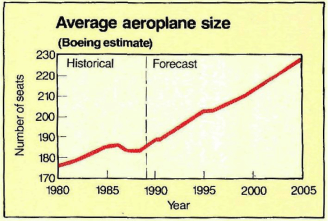
Is the average aircraft size decreasing or increasing by 25%?

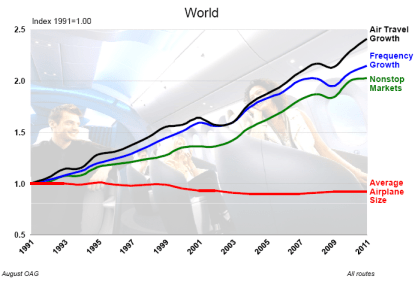
Last year, I wrote a post (Aircraft average size: Boeing’s forecast in 1990 and following evolution) in which I compared what was Boeing’s prediction in 1990 of what was going to be the commercial aircraft average size evolution in the next 15 years versus the same prediction in 1997 and what had been the actual evolution through 2011, as reflected in Boeing’s 2012 Current Market Outlook (CMO).

See the graphics below:

Average aircraft size forecast made in 1990.

Average aircraft size evolution 1991-2011, according to Boeing 2012 CMO.

As I mentioned above, the information of actual evolution was provided by Boeing in 2012’s CMO.

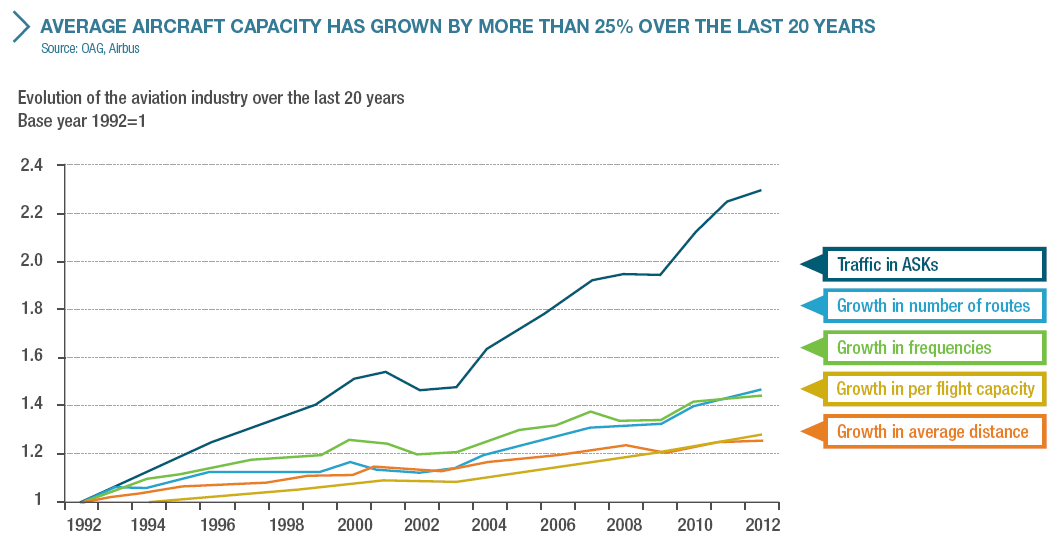
This year (2013), Airbus seems to have responded by providing the same piece of information in its Global Market Forecast (GMF), see the picture below:

Average aircraft size evolution 1992-2012, according to Airbus.

Average aircraft size evolution 1992-2012, according to Airbus 2013 GMF.

The catch then is: is the average aircraft size decreasing (as Boeing says) or increasing by 25% (as Airbus says)?

The best part of the catch is that both cite the same source of information, OAG (Official Airline Guide).

The reader will obviously reach to the conclusion that both companies cannot be taking the same segmentation and that they are using the reported trend to convey an interested message.

After, having seen the number plays that Boeing has recently done in their CMO with the mix of wide-bodies widely changing from year to year in order to promote 787 or 777 (which explained in this post), I take the stand to take with grain of salt the graphic provided by Boeing, and thus, unless I see the numbers by myself, I will understand that average aircraft size has been growing since the 1990s (1).

(1) The funny thing of understanding that the correct interpretation is the one of Airbus (average size has grown by 25%) is that this would mean that Boeing’s own prediction in 1990 would have been proven correct! 🙂

Leave a comment

Filed under Aerospace & Defence

Keys to airlines profitability

Few days ago I read the following tweet from IATA (International Air Transport Association):

It linked an interesting article from its website, where some (brutal) keys about the airline business are summarized:

  • It is estimated that $4 trillion to $5 trillion will be needed to buy the aircraft necessary for growth in the next 20 years (see Airbus and Boeing forecasts here).
  • 75% of the world’s airlines are at least majority owned by the private sector
  • According to a new IATA study, Profitability and the Air Transport Value Chain [PDF, 3.5 MB], in the airline industry — hyper-competitive and suffering from numerous structural problems —investors have never reached WACC.
  • During 2004–2011, the airline industry worldwide  averaged a ROIC of 4.1%. This is an improvement on the average of 3.8% generated in the previous business cycle 1996–2004 but it is nowhere near WACC (7.5%).
  • In 2012 airlines made just 2.56$ per passenger.
  • Fuel has risen to become more than 30% of an airline’s operating costs despite far more efficient operations and engines.
  • Air transport generates somewhere between $16 billion and $48 billion in profits for fuel companies every year.
  • The airline industry has done a pretty good job at cutting cost, with a 60% fall in real terms over the past 40 years.
  • The problem from an investor perspective is that all of those cost reductions have been passed through to customers, leaving equity investors unpaid for risking their capital.
  • Looking at the overall investment picture, investors would get $17 billion more per year if they put their money in equities and bonds of a similar risk profile outside the airline industry.
Air transport generates (...) profits for fuel companies.

Air transport generates (…) profits for fuel companies.

Sad situation of the sector from the point of view of an aviation enthusiast. Nevertheless, all these conclusions necessarily lead me to the following two quotes from remarkable businessmen:

Warren Buffett: “The worst sort of business is one that grows rapidly, requires significant capital to engender the growth, and then earns little or no money. Think airlines. Here a durable competitive advantage has proven elusive ever since the days of the Wright Brothers. Indeed, if a farsighted capitalist had been present at Kitty Hawk, he would have done his successors a huge favor by shooting Orville down.”

Richard Branson: “The quickest way to become a millionaire in the airline business is to start out as a billionaire.”

Leave a comment

Filed under Aerospace & Defence

Airbus vs. Boeing, comparison of market forecasts (2013)

Last Tuesday, John Leahy, Airbus COO Customers, unveiled at a press conference in London the new figures of the 2013-32 Airbus’ Global Market Forecast (GMF, PDF 5.1MB).

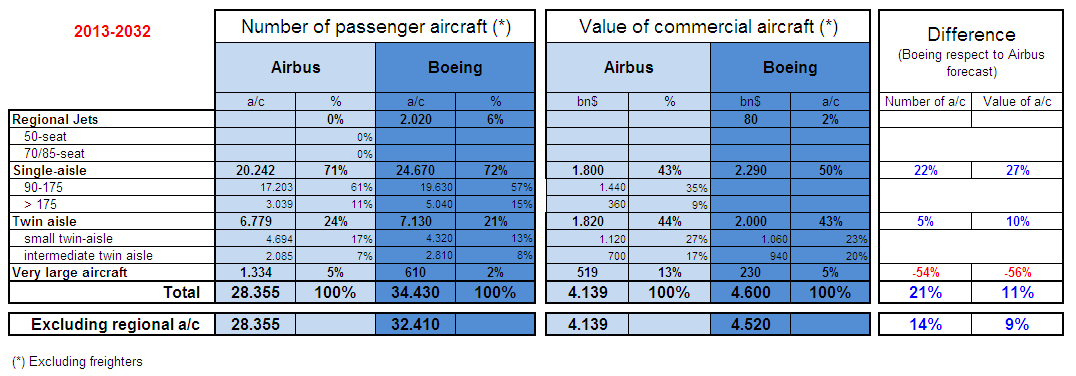
The last two years, I already published comparisons of both Airbus’ and Boeing’s forecasts (Current Market Outlook, CMO, PDF 3.0MB). You can find below the update of such comparison with the latest released figures from both companies.

Comparison of Airbus GMF and Boeing CMO 2013-2032.

Comparison of Airbus GMF and Boeing CMO 2013-2032.

Some comments about the comparison:

  • Boeing sees demand for 14% more passenger aircraft (excluding regional a/c, same proportion as last year) with a 9% more value (excluding freighters).
  • Boeing continues to play down A380 niche potential (54% less a/c than Airbus’ GMF), though for third year in a row it has slightly increased its Very Large market forecast, again by 20 a/c, or 3.4%.
  • On the other hand, Boeing forecasts about 350 twin-aisle and 4,400 single-aisle more than Airbus, clearly pointing to its point-to-point strategy versus the connecting mega-cities rationale presented by Airbus.
  • In terms of RPKs (“revenue passenger kilometer”), that is, the number of paying passenger by the distance they are transported, they see a similar future: Airbus forecasts for 2032 ~14 RPKs (in trillion) (a ~9% increase vs last year GMF) while Boeing forecasts 14.7 (also increased about 7%).

The main changes from last year’s forecasts are:

  • Both manufacturers have increased their passenger aircraft forecast, ~1,000 a/c Airbus and 1,400 a/c Boeing, bigger increase than last year’s change (500 a/c both).
    • In the case of Airbus it has again mainly increased the single aisle segment (700 a/c), probably reflecting the success of the A320neo launch.
    • In the case of Boeing, they decreased the twin aisle segment (80 a/c), but increased the single aisle in over 1,400 a/c.
    • As I noted in a previous post, Boeing dramatically changed the twin-aisle mix, between small and intermediate. Now it has a mix closer to that of Airbus (60-70% of small twin-aisle).
  • Both manufacturers have increased the value of RPKs in 2032  (9% and 7%).
  • Both manufacturers have increased the volume (trn$) of the market in this 20 years, again 12% Airbus (to 4.1trn$) and 3% Boeing (to 4.5trn$) (excluding regionals and freighters).

Some catchy lines for those who have never seen these type of forecasts:

  • Passenger world traffic (RPK) will continue to grow about 4.7% per year (5.0% according to Boeing). This is, doubling every ~15 years.
  • Today there are about 16,100 passenger aircraft around the world (according to Airbus), this number will more than double in the next 20 years to above 33,600 a/c in 2032.
  • 2/3 of the population of the emerging countries will take a trip a year in 2032.
  • Domestic travel in China will be the largest traffic flow in 2032 with almost 1,400bn RPK, or 10% of the World’s traffic.
  • The A20 family: a take-off every 2.5 seconds, with 99.6% reliability.
Trips per capita vs. GDP per capita (source: Airbus GMF).

Trips per capita vs. GDP per capita (source: Airbus GMF).

As I do every year, I strongly recommend both documents (GMF and CMO) which provide a wealth of information of market dynamics. In case you find it tough, to read those kind of booklets, you may take a look at the video of the press conference, a great class on global economy, world aviation, forecasting, trend spotting (1h08’28”):

10 Comments

Filed under Aerospace & Defence

Tribute to Douglas Aircraft Company

Boeing announced this week that it will discontinue the producion of the C-17 Globemaster III in 2015. As an Airbus Military employee working for the A400M (a competitor of the C-17 in export markets), I take the announcement with some relief (if the production really comes to an end). On the other hand, as an aviation enthusiast I gave it another look.

As some media reported, the C-17 was the last aircraft assembly line of Boeing in Long Beach (California), this line shut down marks an end to an era. The C-17 is a legacy program from the former McDonnell Douglas which merged with Boeing in 1997. All the other McDonnell Douglas aircraft programmes which were manufactured in South California at the time of the merger were already stopped during the 5 years that followed the merger (including MD-80 variants, MD-90 and MD-11).

The activities of McDonnell Douglas in South California date back to those of the former Douglas Aircraft Company which merged with McDonnell Aircraft in 1967. All those MD-80/90/11 have as origin the DC-9 which first flew in 1965 and which together with its derivatives is still the 3rd most successful commercial airliner ever (only behind the 737 and A320 families).

I see the closure of the C-17 line as the end of Douglas heritage. In this post I just wanted to pay my small tribute to Douglas Aircraft Company one of the key companies in the history of aviation.

Douglas Aircraft Company

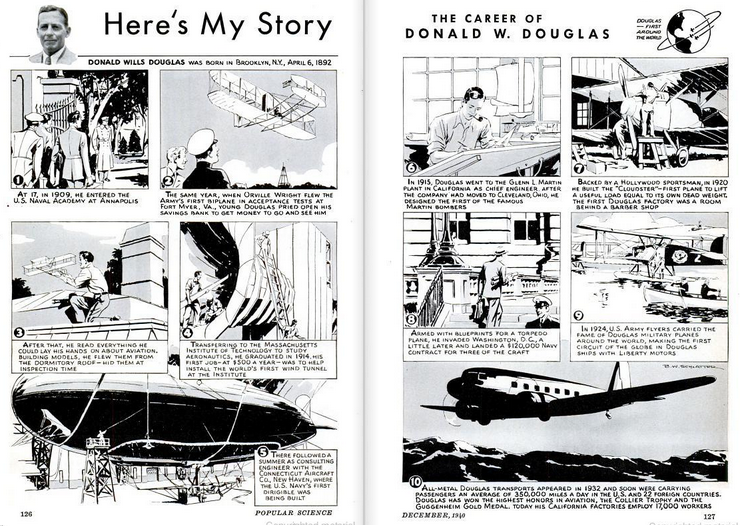
Douglas was incorporated in 1921, after Donald Douglas bought the stake from David R. Davis in the company that they had set up together the previous year. Prior to that Douglas, had studied in the MIT where he was the first ever to graduate with a Bachelor of Science in Aeronautical Engineering. Then he helped with the installation at the MIT of the World’s first wind tunnel. He went to work for the Navy and then for Glenn L. Martin Company (set up by Glenn L. Martin, an Iowan aviation pioneer, hall-of-famer of the Iowa Aviation Museum which we visited in 2011). At Martin he worked in the design of several bombers but he wanted to go to California from where his wife was. Thus he left the company in 1920 to move to Los Angeles where he first set Davis-Douglas Co. You can read about the life of Donald Douglas in the Wikipedia article, at Boeing site or better, in this excerpt from an issue of Popular Science magazine from 1940:

Douglas career (source: Popular Science magazine, October 1940).

Douglas career (source: Popular Science magazine, October 1940).

The last picture in the comic-like biography of Douglas above shows a Douglas Commercial DC-3.

Douglas Commercial DC-3

One simply cannot overstate the importance of the DC-3 in the history of aviation. The DC-3 came as an evolution of the DC-2, and with its improved range and payload capacity it revolutionized both commercial and military aviation. Hundreds of civil aircraft were produced, over 10,000 military versions. The military version C-47 Skytrain came to be one of the iconic aircraft of the World War II first and later of the Berlin Airlift (see this post I wrote about our visit to the Berlin Tempelhof Airport, where today a DC-4 is displayed).

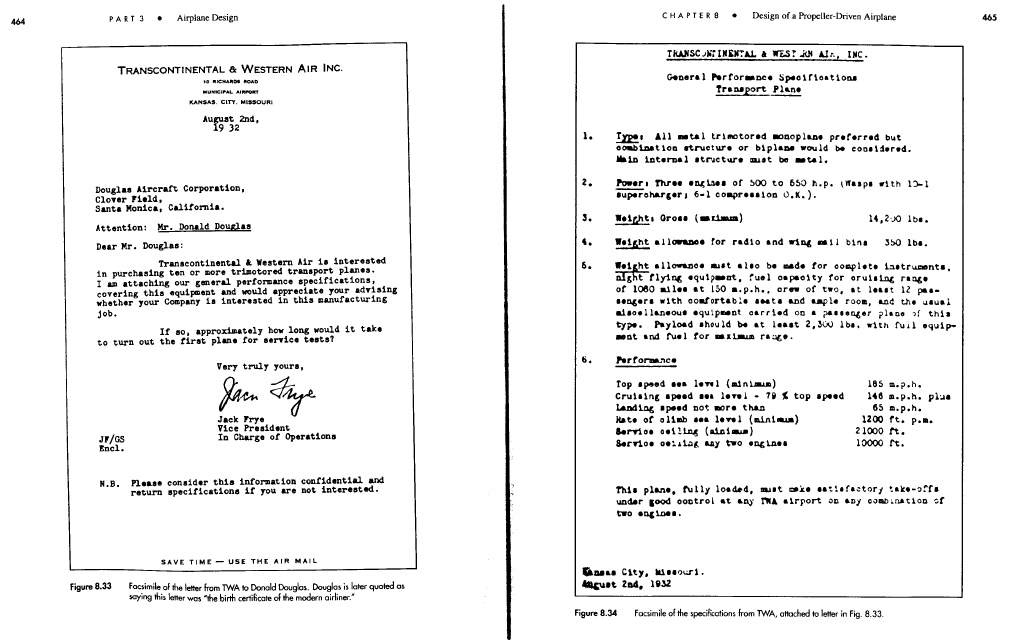
The Douglas Aircraft Company was mainly producing military aircraft until it received in 1932 a letter from Jack Frye, the VP Operations of the iconic airline Transcontinental & Western Air Inc., bettern known as TWA. Jack sent the same letter to 3 aircraft manufacturers (the others being Curtiss-Wright and Glenn Martin) inquiring whether they would be interested in producing an aircraft in response to TWA’s specifications. This came as a response to the launch by Boeing of the 247, which first 60 units were to be destined for its affiliated airline, Boeing Air Transport (both then part of United Aircraft and Transport Corporation). TWA feared that not having access to the 247 for the first years it would lag behind, and thus took the step forward of asking manufacturers to build the aircraft they needed.

John D. Anderson, the curator of aerodynamics at the National Space and Air Museum (see this post about our visit to NASM at Dulles) was also a professor of Aerospace Engineering in the University of Maryland. Among other books, professor Anderson has written “Aircraft Performance and Design (McGraw-Hill, 1999) a terrific book on aircraft design. The chapter 8 of the book describes the process of the Design of a Propeller-Driven Airplane. It includes as a design case study, the Douglas DC-3, 20-pages to delight yourself about history, aeronautics and engineering. It starts with a copy of the letter from Jack Frye and the specifications from TWA:

Letter from TWA to Douglas.

Letter from TWA to Douglas and specifications for a new airplane design.

The chapter describes the different discussions among Douglas’ senior engineers, exchanges with TWA, negotiations, etc. All the technologies employed in the aircraft were already existing in different models. The greatness of the project was in putting them together in one plane (the use of Northrop cantilevered wing, low-wing monoplane, retractable landing gear (to reduce drag), use of flaps (to allow low landing speeds – 65mph as per the spec), use of NACA cowlings to cover the engine…).

There was another great contribution to aeronautics of this development project and that was the one-engine-out performance, required in the specification; though the specification demanded a tri-motor which was able to take-off and cruise with any two engines. To that request, Douglas responded with a detailed analysis of safety in one-engine-out situations, which it presented at the UK’s Royal Aeronautical Society in the paper “The Development and Reliability of the Modern Multi-Engine Air Liner with Special Reference to Multi-Engine Airplanes after Engine Failure“.

The first test plane that came as a result was the DC-1, the production aircraft that followed the acceptance of the prototype was named the DC-2, and the DC-3 was an enlarged version that resulted from another request from American Airlines, which wished a version of the DC-2 capable to carry litters for overnight travel, that came to be the Douglas Sleeper Transport (DST). Douglas worked on that version but immediately saw that the potential of that enlarged version was not in the sleeper version but in having extra payload and comfort for seated passengers in comparison with other airplanes at the time. The DC-3 reduced direct operating costs (DOC) to 60% of those of the Boeing 247, thus converting it in a money maker for the airlines and allowing many more people to afford air travel.

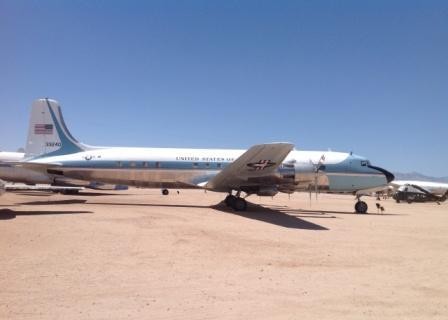
In the following decades Douglas positioned itself as the leading commercial airplane manufacturer until Boeing took this position around the 1960s. Several models came during those years: DC-4, DC-6 (which came to be the Air Force One during Kennedy and Johnson presidencies, see the picture below taken at the Pima Air and Space Museum), the mentioned DC-9 with all its later variants, etc.

DC-6 (VC-118), Air Force One during Kennedy presidency (at PImar Air and Space Museum).

DC-6 (VC-118), Air Force One during Kennedy presidency (at PImar Air and Space Museum).

Later on, financial struggles led to the consolidation first with McDonnell and then with Boeing. As my wife Luca mentioned, “this is what happens in any other industry to many other companies…” true, but this is the industry I like, and thus, I feel that it’s a pity that the long era of Douglas comes to an end. However, even if no more Douglas aircraft are going to come out of Santa Monica or Long Beach factories, there will always be something from the old Douglas in the current Boeing:

Logos from Douglas (prior to 1967) and Boeing (after 1997 merger).

Logos from Douglas (prior to 1967) and Boeing (after 1997 merger).

4 Comments

Filed under Aerospace & Defence

Unions, right-to-work and free-riders

Every now and then, followers of the aerospace industry read news about the relationships between Boeing and the unions. Recall the 8-week strike by the International Association of Machinists (IAM 751) in the fall of 2008, or the more recent negotiations with the Society of Professional Engineering Employees in Aerospace (SPEEA). See, for instance a recent article from Leeham News on the need for change in Washington state, “Right-to-Work, Creepy and Right-to-Worse in Washington State“.

Some months ago I was intrigued by what those terms meant in the American landscape, “right-to-work”, “unionized state”, “non-unionized state”, etc. Thus, I started looking for some definitions in the Wikipedia. And I found some of these terms misleading, or at least when seen from a European frame.

I initially thought that a non-unionized state might have some ban on unions, thus making it possibly more attractive for an employer if it deems it will have the higher hand in a negotiation. But no. There are indeed unions in non-unionized states. Let me just go through some passages taken from the Wikipedia trying to see the different terms:

Open shop: “An open shop is a place of employment at which one is not required to join or financially support a union (closed shop) as a condition of hiring or continued employment”.

Closed shop: “A pre-entry closed shop is a form of union security agreement under which the employer agrees to hire union members only, and employees must remain members of the union at all times in order to remain employed.” […]

“The Taft-Hartley Act outlawed the closed shop in the United States in 1947, but permits the union shop, except in those states that have passed right-to-work laws, in which case even the union shop is illegal. An employer may not lawfully agree with a union to hire only union members; it may, on the other hand, agree to require employees to join the union or pay the equivalent of union dues to it after a set period of time.”

Union shop: “A union shop is a form of a union security clause under which the employer agrees to hire either labor union members or nonmembers but all non-union employees must become union members within a specified period of time or lose their jobs.”

Right-to-work: “A “right-to-work” law is a statute in the United States that prohibits union security agreements, or agreements between labor unions and employers, that govern the extent to which an established union can require employees’ membership, payment of union dues, or fees as a condition of employment, either before or after hiring. “Right-to-work” laws do not, as the short phrase might suggest, aim to provide a general guarantee of employment to people seeking work, but rather are a government regulation of the contractual agreements between employers and labor unions that prevents them from excluding non-union workers”.

After I made this short review of those definitions, I got a complete different picture. Non-unionized states which I initially perceived as places with some intrinsic insecurity for the worker are simply having a  similar scheme than the one we have in Europe: shop-floor workers or engineers at Airbus are not required to join any union to get employment, nor are they forced to pay dues to union if contracted, though they may join one if they deem it in their interest.

I could even think of the union-states as an anachronism (forcing workers to join a union in order to work), however some of the reasons provided by opponents of the right-to-work law have sense:  free-riders would benefit from a collective bargaining agreement negotiated by a union without paying for that negotiation, the weakening of unions may lead to a race to the bottom, etc.

So far, I was never part of any union, thus I fall under the category of free rider, as I have and continue to benefit from social conditions negotiated by large unions.

Union affiliation

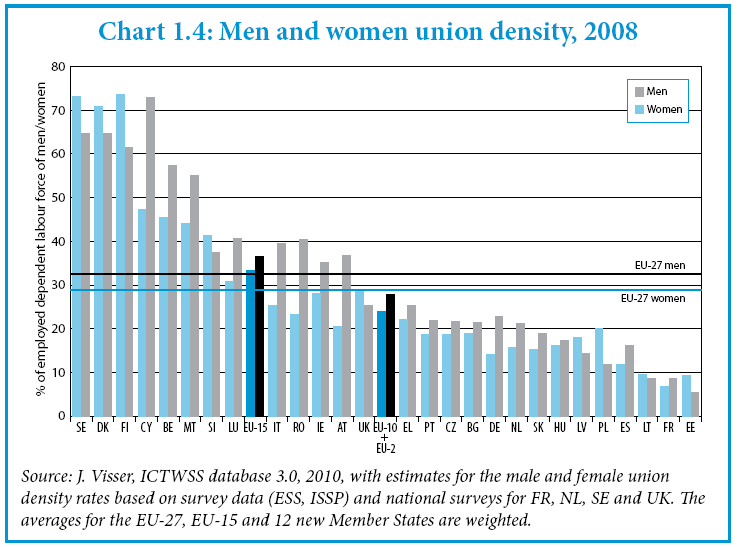
I found an interesting report prepared by the European Commission on “Industrial Relations in Europe (2010)” [PDF, 5MB]. Among the many sides of labour relations covered in the report, I found the graphic below with numbers about union affiliation rates in different European countries.

Union affiliation in Europe (source: European Commission).

Union affiliation in Europe (source: European Commission).

The figures in Spain and France, where I have worked so far, are around or below 10%. I found it in line with non-unionized states in the USA according to the Wikipedia: states without right-to-work laws have an affiliation generally above 10% (up to 25%) whereas states with such laws (thus similar to Spain or France) have lower figures of affiliation, less than 10% and down to 3.5% (with the main exception of Michigan).

Leave a comment

Filed under Aerospace & Defence

First “solo” flight!

My instructor had kept saying to me in the previous lessons “one of these days I’ll release you for the first solo flight” (but then in French). Today, August 30th 2013, the time has come.

I arrived today at the aéroclub René Barbaro, in the aerodrome Toulouse-Lasbordes (LFCL), at about 18:15 (16:15 UTC… to keep it #avgeek). When being asked what would be then plan for today, my instructor, Thierry, immediately answered “est-ce que ça te marche si on fait trois tour de piste et aprés je te lâche?.” To that question one can only answer: “oui, bien sûr!“.

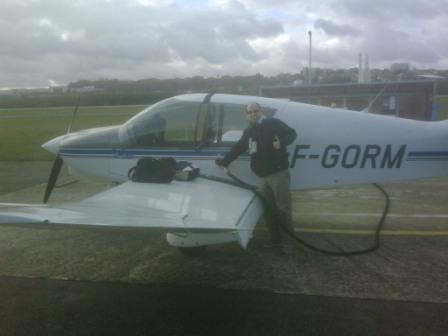
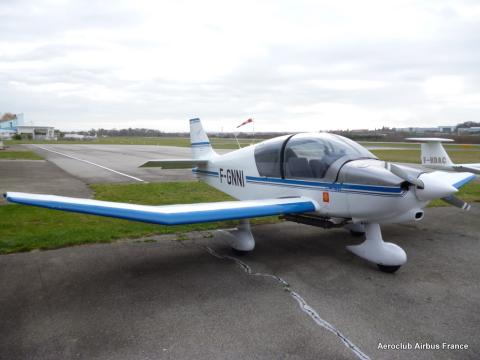
Thus, we took the Robin DR-400-120 Petit Prince with matriculation number F-GNNI (Fox(trot) Golf November November India). A mainly wooden French plane which is quite popular in France. The aircraft has a piston engine which delivers 120 HP, cruises at about 200 km/h, has an empty weight of about 600kg (573kg as per the latest rapport de pessée)… you can see it below:

Robin DR-400 F-GNNI.

Robin DR-400 F-GNNI.

As Thierry proposed, we first made 3 tours de piste, that is 3 laps around he aerodrome circuit.

Despite of some comments on the landings, one take-off performed with flaps retracted (see #Jk5022), at the end of the third landing Thierry got off the aircraft, got his walkie-talkie to hear and intervene in the communications if needed (which was not needed) and went to aéroclub office.

Then, I was finally alone in the plane.

Message to the radio (the tower was not working by then, thus I sent a message to other aircraft in the frequency, 122.7): “Toulouse-Lasbordes, DR-400 au parking Airbus, je roule au point d’arrêt piste 34“. I then went through the different check lists, going through each step in a mixture of Spanish and French (I normally proceed with the list in French but then it felt strange to talk to myself in French thus: “giro al sur y la bille va a la derecha, el cap y el compas decrecen…”).

At about 17:35 UTC, I finally pronounced the words “Fox November India, je m’aligne et je decolle, piste 34“, and with that there I went! (I had to align and take off rather quickly as there was another airplane about to announce its entry in finale).

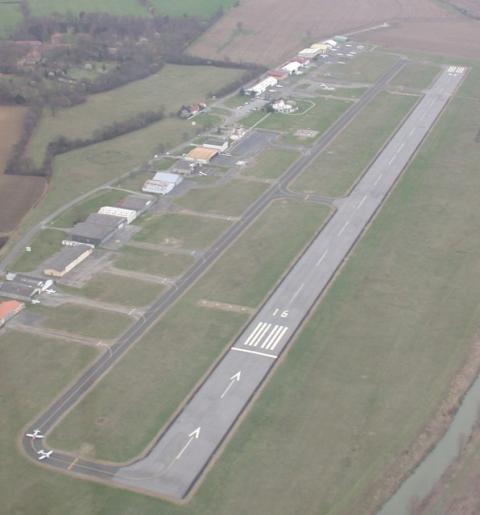
Aerial view of the aerodrome Toulouse-Lasbordes, LFCL (note that today evening the runway in use was the 34, thus, what you see closer is the end of the runway).

Aerial view of the aerodrome Toulouse-Lasbordes, LFCL (note that today evening the runway in use was the 34, thus, what you see closer is the end of the runway).

From then on, an easy flight around the aerodrome that did not take very long but meant a big step for me ensued; a big reassurance. Let’s go through it. Come on board with me…

Take-off: even if I could have taken off at a lower speed, due to the heat and as precaution, I was going to rotate at about 110km/h. Up until then I repeated “the runway is cleared, la vitesse monte, the runway is cleared, all parameters are green…“. I saw some birds flying low and crossing the runway, so I gave myself some seconds before pulling the stick backwards… “je décolle!“.

Climb: immediately after taking off, I had to push the right pedal to compensate the engine effects. During the first phase of the climb I ascended at about 130 km/h (a bit faster as I was alone in the plane) and at 760ft, or 300 pieds sol, I proceeded with the check list après décollage: “volets (flaps) de premier écran à rentrées, pompe électrique off and check that all parameters are still green“. Proceed with the climb now at 150km/h.

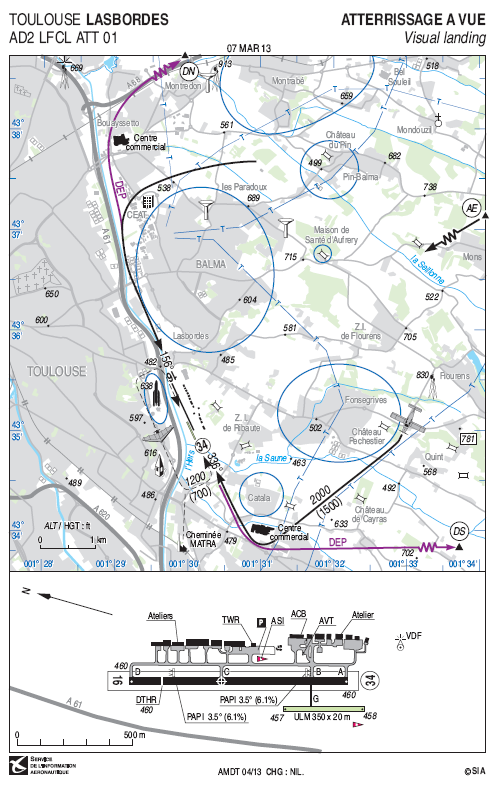
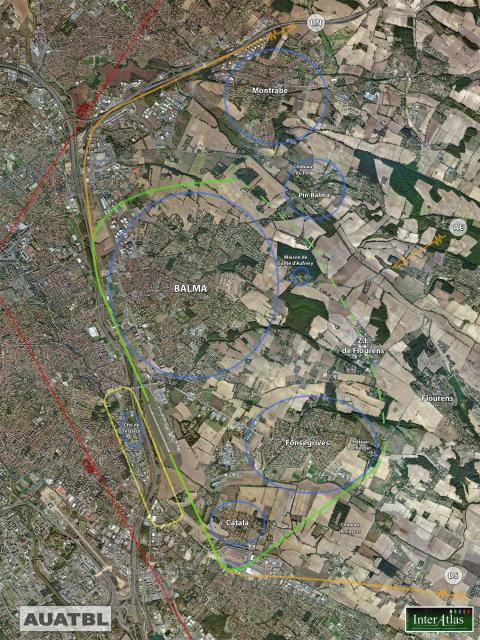
Integration in the aerodrome circuit: You can see in the pictures below the aerodrome circuit, both as it appears in the aeronautical chart [PDF, 644KB] and with a satellite image.

Toulouse Lasbordes (LFCL) carte of the aerodrome (Carte VAC).

Toulouse Lasbordes (LFCL) carte of the aerodrome (Carte VAC).

View of the "circuite de aérodrome".

View of the “circuite de aérodrome”.

As soon as I had passed the village of Balma I turned East still ascending (following the green line upwards and to the right as per the satellite image). Then, just between Balma and Pin-Balma (blue circles in the satellite image) there is a farm which serves as starting point for the aerodrome circuit.

There, I announced myself again: “Fox(trot) November India au début de vent arrière piste 34“. I then reduced the gas from 2,500rpm to 2,000rpm, switched on the electric pump, the carburetor heating and deployed the flaps to the first position (10º)… with those settings the speed should come to 150km/h. I then noticed that while performing these actions I had gained some 200ft (above the 2,000ft of the circuit), which I proceeded to lose quickly and, once corrected, I trimmed the aircraft for 150km/h at 2,000ft QNH.

When I spotted the Château de Pechestier (see carte VAC above), I turned right following the ligne à haute tenstion, reduced the power from 2,000rpm to 1,500rpm (keeping the speed at 150km/h) while losing altitude from 2,000ft to about 1,100ft when over flying the commercial centre at the turn between the sectors étape de basse and finale.

Final approach: “Fox(trot) November India en finale pour un complet“. I then deployed the flaps to the landing configuration (60º) and fixed my sight on the number 34: “vitesse (> 120km/h) – le plan (3.5%) – vitesse – l’axe – …“.

Landing: I believe that one has been the best landing I have performed so far. I guess I was so concentrated that I definitely did my best… I slowed down, exited the runway, “Fox(trot) November India la piste est dégagée, je roule au parking et quite la radio“. I then proceeded with the different check lists, went to the parking of the aeroclub, turned off the airplane… and that was it!

Thierry: “Well, How does it feel the first solo flight?”… the first solo flight.

5 Comments

Filed under Aerospace & Defence

The Museum of Flight (Seattle)

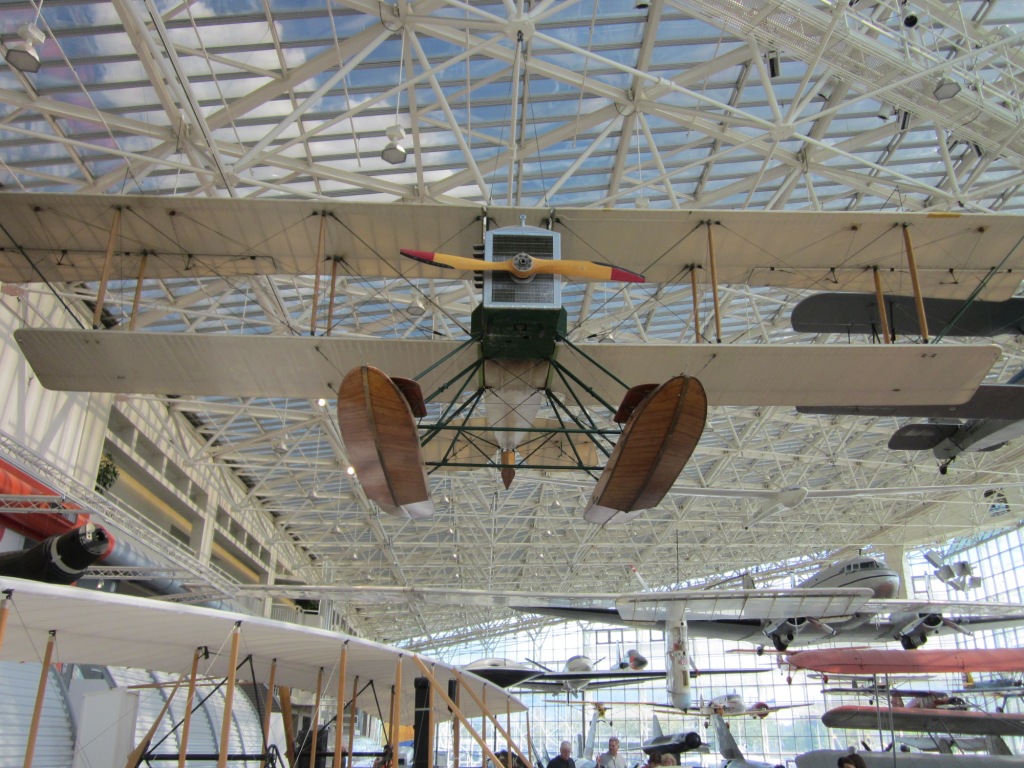
The Museum of Flight, in Seattle, is yet another great aerospace museum. It reminded me very much to the National Air and Space Museum in DC both because of the wealth of aircraft and artifacts in display and the variety of explanations provided (videos, sounds, readings, gadgets to play with…).

The museum is divided in the following areas:

  • Boeing Model 1.

    Boeing Model 1.

    T. A. Wilson Great Gallery (named after Boeing CEO from 1969-1986): this is the first gallery you face when you enter the museum. It hosts:

    • a replica of Boeing Model 1 (first Boeing airplane),
    • a Lockheed SR-71 Blackbird plus a cockpit for visitors to enter in it,
    • a 737 converted into a theater with movies being played inside,
    • an exhibition of the bush pilots of Alaska and the development of air mail,
    • some flight simulators,
    • a DC-3, a Bell “Huey” UH-1H Iroquois, etc.
  • Bill & Moya Lear Gallery (Space Exhibit, named after the founder of Lear Jet Corporation): located at the side of the Great Gallery it has a diorama of the Apollo 17 landing site, with rover included, a replica of the International Space Station Destiny Research Laboratory, etc.
  • The Tower: with direct view over the runway.
  • William E. Boeing Red Barn (named after Boeing founder): in my point of view this is “the” highlight of the museum (allow yourself over an hour for this part alone). It explains both:
    • the birth of aviation: with models and panels explaining the contributions of many of the aviation pioneers (see this blog post in which I went through some of them), and,
    • the history of Boeing: from the moment in which the timber businessman, Bill Boeing founds the company, the first Boeing Model 1 (see replica in the picture above), the tools, materials and processes used at the time, how did the factory look, the great aircraft programmes which meant different breakthroughs for the company and the great engineers behind them…
  • Charles Simonyi Space Gallery (named after the Microsoft executive who became in 2007 the 5th space tourist and who in 2009 travelled to the International Space Station): which highlight is the Space Shuttle Trainer used to train Space Shuttle astronauts at Johnson Space Center in Houston.
  • Airpark: with the Boeing 747 “City of Everett” (first ever 747, first ever wide-body aircraft), a Boeing 707 Air Force One, a Concorde, a Lockheed Constellation…
  • J. Elroy McCaw WWI and WWII galleries (named after a broadcasting magnate): unfortunately I did not have time to properly visit these galleries before the closing of the museum… a reason to come back again.

See some of the pictures I took at the museum:

This slideshow requires JavaScript.

I definitely recommend to visit this museum if you happen to be in Seattle. It is located in the South of Seattle at Boeing Field / King County airport. I would suggest to take no less than 5 hours to visit the museum and to arrive before noon, otherwise there will be some parts that you will not be able to visit properly (as it happened to me with the WWI and WWII galleries).

2 Comments

Filed under Aerospace & Defence, Travelling