Category Archives: Aerospace & Defence

Turboprops market different dynamic

In the last post I discussed about the dynamics of commercial aircraft orders and its correlation with air traffic growth and GDP growth.

In the previous post, I had discussed about turboprops. Today, I want to connect the two dots in a particular way.

I want to show how civil turboprop market is unrelated to the larger and more known turbofan civil aircraft market and how its dynamics are completely unrelated to World GDP growth and thus world air traffic growth.

For this purpose I studied the numbers of ATR (using the info available in its website from yearly news releases discussing results).  I proceeded in the same way as before, analysing the correlation between the different variables.

In order to take a larger time span, I used ATR deliveries instead of orders, as I found a larger data set for deliveries (obviously aircraft delivered were previously ordered, lag in between is not that obvious, today’s backlog is about 3 years production).

In the following graphic I plotted ATR deliveries, GDP growth and oil price:

ATR deliveries vs. GDP growth and oil price.

When calculating correlation between the different variables, I discovered that the correlation between GDP and deliveries is rather low, despite of the time lag applied (be it 2, 3, 4 years…). However I found that the oil prices and deliveries did correlate very well with a lag of 5-6 years, yielding coefficients of 0.55-.65, which are rather high.

This different behaviour of the turboprop market compared to the bigger turbofan market could be explained by the oil price forecasts that airlines shall make each time the oil price goes up.

Again, I can imagine some C-suite executive of a regional airline demanding an oil price forecast/report with which to substantiate his gut-feeling that prices will continue to go up and thus turboprops,  which are more fuel-efficient than turbofans, will be best suited for their short-haul routes.
3 Comments

Filed under Aerospace & Defence, Economy

Air traffic growth vs. aircraft orders

Taking the topic of the headline of this post I want to share some reflections on the commercial aircraft market.

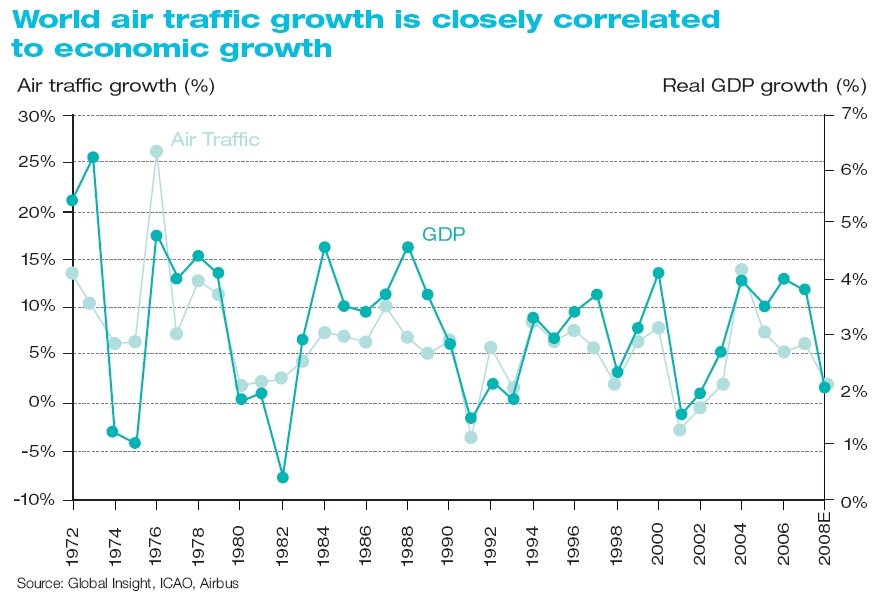
The first is how closely air traffic growth is correlated to world economic growth. This sentence and the following graphic are taken directly from the Global Market Forecast [PDF, 7.9MB] produced by colleagues at Airbus.

Air traffic growth vs GDP growth (source: Airbus).

You may see in the graphic the correlation (correlation coefficient above 0.7) and how the air traffic growth is however much more volatile than the economic growth. This is very intuitive. The better the economic situation the more business trips, family visits and holiday trips will take place. Nevertheless Airbus explains that in some situations and regions this is not enough to forecast traffic and thus they produce hybrid models.

Then, I wondered: how do airlines translate this growth in traffic into airplane orders?

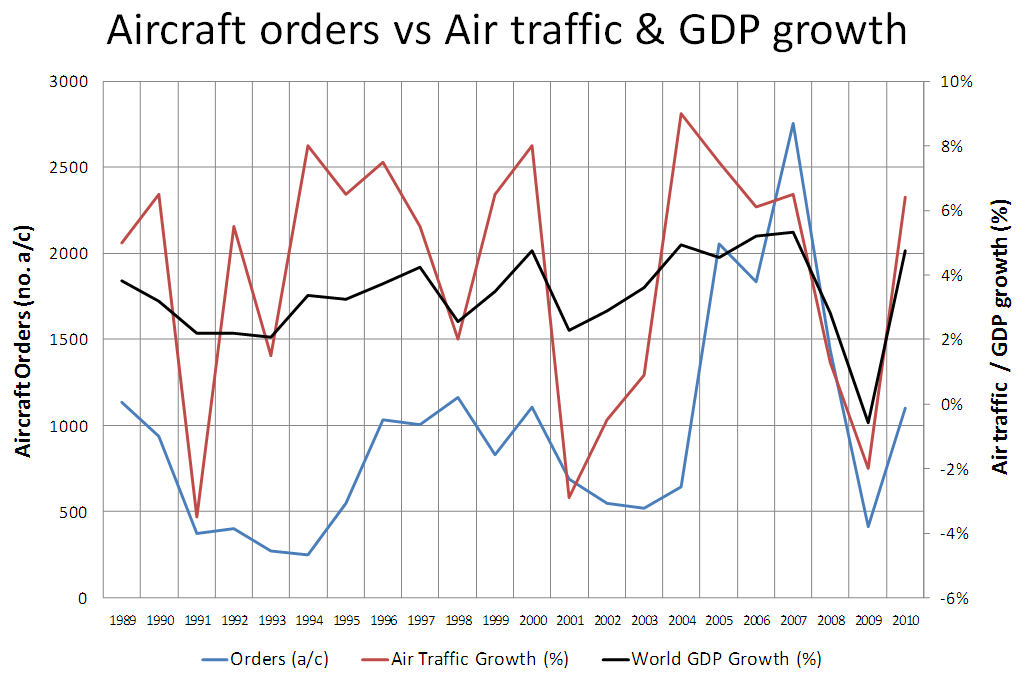
I made some numbers and played with them. I gathered aircraft orders for both Boeing and Airbus in the last ~20 years, plus air traffic and GDP growth over the same period of time. Then, I tried to connect one with another and see how best they would correlate with each other. Even though correlation does not imply causation, it may indicate existence of such causal relations that it’s why I searched for such results.

Here I plotted GDP growth (IMF), traffic growth (ICAO) and aircraft orders:

Aircraft orders vs. air traffic and GDP growth.

One could expect that airlines, after collecting first hand data of traffic growth plus the aggregate demand from industry sources (IATA, ICAO) and after applying their complex planning models would order aircraft from manufacturers. Thus, a correlation might be expected between traffic growth and aircraft orders. What we don’t know is whether airlines would place orders in the same year where the traffic growth actually takes place or there would be a lag (due to the airline analysis process, the negotiation with the manufacturer, arranging the financing, waiting for the next air show…).

The correlation results I got between these 2 variables are satisfactory though not that high. Matching data of the same year yields a 0.35 correlation coefficient. If however, we apply a 1-year lag in between air traffic growth data and orders the correlation is better, 0.44 (a lag of 2 years would worsen it down to 0.27 and so forth).

I found it curious that correlation between orders and GDP growth is much better! Matching data of the same year yielded a 0.61 correlation coefficient (which is rather high). A lag of a year would produce a still high 0.56 (2-year lag, 0.41; 3-year, 2.6…).

This was a striking result for me. After all, even though individual airlines do have complex models and experienced analysts behind them, taking the aggregate of the market, it seems that orders are placed less on data of traffic and more relying on data of economic growth, and rather soon, acting within the same year or a year later!

Who knows how the process within the airlines actually works… I can imagine thoroughly thought and thick studies coming from planning & analysis departments being put aside in the board room where one or two directors (more assertive than the average) convince the rest of the soundness of an operation based half in broad economic prospects (world GDP growth) and half in gut-feeling… wouldn’t surprise me much.

Leave a comment

Filed under Aerospace & Defence, Economy

Turboprops

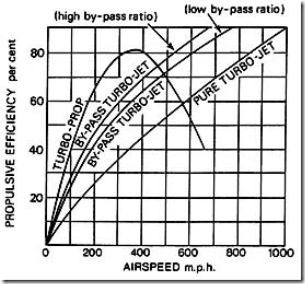
Since some time ago I wanted to write a small entry just to show the following graphic to point a very basic issue to non-engineers:

Efficiency vs. airspeed.

I have very often heard remarks about turbo propellers referring them as old or old technology, etc. I guess that this comes from seeing images of old aircraft with propellers and reciprocating engines, and now people being used to fly in turbofan engines.

However, turbo propellers are neither old nor a worse technology. As almost everything in engineering it all depends on what the requirements are and the price to pay for the solution. Then come the trade-offs. As you may find in the Wikipedia entry [turboprops] “they are mostly used where high-performance short-takeoff and landing (STOL) capability and efficiency at modest flight speeds are required”.

The first requirement is among the ones explaining why some military transport aircraft such as the C-295, the C-130 or the most modern A400M are equipped with turboprops.

The second requirement explains why some regional airlines employ turboprops for short-haul flights, when the distance can be covered at a bit lower speed without a big impact in the flight time.

If you take a look at the picture above, you could start roughly guessing what type of engine you would choose depending at what speed you would normally fly (then more requirements would come into play).

Leave a comment

Filed under Aerospace & Defence

Lamentable entrevista de Ana Pastor a Mahmud Ahmadineyad

El pasado día 15 leí varios tweets haciendo referencia a una entrevista que la periodista de TVE Ana Pastor había hecho a Mahmud Ahmadineyad. Así que la vi.

Debo ser muy raro, porque no he dejado de leer elogios a la periodista y a mí me parece que la entrevista, el papel que hizo como entrevistadora, es lamentable. Sin paliativos.

Me explico:

Se pasa la entrevista interrumpiendo las respuestas del entrevistado o apresurándole con frases del tipo “déjeme estamos terminando, me dicen que se me acaba el tiempo”.

En ocasiones contradice al entrevistado. Aunque éste diga cosas que no sean ciertas, ¿interesa acaso lo que piense la entrevistadora?.

Sonríe mostrando desinterés por las respuestas del entrevistado. Por ejemplo, cuando Ahmadineyad le dice que las armas que usa Libia son vendidas por Occidente. Quizá no le guste escucharlo, pero antes de hacer la entrevista podría haberse informado y habría visto que es cierto.

Esto último me es fácil de comprobar porque he visitado las fuentes anteriormente. Dejo a continuación un par de ejemplos fácilmente demostrables:

  • España. Fuente: el ministerio de industria [PDF]. Las exportaciones en 2009 NO fueron de defensa ni armas como la prensa ha dicho en varias ocasiones, sino lo que se llama material de doble uso, como radares para navegación y control de tráfico aéreo. En total fueron 12.7 millones de €. Habría luego que ver el uso que finalmente se le da.
  • Francia e Italia. Fuente: el Stockholm International Peace Research Institute (SIPRI), autoridad internacional en la materia. En la siguiente herramienta, se puede hacer una búsqueda de exportaciones de armas con destino Libia en los últimos 20 años. Aparece un registro por valor de ~168M€ de exportación de misiles anti-tanque MILAN por parte de Francia, y otro por valor de ~80M€ de exportación de helicópteros por parte de Italia.
  • Estados Unidos. Fuente: el Departamento de Defensa. En su informe anual de 2009 [PDF] muestra como Libia, que había estado bajo embargo durante años, desde 2006 comenzó a recibir exportaciones comerciales de armas desde Estados Unidos, aunque por un valor muy bajo, menos de 1M$ en 2009.

Si la gente vitorea la entrevista porque le ha plantado cara a Ahmadineyad, me parece bien, pero le podría haber tirado un zapato o una estatuilla de Il Duomo a la cara, en vez de hacer una entrevista.

Si TVE quería incordiar y molestar a Ahmadineyad, podría haber hecho muchas otras cosas, en vez de una entrevista.

Si querían presentar una imagen deplorable o ridícula de Ahmadineyad podrían haber hecho un documental, en vez de una entrevista.

A mi ese hombre también me parece detestable. Pero es que Ana Pastor termina la entrevista diciendo “creemos que es bueno escuchar todas las opiniones”, y precisamente eso es lo que no ha hecho. Si desde TVE, no lo querían hacer que no le hubiesen puesto un micrófono delante para empezar.

Lamentable.

Lo único bueno que me pareció que tuvo la entrevista fue el saludo final en farsi.

5 Comments

Filed under Aerospace & Defence, Twitter & Media

Wrong forecasts

Close to midnight of past Thursday we learnt that the winner of the KC-X competition to provide the aerial refuelling aircraft to the US Air Force was Boeing. That was cold news for our company.

I had just tweeted the previous day my bet on the competition:

I never get it right...

To reach to that conclusion I had done some numbers for fun on a late Friday afternoon some months ago in a similar fashion than the defence analyst Scott Hamilton showed in his blog. It is clear that I got it completely wrong.

As I have often told to my friends and colleagues, I am extremely bad with these predictions, as I was already mistaken when the JCA and the previous KC-X competitions were decided…

A note of humour: as my brother points out in fact I am very reliable, you just have to bet to the opposite option of my forecast.

Another colleague told us yesterday “you look like economists explaining your miscalculations…”, as someone put it “it is already hard to explain the past, it is even more difficult to predict the future”.

Already looking forward to the next win.

3 Comments

Filed under Aerospace & Defence

Model of an airport

When I was in primary school I used to have a friend who had an impressive train model layout at home. Soon after, my parents gave me some very nice models that I still keep, though I do not play with them anymore and never continued to grow the layout nor purchased more train models.

Since I joined EADS I began collecting a few static models of aircraft: first an A380, then a Beluga, an A340-600, 2 A400M… Each time I stop at Schiphol airport with enough spare time I pay a visit to the model shop over there, so do I to Airbus online shop

"Static" aircraft model collection at home... as of today.

However, few days ago, I found via Twitter a post in a blog that contained the following video of a model of an airport in Miniatur-Wonderland, Hamburg:

… if I take on this hobby it could be the beginning of my own end! What it’s sure is that whenever I go to Hamburg I’ll pay a visit to the place.

2 Comments

Filed under Aerospace & Defence

A380, a game-changer

Probably you remember having seen in some magazines ads paid by airlines showing their luxury A380 cabins. Singapore Airlines was the first one in launching this kind of branding campaigns.

According to the definition by the Business Dictionary: Branding aims to establish a significant and differentiated presence in the market that attracts and retains loyal customers.”

Few days ago, I received an email with publicity from a company that operates the A380. As you can see, they go a step beyond: they now use the A380 not only for branding but for advertising a concrete product, a specific flight. In one of the destinations offered you may see a label indicating that the flight is served by an A380.

Ad: flight served by an A380.

From the Wikipedia: Advertising is a form of communication intended to persuade an audience to purchase or take some action upon products, ideas, or services.”

If they use it there must be a reason behind. I have heard from colleagues that, in fact, the companies already operating it in some of their routes are noticing that repeatedly the connections offered by an A380 show higher passenger load factor or occupancy rates than the same connections when offered by a different aircraft.

I have never seen anything like this before. It could have happened when the B-747 entered into service in the 70’s, but I was not here then; I didn’t witness it. It doesn’t happen now; not with the 747 nor with other aircraft. I certainly do not base my buying decisions, when I have to flight within Europe, on whether the airline operates a B-737 or an A320 (maybe I should!). But exactly this is happening in the case of the A380. And airlines are profiting from it.

In a previous post I wrote about the difference in current forecasts for the A380 that Airbus and Boeing report (Boeing has steeply reduced its reported forecast in the past decade). If the appeal of the aircraft continues to bring customers in, we could have a reason to believe that in end the orders figure of A380 maybe rather high. Only time and the market will let us know.

In its website, Airbus dubs the A380 as game-changer. One could expect this when a company is talking about one of its products, however when others are basing its branding and advertising on it, we seem to be really facing a game-changer.

Leave a comment

Filed under Aerospace & Defence, Marketing

Salesmanship at Airbus

Yesterday I saw John Leahy, Airbus sales chief, in the corridors of the company for the first time since I arrived to Toulouse. At night, I found via Twitter this special report about him by Reuters.

The report is a very interesting piece, and reading in it about Jean Pierson reminded me of a very curious story I heard some years ago and I wanted to recall for you (this is the only reason for this post).

Pierson was the CEO of Airbus from 1985 to 1998. The story I am talking about appears described in the book “Boeing versus Airbus”, by John Newhouse (I haven’t yet read it but is in my wish list). Let me extract the summary that Reuters gave in this other article.

Pierson […] was at US Airways’ headquarters for what he thought would be a short meeting to tie up a 400-plane deal, the anecdote runs.

At the last minute, US Airways’ then-chairman Stephen Wolf started arguing for a 5 percent discount on the selling price.

“Pierson began slowly lowering his trousers and saying ‘I have nothing more to give.’ He then allowed the trousers to fall around his ankles,” says Newhouse in his book.

Wolf replied: “Pull up your pants. I don’t need any more money,” and the deal was signed, according to the book. The author says he got the story from Pierson himself, and it was confirmed by another person present.

Shortly afterward, US Airways announced the purchase of 124 single-aisle Airbus A320 family jets with options for 276 more, a stab into the heart of Boeing’s competing 737 program. It put the European company on track to overtake Boeing in global orders only two years later.

If the situation ever calls for me to drop my trousers I hope there is no one nearby with the intention of reporting it in a book :-).

3 Comments

Filed under Aerospace & Defence, Books

Impact of Airbus in Toulouse employment

Some days ago, I attended for the first time a meeting of Rosemasters club in Toulouse. We were about 20 people attending. During the introduction round we discovered that there were 5 Airbus employees among us, which was 25% of us (plus 2 former employees). This could be expected given the importance of Airbus in the city of Toulouse… but, how important is it really?

I had read in some studies about the impact of air transport and aerospace industries in the economy of a given region; taking into account direct employment, indirect and induced. You may take a look at the report “The National Economic Impact of Civil Aviation” [PDF, 1.5MB] prepared by DRI•WEFA, to see some multipliers (Table 1 in page 8).

In the study, we can see that in the case of the USA, for every aerospace job there are 1.9 indirect jobs created and 1.5 induced jobs; thus one aerospace job creates 3.4 jobs.

If we use the same figures for the case of Toulouse:

  • Airbus and  EADS employ over 21,000 people here;
  • there would be another 41,000 indirect (employment generated in the businesses that supply goods and services to the aerospace sector) and
  • 32,000 induced jobs (employment in other sectors generated thanks to the income spent by direct and indirect aerospace-related employees) thanks to the activity of EADS in the region, in total ~73,000 extra jobs.

These together with the 21,000 jobs from EADS make up for a total of ~94,000 jobs.

Toulouse is a city of ~440,000 inhabitants, with 1.1 million living in the metropolitan area: ~9% of the population of the metropolitan area has a job created directly or indirectly thanks to EADS activity… if we talk about families, between 25-30% of the families depend on a job created directly or indirectly thanks to EADS activity.

No doubt, aerospace is a strategic sector for the region.

4 Comments

Filed under Aerospace & Defence, Economy, France

Women in aerospace

I recently read an article titled “Why don’t women run airlines?” I found the question interesting, because I have had some conversations about the number of women and especially in management positions within my company.

Surely there are a lot of issues and reasons behind (e.g. what is called “the glass ceiling”) that have been well-studied. When encountered with this question, I asked my senior peers within the department how many women were in their class at the university when studying aerospace engineering: the answer was one or none. That is the proportion of women that one could expect should be in the top management of the company now.

Luckily the trend now is changing, but still, in general, the aerospace sector is lacking women. I compiled some statistics:

  • Only 4% of flagship airlines had a woman as CEO (according to the study in the above-mentioned article).
  • 19,627 women worked for EADS (16.5%) at the end of 2009 (17% in the case of Spain; 13.6% in the case of Airbus).
  • 31.9% women out of the 39,469 students of the Universidad Politécnica de Madrid in the year 2004 (I found this information using the Wayback Machine as the university does not publish this anymore in its website).
    • The admissions of that year kept the same proportion, 32% women.
  • 25.8% women out of the 1,983 students of my engineering school that same year (Escuela Técnica Superior de Ingenieros Aeronáuticos, now EIAE).
    • The admissions of that year had a higher proportion, 31.7% women (something is changing).
  • 41 women out of 191 (21.5%) students graduated with me in November 2005.
    • The promotion of 2005, ideally should have started in September 2000. That year, there were admitted 117 women out of 368 students, or 31.8% (the year I started, 1999, the proportion was 25.2% women… though not published, I guess the share was lower in previous years).
    • The fact that women were 21.5% of graduates while being 25.8% of the population of the school may point at some of the other reasons, which I am not qualified to discuss.

Even if there was no discrimination, I believe it will take some years before 32% of EADS workforce and top management are women (~25 years? when the proportion of the students now in the university reaches all stages of the age pyramid of the company). I guess the same will apply for airlines.

I’m afraid it may never happen that 50% of the workforce in the company are women, probably not until 25 years later than we see such a proportion in the aerospace engineering schools… which 5 years ago was still 32%.

Leave a comment

Filed under Aerospace & Defence