Category Archives: Books

The Art of War

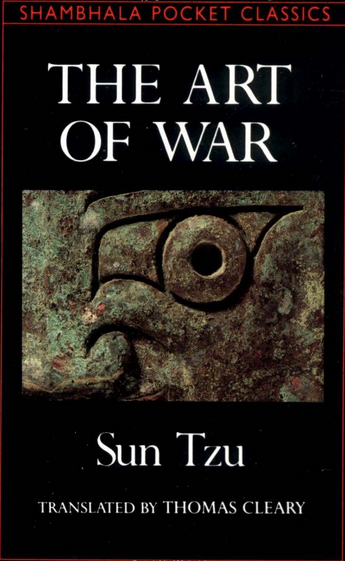
The Art of War, by Sun Tzu.

The Art of War, by Sun Tzu.

I recently finished reading The Art of War for a second time. The book in itself verses on tactics, strategies and concepts related to war. However, today it is recommended for and applied to several fields, from politics, to business management and sports.

The first time I read it I was fresh from having completed an MBA and soon joined the strategy department of Airbus Military, the company I work for. I then took an interest to it from the strategy point of view. However, this time I wanted to read it framing myself from the teamwork, communication and leadership point of view. I found it again, a very enjoyable and useful read.

The book is attributed to Sun Tzu, a Chinese military general, strategist and philosopher who lived in the ancient China (544-496 BC). The version I read is a Spanish translation (by Alfonso Colodrón) from the English translation by Thomas Cleary. If you’re an avid reader of business literature you’ll probably have found some quotes from the book. The ones I remarked this time from the point of view I approached it (the emphasis and comments between brackets are mine):

The Army on the March

If you are careful of your men, and camp on hard ground, the army will be free from disease of every kind, and this will spell victory.

Peace proposals unaccompanied by a sworn covenant indicate a plot. [think of inter-departament relationships]

If there is disturbance in the camp, the general’s authority is weak. [indecision]

The sight of men whispering together in small knots or speaking in subdued tones points to disaffection amongst the rank and file. [engagement]

Too frequent rewards signify that the enemy is at the end of his resources; too many punishments betray a condition of dire distress. [rewards vs. engagement; purpose; self-realization]

To begin by bluster, but afterwards to take fright at the enemy’s numbers, shows a supreme lack of intelligence.

He who exercises no forethought but makes light of his opponents is sure to be captured by them.

If soldiers are punished before they have grown attached to you, they will not prove submissive; and, unless submissive, then will be practically useless. If, when the soldiers have become attached to you, punishments are not enforced, they will still be useless. [reminded me of Jack Welch and the need to discriminate]

Terrain

Regard your soldiers as your children, and they will follow you into the deepest valleys; look upon them as your own beloved sons, and they will stand by you even unto death. If, however, you are indulgent, but unable to make your authority felt; kind-hearted, but unable to enforce your commands; and incapable, moreover, of quelling disorder: then your soldiers must be likened to spoilt children; they are useless for any practical purpose.

Take a look at the book. It can be read in no more than one afternoon. Depending from what perspective you take you will draw some conclusions or others. Some passages will not relate much to your current situation, but several others will.

3 Comments

Filed under Books

Born to run

Born to Run cover.

Born to Run cover.

I recently finished the book “Born to Run“, by Christopher McDougall a runner and author who has collaborated with several magazines including Men’s Health. The book, published in 2009, has recently become a classic reading for runners.

The main thesis of the book is the support of what is called the Endurance running hypothesis, which explains some human evolution traits as being adaptations for long distance running, suggesting that early humans hunted down animals by running after the prey till it died of exhaustion.

Prior to reading the book I had watched some years ago the following TED talk [15’52”] from the author in which he explains the same thesis.

I have to admit that after listening to the talk I was quite sceptic and became somewhat reluctant to the reading of the book. It has been only years after that I was curious enough to give it a try. Now, having completed it, I have to say that the book is quite entertaining and the writing style of McDougall makes it enjoyable.

The other main theme of the book is the approach to the Tarahumara people, native American indians living in the North West of Mexico, which are known for their endurance running.

The book ends with the first Copper Canyon Ultra Marathon, run in 2003 over 51 miles, organized by Micah True (Caballo Blanco) and gathering several Tarahumara natives and some elite American ultramarathon runners. In previous chapters, the author introduces all of the characters that ultimately will take part in the race along some other thesis such as the vegan diet and barefoot running, which I continue to be sceptic of.

What I appreciated most about the book was the vivid description of epic races that took place in the past like some editions of Leadville Trail 100 or the already mentioned Copper Canyon Ultra Marathon, the getting to know those races or the Western States, the Badwater Ultramarathon (through the Death Valley), being introduced to both some legendary Tarahumara runners (Manuel Luna, Arnulfo…) or Western ones such as Scott Jurek, Ann Trason, Matt Carpenter, etc.

Thus, I would recommend the book as an entertaining read and motivating one for someone who is into running even if I remain sceptic of some of the thesis if defends.

Leave a comment

Filed under Books, Sports

Warren Buffett’s 2012 letter to the shareholders of Berkshire Hathaway: dividends, books and sport

Last Saturday Warren Buffett’s 2012 letter to the shareholders of Berkshire Hathaway [PDF, 155 KB] was released. As always, I strongly encourage you to read it (23 pages).

From this year’s letter, I wanted to comment on 3 things:

  • Lesson on dividends’ policy
  • Books
  • Running

****

Dividends’ Policy

In my opinion the great lesson from this letter starts at page 18, when Warren explains the different ways a company has to allocate earnings. He makes a comparison between dividends and what he calls the “sell-off” scenario, where a shareholder can be better off when the company is not paying dividends and instead reinvesting all earnings while the shareholder sells part of his shares to obtain some cash.

See the explanation below (bit long):

“We’ll start by assuming that you and I are the equal owners of a business with $2 million of net worth. The business earns 12% on tangible net worth – $240,000 – and can reasonably expect to earn the same 12% on reinvested earnings. Furthermore, there are outsiders who always wish to buy into our business at 125% of net worth. Therefore, the value of what we each own is now $1.25 million.

You would like to have the two of us shareholders receive one-third of our company’s annual earnings and have two-thirds be reinvested. That plan, you feel, will nicely balance your needs for both current income and capital growth. So you suggest that we pay out $80,000 of current earnings and retain $160,000 to increase the future earnings of the business. In the first year, your dividend would be $40,000, and as earnings grew and the onethird payout was maintained, so too would your dividend. In total, dividends and stock value would increase 8% each year (12% earned on net worth less 4% of net worth paid out).

After ten years our company would have a net worth of $4,317,850 (the original $2 million compounded at 8%) and your dividend in the upcoming year would be $86,357. Each of us would have shares worth $2,698,656 (125% of our half of the company’s net worth). And we would live happily ever after – with dividends and the value of our stock continuing to grow at 8% annually.

There is an alternative approach, however, that would leave us even happier. Under this scenario, we would leave all earnings in the company and each sell 3.2% of our shares annually. Since the shares would be sold at 125% of book value, this approach would produce the same $40,000 of cash initially, a sum that would grow annually. Call this option the “sell-off” approach.

Under this “sell-off” scenario, the net worth of our company increases to $6,211,696 after ten years ($2 million compounded at 12%). Because we would be selling shares each year, our percentage ownership would have declined, and, after ten years, we would each own 36.12% of the business. Even so, your share of the net worth of the company at that time would be $2,243,540. And, remember, every dollar of net worth attributable to each of us can be sold for $1.25. Therefore, the market value of your remaining shares would be $2,804,425, about 4% greater than the value of your shares if we had followed the dividend approach.

Moreover, your annual cash receipts from the sell-off policy would now be running 4% more than you would have received under the dividend scenario. Voila! – you would have both more cash to spend annually and more capital value.”

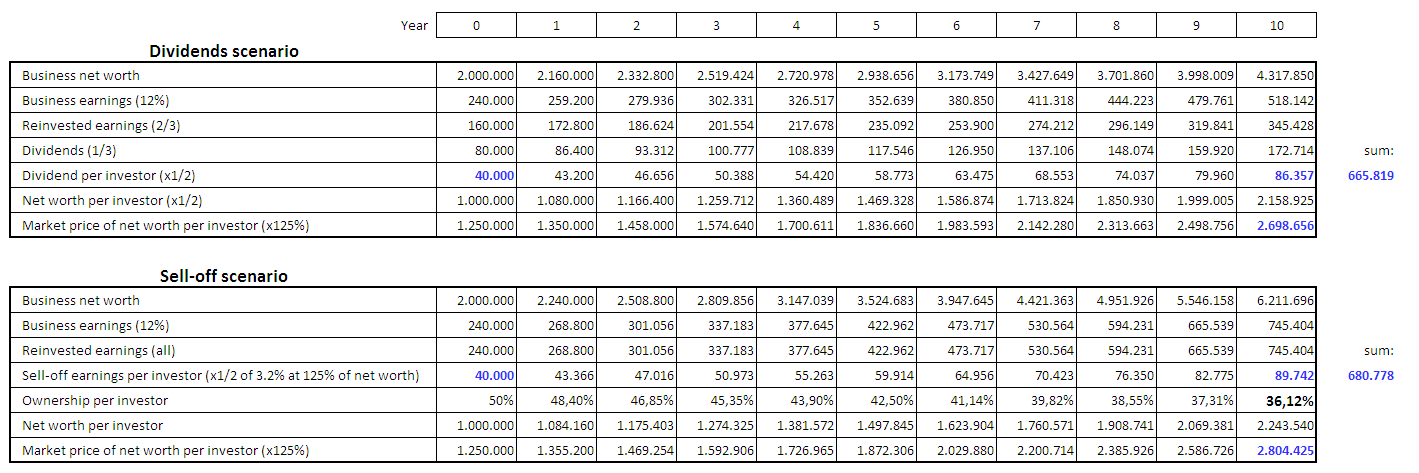
As always, I believe that the best way is to make (play with) the numbers yourself, so you get to understand it once and for all. I paste here the numbers for those not being number-crunchers:

Buffett's sell-off case vs. dividends.

Buffett’s sell-off case vs. dividends.

Books

Over 2 years ago, I read Buffett’s biography “The Snowball: Warren Buffett and the Business of Life“, by Alice Schroeder (of which I wrote a post); it seems that I will have to get the newest one by Carol Loomis, “Tap Dancing to Work: Warren Buffett on Practically Everything“.

There is another book that I should read, according to the following passage in the letter:

“Above all, dividend policy should always be clear, consistent and rational. A capricious policy will confuse owners and drive away would-be investors. Phil Fisher put it wonderfully 54 years ago in Chapter 7 of his Common Stocks and Uncommon Profits, a book that ranks behind only The Intelligent Investor and the 1940 edition of Security Analysis in the all-time-best list for the serious investor. Phil explained that you can successfully run a restaurant that serves hamburgers or, alternatively, one that features Chinese food. But you can’t switch capriciously between the two and retain the fans of either.”

I’ve got all three books in the shelf since 5 years ago, it’s a shame that I have not yet read or gone through the first one!

Running

I found one final surprising and hilarious passage at the end of the letter embedded in the information related to the shareholders meeting:

“On Sunday at 8 a.m., we will initiate the “Berkshire 5K,” a race starting at the CenturyLink. Full details for participating will be included in the Visitor’s Guide that you will receive with your credentials for the meeting. We will have plenty of categories for competition, including one for the media. (It will be fun to report on their performance.) Regretfully, I will forego running; someone has to man the starting gun.

I should warn you that we have a lot of home-grown talent. Ted Weschler has run the marathon in 3:01. Jim Weber, Brooks’ dynamic CEO, is another speedster with a 3:31 best. Todd Combs specializes in the triathlon, but has been clocked at 22 minutes in the 5K.
That, however, is just the beginning: Our directors are also fleet of foot (that is, some of our directors are).

Steve Burke has run an amazing 2:39 Boston marathon. (It’s a family thing; his wife, Gretchen, finished the New York marathon in 3:25.) Charlotte Guyman’s best is 3:37, and Sue Decker crossed the tape in New York in 3:36. Charlie did not return his questionnaire.”

I would have loved to take part in that race. I will probably do so in some other year :-).

Final confession

Luca and I went a couple of years ago to Berkshire Shareholder meeting. This year’s meeting will take place on May 4th.

This year, Luca and I will get married on May 11th, but one of the dates we considered was April 27th, and one of the drivers behind it was to be able to attend 2013 BRK meeting during the honeymoon…

3 Comments

Filed under Books, Investing

My 2012 reading list

At the beginning of the year I set as a personal objective to read at least 15 books. This will be a low number for some of you and a high one for others. To me it looked challenging but achievable… though, I did not achieve it. I completed 10 books and started other 4 which I have not yet finished (they’ll be included in the next year reading list).

See below the list with a small comment for each one, the link to a post about the book in the blog (when applicable), links to Amazon (in case you want to get them) and sometimes to the authors. I have also included a small rating from one to three “+” depending on how much do I recommend its reading:

  1. This time is different” (by C. Reinhart and K. Rogoff) (++): very interesting book offering a comprehensive book to economic and financial crises since 8 centuries ago. The book is full of graphics, statistics, example, anecdotes… I already wrote three posts about it: “The Republic of Poyais“, “The march toward fiat money” and “¿Cómo le ha ido a España en esta crisis?“. 
  2. Le Petit Prince” (by Antoine de Saint-Exupéry) (++): even if narrated as a children’s book, it contains several idealistic messages, fine criticisms of how adults behave, etc. The teachings are mainly transmitted through conversations between a child and the prince and encounters with other characters… I wrote a post about it “Le Petit Prince“.
  3. The consequences of the peace” (by John M. Keynes) (+++): the book was written at the time of the Versailles Conference after the World War I, which he attended as a delegate from the British Treasury. In the book, Keynes explained how the disaster in the making was being produced, due to lack of communication between representatives from USA, UK, France and Italy, and the intention from Clemenceau of taking as much as possible from Germany. Keynes makes a series of estimates of Germany’s production capabilities and that of the regions being taken from it and comparing them with the pretensions that were being included in the negotiations of the treaty. In the book, he warns well in advance the economic and social disaster that the treaty is going to send Germany into. (I have not yet written a specific review of the book, but since I had underlined several passages I don’t discard writing it).
  4. Le bal des ambitions” (by Véronique Guillermard and Yann le Galès) (+): the book tells the story behind the creation of EADS and its first years. Very much like in a thriller, it gives account about the characters involved, the battles for power, etc. I wrote a post about it “Le Bal des ambitions“.
  5. Desolé, nous avons raté la piste” (by Stephan Orth and Antje Blinda) (+): The book consists of a series of awkward situations in a flight described by passengers, pilots and cabin crew, mainly miscommunications between the crew and passengers or funny messages received from the cockpit. The book originated after a collection of the anecdotes posted by readers of the online version of Der Spiegel. . See the review I wrote about it “Sorry, I missed the runway“.
  6. Poor Charlie’s Almanack: The Wit and Wisdom of Charles T. Munger” (by Charlie Munger, compiled by Peter D. Kaufman) (+++): the book is a compilation of Munger’s speeches, quotes, interviews, articles, letters, etc. Some of his speeches are available in Youtube (e.g. this one given for the commencement of USC Law in 2007). One of the main takeaways is the use of several mental models to analyze situations we live in our lives (instead of being stalled in the few models which we are more comfortable with). Another recurring topic is the lack of training in psychology that we get (or even his criticism of how psychology is taught in faculties). I haven’t written a post about the book, but I think I should, if only to share more of his wit and wisdom with you.
  7. The Peter Principle: Why Things Go Wrong” (by Laurence J. Peter) (+++): the book is a hilarious account of situations that arise in companies and institutions of why and how people are promoted, cornered, etc., or in his words is a treatise on hierarchology. The name of the book comes from the Peter Principle which says: “In a hierarchy, every employee tends to rise to his level of incompetence”. I already wrote about it here.
  8. 2010 Odyssey Two” (by Arthur C. Clarke) (++): the book is a sequel to the famous “2001: A Space Odyssey“, and there is a movie as about this book. The story starts with doctor Heywood Lloyd travelling in a combined Soviet-American mission to Jupiter in order to find the spaceship Discovery One from the previous mission and what went wrong with it… I won’t tell more of the plot to avoid spoiling it for someone. I would say that I liked more this book (and movie) than the first one.
  9. The Litigators” (by John Grisham) (++): this novel is very much like most of John Grisham. In this one the plot is about a star young lawyer graduated from Harvard Law School who cannot stand the pressure from a big firm and quits it to join a mediocre small firm with two partners who chase victims of small accidents to help them get some  compensation from insurance companies, with the hope of reaching the big class action which could make the rich.
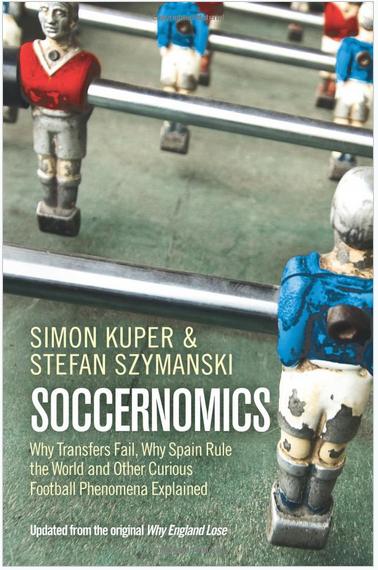
  10. Soccernomics” (by Simon Kuper and Stefan Szymanski) (+++): the authors use economics’ techniques, plenty of data, statistics, citing several papers, studies, etc., in order to bring up uncovered issues about football (such as transfer market, what makes some nations more successful in football…) or refocus the attention about other ones. See the review I wrote about it.

I also completed two other partial objectives: to read at least 2 books in French and 2 about politics/economy. And as always, on the learning side from reading there is Twitter (a source of information or distraction?), the subscriptions delivered to home of the weekly The Economist and the two monthly magazines Scientific American and Toastmasters.

12 Comments

Filed under Books

Ulysses S. Grant on micro management

I loved the candid and at the same time generous description of Union’s general Warren problem with micro management given by Ulysses S. Grant in his “Personal Memoirs”:

Warren’s difficulty was twofold: when he received an order to do anything, it would at once occur to his mind how all the balance of the army should be engaged so as properly to co-operate with him. His ideas were generally good, but he would forget that the person giving him orders had thought of others at the time he had of him. In like manner, when he did get ready to execute an order, after giving most intelligent instructions to division commanders, he would go in with one division, holding the others in reserve until he could superintend their movements in person also, forgetting that division commanders could execute an order without his presence. His difficulty was constitutional and beyond his control. He was an officer of superior ability, quick perceptions, and personal courage to accomplish anything that could be done with a small command.

Well intentioned, with good ideas, forgetting the bigger picture, wanting to keep everything under control, uncapabale of delegating and empowering… evidently, general Warren must had been an excellent officer of a lower rank (“with a small command“) who was raised to his level of incompetence (“His difficulty was constitutional and beyond his control“) following “The Peter Principle” :-).

Leave a comment

Filed under Books

A hilarious anecdote of General Braxton Bragg (by U.S. Grant)

A small post to share a hilarious anecdote I read today in the “Personal Memoirs of Ulysses S. Grant” (which I started reading some months ago, and about which I expect to write further later on in the blog).

After relating how the Battle of Chattanooga was won, U. S. Grant explains in the book some key moves made by the confederate general Braxton Bragg, his personality, etc.

Bragg was a remarkably intelligent and well-informed man, professionally and otherwise. He was also thoroughly upright. But he was possessed of an irascible temper, and was naturally disputatious. A man of the highest moral character and the most correct habits, yet in the old army he was in frequent trouble. As a subordinate he was always on the lookout to catch his commanding officer infringing his prerogatives; as a post commander he was equally vigilant to detect the slightest neglect, even of the most trivial order.

I have heard in the old army an anecdote very characteristic of Bragg. On one occasion, when stationed at a post of several companies commanded by a field officer, he was himself commanding one of the companies and at the same time acting as post quartermaster and commissary. He was first lieutenant at the time, but his captain was detached on other duty. As commander of the company he made a requisition upon the quartermaster—himself—for something he wanted. As quartermaster he declined to fill the requisition, and endorsed on the back of it his reasons for so doing. As company commander he responded to this, urging that his requisition called for nothing but what he was entitled to, and that it was the duty of the quartermaster to fill it. As quartermaster he still persisted that he was right. In this condition of affairs Bragg referred the whole matter to the commanding officer of the post. The latter, when he saw the nature of the matter referred, exclaimed: “My God, Mr. Bragg, you have quarrelled with every officer in the army, and now you are quarrelling with yourself!”

… I tried to rationalize it: having those two hats at the time, Bragg might have wanted to leave in written a record of his request from one side and his denying of it from the other… seeing the reaction of the commanding officer, it seems that there wasn’t a rational side to it. 🙂

1 Comment

Filed under Books

Soccernomics

Soccernomics.

If you love football (soccer) and have read one of the books of the “Freakonomics” saga or any book from Malcolm Gladwell, then “Soccernomics“, by Simon Kuper and Stefan Szymanski (430 pgs.), will be a great read for you.

The book is written in the same style as the other books mentioned above: using economics’ techniques, plenty of data, statistics, citing several papers, studies, etc., in order to bring up uncovered issues about football or refocus the attention about other ones. Some examples:

  • Mastering the transfer market. Departing from the example of Billy Beane in baseball, described in “Moneyball“, by Michael Lewis (of which a movie was also made starring Brad Pitt), the authors show how pouring money in transfer markets doesn’t bring titles. The key issue is to have a balanced net investment (sales/acquisitions). In soccer the main example would be Olympique Lyon which will “sell any player if a club offer more than he is worth”, for which each player is previously assigned a price (much like value investing).
  • The more money is paid to players the better (in salaries). Instead of buying new expensive players it seems to make more sense to pay well and ensure the adaptation of the stars already playing for the team.
  • The market for managers is not yet very open (e.g. no black coaches in main European teams), thus many of them do not make a real difference. There was even an English team Ebbsfleet United who dispensed the coach and allowed subscribed fans to vote the player selection for each match.
  • The book, written at the beginning of 2012 forecasted that soon teams from big European capitals would win the Champions’ League, being those capitals: London, Paris, Istanbul and Moscow. Few months later Chelsea won its first one, let’s see the others.
  • The main factors for the success of football national teams seem to be the experience (international games played by the national team), wealth and population.
  • The authors give much weight to Western Europe dominance of football due to the interconnectedness of continental Europe. Explaining the rise of Spain in the ’90s and ’00s due to its growth in population, improved economy since joining the EU, more experience and exchanges of styles with coaches of other countries.
  • The authors claim that future national football will be dominated by countries such as Iraq, USA, Japan or China.

As you can see there are many different topics, all with some data to support them (even if sometimes you doubt about the consistency of their claims, e.g. their statements on industrial cities as dominating football, dictatorships, etc.). I marked many pages with some anecdotes or papers that I would like to read.

One final anecdote: tips given to clubs and teams in KO competitions in case they face a penalty shoot-out. In the Champions’ League final of 2008, Chelsea and Manchester United reached the penalties. An economist had given Chelsea a study of Manchester goal keeper and penalty-shooters. Once you read the book and the tips the economist provided (“Van der Sar tends to dive to the kicker’s natural side”, “most of the penalties that Van der Sar stops are mid-height, thus is better to shoot low or high”, “if Cristiano Ronaldo stops half-way in the run-up to the ball chances are 85% that he shoots to his natural side”…), it is quite interesting to actually see that penalty shoot-out and how the different players acted.

[Pay special attention at Van der Sar’s reaction at 09’40”, when it seems he noticed about Chelsea having been tipped]

I definitely recommend this book to football fans. I also recommend two other books about which I wrote in the blog some time ago: “How soccer explains the World” and “Historias del fútbol mundial“.

8 Comments

Filed under Books, Sports

Cristiano Ronaldo, Di Stéfano y la tristeza

Viendo el revuelo producido por las declaraciones donde Cristiano Ronaldo decía que se encontraba triste, no pude más que recordar un par de anécdotas de Alfredo Di Stefano.

Una que recordaba haber leído en internet (“Corazón Blanco“) sobre un telegrama que Di Stéfano envió a Bernabeu que recupero:

Alfredo Di Stéfano regresaba a Argentina, sin fecha de vuelta. La Saeta Rubia envía un telegrama a Santiago Bernabéu, a modo de despedida. La misiva, cuyo original está bastante deteriorado y es casi ilegible, dice: “Don Santiago me voy a mi tierra, no sé si volveré pronto. Nunca en estos años se habló mucho de nosotros. Yo llevé la peor parte. Fue un fenómeno o un gamberro. Si no me acerqué a usted fue porque no quería que creyera que busque un puesto regalado. Por lo menos eso no me lo puede quitar nadie. Lo que gané siempre fue con esfuerzo. Observé que para estar bien con usted había que ser falso. Tuve muchas desilusiones y nadie me dio moral. Usted como padre me falló. Ahí se ve que nunca tuvo hijos porque los padres siempre perdonan. Si no vuelvo más le llegue a usted mi felicitación y mi recuerdo cariñoso. Un abrazo, Alfredo”.

Y la otra sobre su despedida del Madrid, anécdota que leí hace años en su biografía “Gracias, vieja” (libro que aprovecho a recomendar), y que se puede leer en el la web del diario As:

“Muñoz se aferraba a que había que vigilar a Facchetti y nosotros decíamos: ‘¿Y quién agarra a Amancio?’. Amancio era como la luz de rápido y estaba jugando fenomenal. Al final, ¿qué pasó? Que Facchetti no se fue arriba casi nunca en el transcurso del partido… Jugamos el encuentro con uno menos, pero Muñoz me mandó a la mierda y me echaron a mí del club porque lo mandé a la mierda yo también”.

Aquel encuentro fue histórico, puesto que fue la última ocasión oficial en la que Di Stéfano vistió la camiseta blanca. Días después, el Madrid disputó la semifinal de Copa ante el Atlético, pero Muñoz no incluyó a La Saeta en la convocatoria.

Leave a comment

Filed under Books, Sports

There are no hot hands in basketball

I started reading the book “Thinking, Fast and Slow“, by the Nobel laureate Daniel Kahneman some months ago, and, even if I am slow progressing with it, I find it extremely interesting.

A recurring topic when reading about how our psychology deceives us is when thinking about probabilities. In this post I wanted to write about a paper he refers to in the book: “The Hot Hand in Basketball: On the Misperception of Random Sequences” [PDF, 1MB], by Thomas Gilovich of Cornell University (1985).

If you have actually made the exercise of coin-tossing several dozens times or have gone several to a casino and watched roulette results, you will believe without effort that seeing long streaks of a certain event (several heads for the coin, over a dozen reds or three 32 in a row for the roulette) is part of the randomness of those games. Basketball players and fans get it consistently wrong when believing in hot hands, and that is precisely what the paper from Gilovich is about and it is a wonderful reading.

It starts with a survey among basketball fans, who no doubt believe in hot hands being behind streaks: 91% believed a player has a better chance of hitting after having converted 2 or 3 throws. They even ventured into assigning probabilities. For a player with 50% in field throws they said the chances of :

  • hitting after a converted throw were 61%,
  • missing after a missed a shot, 42%.

Then he studied the performance of Philadelphia 76ers players (Julius Erving among them) during the season, carefully analyzing the chances of a each player hitting or missing a throw after having missed or hit the previous one, two or three consecutive throws. The results are clear, they do not support the existence of such “hot hands”, they are random. In fact, on average, the chances of hitting after a hit were always lower than the field score % of the team while chances of hitting after a miss were higher and higher than the ones of the supposedly hot hands.

He analyzed the numbers of runs (streaks, like the several heads or tails in a row for the case of a coin) and were not different that what could be expected randomly.

He went on to analyze whether the different players had more cold or hot nights than what can be expected by statistics… also discarded.

Of course, in field throws the author understood that there were many variables at play: for instance, if a player had hit 2 consecutive throws the defense might be harder on him… to eliminate those possible factors influencing results, he went to study free throws, in this case taking the figures from Boston Celtics (Larry Bird among them) and NY Knicks. Guess what? No hot hand in free throws either: there were even more players scoring after a miss than the other way around (but again, nothing statistically significant).

He went even further: he made a controlled experiment with college players in which they threw 100 shots from a distance in which their scoring success was 50% (different distance for each one). Throws were made without opposition but from different position each time. Players got paid according to the hits and could bet higher or lower money each time depending on whether they believed that they were having a hot hand… this, again, proved that there were no hot hands and what’s more: players did believe in those hot hands and were completely unreliable in predicting their next throw chance of success.

The paper has only 21 pages: I encourage anyone who likes psychology, statistics or basketball to read it, its wonderful.

I thought that to conclude this post with a funny note, I could link the following short video of Shane Battier’s “clear” hot hand in the first game of this year’s NBA finals:

Impressive, 3 consecutive 3pt-throws converted in the first quarter!

A difference between now and 1985, when the professor wrote his paper, is that now we don’t need to ask the team statistician about the figures, but NBA site records all of them. I went to check what happened to Shane and his hot hand in that match. After those 3 throws converted, he attempted other 3 in that match: he missed 2.

Still, he had a 66% on 3pt throws that night… what could be a hot night. I went to check his percentages during the season and career. During the finals he made a 0.577%, remarkable; during the whole of the play offs, 0.382% in 3pt. And guess what is his average career (13-years) percentage score for 3pt throws: the same 0.382% he showed in the play-offs. That streak you saw was nothing but the random streak expected from Shane.

Leave a comment

Filed under Books, Sports

Sorry, we missed the runway

I am sure that you have lived awkward situations in a flight. Miscommunications between the crew and passengers or funny messages received from the cockpit. That is precisely the topic of a book I read some months ago.

Sorry, we missed the runway

The book originated after a collection of anecdotes posted by readers of the online version of Der Spiegel. Seeing the success of the initiative, the authors, Stephan Orth and Antje Blinda, decided to launch the book with the original German title “Sorry, wir haben die Landebahn verfehlt” (in French “Désolé, nous avons raté la piste”, which is the version I read).

To be honest, what I was looking for it was more a book about serious incidents or accidents, in order to learn about things not to do as a learning activity towards my private pilot licence. Once I started and saw what it was really about I went on for the fun of it (plus the French learning component).

Among the anecdotes, curiosities and messages accounted:

  • the 747 City of Edinburgh which temporarily lost all 4 engines over Indonesia due to volcano smoke (“We have a small problem. The 4 engines of our aircraft have stopped. We’ll do everything possible to regain control. We hope you’re not very nervous” – they recovered control of 3 engines),
  • “if you forget anything aboard the airplane you’ll be able to find it tomorrow on eBay” (on a flight Orlando-Sacramento),
  • despite intuition: chances of surviving an aircraft accident are 70% (in fact, my economy and business administration teacher at the aerospace engineering school had survived 2 accidents!),
  • (after a heavy landing) “dear Sirs and Madams, please be seated until the captain finishes bringing what is left from the airplane to parking position”,
  • the following near crash of a A320 in Hamburg due to heavy cross wind and a sudden gust,

I guess that you can get a grasp of the book, though you can read the same stories in the link of Der Spiegel above. Finally, the book includes several sources and proposal further readings, among them: 1001crash.com, which I guess it is more the kind of reading I was originally looking for.

1 Comment

Filed under Aerospace & Defence, Books