As this post is being published, 10 am on Saturday 24th September 2011, my friend Serna and I will be in the departure line of the “100 km de Millau”.
This is an, well, the ultramarathon race in France. It starts and finishes in Millau, Aveyron, about 3 hours from Toulouse.
In the near future I will give account of when and how we decided to take part in this race and how did it go. In this post I only wanted to share the news of our participation in it, share a video I found about last year’s edition and inform you that technology, battery and network permitting, I’ll be posting some updates via Twitter from inside the race…
I visited the Cité de l’Espace with my sister during last August holidays. Believe it or not, I had never been there before so I was looking forward to it.
The museum / park is very comprehensive and informative, especially for children and people who would like to know some basics about rockets, satellites and space exploration. Among the different interactive devices you can play with a gyroscope, try to dock into the ISS, launch a vehicle into a stable orbit, experiment how a satellite’s orbit parameters affect its ground-track…
I especially liked the exhibitions about celestial mechanics, space exploration and life in space, the path to the infinite and the real-size replica of the MIR space station.
This slideshow requires JavaScript.
The only downside I find is the price of the ticket, above 20 €. It’s true that there are discounts for students, Airbus employees, etc., but when I compare it with the National Air and Space museums of the Smithsonian institution in DC which are entry free I am disappointed. I believe museums and especially science-related museums should be very affordable for families with small children, when they are most captivated by science at play.
The Cité de l’Espace was definitely worth a visit.
Por todos es conocido el nivel que la economía sumergida tristemente alcanza en España (“Dinero B”, “¿Con IVA o sin IVA?”, “Ay, si quiere factura le tendré que cobrar el IVA”). En junio la Fundación de Cajas de Ahorro (FUNCAS) estimaba que la economía sumergida podía suponer hasta un 24% del P.I.B.
¿Cómo conseguir aflorar parte de estos movimientos de dinero? ¿Qué incentivo puede haber para el comprador en pagar el IVA? ¿Qué incentivo hay para el vendedor en declarar esos ingresos?
Hace unos meses contraté a una empresa de servicios que envía a una persona un par de veces al mes a limpiar el piso donde vivo. Esta es una de las típicas tareas que en España se mueve en dinero B. “¿Cómo voy a hacer yo un contrato a la señora de la limpieza?” “¿Cómo voy a contratarla a través de una empresa intermediaria si me va a costar más caro?”
En Francia me he encontrado con una idea muy simple a la vez que brillante: los gastos en estos tipos de servicios (limpieza, plancha, cuidado de niños, jardinería…) permiten una deducción en impuesto de la renta del 50% de lo gastado hasta un límite (muy superior a lo que yo vaya a gastar al año). Es decir, por cada 100€ que yo gaste en limpieza, me podré deducir 50€ de impuestos.
En España estos servicios se pagan entre 8 y 10 euros por hora, en negro. La persona que realiza el servicio no declara el ingreso, no paga impuestos sobre ello, no cotiza a la seguridad y no pagamos IVA por la transacción.
En Francia estos servicios cuestan entre 18 y 20 euros por hora. Pero teniendo en cuenta que me deduciré la mitad, me acaba saliendo por el mismo precio.
Se establece un contrato de servicios entre una empresa y yo.
La empresa contrata a un limpiador, un contable, unos comerciales.
Se contrata un seguro que cubre posibles desperfectos o robos, dando al usuario un valor añadido.
La factura que me pasan lleva IVA (“TVA”).
La empresa paga impuesto de sociedades si tuviese beneficios, de actividades económicas y seguridad social al trabajador.
El trabajador paga su impuesto sobre la renta y cotiza a la seguridad asegurándose su desempleo y jubilación.
El hecho de haber una empresa intermediaria crea una serie de puestos de trabajo que en España no existirían, además de compras de materiales y servicios (oficina, líneas de teléfono e internet, material de oficina…)
Y todo por esos 50€ que el estado francés dejará de ingresar a través de mis impuestos directos. ¿Por qué me debe subvencionar Francia ese gasto, qué interés tiene? Vamos a ver los números y veréis como le cuadra al estado.
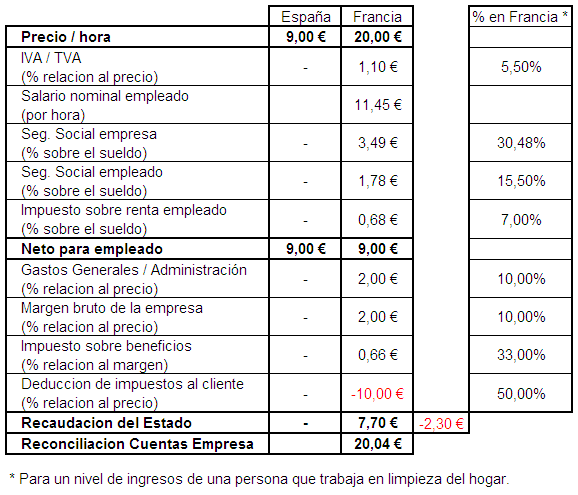
La limpieza del hogar en Francia en números.
Al hacer las cuentas he impuesto que el trabajador reciba un neto equivalente al que recibiría en negro. De ese modo, su incentivo estaría claro: a igualdad de ingresos, mejor estar cotizando a la seguridad social. El precio hora para el usuario finalmente es 1€ más caro en Francia, lo he dejado así en vez de retocar beneficios de la empresa, etc., para poner en valor el extra que el usuario recibe en forma de seguro contra desperfectos y robos, atención de los comerciales, etc. Todo esto al final del año pueden suponerme unos 40€, entiendo que están bien pagados.
Como se puede ver, al estado francés el aflorar 9€ de esta economía sumergida parece que le cuesta 2,30€. Pero hay que tener en cuenta que los gastos generales también suponen ingresos al estado (impuestos sobre la compra de materiales e impuestos y seguridad social de los otros trabajadores de la empresa).Además hay que tener en cuenta que de esta forma el estado se asegura que la persona que realiza la limpieza está trabajando de forma legal y por tanto no está a la vez registrada como desempleada y cobrando un subsidio de desempleo, caso que sucede en España a menudo.
Teniendo en cuenta estos últimos comentarios, es posible que al estado francés le cuadren del todo las cuentas o incluso acabe ingresando más / gastando menos que si no existiese esta medida.
It is 10 years since I ran my last marathon. I have been running again quite often since the beginning of 2011, and a few of you know that in October 2011 I’ll be running the next Toulouse marathon if health permits.
Some months ago, following a recommendation of my brother Jaime, I watched a movie in Youtube called “The Spirit of the Marathon” based on the experiences of some beginners during their training towards running the Chicago marathon in 2007. I strongly recommend the movie to anyone willing take on such challenge.
In the movie, I especially liked the character of Lori, who apart of conveying a positive attitude all time and sharing a beautiful story behind, is running the marathon supporting a cause.
In February, when I decided to take part in the marathon in Toulouse, I thought it would be nice to do as Lori did and try to raise some funds for a cause, for a charity. However, I didn’t know which one to choose nor how exactly to set it up. In the meantime months have passed by, I have not started raising any cash, but luckily my Airbus Running club has sorted out which charity I could run for.
This year, all Airbus runners taking part in the Toulouse marathon are encouraged by the club to raise funds to help the association “Vaincre la mucoviscidose” which helps families of children suffering the illness and creates awareness about it. I think this is surely a worthy cause to run 42.195km for and raise some funds during the training period.
How can you contribute to such cause?
Easy, I have set up an ING savings account for that purpose. All contributions received in that account will be transferred to the associations bank account by 21st October.
Bank account: 1465 0100 91 2021356780 (ING Direct)
IBAN: ES68 1465 0100 91 2021356780
BIC / Swift Code: INGDESMMXXX
Beneficiary: Javier Irastorza
Since in France, contributions to charities are deducted from taxes up to a 66% and I do not want to get any tax benefit out of possible contributions from friends, I will double any contribution that you make so as to offset possible benefits and thus contribute myself to the cause as well, i.e.: if you give 5€ for the charity, I will put another 10€, making a total of 15€ for the charity, out of which 10€ would be tax-deductible, equal to the disbursement I had made.
What’s in it for you?
Apart from contributing to a worthy cause, I will explicitly dedicate my marathon in this blog to all those who have contributed to the cause (if they haven’t requested anonymity).
What it’s more, in line with crowd funding initiatives, I have been working since January on a special project that will only be unveiled after the marathon. That project will also be dedicated to the contributors to that cause who will have the chance of enjoying it before the general public.
Summing up
I’ll do:
100% of the training in these months (~1,100km in 17 weeks),
100% of the running in the marathon (42.195km on October 23rd),
66% of the financial contribution to the cause…
All you have to do is give some euros to make up for that 33% that we will contribute to the children suffering from mucoviscidose. Let’s do it together!
Running at "Corrida Pedrestre" in Toulouse, July 1st 2011.
As part of my effort to learn French, I was reading some passages of “Le Petit Prince” last weekend. There was one that directly struck me:
Les grandes personnes aiment les chiffres. Quand vous leur parlez d’un nouvel ami, elles ne vous questionnent jamais sur l’essentiel. Elles ne vous disent jamais: “Quel est le son de sa voix? Quels sont les jeux qu’il préfère? Est-ce qu’il collectionne les papillons?” Elles vous demandent: “Quel âge a-t-il? Combien a-t-il de frères? Combien pèse-t-il? Combien gagne son père?” Alors seulement elles croient le connaître. Si vous dites aux grandes personnes: “J’ai vu une belle maison en briques roses, avec des géraniums aux fenêtres et des colombes sur le toit…” elles ne parviennent pas à s’imaginer cette maison. Il faut leur dire: “J’ai vu une maison de cent mille francs.” Alors elles s’écrient: “Comme c’est joli!
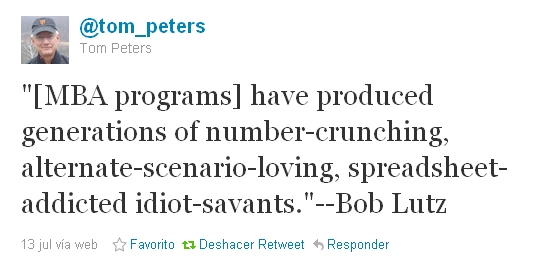
Some days before I had seen the following tweet by the management guru Tom Peters:
Having said this, I can only confess that I am one of those. One of those old people, grande personne, that loves numbers, crunching numbers, spreadsheets, etc…
If you asked me something about for example my drive to the job every morning, I wouldn’t say “Oh, it’s beautiful, there are lots of trees, you can smell this or that”, no, no…
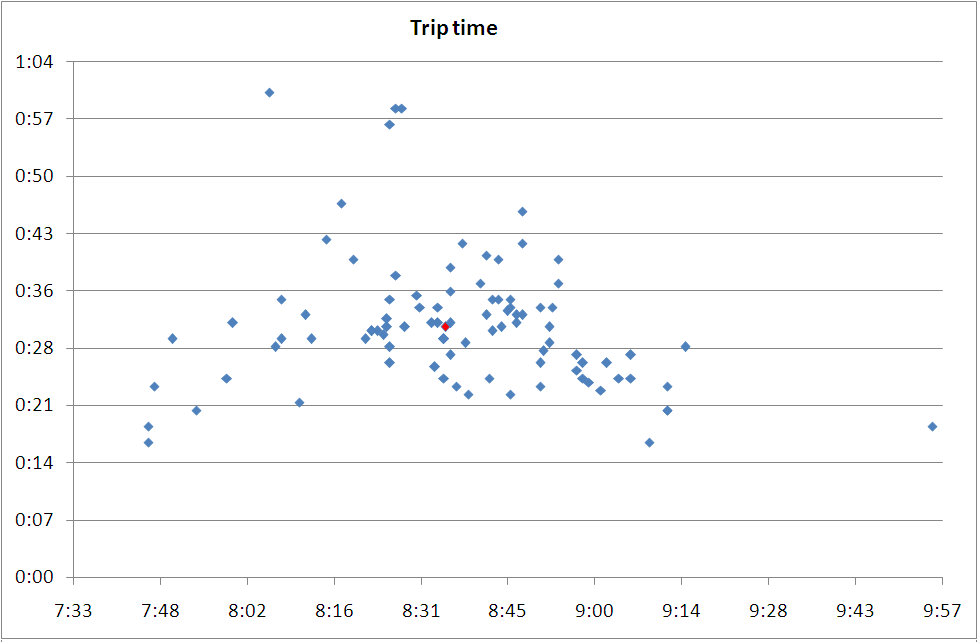
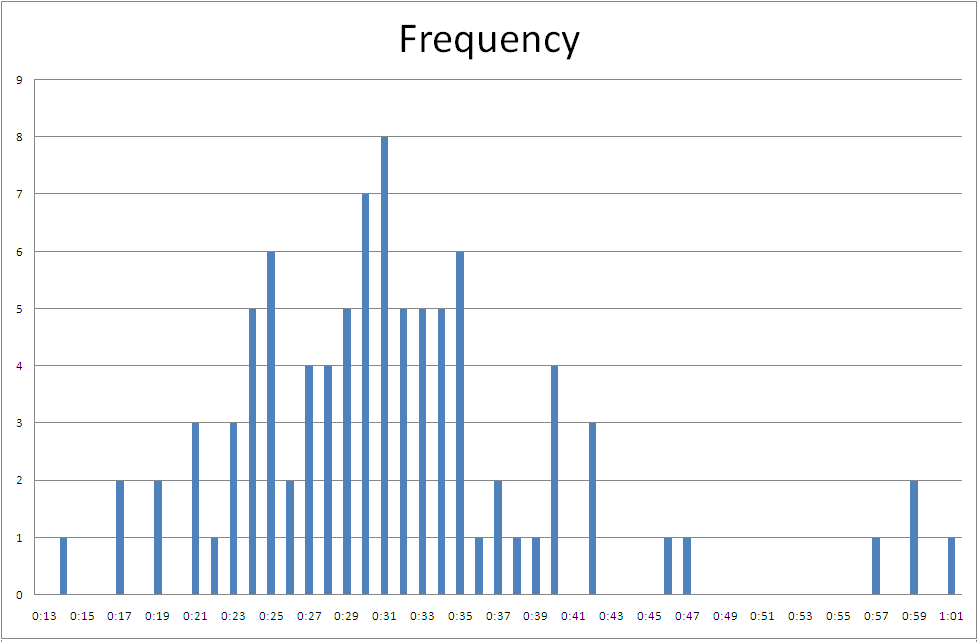
I would tell you: “it takes door-to-door an average of 31 minutes -which coincidentally is the exact time most repeated-, I depart at 8:35am on average, I have tried 3 different routes and route number 3 seems to be about 4 minutes shorter on average than the other 2 routes, I found out that it is as good to be an early comer to the office than to arrive at about 9:30am, while the worst time to leave home is about 8:15am… Tuesdays are the worst days normally, taking on average about 5 minutes more than Wednesdays, the best day”. Numbers.
And I would have said all these because during the last 7 months I had been taking note of the all the numbers related to those trips, crunching them in a spreadsheet, etc, etc…
In this post I just wanted to share a couple of thoughts that I discussed with my father and older brother some months ago on the welfare state that we enjoy in Europe.
Luca and I went on a holiday trip to Japan 3 years ago. There, while in Kyoto and thanks to a cultural association, we enjoyed an activity consisting of spending the afternoon and evening with a Japanese family at their place.
The Takatori family lived in the centre of Kyoto (a wonderful city). He was an engineer who worked for a big electronics company (I forgot the name), thus I imagine that he earned a decent salary. The family lived in a 40-50 sqm flat, without bedrooms for the teenage children as they slept in futons in the living room. The Takatoris had no car and travelled either by bike or public transport every where.
At some point in the conversation we talked about travelling, holidays, etc., and then I asked him how many holidays did he had? “120 days.” I was surprised, “120 days?!?” He explained it better: “There are 120 days a year in which I don’t work, including weekends”… I started making the numbers: since the year has 52 weeks, 104 days are weekends, these left only 16 days off for Mr. Takatori, including bank holidays. This was in Japan and a medium class family.
I take it that in the rest of East Asia the conditions will be lower and work ethics will be at par with Japan (think of Chinese shops opening schedules in Europe).
When I compare that with Europe: 35 hour work-week (in France), a collective bargaining agreement with 211 working days a year (or 154 non-work days as Takatori viewed it – since weekends are the same here and in Japan, that means we enjoy 34 days more of holidays, or 7 more full weeks!), subsidies for a myriad of things, retirement at 60 (in France, with protests when raised to 62)… well, there’s simply no comparison.
Sure, the system we have here is something to be proud of, but then again, will it last? It’s not like the Takatoris of Japan, China, South Korea, etc., will refrain to: work an hour or a day more, lower a dollar in a price, retire a year later, etc., so we can continue to enjoy our welfare state.
Will it last? I have no answer, it escapes my power of analysis, but if I were you, I’d start saving yesterday.
The Red Arrows are the UK Royal Air Force Aerobatic Team. They are one of the most famous acrobatics teams worldwide. They were formed in the ‘60s when several unofficial teams were united under the new official team of the RAF.
The Red Arrows were performing yesterday at Muret Air exhibition, just 12km away from Toulouse so I went there to spend the day with some colleagues from Airbus (which kindly sponsored the show providing fuel for the aircraft). The organization of the event left the Red Arrows for the end of the day. The team is composed of 9 pilots plus an extra one who acts as road manager and commentator during the show (animator I should say). They fly BAE Hawk airplanes and are about 33 years old on average.
The several figures in different formation patterns that they performed were impressive (Diamond, Apollo, Vixen, Heart, Palm tree, etc.). I must admit that this was the first exhibition I attended, as the only other time when I witnessed acrobatics was at the Red Bull Race in Budapest in the summer of 2007, when I was on holidays there with friends.
I took several pictures and videos of their performance, but somehow I didn’t manage to save most of the videos correctly, so I can only show below the pictures in the slide show below:
This slideshow requires JavaScript.
There were another two teams performing: the French Air Force Cartouche Doré (flying 3 TB30 Epsilon, made by Socata, a filial of EADS) and the Breitling Jet Team. The latter is a civilian acrobatic team (the only one) based in France. They fly L-39 Albatros.
Apart from these teams, there were several other planes that were flying in the show: L-39 Albatros, Cap 232, ATR-42, Beech King Air 200, some Pipers (simulating a fight between a police airplane and another one), P40… but the only ones my smartphone saved correctly in videos were the flights of the A380 and the A400M (no kidding, I did over 20 videos and discovered only these 2 were stored in the memory), enjoy them:
It was a good experience, perfect for a sunny Saturday. I wanted to remark the importance of having a good commentator and music to enhance the show. In Muret the commentator was great (apparently he is famous in France and engaged in all air shows) but the music was not always the best, though when it was it really made you (seriously) think “I want to fly one of those”…
Some days ago, I attended for the first time a meeting of Rosemasters club in Toulouse. We were about 20 people attending. During the introduction round we discovered that there were 5 Airbus employees among us, which was 25% of us (plus 2 former employees). This could be expected given the importance of Airbus in the city of Toulouse… but, how important is it really?
I had read in some studies about the impact of air transport and aerospace industries in the economy of a given region; taking into account direct employment, indirect and induced. You may take a look at the report “The National Economic Impact of Civil Aviation” [PDF, 1.5MB] prepared by DRI•WEFA, to see some multipliers (Table 1 in page 8).
In the study, we can see that in the case of the USA, for every aerospace job there are 1.9 indirect jobs created and 1.5 induced jobs; thus one aerospace job creates 3.4 jobs.
If we use the same figures for the case of Toulouse:
Airbus and EADS employ over 21,000 people here;
there would be another 41,000 indirect (employment generated in the businesses that supply goods and services to the aerospace sector) and
32,000 induced jobs (employment in other sectors generated thanks to the income spent by direct and indirect aerospace-related employees) thanks to the activity of EADS in the region, in total ~73,000 extra jobs.
These together with the 21,000 jobs from EADS make up for a total of ~94,000 jobs.
Toulouse is a city of ~440,000 inhabitants, with 1.1 million living in the metropolitan area: ~9% of the population of the metropolitan area has a job created directly or indirectly thanks to EADS activity… if we talk about families, between 25-30% of the families depend on a job created directly or indirectly thanks to EADS activity.
No doubt, aerospace is a strategic sector for the region.
Today, I found in the mailbox the first issue of The Economist to arrive at my new place. I took it and went for a walk to read it in a park by the river.
The park I went to is called “La prairie des Filtres”, named after the infiltration galleries used to purify muddy water pumped from the river Garonne, cleaned and brought up to the water tower of Toulouse. The system was first established back in 1821.
This park was also the place that served as the first field for the rugby matches of the Stade Toulousain, the local team which happens to be the most laureate club in France and Europe (having won 4 European Cups, more than any other club). The team now plays sometimes at the Stadium of Toulouse, just across the river, though most of the times plays at the Ernest Wallon stadium at the other side of the city. I guess I’ll have to pay a visit to one of its matches.
Now… the park is where I read the paper and run by the riverside…



 The Blog by Javier