Category Archives: Investing

My 0.7%

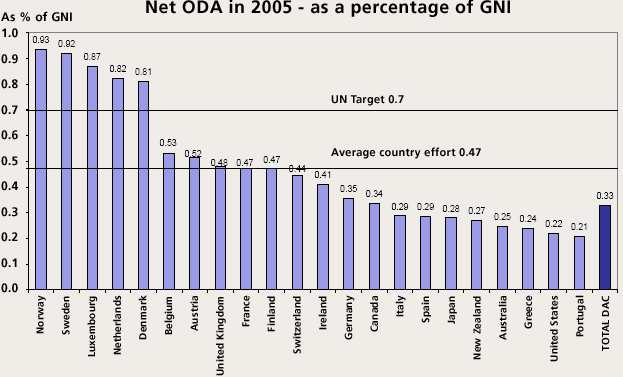
“0.7%” refers to the repeated commitment of the world’s governments to commit 0.7% of rich-countries’ gross national product (GNP) to Official Development Assistance. This figure was first pledged 35 years ago in a 1970 UN General Assembly Resolution.

Where does the figure “0.7%” come from?

I didn’t know, so I researched a bit and it seems that comes from Lester B. Pearson (PDF, 40KB), former Prime Minister of Canada, who in 1969 recommended that resources equivalent to a minimum of 1% of the GNP of developed nations should flow to developing countries.

This 1%  would be made up of official development assistance, other official flows from the government, and private sector flows; the official development assistance component of the 1% commitment would be equivalent to 0.7% of GNP.

By 2005 only 5 countries of the OECD were meeting or exceeding the target: Denmark, Luxembourg, Netherlands, Norway and Sweden, not a surprise. The rest of them were well below, some even decreasing the assistance.

OECD 2005 Official Development Aid

What can we do?

Since some years ago, I dedicate 0.7% of my personal net income to development aid. I make the calculation every year in January, when I have an idea of how much I pocketed the previous year.

I took sometime last weekend to make the calculation, research a little bit and direct the funds to the selected NGOs, which this year have been:

  • Kiva: a micro lending portal, that I have talked about in the blog sometimes. I added some more funds.
  • Médecins sans Frontières. Last year, I already donated some cash to the Spanish branch after the earthquake in Haiti; this year I’ve become member of the French one: as a friend who works in development assistance explained to me, this helps the NGO to plan their activities, rather than relying on occasional donations.
  • Vittana: a micro lending portal specialized on credits for education purposes, very similar to Kiva in its conception. I learnt about it last year already and twitted about it, but it has been now the first time I used it.
  • Ofxam: a well-known NGO working “to find lasting solutions to poverty and injustice”.
  • Anti-Slavery: an NGO which works to eliminate all forms of slavery around the world… incredible, “slavery” :-(.

6 Comments

Filed under Investing

My investment fund

After two years of investing for fun, I was troubled because neither the ING internet banking tool nor Google Finance enabled me to correctly monitor the profitability of our investments.

  • Google Finance shows each new addition of capital as an increase of assets (price) in the same way as if a particular stock had increased its market price. So after a year our portfolio showed an increase of 97%… but most of it was due to new additions of capital.
  • While with ING, each time we added some cash it lowered the profitability as it went directly to the denominator of the equation (the same happens with Google Finance “gain”).

I discussed this with Luca, read a little bit and then I found out that the best way would be to treat ourselves as a mutual open-ended fund (fondo de inversión). I had to define a net asset value per share (valor liquidativo de la participación) at the beginning of the period and then treat each addition of capital as an issue of new shares to ourselves.

After spending sometime digging in the files and emails of the past two years, reading a bit about how to treat these values, etc., from now on we can readily compare at any moment our “J&L investment fund” with any other fund, stock or index. So did I…

If we had a commercial mutual fund we would announce ourselves with something like:

  • In the year 2010 the gains of the fund were +22.8% compared to
    • S&P 500 ~ +13% (target index)
    • Dow Jones ~ +11%
    • NASDAQ ~ +17%
    • IBEX 35 ~ -17%
    • Euro Stoxx 50 ~ -10%
  • The gains of the fund since its creation in January 2009 have been +86.6%, with a compounded annual gain of +37.6%.

Not bad.

Nevertheless, if we compare it to the leading Spanish value investing fund managers from Bestinver, in 2010:

  • Bestinfond ~ +19%;
  • Bestinver Internacional ~ +26%;
  • Bestinver Bolsa ~ +5%

Since January 2009 both Bestinfond and Bestinver Internacional have fared better than “J&L”, though not Bestinver Bolsa.

Today, now that is already defined, the net asset value per share is 57.19€… however “J&L fund” is not yet that open-ended: it’s open to our own additions to the fund but not to third-party capital… maybe in a couple of years we go and set up an investment club or fund :-).

After reading Ben Graham’s book “Intelligent Investor” I wanted to give it a try with investing, this is why I invest in stocks myself, but, clearly, if you are tempted to follow third-party advice, rumours, tips, etc., you’ll be better off just investing in a low-cost index fund (a strategy described by Burton G. Malkiel’s book “A Random Walk Down Wall Street”) or take a look at the above-mentioned value investing managers.

NOTE: “J&L fund” numbers are pre-tax of capital gains, include dividends (after-tax) and are net of transaction costs & commissions.

10 Comments

Filed under Investing

Venture Capital & Crowdfunding

I started giving loans through Kiva almost two years ago. About at the same time, after gathering some savings, I started investing again in the stock market.

Last month, I attended TEDxMadrid, where Nicolás Alcalá explained how a movie he and his team are working on (“El Cosmonauta”) will be financed through crowdfunding. I then discussed with a friend that precisely I was looking for a similar approach, but applied to general businesses: a kind of Kiva for for-profit start-ups.

Subsequently, I first found Kickstarter about a month ago through Fred Wilson (@fredwilson). However, in Kickstarter the funders of projects are not entitled to equity in the venture nor a share of the future profits. The funders get some merchandising or recognition for the helping hand they have given, depending on the amount they have invested.

Then I found GrowVC.

From what I gathered, this is more or less what I was looking for: a way to invest some small amount of cash (~1,000$ a year) together with other funders into a larger pool that will act as a Venture Capital operation, sharing the future profits of the business that was funded.

With this post I wanted to share these initiatives with you and also to explain what I was looking for. Now, let me throw an open question to readers: anyone knows a similar concept that I may be interested in? If so, please, let me know.

(Bear in mind that I haven’t got, yet, hundreds of thousands of Euros to invest following this approach… the larger part is invested in a much more Graham-like defensive approach)

8 Comments

Filed under Investing

The Snowball, Warren Buffett bio (book review)

Last Christmas, my brother gave me “The Snowball: Warren Buffett and the Business of Life“, by Alice Schroeder. He completely hit on the spot, though I only started reading it during last August holidays (Luca also started reading it to the point that she ended up buying her own Kindle version of it!).

The book is a thorough review of Buffett’s life, including relationships with family & friends and investment decisions. I had previously read other books about Buffett, but they were merely about his investment “strategy” so to say, nothing compared to this one. To complete the book, the author made over 250 interviews, so you can imagine the many insights contained in it.

There are many lessons or just ideas that can be taken from this book. Let me just point the few I can recall at the moment of writing this post:

  • The Inner Scorecard: the idea of acting and valuing yourself according to what you care about and not according to what others’ deem important.
  • The concept of margin of safety: from Benjamin Graham (recommended reading “The Intelligent Investor“).
  • Circle of competence: the idea of looking for simple business that have an enduring competitive advantage (technology companies are not that simple).
  • Cigar butts: companies which are worth more “death than alive” (looking for cheap price to book).
  • Snowball: the idea that compounding interest acts as a snowball falling down the hill, the sooner you start the larger the ball will be down the road (thinking about retirement here).
  • The story of the genie: or that you should invest in your own health as your body is the only one you are going to be given in this life.
  • The Ovarian lottery and the idea that philanthropy achieves more if exercised now and trying to maximize its impact.

Throughout the book you get to learn about many great entrepreneurial characters (e.g. Rose Blumkin, Bill Gates); about the workings of the board of directors of some companies (e.g. Coca Cola, Berkshire Hathaway); about some of the most impressive falls in corporate history (e.g. Solomon Brothers, Long Term Capital Management); about several depressions, recessions and crisis; and above all you learn about what were the thoughts and calculations behind some of Buffett’s investments decisions since the early 1940’s to date.

I definitely recommend this book (700+ pgs.).

5 Comments

Filed under Books, Investing

Is talent really worth it? (Book review)

I am subscribed to The Economist since about 3 years ago. It not only provides with very interesting articles every week and lots of new ideas, but from time to time I am asked to take part in surveys. As a way to show appreciation they normally offer a study, a book, etc…

The latest book that I received from them and read is “Pay check. Are top earners really worth it?”, by David Bolchover.

The book is ferocious critique of CEO’s and finance workers’ pay. The average CEO in the USA earned in 1980 42 times the average blue-collar salary, while by 2000 this multiple increased to 531 times!

The book makes a clear difference between entrepreneurs, true generators of wealth, and the top management of multinational companies. He argues that there are three necessary conditions to award a high pay to the CEO:

  • Enough revenues available.
  • The CEO should have a measurable and substantially positive impact in the company (e.g. like one could defend the impact of a sports star within a team).
  • We would need to demonstrate beyond reasonable doubt that his abilities are extremely rare making him difficult to replace (could Jordan be replaced in Chicago Bulls?).

More often than not, this is not the case.

The favourite excuse being used to award exorbitant salaries is the scarcity of “talent”. The origin of the “talent” ideology seems to be the 1998 article from McKinsey “The War for Talent”.

Some of the extreme cases cited in the book…

  • Lehman Brothers CEO at the time of bankruptcy, Dick Fuld, who in his 15 years as CEO pocketed $466 million ($34M in 2007) before filing the largest bankruptcy in history (with $613 billion in debts), placing him as the worst CEO in American history according to Portfolio magazine.
  • Oil companies BP and Shell which both CEOs missed the objectives in 2008 yet still managed to be handed the undeserved bonus by the compensation committee from each company!

The author states that today, the main enemy of capital is… “talent”, those undeservingly taking the money away from shareholders and calls for shareholder activism to revert this situation and bring the money to whom it belongs (us, the shareholders… either directly or through investment and pension funds…).

I do recommend this book (~125 pgs.).

3 Comments

Filed under Books, Economy, Investing, Personal development & HR

Learning while investing

During last days I had some fun learning different terms used in the shipping industry while investigating some possible investments. Let me share some of these examples:

Panamax”: this is a term for the size limits for ships traveling through the Panama Canal.

“Panamax is determined principally by the dimensions of the canal’s lock chambers, each of which is 110 ft (33.53 m) wide by 1,050 ft (320.04 m) long, and 85 ft (25.91 m) deep. The usable length of each lock chamber is 1,000 ft (304.8 m). The available water depth in the lock chambers varies, but the shallowest depth is at the south sill of the Pedro Miguel Locks and is 41.2 ft (12.56 m) at a Miraflores Lake level of 54 ft 6 in (16.61 m). The height of the Bridge of the Americas at Balboa is the limiting factor on a vessel’s overall height.”

(Did you ever have such an idea of the size of the Panama Canal?)

The two ships seen here seem almost to be touching the walls of the Miraflores Locks.

The same applies to the term “Suezmax”.

Another curious term is “Capesize“… which meaning by now you may already guess: “Capesize ships are cargo ships originally too large to transit the Suez Canal (i.e., larger than both Panamax and Suezmax vessels). To travel between oceans, such vessels used to have to pass either the Cape of Good Hope or Cape Horn. [I especially liked this last clarification] In effect Capesize reads as “unlimited”.” (Sure, once you have to travel around in the open ocean… you put the limit).

Lastly, “Deadweight tonnage”: this is “the sum of the weights of cargo, fuel, fresh water, ballast water, provisions, passengers, and crew.” It is curious that in the shipping industry this is also called “payload” according to the Wikipedia, while in the air cargo industry we refer by payload to just the weight of cargo / passengers…

Leave a comment

Filed under Education, Investing, Personal development & HR

Studios are more profitable than flats

Two weeks ago I was having some drinks with a good friend of mine. Talking about books we were reading we ended up talking about investments.

He had the idea of buying a small studio in order to rent it, because the margin you could get in a small studio compared to its price was larger than if you did the same with a larger apartment.

I wanted to test the argument with idealista.com, the leading real state website in Spain. Apart from the many ways in which you can screen and sort out houses, the site has a very handy piece of information which is the average price per square meter of your selection either for rental or sale.

I restricted my searches to the district “Centro” in Madrid. I then looked for average prices of “studios” of “less than 60m2” and “flats” of “more than 80m2”, both for rental and for sale. The minimum sample of houses was 175 and the maximum over 700, so I believe they can be considered a good sample for this little study. I then looked for the averages:

  • Studio of less than 60m2:
    • Rental: ~17 €/m2 per month.
    • Sale:  ~4,287 €/m2.
  • Flat of more than 80m2:
    • Rental: ~13 €/m2 per month.
    • Sale:  ~4,295 €/m2.

As you can already see, the price per square meter is very slightly higher in the case of flats (~0.2%) while the price of rental is much higher in small studios (~31%).

What is the profitability of the case?

We can make the calculation with these per square prices. If you buy the small studio and put it for rent, you would earn from it 12 times 17€ per year (204€), this is 4.8% return on the asset, which in this case is a square meter valued at 4,287€. For the larger flat the earnings would be 3.6%. Thus, as my friend said renting small studios is a whole 31% more profitable than renting larger flats.

Paid by itself? My friend also mentioned that you could even get a mortgage that it was cheaper than the monthly rent and thus really not needing to dedicate ~100k€ to the purchase of the prize, but paying the flat simply with the monthly rent incomes.

That case also holds true with current low interest rates. I checked the case for a small studio of 25m2 and you could charge about 425 euros while the mortgage would be around 322 (25 years). This case would not be true anymore if you want to pay the studio in a shorter time, or interest rates rise.

This  case also excludes the extra costs that house ownership has (repairs, improvements in the building, idle time between renters…). So we should see the figure 4.8% as a ceiling.

I still would prefer investing in stocks, where returns have been higher throughout history and avoids you the hassle of dealing with the problems involved with real state…

1 Comment

Filed under Investing

The most profitable roulette

Last weekend I attended Riaza’s local festivities with some friends who have a house there. Riaza is a small and beautiful village in the province of Segovia famous for its main square.

One of my friends raised to me the issue of a game being organized by some locals. It was a kind of casino roulette, but very much simplified…

Instead of 36 numbers plus zero, there were only six. Instead of using an actual roulette, they used just a six-sided die and small cup. Instead of casino coins, bets were placed directly with cash, starting from one euro. Instead of using a green clothed table they used a small wooden board with the images of 6 Spanish playing cards; with numbers 1 to 6.

Prize. We did not know how they came up with the amount of the prize, but it was perfectly established to maximize their benefits and attract as many players as possible. In case you bet for the right number, they gave you 4 times the amount you bet plus your stake, i.e., you bet 1 euro and are lucky, you then walk away with 5 euros.

If they had offered more money, the expected value for the organizers would have been zero or a loss. Have they offered less (e.g., to just double the bet) and not so many people would have been tempted by the game.

Offering 4 times the stake to the players, means  to them a mathematical expectation of -0,17 € for a one-euro bet. For the organizers means the opposite: a business with an expected profit of 17% of all the amounts at stake.

Compare this to the business of a casino with a French roulette, with 37 numbers, in which the expected profit for the casino is 2.7% (where the prize for hitting the number is 35 times the amount you bet). This local game is 6 times more profitable than the casino!

The next question is: how much money could they make out of it? I first saw them at 2:30 am of Sunday morning. At 3:30 am they were still there, though at 4:30 am they were not. Let me assume they hold the village-casino for about 8 hours a day (from 20 pm to 4 am, being conservative, i.e., assuming they are not out there during most of day time).

The highest amount we witnessed at the table at one single round was in excess of 40 € (including a 20€ note), but I assume they had some collaborators among the crowd. The lowest amounts were around 6-8 euro per round. Let’s assume the average to be around 10€ per round.

Each round we witnessed lasted very short time: less than a minute, though we did not measure it. Let’s assume there was exactly a minute, and that they kept that rhythm during the 8 hours…

  • They would have earned about 1.67€ per round.
  • About 100€ per hour (33€/hour per person, taking into account that they were three organizers).
  • 800€ per day.

By organizing the game for four or five days during the festivities they managed to take home their monthly salaries for the three of them out of this simple game.

Some times it is surprising how easy a business can be.

4 Comments

Filed under Investing, Miscellanea, Travelling

Saving 1,700€ with a hair clipper

Often, after I have cut my hair, it is raised within a conversation the issue of the hair clipper and me cutting it by myself… Last time this happened was couple of weeks ago, and then I decided to reflect on it, make some numbers and write a small post about it.

I bought a Philips hair clipper machine at sometime around 2000-2002 (say 2001). It cost around 20€, though I remember we paid for it in pesetas (1 euro = ~166 pesetas). Since I had started losing some hair, the haircut I was already having was pretty simple: shaving it down to around 9-12mm. Beginning 2002 barber shops were charging about 8.5€ (I do not know how much do they charge now… assuming the price increased with inflation now it should be about 10-10.5€). That was the main driver behind the purchase: the payback time would be extremely quick, between 2 and 3 hair cuts.

In the last 10 years I may have had around 120-130 hair cuts (every 3-4 weeks). These, at the market price would have cost ~1,210€. However, there are some more aspects to take into consideration.

Time. When I used to go to a barber shop, the whole process (home door to home door) would take around 1 hour and a half (90′ – transport, waiting, cutting, transport), while now it takes no more than 20′ (maximum). Then and now, I take a shower afterwards, so I will keep it out of the comparison. This means that now I am saving 70′ each time I have a hair cut… counting the 130 cuts of the last ten years, these amount to 150 hours (about 15 hours / year). I will value these hours on the cheap side, since half of this time I was a student, so let us say 5€/hour. The time savings amount to another ~750€.

This time was my time. However, in about 2/3 of the cuts I counted with the help of either my mum or my partner. They contribute less time as preparation and clean up is done by myself, so let me say they spent about 10′ (~60 hours of their time in 10 years). Let me value their time as 3 times as expensive as mine (this way I am conservative in the business case comparison). This would be an extra cost of 215€ (no matter that it never implied a cash outflow… thanks!).

The price of the electricity of the couple of light bulbs and the clipper used when cutting hair at home (when at the barber’s it is included in the price) is almost negligible (at ~0.1kW/h). I started the calculations, but they amount to less than 1€. The water used in cleaning up is also quite cheap (at about 0.0013€/liter). Assuming each time I used 10 liters in cleaning up (maximum), this makes another ~1.7€.

Finally, I am not including in the calculation the cost of transportation to the barber shop and environmentally aspects of that transportation. We could think that in the 70′ free time that I am given due to cutting it at home I can engage in an equally transport-intensive activity with the same environmentally unfriendly consequences.

If we add up all the savings and costs… -20€ (clipper) +1,210€ (cut price) + 750€ (my time) -215€ (family time) -1€ (electricity) -1.7€ (water) = ~1,722€. After 10 years, the cumulative positive cash flow of that tiny 20€ investment back in 2001 is over 1,700 euros. Ah, and it never required any maintenance.

Do you still want to go to the barber shop?

7 Comments

Filed under Investing

Bill Clinton endorsing Kiva (video)

Some months ago, I gave a loan through Kiva to Fizuli Agdjabayov, a man who has a small transport business in Azerbaijan. Yesterday I got an email with the latest post of one of Kiva’s blogs about a visit of a Kiva fellow to Azerbaijan.

I especially liked the two videos that Yelena Shuster, the fellow, had prepared about her visit. I immediately thought about sharing these with you through the blog; this is what I am doing with this post. Enjoy the video:

I believe that seeing these fellows visiting the entrepreneurs in person is the best way to gain confidence about this system. By chance, on a trip to Peru, I could visit as well an entrepreneur that had received a loan through Kiva; then I wrote about that experience in a previous post in this blog.

The second best way to gain confidence on initiatives like Kiva is by seeing Bill Clinton endorsing them in an interview. I came across the following video while watching Yelena’s, in it Bill explains how Kiva works:

3 Comments

Filed under Helping others, Investing