I was given the book “How Soccer Explains the World” as a present by Luca & her mother about 2 months ago. They bought it in the London bookshop Daunt Books, and it came with a bookmark of the shop… impressive. Take a virtual tour around the book shop, it definitely deserves a stop in the next visit to London.
The book… since I have been questioned about it many times: no, soccer does not explain the World. However, it is a very interesting book drawing parallels about historical moments in recent history and how they were connected with football issues going on at the moment in the same places.
The first chapter for example tells about Serbian paramilitary groups, their connection with football and how they were instrumental in the Yugoslavian wars. In that chapter you read lots of names that ring a bell from having followed football recently: Obilic, Arkan, the great Red Star of 1991 (Prosinecki), Ognjenovic (a singing of Real Madrid), Zvonimir Boban… all these names let the reader connect with the story. In my case, having been in these locations and having good friends from both Serbia and Croatia increased the interest of it.
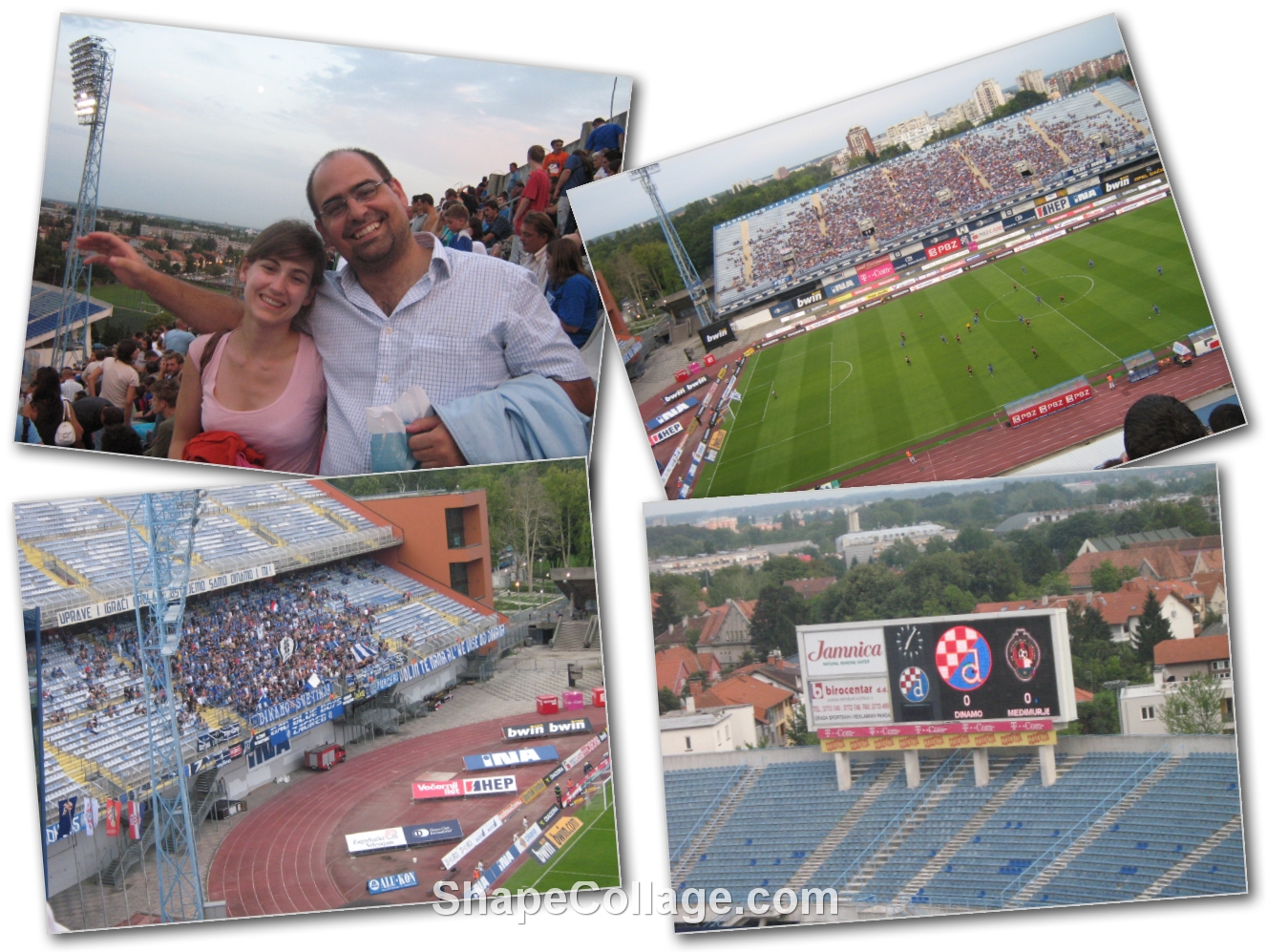
Luca & I attending the game Dinamo Zagreb vs. Medimurje (Croatian league) in 2007... because Dinamo offered an open-doors day after having made a good selling of tickets against Werder Bremen the previous week...
There are other chapters that may draw the attention of many: a whole chapter dedicated to F.C. Barcelona (the favourite team of the writer, Franklin Foer… an American, you see), other to Celtic-Rangers rivalry, disdain for soccer in the USA, Ajax, racism in football…
I recommend this book, especially in times of a World Cup.
I visited La Alhambra in the Easter of 2009 and I was disappointed with it. I have always heard wonderful stories, descriptions… one day it was Bill Clinton bringing Hillary there, other day it was about the sunset… the case is that I didn’t find anything there that I hadn’t seen in the Reales Alcazares in Seville (where I spent a year studying and working) and in a better state of conservation.
Whenever I say this to someone, their reply is “but it’s not only the buildings, it’s the atmosphere, the location, the view…”… mmm… yes, sure, but I came there expecting to see one of the Seven Wonders in the World… and frankly, I have seen other breathtaking places (Machu Picchu, Iguaçu falls…) where you don’t need someone reminding you that “it’s not only this, you need also to take into account that…”.
Two weeks ago I attended the Toastmasters District 59 Conference, “Springtime at the Beach”, in The Hague. This was the first time I attended such a conference, and I was impressed at the level of the speakers and the organization of the conference itself.
Being an Area Governor, for me the event lasted two days and half, starting on Friday June 4th afternoon with an executive committee meeting, following with the start of the conference, later the evaluation contest and a party with divisions showcase. That wasn’t a slow start.
On Saturday we had some workshops, the elections of new officers and the international speech contest. The way the conference, workshops and elections are held reminded me very much of my time at AEGEE and how there the Agorae were held; even some of the topics covered are similar, the way sometimes the focus is put on the procedure and not on listening at length to what the candidates plan to do if elected, etc…
On Sunday we had more workshops and the training for the new district officers (namely Division and Area Governors).
International Speech Contest. This is the main attraction of the event. We could say that we paid the 135€ fee of it to attend this contest. We had 10 speeches, one representing each division. As I wrote above, the level was very high. I couldn’t see a clear winner; a prove of that is that only one of my 3 favourites came among the 3 first ones. The winner, Na Elom Amouh, told us about his journey from Togo to Munich and how we should never give up in the pursuit of our dreams. A motivational speech. In general, most speeches in these competitions tend to call the audience for noble purposes, inspire good behaviours, etc. I must admit that some of those speeches do get to move you.
Evaluation Contest. Here, the participants had to evaluate a very good speech from former District Gov Christopher Magyar. This is not an easy task, as it is always more difficult to find points of improvement. Even though in this contest the level was very high as well, with very analytical and encouraging evaluations, this time my 3 favourites came in the first 3 positions, the winner being Tara Majumdar.
Miscellanea. There are many small details, side happenings, different situations that contribute to enlarge the baggage the one takes from the conference.
The landscape surrounding the conference letting members to relax.
The music being played in the plenary sessions, especially the banners parade bringing up the spirits of all attendees.
The chance to have meals in the terrace.
The wonderful garden for the gala party and the party at the beach.
The attentive organisers… the continuous availability of stroop waffles, coffees, etc.
The counting of votes behind the scenes… when each one is coming up with a different number!
The entertaining way in which chairs conducted the contests.
The experience of tweeting the event (from @TM_Madrid and @javierirastorza)…
This slideshow requires JavaScript.
Learning experience. Overall, the conference is an intense learning experience. You learn how others organise officers’ trainings, set up clubs, give recognition to members, set up workshops, and use different techniques and skills in public speaking… To end this post I wanted to remark two workshops that I attended and especially liked:
Pecha Kucha: this is a presentation technique originally from Japan that consists of preparing a presentation that consists of 20 slides, each one lasting 20 seconds and that will run automatically. You, the presenter, can’t stop it so you need to time yourself to precisely convey your different messages when each slide is being shown. It was very dynamic and I think it’s a nice challenge to try it one day. Check out the calendar of Pecha Kucha nights in different cities around the World.
Youth Leadership Program: this is Toastmasters program for youngsters. A couple of Toastmasters explained how they have carried it in a school with teenagers. From what I saw, it must be a very rewarding experience, a way to give back something to society and at the same time a way to help young students improve their skills. This is also another challenge I might try one day.
Next District conference… in Barcelona; I’ve already booked my place there!
Last weekend, Luca and I went to Casablanca. We had planned this trip together with two friends who could not come in the last-minute. Indeed the trip had been mainly planned by them, so we found ourselves in the plane reading some papers trying to discover what was to be seen in Casablanca (“Casa”), where we were staying, how to get there and so on (by the way, now that I mention the flight, the two Easyjet flights were with 1 hour delay each as have been 90% of the flights I have experience with them… by far this is the least reliable airline that I have ever used). I normally tend to thoroughly prepare my trips, so this was an unusual experience.
Casa is not one of the seven wonders but it is a nice city to spend a weekend out, especially if you have never been to Morocco as was our case.
Out of the comfort zone.
The main attraction is the Hasan II mosque, which is huge, located by the sea and surrounded by a wonderful park. It is very nicely illuminated by night as well. When we got there, guided visits were just finished… but the odds where that we were asking about visits to the right person in the right moment… a worker of the mosque who apparently earns some extra cash by opening the doors discretionarily and making “private” tours at will.
There we were, together with some other 4 tourists, visiting the interior, making pictures and wondering how much this would cost. When we were getting out I left a 20 dirham (~2€) note in the guy’s hand, he saw it and looked at me with smiley face a bit tilted down like saying “Javier, come on, you know this doesn’t make up for it”… well, this was the first experience I can recall of such a situation. I didn’t have a clue of how much I was supposed to give (the official visit cost 120 dirham per person, 240MAD in total) or how much others had given; the only thing I knew is that in my pocket I only had one more note of 20MAD and some others of 200MAD… so I took the 20MAD one, place it in his hand and left without ever turning my head back.
The previous anecdote clearly put us out of our comfort zone. We were out there in some other situations as well. I would say that in many of them you have the feeling that someone out there wants to cheat you. So you end up negotiating for everything which hasn’t got attached a price tag to it. So there I was bringing down prices (in my poor French!): a pair of babouches down 15MAD, a funny camel down 5MAD, a taxi down 7 MAD, another taxi down 30MAD… so much stress, so much effort to save 57MAD, less than 5.7€!! At least you get to practice negotiation skills…
The low prices that make you mad when seeing the outcome of the negotiations, on the other hand, have the positive effect that you can easily afford dining in very good places such as La Fibule and La Sqala, both by the sea; and both culinary experiences being part of the highlights of the visit.
Sightseeing. The other two main attractions for us were walking through the Medina Habous and the Ancienne Medina. We liked it more the architecture in Habous, though we had a deeper “cultural” immersion in the Ancienne one. Before going for dinner the first night, we decided to have a walk around, so we went into the Medina and took one street left, one right, then… we found ourselves walking without any sense of direction, in some crowded streets without any single tourist.
I then made the comment “it feels so safe to walk here without having read in a travel guide that we should not walk here after certain time and in these not well-lit streets”. As I said we hadn’t read anything in advance, and only now I have checked that indeed some sites make the point of it being a dangerous place by night… well, sometimes it may be better not to let that fear get into you by reading such things in advance.
There were plenty of other mosques that you may not visit, but that you notice especially when all of them call for the prayer time at once. Hear their choir recorded from the great terrace that our hotel had at the rooftop.
Finally, we also visited an old Christian cathedral that now is used as an art gallery.
Today is the Europe Day or Schuman Day. To celebrate this I wanted to share some pictures and thoughts.
The first time I travelled abroad consciously was in 1995, on trip I made with an aunt, two cousins and my brother to Germany. I remember one picture we took of us on the Germany-Austria border (already then; the only thing indicating that we were coming to a different country was a signpost). I remember the act of crossing a border as something special.
Last Easter, on a trip to Brazil, we had to cross the border between Brazil and Argentina in order to see Iguaçu falls from Argentina. Again, this act of crossing borders felt special. When was the last time I had to cross a full-fledged border, with a police stand post in either side of the borderline? (The term “full-fledged” includes police, long queues, waiting for almost an hour…).
I have travelled abroad lately, but apart from controls in airports we normally don’t get to see this so often, at least not in Europe. The last time I went through this was between Croatia and Bosnia on a trip in 2007, nevertheless there was minimal infrastructure on that border. The previous time was on 2003, when I crossed the Estonia-Latvia border by bus or the Macedonia-Kosovo one on foot.
After having crossed the border, already in Argentina, I remember I made a comment to Juan Pablo, the driver (quite a Boca fan!), along the line of when would those borders in South America disappear… his reply: “that cannot happen; South America is really only two countries, Argentina and Brazil, and if that was to happen, the day after thousands of people from Peru, Bolivia would be coming here…”.
This slideshow requires JavaScript.
I remember having heard similar comments in Europe both in 2004 and 2007, when two waves of Eastern European countries entered the European Union…
I was looking through some numbers in the Wikipedia (with data from I.N.E.): amongst the 29 the main inflows of immigrants in the period 2001-2008 only 3 corresponded to immigration from the countries that became part of the Union during those years: Romania (1st), Bulgaria (9th) and Poland (16th). Of the 14 most numerous groups living in Spain there are again only 3 from Eastern European countries: Romania (2nd), Bulgaria (8th) and Poland (14th).
Leaving aside the discussion of the benefits of that immigration, I just wanted to see whether that fear had materialized. I don’t think so.
There will be a day in which Juan Pablo will cross the Brazil-Argentina line without any stops and then he may as well be surprised when he encounters a full-fledged border somewhere else.
While in Brazil last Easter, I read in my guide that in the city of Sao Paulo lived the largest Japanese ethnic group outside Japan. My first thought was: that’s not surprising; by heart I made the following reasoning “if Sao Paulo is among the six or seven biggest cities in the World and we exclude Tokyo and Chinese cities… there is a chance of 15-20% of it being Sao Paulo”.
Later on I was told that in Sao Paulo also lived the biggest communities of several other nationalities… yes, the same rationale could apply (I guess it would come a point where not every nationality could have their largest community abroad in Sao Paulo… but I found no way to prove that).
This may give us an idea of the diversity of the city as well as the country, Brazil… and that is something you keep feeling when you visit it… you suddenly see something and tell yourself “I have seen that somewhere else…”. Like if there were wormholes connecting different parts of the World… Be it music, food, architecture, clothing, traditions…
Let me focus on some examples:
The first two examples are related to Japan.
See the Japanese traditional gates (or Torii), both in Japan (this case in the island Miyajima) and in the Japanese neighbourhood in Sao Paulo.
Note the striking similarities of procedures used to push people into the subway coaches both in Sao Paulo and Tokyo (in this case I was later told by my sister that in a TV programme about Spanish living abroad it was commented that the metro of Sao Paulo was inspired by the one in Tokyo).
Japanese gates, Torii, in Sao Paulo and Miyajima.
People queueing in Sao Paulo and Tokyo subways.
The next striking example is one that I already posted about: the Banespa tower in Sao Paulo compared to the Empire State Building in New York (you almost wouldn’t notice the difference if it wasn’t for the height of ESB).
Banespa Building (photo by Felipe Mostarda) and Empire State Building (photo by David Shankbone).
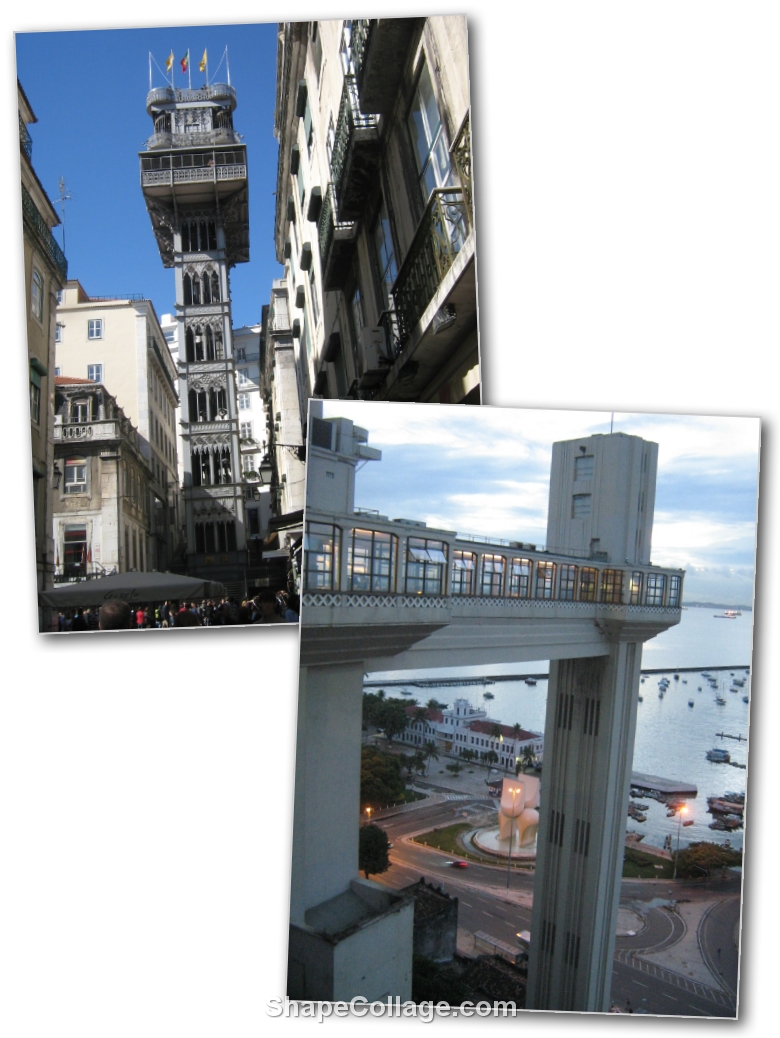
Other very similar example is found between two elevators: the Lacerda elevator in Salvador de Bahia and the elevator of Santa Justa in Lisbon… here the main difference is the queue and pricing… in Lisboa you may wait 30 minutes and pay over 1 euro, while in Salvador you wait less than a minute and pay 0,15 R$ (this is 6 euro cents!)…
Elevators of Santa Justa (Lisbon) and Lacerda (Salvador).
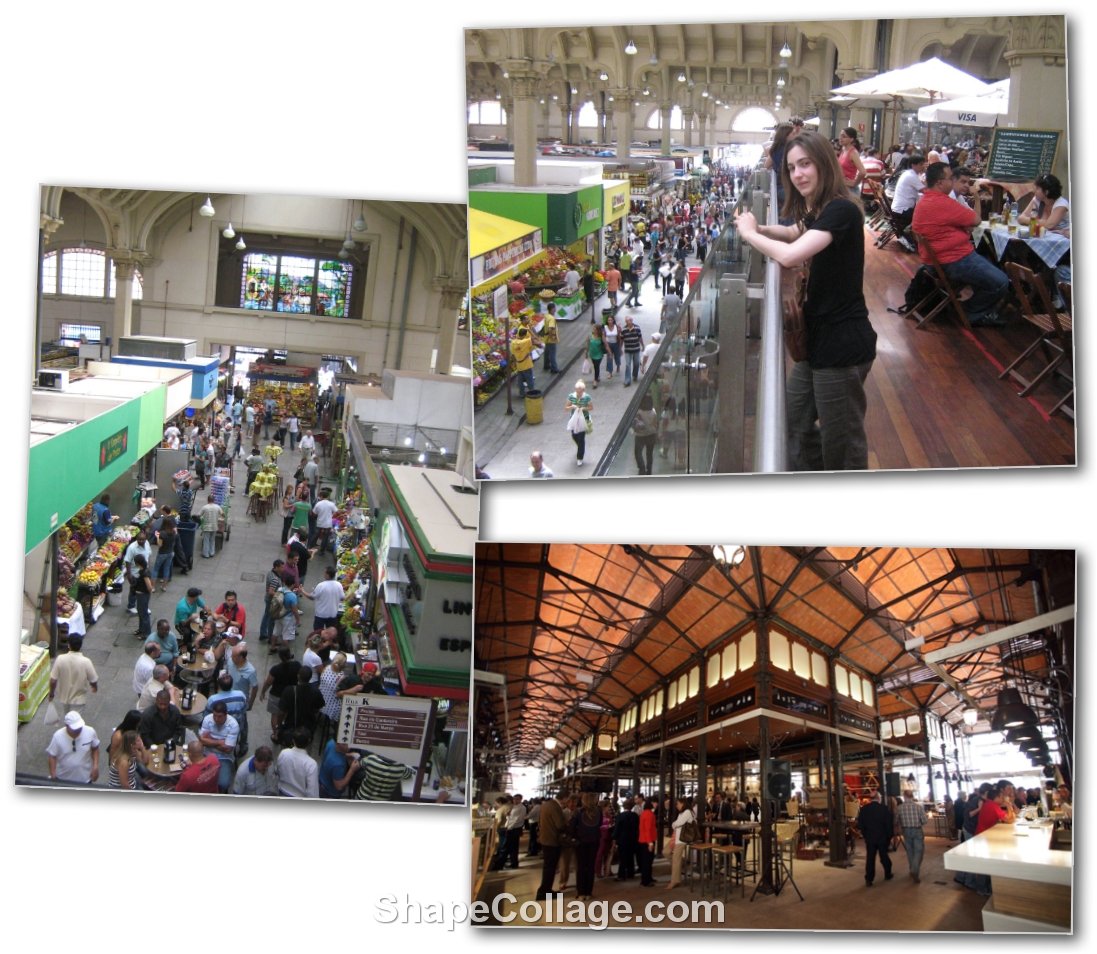
Similar experiences can be found as well inside two different markets: the Sao Paulo Municipal Market and Mercado de San Miguel in Madrid, the first one offering a wider variety of products (including good Spanish jamón in the “Emporio Arabe”?!?) and the latter a more upscale atmosphere. (If at the market in Sao Paulo, do not miss the codfish pastel and mortadella sandwich at Hocca bar!!).
Municipal markets in Sao Paulo and Madrid.
Lastly you all know the Cristo Redentor in Corcovado Mountain, Rio de Janeiro… there is a similar Christ in Lisbon, just at the opposite riverside from Praça do Comerço (though I admit that in this case it is in Lisbon where you think “oh, I’ve seen this somewhere else”).
Christs in Rio de Janeiro (being overhauled) and Lisbon.
I have already mentioned Toastmasters quite a few times in the blog. From the Toastmasters International site:
“[…] Toastmasters International has grown to become a world leader in helping people become more competent and comfortable in front of an audience. The nonprofit organization now has nearly 250,000 members in more than 12,500 clubs in106 countries, offering a proven – and enjoyable! – way to practice and hone communication and leadership skills.
Most Toastmasters meetings are comprised of approximately 20 people who meet weekly for an hour or two. Participants practice and learn skills by filling a meeting role, ranging from giving a prepared speech or an impromptu one to serving as timer, evaluator or grammarian.
There is no instructor; instead, each speech and meeting is critiqued by a member in a positive manner, focusing on what was done right and what could be improved.
Good communicators tend to be good leaders.”
There are 15 Toastmasters clubs in Spain in Portugal (3 of them in Madrid!), with over 400 members. Next weekend (April 24th), we will gather in Porto for the Division conference. There, we will have several workshops, lectures and presentations delivered by prominent speakers; among them Ed Tate, World Champion of Public Speaking in 2000, and John Zimmer, four times European Champion of Public Speaking.
Even more interesting will be the contests that will take place there: Evaluation and International Speech contests. From our Area (Madrid and South of Spain) there will be four participants taking part in them: Jane Kinnear, Ruben Navarro, Damian Alcolea and Alexander Hristov.
I am sure they will make a great performance and above all they’ll learn a lot just by participating in the contest. The rest of us attending will enjoy two great contests in a memorable weekend!
Time ago I already introduced you to my Lego. Some weeks ago during a Gol flight in Brazil I was reading through the in-flight magazine when I found an article that talked about Meez among other things.
I was just playing with it little bit. Please, meet my avatar, “Javier in casual Friday” (just if I wore casual on Fridays…).
Banespa building is an important skyscraper in the financial center of Sao Paulo. Banespa stands for Banco do Estado de Sao Paulo, which now is owned by Banco Santander. The building was designed by a Brazilian architect, Plínio Botelho do Amaral, who was inspired by the Empire State Building. It was for 20 years the highest building in Sao Paulo, until surpassed by Edificio Itália.
Banespa Building (photo by Felipe Mostarda) and Empire State Building (photo by David Shankbone).
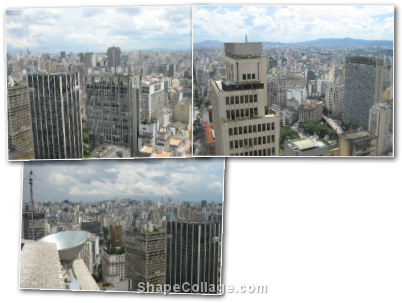
At the top of the building there is an observation deck from which you can see stunning views of Sao Paulo, with hundreds of skyscrapers in whichever direction you look at for kilometers and kilometers. Then you realize that you are in Sao Paulo, the 6th or 7th most populated city in the world (depending whether you look at the city limits or metropolitan area).
Sao Paulo skyline from Banespa observation deck.
Other famous observation decks that I visited recently were the one in the ESB and the Top of the Rock at the GE Building Rockefeller Center, there are some differences though:
Height: Banespa, 161 m; Rockefeller, 259 m; ESB, 443 m.
Number of floors: Banespa, 35; Rockefeller, 70; ESB, 102.
Construction finished in the year: Banespa, 1947; Rockefeller, 1939; ESB, 1931.
Race in New York. Let me share here with you a story about a race to build the tallest building that took place in the late 1920’s. I found this story in the book, “Tales of New York”, which I commented in a previous post.
Three buildings were being built at the same time, the 40 Wall Street, the Chrysler Building and the Empire State Building. Competition among them was fierce at the time, with names of big industrialists behind them. Plans were revised once and again. The first one in being finished was the 40 Wall Street in April 1930 which claimed the title of world’s tallest building at the time. Originally it was to be 840 ft but along the race the plan was revised to make it just 2 feet taller than the Chrysler building plan at the time 925 ft, at completion the 40 Wall Street height was increased to 927 ft.
During the last weeks of its construction loads of iron and steel were brought to the interior of the Chrysler building. People thought that it was part of the interior decoration, filled with metallic details and motives of the automotive industry. But once its rival building was finished, on a clear day in the morning a needle-like metallic structure was raised from the center of the top of the Chrysler building to the surprise of the population of New York. On May 27th 1927, the Chrysler building was finished, in the end measuring 1,046 ft, taking the title of tallest building from 40 Wall Street merely a month after.
Walter Chrysler had worked in the past together with the man behind the Empire State Building, John J. Raskob, then CFO of General Motors, one of the main competitors in the automotive industry. He wanted him to either fail in the pursuit of building the tallest skyscraper or becoming bankrupt if he made it. With 1,046 ft height the Chrysler was to be tallest than the Empire State Building when it would be finished, however in the year that took the ESB to be finished the design was subsequently changed measuring 1,454 ft when it was finally finished in 1931, taking the title of tallest building from the Chrysler just a year later.
Just to close the post…
nowadays the tallest building is the Burj Khalifa in Dubai with 828m (160 floors),
the tallest building in Europe is Commerzbank Tower in Frankfurt with 259m (65 floors) and very close to it is the Main Tower (200m) that hosts a very nice restaurant which is the only observation deck in the skyscrapers of the city,
the tallest in Spain is the Caja Madrid Tower with 250m (45 floors) which holds the 148th position in the list of highest skyscrapers.
another interesting point is to see the evolution of the title of “tallest skyscraper in the world”.