This morning, as this post is being published I’ll be starting the 19th Rome marathon, together with my friends Serna, Manuel and brother Jaime.
I am very satisfied with the way I could train towards this marathon, no injuries this time.
Since running Berlin marathon last September 30th, I only stopped for a couple of weeks and swiftly started running again. Even if I started a bit late to pick up with the number of miles run per week (from mid December instead of mid November) I have amounted almost 800km in these last months, including:
5 days of tough series training: 12x400m, 14x400m, 8x800m, 9x800m and 10x800m.
7 long runs of over 16km each, 4 of them over 20km.
5 races: San Silvestre Vallecana (10km), Course des Rois (10km), Le Deca d’Escalquens (10km), Trailhounet (18km) and Media Maratón de La Latina (21km).
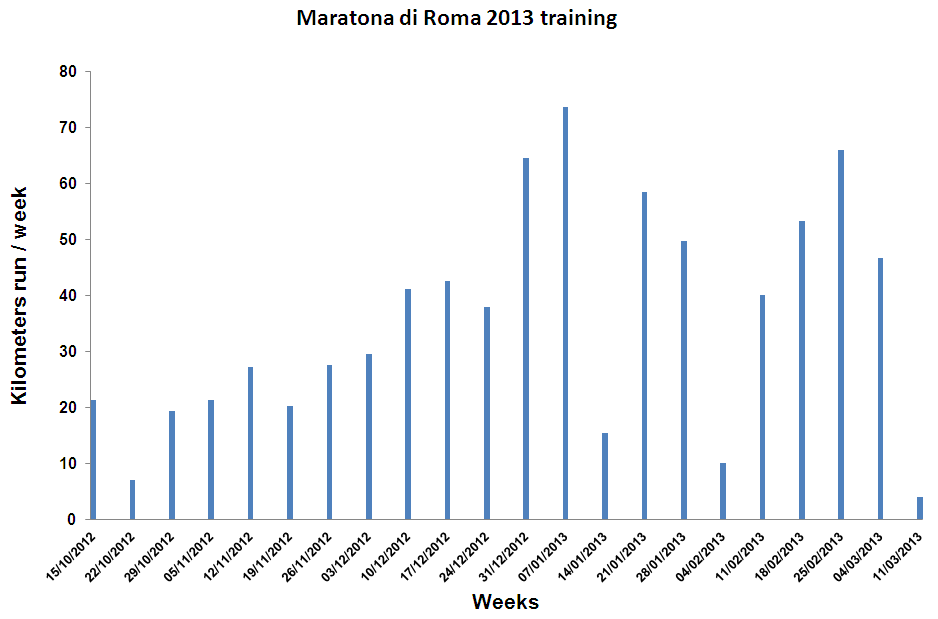
You can see below the mileage run per week:
Maratona di Roma 2013 training season. Kilometres run per week.
A lesson learned from previous training sessions: when I noticed that some muscle or tendon was getting sore from too much training I did not hesitate in slowing down that week, instead of keeping up with the training until getting seriously injured. Let’s see today how it goes, anyway, as Jaime says, it’ll sure be a day for the epic :-).
One of the sports introduced by the British working at the mine of Rio Tinto (post about the visit to it I made the last week here), was football.
Welcome to Minas Riotinto (“Birthplace of Spanish football”).
I didn’t expect anything special as I had not researched the topic beforehand but I hoped there would be something knowing that the origin was there. This was immediately confirmed as there is a signpost at the entrance of the village about the relation of it with football.
But then, there was nothing else but the statue you can find below in front of the local football club field (playing in who knows which division).
I asked at the mining museum whether there was something to be visited about football and its origin in Spain. There wasn’t. “The town hall has a project of building a local museum of football, but today there is nothing”. What a pity. I guess I am not the only person who when travelling is searching for this kind of places and memorabilia, thus I guess it could have some potential.
Statue celebrating the origin of Spanish football in Minas de Rio Tinto (Huelva).
It is not the first time that I get this disappointment. You may remember that I had the same feeling when searching for the roots of football at the Freemasons in London. I would love to see such museum like the one about golf in St. Andrews, I hope that one day I will be able to do so. To date, the closest to that is the one-page text below, found at the mining museum:
Page about the introduction of football in Rio Tinto by British RTCL workers.
Rio Tinto is a river flowing through the South of Spain opening to the Atlantic ocean at Huelva. I had wanted to visit it since long time ago. It is not just any river: it is especially acidic (pH2), it has a high content in heavy metals and as its name points out, it is red (“tinto”), due the iron dissolved in the water.
The Rio Tinto area has been a mining site since ancient times, and it is there that the British mining company, bearing that name, was founded in 1873, when some international investors bought the site to the Spanish government. The mining activity grew so much that at some time it was reported as the biggest mining site in the world (especially for copper).
The influence of the operation in the area reached every corner of life:
The ancient village of Minas de Rio Tinto was brought down in order to exploit the underground below it and had to be displaced.
A huge train system (over 300km of rails), only second to the national state train system, was built to bring metals to the port of Huelva.
The British colony formed by the company workers and managers brought by the owners introduced all kinds of changes in the society: from religion to the introduction of several sports (football, tennis, polo, criquet…).
The Mediterranean forest in the area was completely destroyed. Today, the a forest of pine trees, more resistant to the acidic conditions has been planted.
At first, several dozens of children were employed (about 50 under age 10!), salaries would be paid out in coupons to exchange for food from the company, work conditions were deplorable. Years later, partly due to the pressure of organized unions led the company to improve the standards of workers and to provide several social benefits. A major cornerstone was the strike that occurred in the first days of February of 1.888 which ended in the killing of over hundred demonstrators (“Año de los Tiros“).
In 1.955 the Spanish State bought back a majority stake of the operation to the Rio Tinto Company Ltd., which was kept ongoing for some decades, but today is closed.
Today, Rio Tinto has a very different interest, as it serves scientists from NASA to study the bacteria living in the extreme conditions of the river. This helps them in studying the plausibility of life in Mars under similar conditions.
The landscape is unique, striking. We took several pictures of it and I share some of them below:
This slideshow requires JavaScript.
The village has a wonderful mining museum, a train tour through the mining complex (11km route and back) along the river, a small mine can be visited (entering 200m into it) and a typical British house of the time is also open for tourism. It is a very interesting tour for a day (different packages starting from 10€; just ~60 km from Seville).
We also recorded some 5 videos along the train tour. See the first one here (you may find the rest at my Youtube channel):
At the beginning of the year, as a yearly goal I decided to keep on learning new things. One of the actions I took was signing up for some courses (in Coursera platform).
The courses were great, the way of learning is very encouraging: with videos, small and bigger assignments, online forums, students from all over the world helping each other, aspiring career starters and retired people wanting to learn something new together in a global class.
I followed them for some weeks but finally I was unable to keep up with them and dropped. I felt frustrated for that.
Those of you who know me well might think “a course on creativity, how unlikely of Javier?”. Well, I decided to join it because I thought it could be fun… and some of the assignments are fun!
In this post I wanted to first raise awareness of this kind of free education and, secondly, to share the video I took last weekend in Seville for an assignment. Enjoy:
What was the assignment about?
“Your challenge is to use TWO HOUSEHOLD ITEMS of any type – to come up with a brand new SPORT. Use your creativity to generate something you have never seen before.
You will be evaluated on your creativity and presentation. Deliver a drawing, photo, or video demonstrating the sport. Feel free to include a short description.”
The Holocaust Memorial or Memorial to the Murdered Jews of Europe was inaugurated in Berlin about 7 years ago close to the Brandenburg Gate.
If you see the following picture from Wikimedia, you get a glimpse of what could be a huge cemetery of concrete slabs.
Holocaust Memorial (by de:Benutzer:Schreibkraft).
The memorial is described in the Wikipedia with the following words:
“It consists of a 19,000 square metres (4.7 acres) site covered with 2,711 concrete slabs or “stelae“, arranged in a grid pattern on a sloping field. […] According to Eisenman’s project text, the stelae are designed to produce an uneasy, confusing atmosphere, and the whole sculpture aims to represent a supposedly ordered system that has lost touch with human reason.“
However, the memorial is not to be contemplated from the air as seen above, but from the ground and people can walk through it.
If you visit the site you’ll experience or watch some unintended consequences: people tend to sit on the stones, run between them, jump from one to another, play “hide and seek”… the least people do is to experience with light and shadows, distances, slopes…
This slideshow requires JavaScript.
Then there is a poor security guard calling on people (sometimes bunches of playful students) to “behave”, not to run, jump, etc.
Take a look at the water counter in the picture below:
Water counter at hostel.
We found these water counters at the hostel we were lodged in Berlin. I immediately started taking note of how many litres I consumed in each of the showers I took. First one:
I checked in the internet and found references of average consumptions for showers between 80 and 120 litres. The following days I tried to save some water (of course without compromising the cleaning part :-)). The minimum consumption I had was of 34L, the rest in the end were around 42L.
In the process I discussed with Luca whether hotels could incentivize in some ways (other than displaying the counter at our sight) the saving of water by the guests. We thought of possible messages in the way of “the average guest consumes 100L per shower, see if you can use less water! Do it for the planet!”, or whether some discounts / surcharges could be offered / imposed to those consuming less / more water.
However, I checked water prices in France and in Toulouse and it is around 3.3€ per cubic metre (m3). That is, in 5 days, having seen the counter and having tried to minimize water consumption all I saved was about 0.38 m3 or about 1.25€… this is economically meaningless in comparison with the hotel bill.
At those prices, I guess all we could do is trying to save water out of our consciences and not driven by an economic drive (the same level of saving I achieved could mean ~35€ a year per person).
During our last stay in Berlin we were lodged at a hostel in Fasanenstrasse, close to Kurfürstendamm (Charlottenburg). The pension was in an old building which was protected by some urbanism laws which prevented the owners to perform some works.
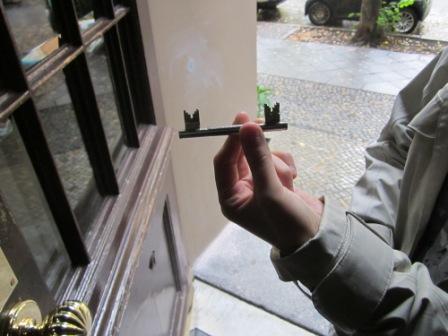
Thus, the building maintained a curious key lock system at the front door which was activated by night. The key was double sided as it can be seen in the picture below.
Old Berlin front door key.
In order to open the door you would have to introduce the key in the lock, unlock it and then fully insert the key in the door until it would appear in the interior of the house. You would then have to lock it from the inside and remove the key from the inside by pulling from the other end of the key.
We found it funny and curious, so we recorded this short video showing the system:
Berlin Tempelhof Airport was one of the spots that we wanted to visit in Berlin. The airport was built in the 1920’s and had been an iconic airport for decades, e.g., by the famous Berlin Airlift which with the allied forces supplied West Berlin once surface traffic was blocked by the Soviet Union in 1948.
Other historic events happening in the airport (quoted from Wikipedia):
In 1909, Frenchman Armand Zipfel made the first flight demonstration in Tempelhof, followed by Orville Wright later that same year. Tempelhof was first officially designated as an airport on 8 October 1923. Deutsche Luft Hansa was founded in Tempelhof on 6 January 1926.
[…] described by British architect Sir Norman Foster as “the mother of all airports”.
The airport closed operations in 2008.
The coincidence was that the Berlin marathon fair was organized at Tempelhof thus we didn’t need to schedule the visit since we would go there to pick the running bibs.
See below some pictures from the airport.
This slideshow requires JavaScript.
I had some fun with my brother remembering that the airport is also featured in the movie “Indiana Jones and the Last Crusade” (when they get into a zeppelin). I tried to find in Youtube some scenes in which the airport could be recognised, but the only scene that I find related to it is when Indiana and his father are already aboard the zeppelin:
A whole decade has passed since the first time that I visited Berlin with my brother. This time again, we dedicated some time to visit some touristic highlights. I will write some posts in relation to that visit.
This first one will be dedicated to the East Side Gallery. From the Wikipedia:
The East Side Gallery is an international memorial for freedom. It is a 1.3 km long section of the Berlin Wall located near the centre of Berlin on Mühlenstraße in Friedrichshain-Kreuzberg. […]
The Gallery consists of 105 paintings by artists from all over the world, painted in 1990 on the east side of the Berlin Wall. […]
It is possibly the largest and longest-lasting open air gallery in the world. […]
The paintings at the East Side Gallery document the time of change and express the euphoria and great hopes for a better and free future for all people of the world. […]
The wall has been damaged by several reasons and gone through subsequent series of restorations.
See below some pictures from the East Side Gallery (status from September 2012):
One of the events that include some big marathons is a morning run the previous day, the so-called “breakfast run”.
When we ran the marathon in Paris, only our friend Serna attended that run. This time we went together and Luca and my brother Jaime waited for us at the end.
This stadium today hosts Hertha Berlin football matches, but it is better known as the stadium where the summer olympic games of 1936 were celebrated: the first ones televised, inaugurated by Adolf Hitler and the ones in which the athlete Jesse Owens won 4 gold medals.
See below some of the pictures we took during that morning run:
This slideshow requires JavaScript.
Hopefully the next time we’ll remember to bring either flags or a festive costume as many of the other runners typically do.
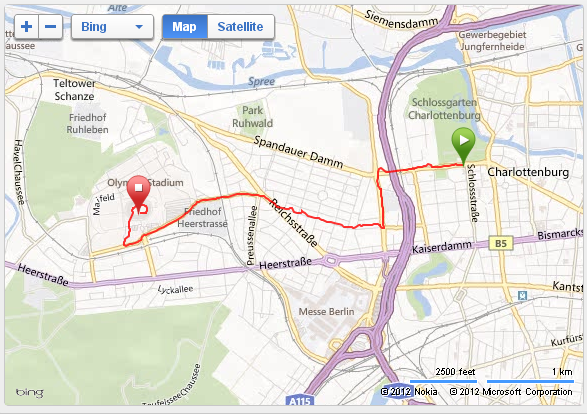
See the route we followed from the palace in Charlottenburg to the stadium as recorded by my Germin GPS:
Breakfast run route.
Finally, I found two interesting documents in relation to the stadium and the games:
The stadium plan [PDF, 1.7 MB] from today’s stadium website. In it you can see the location of the Maifeld (used for Hitler’s government celebrations and during the olympics for the equestrian events), the Bell Tower, the stadium and the Olympischer Platz.
The official report [PDF, 42.4 MB, 640 pages] of the games. It contains all kind of info about the International Olympic Committee at the time, hundreds of pictures of the Games and all of results of the different events.



 The Blog by Javier