
El amor en los tiempos del cólera

El amor en los tiempos del cólera.

El amor en los tiempos del cólera.

Cuenta Gabriel García Márquez que al escribir “El amor en los tiempos del cólera” se inspiró en parte en el romance de sus padres (“La única diferencia es que mis padres se casaron. Y tan pronto como se casaron, ya no eran interesantes como figuras literarias”) y otro de unos ancianos que mantuvieron su amor en secreto durante décadas.

La novela fue publicada en 1985, tres años después de que recibiese el premio Nobel de literatura (ver discurso de aceptación del premio).

Seguramente la obra más aclamada de García Márquez sea Cien años de soledad, pero a mí me ha gustado bastante más “El amor en los tiempos del cólera”: una novela romántica que describe la relación durante toda una vida entre principalmente tres personajes: Fermina Daza, su marido, Juvenal Urbino, y su eterno pretendiente, Florentino Ariza.

Personalmente, parte de la narrativa y descripciones en “Cien años de soledad” se me hicieron pesados, en “El amor en los tiempos del cólera” ha sido al contrario. Largas páginas con densos párrafos se pasan en un suspiro gracias a la cantidad de figuras retóricas que usa García Márquez y hacen de la lectura un juego. En múltiples ocasiones me he encontrado después de leer un pasaje admirando el juego de palabras que acababa de hacer el autor.

Otro de los aspectos que me ha gustado del libro ha sido la personalidad y franqueza de los personajes, principalmente de Fermina Daza.

Como siempre, cuando leo un libro lo dejo lleno de páginas marcadas, pasajes subrayados, etc., os dejo algunos aquí para incitaros a la lectura.

“- Déjame aquí -dijo-. Sí había jabón”

[Juvenal Urbino a su esposa, después de llevar meses sin hablarse y durmiendo en habitaciones separas por una estúpida discusión, se retracta de su posición inicial aun sabiendo que tenía razón con tal de quedarse en la cama de matrimonio]

***

“… por su carácter, las cartas de ella eludían cualquier escollo sentimental y se reducían a contar incidentes de su vida cotidiana con el estilo servicial de un diario de navegación. En realidad eran cartas de distracción, destinadas a mantener las brasas vivas pero sin poner la mano en el fuego, mientras que Florentino Ariza se incineraba en cada línea.”

***

 “Escapó por milagro de una ejecución sumaria acusado de ser un espía que mandaba mensajes en clave de sol…”

[Habiéndose decretado el toque de queda a Florentino lo encuentra y detiene una patrulla militar cantando a Fermina]

***

 “Y algo que había de ser desde entonces la razón de su vida: la convenció de que uno viene al mundo con sus polvos contados, y los que no se usan por cualquier causa, propia o ajena, voluntaria o forzosa, se pierden para siempre. El mérito de ella fue tomarlo al pie de la letra.”

[Florentino Ariza a la viuda de Nazaret]

***

“… lo primero que le preguntaron en el puerto fue cómo le habían parecido las maravillas de Europa, y ella resolvió muchos meses de dicha con cuatro palabras de su jerga caribe:

–       Más es la bulla.”

[Fermina Daza. Esto me recuerda al pensamiento que me viene cuando alguien pregunta por Madrid, qué visitar en pocos días, qué tiene de especial, etc.]

***

“… y solo entonces había comprendido que un hombre sabe cuándo empieza a envejecer porque empieza a parecerse a su padre”

***

“… lo volteó al derecho y al revés con su sabiduría de perro viejo, lo paró de cabeza, lo subió y lo bajó, lo volvió a parir como nuevo, le hizo trizas sus virtuosismos teóricos, y le enseñó lo único que tenía que aprender para el amor: que a la vida no la enseña nadie.”

[Ausencia Santander a Florentino Ariza, quien estaba escribiendo un libro de instrucciones para enamorados]

***

“Sólo ellas sabían cuánto pesaba el hombre que amaban con locura, y que quizás las amaba, pero al que habían tenido que seguir criando hasta el último suspiro, dándole de mamar, cambiándole los pañales embarrados, distrayéndole con engañifas de madre para aliviarle el terror de salir por las mañanas a verle la cara a la realidad.”

***

“… se había enredado más pronto de lo que ella creía en una maraña de convenciones y prejuicios de su nuevo mundo. Al principio tenía una frase ritual para afirmar su libertad de criterio: “A la mierda el abanico que es tiempo de brisa”.” [Fermina Daza]

***

Era un marido perfecto: nunca recogía nada del suelo, ni apagaba la luz, ni cerraba una puerta.” [Sobre Juvenal Urbino]

***

“… le contó que había estado esa tarde con su confesor, temió quedarse ciega de rabia. Desde el colegio tenía la convicción de que la gente de la iglesia carecía de cualquier virtud inspirada por Dios. […] Pero que su esposo le hubiera permitido al confesor inmiscuirse hasta ese punto en una intimidad que no era solo la suya, sino también la de ella, era algo que iba más allá de todo.

–       Es como contárselo a un culebrero de los portales – dijo.

Para ella era el final” [Fermina Daza]

***

“… la aterrorizaba la voracidad con que los objetos iban invadiendo los espacios de vivir, desplazando a los humanos, arrinconándolos, hasta que Fermina Daza los ponía donde no se vieran. […] escondía el desorden”

***

“Sin embargo, el rápido progreso de la aviación era un peligro real para todos. Ella trató de consolarlo: los buques existirían siempre, porque no eran muchos los locos dispuestos a meterse en un aparato que parecía ser contra natura.” [Floretino Ariza y Fermina Daza sobre los aviones.]
3 Comments

Filed under Books

Swimming with dolphins in Mauritius

Mauritius is an island nation some 2,000 km off the East coast of Africa, in the Southern hemisphere, about 1/4th the size of the region of Madrid. Most of its surface is covered by sugar cane fields and a national park. The beaches are splendid. A major part of its coast is surrounded by coral reef. The service by Mauritians is terrific.

We have just come from spending a relaxing week over there and in this blog post I wanted to share one experience that marked me from this trip: swimming with dolphins in open waters.

One of the excursions offered was to go one day very early in the morning to take a boat off from Tamarin port in order to spend about 2 hours swimming with dolphins. One tourist from our group asked “what are the chances of actually seeing dolphins?”, “over 95%” confidently said the tour operator who tried to sell the different packages.

As the experience promised to be unique we went for it. And unique it was.

After having driven for almost 2 hours to cross the island, at 7am we were in the boat already seeing dolphins. We put on the snorkelling kit: flippers, mask and tube and off to the water.

At first, the anxiety made me lose my breath. After less than one minute you get used to it. In less than 2-3 minutes you get to locate the dolphins just by seeing their fins some meters away. Then you start swimming trying to chase them. “Look down!” said the guide. Once, you look down, you get to see some dolphin swimming some meters below. Then 2, 3, 4… and off you go swimming along with them. With the flippers it doesn’t even cost a lot of effort to keep pace with them. Soon enough you see yourself surrounded by over 10 dolphins. You think that they are not more than 20 centimetres away, you extend your arm but cannot touch them. They’re probably not far away, but not that close either. They swim on the surface, breath and go down some metres under the surface. You follow them from up above until they come up again. This sequence is repeated once and again. Until at some point you lose that group. Back to the beginning. You locate some dolphin, swim towards it and then find a group… it went on and on for almost 2 hours.

See a video we took and some pictures below (1).

This slideshow requires JavaScript.

If you ever have the chance, do not miss it.

(1) In Youtube you may find much better videos taken with cameras under the water surface.

1 Comment

Filed under Travelling

Transcript of 2014 Berkshire Hathaway Annual Q&A with Warren Buffett and Charlie Munger

Last Saturday, May 3rd, Berkshire Hathaway held in Omaha its annual shareholder meeting, attended by over 30,000 shareholders. The most expected part of that weekend is the Q&A session of the meeting, in which Warren Buffett and Charlie Munger answer to dozens of questions.

The meeting is neither televised, nor recorded or streamed. However, the financial website Motley Fool has done a terrific job publishing a transcript of the session. Find the link here and allow yourself at least a couple of hours to read through it (the Q&A session takes hours itself!). I strongly encourage the reading. As a teaser, find below some of the gems:

No CEO looks at proxy statements and comes away thinking that I should be paid less.” Warren Buffett.

“We can’t earn same return on capital with over $300 billion market cap. Archimedes said he could move the world with a long enough lever. I wish I had his lever” Buffett

“If you are in any social organization, if you keep belching at the dinner table, you’ll be eating in the kitchen” Buffett (on Boards of Directors)

“Cash or available credit is like oxygen: you don’t notice it 99.9% of the time, but when absent, it’s the only thing you notice” Buffett

“By the standards of the rest, we over-trust. […] because we carefully selected people who should be over-trusted” Charlie Munger

“There’s something about owning a brand to educate yourself about things you might do in the future.” Buffett

At the beginning, we knew nothing. We were stupid. If there’s any secret to Berkshire, it’s that we’re pretty good at ignorance removal.” Munger

“… if you think you understand, you’re not paying attention.” Munger

“There’s changes going on with all our businesses. We want managers to think about change, what’s going to be needed for the future” Buffett

“Being realistic when realizing your own shortcomings is important.” Buffett (on the circle of competence)

“There’s a point you start getting inverse correlation between wealth and quality of life” Buffett

“I think America made a huge mistake by letting the public school systems go to hell…” Munger

(on home mortgage market) “you had the biggest bunch of thieves & idiots running things, I’m not trusting private industry in this field” Munger

“The net utility from finance majors has been negative.” Buffett

Some other readings I recommend in relation to this post:

Leave a comment

Filed under Investing

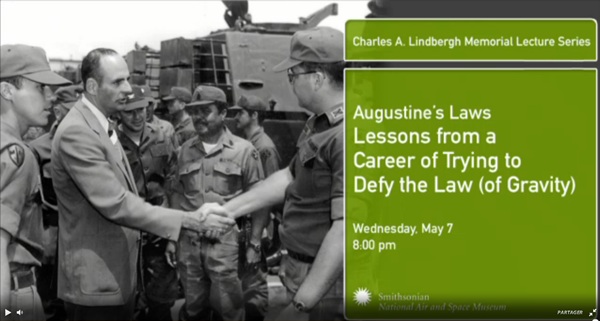
“Lessons from a Career of Trying to Defy the Law (of Gravity)”, lecture by Norman Augustine

Norman Augustine is an aeronautical engineer whom I have referred to often in this blog mainly due to his book “Augustine’s Laws” of which I wrote a review (find it here). He started working at Douglas Aircraft Company (1) in 1958, though through his long career he has occupied several positions in the administration and other major aerospace companies such Martin Marietta and then Lockheed Martin (2).

In my review about his book I wrote:

The book reviews A&D programs, especially their mismanagement and failures from the Wright brothers times till the early 80′s, when the book was written. The book is hilarious.

Lecture by Norman Augustine.

Lecture by Norman Augustine.

Some readers may believe I overstate it. Well, I invite you to watch the lecture he gave 2 days ago at the Smithsonian National Air and Space Museum (3) as part of the Charles A. Lindbergh Memorial Lecture Series. The lecture was titled “Lessons from a Career of Trying to Defy the Law (of Gravity)” [47’59”].

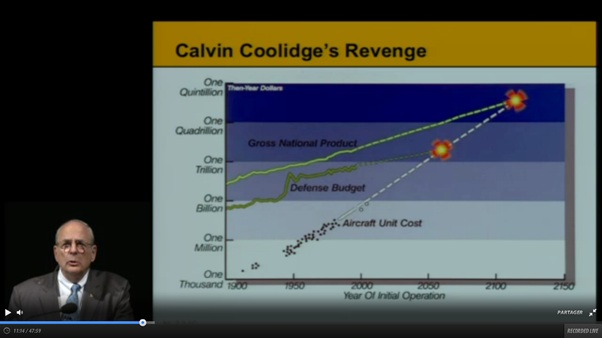
During the lecture Norman shares a great deal of the wisdom he has accumulated through his long career, part of it condensed in his Laws, compiled in his book. One of the laws I like the most is possibly the number IX:

In the year 2054, the entire defense budget will purchase just one tactical aircraft. This aircraft will have to be shared by the Air Force and Navy 3 1/2 days each per week except for leap year, when it will be made available to the Marines for the extra day. (LAW NUMBER IX)

I think it is priceless to have Norman explain it in person:

Augustine's Law IX.

Augustine’s Law IX.

During the lecture he used an update of his law (written in the 80’s) made by The Economist a few years ago which I covered also in this blog (4).

Other topics covered by Augustine during the lecture include: the importance of thinking with a systems point of view, the evolution of aerospace industry in the last decades, the importance of strategy and leadership, all covered by his fine humor and wit.

(1) You may read here a tribute I wrote about Douglas Aircraft Company.

(2) Some years ago I wrote this post about Lockheed’s Skunk Works.

(3) You may find here a post I wrote about my visit to the Smithsonian National Air and Space Museum at Dulles.

(4) I few months ago I wrote another post reviewing the application to bomber aircraft of Augustine’s Law IX with new US long range bomber program. In his book Norman includes an extrapolation as well of bomber aircraft increasing costs, even if the wording of the law takes tactical aircraft as the benchmark.

Leave a comment

Filed under Aerospace & Defence

Rotterdam marathon

Last Sunday 13th April, I completed Rotterdam marathon together with JaimeSerna and Manuel. In a race preview post I wrote that I arrived to this marathon a bit short of training, having completed just about 2/3 of the training plan. In the weeks prior to the race I had asked my brother what pace he intended to start with. Having in mind the lack of thorough training, I thought of starting at a pace slightly below 5’20” per km but not below 5′. That rhythm, if sustained through the end, would allow a new personal best (at that point 3h45’35”, achieved in Paris, April 2012).

Jaime and I started the race together, departing from the box “E”. We ran together 15 kilometres, pacing each other, ensuring we would not run too fast or too slow. At km. 15 Jaime said he wanted to soften the pace a little and since then I ran alone. My intention up to then was just to try to sustain low 5’s until km. 25, just before the climb of the Erasmus bridge back to the city centre. I thought that climb would take its toll and wanted to arrive to it with some time cushion, climb it relaxed and see if after it I could go back to a similar pace.

Just when we crossed the bridge I saw that I had not slowed down but the pace was still at 5 minutes per km. This encouraged me. I took the second energetic gel bag and ate it (I consumed the first one at km. 15) and told to myself “let’s try to run a few more kilometres at 5′, one at a time”.

… and those were the best 10 kilometres of my race, from 25 to 35, where I employed less than 50′ and enjoyed it a lot. I was overtaking runners, very focused on my own pace, breathing correctly, drinking at every supply post, eating another energy gel bar at km. 33, refreshing myself with sponges…

Rotterdam marathon: pace (min / km) evolution.

Rotterdam marathon: pace (min / km) evolution.

Running at km. 40.

Running at km. 40.

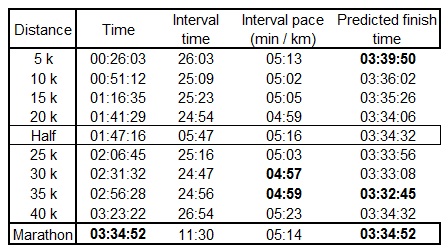
At some point, seeing that I was maintaining paces of 5′ and that I had only a cumulative 1’30” over the time for 3h30′, I thought that would be possible. However, at km. 36 I started feeling stiffer. The running was less smooth. Nevertheless, I told again to myself “let’s try to clock kilometres at about 5’20” “, and so I did with the exception of km. 41, but offset with 42. The last 500 metres I sprinted to try to clock a time under 3h35′, which I did: 3h34’52”, a new personal best time in marathon.

Rotterdam marathon 5k splits, paces and predicted finish times.

Rotterdam marathon 5k splits, paces and predicted finish times.

Finish photo.

Finish photo.

From the marathons I have completed in these last 3 years, Rotterdam marathon does not have the best scenery (Rome, Paris), nor is the flattest (Berlin), or the one with the best start (Rome) or finish (Athens, Berlin)… but it has been in Rotterdam where I have enjoyed the most running, where I have had the best feelings and the best race management.

One take away for me of this marathon is something which I had read often: don’t give all out from start, keep something for the second half. After the race, I have made the numbers and the comparison: Rotterdam and Paris (my previous PB) have been the slowest 2 marathons till the half marathon.

Comparison of splits in the last 6 marathons.

Comparison of splits in the last 6 marathons.

Finish photo: 11th marathon.

Finish photo: 11th marathon.

In Rotterdam, the starting at pace above 5′ was not intended in order to keep faster paces for the second half. I wish I had had such confidence and good strategy from the outset. No, we started at those paces in order to see if we could be between 3h40′ and 3h45′. But I take the lesson for the future, for the 12th marathon…

Rotterdam marathon diploma.

Rotterdam marathon diploma.

7 Comments

Filed under Sports

Running and support items

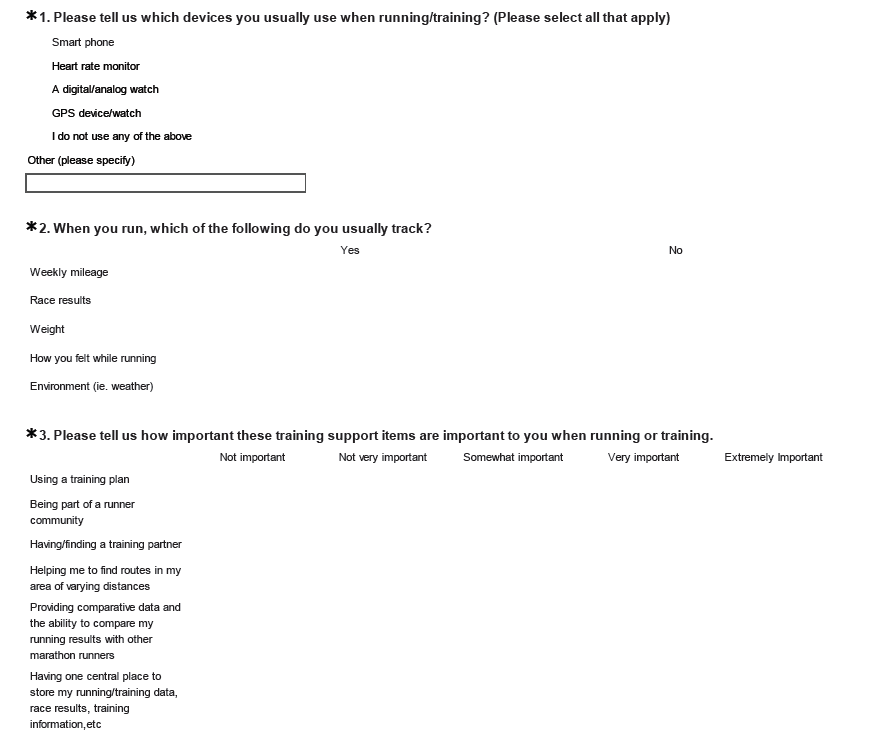
Few days ago I completed a survey from one of the sponsors of the 2014 New York Marathon, which I will run on November 2nd. I found the survey interesting and positive as it made me reflect on some topics which I would possibly would not have deemed very important to running. See some of the questions below and reflect on them in relation to your running habits.

NY Marathon survey questions.

NY Marathon survey questions.

Which devices do I usually use when running/training? The fact is that I always use a digital watch with GPS and often a heart monitor. No smart phone or iPod. What is more, if I am not wearing the GPS/watch it feels as if I had not run…

When you run, which of the following do you usually track? Mileage, results, weight… plus series times, average training paces, hear rates…

How important these training support items are important to me when running or training?

  • Using a training plan: Extremely important. Very often is essential to find the courage to go out and run, especially when the weather conditions are not the best. It is also very important to push yourself, go for the last series repeat, etc.
  • Being part of a runner community: I initially thought this was not very important. False. It is. Being able to discuss with friends how you are evolving, how you felt at races, taking part together in races, etc., also makes it much better.
  • Having/finding a training partner: I also thought that this was not important as most of the time I run alone. Nevertheless, when I have the opportunity to run in Toulouse, Madrid or wherever in Spain with my marathon pals and other friends it makes it so much better.
  • Helping me to find routes in my area of varying distances: Very important. When you have lots of distances already measured, it reduces the thought process of deciding where to go and reduces uncertainty.
  • Providing comparative data and the ability to compare my running results with other marathon runners: the comparison with other runners is not so important to me, but being able to compare my runs with previous ones to sense how I am evolving it is very important.
  • Having one central place to store my running/training data, race results, training information, etc.: again, extremely important.

What about you?

Leave a comment

Filed under Sports

Rotterdam Marathon preview

Next Sunday, April 13th, I will take part in the Rotterdam Marathon together with the usual suspects (Jaime, Serna and Manuel). I am arriving to this marathon a bit short of training as I already reflected at the time of running Blagnac’s half marathon about a month ago. I may have completed just about 2/3 of the training plan I followed, having run just about 500km in the 16 weeks preceding the marathon. Thus, in this preview instead of talking about how I arrive to it I wanted to focus on the front of the race.

Rotterdam marathon is one of the fastest marathons in the world nowadays. On top of that, I learnt a few weeks ago that Kenyan athlete Eliud Kipchoge will take part in it. Kipchoge has today the 7th best time (1) in the distance (2h4’5″), achieved in only his second attempt at a marathon, in Berlin on the 29th of September 2013, when Wilson Kipsang beat the World Record (2h3’23”). I then wondered whether on Sunday a new world record could be set.

To be clear, setting up an athletics record is not an easy feat. Especially not in a marathon. But taking that question as a departure point I deep dived a bit into the data in order to learn more about the race.

The last time the marathon WR record was set in Rotterdam was in 1988 (26 years ago), when Belayneh Densamo left it at 2:06:50. Since then the WR has been beaten 8 times; once in Chicago, once in London and 6 times in Berlin, among them the last 5 times (see here the progression). Thus, we could confidently say that Berlin is the fastest marathon nowadays.

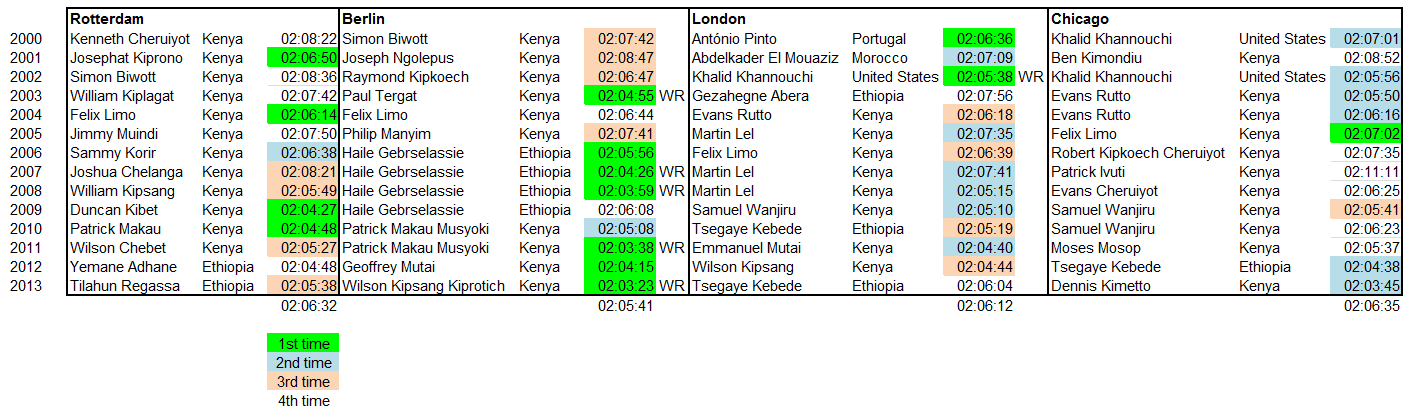
I then made a comparison of those 4 fast marathons over the last 14 years (since 2000), to see which one was the fastest race each of those years. See the results in the table below:

World fastest marathons (2000-2014).

World fastest marathons (2000-2014).

In the table you may see that out of the 14 years Berlin was the fastest of the 4 marathons in 7 (50%), however Rotterdam was the fastest marathon in 4 of those years (with a best time of 2h4’27”). By average winning times it would came 3rd (with a 2h6’32”) just after Berlin and London.

A curiosity, only twice in the past 14 years has the same runner won both Rotterdam and Berlin marathons in the same natural year: Felix Limo (2004) and Patrick Makau (2010) (2), both times each runner made a faster time in Rotterdam.

My train of thought then suggested: you are only paying attention to the winners’ times, you should compare more times to sense the profile of the race. I then found the following terrific website with all time best performances in track and field (maintained by Peter Larsson). With that database the analysis was rather simple.

I focused on the top 100 all-time marathon best times, of those:

  1. Berlin: 15 of the 100 all-time best times were achieved in Berlin, with a top 5 average time of 2h3’53” and a top 10 average of 2h4’18”.
  2. Chicago: 13/100; 2h4’29” (top 5); 2h5’4″ (top 10).
  3. Dubai: 18/100; 2h4’39” (top 5); 2h4’46” (top 10).
  4. Rotterdam: 14/100; 2h4’40” (top 5); 2h5’54” (top 10).
  5. London: 14/100; 2h5’02” (top 5); 2h5’15” (top 10).

Taking into account the top 100 times, Rotterdam marathon falls to the 4th place, seeing the irruption of Dubai as one of the top marathons, with all those times achieved in the last 6 years (run since 2000).

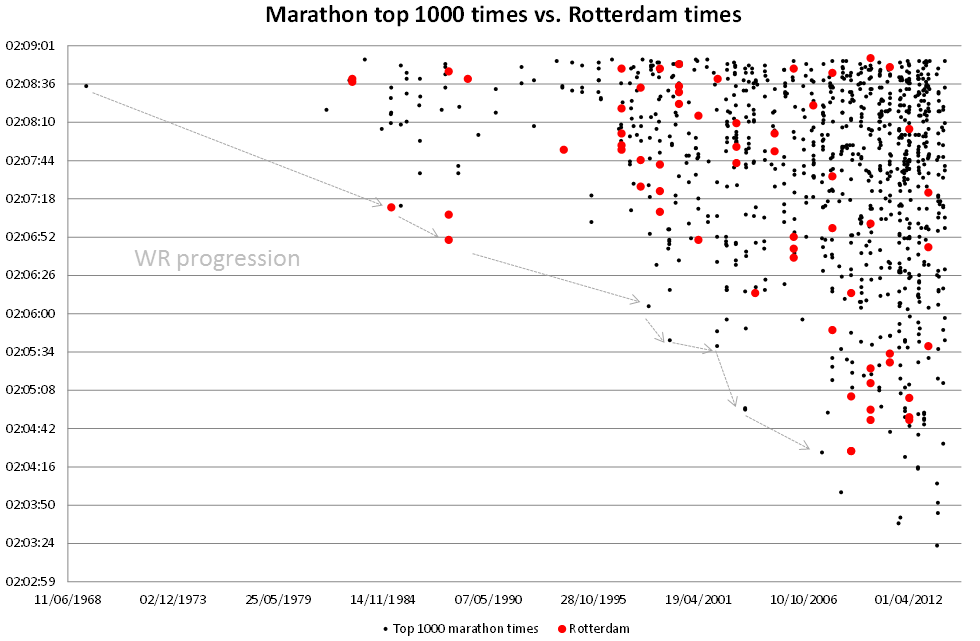
I then went a further step and made the following graph taking into account the top 1,000 times achieved in the last 45 years and highlighted in red those achieved in Rotterdam:

Marathon top 1000 times vs. those achieved in Rotterdam.

Marathon top 1000 times vs. those achieved in Rotterdam.

With those top 1,000 times, I then went back to compare the head to head of Rotterdam vs. Berlin, this time not only comparing winners times as above (Limo and Makau) but all those runners who run consecutively Rotterdam and Berlin, and checked in which race did they achieve the fastest of the 2 (or 3) times. See the results:

Runners among top 1,000 marathon times having run consecutively in Rotterdam and Berlin.

Runners among top 1,000 marathon times having run consecutively in Rotterdam and Berlin.

Of the top 1,000 marathon times, 16 runners achieved some of then running consecutively in Rotterdam and Berlin (or viceversa) (3). I made this comparison assuming that they must have been in a similar fitness (though not necessary). Of the 16, 9 of them achieved the better time in Rotterdam, 7 in Berlin. Among those times, the best 4 were achieved in Rotterdam (James Kipsang Kwambai, Patrick Makau, Geoffrey Mutai, Abel Kirui).

Then, having seen all these times, tables and graphics:

  • In the last 16 years the marathon WR has been beaten once every second year (8 times).
  • Rotterdam is arguably between the 2nd and the 4th fastest marathon.
  • However, the best time in Rotterdam (2h4’27”, Duncan Kipkemboi in 2009) is only the 14th best time overall.
  • Kipchoge PB is among the top 7 times after only his 2nd attempt at the distance.
  • Kipchoge ran in Berlin in September 2013 (2h4’5″), chances are that he beats that time running consecutively in Rotterdam in 2014.

Given the size of the feat I would not bet much on it, but I would not discard it either. Either way, I will only discover what happened about 2 hours after the race, at the front, has finished.

In case you feel like cheering me up and feel sorry for being thousands of kilometers away, don’t worry: click on this link and you will arrive at a website provided by the organization in which you can leave either one or two support messages that will be shown to me when I run by the kilometer 37 or I am just 500m from the finish line (my bib number for this race will be 1599).

Finally, find a classic picture from my brother (and marathon pal) Jaime symbolizing this marathon:

(1) Excluding times from Boston and other races not qualifying for IAAF world records.

(2) A year later, in 2011, Patrick Makau set a new WR in Berlin, 2h3’38”.

(3) Felix Limo, Geoffrey Kipsang and Jackson Koech run 3 consecutive races in a row each.

5 Comments

Filed under Sports

1907 Voisin-Farman biplane

In a previous post I discussed the importance of  Issy-Les-Moulineaux in the history of French aviation. I focused the first part of that post in the first 1-km closed circuit flight by Henri Farman on the 13th of January 1908.

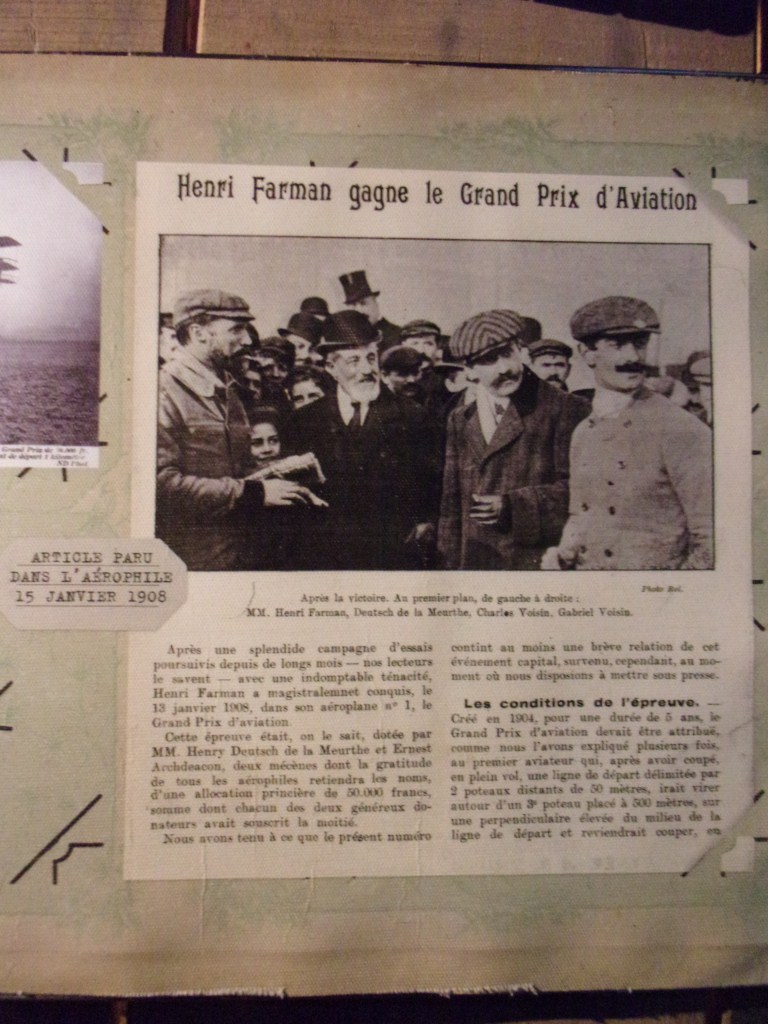
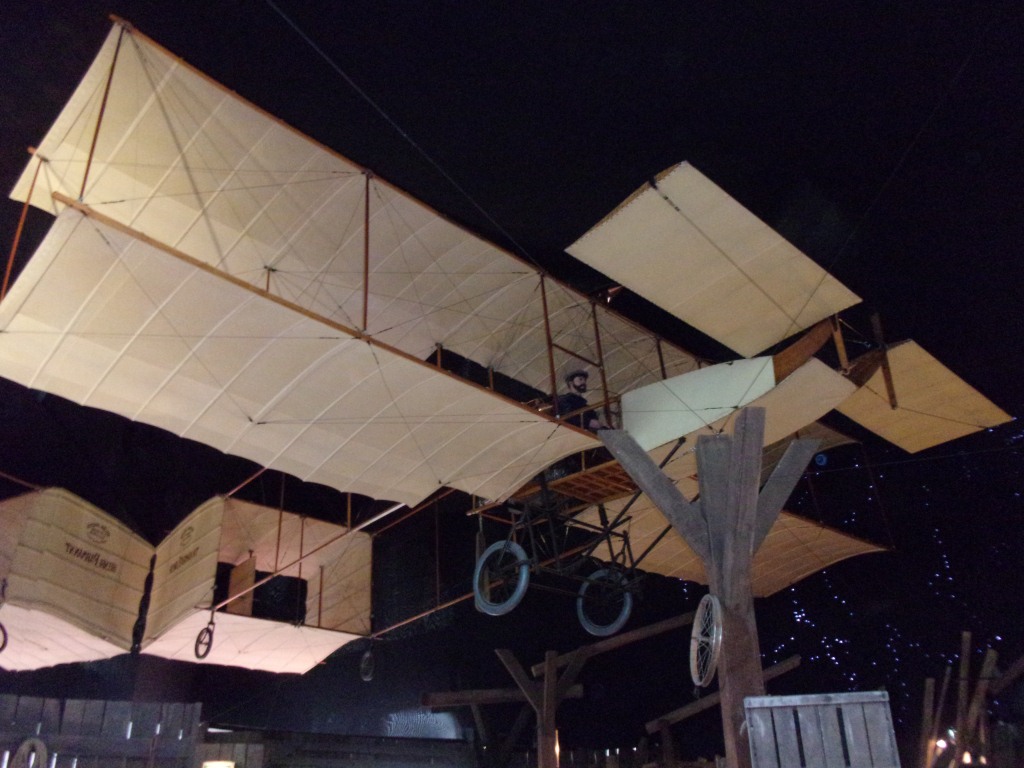
In this post I just wanted to leave a couple of pictures taken at the Musée de l’Air et de l’Espace (Le Bourget) showing a replica of that plane and an article appearing two days later in the L’Aerophile explaining the achievement (in French).

Article appeared on 15 January 1908 in L'Aerophile.

Article appeared on 15 January 1908 in L’Aerophile.

1907 Voisin-Farman biplane.

1907 Voisin-Farman biplane.

Leave a comment

Filed under Aerospace & Defence, France

Issy-Les-Moulineaux: cradle of European aviation

The city of Paris, among other things, can pride itself for the role it played in the early development of aerospace and aviation. In my opinion and to my knowledge there 3 or 4 quite important places in Paris where one can breath the history of those times, one of them is Issy-Les-Moulineaux. In a previous post I mentioned the space dedicated to the aviation history in the gallery of the village placed at the Musée Français de la Carte à Jouer.

Issy is a suburb just at the southwest of Paris, where the Périphérique crosses the river, south of the XV arrondisement.

At the turn of the XX century there was in Issy a military field dedicated to training. With the advent of aviation, that field started to be dedicated to aviation by the several pioneers who decided to relocate their activity there.

One of the images that symbolizes the French nascent aviation industry at the time is the one shown in the picture below. In it we can see Henri Farman (car racing pilot and aviator) flying the 1907 Voisin biplane winning the Archdeacon Prize for the first closed-circuit kilometer flight in Europe. That flight took place in the military field at Issy-Les-Moulineaux.

Henri Farman winning the Archdeacon Prize for the first closed-circuit kilometer flight in Europe (file from Wikimedia Commons, unrestricted picture belonging to the Library of the Congress).

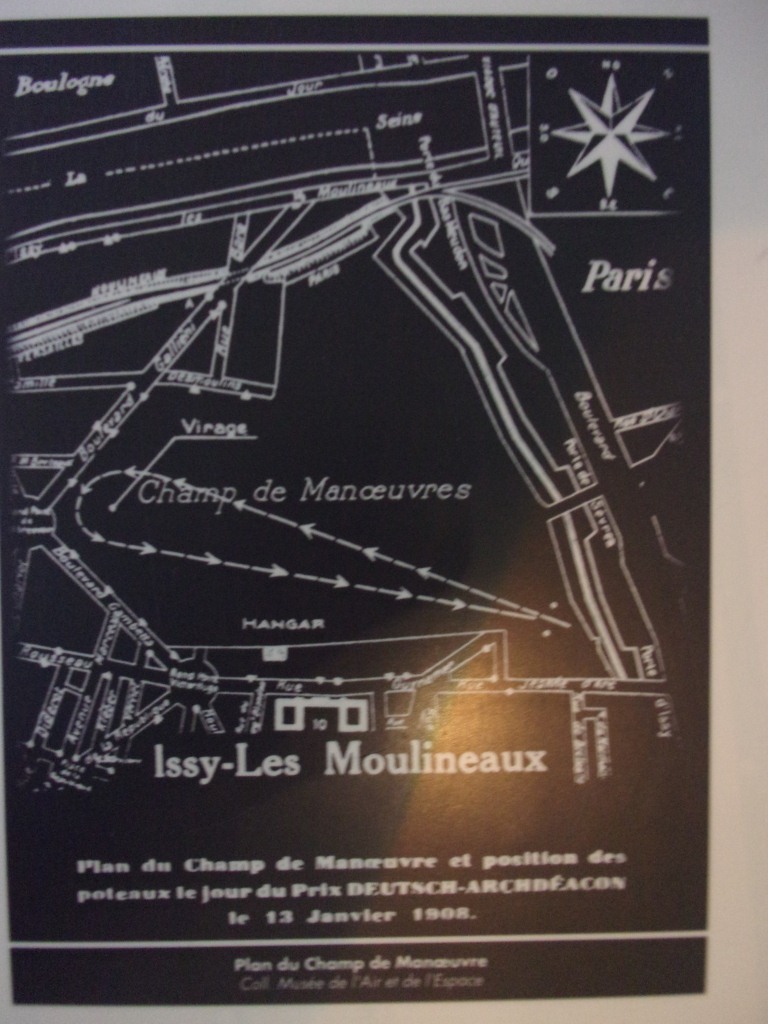
Circuit of the first 1km closed circuit flight at Issy.

Circuit of the first 1km closed circuit flight at Issy.

The circuit can be seen in the following graphic at the gallery of the village of Issy. The circuit was marked by 3 poles planted on the ground. Two poles marked the depart and arrival. One pole located at 500m marked the turning point.

The morning of of the 13th of January 1908, Farman took off with the Voisin biplane equipped with an Antoinette engine for a flight that lasted 1 minute and 28 seconds (thus at an average speed of 41 km/h). With this flight, Farman, won the Archdeacon Prize, which had been set back in 1904 by  Henri Deutsch de la Meurthe and Ernest Archdeacon, with an allocated sum of 50,000F.

In fact, apparently, Farman had achieved the feat already 2 days earlier, but it was only on the 13th of January that the flight was officially controlled by a commission from the Aero-Club de France (an institution created in 1898 to encourage the development of flight by individuals like Ernest Archdeacon, Jules Verne, André Michelin, Alberto Santos-Dumont, Henry Deutsch de la Meurthe among others).

In the picture with the circuit you may locate the aviation field by seeing the wind rose and the river Seine on the top of the image. Today, that field is the Heliport of Paris, the street surrounding it being called Rue Henri Farman.

That first closed circuit in Europe may be the most iconic image of Issy, but it was not the first happening nor the last aviation achievement that took place there, see some others below:

  • 1905 (March, 26): at the initiative of Ernest Archdeacon a glider type Wright, towed by a car, rose to about 10m.
  • 1906 (August, 18): the Romanian Traian Vuia flies for about 11-24m rising just 2.5m above the ground.
  • 1907 (July, 11): Louis Bleriot makes his first flight aboard his monoplan VI Libellule.
  • 1907 (November, 5): Léon Delagrange flies aboard a Voisin-Delagrange over 300m in a semicircle.
  • 1907 (November, 17): Alberto Santos-Dumont makes his first flight on the XIX Demoiselle.
  • 1910 (March, 9): Elise Raymonde de Laroche obtains her pilot licence, being the first woman in the world to receive one.
  • 1910 (June): the first metallic plane ever is tested in Issy.
  • 1911 (May): the raid Paris-Madrid was organized, with departure from Issy. Among the 8 pilots taking part in the race was Roland Garros. That day one of the airplanes suffered an accident when taking off, crashing against the authorities and killing the then French war minister, Maurice Berteaux.

It goes without saying, that this shall be a mandatory stop for any aviation enthusiast passing by Paris.

Aviation room at the Gallery of Issy (Musse de las Cartes a Jouer).

Aviation room at the Gallery of Issy (Musse de las Cartes a Jouer).

2 Comments

Filed under Aerospace & Defence, France

Musee Mecanique (San Francisco)

Luca and I visited the Musee Mecanique during our honeymoon last year. It is located at the Pier 45 in San Francisco and it includes a private collection of hundreds of mechanically operated musical instruments, arcade games, voyeurism slot machines and, possibly, the only existing steam engine motorcycle (built in 1912). The entry to the museum is free of charge and you will go by spending some quarters by playing to the different games, as we did. Fair deal.

The owner of the museum, Edward Galland Zelinsky, explains in its website how the collection originated.

Musee Mecanique

Musee Mecanique

We had a great time there discovering what kind of games were played decades ago in feasts, remembering the kind of games we did play in the late 80s and 90s and seeing the great commonality in the mechanisms that operate otherwise seemingly different games. The same or similar mechanisms are used to make games of soccer, baseball or ice hockey. Or the contrary, different mechanisms are used to conceive very dissimilar machines to play baseball.

See some of the pictures we took in the museum.

This slideshow requires JavaScript.

We definitely recommend the visit to the museum as part of a walk to the Piers of San Francisco.

1 Comment

Filed under Travelling