London 2012 Olympic Games (project management)

Yesterday, I attended a conference by Ian Crockford on project management based on his experience at the Olympic Delivery Authority (ODA), the public body responsible for ensuring the delivery of the infrastructure, design and construction of buildings, transport and the legacy of the London 2012 Olympic Games.

london-2012-olympic-games4During the conference, Ian showed a couple of videos, several key figures of the project, and some insights of the best practices that were used, the main challenges they faced, the stakeholders they dealt with, the themes they worked on in parallel to achieving the project objectives and some anecdotes. Let me show some of the notes I took during the conference even if not in a very orderly fashion:

  • Time is the enemy”, even though he conceded that having such an immovable deadline (summer 2012) helped a lot. However, they aimed at completing the project one year in advance (summer 2011) to allow for 1 year of testing.
    • “80% of the value is gained in 20% of the time”, this is risky as it leaves you with 80% of the time to only achieve the remaining 20% of value… and the chances are that you screw it up:
      • it’s easy to lose value,
      • hold onto time,
      • increasing value is very difficult.
  • “Nail down the scope and budget early and stick to it”. After the designation of London in 2012, the ODA took 2 full years to plan everything, including the budget, which was only completed in June 2007 and published in November 2007. From the beginning they announced a plan along the line: “2 + 4 + 1”, 2 years of planning (allow enough time for planning), 4 years of building (including demolishing, construction, etc.) and 1 year of testing.
    • Even if he mentioned that changes are inevitable” he advised to create a culture of not accepting changes easily, only if very well justified.
  • Strategic themes (in parallel of project objectives): increase health and safety of the works (x10 times the British works H&S average), sustainability (local lobbies, Greenpeace, WWF…), equity (gender, race…), development (creation of apprenticeships linked to contracts with suppliers), etc.
    • Emphasis was on the increase in health and safety. It started as a bold objective,  with an open environment with all suppliers where they were told that the ODA would welcome every initiative that increased safety. This had many reinforced effects: lower employee turn over, better productivity, good atmosphere, etc.
  • Size (contracts, figures): the ODA had,
    • 150 NEC3 tier-1 contracts (valued at 2.5bn£) for the Olympic Park,
    • 160 JCT contracts (valued at 1bn£) for the Olympic Village,
    • up to 3,000 tier-2 contracts,
    • 10 concession contracts (utilities)
    • spend peaked at 180m£ per month in the Park,
  • Size (people):
    • The Olympic Park would host about 300 thousand people per day: 250k visitors, 25k media and 25k athletes. This lead to the provisional sizing of some of the infrastructures for such capacity and to provide for the removal of some temporary installations after the Games (e.g. bridges which during the Games had a width of 50ft, today are narrower than 20ft).
    • 47 thousand people worked on the project. Given the short-term nature of the project it was a challenge to attract and retain the people, to motivate and inspire them.
  • Decision making with emphasis on empowerment. “Let the partners deliver”. Asked about things that were underestimated he mentioned “the innovation capability of suppliers given the right environment” (examples given: new system to introduce handicapped into the pool, green plastics…).
  • Documentation: focus from the beginning in getting all the paperwork right (otherwise it may prevent the delivery of completed buildings, etc.).
  • Asked about the impacts of the crisis, he mentioned:
    • need for insolvency management,
    • 2 projects that were to be privately financed in the end were publicly financed (a housing project and the media centre),
    • as the budget was planned prior to June 2007 and the completion of the project ran from 2007 to 2011, many of the costs had been overestimated. This turned in a positive impact (opportunity). Forecasted inflation was not correct, expected bubble in property prices in East London did not happen, etc.
  • “It turns out that if you follow all the bits of Project Management manual… it works!”, even if he conceded that the last 6 months were spent micromanaging through completion.

Finally, there was a question that I wanted to ask before even going to the conference but that in the end I couldn’t ask (nevertheless I asked another one – on budgets). My home city, Madrid, has been a candidate city to host the summer Olympic Games for 2012, 2016 and 2020, coming as losing bidder the three times (London, Rio de Janeiro, Tokyo). Trying to put the blame on someone or to find explanations for the painful defeats, the Spanish press has been prolific and ingenious in finding reasons. On the other side, the Spanish press was also quick to find the explanation for the selection of London for the 2012 Games either in the great last speech by Sebastian Coe or the last-minute lobbying by Tony Blair in Singapore (these explanations fail to explain why other speeches by remarkable athletes or lobbying by other high-ranking politicians go unrewarded). I wanted to ask Ian what was in his opinion the key winning argument or the strongest point of the London 2012 bid, but it turned out that he offered it right away in his speech (“won the bid for London”): the sustainable legacy, the tilting of London centre of gravity towards the East (Stratford), the recovery of a deprived area, the cleaning of polluted areas around the river, the effective use of facilities after the Olympics (a project which still runs until 2014). He pointed that in the cases of Sydney and Athens, the legacy had been a failure…

One of the videos he played, “Great Britain delivers” (3’32”):

1 Comment

Filed under Personal development

Encuentro Anual Antiguos Alumnos EOI (2013)

El pasado martes 17 de septiembre tuvo lugar el Encuentro Anual Antiguos Alumnos EOI (la escuela de negocios Escuela de Organización Industrial), con el lema “El Éxito es la Cooperación”. Dado que esa tarde estaba en Madrid, acudí al evento con un amigo y mi hermano, todos antiguos alumnos de la escuela.

La velada estuvo animada y presentada por el mago Luis Boyano quien hizo las delicias del público y sobretodo ayudó a animar el ambiente al principio.

Seguidamente, hubo tiempo para un par de discursos institucionales por parte del director de la escuela y del presidente del Club EOI (la asociación de antiguos alumnos), Fernado Moroy. Fernando destacó algunos puntos interesantes que hacen fuerte a una escuela: la formación continua, fomentar la empleabilidad de sus (ex-)alumnos, crear comunidad y la excelencia de sus (ex-)alumnos; además de la simbiosis Escuela – Asociación de Antiguos Alumnos. En todos esos aspectos teníamos la impresión de que la Escuela trabaja bien, y, sin embargo, queda la sensación de que falta algo (¿qué? y ¿cómo conseguirlo?). Por otro lado, tras la conferencia nos confirmó que el club cuenta en la actualidad con más de 4.000 socios, de entre los aproximadamente 50.000 alumnos que han pasado por sus clases desde su fundación en 1955.

Antes de la conferencia se dieron también premios a dos antiguos alumnos por su trayectoria y a una empresa por su compromiso con la formación. De entre los alumnos destacaré a Elena Mayoral (ingeniero aeronáutico por la ETSI Aeronáuticos de Madrid) por ser la primera mujer directora del aeropuerto de Madrid-Barajas en su historia (desde el pasado 1 de abril de 2013). No tiene una papeleta fácil (como tuiteé pocos días antes y sin conocer que se iba otorgar este premio):

Y finalmente, la velada llegó al momento más esperado: la conferencia de Emilio Duró, economista que últimamente se ha venido especializando como consultor, conferenciante sobre motivación, felicidad, etc. Existen multitud de vídeos suyos en internet (más abajo enlazo uno). El mensaje de Emilio viene a decir que no desaprovechemos el tiempo, que somos dueños de nuestros estados de ánimo, que busquemos razones y situaciones que nos permitan ser más felices. Para ello comienza con un repaso sobre su vida (riéndose de sí mismo), se apoya en algunas estadísticas de estudios (que no termina de citar), comenta anécdotas y relatos de terceras personas (como la historia relatada por el prisionero en un campo de concentración, durante la Segunda Guerra Mundial, Victor Frankl, descrita en su libro “Man’s Search for Meaning” o la vivida por Ric Elias durante los minutos previos al amerizaje de su avión en el río Hudson – vídeo enlazado debajo), usa una gran variación vocal y utiliza todo el espacio a su alrededor, además de interactuar con la audiencia. La conferencia se extiende entre 40 minutos y más de una hora, pero se hace muy amena, además de dejar varias perlas para recordar:

  • “En ningún funeral se ha visto un camión de la mudanza tras el coche fúnebre.”
  • “La vida cambia en un instante y no nos damos cuenta. Los planes no sirven. Nunca pospongas nada porque puede no llegar.”
  • “La primera causa de la infelicidad es la memoria. Borradlo todo.”
  • “Y resulta que con todo lo grande que es el universo, Dios o quien sea se dedica a recoger marrones por el mismo para soltártelos a ti… no será que el marrón eres tú.”

Y termina su charla dando los siguiente consejos para ser más felices: hacer deporte (para mejorar el estado físico), tener contacto físico con otras personas (especialmente cuando son menores de 3 años), compartir (ser altruista), seguir aprendiendo (no dejar de estudiar cosas nuevas) y ponerle pasión a la vida.

Vídeo resumen del encuentro (1h49’18”):

Vídeo con la charla TED de Ric Elias, “3 cosas que aprendí mientras mi avión se estrellaba” (5’03”):

1 Comment

Filed under Education

Tribute to Douglas Aircraft Company

Boeing announced this week that it will discontinue the producion of the C-17 Globemaster III in 2015. As an Airbus Military employee working for the A400M (a competitor of the C-17 in export markets), I take the announcement with some relief (if the production really comes to an end). On the other hand, as an aviation enthusiast I gave it another look.

As some media reported, the C-17 was the last aircraft assembly line of Boeing in Long Beach (California), this line shut down marks an end to an era. The C-17 is a legacy program from the former McDonnell Douglas which merged with Boeing in 1997. All the other McDonnell Douglas aircraft programmes which were manufactured in South California at the time of the merger were already stopped during the 5 years that followed the merger (including MD-80 variants, MD-90 and MD-11).

The activities of McDonnell Douglas in South California date back to those of the former Douglas Aircraft Company which merged with McDonnell Aircraft in 1967. All those MD-80/90/11 have as origin the DC-9 which first flew in 1965 and which together with its derivatives is still the 3rd most successful commercial airliner ever (only behind the 737 and A320 families).

I see the closure of the C-17 line as the end of Douglas heritage. In this post I just wanted to pay my small tribute to Douglas Aircraft Company one of the key companies in the history of aviation.

Douglas Aircraft Company

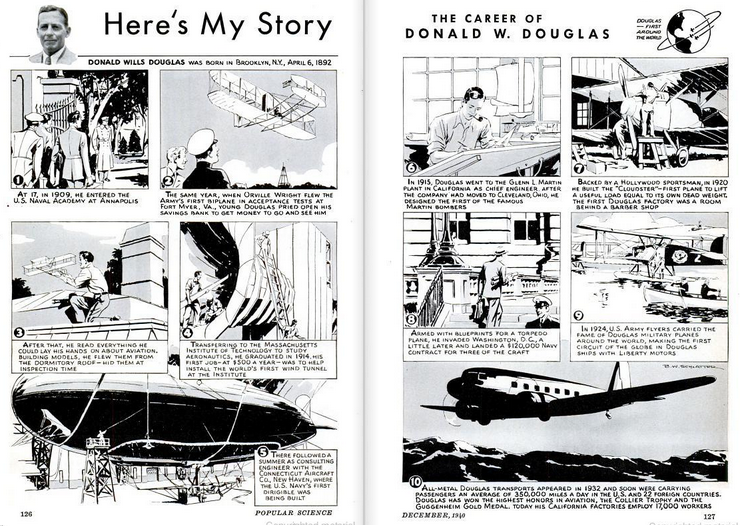
Douglas was incorporated in 1921, after Donald Douglas bought the stake from David R. Davis in the company that they had set up together the previous year. Prior to that Douglas, had studied in the MIT where he was the first ever to graduate with a Bachelor of Science in Aeronautical Engineering. Then he helped with the installation at the MIT of the World’s first wind tunnel. He went to work for the Navy and then for Glenn L. Martin Company (set up by Glenn L. Martin, an Iowan aviation pioneer, hall-of-famer of the Iowa Aviation Museum which we visited in 2011). At Martin he worked in the design of several bombers but he wanted to go to California from where his wife was. Thus he left the company in 1920 to move to Los Angeles where he first set Davis-Douglas Co. You can read about the life of Donald Douglas in the Wikipedia article, at Boeing site or better, in this excerpt from an issue of Popular Science magazine from 1940:
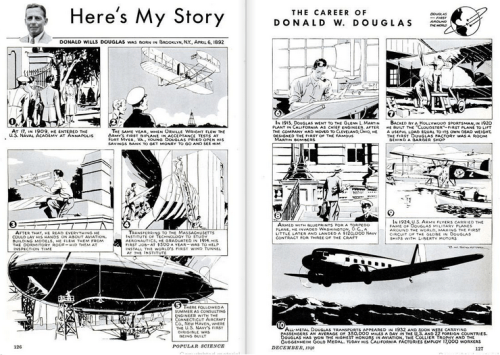
Douglas career (source: Popular Science magazine, October 1940).

Douglas career (source: Popular Science magazine, October 1940).

The last picture in the comic-like biography of Douglas above shows a Douglas Commercial DC-3.

Douglas Commercial DC-3

One simply cannot overstate the importance of the DC-3 in the history of aviation. The DC-3 came as an evolution of the DC-2, and with its improved range and payload capacity it revolutionized both commercial and military aviation. Hundreds of civil aircraft were produced, over 10,000 military versions. The military version C-47 Skytrain came to be one of the iconic aircraft of the World War II first and later of the Berlin Airlift (see this post I wrote about our visit to the Berlin Tempelhof Airport, where today a DC-4 is displayed).

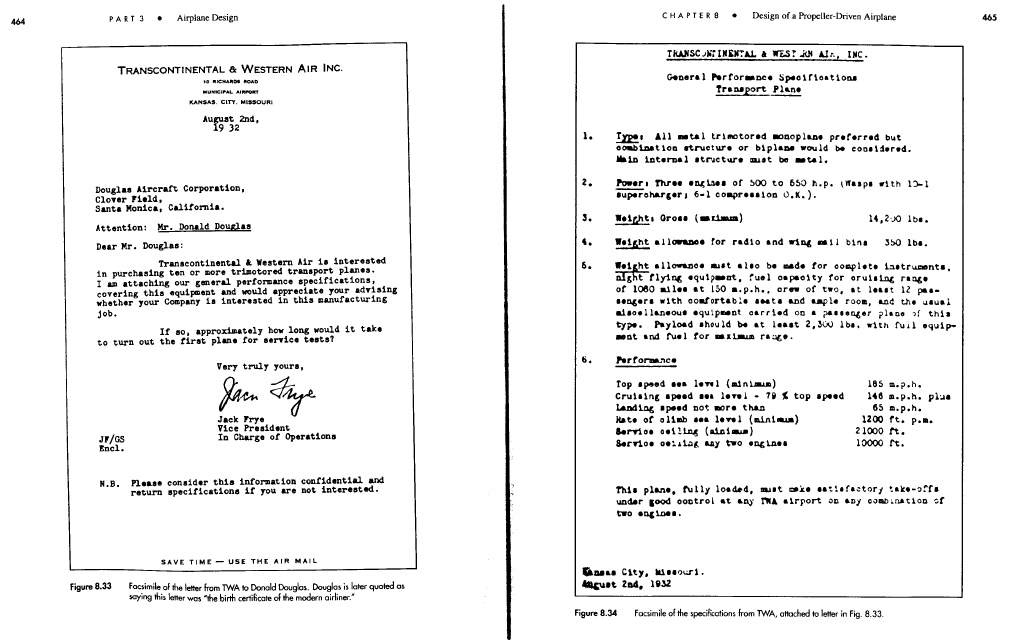
The Douglas Aircraft Company was mainly producing military aircraft until it received in 1932 a letter from Jack Frye, the VP Operations of the iconic airline Transcontinental & Western Air Inc., bettern known as TWA. Jack sent the same letter to 3 aircraft manufacturers (the others being Curtiss-Wright and Glenn Martin) inquiring whether they would be interested in producing an aircraft in response to TWA’s specifications. This came as a response to the launch by Boeing of the 247, which first 60 units were to be destined for its affiliated airline, Boeing Air Transport (both then part of United Aircraft and Transport Corporation). TWA feared that not having access to the 247 for the first years it would lag behind, and thus took the step forward of asking manufacturers to build the aircraft they needed.

John D. Anderson, the curator of aerodynamics at the National Space and Air Museum (see this post about our visit to NASM at Dulles) was also a professor of Aerospace Engineering in the University of Maryland. Among other books, professor Anderson has written “Aircraft Performance and Design (McGraw-Hill, 1999) a terrific book on aircraft design. The chapter 8 of the book describes the process of the Design of a Propeller-Driven Airplane. It includes as a design case study, the Douglas DC-3, 20-pages to delight yourself about history, aeronautics and engineering. It starts with a copy of the letter from Jack Frye and the specifications from TWA:

Letter from TWA to Douglas.

Letter from TWA to Douglas and specifications for a new airplane design.

The chapter describes the different discussions among Douglas’ senior engineers, exchanges with TWA, negotiations, etc. All the technologies employed in the aircraft were already existing in different models. The greatness of the project was in putting them together in one plane (the use of Northrop cantilevered wing, low-wing monoplane, retractable landing gear (to reduce drag), use of flaps (to allow low landing speeds – 65mph as per the spec), use of NACA cowlings to cover the engine…).

There was another great contribution to aeronautics of this development project and that was the one-engine-out performance, required in the specification; though the specification demanded a tri-motor which was able to take-off and cruise with any two engines. To that request, Douglas responded with a detailed analysis of safety in one-engine-out situations, which it presented at the UK’s Royal Aeronautical Society in the paper “The Development and Reliability of the Modern Multi-Engine Air Liner with Special Reference to Multi-Engine Airplanes after Engine Failure“.

The first test plane that came as a result was the DC-1, the production aircraft that followed the acceptance of the prototype was named the DC-2, and the DC-3 was an enlarged version that resulted from another request from American Airlines, which wished a version of the DC-2 capable to carry litters for overnight travel, that came to be the Douglas Sleeper Transport (DST). Douglas worked on that version but immediately saw that the potential of that enlarged version was not in the sleeper version but in having extra payload and comfort for seated passengers in comparison with other airplanes at the time. The DC-3 reduced direct operating costs (DOC) to 60% of those of the Boeing 247, thus converting it in a money maker for the airlines and allowing many more people to afford air travel.

In the following decades Douglas positioned itself as the leading commercial airplane manufacturer until Boeing took this position around the 1960s. Several models came during those years: DC-4, DC-6 (which came to be the Air Force One during Kennedy and Johnson presidencies, see the picture below taken at the Pima Air and Space Museum), the mentioned DC-9 with all its later variants, etc.

DC-6 (VC-118), Air Force One during Kennedy presidency (at PImar Air and Space Museum).

DC-6 (VC-118), Air Force One during Kennedy presidency (at PImar Air and Space Museum).

Later on, financial struggles led to the consolidation first with McDonnell and then with Boeing. As my wife Luca mentioned, “this is what happens in any other industry to many other companies…” true, but this is the industry I like, and thus, I feel that it’s a pity that the long era of Douglas comes to an end. However, even if no more Douglas aircraft are going to come out of Santa Monica or Long Beach factories, there will always be something from the old Douglas in the current Boeing:

Logos from Douglas (prior to 1967) and Boeing (after 1997 merger).
Logos from Douglas (prior to 1967) and Boeing (after 1997 merger).
4 Comments

Filed under Aerospace & Defence

Unions, right-to-work and free-riders

Every now and then, followers of the aerospace industry read news about the relationships between Boeing and the unions. Recall the 8-week strike by the International Association of Machinists (IAM 751) in the fall of 2008, or the more recent negotiations with the Society of Professional Engineering Employees in Aerospace (SPEEA). See, for instance a recent article from Leeham News on the need for change in Washington state, “Right-to-Work, Creepy and Right-to-Worse in Washington State“.

Some months ago I was intrigued by what those terms meant in the American landscape, “right-to-work”, “unionized state”, “non-unionized state”, etc. Thus, I started looking for some definitions in the Wikipedia. And I found some of these terms misleading, or at least when seen from a European frame.

I initially thought that a non-unionized state might have some ban on unions, thus making it possibly more attractive for an employer if it deems it will have the higher hand in a negotiation. But no. There are indeed unions in non-unionized states. Let me just go through some passages taken from the Wikipedia trying to see the different terms:

Open shop: “An open shop is a place of employment at which one is not required to join or financially support a union (closed shop) as a condition of hiring or continued employment”.

Closed shop: “A pre-entry closed shop is a form of union security agreement under which the employer agrees to hire union members only, and employees must remain members of the union at all times in order to remain employed.” […]

“The Taft-Hartley Act outlawed the closed shop in the United States in 1947, but permits the union shop, except in those states that have passed right-to-work laws, in which case even the union shop is illegal. An employer may not lawfully agree with a union to hire only union members; it may, on the other hand, agree to require employees to join the union or pay the equivalent of union dues to it after a set period of time.”

Union shop: “A union shop is a form of a union security clause under which the employer agrees to hire either labor union members or nonmembers but all non-union employees must become union members within a specified period of time or lose their jobs.”

Right-to-work: “A “right-to-work” law is a statute in the United States that prohibits union security agreements, or agreements between labor unions and employers, that govern the extent to which an established union can require employees’ membership, payment of union dues, or fees as a condition of employment, either before or after hiring. “Right-to-work” laws do not, as the short phrase might suggest, aim to provide a general guarantee of employment to people seeking work, but rather are a government regulation of the contractual agreements between employers and labor unions that prevents them from excluding non-union workers”.

After I made this short review of those definitions, I got a complete different picture. Non-unionized states which I initially perceived as places with some intrinsic insecurity for the worker are simply having a  similar scheme than the one we have in Europe: shop-floor workers or engineers at Airbus are not required to join any union to get employment, nor are they forced to pay dues to union if contracted, though they may join one if they deem it in their interest.

I could even think of the union-states as an anachronism (forcing workers to join a union in order to work), however some of the reasons provided by opponents of the right-to-work law have sense:  free-riders would benefit from a collective bargaining agreement negotiated by a union without paying for that negotiation, the weakening of unions may lead to a race to the bottom, etc.

So far, I was never part of any union, thus I fall under the category of free rider, as I have and continue to benefit from social conditions negotiated by large unions.

Union affiliation

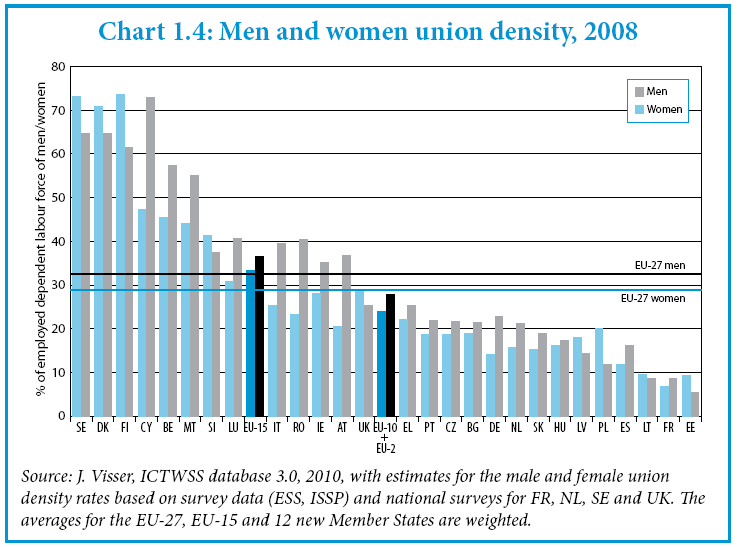
I found an interesting report prepared by the European Commission on “Industrial Relations in Europe (2010)” [PDF, 5MB]. Among the many sides of labour relations covered in the report, I found the graphic below with numbers about union affiliation rates in different European countries.

Union affiliation in Europe (source: European Commission).

Union affiliation in Europe (source: European Commission).

The figures in Spain and France, where I have worked so far, are around or below 10%. I found it in line with non-unionized states in the USA according to the Wikipedia: states without right-to-work laws have an affiliation generally above 10% (up to 25%) whereas states with such laws (thus similar to Spain or France) have lower figures of affiliation, less than 10% and down to 3.5% (with the main exception of Michigan).

Leave a comment

Filed under Aerospace & Defence

Toulouse half marathon 2013

Today I took part in the Semi Marathon de Toulouse. I had run this race already in 2011, where I achieved my personal best time in the distance (1h42’30”). The race is quite flat and runs two laps at a circuit of almost 10 kilometres, with some variations at the beginning and the end to reach the 21.1km.

I am now in the middle of the training period following a plan towards Athens Classic Marathon in November. Despite of not focusing the training on this race, and due to the PB in 10k obtained two weeks ago I was looking forward to beat my half marathon PB, aiming at clocking a time at least below 1h40′.

I went to Sept Derniers, the neighbourhood where the race is starting together with Luca and Andrea. There we met my colleague Manuel and together we did some warming up.

The race started about 15 minutes late. Manuel is lately in great shape so he wanted to start at the front of the pack, thus, I accompanied him there. This made me run the first kilometre much faster than I wanted to. From then on I slowed a bit until I just came to be running just a few seconds under 4’40” per km, that would ensure me to finish below 1h39′.

I could pace myself well until the km 14, from that moment I found it hard to keep a pace under 4’40”. I guess I paid the extra effort of the first 2-3 kilometres. Nevertheless, I made the numbers in my head and saw that even clocking times around 4’44”-4’48” I would be well under 1h39′ if I didn’t have any further problem (which almost had at the km 17, when I almost fell after bending the left ankle).

Just before entering the athletics track in the Airbus’ sports facilities, TOAC, I checked the watch and knew that I would be under 1h38′, as I would accomplish that final 400m lap in under 2 minutes.

I finally beat my best time in half marathon by 5 minutes! For which I am quite happy. I ended in 1h37’29” as per my Garmin (a couple of seconds more as per the official timing – no net time provided by the organization). I came in the 241th out of 1080, not being that especially important I made it to the top 23% percentile for the second race in a row (in Colomiers I came in 226th out of 990).

Thus, in 2 weeks I have beaten 2 PBs (10k & 21k)! Let’s hope that the health keeps going well with the training besides the small inflammation I have now in the right knee.

Enjoy some pictures of me running today (most of them taken by Luca):

This slideshow requires JavaScript.

3 Comments

Filed under Sports

Boulevards de Colomiers 2013

Colomiers is a village close to Toulouse. Today, I went there to take part in the race “Boulevards de Colomiers”, over 10km. Last year, I had already taken part in it, where I achieved my personal best over that distance with 46’14” (despite of the problems I had at the time with the Achilles tendon).

Posing with Andre prior to the start.

Posing with Andre prior to the start.

This year, I had in mind to follow the 45′-pacer as far as I could to break a new personal best. So from the start I followed the pacer, together with my co-worker Manuel. The weather was a bit hot and sunny, I would have preferred it colder and cloudy, thus I tried to take a bit of water in each of the water supply points, to ensure I was well hydrated.

Boulevards de Colomiers 10k circuit.

Boulevards de Colomiers 10k circuit.

The race had 2 laps around a 5k circuit in the centre of the village. I tend to like this kind of races as then in the second half one can know what to expect (where the water stations are, sharp turns, small hills…). I was following more or less comfortably the pacer up until the 7th kilometre.

Running at about 5k.

Running at about 5k (see the pacer with the blue balloons, I am in the centre with the yellow t-shirt, picture taken by Luca).

I found it not so easy to keep up the pace from the 8th to almost the end. I think it is mostly a psychological issue: the knowing that there is only 1 kilometre to go, that you are already going to beat the PB, etc., make the brain to send signals to the muscle in the way of “it’s ok, you can relax a bit, it’s done”

Then I saw the shop where we used to rent skies, knew that there were less than 400m to go and kept the effort up, at that point the pacer slowed to look and cheer up at the pack of runners that were following him (thanks!) and there we went for a last sprint.

I finished in 44’28” as recorded by my Garmin, setting a new Personal Best with a margin of 1’46” under the previous one. I’m very happy for that, thus I celebrated it taking this other picture:

Posing with Andrea after having finished.

Posing with Andrea after having finished.

5 Comments

Filed under France, Sports

First “solo” flight!

My instructor had kept saying to me in the previous lessons “one of these days I’ll release you for the first solo flight” (but then in French). Today, August 30th 2013, the time has come.

I arrived today at the aéroclub René Barbaro, in the aerodrome Toulouse-Lasbordes (LFCL), at about 18:15 (16:15 UTC… to keep it #avgeek). When being asked what would be then plan for today, my instructor, Thierry, immediately answered “est-ce que ça te marche si on fait trois tour de piste et aprés je te lâche?.” To that question one can only answer: “oui, bien sûr!“.

Thus, we took the Robin DR-400-120 Petit Prince with matriculation number F-GNNI (Fox(trot) Golf November November India). A mainly wooden French plane which is quite popular in France. The aircraft has a piston engine which delivers 120 HP, cruises at about 200 km/h, has an empty weight of about 600kg (573kg as per the latest rapport de pessée)… you can see it below:

Robin DR-400 F-GNNI.

Robin DR-400 F-GNNI.

As Thierry proposed, we first made 3 tours de piste, that is 3 laps around he aerodrome circuit.

Despite of some comments on the landings, one take-off performed with flaps retracted (see #Jk5022), at the end of the third landing Thierry got off the aircraft, got his walkie-talkie to hear and intervene in the communications if needed (which was not needed) and went to aéroclub office.

Then, I was finally alone in the plane.

Message to the radio (the tower was not working by then, thus I sent a message to other aircraft in the frequency, 122.7): “Toulouse-Lasbordes, DR-400 au parking Airbus, je roule au point d’arrêt piste 34“. I then went through the different check lists, going through each step in a mixture of Spanish and French (I normally proceed with the list in French but then it felt strange to talk to myself in French thus: “giro al sur y la bille va a la derecha, el cap y el compas decrecen…”).

At about 17:35 UTC, I finally pronounced the words “Fox November India, je m’aligne et je decolle, piste 34“, and with that there I went! (I had to align and take off rather quickly as there was another airplane about to announce its entry in finale).

Aerial view of the aerodrome Toulouse-Lasbordes, LFCL (note that today evening the runway in use was the 34, thus, what you see closer is the end of the runway).

Aerial view of the aerodrome Toulouse-Lasbordes, LFCL (note that today evening the runway in use was the 34, thus, what you see closer is the end of the runway).

From then on, an easy flight around the aerodrome that did not take very long but meant a big step for me ensued; a big reassurance. Let’s go through it. Come on board with me…

Take-off: even if I could have taken off at a lower speed, due to the heat and as precaution, I was going to rotate at about 110km/h. Up until then I repeated “the runway is cleared, la vitesse monte, the runway is cleared, all parameters are green…“. I saw some birds flying low and crossing the runway, so I gave myself some seconds before pulling the stick backwards… “je décolle!“.

Climb: immediately after taking off, I had to push the right pedal to compensate the engine effects. During the first phase of the climb I ascended at about 130 km/h (a bit faster as I was alone in the plane) and at 760ft, or 300 pieds sol, I proceeded with the check list après décollage: “volets (flaps) de premier écran à rentrées, pompe électrique off and check that all parameters are still green“. Proceed with the climb now at 150km/h.

Integration in the aerodrome circuit: You can see in the pictures below the aerodrome circuit, both as it appears in the aeronautical chart [PDF, 644KB] and with a satellite image.

Toulouse Lasbordes (LFCL) carte of the aerodrome (Carte VAC).

Toulouse Lasbordes (LFCL) carte of the aerodrome (Carte VAC).

View of the "circuite de aérodrome".

View of the “circuite de aérodrome”.

As soon as I had passed the village of Balma I turned East still ascending (following the green line upwards and to the right as per the satellite image). Then, just between Balma and Pin-Balma (blue circles in the satellite image) there is a farm which serves as starting point for the aerodrome circuit.

There, I announced myself again: “Fox(trot) November India au début de vent arrière piste 34“. I then reduced the gas from 2,500rpm to 2,000rpm, switched on the electric pump, the carburetor heating and deployed the flaps to the first position (10º)… with those settings the speed should come to 150km/h. I then noticed that while performing these actions I had gained some 200ft (above the 2,000ft of the circuit), which I proceeded to lose quickly and, once corrected, I trimmed the aircraft for 150km/h at 2,000ft QNH.

When I spotted the Château de Pechestier (see carte VAC above), I turned right following the ligne à haute tenstion, reduced the power from 2,000rpm to 1,500rpm (keeping the speed at 150km/h) while losing altitude from 2,000ft to about 1,100ft when over flying the commercial centre at the turn between the sectors étape de basse and finale.

Final approach: “Fox(trot) November India en finale pour un complet“. I then deployed the flaps to the landing configuration (60º) and fixed my sight on the number 34: “vitesse (> 120km/h) – le plan (3.5%) – vitesse – l’axe – …“.

Landing: I believe that one has been the best landing I have performed so far. I guess I was so concentrated that I definitely did my best… I slowed down, exited the runway, “Fox(trot) November India la piste est dégagée, je roule au parking et quite la radio“. I then proceeded with the different check lists, went to the parking of the aeroclub, turned off the airplane… and that was it!

Thierry: “Well, How does it feel the first solo flight?”… the first solo flight.

5 Comments

Filed under Aerospace & Defence

The Museum of Flight (Seattle)

The Museum of Flight, in Seattle, is yet another great aerospace museum. It reminded me very much to the National Air and Space Museum in DC both because of the wealth of aircraft and artifacts in display and the variety of explanations provided (videos, sounds, readings, gadgets to play with…).

The museum is divided in the following areas:

  • Boeing Model 1.

    Boeing Model 1.

    T. A. Wilson Great Gallery (named after Boeing CEO from 1969-1986): this is the first gallery you face when you enter the museum. It hosts:

    • a replica of Boeing Model 1 (first Boeing airplane),
    • a Lockheed SR-71 Blackbird plus a cockpit for visitors to enter in it,
    • a 737 converted into a theater with movies being played inside,
    • an exhibition of the bush pilots of Alaska and the development of air mail,
    • some flight simulators,
    • a DC-3, a Bell “Huey” UH-1H Iroquois, etc.
  • Bill & Moya Lear Gallery (Space Exhibit, named after the founder of Lear Jet Corporation): located at the side of the Great Gallery it has a diorama of the Apollo 17 landing site, with rover included, a replica of the International Space Station Destiny Research Laboratory, etc.
  • The Tower: with direct view over the runway.
  • William E. Boeing Red Barn (named after Boeing founder): in my point of view this is “the” highlight of the museum (allow yourself over an hour for this part alone). It explains both:
    • the birth of aviation: with models and panels explaining the contributions of many of the aviation pioneers (see this blog post in which I went through some of them), and,
    • the history of Boeing: from the moment in which the timber businessman, Bill Boeing founds the company, the first Boeing Model 1 (see replica in the picture above), the tools, materials and processes used at the time, how did the factory look, the great aircraft programmes which meant different breakthroughs for the company and the great engineers behind them…
  • Charles Simonyi Space Gallery (named after the Microsoft executive who became in 2007 the 5th space tourist and who in 2009 travelled to the International Space Station): which highlight is the Space Shuttle Trainer used to train Space Shuttle astronauts at Johnson Space Center in Houston.
  • Airpark: with the Boeing 747 “City of Everett” (first ever 747, first ever wide-body aircraft), a Boeing 707 Air Force One, a Concorde, a Lockheed Constellation…
  • J. Elroy McCaw WWI and WWII galleries (named after a broadcasting magnate): unfortunately I did not have time to properly visit these galleries before the closing of the museum… a reason to come back again.

See some of the pictures I took at the museum:

This slideshow requires JavaScript.

I definitely recommend to visit this museum if you happen to be in Seattle. It is located in the South of Seattle at Boeing Field / King County airport. I would suggest to take no less than 5 hours to visit the museum and to arrive before noon, otherwise there will be some parts that you will not be able to visit properly (as it happened to me with the WWI and WWII galleries).

2 Comments

Filed under Aerospace & Defence, Travelling

B-36 Peacemaker

In a previous post about the Pima Air & Space Museum, I mentioned that I viewed the (Consolidated) Convair B-36 Peacemaker bomber as one of the highlights of the museum.

The B-36 was a strategic bomber which operated at the beginning of the cold war. The design of the aircraft started prior to the entry of USA in the WWII. The US Army Air Corps was seeking a bomber with an un-refueled intercontinental range, that is, that could fly from the US East Coast to Europe, drop bombs and fly back to the USA without being refueled. That mission was out of the range of the bombers being used at the time, the Boeing B-17 Flying Fortress and the Consolidated B-24 Liberator.

A bit less than 400 aircraft were built and it was retired from service at the beginning of the 1950s, when the B-47 and B-52 started to take over its role.

XB-36 prototype with single-tyre landing gear legs (and without jet engines).

The development of the aircraft showed some pitfalls that are curious to reflect on. For example, initially the main landing gear consisted of two legs with a single (huge) tyre each (see picture in the right). That caused significant pressure to be stood by the runway resulting in it being able to operate only from 3 runways in the USA (!). In the pictures below you can see that the series production has 4 wheels per leg.

Another interesting point is that of the engines. The B-36 initially had six 28-cylinder Pratt & Whitney R-4360 “Wasp Major” radial engines (see the internal movement of a piston radial engine in this post, with a video taken at National Air and Space Museum in Dulles, DC). Each engine drove a three-bladed propeller, 5.8m of diameter (for comparison, A400M propellers have a 5.3m diameter), mounted in the pusher configuration. This configuration led to some engine fires due to engine-overheating. The aircraft also was very slow in taking off and thus from the version B-36D Convair added 4 General Electric J47-19 jet engines, two in each outer part of the wings. This improved take-off performance, however in normal cruise, to reduce fuel consumption the jet engines were shut off, and some louvers covered the air intakes to reduce drag (see pictures below). This made the B-36 have in the end 10 (!) engines: 6 piston engines and 4 jet engines (“six turnin’ and four burnin’ “, as described by Airmen Magazine, the official US Air Force magazine).

See some of the pictures of the Convair B-36 Peacemaker that I took at Pima in the slide show below:

This slideshow requires JavaScript.


To put things into perspective, some of the technical specifications:

  • Length: 49.42m >> A380 length is 72.73m (much longer)
  • Wingspan: 70.12m >> A380 wingspan is 79.75m (~)
  • Wing area: 443.5m2 >> A380 wing area is 845m2 (almost 2x)
  • Empty Weight: 75,530kg >> A400M empty weight is 76,500kg (~)
  • Maximum Take Off Weight: 186,000kg >> A400M MTOW is 141,000kg (lower)
  • Combat radius: 3,465nm >> B-52 combat radius is 3,890nm, or 787 range of ~8,000nm (note radius vs. range) (~)
  • Armament: 39,000kg of bombs >> B-52 carries ~31,500kg of bombs (lower)

Finally, you may see below the first part of a 30-minute documentary about the B-36, the requirement behind it, its prototypes, development, etc.:

4 Comments

Filed under Aerospace & Defence

Confidence in institutions: UK vs. Spain

Evaluation of institutions, entities and social groups (source: Metroscopia for El País, 25/08/2013).

The Spanish newspaper El País published yesterday a survey it had commanded to Metroscopia about the confidence that Spanish people had in different institutions (see the complete article, in Spanish, “Por qué no se hunde España“). See a summary of the results in the graphic to the right.

Following an exercise during a training module last year, I published a post discussing a similar survey which is yearly made in Britain by the consultancy Ipsos Mori, the Veracity Index (see in the link results from 1983 to 2011).

I thought that it could be interesting to show the results of both surveys side by side to try to spot some commonalities and some differences of how the different groups and institutions are perceived in Britain and in Spain. I did the comparison even if the questions used for the survey are not exactly the same in both cases and if one survey dates from 2011 and the other from 2013. See the comparison in the picture below.

Another difference is that the Spanish survey is including up to 36 different groups versus 16 being evaluated in the UK, but this is not impacting the comparison as each group is rated individually.

Let’s see the similarities:

  • 4 institutions / groups are very well-regarded in both countries, with a rating over 70% in both cases: doctors, teachers, professors and scientists.
  • 4 institutions / groups are very badly regarded in both countries, with a rating of around 30% or lower in both cases: unions, business leaders, government and politicians.

The biggest differences:

  • 3 groups are much better perceived in Spain than in the UK: the police, civil servants and journalists.
  • 2 groups are much worse perceived in Spain than in the UK: judges and clergyman/priests (especially bishops).
Comparison of confidence polls in Britain (2011) and in Spain (2013) (sources: Ipsos and Metroscopia for El País).

Comparison of confidence polls in Britain (2011) and in Spain (2013) (sources: Ipsos and Metroscopia for El País).

How would you rate these groups? (my rating is published in the post from some months ago)

Leave a comment

Filed under Miscellanea