Looking for a book shop in San Francisco we saw the exterior of The Stinking Rose restaurant:
The Stinking Rose, at 325 Columbus Street (San Francisco).
It first caught Luca’s attention, and we went to check the menu and whether there was any description in the guide (which there was). The restaurant is a garlic restaurant started by an Italian some decades ago, meaning that all their dishes included garlic! I loved that and immediately tried to persuade Luca to get in.
I think that instead of giving a thorough description of the restaurant by me I can show you the description of the restaurant made by them:
Description of the restaurant.
Have you seen that sentence: “We Season Our Garlic with Food”? Take then a look at the first dish we ordered: garlic bread, with minced garlic with herbs plus garlic…
A good starter.
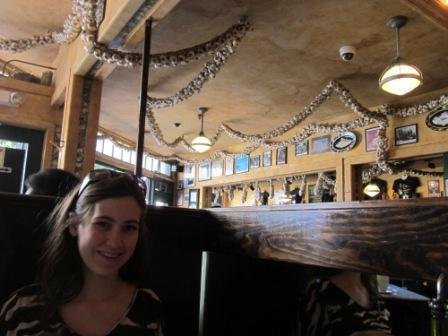
Finally, take a look at how the interior is decorated with garlic bulbs all over the place (it reminds me to “Museo del Jamón” in Spain):
Garlic bulbs all over the place!
I guess that many of the readers will think “yuck!”, as Luca did at the beginning. Well, this is because you have never tried it… do so the next time you are either in San Francisco or Los Angeles.
At the beginning of the year I had just a few objectives in relation to running:
Reach 2,000km run along the year.
Reach personal best times in 10k, half marathon and marathon.
Run 2 marathons.
Now, just one week after mid-year it’s a good moment to take a look at how these months have gone regarding the running part:
I have already run 2 marathons (Rome and San Diego) though in none of them I was under 3 hours 45 minutes. In Rome I was close to it (a minute slower) but didn’t reach it. I will even run a 3rd marathon this year in Athens next November (health permitting).
So far, even if I have run more races in 6 months than ever (10 races), I only attempted one half-marathon, in La Latina district (Madrid) which is not the best circuit to attempt a PB; I didn’t achieve it. I clocked 1:44:49 vs. the 1:42:30 I did in Toulouse in 2011.
I have run 3 races of 10 kilometres. In the first one of the year I was short of only 6 seconds to beat my PB (46:14) clocking 46:20. One of the other two was a cross and the third one was the Corrida Pedestre de Toulouse, where the distance is not even 10k but 9.64km and despite of that I was not in the rhythm to do any PB.
In relation to the mileage: in the first 6 months I ran 920 km, a bit less than 1,000km, but not a difference that I can’t make up for in the second half of the year.
Some stats to close the post:
920 km run from January 1st to June 30th.
206 km run in races in this time (22.4% of the distance).
86 hours and 58 minutes running in this 6 months.
19 hours and 46 minutes running in races in this time (22.7% of the time –> long trails).
Some weeks ago Luca and I spent a weekend in the Central Massif in France, a plateau the size of Castile and Leon, with an average height of around 600m.
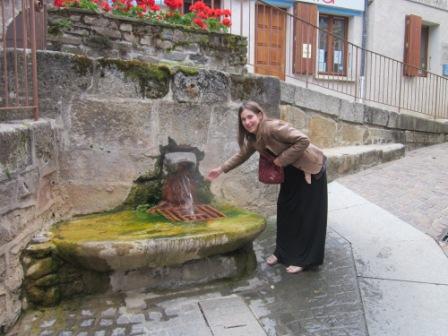
On Friday we went to Chaudes-Aigues where we wanted to spend the saturday in a spa. The village, in the region of Auvergne, has less than 1,000 inhabitants, a couple of hotels and restaurants and its famous for its hot springs. With over 30 different springs starting from 45ºC to 82ºC, the latter is supposed to be one of the hottest ones in Europe (if not the hottest as proudly announced in the signpost close to it).
Luca by the 82ºC hot spring in Chaudes-Aigues (arguably the hottest in Europe… the spring as well).
Another curious thing of Chaudes-Aigues is a network of hot water going through private houses built back in the year 1,332, which is still working today though only in those original houses.
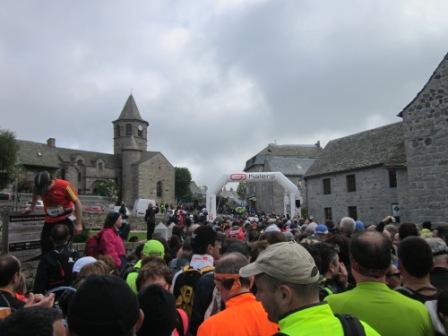
On Sunday morning, we woke quite early to cover the distance to Nasbinals, another little commune in the region of Aubrac where I wanted to run a ~18km trail.
Start line of the trail.
I started the trail in the back of the pack so I took the first kilometres without stress trying to run with the crowd and only overtaking other runners where possible and moderately easy. In that way I could enjoy at some points the views offered by the circuit of the trail, which at points was through closed forests but at some others was through open countryside.
Fields of Aubrac.
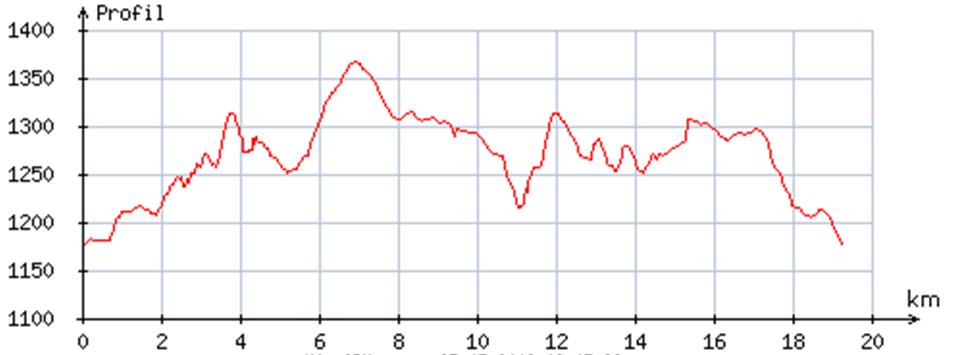
I was running with the water bag and carried some vanilla-flavoured energetic gels, so I did not have any problems with supplies, I didn’t need to use those provided by the organization. One good point of the trail is that the route was very well marked, however, the measuring of the distance wasn’t. The trail was supposed to be 18 kilometres long, and when my GPS-watch indicated 17.75km I saw a signpost saying “Arrivée 2 km”. In the end I measured 19.60 km, but I guess the organization knows this, as in their own web, when showing the altitude profile, the distance they have measured is clearly over 19km.
Profile of the race “Trail des Capucins” (over 19km instead of the announced 18km).
It is not such a big issue, though you may have been managing your strength resources to have a last good kilometre and instead you find out that there are still 2 more to go! It would be as easy as to announce the trail as a 19km or 19.6km instead of 18km.
In the end it took me over 2 hours and 12 minutes, and ended the 255th out of 810 runners. A good run for a Sunday morning.
Even if not of very good quality, you can find below a short video I recorded around the 8th kilometre to give a glimpse of how these trails are:
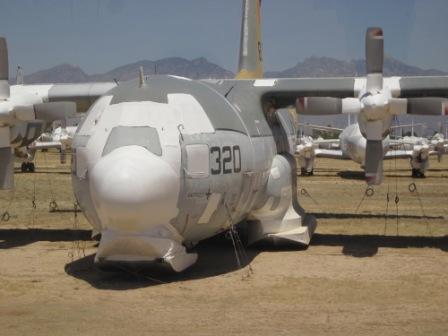
Some of you may have wondered why all aircraft windows and so many other parts in the pictures I showed in previous blog posts about The Boneyard are covered with white paint?
C-130 Hercules covered with spraylat (note that it is fitted with skis for Arctic and Antarctic operations).
To protect heat-sensitive parts from the desert high temperatures these parts are covered with two different coatings: the first layer being a dark paint while the second layer is the characteristic white one, reflecting sunlight and heat. The paint is a vinyl plastic called spraylatafter the company that produces it, Spraylat Corporation.
You may check the detail of Aerospace Maintenance and Regeneration Group (AMARG) storage processes in the following two links from the Wikipedia and “AMARC experience” (“AMARC” being the previous name for AMARG).
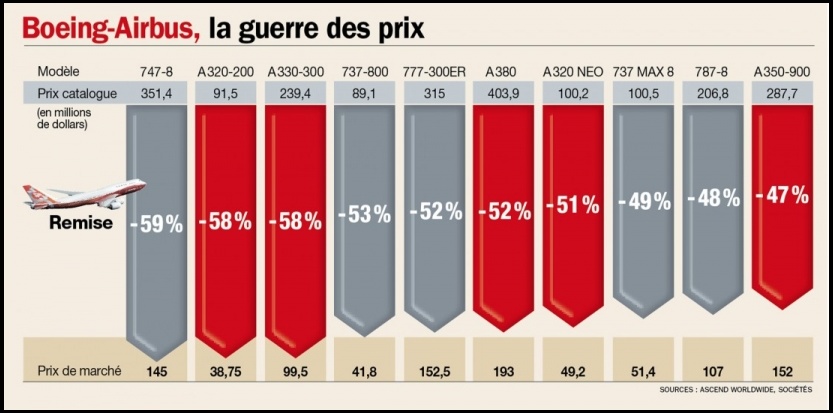
Last week, ahead of the start of the Le Bourget air show, the French portal Challenges.fr, published an article “Le vrai prix des avions d’Airbus et de Boeing” with an interesting graphic showing a comparison of the prices after discounts of commercial aircraft both of Boeing and Airbus.
Find the graphic below:
Commercial aircraft discounts according to “Challenges”.
In order to make the graphic, Challenges quotes as sources the consultants of “ASCEND Worldwide” (which has the industry-reference database of world commercial aircraft fleets) and unnamed companies (airlines such as American, Delta or Southwest, as per declaration of analysts quoted in the article).
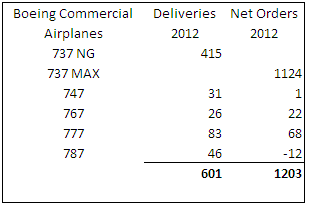
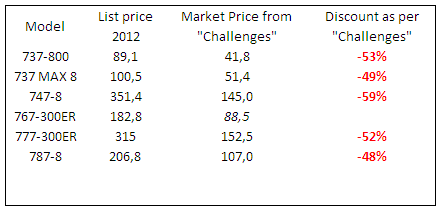
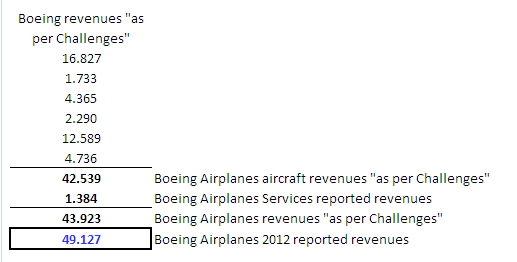
I have published in this blog yearly estimates for the average discount that Boeing applies to its aircraft. Find here the latest of that blog posts. In that post I arrived to an estimated average discount of 45%. Thus, when I read the article by Challenges I first thought “too high, to be average prices”. I thus run the reverse calculation: departing from Challenges “market prices” I calculated what would have been Boeing Commercial’s 2012 revenues (1).
Boeing 2012 deliveries and net orders.
Boeing prices as per Challenges (767 added with the same discount as the 777-300ER).
Boeing Airplanes revenues “as per Challenges“.
Having run the numbers, I find the estimated value of 2012 revenues for Boeing Airplanes as too low (44bn$ vs. the reported 49bn$) using aircraft “market prices” as published by Challenges, as I first thought. I guess that the figures that Challenges published refer to the higher discounts having recently been applied, to the biggest customers making the biggest orders, such as those mentioned in the article (American, Delta or Southwest).
Thus, I would not take them as average or market price, those are the prices that a few can get.
—
(1) A couple of considerations must be made: Challenges does not publish any market price for 767s (the same discount of the 777-300ER was used), and does publish only one price of 737NGs or 777s; thus the result will not be very accurate.
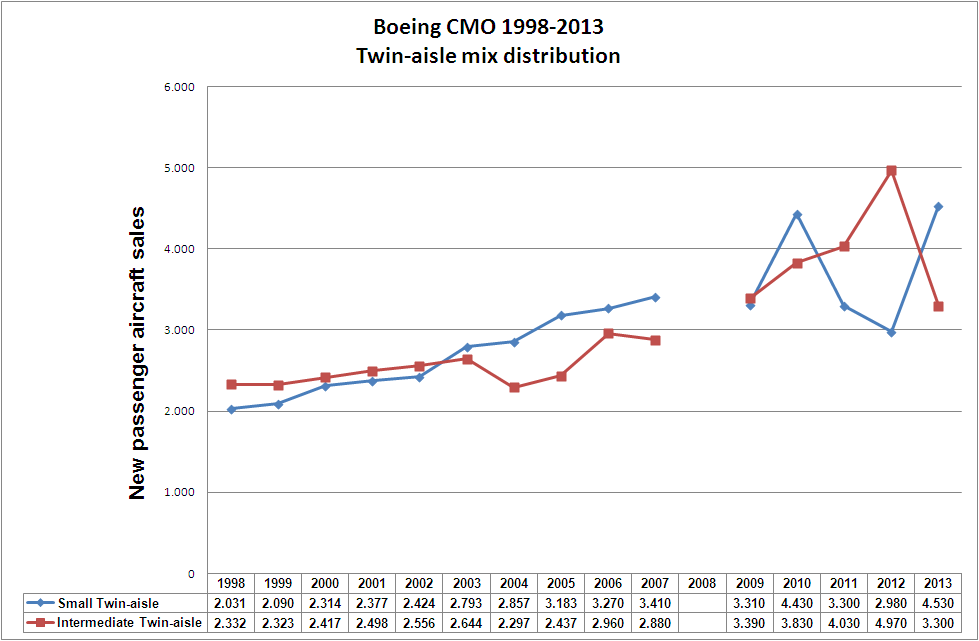
A couple of days ago I wrote about the publishing by Boeing of its Current Market Outlook for 2013-2032. In that post I made a very brief review of it, and mentioned that I was puzzled by the change in the predicted mix of twin-aisle sales, between small and medium wide-bodies. To recall the numbers:
small wide-bodies: from 2,720 a/c in CMO2012 to 4,320 a/c in CMO2013, whereas,
medium wide-bodies: from 4,490 a/c in CMO2012 to 2,810 a/c in CMO2013.
Since I keep a collection of CMOs from years back, I decided to compare the figures of this wide-bodies mix along the last 15 years…
Twin-aisle mix distribution (Boeing CMO 1998-2013).
Seeing at the graphic (made using Boeing figures):
During the first 5 years (1998-2003) the trends are quite constant.,
From 2003 to 2007, the mix is reverted, possibly to favour the launch of the 787.
In 2008 the CMO did not provide the split.
From 2009 to 2013, you can see that both trends in the forecasts are erratic… why? Only Boeing knows.
I once wrote about how it took me some visits to different museums and reading a book to connect the dots and see what was the controversy in France about the Wright Brothers pioneering first flight.
It takes several museums to get a complete glimpse of the story of the X-15.
This experimental aircraft, powered with a rocket engine, was used to reach the edge of outer space and gather data for aircraft and space design. In doing so, it set several records of speed and altitude. To date it keeps the speed record of any manned flight with over 7,000 km/h (bear in mind that this a rocket engine, vs. the record for an atmospheric engine reached with the SR-71). The aircraft also flew several times above 50 miles, which by then in the USA was considered the limit for outer space, thus making some of its pilots being recognised as astronauts by NASA and USAF. The International AstronauticsFederation (FIA), however, sets the limit at 100km of altitude. Still two of the X-15 pilots flew over that height being them also recognised as astronauts by the FIA.
The aircraft itself, the North American X-15, is displayed at the National Space & Air Museum at the Mall in Washington DC (which I first visited in December 2008) and USAF Museum in Ohio, while one of the mock-ups is displayed at the Pima Air & Space Museum in Tucson (which we visited last May 2013).
North American X-15 the National Air & Space Museum in the Mall (picture from Ad Meskens).
The flight tests in which the X-15 set so many high altitude and speed records were performed at Edwards AF Base in Mojave (which we visited in May 2013). At the Flight Test Center museum you can read some displayes about its story.
Rogers Dry Lake at Edwards (public domain image).
Finally, the mother ships from which the different X-15 aircraft were launched were modified B-52 Stratofortress bombers. The two aircraft are displayed in the Pima Air & Space Museum in Tucson (which we visited last May 2013) and again the Dryden Flight Research Center which is also located at Edwards AFB.
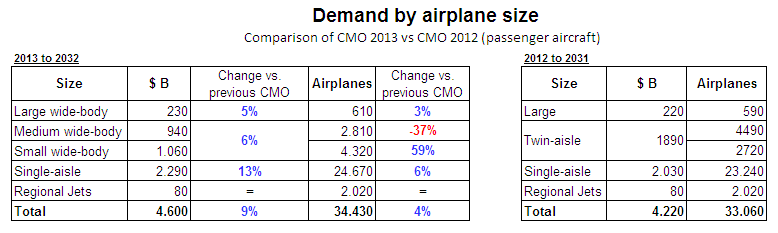
I just compared the figures for passenger aircraft of the last two years’ CMOs:
CMO 2013 vs 2012 comparison.
Some comments to it:
You can see that the total number of new aircraft delivered has slightly increased from 33,060 to 34,430, a 4%, which is consistent with the constant 5% traffic increase that Boeing predicts.
The volume (Bn$) increases by a larger percentage, 9% (380 Bn$)… this is due mainly to the double increase in:
(1) single-aisle aircraft expected sales 6,2% (+1,430 aircraft), and
(2) the average price list with which the list is computed, another 6.3% (from 87.3m$ to 92.8m$)
I am puzzled to see the the sudden change in the predicted mix of twin-aisle sales, between small and medium wide-bodies…
small wide-bodies: from 2,720 a/c in CMO2012 to 4,320 a/c in CMO2013, whereas,
medium wide-bodies: from 4,490 a/c in CMO2012 to 2,810 a/c in CMO2013
as you can see the combined figure slightly changes (7,130 vs. 7,210), however the distribution among the two categories is drastically changed. Why is that? A question to Randy Tinseth that he did not address in his blog when the CMO was unveiled.
I would tend to think that the move is done to push some market development based on some models (787) instead of others (777), but given that it is precisely now when the upgraded versions of the 777 are supposed to be pushed into the market I fail to see the logic behind this.
Find below the nice infographic that the guys from Boeing have put up together:
Boeing Commercial Aviation Market Forecast 2013-2032 infographic.
As always, I recommend going through the CMO, as you can learn a lot about the business: from global numbers, to growth, traffic figures, fleet distributions, forecasts, etc… You may find the presentation [PDF, 9.6 MB], the booklet [PDF, 3.0 MB] and the file [XLS, 0.4 MB] with all the data.
For a comparison between this CMO and the respective Airbus’ GMF we will have to wait until after the summer, when Airbus publishes its update. Until then, find here the comparison based on 2012 market studies.
During the visit to AMARG, the guide explained us one historical anecdote taking the following picture as the departing point:
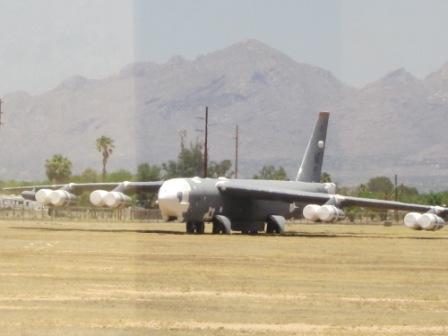
B-52 Stratofortress without horizontal tail plane.
The curiosity of the picture: as you can see the aircraft has no horizontal tail plane (HTP).
The story went as follows: as part of Arms Control and Disarmament agreements between the USA and USSR, the USA had to retire a certain number of B-52 aircraft from service (over 300 of them). At some point a soviet delegation visited The Boneyard at Tucson to witness the retirement of those A/C. However, they said that being the AF base right there, side by side of the boneyard, the USSR could not have any guarantee that those B-52s would not be immediately put back into active service just after the soviets had left the city, and thus required that Americans dismantled the HTPs from all B-52s that were to be retired as part of the agreements. In that way they could always check via satellite image whether they had those HTP on or off…
Later on I checked the story in the Wikipedia where you may see the whole background of the START agreement. Some of the aircraft were chopped into 5 pieces. Those you cannot see in the guided visit to Davis-Monthan AFB but you can see them in satellite image here:
"The Boneyard" (AMARG): 4,000 USAF a/c parked or partly scrapped. There're very few things as impressive as this #fbpic.twitter.com/XE01FvVII2
— Javier Irastorza (@javierirastorza) May 31, 2013
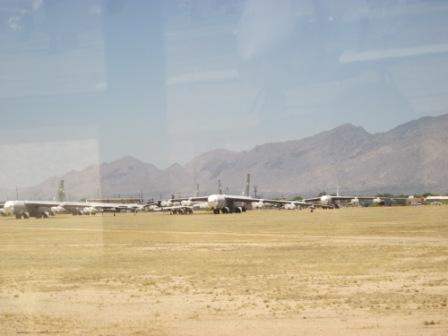
The Boneyard is an aircraft and equipment storage facility located at Davis-Monthan AF Base near Tucson (Arizona). The are over 4,000 military aircraft stored at the place. Most of them come from the USA (not only from the air force, but from other services as well) but there are some aircraft from foreign countries. The aircraft are stored for several reasons and in different conditions.
Some of them are maintained waiting for a possible future use of them (be it with US armed forces or through some foreign military sale, that is the case of several old versions of C-130, F-16).
Other aircraft are kept so their parts can be used as spare parts for other active flying aircraft (e.g. C-130, KC-135).
Finally, there are aircraft which are stored waiting to be scrapped so the metal can be reused somewhere else.
KC-135 partly scrapped.
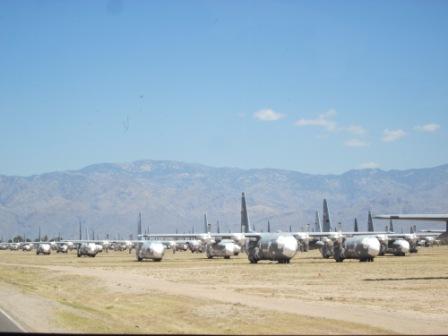
Hundreds of C-130.
There are whole fleets of retired aircraft: C-141 Starlifter (retired once the C-17 took over their role), half of the C-5 Galaxy fleet (the A versions, due to budget constrains and fleet strategic decisions), the Vietnam-era helicopters Hueys and Cobras…
The Boneyard can be visited with a guided tour organised by the Pima Air and Space Museum (I will write about this museum in another post). The tour is made with a bus which goes through the Boneyard very slowly and making several stops (though guests cannot exit the bus). The guides are veterans from the US armed forces, who have flown or maintained some of those models that you get to see. The wealth of knowledge that they have about them, the anecdotes and stories that they tell during the tour are worth much more than the 7$ that the tour costs.
The place is impressive, overwhelming. Not only there are thousands of aircraft but the seeing of them fully aligned, whole fleets of different models helps you put things into perspective:
Spanish AF has 14 C-130 Hercules vs. the hundreds of them you see at The Boneyard.
The dozens of retired Lockheed C-5A Galaxy that you can see there have a combined payload capacity of over 5,000 tonnes… which is more than the complete payload capability of any other air force in the world except the US one…
You may want to take a look at satellite images from the Boneyard here:









 The Blog by Javier