Viernes 23 de septiembre. Recojo a Serna del aeropuerto de Toulouse sobre las 15 horas. Empieza un fin de semana de aventura. De locura.
Antes de dirigirnos a Millau, Aveyron, en el sur de Francia, pasamos por mi piso en el barrio de Saint Cyprien para terminar de preparar las bolsas y comer un poco. Serán al menos 3 horas de viaje, primero por autopista y luego por carreteras nacionales, de dos carriles, donde tampoco podremos ir muy rápido.
De camino a Millau pasamos por Saint Affrique, donde está situada la parada intermedia de la ultramaratón del kilómetro 71. Desde allí comenzamos a ver marcas en el suelo en algunas carreteras, indicando el sentido de la marcha y de vez en cuando el kilometraje. Sin quererlo estamos empezando a reconocer el terreno.
Al llegar a Millau, nos costó algo más reconocerlo. Ni con mapa. Dimos varias vueltas hasta encontrar el parque de la Victoria, prácticamente en el centro de la ciudad, donde se recogían los dorsales y se celebraba la tradicional fiesta de la pasta que hay en las vísperas de las maratones.
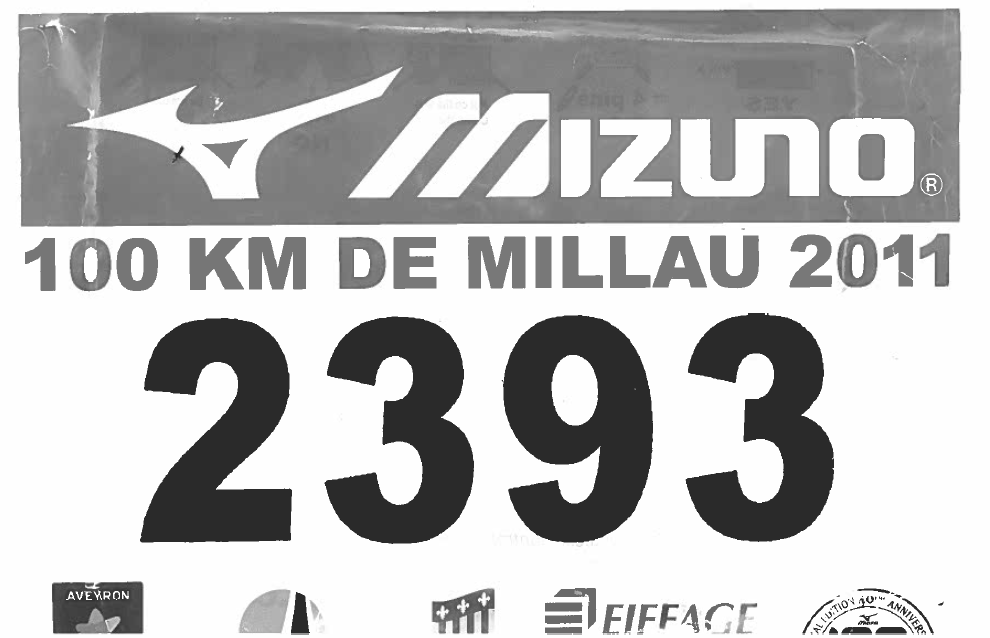
2393 y 2881, serían nuestros dorsales.
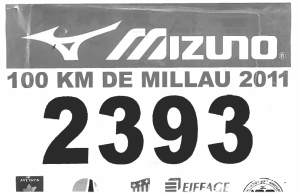
Dorsal de Millau.
En la comida de la pasta encontramos, si cabe, el único punto negativo de la organización de la carrera: no estaba incluida en el precio de la inscripción, 55€. Para tomar esa cena a base de pasta la noche anterior había que pagar otros 12€. Una pequeña falta de tacto. En otras carreras está incluido en el precio. Bastaba con subir el precio de la inscripción si hacía falta.
Tras la cena, todavía nos restaba conducir otros casi cincuenta kilómetros por sinuosas carreteras, siguiendo la ribera del río Tarn, en noche cerrada, hasta Meyrueis, donde se encontraba nuestro hotel. Millau y sus alojamientos estaban totalmente ocupados desde mucho antes de que nosotros hiciéramos la reserva. Más de 3200 corredores se apuntaron este año a correr los 100km de Millau, además de otros más de 500 que correrían la maratón que se organizaba al mismo tiempo y en el mismo recorrido.
Antes de echarnos a dormir, pasada la medianoche, estuvimos preparando meticulosamente cuales serían las cosas que dejaríamos en la bolsa a depositar en el km 42, cuales en la bolsa a depositar en el km 71 y con cuales saldríamos.
Llevábamos un arsenal de material: crema solar, gorras, riñoneras, camelbak, pantalones y ropa interior para cada tramo, camisetas técnicas, calcetines y zapatillas para cada tramo, pañuelos, pilas, tiritas, analgilasa y zantac, gel energético para cada docena de kilómetros, sudaderas, cortavientos y forro polar, blackberry, cámara de fotos y bandera de España, guantes, toallas y gel para ducharse en cada punto intermedio, cargador del GPS, algo de dinero y el DNI. Bien parece que nos fuésemos de vacaciones, y lo que íbamos a hacer todo el día era correr y correr. Lo único que no prevenimos fue una botellita de agua que nos tocó comprar en el km42.
Estrategia
Desde hacía semanas, Serna y yo habíamos hablado sobre qué ritmo llevar, qué objetivo marcarnos, etc. La noche anterior todavía seguíamos dándole vueltas. Manejábamos diferentes informaciones: paradas largas con ducha y cambio de ropa, 100km en 13 horas para un corredor de maratón en 4 horas, terminar la maratón fresco…
Yo pensaba que haciendo un ritmo de 7’20’’/km en la maratón y algo más lento después, con dos paradas largas podríamos terminar sobre la 1 de la madrugada, tras unas 15 horas. Serna lo consideraba optimista.
La organización ponía a disposición de los corredores varias “liebres”. Serna y yo nos debatíamos sobre si comenzar siguiendo a algunas de las de 13 horas o a la de 14. Finalmente optamos por una de las de 13.
Logística
El sábado 24 nos levantamos temprano, antes de las 7, para tomar un desayuno en el hotel y poder digerirlo antes de la carrera. Esa noche apenas pude dormir. La incertidumbre, la tensión, las expectativas no me dejaban conciliar el sueño.
Al llegar a Millau conseguimos aparcar el coche no muy lejos del parque de la Victoria. Fuimos andando hasta él y dejamos la segunda bolsa, la de Saint Affrique, en el camión que la trasladaría hasta allí. Luego nos cambiamos y dejamos la otra bolsa, la primera, en el puesto donde se quedaría guardada hasta nuestra vuelta a Millau tras completar la primera maratón.
Una vez listos para correr, nos dirigimos hacia las zonas demarcadas para corredores, desde donde saldríamos dando un paseo por las calles de Millau hasta la salida de la carrera situada en la calle Jean Jaures.
L’autre dimension
A las 10 de la mañana comenzamos la aventura. Mucha emoción contenida en los más de tres mil corredores se libera poco a poco con la salida. Tampoco hubo una gran aglomeración; tardamos menos de un minuto en cruzar la salida. Y no hubo problemas para correr desde el principio: todos íbamos a un ritmo al trote. Al principio en torno a los 6 minutos por kilómetro… de nuevo, una vez más, nuestras estrategias de carrera al garete desde el principio.
Primero nos dijimos que podíamos seguir a ese ritmo más rápido que 7’/km hasta que cogiésemos a la liebre de las 13 horas. Tras cogerla, unos kilómetros después, seguimos a esos ritmos. Eran cómodos. Corríamos “sans difficulté’’, así hasta la media maratón, tal y como decía un periódico local en la edición del viernes al describir el perfil de la carrera.
Esa primera media maratón fue una delicia. Siguiendo por la carretera a Meyrueis, remontando el curso del Tarn, recorrimos 21 kilómetros prácticamente llanos, con unas vistas del valle impresionantes, rodeados de naturaleza y a un ritmo que nos permitía conversar y bromear.
Ravitos
La disposición de avituallamientos durante la carrera y su contenido es algo realmente digno de mención. Tuvimos avituallamiento líquido y sólido cada 4 ó 5 kilómetros prácticamente. Abundantes y variados. Variados en cada puesto y entre distintos puestos conforme avanzaba la hora del día.
Al principio había frutos secos, uvas pasas, chocolate, plátanos, gajos de naranja, bizcocho, etc., acompañado de agua, coca cola, zumo, bebida energética… Más tarde se fueron añadiendo bocadillitos de jamón, panecillos con queso, con foie, azucarillos, sopa caliente, salchichas, cerveza, café…
Desde el principio, Serna y yo nos prodigamos en los avituallamientos o ravitos. Este será uno de los aspectos a cambiar si alguna vez repetimos y queremos mejorar nuestros tiempos. Pero esta vez, donde no queríamos fallar era en la hidratación y alimentación. Y no lo hicimos. Tanto es así, que en torno al kilómetro 30 le comentaba a Serna que me sentía como el lobo del cuento con la barriga llena de piedras de tantas cosas que había comido.
Suiveurs a vèlo.
A pesar de que Serna y yo corríamos solos, la mayoría de corredores iban acompañados de un seguidor en bici. Los seguidores debían llevar un dorsal al efecto proporcionado por la organización con el mismo número que el corredor.
Los seguidores además de animar y dar un soporte moral, les iban llevando a los corredores diversas bebidas, alimentos, ropa, etc., con lo que en teoría los corredores se ahorran peso en riñoneras o camelbak y se evitan el tener que parar en todos los avituallamientos. De hecho, podrían organizarse para que solo el acompañante en bici se pare, rellene sus botellas, haga acopio de comida y el corredor pueda dedicarse a correr.
Aunque ahora no me imagino cómo se podrían aguantar 13 horas corriendo prácticamente sin parar, seguramente tiene su aspecto positivo dado que no dejas enfriarse a los músculos ni a las articulaciones. Nosotros cada vez sufríamos más tras cada parada al volver a ponernos en marcha. Quizá si no tuviésemos la necesidad de parar en seco unos minutos podríamos continuar con una carrera suave sin tantos dolores.
Los acompañantes en bici esperaban a sus corredores a partir de pasados unos kilómetros, en torno al km 9. Desde entonces, pedaleaban junto a ellos, y lo que ya era una marea humana se convirtió en un continuo de bicis y personas, por lo que a veces se hacía difícil encontrar huecos para progresar.
Se daban ocasiones en que un giro sin avisar, una parada repentina daban lugar a colisiones, pero pasados los kilómetros, el filtrado iba ocurriendo por sí mismo. En el kilómetro 30 ya no había prácticamente problemas de aglomeraciones, en el 50 no había ninguno.
Nosotros en el kilómetro 9 echamos en falta a Pablete, otro compañero de la Escuela, a quien le hubiera gustado participar… quien sabe, quizá haya más oportunidades como ésta.
Maratón
En febrero, hace siete meses, pensaba que mi objetivo del año sería correr la maratón de Toulouse, en el mes de octubre. Es objetivo sigue estando ahí: correr la maratón al ritmo de maratón que me resulte posible aguantar. Sin embargo, el hecho de correr una ultra maratón, tiene el efecto colateral, de que como parte de la prueba se corre una maratón. Y no ha hecho falta esperar a octubre, ya en septiembre he completado mi cuarta maratón, casi 10 años después de la última.
A partir del kilómetro 22 ya estaba corriendo distancias que no había superado desde hacía 10 años y así se lo dije a Serna. A partir de las tres horas y media, él me indicó que estaba corriendo en tiempos inexplorados para él (su única maratón hasta entonces, fue en menos de ese tiempo).
Y así fuimos, subiendo y bajando colinas, a ritmos de 6’20” por kilometro, de un ravito al siguiente, comiendo y bebiendo, hasta que llegamos a Millau y completamos nuestra maratón, en algo menos de 4 horas y 50 minutos. La diferencia es que esta vez, en vez de descanso, nos esperaban otros casi 60km de carrera.
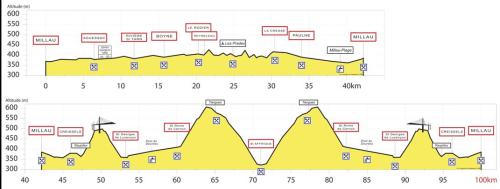
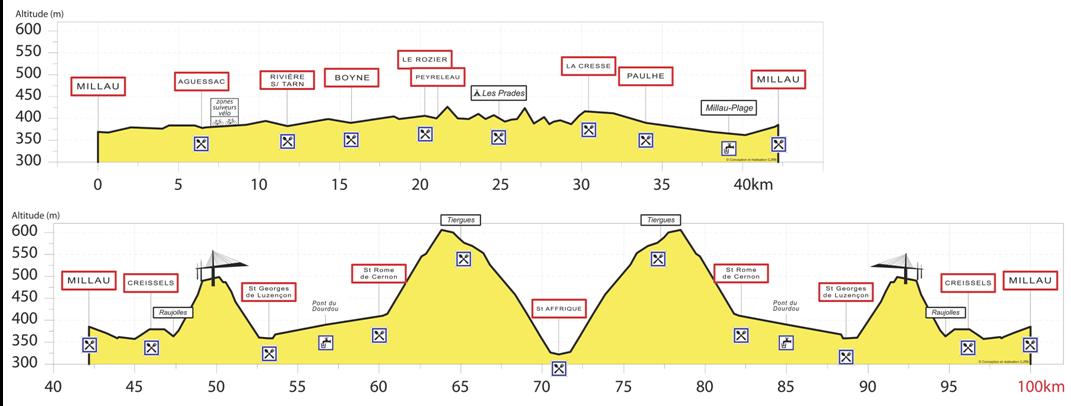
Perfil de la carrera.
Como Serna indicó terminada la carrera, fue una delicia el correr una maratón a un ritmo suave, sin buscar una marca, disfrutando del paisaje y la conversación. Pienso que eso, el quitarse la tensión de la carrera solo puede hacerse cuando la distancia a cubrir es mucho mayor. Solo por ello, el probar una carrera de 100 km, incluso sin intención de terminarla merece la pena, por darse el gusto de probar una maratón relajadamente.
Paradas
Justo antes de entrar en Millau y completar la maratón, la liebre de las 13 horas nos adelantó. Más tarde he sabido, que varios compañeros de la empresa que terminaron en 12 ó 13 horas hasta ese momento iban en nuestros tiempos.
Al llegar a Millau, nosotros seguimos con nuestro plan: comer, hidratarnos, cambiarnos de ropa y ducharnos. Habíamos leído y nos habían dicho que era recomendable, y tampoco teníamos ninguna prisa. Si llegamos sobre las 4 horas y 50 minutos, salimos de allí para continuar con la carrera a las 5 horas y 37 minutos, tras casi 50 minutos de parada.
Psicológicamente nos vino muy bien, y la ducha nos relajó mucho. Incluso íbamos por debajo del tiempo previsto: 5 horas de maratón más una hora de parada. Pero luego nos costó retomar la marcha, nos habíamos enfriado bastante. Igual hubiese necesitado un pequeño masaje, y sin duda menos descanso.
En la parada del km 71, en Saint Affrique volvimos a parar del orden de 45 minutos. Allí no había duchas, pero lo que nos ahorramos en ello lo perdí por un masaje que necesitaba. Si algún día volvemos a correr una prueba similar, esta es otra lección aprendida: se gana y pierde más tiempo en las paradas que en el asfalto, y para ello es necesario contar con un equipo detrás.
Andando
Quizá haya gente a la que oír que en una carrera se hace un tramo andando le suene a derrota, a no haber aguantado. En muchas pruebas se anda en tramos, especialmente de subida. Y andan todos o casi todos. Quizá no anden los primeros, pero ellos juegan otra liga, tienen otra preparación, están hechos de otra pasta.
En muchos trails por el monte se anda porque apenas si se puede mantener la verticalidad, casi se gatea. Otras veces se anda porque se atraviesan zonas de rocas, de troncos. Y otras veces, se anda porque la carrera es muy larga y no tiene sentido quemar todas las fuerzas en un repecho de 2 kilómetros si detrás hay otros 10 en que correr.
En Millau, Serna y yo anduvimos unos 15 kilómetros. Unos 14 en subidas: dos veces hasta el paso por debajo del famoso viaducto y otras dos hasta Tiergues. Los otros metros fueron en llano, cuando la rodilla no respondía, y a 2 kilómetros del final, reservando unas pocas fuerzas para hacer un último kilómetro para recordar.
Otros corredores corrieron más: o porque iban más fuertes, o incluso porque yendo más lento preferían ir más despacio en los llanos y correr todo el tiempo. Otros tantos corrían menos. Caída la noche muchos eran los que ya no podían correr, ni cuesta arriba, ni en llano, ni cuesta abajo. La noche era muy larga y ellos llegarían. Si no en 15 horas, lo harían en 16, 17 ó las que fuese. La heroicidad de Millau no hace distinciones.
Viaducto
Antes de salir de Millau, compramos un par de botellas de agua, y ya totalmente equipados proseguimos la marcha. El discurrir de los kilómetros nos fue llevando al famoso viaducto de Millau.
El viaducto, obra de Norman Foster y Michel Virlogeux, tiene más de dos kilómetros de largo y es el más alto del mundo con casi 270 metros en su punto más profundo. A pesar de lo que yo pensaba, la carrera no lo atraviesa en ningún momento, sino que cruza por debajo de él. En mayo, sí que hay otra carrera popular que lo cruza, pero ésta no.
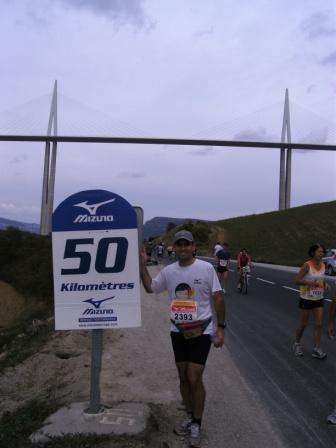
Viaducto de Millau.
La subida hasta el paso del viaducto es la primera en la que tuvimos que pasar de correr a andar. Andar a un ritmo de 11 minutos por kilómetro, algo más de 5 kilómetros por hora en subida, que no está mal.
Casi al llegar arriba, echamos a trotar: no podía ser que lo cruzásemos andando, además de que enseguida vendría la bajada y el punto kilométrico 50, parada obligatoria para sacar una de las fotos más recurrentes de la prueba, con el viaducto de fondo.
Dolor
En la bajada del viaducto fue cuando comencé a sentir el primer dolor: flato. Hasta entonces notaba las piernas cargadas, pero era soportable. El flato, en carrera, es prácticamente insoportable. Te obliga a decelerar, pero no quería parar. Seguimos corriendo, más suavemente y forzando una respiración profunda para ver si me recuperaba, y así fue. Poco a poco me fui recuperando, y aunque en otros momentos de carrera sentía un pequeño conato de flato, nunca llegó a reproducirse.
Fue entonces cuando nos cruzamos en carrera con Michaël Boch, flamante ganador de la edición anterior, que iba camino de ganar por segunda vez. Nosotros íbamos por el km 52, y él, ya de vuelta, iba por el 90… lanzado a terminar en poco más de 7 horas, menos de la mitad de nuestro tiempo. Otra liga.
En los siguientes avituallamientos me obligaba a realizar pequeños estiramientos, ya que me notaba acartonado, con poca flexibilidad. Hasta que en torno al kilometro 60 tuve que parar a que me dieran un pequeño masaje para relajar los cuádriceps, bíceps femorales y gemelos. El remedio duró unos pocos cientos metros. Al cabo de unos minutos las sensaciones volvían a ser parecidas: músculos cargados, rodilla muy exigida… la sensación de que un mínimo golpe en la pierna te rompería algo. Estábamos en los últimos metros de los 6 kilómetros de subida tendida antes de comenzar la dura ascensión a Tiergues; segundo momento en el que tuvimos que caminar.
Hasta entonces, habíamos visto alguna ambulancia yendo y viniendo. Unas veces con sirena, llevando a alguien con más o menos urgencia y otras sin ella, buscando gente con problemas. Y es que pasada la maratón, empezábamos a ver más y más personas tumbadas en las cunetas con sus acompañantes al lado. Unos sin fuerzas, otros con dolores, alguno con mareos, hipotermias, etc.
En torno al km 60 nos cruzamos por primera vez con el autobús. La primera vez iba prácticamente vacío. Conforme avanzaba la tarde y la noche cada vez iba más lleno. El autobús recogía a la gente que llegada a Saint Affrique, en el km 71 había dicho basta al sufrimiento. Con todos los dolores que pudiéramos sentir, que fueron muchos e intensos, tuvimos la suerte de no sufrir ninguna lesión que nos impidiera movernos, ni de caer en una cuneta ni nos dejamos vencer por el desánimo hasta el punto de coger aquel fantasmagórico autobús.
Cuando se buscan los límites del cuerpo humano, como en este tipo de pruebas, es muy posible que se encuentren dichos límites.
Mentalidad
La primera subida a Tiergues fue muy dura. Sobretodo mentalmente. Llegaba con varios problemas físicos y todavía quedaban más de 35 kilómetros para meta. Gracias a que Serna venía conmigo, y gracias a que venía más fuerte no cundió el desánimo.
En algún momento llegué a pensar en si dejarlo, pero enseguida me saqué tales pensamientos de la cabeza. Habíamos venido a terminar la prueba. Aunque llevábamos casi 9 horas en la carretera, todavía quedaban 15 para las 24 horas del límite y no teníamos prisa. Al llegar a la cima en Tiergues comenzamos a trotar de nuevo hasta el km 65 donde había un último ravito antes de la bajada a Saint Affrique. Allí pedí que me echasen un sustitutivo del réflex (froid par les genous) y seguimos la carrera trotando, con mucho dolor.
Al cabo de un par de minutos, pensé: “quizá si me dejo ir, yendo a un ritmo más alegre, las articulaciones se calientan y tampoco me va a doler más y llegaremos antes a Saint Affrique. Una vez allí volveremos a subir andando y entonces solo quedarán 22 kilómetros, de los que veremos cuantos puedo correr”.
Los días antes de ir a Millau había leído un relato de un participante en los 101 de Ronda. De cómo anduvo desanimado hasta casi el km 40 y en cierto momento se motivó, sacó fuerzas de donde no había y pasado el ecuador de la carrera se puso a correr y a correr hasta el final. Había compartido con Serna ese relato, y deseaba que algo así me ocurriera. Algo así ocurrió en aquella bajada a Saint Affrique.
A pesar del dolor, bajamos como locos, corriendo todo lo que las piernas nos permitían. Adelantando a todos los corredores que nos encontrábamos. Cada vez mejor. Los dolores se mitigaban por la rabia de llegar abajo y llegar antes de las 20:00, otro hito mental del que habíamos hablado. Y lo conseguimos.
Llegamos a las 19:55. Durante los 40 minutos anteriores, ya sin cronómetro ni GPS, le pedía referencias de tiempo a Serna cada poco. Me iba auto motivando viendo que sí, que lo íbamos a conseguir. Y así fue.
En esa bajada mi perspectiva de carrera cambió completamente. Todavía no habíamos llegado a Saint Affrique, y sabia que no me subiría en aquel bus. Quedaban más de 30 kilómetros, pero me sentía como si solo quedasen 22 y cuesta abajo. Sabía que íbamos a terminar la carrera. A la 1 de la mañana o a las 7, pero llegaríamos a Millau.
Oscuridad
Tras la parada en Saint Affrique comenzamos a correr por las calles del pueblo ya con la linterna frontal en la cabeza, todavía no nos dábamos cuenta de lo imprescindible que iba a ser. Al llegar al borde de la montaña, a las afueras del pueblo, comenzamos a caminar de nuevo, durante más de 6 kilómetros seguidos sin parar. Algo más de una hora. Volvíamos a tener tiempo de hablar.
La noche era cerrada. Solo se veían las luces de las lámparas de los otros corredores. Un par de veces creímos ver un rayo, pero no hubo tormenta, todo lo contrario; la noche era estrellada. Una jornada perfecta para correr.
Pasamos el km 75, seguimos andando y comenzamos a ver a lo lejos el ravito del km 77, que sería el ultimo antes del comienzo de la diversión.
All in
Antes del avituallamiento le dije a Serna, que no sabía cómo me responderían las piernas, pero que intentaría correr de ese momento al final en todos los llanos y descensos. Solo andaríamos la cuesta arriba hasta llegar al viaducto, 2 kilómetros. Para intentar correr de nuevo, en ese avituallamiento me declaré “all in”: pedí que me aplicasen de nuevo réflex en la rodilla, tomé un par de cervezas, un tubo de gel energético, coca cola, dos pastillas de analgilasa y algo de chocolate y roquefort. Si había algo que me podía ayudar a no sentir el dolor y correr, allí lo probé todo, y casi dos horas después de la anterior bajada, volvimos a repetir la experiencia durante otros 4 km. Y luego otros 3, y otros 3… y así fuimos avanzando.
En cada avituallamiento parábamos a rellenar agua y comer un poco. Si acaso beber un café o curar un conato de ampolla, pero ya no más masajes. Intentamos no perder mucho tiempo, no enfriarnos, sino volver al asfalto y correr y correr. Adelantando a la gente. Allí volvimos a correr a 6 minutos el kilómetro. Recuerdo que le preguntaba a Serna por más y más referencias de tiempo. “A ver si a y veinte llegamos al ravito, faltan 3 kilómetros”, y él me decía “¿Tú crees que vamos a 6’/km?”, sí, lo creía. Y sí, íbamos a ese ritmo y llegamos en ese tiempo.
Fueron los mejores momentos del día. Si correr la maratón tranquilos, relativamente frescos, disfrutando del paisaje, hablando, fue una experiencia muy gratificante; correr los últimos veinte kilómetros, sin apenas hablar, con dolor, en completa oscuridad, lo fue todavía más.
Nada nos podía parar. Ni siquiera el contratiempo en el km 88, cuando al salir de ser atendido de los principios de ampollas de los pies, no podía doblar la rodilla. Alarmado, volví a entrar a que me aplicasen réflex. Y al salir caminamos unos 500 metros hasta el comienzo de la rampa al viaducto. Poco más de dos kilómetros. Si en ese tiempo se calentaba de nuevo la rodilla, ya solo nos quedarían unos siete y medio hasta Millau y corriendo como locos o andando estaríamos allí.
Al coronar, volvimos a empezar a trotar despacio y luego acelerar. El mismo proceso de las bajadas anteriores. Pero ya llegando a las calles de Millau. La poca gente que quedaba en las aceras o arcenes nos animaba, “Bon courage!”. Prácticamente nadie corría ya. Se extrañaban al vernos correr con todas nuestras fuerzas y por ello nos animaban. Nosotros se lo agradecíamos y a la vez nos estimulaba a seguir corriendo.
Le preguntaba a Serna referencias. Al paso por el km 95, eran las 00:35, allí ya le dije: “lo siento, no llegaremos antes de la 1”, “¡Qué más da! Ese era nuestro horario más optimista, esta mañana hubiéramos firmado si nos dicen que íbamos a estar aquí ahora”. Los 5 km que quedaban no los cubriríamos en 25 minutos. Los cubrimos en 40, parando en un avituallamiento, andando unos metros tras ponerme una bandera y haciéndonos unas fotos.
Último kilómetro
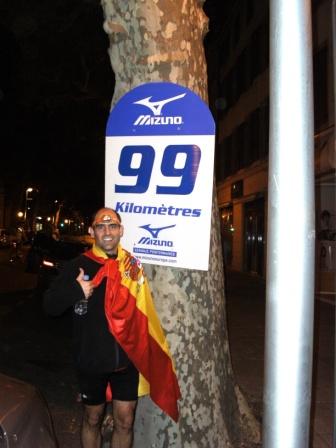
Unos metros antes le pedí a Serna que anduviésemos unos metros para guardarnos algo para el final. Sacamos la bandera de España que había traído especialmente para estos metros finales. Me la enfundé como capa. Y tras un par de calles, volvimos a trotar.
Cruzamos una zona de bares donde la juventud nos jaleaba. La gente gritaba. Se escuchaba “Viva España”. Nos llevaban en volandas.
Paramos a hacernos la última foto junto al hito del km 99, y proseguimos nuestra carrera hasta el parque de la Victoria. Serna iba fortísimo y le tenía que pedir que se guardase algo para el último sprint del parque, la última subida.
Entramos en el parque donde algunos corredores llegaban andando y nosotros veníamos como aviones, esprintando. Los últimos 300 metros parecían como de una serie de velocidad. No se notaban los casi cien kilómetros que llevábamos en las piernas.
Pasamos por debajo del último arco. Otro empujón para subir a la plataforma metálica que se introducía en el pabellón. Íbamos casi saltando. Últimos 30 metros. Seguimos esprintando hasta la plataforma en el centro del pabellón, donde entramos juntos y tras finalizar nos fundimos en un abrazo.
Lo habíamos conseguido. Habíamos terminado nuestra primera ultra maratón.
Resultado
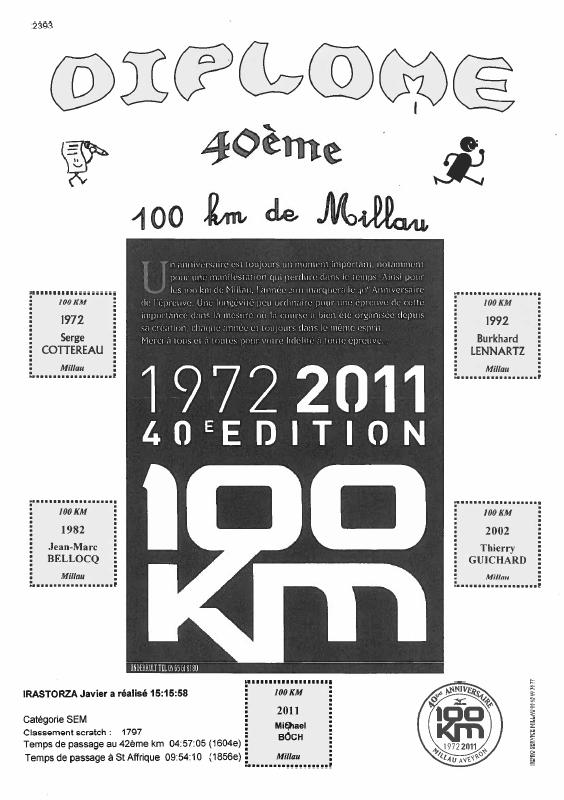
Como siempre digo, el resultado en la clasificación es lo que menos importa, y más en una carrera como esta donde nuestra única ilusión era terminar. Terminamos, luego el objetivo lo cumplimos. Además, conseguimos terminar en 15 horas y 15 minutos, con lo que estuvimos a tan solo 15 minutos de nuestra previsión más optimista. Un masaje menos, 3 avituallamientos más rápidos, un cambio de ropa más eficiente…
Con nuestro tiempo terminamos en las posiciones 1786 y 1787 de los más de 3200 corredores que se inscribieron. Esto nos sitúa en el percentil 44%, en el bloque medio, algo por detrás de la mitad. Si tenemos en cuenta que se retiraron del orden de 800 corredores, de entre los que completaron los 100 km terminamos en el percentil 25%, justo en el último cuarto. Pero esto pone de relevancia ese hecho: terminamos.
De todos modos, alguna vez he hecho la reflexión de que en semejante prueba, tanto coraje exige el terminarla como el retirarse. Los días siguientes a la prueba no puedes entrenar, apenas puedes moverte, y no haces más que descubrir pequeñas o mayores lesiones producidas durante la carrera. El desgaste al que se somete al cuerpo es inmenso. Tomar la decisión de retirarse puede ser sabia, si se quiere evitar un mal mayor. Y por mucho dolor que se tenga, si todavía uno se puede mover es muy difícil aparcar toda la ilusión que uno tiene por terminar y quedarse en Millau al paso de la maratón o subirse al autobús en el km 71.
Terminar puede ser también una decisión difícil. Hace falta mucha capacidad de sufrimiento. Cuando todavía te alejas de la meta, cuando te faltan 35 kilómetros y te duelen las piernas, la espalda, las rodillas y has tenido flato, también hace falta mucha fuerza de voluntad para decir: sigo adelante. La ilusión sigue ahí, pero con la toma de la decisión, sabes que te quedan más de 5 horas de dolor en las carreteras, muchas más si la condición física empeora.
En esos momentos, es cuando se agradecen todos esos pequeños esfuerzos hechos en los meses anteriores y que han ido afianzando la voluntad. Recordaba esas situaciones en que me decía “si no salgo hoy a las 6 de la mañana por dormir un rato más, ¿Cómo voy a continuar en Millau cuando venga alguna adversidad?”.
Famillau
Después de llegar y cambiarnos de ropa, nos quedamos a cenar en el pabellón, repleto de corredores y familiares que estaban cenando, bebiendo, recibiendo a los que llegaban después.
Seguían llegando corredores. De uno en uno, de dos en dos. Un flujo continuo. Paseando entre la multitud estaba el ganador, Michaël, departiendo con unos y otros, más de 7 horas después de haber terminado él. Uno más de lo que vienen en llamar la Famillau, de la que ahora somos parte.
Cada uno de los que estábamos allí nos sentíamos ganadores. Apenas podíamos caminar, nos dolía todo el cuerpo y sin embargo estábamos henchidos de felicidad. Nadie nos podría quitar que habíamos completado los 100 km de Millau, como dice la organización: “Otra dimensión”.
Un sueño nacido de una bravuconada, un año y medio antes. Una experiencia inolvidable un año y medio después.
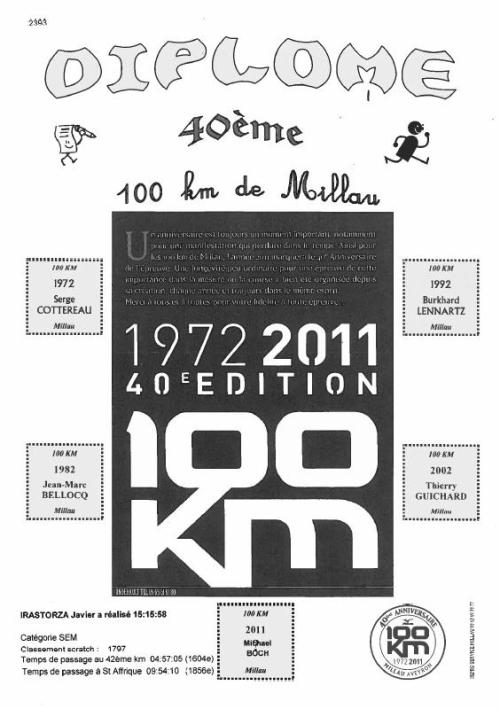
Diploma 100km Millau 2011.