Hace unos meses leí el libro “Todo va a cambiar”, de Enrique Dans (profesor del Instituto de Empresa y blogger), que recomiendo.
De este libro en particular me gusta la diversidad de temas que trata y el enfoque positivo, divulgador que tiene con cada uno de ellos: neutralidad de la red, copyright, impacto de las nuevas formas de comunicación en las empresas y las personas, políticas de comunicación de empresas e instituciones, relaciones con clientes, soluciones a problemas desde las nuevas tecnologías, generación de contenidos, web 2.0…
Para aquellos que lean regularmente su blog, este libro no aporta grandes novedades, se trata más bien una recolección amplia y ordenada de las visiones que el autor tiene sobre varios temas de los que regularmente escribe en el blog.
Especialmente anima a que la gente experimente, use redes sociales, escriba un blog, se haga una cuenta en twitter, etc. Además ofrece varios consejos para padres con hijos pequeños sobre cómo afrontar el acceso de estos a la red de una forma natural, lejos de intentar prohibir el uso de la misma.
Unos meses después de haber leído el libro, los capítulos sobre el impacto en la sociedad de las nuevas tecnologías cobran mayor relevancia tras haber visto los muchos movimientos originados y / o amplificados tanto en los países árabes como en España antes y después la últimas elecciones municipales y regionales.
Como dice el autor al final del libro: no es que todo vaya a cambiar, sino que todo ya ha cambiado…
Por cierto, ante la pregunta ¿debo tener/abrir un blog? La respuesta del autor, que comparto, es: si todavía no lo tienes la respuesta es sí.
Finalmente, quería dejar un enlace a otro post escrito por un amigo en el blog de los Jefotecs donde también dan su visión sobre algunos de los temas que trata el libro (descargas, conocimiento, neutralidad de la red).
“We saw a sign at the interstate and decided to come.”
“Great, it’s nice to see that advertisement works”…
This was our first exchange with the clerk at the Iowa Aviation Museum. We had just bought our tickets for 7$ and registered our names in a pristine visitors’ list. I guess we were the first visitors of that day, probably of the week, conceivably of the month, who knows if even in the year.
Luca and I were in our way from Des Moines to Omaha. I thought it would take 4 hours but soon discovered that we would arrive much earlier than we wanted. Having already passed the exit for the John Wayne birth place, when I saw the sign for the “Iowa State Aviation Museum” I didn’t think it twice. I turned the wheel and took the exit.
We had to drive another 10 miles on a more than boring road and then 2 more miles to reach the museum at the aerodrome or the Greenfield Municipal airport.
The museum had some unique pieces from the early days of aviation (e.g. the 1st airplane ever to carry the name “Piper”, the J-2… a one derived from it was the plane I flew in Poland). Nevertheless I wanted to commend the museum for 3 other things:
Diffusion of passion for aviation: I find it admirable that in such remote places, they do gather some resources, collect some assets and put up a museum for the delight of fans, to spread the passion for aviation and seed the souls of future engineers.
Scheme of contributors to the museum: to finance that museum they have in place a scheme in which both companies and individuals contribute to its sustaining. In exchange they get public recognition in the form of a golden plaque at the Hall of Fame of the museum.
Hall of Fame: I also admire the tribute paid to pioneers from the region and people who played a key role in aviation in the form of that Hall of Fame.
In that Hall of Fame you learn that an Iowan volunteer became the youngest aviator in US Army Aviation Section in WWI (Clifton P. Oleson); another Iowan built the 1st multi-passenger seaplane, the 1st twin-engine bomber, designed the 1st honeycomb structural supports and was the founder one of the companies behind today’s Lockheed Martin (Glenn L. Martin); another Iowan, this time a woman nurse, unsuccessfully sought a pilot position at Boeing Air Transport, but influenced the president with her idea of placing nurses on-board airplanes to make passengers feel more comfortable with flying (Ellen Church became the first stewardess in history); and another 2 Iowans were the chief engineer and the first pilot to fly the famous Lockheed SR-71 Blackbird (William J. Fox & Louis W. Schalk).
In the hall you also find out that an Iowan lost the first ever race between a car and an airplane (Carl S. Bates) and that a cloth sewn by the wife of a first cousin of the Wright Brothers is worthy enough to make it to the Hall of Fame (especially if that cousin happens to be the great, great, great-grandfather of a fellow from Greenfield…).
Barnstormingis a term I learnt at the museum (well, you go to museums to learn, don’t you?) that refers to the entertainment that first aviators provided in different villages in the 1920s, where they would fly as in a circus to show the airplanes to villagers, perform some stunts and get some cash by carrying affluent citizens in short demonstration flights. This, also contributed to spread the passion for flight.
This slideshow requires JavaScript.
—
PD: I join the legion of admirers of Luca for standing these #avgeek visits not only stoically but even enthusiastically.
Yesterday I wrote about what was my dream job as a child: being an astronaut. I work now for Airbus, and for many people, that seems to be the dream company to work for according to some studies.
Already last year, I posted about the study made by Randstad which placed EADS (mother company of Airbus) as the most preferred one in Spain.
This year, the same study by Randstad [PDF, 1.5Mb] has placed again EADS as the favourite company for workers (out of a study including the 150 largest companies in the country), even though the sector Aviation placed only as the third most wanted one.
Apparently the 3 factors in which EADS led the rankings were: the quality of in-company education, the interest of the work performed and the pay policy.
Moreover, recently it was released another study, this time targeted to engineering students across Europe. This one placed again EADS in the top 3 preferred employers behind Google and Audi, and ahead of BMW and Apple.
The good news: EADS will be recruiting over 4,000 employees in 2011.
Some days ago, I got an email from a source-of-ideas-for-blogs service called Plinky, from which I have already picked some good ideas to write about in posts in the past (on charities, advice…).
The question I liked this time from the email was:
“What was your childhood dream job?”
I don’t know whether I have been posed this precise question many times or not, what I know is the answer to it and that I have given that answer many times to other questions.
When I was a child I wanted to be an astronaut. I don’t know exactly why, but that was my dream job. Surely, I can recall memories of toys related to space, such as a model of the Challenger that my brother and I played with (I presume it came before the accident), or toys related with Star Wars, etc.
This passion, among other factors, led me to study aerospace engineering, and then work for Airbus, which is not working as an astronaut but is still working in the aerospace business. Many times, I have been asked why I studied what I did, sometimes by corporate HR quizzers, and this is what came as a response.
Would I still want to be an astronaut?
Sure! But, yes, I am not pursuing it. I guess I am just waiting for the moment when commercial space flight costs not 20M$ but about 100k$, and if by then I can afford it I guess I would pay for enjoying a stunt out there.
Berkshire Hathaway was a small textile company in Rhode Island. As many other textile companies it was struggling due to cheap labour competition elsewhere. Warren Buffett had already invested in the company before realising that it was headed for the worst. He was about to sell his stake when he felt irritated by an underbid from the managing director, then he decided not only not to sell his shares but to invest until gaining control, sacking the CEO and completing what he later referred to as his worst investment mistake he ever made…
Today Berkshire is a very different outfit: a big conglomerate, with over 130 billion USD in revenues, with a big insurance arm, dozens of operating companies and large investments in securities. Warren Buffett, his current CEO, regarded as the best investor ever.
Berkshire Hathaway annual shareholder meeting (BRK 2011, for this year’s event) is an extraordinary event, widely covered by press and attended by over 30.000 investors and relatives.
I explained in a previous post how I became interested in investing and when and why Luca and I became shareholders of Berkshire, now I want to give a small account of my experience in my baptism in the Woodstock for Capitalists (pictures below)…
… on Thursday 28th April Luca and I picked a rental car in Chicago, from where we would drive 800km to Omaha, Nebraska, with a stop over in Des Moines. Early in the afternoon Friday 29th we arrived at our hotel in Omaha, where the receptionist informed that there was a package waiting for us: our credentials for the weekend (thanks Debra!).
The event is not restricted to just the shareholders meeting, it is composed of a series of events covering the whole weekend. Let me describe them.
Cocktail at Borsheims. On Friday evening several buses would pick shareholders up from an infamous mall to bring us to Borsheims, the group’s jewellery shop. In front of the shop there was a big tent with live music, drinks and food. The shop was open, with re-doubled staffing to attend shareholders in eventual sales (as Buffett says “what better occasion to propose to your girlfriend than at BRK shareholders meeting?”).
Shareholder meeting on Saturday morning. The meeting started at 8:30am, doors opened at 7:00am and Luca and I arrived at 6:45am when there was already a huge queue. The meeting is held at the Qwest Center, a big convention center, which has room for exhibition and a sports indoor arena where the meeting is held. The exhibition area is packed by stands selling all kinds of goods from the group subsidiaries: boots, construction tools, books, sports wear, insurance… anything at a nice discount for shareholders. What better place to go shopping than to your own shop at a discount? To open the day some very funny videos and commercials were displayed. One featuring cartoons of Buffett, Munger and Schwarzenegger as Governator was especially welcomed.
Q&A session. Most of the meeting, until about 15:30 in the afternoon is a questions and answers session. This is when everybody wants to test and listen to the insights from the “Oracle of Omaha”. They made room for approximately 60 questions. Half were selected by 3 journalists from the thousands sent in by shareholders and the other half were drawn just before the meeting from volunteering shareholders in the floor.
This Q&A session is the most widely event reported by media. If you have read anything about the meeting, it was most probably said there. Instead of me telling here again what’s that was said, let me just refer to my first and second favourite accounts from other sources.
Charlie T. Munger. He is the vice chairman of the company and doesn’t get nearly as much coverage in the media as Buffett, however Warren has for him the highest regard. Munger has written a book, “Poor Charlie’s Almanack”, which is a treasure of wit and wisdom (and heavy as a brick).
At the meeting he is sitting side by side Warren all day during the meeting, looking half asleep and eating candies. Every now and then he replies with a “I have nothing to add” whenever Warren asks him for comment, except for a few times when he gets to give his point. That point goes without cosmetics straight to the issue at hand: “Much of the present crisis was caused not so much by evil but by stupidity”, [on financial projections] “seeing them in paper or in a screen makes some people believe they’re something serious”, “It seems both parties are competing to see which can be the most stupid. What it’s worse, they’re topping each other”, “Insurance is a difficult business: there are many temptations to be stupid… like in banking”…. after hours of this is when Warren came with his “If there’s anybody we’ve forgotten to insult, pass a note up and we’ll get to you.”
Business meeting. Just as a reminder I will say that this was a shareholders meeting. I hadn’t been in any other before though I had seen some either by streaming or podcast. Luca had attended one of EADS. At BRK the shareholders meeting itself lasted… 20 minutes? Reports, directors for the next year, etc., were voted in a matter of seconds. The only issue which took longer was a proposal to get all subsidiaries to report their carbon impact anticipating eventual legislation. Several shareholders took the word for and against and it was finally turned down… this is America.
Picnic at the Nebraska Furniture Mart. Once the shareholders meeting was finished, we all headed for NFM to enjoy a very professionally organized picnic as well as to visit the furniture shop (largest one in North America). This is another BRK subsidiary founded by Mrs. Rose Blumkin, a strong woman who emigrated from Russia at the beginning of the XX century and started the business at her place, and after a disagreement with Warren went on to open a new business well into her ‘90s, being involved in the operations until shortly before her death at 104.
Brunch at Borsheims. On Sunday morning shareholders could go back to the jewellery shop to have a brunch while shopping, playing bridge or chess, seeing the performance of a magician, etc… It sounds all fine for a Sunday morning plan, the singularity comes from that jewels were sold by Warren Buffett himself, you could play bridge with or against Bill Gates, the chess game was against US champion, etc.
Lunch at Gorat’s. On Sunday two steak houses in Omaha closed doors for shareholders of BRK. Luca and I booked a place in both; one for lunch, the other for supper. Both are Buffett’s favourite places and this is why he recommends them (not being part of the group). Food was wonderful, just too much for us to finish everything.
Dinner at Piccolo’s. This would be our last event in the weekend. We had finished lunch just 5 hours before and were not really hungry. In fact, we were not hungry at all, but we went on with the plan. While we were having our burgers, Warren and Bill came in with their entourage to have dinner at a table 2 tables away from ours. It felt awkward to say the least but this how we closed our BRK2011, our first.
The Red Arrows are the UK Royal Air Force Aerobatic Team. They are one of the most famous acrobatics teams worldwide. They were formed in the ‘60s when several unofficial teams were united under the new official team of the RAF.
The Red Arrows were performing yesterday at Muret Air exhibition, just 12km away from Toulouse so I went there to spend the day with some colleagues from Airbus (which kindly sponsored the show providing fuel for the aircraft). The organization of the event left the Red Arrows for the end of the day. The team is composed of 9 pilots plus an extra one who acts as road manager and commentator during the show (animator I should say). They fly BAE Hawk airplanes and are about 33 years old on average.
The several figures in different formation patterns that they performed were impressive (Diamond, Apollo, Vixen, Heart, Palm tree, etc.). I must admit that this was the first exhibition I attended, as the only other time when I witnessed acrobatics was at the Red Bull Race in Budapest in the summer of 2007, when I was on holidays there with friends.
I took several pictures and videos of their performance, but somehow I didn’t manage to save most of the videos correctly, so I can only show below the pictures in the slide show below:
This slideshow requires JavaScript.
There were another two teams performing: the French Air Force Cartouche Doré (flying 3 TB30 Epsilon, made by Socata, a filial of EADS) and the Breitling Jet Team. The latter is a civilian acrobatic team (the only one) based in France. They fly L-39 Albatros.
Apart from these teams, there were several other planes that were flying in the show: L-39 Albatros, Cap 232, ATR-42, Beech King Air 200, some Pipers (simulating a fight between a police airplane and another one), P40… but the only ones my smartphone saved correctly in videos were the flights of the A380 and the A400M (no kidding, I did over 20 videos and discovered only these 2 were stored in the memory), enjoy them:
It was a good experience, perfect for a sunny Saturday. I wanted to remark the importance of having a good commentator and music to enhance the show. In Muret the commentator was great (apparently he is famous in France and engaged in all air shows) but the music was not always the best, though when it was it really made you (seriously) think “I want to fly one of those”…
“The Smithsonian Institution was founded for the “increase and diffusion of knowledge” from a bequest to the United States by the British scientist James Smithson (1765–1829), who never visited the new nation. In Smithson’s will, he stated that should his nephew, Henry James Hungerford, die without heirs, the Smithson estate would go to the government of the United States to create an “Establishment for the increase & diffusion of Knowledge among men”.
“The Smithsonian Institution is the largest museum complex in the world, and many of its buildings are historical and architectural landmarks.”
During our last trip to USA, Luca and I visited both locations of the National Air & Space Museum of the Smithsonian institution. I had already been at the one in the Mall and I already talked about it briefly in a previous post. I wanted to write about the museum at Dulles, close to DC international airport.
That museum is named after Steven F. Udvar Hazy, who is the CEO of Air Lease Corp, an airplanes leasing company. Previously he was chairman and CEO of ILFC, another leasing company, together with GECAS, one of the 2 biggest. The guy is a living legend or commercial markets: when he blessed or criticizes an aircraft it is seriously noticed by the manufacturers. He donated 65M$ to the Smithsonian to set up this museum and that’s why it carries his name. Thanks Steve! What a museum! The NASM is awesome!
The museum has dozens if not over a hundred of airplanes, satellites, rockets, helicopters, etc., in display, all tagged with small explanation of the aircraft.
On our visit we joined a free guided tour, another fabulous feature of the museum. Our guide was Bill Laux, a veteran pilot from the Navy. He was originally from Omaha where we would be going in a couple of days while he would be heading also in a couple of days to Belgium… crossing roads.
We stayed with Bill for about 2 hours, following one explanation after the other, one curiosity here, another detail there, etc. I remember visiting Ellis Island in NYC 2 years ago with a ranger who also filled the tour with stories. This is something I really like: instead of paying for a quick tour or audio-guide, they make use of the willingness of these volunteers to pass on their knowledge.
I have to admit that the session was for core aviation geeks, and I want to commend Luca for standing it. At the beginning we were a group of 10-12 people, wives and children included. The guide asked: “Who has got an aerospace background?” 4 or so of us raised hands… after 30 minutes of tour only Luca and those with aviation background continued with the tour (no sight of wives and children). After 1 hour 30 minutes, only Luca and me. After 2 hours the guide went “well, we’ve seen pretty much everything” :-). Thanks Bill!
I scanned one of the sides of the map of the museum to post it here. The map covers the Boeing hangar, but bear in mind that there is another hangar missing (James S McDonnell, which hosts a Space Shuttle), an IMAX cinema, the restoration hangar and the control tower.
I wanted to post it here so you can get a grasp of what we’re talking about. Airplanes packed side by side, one of top of the other… and not any airplane, some are unique pieces. Let me just comment on a few of them (of which below you can find the pictures):
The Space shuttle Enterprise: which never went to outer space as it was used only for training purposes, to let astronauts command the powerless flight after re-entry. Believe it or not, it was going to be named “Constitution”, trekkies had not stepped in.
A Lockheed SR-71A Blackbird: the reconnaissance aircraft which set the record as fastest aircraft back in 1976.
The Boeing 367-80 “Dash-80”, which as I already mentioned in a previous post, was the prototype Boeing built to test and market a new configuration for commercial jet aircraft, a configuration which all commercial aircraft have followed more or less ever since.
A Concorde.
The famous B-29 Enola Gay.
The Langley Aerodrome A: a model that Samuel Pierpont Langley (a manned flight pioneer and secretary of the Smithsonian institution at the time) used to try to set the first heavier-than-air flight… he didn’t, as the model crashed in the Potomac river.
A Junkers 52 built by the Spanish CASA.
A Boeing 307 Stratoliner: the first pressurized commercial aircraft.
This slideshow requires JavaScript.
I would only give one point of improvement for the museum: now you cannot get into the aircraft except for simulators, if they would just change that policy it would be just perfect (in the Mall you can actually enter in some models, e.g. Spacelab).
I forgot to mention some extras: the museum is free (free as in zero dollars), it has a transport leaving every hour to and from Dulles airport which costs just 50 cents, has lockers for big luggage free of charge, has a nice souvenir shop with plenty of aviation books and even a McDonald’s to recover some strength at half way of the visit…
In future posts I will comment some of the details of some aircraft… give credit to Bill, our guide.
I belong to a couple of Toastmasters clubs in Madrid and Toulouse. Within the organization, clubs are gathered in areas, areas in divisions and divisions in districts. My clubs are part of District 59 which during last weekend it held the spring conference.
District 59 comprises continental Europe. It is now composed of 190 clubs, having grown from 53 in 2001! (or ~14% compounded annual growth during the last decade) and over 5,300 members. At the event we were about 300 Toastmasters (just over 5% of the population), in which had been the largest District conference in the history of the district.
The weekend was great. I started on Friday by going for a sightseeing 10km run through Lisbon as we would not have any time out of the conference. Then, I together with another ~60 members attended a wonderful workshop by Darren LaCroix which I described in a previous post.
This was followed by which it’ll be my last DECM (or District Executive Committee Meeting, as Area Governor of H2) for a while. There it was decided that in the next District Conference there will be semi-finals to shorten the Saturday speech contest (the conference itself was moved to 25-27 November, in Basel, Switzerland). The District is performing well, now ranking #2 of ~80 districts in the World, though it won’t be recognised unless more CCs and ACs are achieved (Competent and Advance Communicator awards). Then the conference itself started.
This was a special event as Pat Johnson, Toastmasters international president, was also present. She gave two keynote speeches: one about the typical Toastmaster member (to discover there isn’t such in TM diversity) and another one on leadership (“It’s amazing how much you can get done if you don’t care about who gets the credit”, H. Truman), both very good presentations, full of insight and experiences.
Toastmasters 2.0
One important thing to note is that this has been the first conference to be widely tweeted. I had attended other Toastmasters conferences in which only some members were tweeting the event, but in this one tweeting was openly encouraged by Jack Vincent, the moderator of the District account (@Toastmasters59), and proved to be a success. Check it out searching the hash tag #tm59 for everything related to the District or #tmlx11 for that particular conference related matters.
On Sunday morning there was a panel discussion about experiences of using the web in Toastmasters. I especially liked the information shared by Marina Lussich, from her club, Barcelona TM. They got to incorporate the use of the web into the Competent Leader manual by assigning roles as “blogger of the day”, etc, which are taken into account for the CL award. Great idea!
In that session it was also raised the possibility of getting sponsors to cover the costs for the streaming of the conference in the future (privacy issues of contestants should be taken into account). It could be interesting for Basel.
Contests
Finally, the most important part of the weekend: the contests. Again we had the chance of witnessing 2 fabulous contests. The Evaluation Contest results were:
Once again: The organization of the event was superb: The venue, the rooms, the availability of free wi-fi, meals, soundtrack of the event, characterization of the conference chair as Henry the Navigator, performance of a university Tuna group, the Gala Dinner, the helpdesk, etc… Congratulations guys! After having been in 3 conferences organized by you, you rock and keep getting better!
Darren LaCroix is a Toastmasters member who won the World championship of public speaking in 2001. Last Friday, I attended a workshop on public speaking that he gave in Lisbon, just before our District 59 Spring conference.
The guy is impressive. The 3-hour workshop was fantastic. The deal was truly value for money.
He explained his story more or less in his winning speech from 2001, repeated at an event of the NSA in the following video:
10 years later, he is even better… but he wasn’t always like that. During the weekend he played another video of himself in the late 80´s. He was then a disaster of a public speaker. He then went on a journey of studying the best speakers and working hard to improve until being what he is today. This sounds very much as the American dream story… but having seen the video back then and seeing the dozens of shelves filled of videos and cassettes of speeches that he went through in those 10 years, there is little doubt of the truthfulness of that story. As he said “I use the tool of Toastmasters better than most”.
Some takeaways of the workshop
I will leave below some of the notes I took during the workshop, to share them with you and to have them properly stored for myself (still, if you get the chance of attending one of his workshops, do yourself the favour and book a place in it). Many of them are quotes either from him or from his coaches, sometimes I didn’t get right the source.
The most important part of a presentation: “The thought process in the audience’s mind”.
He introduced the concept of “salting” a presentation: getting your audience to want to hear your message before you deliver it (building up curiosity, tension).
The 4 most important habits to create:
Never turn down stage time (he even subscribed to 4 different club to “quadruple his failure rate”).
Record yourself every time (“yeah, it’s hard to listen to yourself… but guess who we have to listen to!”).
Be confident enough to be humble.
You must crave feedback.
“Habits are like train tracks: take a long time to put in place but once there they’ll take you anywhere”, Patricia Fripp.
On nervousness before an audience: “Did anyone come here to watch me fail?”
“Skill set without mindset will get your audience upset”.
Sometimes emphasizing is de-emphasizing (from the lyrics of some U2 song).
“Clarity and simplicity”, for the audience. Use the stage with a purpose.
“Don’t add humour, uncover humour”. Not especially in favour of adding others’ jokes, if you do that you have to say so.
If you are inauthentic and the audience senses that, they won’t follow you.
“Connect before you can educate, entertain and persuade” (he had greeted 90% of the audience individually before starting the workshop). As a curiosity he mentioned the movie “Avatar”, in which the creatures are connected through hair and ponytails, e.g. “the horse chooses the rider”, in the same way the goal of the speaker is to get the audience to like him.
For professional speakers the pay has to be a side effect.
We are not taught how to incorporate feedback.
“Toastmasters slogan should be: `The best place to make mistakes´”.
“The difference between good and great speakers is 100 speeches”, Dale Carnegie. An average Toastmaster member gives 3-4 speeches per year (it’d take 25 years to give 100). Take every opportunity you have to give speeches. He delivered his winning speech 22 times in the 3.5 months previous to the competition. “What is your stage time rate?”; join more clubs.
“Speaking as a dialogue, not a monologue”. Use pauses to give people time to reflect, especially when speaking to people of different cultures and when you ask rhetorical questions. Since pauses are uncomfortable for the speaker, give yourself something to do mentally, e.g. counting “1001, 1002, 1003…” (Internal dialogue)
Use stories
“Jesus did not use Power Point… he used parables”. Tell one to make a point; then another one to make another point. Use very clear transitions between stories. Be careful of narrating the story: not good to step in and out of the story. “Take us, don’t tell us”. A story goes directly into the subconscious.
“What can you do to tell the story without words?”. The emotion is in the eyes (“eye-motion”). Reaction tells the story.
In a story: at least one of the characters has to change the emotion from the beginning to the end. Focus on telling better stories. The audience needs to know who is speaking: the best way to achieve it is by using the name of the recipient of the message in the dialogue (no need to change position, just a heel-turn).
V.A.K.S. = Visual Auditory Kinesthetic Smell (strongest one is describing smell)
Invite the audience into the scene (use “you”). “I / you ratio”: Even when telling a personal story, use more times the pronoun “you”.
“Tap and transport”: ask a question about a personal memory of the audience and then bring them into your story (they’ll relate what you say with their story, it’ll be their story). Once telling the story is better to use present tense. Do not ask “How many of you…?”, use instead “Have you…?”, the test is that you would never ask to a friend in a 1-to-1 conversation “How many of you?”.
“It doesn’t matter what you see, it matters what the audience see when you say it”, Patricia Fripp.
Not in favour of memorizing a speech (internalize it). Never give a speech in front of a mirror. Do not memorize gestures (inauthentic).
What do you want the audience to do / think / feel after hearing your speech? You must be able to phrase that message in 10 words or less.
On the use of simple vocabulary/grammar: “the audience wants you present, not perfect”.
Hold the silence before starting the speech (shows confidence): the “Ed Tate scan”. How stable you are in the first 30 seconds tells the audience how stable the message is.
Let it go. The true story is not so important. You may have to twist some details or cut some parts.
Opening: CSI beginning, i.e. directly into the crime scene.
Do not preach. Don’t tell people what to do (“you should”), instead tell what you did, what “we” could do, etc…
Recordings of Toastmasters finals speeches can be found at: Bill Stephens Productions. Darren found out that the champions:
Had a coach.
Paused.
Used Word to write the speeches (counting words).
Had a sparkle in the eye (they owned the stage).
If there is anything we should take home from the workshop, it is: “Stage time, stage time, stage time”.
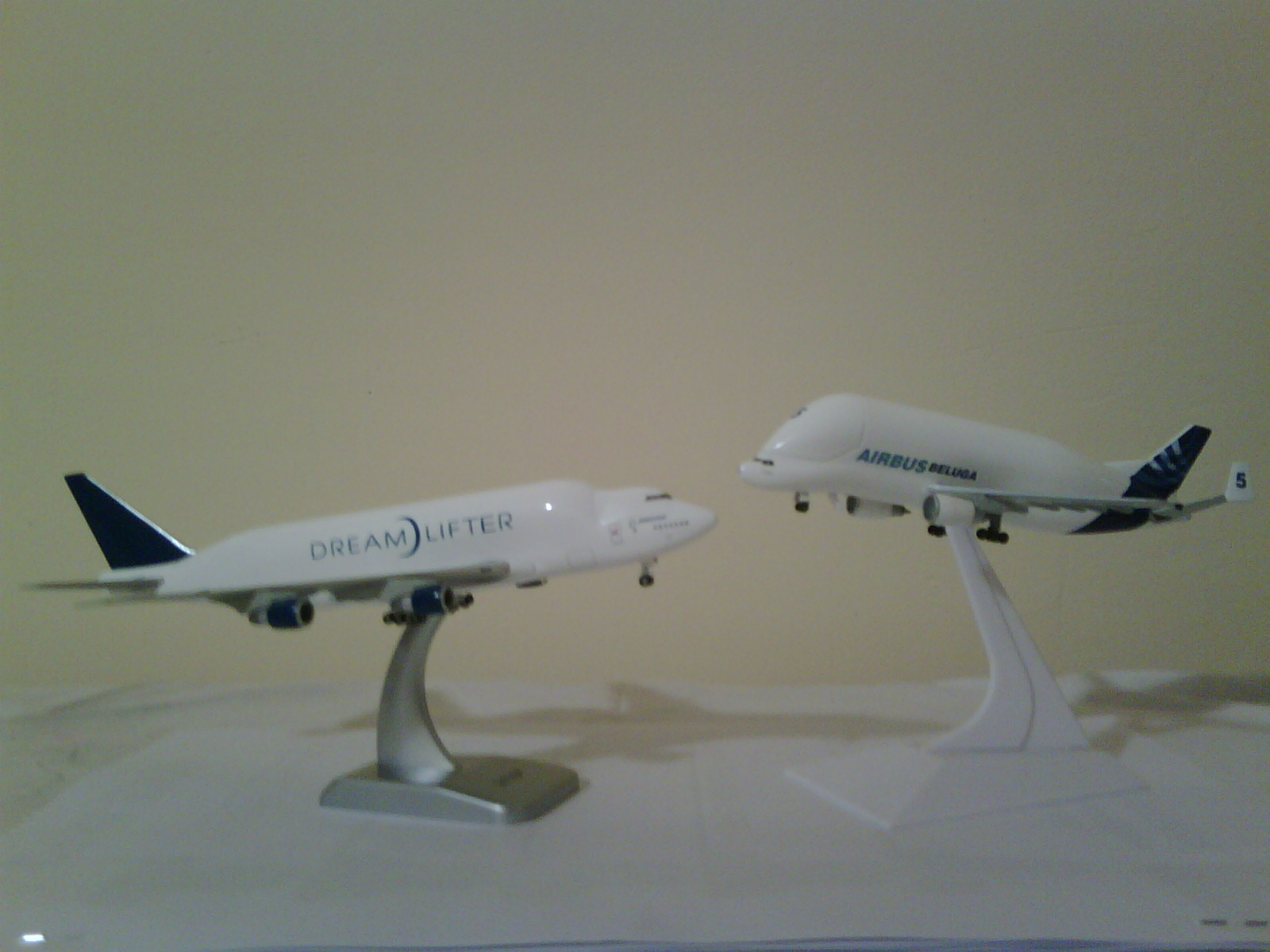
While looking at the small-scale models of aircraft at home, some days ago, I locked on the Beluga and the Dreamlifter (Airbus and Boeing transport aircraft to bring major components from one factory to another). I had become used to the sight of the Beluga but seeing then both together I realized that they are indeed bizarre.
While Airbus relied on the Beluga since years ago (and before, it used the Super Guppy; now resting at the museum by Airbus factory in Toulouse), Boeing only decided to modify 747s for this purpose to reduce transportation times in the 787 manufacturing.
In this post I didn’t want to make any technical comparison, just wanted to show this picture and ask: which one do you think is the prettiest (or the ugliest)? I haven’t made up my mind yet.