Big Mac in Aswan

While in Aswan, Egypt, I went to a McDonald’s restaurant. When I finished my meal I went to the counter to ask “What is the price of a single Big Mac?”, “16.5 Egyptian pounds”.

I wanted to check The Economist‘s Big Mac index, their exchange-rate scorecard (see a detailed explanation), for the case of Egypt.

Already in the last list published it can be seen that they used a 13.0 pound price, while I was given 16.5 pound (probably because I went to a more touristic McD restaurant than the average). At the time of writing the post the exchange rate is: 1 E£ = 0.1726 US$.

The reference is always the price of the hamburger in USA (average of Atlanta, Chicago, New York and San Francisco), which in the latest publication of the index was 3.73$.

The dollar cost at the exchange rate of the hamburger was 2.848$; according to that, the Egyptian pound is 24% undervalued against the dollar (in relation to Aswan prices). The Economist normally calculates as well the implied purchasing power parity of the dollar: 4.42 (=16.5/3.73) while the actual exchange rate was 5.79 (=1/0.1726).

Finally, I wanted to remark 3 other things that caught my attention in the restaurant:

  • They had an employee of the month award and published it.
  • The uniform of the global company made local.
  • They provided delivery service… I wish they did that in Europe.

1 Comment

Filed under Economy, Travelling

New entrants in the commercial aircraft business

In a previous post, I mentioned the new entrants in the large commercial aircraft business (Bombardier CSeries, Embraer, Russian MS-21, Sukhoi SuperJet, Comac C919, Mitsubishi…). Now that the latest market forecasts both from Airbus (Global Market Forecast) and Boeing (Current Market Outlook) are available, I wanted to briefly note how they are treating the segment that most of these entrants would enter: single aisle jet aircraft.

For example, Boeing in this year’s CMO already splits the single aisle between 90-175 passengers (where new entrants would fall into) and over 175 passengers (still the safe harbor?). In previous studies Boeing didn’t offer such sub-segmentation. On the other hand, Airbus hasn’t published yet such differentiation.

It is even more interesting to compare last year’s GMF and CMO with this year’s ones.

  • Airbus saw a demand for 16,977 single aisle aircraft in 2009 while in 2010 sees a demand for 17,870.
  • Boeing saw a demand for 19,460 single aisle aircraft in 2009 while in 2010 sees a demand for 21,150.

In other words Airbus has increased the single aisle market forecast in 893 aircraft, while Boeing has increased it in 1,690 aircraft… Both have made the forecasted pie bigger before it will have to be shared.

On average, they see ~1,300 more single aisle aircraft than what they saw last year… In the case that these extra aircraft was room made for new entrants, that would leave the new entrants a market share of 6.7% of the single aisle market… not much.

However, those entrants are not yet delivering in that segment and most of their deliveries would come at the second half of the 20-year period. By 2029, it could well be possible that their combined market share is around 10%… still not a big share, but already ~7bn$ yearly business (in 2010 dollars); a ~4.4bn$ after discounts, an amount the size of Embraer revenues (the 3rd company in commercial aviation, reason enough for them to enter the segment).

Boeing even concedes that of the 21,150 single aisle aircraft, 86% of them will be between 90-175 passengers, precisely the market sub-segment that will be ferociously fought.

Leave a comment

Filed under Aerospace & Defence

Commercial aircraft market size after discounts (update)

In an older post I already made an analysis of the aircraft discounts related to the published list prices (by the way, Boeing just raised its list prices 5.2% a couple of days ago). In that case, I used the revenues and deliveries of Boeing in the previous 3 years (38% discount was the result!).

Using that information, now that the latest market forecasts both from Airbus (Global Market Forecast) and Boeing (Current Market Outlook) are available, we can say that the real market size in the next 20 years will be in the order of 2,100bn$ (average of both forecasts in 2010 dollars).

Flow of airplanes

Another very interesting feature that Airbus published in last year’s GMF (it is not yet in this year’s publication) and Boeing used for this year’s CMO is a graphic showing the dynamics of aircraft. In it you may understand how from today’s fleet, adding new deliveries, retiring old aircraft, converting some from passenger to freight transport they arrive to the forecasted fleet in 2029.

I include below both graphics.

Leave a comment

Filed under Aerospace & Defence

Airbus vs. Boeing, comparison of market forecasts

Airbus announced on Monday its latest Global Market Forecast (PDF, 4.6MB) for the 20-year period 2010-2029. Media has already highlighted the main points: ~26,000 new aircraft will be delivered with a market value of ~3,200bn$.

Some months ago, Boeing published its equivalent study, the Current Market Outlook (PDF, 8.2MB) for the same period.

It is interesting to compare the two of them. In that way we can see how each other treat competitors’ products (mainly A380) and how they try to shape the market and send messages to it (point-to-point & hub-spoke).

However, it is not easy to compare the studies as they use slightly different segmentations, disclose in different ways the value of aircraft for the segments (list prices) and is not always clear how to discount freighter aircraft from global figures. I dig for some time into those numbers and arrived to the following table:

Comparison of Airbus GMF and Boeing CMO 2010-2029.

Some comments on the comparison:

  • Boeing sees demand for 13% more aircraft with a 10% more value.
  • However, this higher demand is not applicable to all segments: Boeing sees ~60% less A380s or equivalent being delivered over the next 20 years, while 18% more single aisle (A320s) and 12% more twin aisle (A330/A350s).
  • Boeing plays down A380 potential, but sees a very similar number of RPKs (“revenue passenger kilometer”), that is, the number of paying passenger by the distance they are transported. Airbus forecasts for 2029 12.03 RPKs while Boeing forecasts 12.60 (in trillion).
  • The difference of less than 5% in RPKs means that out of the 13% difference in aircraft deliveries over 8% comes from the different business model each company is trying to push.
  • Finally, we can see that Boeing uses again higher average prices for smaller aircraft and a lower reference price for A380s.

Enjoy the two documents, differences apart, they gave a very good piece of information and insight about the market.

7 Comments

Filed under Aerospace & Defence

Archaeologists

There is no doubt that archaeologists have done and continue to do a great and exhaustive work in Egypt… (yes, there is a “but” coming) But, while visiting several temples last week, I really got sick of seeing their signature in the middle of the statues, walls, hieroglyphics, etc…

Signatures from archaeologists ar various sites in Egypt.

Can you imagine that a conservator / restaurateur from the Louvre museum had just signed in the middle of La Gioconda while performing some work on the painting? Like: “L. Bernard, 1835” in the cheek or the forehead, where there is plenty of space.

I want to think that this was the norm in XIX and early XX century and that nowadays it is not happening, otherwise: archaeologists, please refrain from doing that!

As Luca put it: these were people who failed to understand their place in history. After all, to the general public Lecaros, Black, Hamdy Bey, Federici, Levinge, etc., are completely unknown names (luckily! imagine how many of their signatures and in what places would have been needed for them to be stars!).

Having said that… who knows, maybe around the year 5,464 someone visiting these places may find a plaque honouring these signatures, like the one that can be seen today in Saqqara outlining the first “graffiti” in history, yet another inscription from another archaeologist in the year 1,232 BC, Hadnakhte, who wrote, on the wall of an already then 1,500 years old building, the following: “on a pleasure trip west of Memphis”.

Hadnakhte's graffiti in the House of the South, Saqqara.

3 Comments

Filed under Travelling

The best (and the worst) of the first 100 posts

Today is a symbolic day for the blog: this is its 100th post.

I started the blog in February 2010 and about 15 posts ago I thought: “what could I write about for my 100th post?”.

A reflection: To be honest, after 100 posts I still haven’t got a clear idea of which post topics you, the readers, like more and which less. What do you think? In this post, I will just give you the list of the ten most read posts and the ten least read ones…

1. An aircraft worth its weight in gold?
2. FC Barcelona copying Real Madrid
3. A Kiva success story
4. Mi adiós a Ibercaja
5. Boeing forecast for A380
6. Most common letters in English and Spanish
7. TEDxMadrid 2010
8. Venture Capital & Crowdfunding
9. 3 wishes to Nosso Senhor do Bonfim
10. My flat-renting decision process

90. Giving feedback at Pixar
91. From climbing to merely walking
92. Sao Paulo from the top of Banespa building
93. How rain determines olive tree economics
94. Nothing like a good red wine…
95. Speech about Minifutbol
96. Three centuries of confusion
97. Opera with subtitles
98. Book review: Pirate Latitudes
99. Book review: La Hermandad de la Sabana Santa

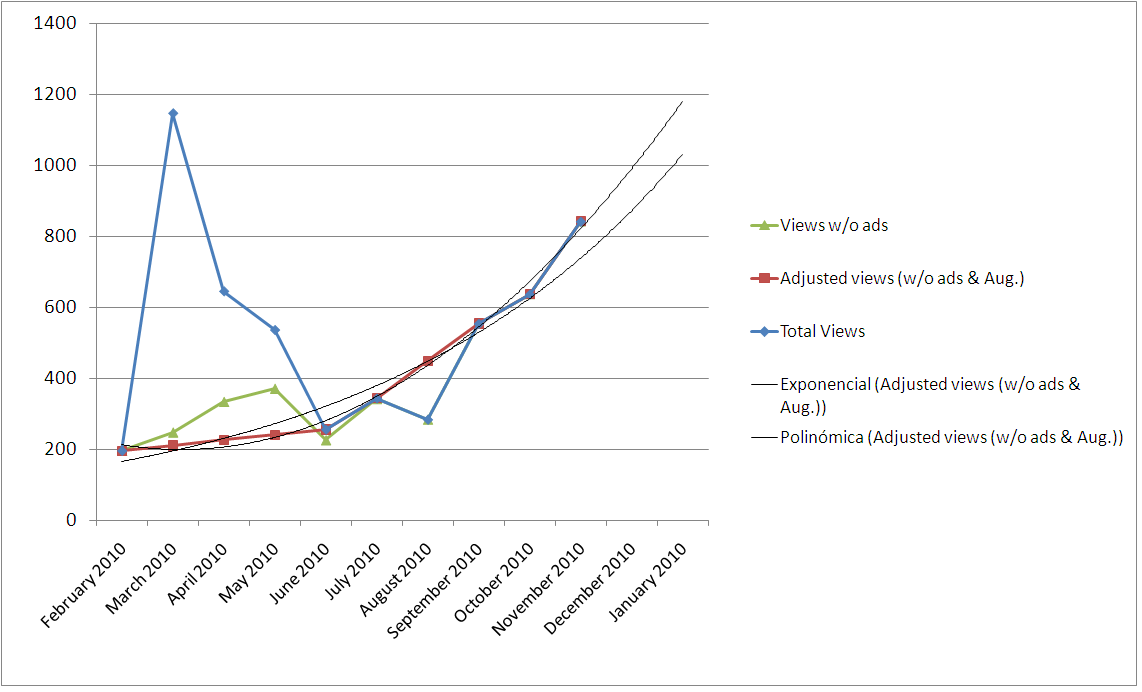
Some stats from this period: over 5,700 visits (~18 per day), being the day I announced that I moved to Toulouse the most visited one.

Let’s see what I’ll write in the next 100 posts…


NOTE: the box in the right showing “Top Posts” shows the most read ones in the last week, not the all-time most read ones (the ones above).

6 Comments

Filed under Personal development

The first bloggers

I found while visiting some tombs in the Valley of the Kings and temples in Luxor that the Egyptian pharaohs were the first bloggers.

There are paintings older than the hieroglyphics from Egypt but, unless I am mistaken, we don’t know whether they just capture scenes of daily life/gods or relate to the story of a single individual (and in if that was the case, who is he?).

In the case of the pharaohs, they inscribed (or those working for them) in the walls and columns what had happened to the pharaoh in his life, apart from stories related to gods. Some months later or the next year they would come back and update it with the latest achievements (wars, victories, offers to different gods…).

Luckily, today we can just store our storyline (or whatever we may want to write about) in the internet and save ourselves the effort of gathering up to 134 columns as in the Great Hypostyle Hall in Karnak, Luxor (larger than St. Peter’s Basilica in Rome and St. Paul’s Cathedral in London together – some pictures below).

This slideshow requires JavaScript.

4 Comments

Filed under Travelling

Nuestra Señora de Loreto

Alguna vez le he dicho a Luca o a algún amigo a modo ilustrativo “con unas alas suficientemente grandes y un motor suficientemente potente se podría hacer volar a tu casa, otra cosa es que fuese eficiente”.

El 10 de diciembre tuvo lugar la conmemoración de Nuestra Señora de Loreto, la patrona de la aviación. Hace unos años encontré algo de información sobre ella y el origen de este patronazgo, que rescato en este post para vuestro deleite, en español e inglés (distintas fuentes), ya que no tiene desperdicio.

Como podéis ver, ya en el siglo XIII unos ángeles probaron mi teoría del primer párrafo con la casa que la Sagrada Familia tenía en Nazaret.

“[…] una antigua tradición que arranca del siglo XIII, según la cual la casa de Nazaret que vio nacer y crecer a la Virgen, y en la que vivió la Sagrada Familia, fue trasladada por los ángeles, primero a Dalmacia (Croacia) y después a Loreto (Italia), en tiempos del Papa Celestino V.”

Siglos más tarde vinieron los motores, los hermanos Wright, los ingenieros, la aviación comercial… la mejora de la eficiencia.

1 Comment

Filed under Aerospace & Defence

Special assistance vs. free ride

This morning, at Cairo airport I found something I hadn’t seen since 2007 when I went to Moscow sometimes: passion for wheelchairs.

During the last week in Egypt, Luca and I have seen just 2 wheelchairs (in fact, she saw 2, I can only recall having seen one at Giza).

How many thousands of people we may have seen during this week? 1,000, 2,000, 10,000? No idea. But having been all day in the streets, museums, temples, etc., where there were crowds, I guess they were many. Let me use 2-3 thousands for simplification.

I know, this may be not a statistically relevant sample, but let me say there is a user of wheelchair per 1,000 inhabitants (there may be published stats on this out there; I didn’t check).

As you know, airline companies offer special assistance to get on board their aircraft. Yesterday, we found at the boarding gate 10 wheelchairs. We flew aboard a B777-200 with no more than 50-60% seats occupied, about 200-250 passengers. That is, 4-5% of passengers required special assistance in the form of a wheelchair.

As, I said, these are not statistically relevant samples, but these numbers bring to me some (provocative) thoughts:

  • At the airport we found 50 times more wheelchairs than in the outside world! That is what I call passion for them.
  • What is it so attractive in wheelchairs at airports? It’s a free ride (some body actually pushes it!), you get to avoid long queues and board first
  • Why don’t they all use wheelchair outside the airport? Nobody pushes it! The fact that streets and facilities are not adequately prepared might be a deterrent as well (just for people who can walk despite some difficulty).
  • It could happen that those flying are not the ones we found in touristic places and streets in Egypt… however, the factor of 50 is strikingly high to be explained only because of that, plus it would be strange for them to venture taking international flights and not wandering through the city.

Having said that, I’m totally in favour that this special assistance is provided because there will always be people who do need it. I wrote this post just out of surprise of seeing a queue of 10 wheelchairs, something I hadn’t seen in 3 years.

4 Comments

Filed under Travelling

Home

By now, most of you are aware that I moved recently to Toulouse. Some of you may have read about the process of finding my new flat.

I live in the Rue du Cimetière Saint-Cyprien, close to the city centre. Going back and for to work takes about 20 minutes, there is traffic as they say here, but nothing compared to larger cities.

My street.

The flat is what they call a T3; this is a living room plus 2 bedrooms. The kitchen is way larger than my cooking skills will ever ask for. It has an open-air private parking lot…

… but really, what makes me call it home is this view:

Sweet home.

1 Comment

Filed under Travelling