Tag Archives: Airbus

Airbus vs. Boeing, comparison of market forecasts (2012)

Yesterday, John Leahy, Airbus COO Customers, unveiled at a press conference in London the new figures of the 2012-31 Airbus’ Global Market Forecast (GMF, PDF 5.6MB).

The last two years, I already published comparisons of both Airbus’ and Boeing’s forecasts (Current Market Outlook, CMO, PDF 3.0MB). You can find below the update of such comparison with the latest released figures from both companies.
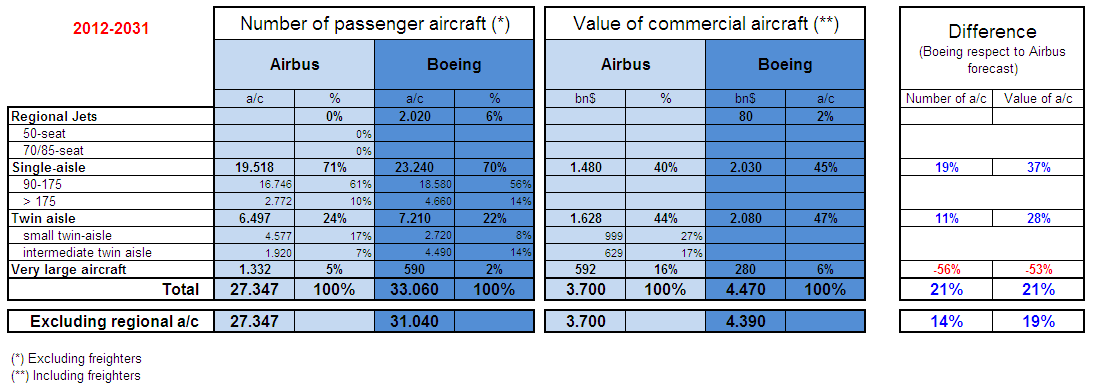
Comparison of Airbus GMF and Boeing CMO 2012-2031.

Some comments about the comparison:

  • Boeing sees demand for 14% more passenger aircraft (excluding regional a/c) with a 19% more value (including freighters).
  • Boeing continues to play down A380 niche potential (56% less a/c than Airbus’ GMF), though for second year in a row it has slightly increased its Very Large market forecast, this time by 20 a/c, or 3.5%.
  • On the other hand, Boeing forecasts about 200 twin-aisle and 4,200 single-aisle more than Airbus, clearly pointing to its point-to-point strategy versus the connecting mega-cities rationale presented by Airbus.
  • In terms of RPKs (“revenue passenger kilometer”), that is, the number of paying passenger by the distance they are transported, they see a similar future: Airbus forecasts for 2031 ~12.8 RPKs (in trillion) (a ~4% increase vs last year GMF) while Boeing forecasts 13.8 (also increased about 3%).

The main changes from last year’s forecasts are:

  • Both manufacturers have increased their passenger aircraft forecast in about 500 a/c, less dramatically than last year’s change.
    • In the case of Airbus it has increased the single aisle segment, probably reflecting the success of the A320neo launch.
    • In the case of Boeing, they decreased both single aisle (130 a/c) and small twin aisle (300 a/c), but increased the intermediate twin-aisle in 900 a/c… selling internally a new version of the 777?
  • Both manufacturers have increased the value of RPKs in 2031.
  • Both manufacturers have increased the volume (trn$) of the market in this 20 years, 12% Airbus (to 3.7trn$) and 10% Boeing (to 4.4trn$).

Some catchy lines for those who have never seen these type of forecasts:

  • Passenger world traffic (RPK) will continue to grow about 4.7% per year (5.0% according to Boeing). This is, doubling every ~15-20 years.
  • Today there are about 15,500 passenger aircraft around the world, this number will more than double in the next 20 years to above 32,500 a/c in 2031.
  • The A380 market equation: Urbanisation + Mega-cities + Wealth = VLAs (Very Large Aircraft, i.e. A380 and B747).
  • Emissions of aviation industry amount to 2% of man-made CO2 emissions.
  • Centre of gravity of world travel will have moved from the Atlantic Ocean (in 1971) to the Middle East (2031).
  • A key driver here is the propensity to fly of the people as the economies of their countries grow. This is captured well by the graphic below, a classic in the industry. This time, Airbus mentioned in the GMF that it has carried out a survey during summer asking 10,000 people around the world whether they expected to fly more in the future. This was true especially in China and India.

Trips per capita vs. GDP per capita (source: Airbus GMF).

Again, I strongly recommend both documents (GMF and CMO) which, differences apart, provide a wealth of information of market dynamics. The complete book from Airbus will be published online next week according to Chris Emerson (SVP for Future Programmes & Market Strategy).

In case you find it tough, to read those kind of booklets, you may take a look at the video of the press conference, a great class on global economy, world aviation, forecasting, trend spotting…

11 Comments

Filed under Aerospace & Defence

Flight destination: Corsica

I often use a version of Eleanor Rooselvet‘s famous quote “do one thing that scares you everyday“. It’s not that I try to do something that scares me, but something which either brings me out of the comfort zone or that I simply would tend to procrastinate.

Today’s scary thing is flying together with my friend Asier and his flight instructor, Jean-Louis, to Corsica. Prior to taking the decision of joining this “adventure” about 2 months ago, I had barely made 10 flights amounting to less than 8 flight hours… in the last week I was learning with my instructor, Thierry, the basics of flight navigation, the use of charts in flight, the use of VOR, etc., in order to profit the most from this experience. It definitely feels less scary now. And then, I’ll always have Jean-Louis by my side at the time of piloting the airplane. I’m happy to be stretching the comfort zone.

In the previous days I also learnt a lot with Asier on how to plan the route, noting headings, altitudes, radio frequencies, air spaces, aerodromes, etc.

Planning the flight to Corsica.

The head of the MBA I studied in Seville used to describe it as a “experiences accelerator”; in the context of flying this trip to Corsica (a group activity of the Airbus Aviation Society I belong to) really feels like such an experience accelerator.

If everything goes well, we’ll be in Propriano (LFKO) before 15:00. Then we could have one or two days of visiting the island, either by car… or by plane. Ajaccio, where Napoleon was born; Bonifacio; the dolmens close to Ajaccio… I’ll keep you updated when we’re back :-).

1 Comment

Filed under Aerospace & Defence, Travelling

Aerogeek dentist

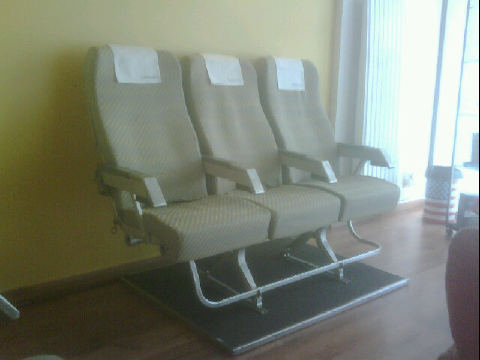
Some time ago I wrote about the impact of Airbus in the employment in the Toulouse area. Some weeks ago I went to a dentist in Blagnac, a village close to Toulouse (where Airbus is in fact based). There I could see how Airbus is impacting Toulouse area in other ways. I then tweeted the following with the picture below attached:

https://twitter.com/#!/javierirastorza/status/185795207676182530

Waiting room seats.

What I missed in that first visit was the geek details of the cloth covers of the seats. Take a closer look in the pictures below…

"Briteeth" Airways.

"Lufthanzahn".

Definitely, my dentist must be another aerogeek.

2 Comments

Filed under Aerospace & Defence, France

What is the price of an A380?

Yesterday, it appeared in Flight International website, an article in which the price of an A380 was unveiled. Generally, aircraft real prices are never disclosed, that is why that was news. What it is normally published is the list prices for the different aircraft (here you may see Boeing’s list).

The article disclosed the price for an A380 acquired by Nimrod Capital LLC, which is to lease it to Emirates. The price: 234m$. Since the list price for the A380 is 375m$, that means it was purchased with a 38% discount, as the article says.

For obvious reasons, I will not comment on Airbus prices (*). Here, I just wanted to mention that, using a quite detailed approach, some time ago, I calculated which were Boeing’s discounts. I explained everything in a post.

I used the number of aircraft delivered per year, the net orders per year, all for a period of three consecutive years, and matched the list prices versus the revenues recognised in the yearly income statement published by the company in each of those years… I figured out which was the discount that minimized errors for the period of three years. Guess what was the result I came up with: 38% for the period 2007-2009 and 39% for the period 2008-2010.

(*) Disclaimer: I have never worked in anything related to aircraft pricing, sales or marketing in Airbus. Thus, I have no insider clue about its prices.

Leave a comment

Filed under Aerospace & Defence

Airbus vs. Boeing, comparison of market forecasts (2011)

Some days ago, John Leahy, Airbus COO Customers, unveiled at a press conference in London the new figures of 2011-30 Airbus’ Global Market Forecast (GMF, PDF 28.8MB).

Last year, I already published a comparison of both Airbus’ and Boeing’s forecasts (Current Market Outlook, CMO, PDF 3.2MB). You can find below the update of such comparison with the latest released figures from both companies.

Comparison of Airbus GMF and Boeing CMO 2011-2030.

Some of last years’ comments still apply:

  • Boeing sees demand for 15% more aircraft with a 21% more value (excluding regional a/c).
  • Boeing continues to play down A380 niche potential (57% less a/c than Airbus’ GMF), though it has increased its Very Large market forecast by 40 a/c, or 7.5% (Did Emirates new order at ILA change their minds?)
  • On the other hand, Boeing forecasts about 600 twin-aisle and 4,000 single-aisle more than Airbus, clearly pointing to its point-to-point strategy.
  • In terms of RPKs (“revenue passenger kilometer”), that is, the number of paying passenger by the distance they are transported, they see a similar future: Airbus forecasts for 2030 12.3 RPKs while Boeing forecasts 13.3 (in trillion).

The main changes from last year’s forecasts are:

  • Both manufacturers have drastically increased their single-aisle forecast: +1,300 a/c in the case of Airbus and +2,200 in the case of Boeing.
  • In general all numbers have been increased: single-aisle (as mentioned above), twin-aisle (between 50-150 more), large aircraft (between 40-80 more), value of aircraft and RPKs… it seems that for commercial aircraft manufacturers not only the crisis is passed but they see a rosy future lying ahead.

Again, I strongly recommend both documents (GMF and CMO) which, differences apart, provide a wealth of information of market dynamics. I am especially happy to have encountered this year again full version of Airbus GMF, not only a short one [PDF, 4.7MB].

7 Comments

Filed under Aerospace & Defence, Marketing

What was my childhood dream job?

Some days ago, I got an email from a source-of-ideas-for-blogs service called Plinky, from which I have already picked some good ideas to write about in posts in the past (on charities, advice…).

The question I liked this time from the email was:

“What was your childhood dream job?”

I don’t know whether I have been posed this precise question many times or not, what I know is the answer to it and that I have given that answer many times to other questions.

When I was a child I wanted to be an astronaut. I don’t know exactly why, but that was my dream job. Surely, I can recall memories of toys related to space, such as a model of the Challenger that my brother and I played with (I presume it came before the accident), or toys related with Star Wars, etc.

This passion, among other factors, led me to study aerospace engineering, and then work for Airbus, which is not working as an astronaut but is still working in the aerospace business. Many times, I have been asked why I studied what I did, sometimes by corporate HR quizzers, and this is what came as a response.

Would I still want to be an astronaut?

Sure! But, yes, I am not pursuing it. I guess I am just waiting for the moment when commercial space flight costs not 20M$ but about 100k$, and if by then I can afford it I guess I would pay for enjoying a stunt out there.

7 Comments

Filed under Aerospace & Defence

Muret Air show 2011

The Red Arrows are the UK Royal Air Force Aerobatic Team. They are one of the most famous acrobatics teams worldwide. They were formed in the ‘60s when several unofficial teams were united under the new official team of the RAF.

The Red Arrows were performing yesterday at Muret Air exhibition, just 12km away from Toulouse so I went there to spend the day with some colleagues from Airbus (which kindly sponsored the show providing fuel for the aircraft). The organization of the event left the Red Arrows for the end of the day. The team is composed of 9 pilots plus an extra one who acts as road manager and commentator during the show (animator I should say). They fly BAE Hawk airplanes and are about 33 years old on average.

The several figures in different formation patterns that they performed were impressive (Diamond, Apollo, Vixen, Heart, Palm tree, etc.). I must admit that this was the first exhibition I attended, as the only other time when I witnessed acrobatics was at the Red Bull Race in Budapest in the summer of 2007, when I was on holidays there with friends.

I took several pictures and videos of their performance, but somehow I didn’t manage to save most of the videos correctly, so I can only show below the pictures in the slide show below:

This slideshow requires JavaScript.

There were another two teams performing: the French Air Force Cartouche Doré (flying 3 TB30 Epsilon, made by Socata, a filial of EADS) and the Breitling Jet Team. The latter is a civilian acrobatic team (the only one) based in France. They fly L-39 Albatros.

Apart from these teams, there were several other planes that were flying in the show: L-39 Albatros, Cap 232, ATR-42, Beech King Air 200, some Pipers (simulating a fight between a police airplane and another one), P40… but the only ones my smartphone saved correctly in videos were the flights of the A380 and the A400M (no kidding, I did over 20 videos and discovered only these 2 were stored in the memory), enjoy them:

It was a good experience, perfect for a sunny Saturday. I wanted to remark the importance of having a good commentator and music to enhance the show. In Muret the commentator was great (apparently he is famous in France and engaged in all air shows) but the music was not always the best, though when it was it really made you (seriously) think “I want to fly one of those”…

1 Comment

Filed under Aerospace & Defence, France

Beluga vs. Dreamlifter

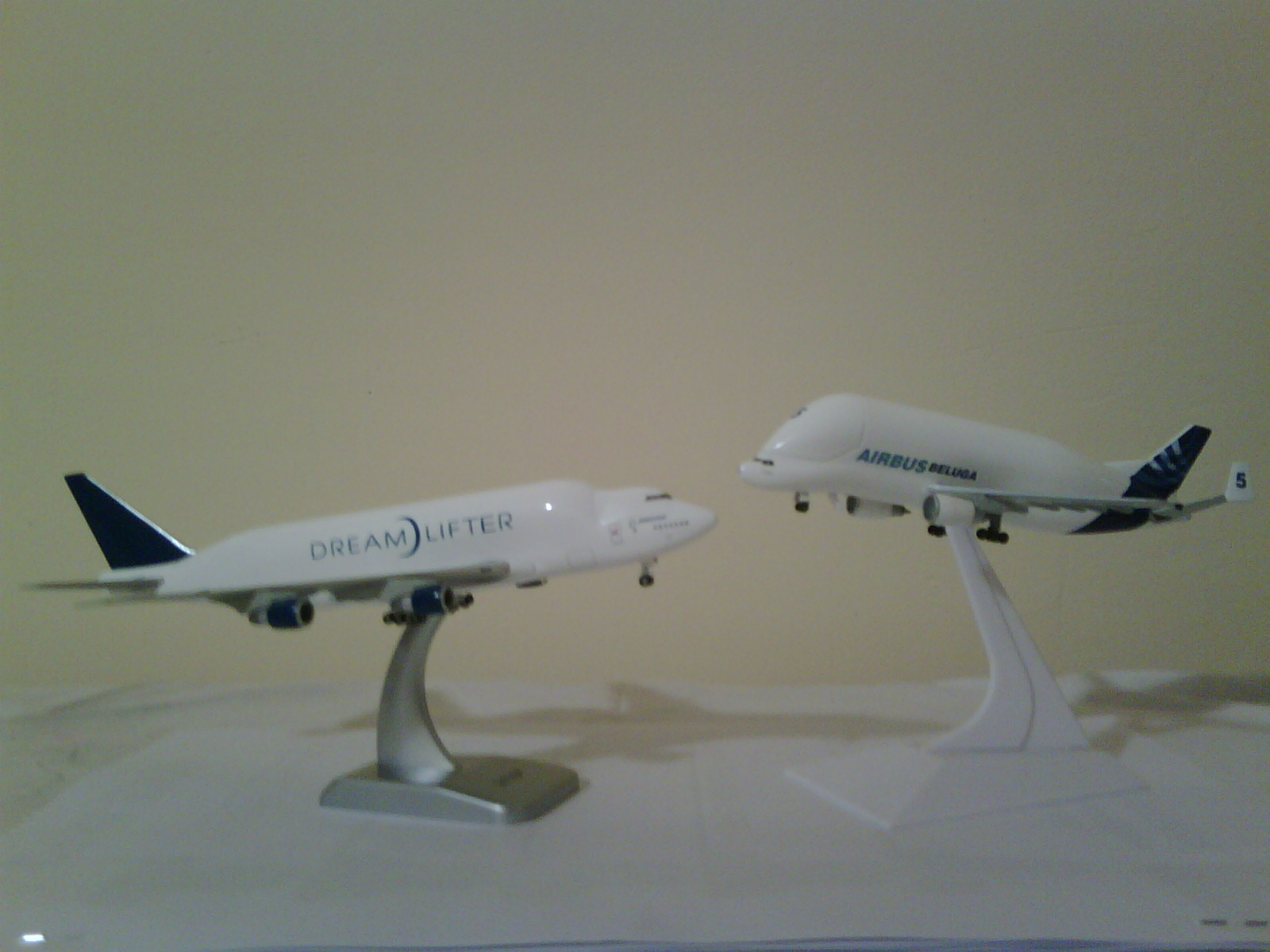
While looking at the small-scale models of aircraft at home, some days ago, I locked on the Beluga and the Dreamlifter (Airbus and Boeing transport aircraft to bring major components from one factory to another). I had become used to the sight of the Beluga but seeing then both together I realized that they are indeed bizarre.

While Airbus relied on the Beluga since years ago (and before, it used the Super Guppy; now resting at the museum by Airbus factory in Toulouse), Boeing only decided to modify 747s for this purpose to reduce transportation times in the 787 manufacturing.

In this post I didn’t want to make any technical comparison, just wanted to show this picture and ask: which one do you think is the prettiest (or the ugliest)? I haven’t made up my mind yet.

Dreamlifter vs. Beluga.

10 Comments

Filed under Aerospace & Defence

747

I attended a course at the AirBusiness Acedemy of Airbus some weeks ago. In one of the coffee breaks I hanged around in the building’s library and I found a book that I wanted to read, so I picked it: “747”, by Joe Sutter with Jay Spencer.

Joe Sutter is the engineer who led the engineering development of the Boeing 747, the Jumbo. The book, a biography of Sutter, covers all his life but it is mainly centered in the happenings, decisions, struggles, individuals, etc., involved in the development of the 747 and other aircraft.

I particularly liked the many engineering problems that he mentioned in the book, why & when they encountered them and how they overcame them: e.g. how they debugged the B 377 Stratocruiser, the decision of placing 737 engines under the wing, going for 4 main landing gears in the 747, etc., and the innovations that they introduced in commercial aviation with different aircraft: first pressurized aircraft (B 307 Stratoliner, with the issue they had with the vertical stabilizer), the jet engine mounted in pylons under the wings (with the B 367-80 prototype –now resting at the Air & Space museum at Dulles, DC- which evolved in the 707; configuration mainly used until today), the first wide-body aircraft (B 747), etc.

He also described many details about dealings with customers (e.g. Juan Trippe in Pan Am, Iraqi customers), competitors (including Russian delegations during Cold War), and colleagues at Boeing (with some heated discussions and internal politics, where he doesn’t save any detail).

As a curiosity, I finished the book while flying from Chicago to Frankfurt some days ago aboard a B 747, the first time I flew in one. I was sitting by the wing and took some pictures of the wing (first with a triple-slotted flaps) at different moments of the flight.

This slideshow requires JavaScript.

The book is a very interesting read which I recommend to anyone with passion for aircraft (engineer or not).

6 Comments

Filed under Aerospace & Defence, Books

Air traffic growth vs. aircraft orders

Taking the topic of the headline of this post I want to share some reflections on the commercial aircraft market.

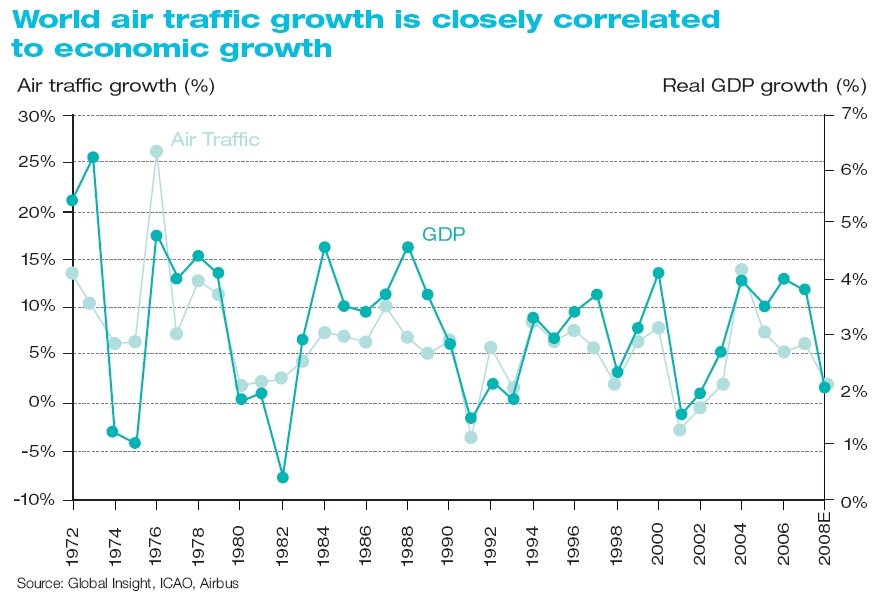
The first is how closely air traffic growth is correlated to world economic growth. This sentence and the following graphic are taken directly from the Global Market Forecast [PDF, 7.9MB] produced by colleagues at Airbus.

Air traffic growth vs GDP growth (source: Airbus).

You may see in the graphic the correlation (correlation coefficient above 0.7) and how the air traffic growth is however much more volatile than the economic growth. This is very intuitive. The better the economic situation the more business trips, family visits and holiday trips will take place. Nevertheless Airbus explains that in some situations and regions this is not enough to forecast traffic and thus they produce hybrid models.

Then, I wondered: how do airlines translate this growth in traffic into airplane orders?

I made some numbers and played with them. I gathered aircraft orders for both Boeing and Airbus in the last ~20 years, plus air traffic and GDP growth over the same period of time. Then, I tried to connect one with another and see how best they would correlate with each other. Even though correlation does not imply causation, it may indicate existence of such causal relations that it’s why I searched for such results.

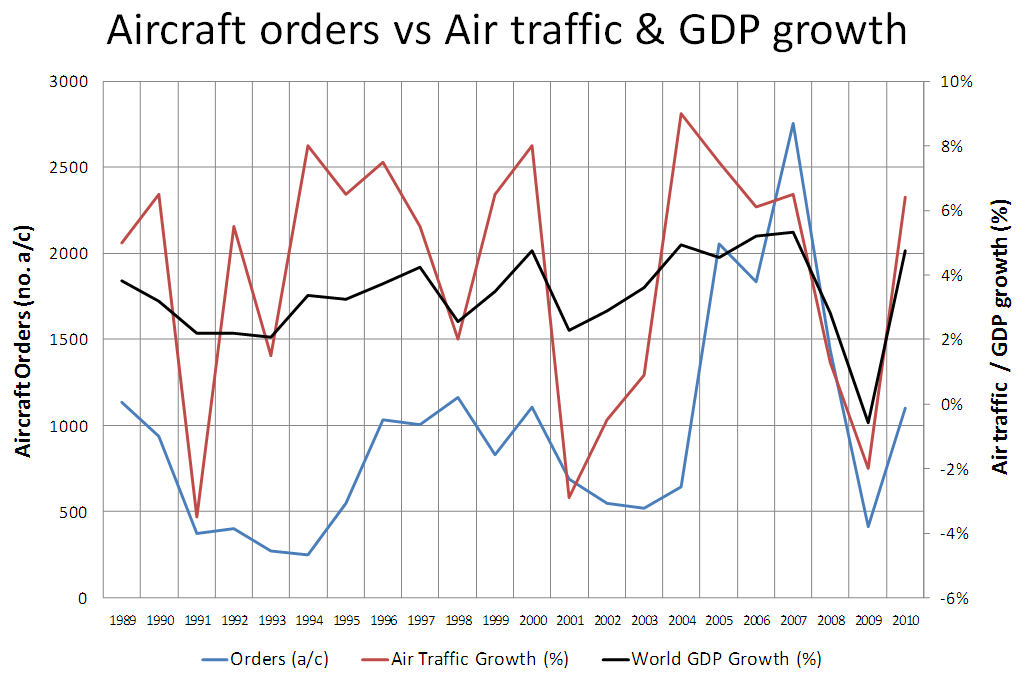
Here I plotted GDP growth (IMF), traffic growth (ICAO) and aircraft orders:

Aircraft orders vs. air traffic and GDP growth.

One could expect that airlines, after collecting first hand data of traffic growth plus the aggregate demand from industry sources (IATA, ICAO) and after applying their complex planning models would order aircraft from manufacturers. Thus, a correlation might be expected between traffic growth and aircraft orders. What we don’t know is whether airlines would place orders in the same year where the traffic growth actually takes place or there would be a lag (due to the airline analysis process, the negotiation with the manufacturer, arranging the financing, waiting for the next air show…).

The correlation results I got between these 2 variables are satisfactory though not that high. Matching data of the same year yields a 0.35 correlation coefficient. If however, we apply a 1-year lag in between air traffic growth data and orders the correlation is better, 0.44 (a lag of 2 years would worsen it down to 0.27 and so forth).

I found it curious that correlation between orders and GDP growth is much better! Matching data of the same year yielded a 0.61 correlation coefficient (which is rather high). A lag of a year would produce a still high 0.56 (2-year lag, 0.41; 3-year, 2.6…).

This was a striking result for me. After all, even though individual airlines do have complex models and experienced analysts behind them, taking the aggregate of the market, it seems that orders are placed less on data of traffic and more relying on data of economic growth, and rather soon, acting within the same year or a year later!

Who knows how the process within the airlines actually works… I can imagine thoroughly thought and thick studies coming from planning & analysis departments being put aside in the board room where one or two directors (more assertive than the average) convince the rest of the soundness of an operation based half in broad economic prospects (world GDP growth) and half in gut-feeling… wouldn’t surprise me much.

Leave a comment

Filed under Aerospace & Defence, Economy