Tag Archives: forecast

Review of Boeing Current Market Outlook 2013

Last week, just ahead of Le Bourget air show, Boeing Commercial published its yearly update of the Current Market Outlook (CMO) for the next 20 years of commercial aircraft market (2013-2032).

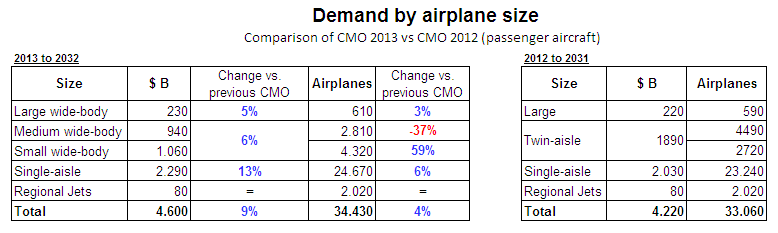
I just compared the figures for passenger aircraft of the last two years’ CMOs:
CMO 2013 vs 2012 comparison.

CMO 2013 vs 2012 comparison.

Some comments to it:

  • You can see that the total number of new aircraft delivered has slightly increased from 33,060 to 34,430, a 4%, which is consistent with the constant 5% traffic increase that Boeing predicts.
  • The volume (Bn$) increases by a larger percentage, 9% (380 Bn$)… this is due mainly to the double increase in:
    • (1) single-aisle aircraft expected sales 6,2% (+1,430 aircraft), and
    • (2) the average price list with which the list is computed, another 6.3% (from 87.3m$ to 92.8m$)
  • I am puzzled to see the the sudden change in the predicted mix of twin-aisle sales, between small and medium wide-bodies…
    • small wide-bodies: from 2,720 a/c in CMO2012 to 4,320 a/c in CMO2013, whereas,
    • medium wide-bodies: from 4,490 a/c in CMO2012 to 2,810 a/c in CMO2013
    • as you can see the combined figure slightly changes (7,130 vs. 7,210), however the distribution among the two categories is drastically changed. Why is that? A question to Randy Tinseth that he did not address in his blog when the CMO was unveiled.

I would tend to think that the move is done to push some market development based on some models (787) instead of others (777), but given that it is precisely now when the upgraded versions of the 777 are supposed to be pushed into the market I fail to see the logic behind this.

Find below the nice infographic that the guys from Boeing have put up together:

Boeing Commercial Aviation Market Forecast 2013-2032 infographic.

As always, I recommend going through the CMO, as you can learn a lot about the business: from global numbers, to growth, traffic figures, fleet distributions, forecasts, etc… You may find the presentation [PDF, 9.6 MB], the booklet [PDF, 3.0 MB] and the file [XLS, 0.4 MB] with all the data.

For a comparison between this CMO and the respective Airbus’ GMF we will have to wait until after the summer, when Airbus publishes its update. Until then, find here the comparison based on 2012 market studies.

9 Comments

Filed under Aerospace & Defence

World commercial aircraft fleet: forecast vs. actual

Some weeks ago I made a comparison about Airbus and Boeing aircraft market forecasts. Last week I published a couple of posts about the evolution in the forecasted aircraft average size and on the accuracy of these market forecasts. For this, I looked for old issues of Boeing Current Market Outlook from as back as 1990.

The next step then it was obvious, I compiled the following graphic showing with the data available information over a 40-year span on:

  • The evolution of world commercial aircraft fleet year by year (blue line) from 1995 to 2011,
  • The forecasted world aircraft fleets by Boeing CMO (red line) from 2000 to 2031 (with some gap years). For 2015 to 2031 the forecast was made 20 years ahead; for 2010-13 it was made 15 years ahead; for 2005-2008, 10 years ahead and for 2000-2003, 5 years ahead.
  • The published 20-year aircraft market forecast year by year.

World commercial aircraft fleet: forecast vs. actual (data source: Boeing CMO).

As you can fleets, forecasted fleets and market fleets have all been increasing year by year. The compounded annual growth rate (CAGR) for each one has been:

  • Actual fleet growth: 3.73% from 1995 to 2011 (2.88% from 2000 to 2011).
  • Forecasted fleet growth: 3.55% from 2000 to 2031 (3.69% from 2000 to 2011).
  • 20-year market forecast: 5.07% from 1992 to 2012 (3.43% from 2001 to 2012).

It is interesting to see that in those years when there is both figures for actuals and forecasted fleets the figures are close (-3.3% average deviation) and so is the trend, though forecasted fleet was lower at the beginning of that period (-7.2% in 2000) and grew at a higher rate until almost matching the numbers in 2011 (+1.2%).

Even though, the 20-year market forecasts have grown at a higher rate than fleets, it is mainly because the first data that I could retrieve come from the economic crisis of the beginning of the 1990’s, when Boeing trimmed down its forecasts. From the 2000’s the figures for market forecast have grown at a similar rate than those of fleets. And so will be the growth of forecasted fleet from 2011 to 2031: 3.5%.

****

Notes:

  • 1990 CMO long-term market forecast is made for 15 years, not 20.
  • Forecast of fleet for the periods 2000-2003, 2005-2008 and 2010-2013 does not come from CMOs published 20 years before, but from 5, 10 and 15-year fleet forecasts included in the CMOs of 1996, 1997, 1998 and 1999.
  • Boeing does not publish 5, 10 and 15-year fleet forecasts anymore.
  • It would be interesting to have a per-segment graphic, however there is not consistent data to produce it for the same time span. Boeing changed singe-aisle cut-off seat size from 1999-2000, in 1996-1997 and 2008 didn’t report the split within twin-aisle, in 2008 it also didn’t report the split within single-aisle.

2 Comments

Filed under Aerospace & Defence

Aircraft market forecasts accuracy

In a previous post I wrote about how the predicted average aircraft size by Boeing in 1990 did not match the actual evolution of that average size since then. In a more general context, how accurate are these aircraft market forecasts? Especially taking into account that they forecast along a 20-year period.

I dug in the archives and found an article in Flight International‘s issue of 10-16 March 1993 which compared Airbus’ GMF and Boeing’s CMO (you can find 2012 comparison here). Some excerpts from that article:

  • “Boeing is projecting deliveries of 12,005 aircraft, worth $815 billion at current values, from 1993 to 2010.”
  • (Boeing) “The trend towards larger aircraft will accelerate so that, although single-aisle types will account for about two-thirds of all deliveries, they will comprise 74% of those up to 2000 and only 60% beyond.”
  • “Airbus Industrie has released an upbeat forecast, predicting market demand for 11,653 new jet airliners to be delivered during 1992-2011, up from the 11,500 deliveries predicted in 1991.”
  • (Airbus) “The manufacturer foresees an accelerating demand for widebodied aircraft, driving average airliner size from today’s 176 seats to 255 seats in 20 years.”
  • (Airbus) “The global jet-airliner fleet will grow to 10,000 by 1998 and to almost 15,000 by 2011.

Now, let’s see what was the fleet at the end of 2011. Seeing Airbus’ Global Market Forecast from 2012, the departing numbers are those of 2011 fleet.

  • Passenger aircraft: 15,556 a/c.
  • Freighter aircraft: 1,615 a/c.

Thus, 17,171 a/c at the end 0f 2011. The GMF from 1992 underestimated the 20-year market by slightly above 2,100 or nearly 15% error. Not a bad shot taking into account the time span used.

Let’s take a more recent example, this time from Boeing. In the CMO from 1997, we find the following chart showing Boeing’s forecasted fleet size and distribution for 2001, 2006, 2011 and 2016 year-ends.

1997 Boeing CMO year-end fleet forecasts for 2001, 2006, 2011 & 2016.

In 2012 CMO, Boeing offered figures of 2011 year-end fleet.

Fleet at year end 2011 according to Boeing 2012 CMO.

We can make a quick comparison:

Comparison of aircraft fleet at year-end 2011: 1997 forecast vs. actual (sources: Boeing CMO 1997 and 2012).

Some reflections:

  • The total fleet figure was missed only by 1%.
  • The single-aisle figure was missed only by 2%, though less larger single-aisle were acquired than expected.
  • Where the forecast is off mark is in both regional jets (underestimated) and twin-aisle, where there are almost 1,800 less aircraft in the current fleet than forecasted… another reason for Boeing to play down on A380 segment.

***

NOTE: Figures of current fleet from Boeing and Airbus differ. Some causes: Airbus does not include figures for regional jets, and definitions between large aircraft and twin-aisle vary from one company to the other. Other than that, figures for freighters are similar, 1,615 (A) vs. 1,740 (B), as they are for passenger single-aisles, 12,161 (A) vs 12,030 (B).

3 Comments

Filed under Aerospace & Defence

Airbus vs. Boeing, comparison of market forecasts (2012)

Yesterday, John Leahy, Airbus COO Customers, unveiled at a press conference in London the new figures of the 2012-31 Airbus’ Global Market Forecast (GMF, PDF 5.6MB).

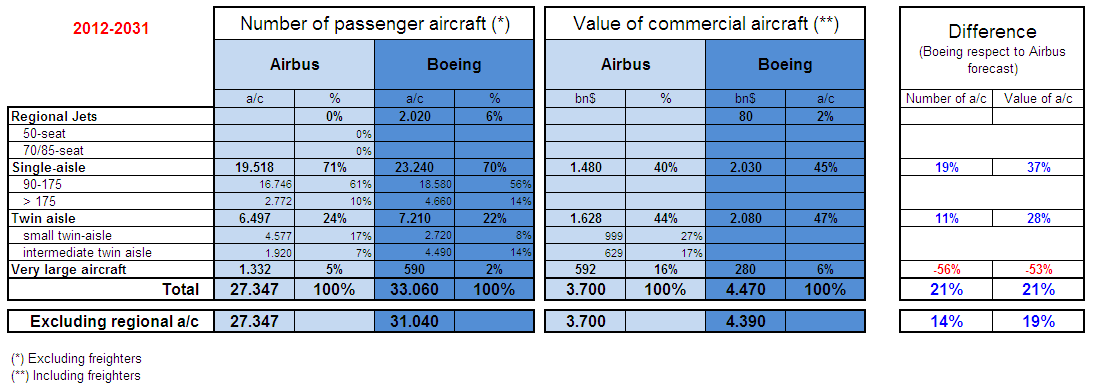
The last two years, I already published comparisons of both Airbus’ and Boeing’s forecasts (Current Market Outlook, CMO, PDF 3.0MB). You can find below the update of such comparison with the latest released figures from both companies.

Comparison of Airbus GMF and Boeing CMO 2012-2031.

Some comments about the comparison:

  • Boeing sees demand for 14% more passenger aircraft (excluding regional a/c) with a 19% more value (including freighters).
  • Boeing continues to play down A380 niche potential (56% less a/c than Airbus’ GMF), though for second year in a row it has slightly increased its Very Large market forecast, this time by 20 a/c, or 3.5%.
  • On the other hand, Boeing forecasts about 200 twin-aisle and 4,200 single-aisle more than Airbus, clearly pointing to its point-to-point strategy versus the connecting mega-cities rationale presented by Airbus.
  • In terms of RPKs (“revenue passenger kilometer”), that is, the number of paying passenger by the distance they are transported, they see a similar future: Airbus forecasts for 2031 ~12.8 RPKs (in trillion) (a ~4% increase vs last year GMF) while Boeing forecasts 13.8 (also increased about 3%).

The main changes from last year’s forecasts are:

  • Both manufacturers have increased their passenger aircraft forecast in about 500 a/c, less dramatically than last year’s change.
    • In the case of Airbus it has increased the single aisle segment, probably reflecting the success of the A320neo launch.
    • In the case of Boeing, they decreased both single aisle (130 a/c) and small twin aisle (300 a/c), but increased the intermediate twin-aisle in 900 a/c… selling internally a new version of the 777?
  • Both manufacturers have increased the value of RPKs in 2031.
  • Both manufacturers have increased the volume (trn$) of the market in this 20 years, 12% Airbus (to 3.7trn$) and 10% Boeing (to 4.4trn$).

Some catchy lines for those who have never seen these type of forecasts:

  • Passenger world traffic (RPK) will continue to grow about 4.7% per year (5.0% according to Boeing). This is, doubling every ~15-20 years.
  • Today there are about 15,500 passenger aircraft around the world, this number will more than double in the next 20 years to above 32,500 a/c in 2031.
  • The A380 market equation: Urbanisation + Mega-cities + Wealth = VLAs (Very Large Aircraft, i.e. A380 and B747).
  • Emissions of aviation industry amount to 2% of man-made CO2 emissions.
  • Centre of gravity of world travel will have moved from the Atlantic Ocean (in 1971) to the Middle East (2031).
  • A key driver here is the propensity to fly of the people as the economies of their countries grow. This is captured well by the graphic below, a classic in the industry. This time, Airbus mentioned in the GMF that it has carried out a survey during summer asking 10,000 people around the world whether they expected to fly more in the future. This was true especially in China and India.

Trips per capita vs. GDP per capita (source: Airbus GMF).

Again, I strongly recommend both documents (GMF and CMO) which, differences apart, provide a wealth of information of market dynamics. The complete book from Airbus will be published online next week according to Chris Emerson (SVP for Future Programmes & Market Strategy).

In case you find it tough, to read those kind of booklets, you may take a look at the video of the press conference, a great class on global economy, world aviation, forecasting, trend spotting…

http://www.youtube.com/watch?v=ohtHBPZI5R0

11 Comments

Filed under Aerospace & Defence

Airbus vs. Boeing, comparison of market forecasts (2011)

Some days ago, John Leahy, Airbus COO Customers, unveiled at a press conference in London the new figures of 2011-30 Airbus’ Global Market Forecast (GMF, PDF 28.8MB).

Last year, I already published a comparison of both Airbus’ and Boeing’s forecasts (Current Market Outlook, CMO, PDF 3.2MB). You can find below the update of such comparison with the latest released figures from both companies.

Comparison of Airbus GMF and Boeing CMO 2011-2030.

Some of last years’ comments still apply:

  • Boeing sees demand for 15% more aircraft with a 21% more value (excluding regional a/c).
  • Boeing continues to play down A380 niche potential (57% less a/c than Airbus’ GMF), though it has increased its Very Large market forecast by 40 a/c, or 7.5% (Did Emirates new order at ILA change their minds?)
  • On the other hand, Boeing forecasts about 600 twin-aisle and 4,000 single-aisle more than Airbus, clearly pointing to its point-to-point strategy.
  • In terms of RPKs (“revenue passenger kilometer”), that is, the number of paying passenger by the distance they are transported, they see a similar future: Airbus forecasts for 2030 12.3 RPKs while Boeing forecasts 13.3 (in trillion).

The main changes from last year’s forecasts are:

  • Both manufacturers have drastically increased their single-aisle forecast: +1,300 a/c in the case of Airbus and +2,200 in the case of Boeing.
  • In general all numbers have been increased: single-aisle (as mentioned above), twin-aisle (between 50-150 more), large aircraft (between 40-80 more), value of aircraft and RPKs… it seems that for commercial aircraft manufacturers not only the crisis is passed but they see a rosy future lying ahead.

Again, I strongly recommend both documents (GMF and CMO) which, differences apart, provide a wealth of information of market dynamics. I am especially happy to have encountered this year again full version of Airbus GMF, not only a short one [PDF, 4.7MB].

7 Comments

Filed under Aerospace & Defence, Marketing

Commercial aircraft market size after discounts (update)

In an older post I already made an analysis of the aircraft discounts related to the published list prices (by the way, Boeing just raised its list prices 5.2% a couple of days ago). In that case, I used the revenues and deliveries of Boeing in the previous 3 years (38% discount was the result!).

Using that information, now that the latest market forecasts both from Airbus (Global Market Forecast) and Boeing (Current Market Outlook) are available, we can say that the real market size in the next 20 years will be in the order of 2,100bn$ (average of both forecasts in 2010 dollars).

Flow of airplanes

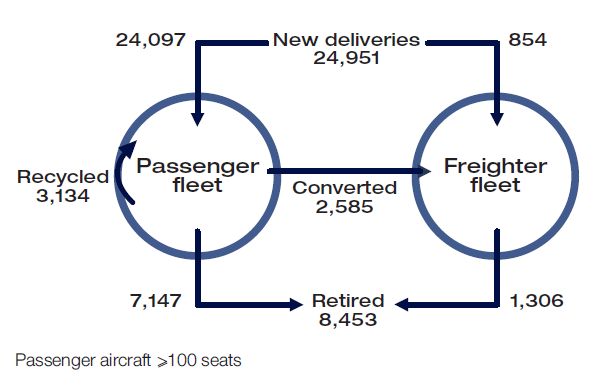
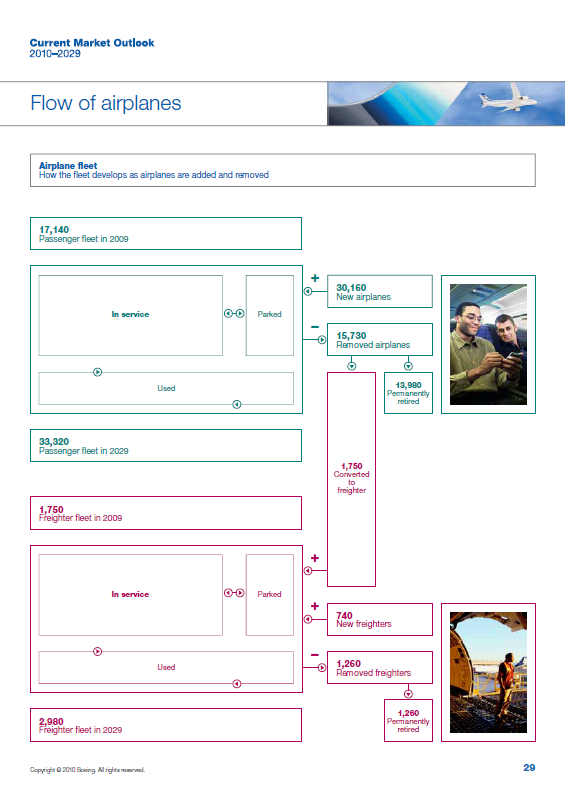
Another very interesting feature that Airbus published in last year’s GMF (it is not yet in this year’s publication) and Boeing used for this year’s CMO is a graphic showing the dynamics of aircraft. In it you may understand how from today’s fleet, adding new deliveries, retiring old aircraft, converting some from passenger to freight transport they arrive to the forecasted fleet in 2029.

I include below both graphics.

Leave a comment

Filed under Aerospace & Defence

Boeing forecast for A380

The last two issues of Boeing’s Current Market Outlook, included a slide in which Boeing wanted to prove that their forecasts have been more accurate in the last 10 years. They compare actual aircraft demand versus both Airbus and Boeing forecasts in the year 2000.

Boeing Current Market Outlook, different views.

I find it interesting that all segments are described as such, segments: “Single-aisle”, “Twin-aisle”, “Large”… except for Airbus forecast in which Boeing introduces the model “A380”. As if wanting to point that Airbus was wrong in its A380 forecast… as if wanting to steer demand.

Let’s see the numbers:

  • Actual demand (2000-09): ~300 aircraft.
  • Boeing forecast (2000-19): ~700 aircraft, assuming equal split (among the 2 decades): ~350 a/c in 2000-09.
  • Airbus forecast (2000-19): ~1,300 aircraft, assuming equal split: ~650 a/c in 2000-09 (although A380 first flight took place only in April 2005).

As of today, Airbus has sold 234 A380s, including the latest 32 from Emirates. The prospects for the aircraft seem brighter as operators started operating it, on the other hand Boeing 747-8 orders have stalled since 2007.

A bit of history.

Yesterday, I was digging into back materials and I found two interesting pieces. Both from Boeing’s website in the year 1996 (using the way back machine). The first one is from a webpage about delivering value it could be read:

“In an industry defined by continual change, customers expect Boeing to help them prepare for the challenges ahead. That’s why we work closely with customers to understand their long-term requirements.

Customers have expressed interest in many potential airplanes, including:

  • An airplane smaller than the 737-600, seating 80 to 100 passengers.
  • An airplane larger than today’s 747-400.
  • A capable and cost-effective supersonic jetliner.
  • Derivatives of current models.”

Of those potential airplanes: we have seen the Embraer 190, the Airbus A380, derivatives and the only one that never came true was the supersonic jetliner

Artist image of Boeing Sonic Cruiser.

The other piece is from a news release on the occasion of the Farnborough air show of 1996 (2010 edition is taking place right now). There, Boeing stated:

Most major aerospace companies agree that airlines will require 500 to 700 airplanes capable of carrying more than 500 passengers. Boeing forecasts 500 airplanes will be needed by the year 2015.

Much of the demand for these very large airplanes will be generated by steady growth in air travel to and from Asia, and by capacity constraints at some of the world’s largest airports.

The 747-600X, with its ability to carry 548 passengers on routes up to 7,750 nautical miles (8,900 statute miles or 14,350 km), is designed to fill this market need. It will allow airlines to accommodate traffic growth without increasing the number of departures scheduled for busy airports.

During the next 20 years, airlines also will need approximately 600 airplanes capable of carrying between 400 and 500 passengers.

The Boeing 747-400 and 747-500X are designed to fill this market need.”

At this point it is useful to remember that in 1993 Boeing together with Airbus consortium companies started the feasibility study for the Very Large Commercial Transport (VLCT). Boeing left the joint study two years later. Nevertheless, still in 1996 it stated in its website that demand of aircraft carrying above 400 seats (747 and A380 of today) in the following 20 years would be between 1,100-1,300 planes, very close to Airbus forecast of the year 2000. The reasons behind that demand were the same Airbus argues nowadays: growth in Asia, constrains in largest hubs…

Later on, Boeing changed its forecast down to 700 aircraft.

3 Comments

Filed under Aerospace & Defence