Category Archives: Aerospace & Defence

Aircraft market forecasts accuracy (update 2014)

About two years ago I wrote a post in which I analyzed the accuracy of commercial aircraft market forecasts. In particular, Boeing’s series of yearly Current Market Outlook (CMO). In that comparison, between the CMOs from 1997 and 2012, we could compare the predicted and the actual world fleets at 2011 year-end. Except for the twin-aisle segment and especially the large aircraft sector, the accuracy was remarkable, as the estimated global fleet only exceeded the actuals in 1%.

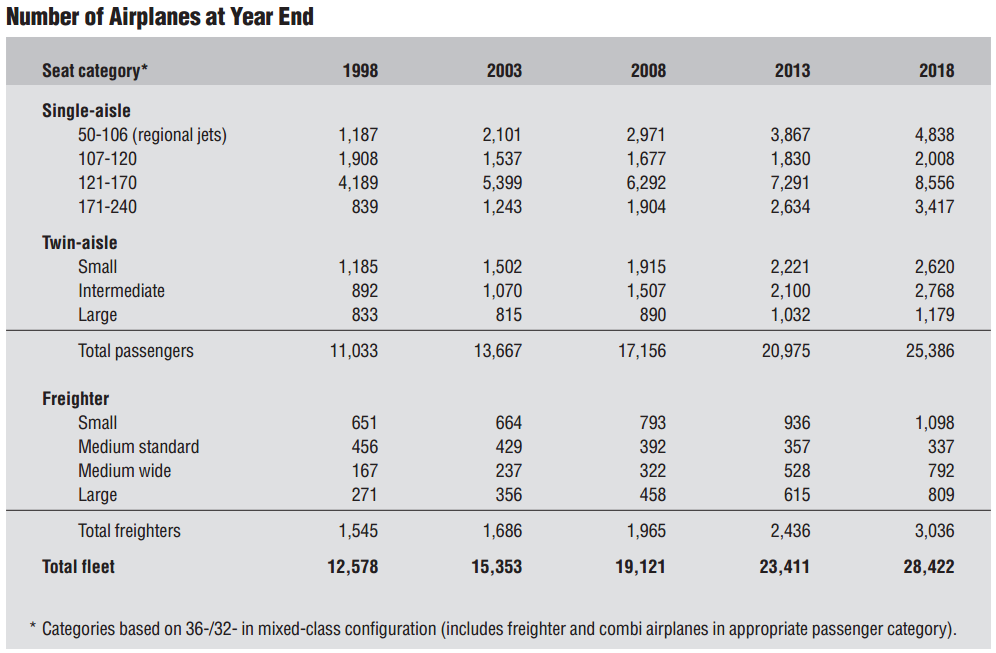
In this post, I just wanted to provide an update with the figures from the latest CMO (2014), released a few weeks ago, in comparison with 1999’s CMO. In that CMO from 1999 [PDF, 1.5MB], we find the following chart showing Boeing’s forecasted fleet size and distribution for 2003, 2008, 2013 and 2018 year-ends.

1999 Boeing CMO year-end fleet forecasts for 2003, 2008, 2013 & 2018.

1999 Boeing CMO year-end fleet forecasts for 2003, 2008, 2013 & 2018.

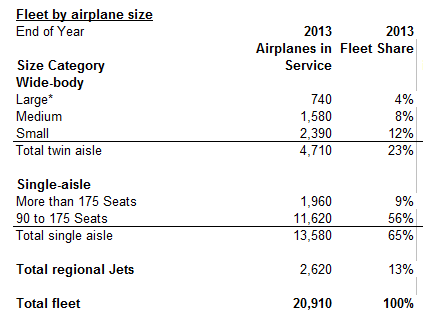
In 2014 CMO, Boeing offered figures of 2013 year-end fleet (1).

Fleet at year end 2013 - Boeing 2014 CMO.

Fleet at year-end 2013 – Boeing 2014 CMO.

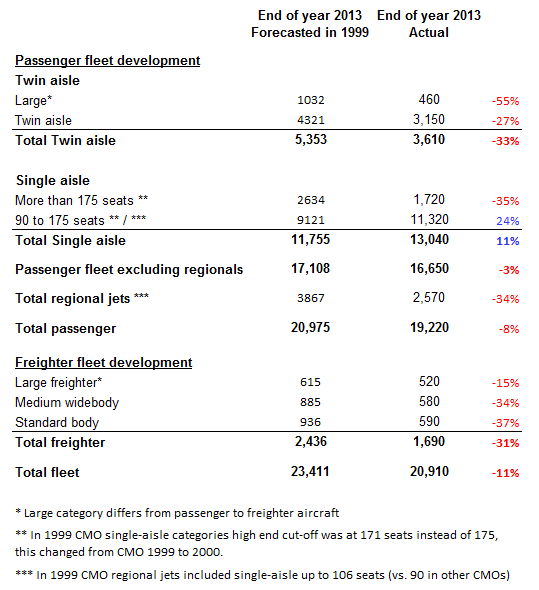
And now, the comparison is immediate:

Comparison of aircraft fleet at year-end 2013: 1999 forecast vs. actual (sources: Boeing CMO 1999 and 2014).

Comparison of aircraft fleet at year-end 2013: 1999 forecast vs. actual (sources: Boeing CMO 1999 and 2014).

Some reflections:

  • The forecasts for all segment except for single-aisle (737-800) predicted higher numbers of aircraft in the fleet than the actuals have shown 15 years later (2).
  • The total fleet figure was missed by 11%, a larger deviation than the 1% from two years ago.
  • The 737 has been the model outselling the forecasts, offsetting partially the lower demand in all other segments. In particular, even if deviations per segment have been higher, the global forecasted figure for passenger aircraft has been missed by only 3%.
  • The forecast is especially off mark the twin-aisle, where there are over 1,700 less aircraft in the current fleet than forecasted (3).

For the next such comparison we will need to wait some years, as from the year 2000 Boeing provided CMOs in a different fashion, offering a view of the forecasted fleet only 20 years from the date in question, instead of a view every 5 years. Therefore, we will have to wait until 2017, when we will be able to compare the 20-year forecast from 1997 CMO with the actuals of 2016 to be provided in 2017 CMO.

(1) In order to see the detailed split per segment differentiated between passenger and freighter aircraft, until the released of the full CMO, it is needed to use the exploring data tool offered in Boeing’s site.

(2) The differences in accuracy between the lower and higher end of the small-aisle segment should not be taken into account, as they are influenced by the different consideration of the cut off number of seats between a CMO and the other.

(3) Possibly a reason why Boeing plays down on the 747-8I and A380 segment.

4 Comments

Filed under Aerospace & Defence

“A bird in the hand is worth two in the bush” (speech)

Thanks to the drive of some individuals (Sarah, EduardoDominique) a new Toastmasters corporate club (1) is being created within Airbus in Toulouse, where I work.

I joined Toastmasters in 2007 when I lived in Madrid and I have written often about Toastmasters in this blog, however I had become inactive in the last couple of years. This new initiative is very convenient and thanks to it I am engaging myself again in the association.

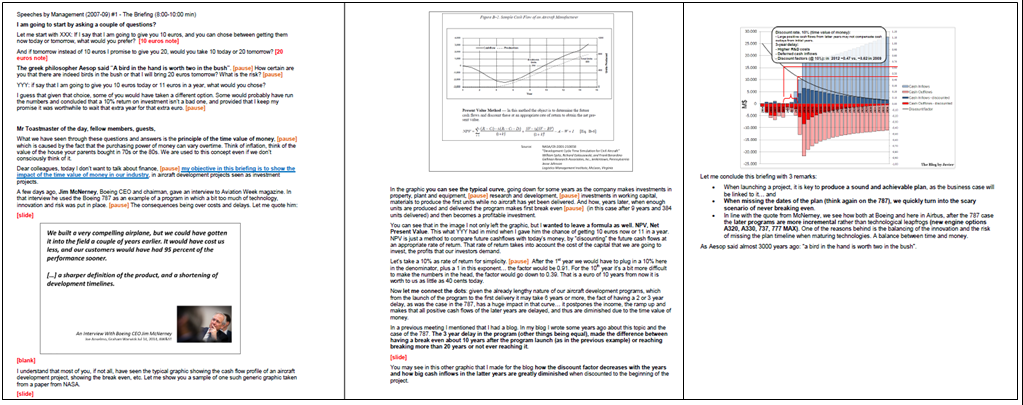
Today, I gave again a prepared speech in Toastmasters (2). In this post I just wanted to share it. Find it here, “A bird in the hand is worth two in the bush”, and below:

A bird in the hand is worth two in the bush

The topic of the speech is known for the reader of this blog: impact of delays in aircraft development projects seen as investment projects, the time value of money, discounting cash flows, break even, etc.

The feedback that I got: It was well received, especially the introduction, the interaction with the audience, the structure and how the topic was introduced and the main points called back in the end. However, I lost some individuals with the last slide, which needed some more explanation. I should have simplified the graphic. Some demanded more pauses and better vocalization.

(1) Up to now it is a prospect Toastmasters club.

(2) Project #1 of the “Speeches by Management” advanced manual: “The briefing”.

1 Comment

Filed under Aerospace & Defence, Investing, Toastmasters

Wide-body mix in 16 years of Boeing CMOs

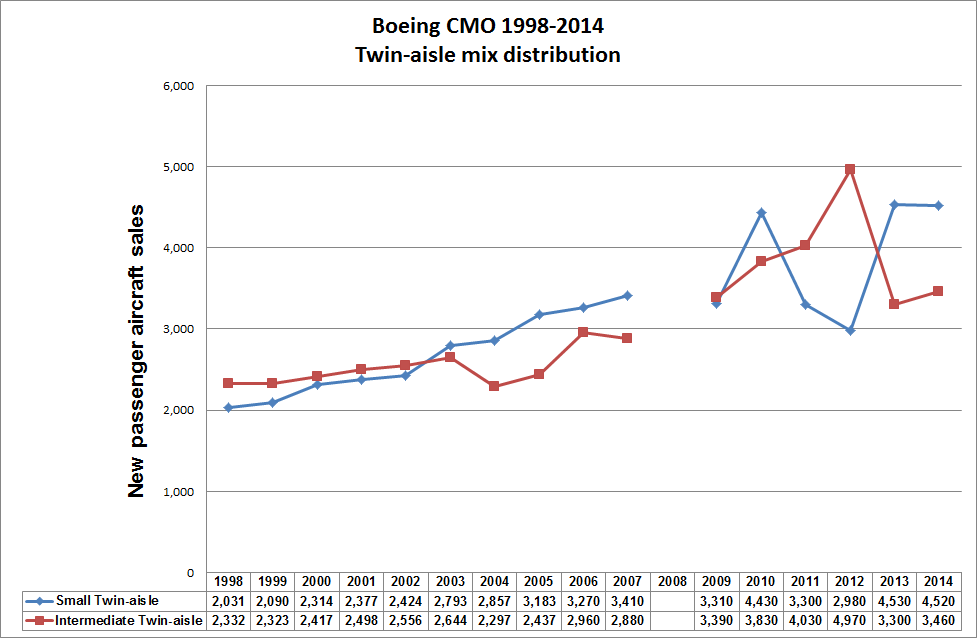
Last year I wrote a post showing the puzzling change in Boeing’s predicted mix of twin-aisle sales, between small and medium wide-bodies (“Wide-body mix in 15 years of Boeing CMOs”). A few days ago I wrote a post about the publishing by Boeing of its Current Market Outlook for 2014-2033. This year’s CMO is more consistent with last years figures, i.e., the larger share of the forecasted market corresponds to small wide-bodies (787s from Boeing perspective). Recall the numbers:

  • small wide-bodies: 4,270 a/c in CMO2014 (passenger aircraft only),
  • medium wide-bodies: 2,990 a/c in CMO2014.

However, the trend is changed again in this year’s CMO in comparison with last year’s one: small wide-bodies market decreases while the medium wide-bodies’ one increases again. Since I keep a collection of CMOs from years back, I will include again a comparison going 16 years back…

Twin-aisle mix distribution (Boeing CMO 1998-2014).

Twin-aisle mix distribution (Boeing CMO 1998-2014).

Seeing at the graphic (made using Boeing figures):

  • During the first 5 years (1998-2003) the trends are quite constant.,
  • From 2003 to 2007, the mix is reverted, possibly to favour the launch of the 787.
  • In 2008 the CMO did not provide the split.
  • From 2009 to 2014, you can see that both trends in the forecasts are erratic… why? Only Boeing knows.

4 Comments

Filed under Aerospace & Defence

Review of Boeing Current Market Outlook 2014

Just ahead of Farnborough air show, Boeing Commercial has published its yearly update of the Current Market Outlook (CMO) for the next 20 years of commercial aircraft market (2014-2033).

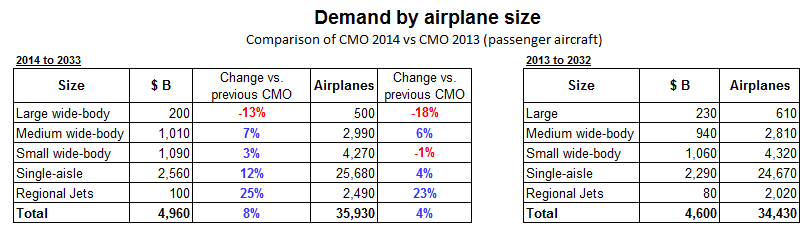
I have just compared the figures for passenger aircraft of the last two years’ CMOs:

CMO 2014 vs 2013 comparison.

CMO 2014 vs 2013 comparison.

Some comments to it:

  • You can see that the total number of new aircraft delivered has slightly increased from 34,430 to 35,930, a 4%, which is consistent with the constant 5% traffic increase that Boeing predicts (1).
  • The volume (Bn$) increases by a larger percentage, 8% (360Bn$)… this is due mainly to the increase in:
    • single-aisle aircraft expected sales in volume (12%, +270Bn$) and aircraft (+1,010), and
    • medium wide-body segment with 180 more aircraft (+6%) and an increase in volume of 70Bn$ (+7%).
  • Last year I wrote about a sudden change between CMO 2013 and CMO 2012 of the mix in wide-bodies; CMO 2014 is more consistent with last year’s one even if the trend is reverted again.

This year study’s figures seem to push for the 737 and 777, which is backed by the presentation as well. It is curious how 777 market is increased whereas 787 is slightly decreased.

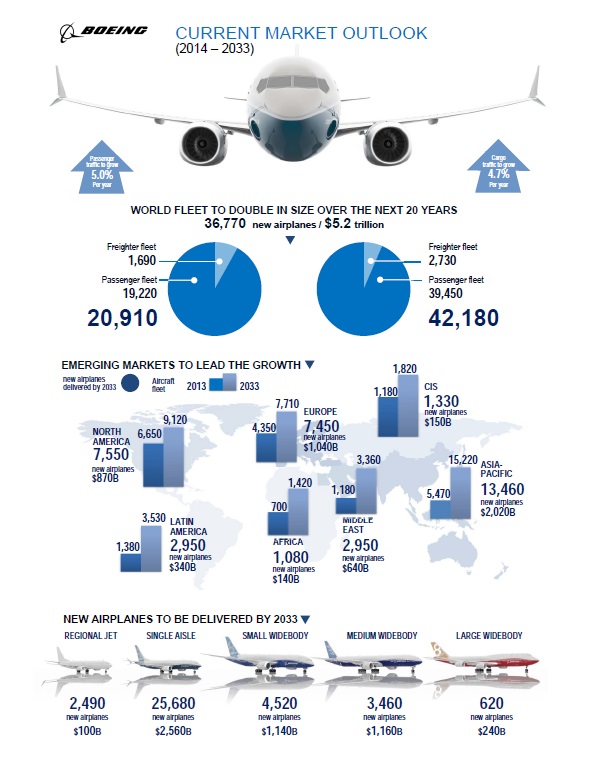
Find below the nice infographic [PDF, 0.1MB] that the guys from Boeing have put up together:

Boeing Commercial Aviation Market Forecast 2013-2032 infographic.

Boeing Commercial Aviation Market Forecast 2013-2032 infographic.

As always, I recommend going through the CMO, as you can learn a lot about the business: from global numbers, to growth, traffic figures, fleet distributions, forecasts, etc… You may find the presentation [PDF, 10.6 MB] and the file [XLS, 0.7 MB] with all the data.

For a comparison between this CMO and the respective Airbus’ GMF we will have to wait until after the summer, when Airbus publishes its update. Until then, find here the comparison based on 2013 market studies.

(1) These two ratios, 4% fleet growth and 5% traffic growth, point to an implicit increase in the average size of the aircraft in fleet.

(2) Find the review I wrote comparing 2013 CMO with 2012 CMO.

5 Comments

Filed under Aerospace & Defence

Musée de l’Aéronautique of Luchon

On July 19th of 1945, the British bomber Halifax Mk III Mz 981, from the 644th squadron of the Royal Air Force’s 38th transport command departed from Christchurch, in the South of England’s coast on a training mission that would take it all the way to the Cape d’Adge in the Mediterranean French coast.

Route followed by Halifax III MZ 981.

Route followed by Halifax III MZ 981.

On the way back, the aircraft would return to England crossing the South of France till the Atlantic ocean by way of Toulouse. With the fall of the night the pilot took a wrong heading (1) towards the Pyrenees, crashing against the Pic Lampau (2,543m).

About 50 years later, in the eighties, Léon Elissalde, an important figure of Luchon at the time, knowing about the crash of the Halifax III during WWII set out to look for lost parts of the aircraft. He found some of the engines, propellers, crankshafts, etc.

He knew about other crashes in the Pyrenees during WWII as well. A British Halifax II which crashed against the Pic Douluy when coming on a mission all the way from Algeria (see a description of that mission here, in French) and two German Dornier 217 equipped with BMW engines which allegedly were on the look out for the area where maquis were hidden in the mountains.

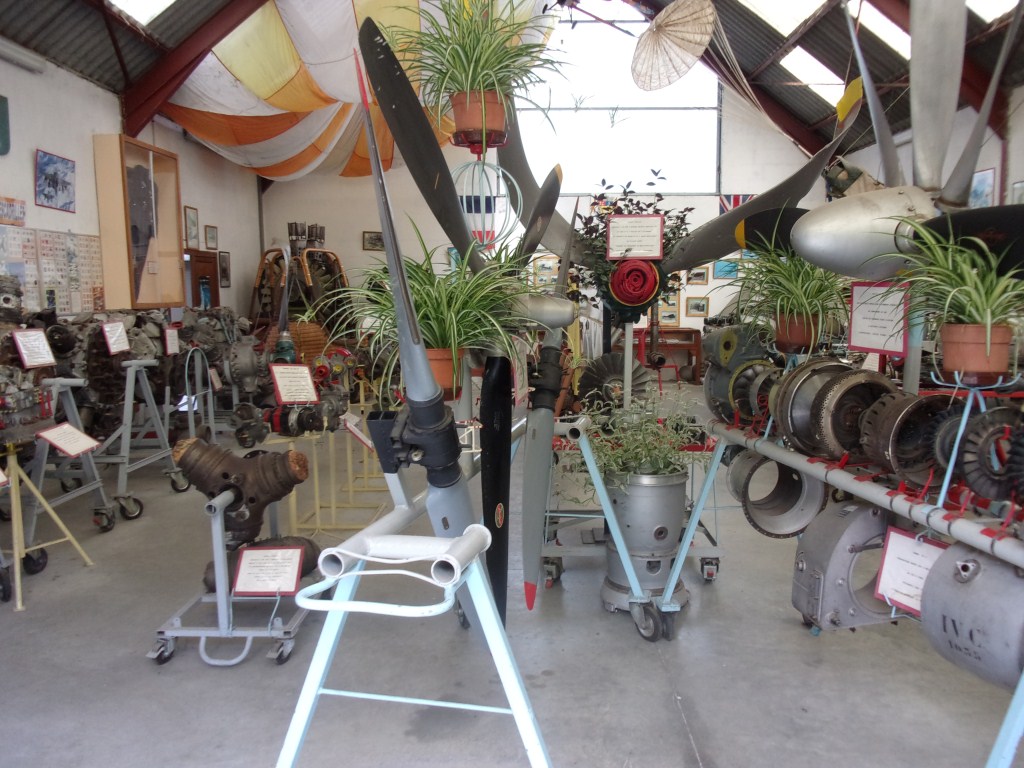
Elissalde, with all those parts created the Musée de l’Aéronautique of Luchon, located in a small hangar of village’s aerodrome.

Museum interior.

Musée de l’Aéronautique of Luchon.

We visited the museum last weekend. We counted with the guidance of a retired technician of the Armée de l’Air (French Air Force), who described the details of each of the engines, aircraft in which they were mounted and the mission the flew when they crashed. The visit lasted about an hour.

Breguet 941S preserved at Musée de l’Air et de l’Espace, image by PpPachy.

The museum includes some other engines, such as the turbojet Hispano Suiza Nene, which equipped the French Mistral, or the turboshaft Turmo III D3, which equipped the aircraft Breguet 941. The 941 was a short take-off and landing (STOL) aircraft with blown wings designed in the 1950s and which flew for the 1st time in 1961. One curiosity of this aircraft is that using 4 turboshaft engines (designed to power helicopters, not planes), all 4 engines’ turbines did not directly turn the propellers but rather powered a common shaft that ran along the leading edge of the wing powering the 4 propellers. A Breguet 941 is displayed at the Musée de l’Air et de l’Espace at Le Bourget, Paris.

Luchon is a nice village located at the heart of the Pyrenees, close to Super Bagneres skiing station, to some of the summits cycled in the Tour de France and has a great spa with water from natural sources. It is a great destination where to spend a few days. One hour of those days is well employed visiting the aviation museum.

This slideshow requires JavaScript.

(1) My flight instructor uses to say “Dans l’air, le cap est la vie” (“in the air, the heading is the life”).

1 Comment

Filed under Aerospace & Defence, France

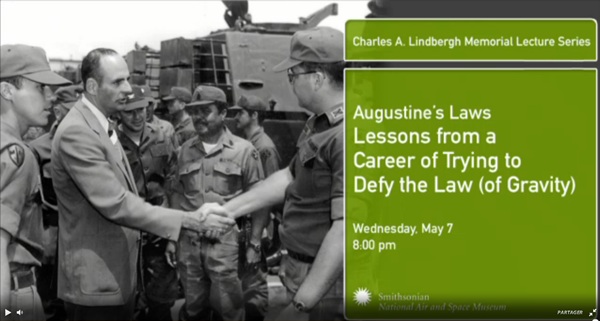
“Lessons from a Career of Trying to Defy the Law (of Gravity)”, lecture by Norman Augustine

Norman Augustine is an aeronautical engineer whom I have referred to often in this blog mainly due to his book “Augustine’s Laws” of which I wrote a review (find it here). He started working at Douglas Aircraft Company (1) in 1958, though through his long career he has occupied several positions in the administration and other major aerospace companies such Martin Marietta and then Lockheed Martin (2).

In my review about his book I wrote:

The book reviews A&D programs, especially their mismanagement and failures from the Wright brothers times till the early 80′s, when the book was written. The book is hilarious.

Lecture by Norman Augustine.

Lecture by Norman Augustine.

Some readers may believe I overstate it. Well, I invite you to watch the lecture he gave 2 days ago at the Smithsonian National Air and Space Museum (3) as part of the Charles A. Lindbergh Memorial Lecture Series. The lecture was titled “Lessons from a Career of Trying to Defy the Law (of Gravity)” [47’59”].

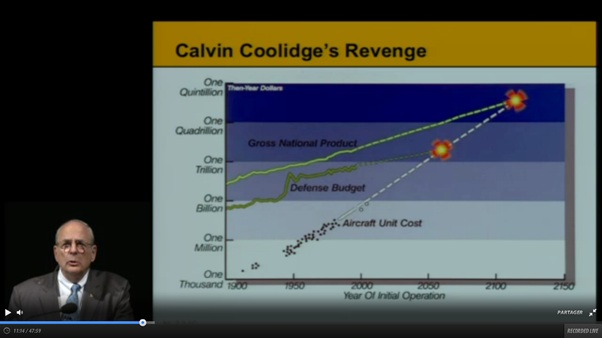
During the lecture Norman shares a great deal of the wisdom he has accumulated through his long career, part of it condensed in his Laws, compiled in his book. One of the laws I like the most is possibly the number IX:

In the year 2054, the entire defense budget will purchase just one tactical aircraft. This aircraft will have to be shared by the Air Force and Navy 3 1/2 days each per week except for leap year, when it will be made available to the Marines for the extra day. (LAW NUMBER IX)

I think it is priceless to have Norman explain it in person:

Augustine's Law IX.

Augustine’s Law IX.

During the lecture he used an update of his law (written in the 80’s) made by The Economist a few years ago which I covered also in this blog (4).

Other topics covered by Augustine during the lecture include: the importance of thinking with a systems point of view, the evolution of aerospace industry in the last decades, the importance of strategy and leadership, all covered by his fine humor and wit.

(1) You may read here a tribute I wrote about Douglas Aircraft Company.

(2) Some years ago I wrote this post about Lockheed’s Skunk Works.

(3) You may find here a post I wrote about my visit to the Smithsonian National Air and Space Museum at Dulles.

(4) I few months ago I wrote another post reviewing the application to bomber aircraft of Augustine’s Law IX with new US long range bomber program. In his book Norman includes an extrapolation as well of bomber aircraft increasing costs, even if the wording of the law takes tactical aircraft as the benchmark.

Leave a comment

Filed under Aerospace & Defence

1907 Voisin-Farman biplane

In a previous post I discussed the importance of  Issy-Les-Moulineaux in the history of French aviation. I focused the first part of that post in the first 1-km closed circuit flight by Henri Farman on the 13th of January 1908.

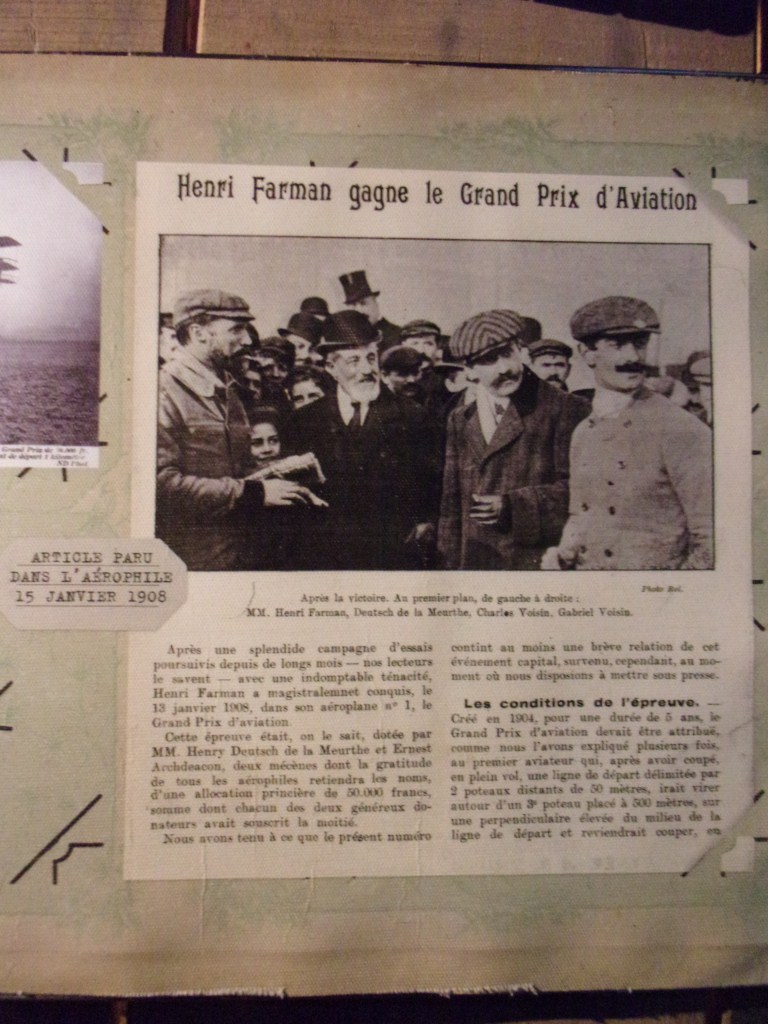
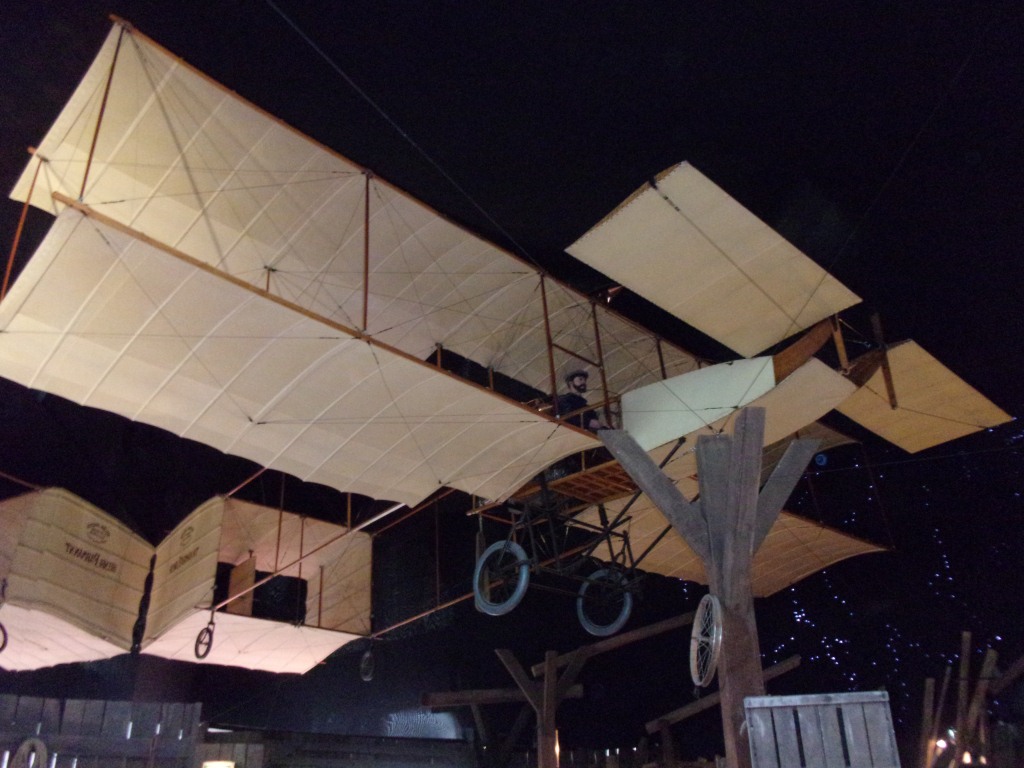
In this post I just wanted to leave a couple of pictures taken at the Musée de l’Air et de l’Espace (Le Bourget) showing a replica of that plane and an article appearing two days later in the L’Aerophile explaining the achievement (in French).

Article appeared on 15 January 1908 in L'Aerophile.

Article appeared on 15 January 1908 in L’Aerophile.

1907 Voisin-Farman biplane.

1907 Voisin-Farman biplane.

Leave a comment

Filed under Aerospace & Defence, France

Issy-Les-Moulineaux: cradle of European aviation

The city of Paris, among other things, can pride itself for the role it played in the early development of aerospace and aviation. In my opinion and to my knowledge there 3 or 4 quite important places in Paris where one can breath the history of those times, one of them is Issy-Les-Moulineaux. In a previous post I mentioned the space dedicated to the aviation history in the gallery of the village placed at the Musée Français de la Carte à Jouer.

Issy is a suburb just at the southwest of Paris, where the Périphérique crosses the river, south of the XV arrondisement.

At the turn of the XX century there was in Issy a military field dedicated to training. With the advent of aviation, that field started to be dedicated to aviation by the several pioneers who decided to relocate their activity there.

One of the images that symbolizes the French nascent aviation industry at the time is the one shown in the picture below. In it we can see Henri Farman (car racing pilot and aviator) flying the 1907 Voisin biplane winning the Archdeacon Prize for the first closed-circuit kilometer flight in Europe. That flight took place in the military field at Issy-Les-Moulineaux.

Henri Farman winning the Archdeacon Prize for the first closed-circuit kilometer flight in Europe (file from Wikimedia Commons, unrestricted picture belonging to the Library of the Congress).

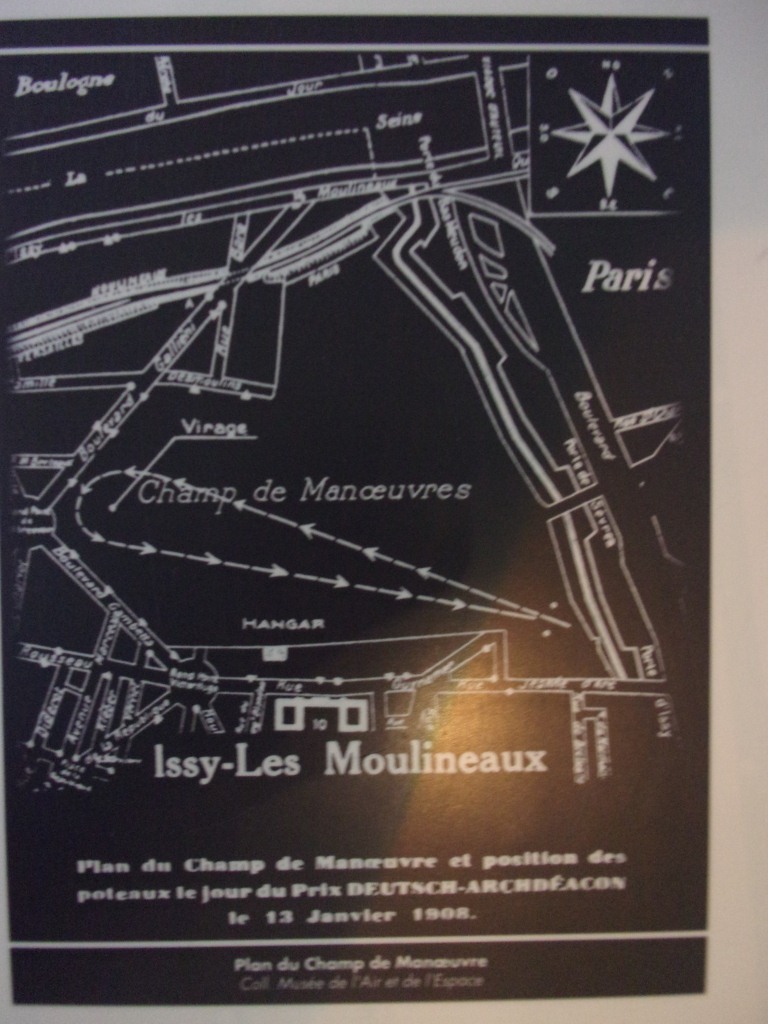
Circuit of the first 1km closed circuit flight at Issy.

Circuit of the first 1km closed circuit flight at Issy.

The circuit can be seen in the following graphic at the gallery of the village of Issy. The circuit was marked by 3 poles planted on the ground. Two poles marked the depart and arrival. One pole located at 500m marked the turning point.

The morning of of the 13th of January 1908, Farman took off with the Voisin biplane equipped with an Antoinette engine for a flight that lasted 1 minute and 28 seconds (thus at an average speed of 41 km/h). With this flight, Farman, won the Archdeacon Prize, which had been set back in 1904 by  Henri Deutsch de la Meurthe and Ernest Archdeacon, with an allocated sum of 50,000F.

In fact, apparently, Farman had achieved the feat already 2 days earlier, but it was only on the 13th of January that the flight was officially controlled by a commission from the Aero-Club de France (an institution created in 1898 to encourage the development of flight by individuals like Ernest Archdeacon, Jules Verne, André Michelin, Alberto Santos-Dumont, Henry Deutsch de la Meurthe among others).

In the picture with the circuit you may locate the aviation field by seeing the wind rose and the river Seine on the top of the image. Today, that field is the Heliport of Paris, the street surrounding it being called Rue Henri Farman.

That first closed circuit in Europe may be the most iconic image of Issy, but it was not the first happening nor the last aviation achievement that took place there, see some others below:

  • 1905 (March, 26): at the initiative of Ernest Archdeacon a glider type Wright, towed by a car, rose to about 10m.
  • 1906 (August, 18): the Romanian Traian Vuia flies for about 11-24m rising just 2.5m above the ground.
  • 1907 (July, 11): Louis Bleriot makes his first flight aboard his monoplan VI Libellule.
  • 1907 (November, 5): Léon Delagrange flies aboard a Voisin-Delagrange over 300m in a semicircle.
  • 1907 (November, 17): Alberto Santos-Dumont makes his first flight on the XIX Demoiselle.
  • 1910 (March, 9): Elise Raymonde de Laroche obtains her pilot licence, being the first woman in the world to receive one.
  • 1910 (June): the first metallic plane ever is tested in Issy.
  • 1911 (May): the raid Paris-Madrid was organized, with departure from Issy. Among the 8 pilots taking part in the race was Roland Garros. That day one of the airplanes suffered an accident when taking off, crashing against the authorities and killing the then French war minister, Maurice Berteaux.

It goes without saying, that this shall be a mandatory stop for any aviation enthusiast passing by Paris.

Aviation room at the Gallery of Issy (Musse de las Cartes a Jouer).

Aviation room at the Gallery of Issy (Musse de las Cartes a Jouer).

2 Comments

Filed under Aerospace & Defence, France

WWI aces: Fonck and Baron von Richthofen

In an old post about French aviation pioneers I had already written about René Fonck. He was the top French (and allied) ace during WWI, second only to the Red Baron, Manfred von Richthofen. In a previous post I wrote about the Musée de l’Air et de l’Espace, in Le Bourget. In that museum you may find a section dedicated to WWI aces.

There is an article in the Wikipedia about WWI aces. Figures with the top 2 aces match: 80 for the Red Baron and 75 for Fonck, not so for the 3rd, as in the museum Mannock is credited with 73 and in the Wikipedia is only credited with 61, even if the claim of 73 is referenced.

I wanted to write this article for a couple of reasons:

  1. Despite of the fact that aviation has just over a century of history, I find that there are lots of controversies as to the history of aviation, while it should ideally be rather easy to get the facts right with the information technologies at our disposal nowadays and possibly having the records of the different happenings still in existence. We are not talking about archaeology here.
  2. At this respect, museums play an important role in trying to get history right. In relation to the aces and the official figures about the 2 top aces, the museum in Le Bourget seems to get them right. The 3rd ace seems not to be so correct, but this does not bother me. What bothers me is the reference attached to Fonck’s victories tally in the panel at the museum, which claims that counting not officially recognised victories the tally could reach 127 (from 75 official ones). The museum then fails to mention that von Richthofen also has a number of claimed victories unaccounted for.

What is the role of the museum here? Trying to educate and teach about aviation, convey some history facts or rather play a game in such a way that a French ace seems to be on top no matter what?

I would expect more fact-based independent treatment of information on the part of museums and historians.

1 Comment

Filed under Aerospace & Defence

Musée de l’Air et de l’Espace (Le Bourget)

The Musée de l’Air et de l’Espace, in Le Bourget (north of Paris), is yet another great aerospace museum. It reminded me very much to the Aviodrome (The Netherlands) in the chronological point of view of the visit and the local aspect to it (1), paying special attention to French aviation pioneers, flying aces, French fighter aircraft, etc. This is possible, as the role France has played in the development of aviation is, no doubt, crucial.

You may see the distribution of the museum and its galleries in the plan below:

Plan of the museum.

Plan of the museum.

I will now list some of the things that in my opinion make this museum unique (I will leave some anecdotes or details to future blog posts), accompanied by the respective pictures.

Model of Alberto Santos Dumont's Demoiselle (1908).

Model of Alberto Santos Dumont’s Demoiselle (1908).

Alberto Santos-Dumont was a Franco-Brazilian aviation pioneer (2) who with his 14-bis, “Oiseau de proie“, on the 23rd of October 1906, in Paris, performed the first officially witnessed unaided takeoff and flight by a heavier-than-air aircraft. In the picture above you can see him aboard another of his early models, a Demoiselle from 1908.

Workshop of the brothers Voisin (L’Atelier des Freres Voisin),

Workshop of the brothers Voisin (L’Atelier des Freres Voisin).

Some of the construction pioneers at the time were the Voisin brothers. The museum has model of how an aircraft construction workshop could look like at the time, “L’Atelier des FrèresVoisin” (this reminded me of the William E. Boeing Red Barn at the Museum of Flight in Seattle, see a post about it here).


Nacelle of a dirigible  Zeppelin LZ 113.

Nacelle of a dirigible Zeppelin LZ 113.

Not everything in aviation are heavier-than-air machines, above you can see the inside of a nacelle of a Zeppelin LZ 113 used in war operations.

Old Le Bourget airport hall ("8 columns hall").

Old Le Bourget airport hall (“8 columns hall”).

Le Bourget was the first civil airport in Paris, opened in 1919. It was in Le Bourget where Charles Lindbergh landed his Spirit of Saint Louis in on the 27th May 1927 when he first crossed the Atlantic Ocean. The museum today occupies part of the old airport. In the picture above you may see the main hall, designed by the architect Georges Labro in a tender made in 1935 the ministry of aviation. The building was inaugurated in 1937 (this hall reminded me of Berlin Tempelhof, you may see a post I wrote about it here).

Models gallery.

Models gallery.

The museum includes an aircraft models gallery. As a collector of models, I liked to spend some time wandering through these models. It also helps to test your own capabilities as a spotter without having to walk or wait a lot.

Inside a C-47 Skytrain Dakota

Inside a C-47 Skytrain Dakota.

In this museum you can get on board a C-47 Skytrain (Dakota being the British designation for the airplane). I believe this was the first time I was inside a DC-3 (an aircraft of which importance to aviation cannot be overstated (3)), as if I remember well, in the Aviodrome you could get inside a DC-2 not -3.

Cut out of a Dassault Mirage F1.

Cut out of a Dassault Mirage F1.

In other museums I had seen cut outs of engines, here in Le Bourget you may see a full size cut out of a Dassault Mirage F1, a wonderful entertainment for engineers and aviation enthusiasts.

747 and Ariane 5

747 and Ariane 5.

In Le Bourget you can see replicas of the Ariane 4 and Ariane 5 (4). That allows you to get a picture of both in the same frame or to get them with a Boeing 747, as pictured above.

Inside of a Boeing 747 cut out.

Inside of a Boeing 747 cut out.

The Boeing 747 is legendary aircraft in itself (5) and the chances of flying in it are decreasing by the year as more airplanes are being retired from service. In Le Bourget, you get the chance to see it really from the inside, as parts of it are really cut out so you can admire its structure, systems, etc.

Concorde: prototype 001 and series airliner.

Concorde: prototype 001 and series airliner.

Some museums around the world have the Concorde as a highlight. In some of them you may get into it. Here in Le Bourget you may get into 2, one of them being the prototype 001, where you can see some flight test installations used for different experiments made with it.

I definitely recommend to visit this museum if you happen to be in Paris. It is located at Le Bourget airport and the entrance is free of charge. A ticket to get into some of the aircraft (747, Concorde, C-47) is sold for 8 euros. I would suggest to take no less than 4 hours to visit the museum.

(1) In the Aviodrome the local focus is put into the figure of Anthony Fokker.

(2) See in this post a review of French aviation pioneers.

(3) See more of the DC-3 in this post that a wrote as a tribute to Douglas Aircraft Company.

(4) So far, I had only seen a replica of the Ariane 5 at the Cité de l’Espace in Toulouse, see here a post I wrote about it.

(5) See here a book review I wrote about “747” by Joe Sutter, the programme chief engineer.

5 Comments

Filed under Aerospace & Defence, France