Category Archives: Aerospace & Defence

Wide-body mix in 15 years of Boeing CMOs

A couple of days ago I wrote about the publishing by Boeing of its Current Market Outlook for 2013-2032. In that post I made a very brief review of it, and mentioned that I was puzzled by the change in the predicted mix of twin-aisle sales, between small and medium wide-bodies. To recall the numbers:

  • small wide-bodies: from 2,720 a/c in CMO2012 to 4,320 a/c in CMO2013, whereas,
  • medium wide-bodies: from 4,490 a/c in CMO2012 to 2,810 a/c in CMO2013.

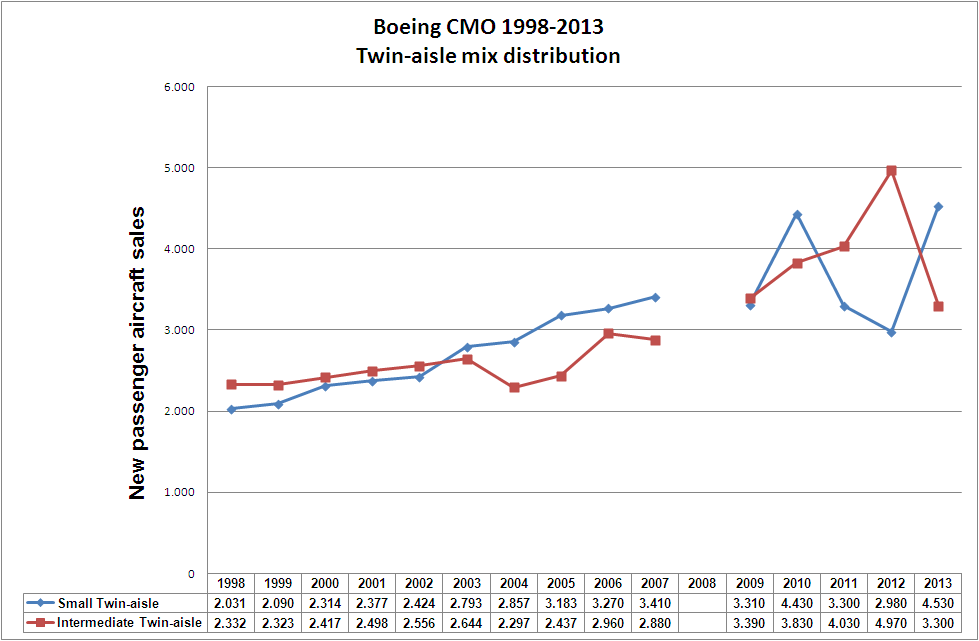
Since I keep a collection of CMOs from years back, I decided to compare the figures of this wide-bodies mix along the last 15 years…

Twin-aisle mix distribution (Boeing CMO 1998-2013).

Twin-aisle mix distribution (Boeing CMO 1998-2013).

Seeing at the graphic (made using Boeing figures):

  • During the first 5 years (1998-2003) the trends are quite constant.,
  • From 2003 to 2007, the mix is reverted, possibly to favour the launch of the 787.
  • In 2008 the CMO did not provide the split.
  • From 2009 to 2013, you can see that both trends in the forecasts are erratic… why? Only Boeing knows.

9 Comments

Filed under Aerospace & Defence

North American X-15

I once wrote about how it took me some visits to different museums and reading a book to connect the dots and see what was the controversy in France about the Wright Brothers pioneering first flight.

It takes several museums to get a complete glimpse of the story of the X-15.

This experimental aircraft, powered with a rocket engine, was used to reach the edge of outer space and gather data for aircraft and space design. In doing so, it set several records of speed and altitude. To date it keeps the speed record of any manned flight with over 7,000 km/h (bear in mind that this a rocket engine, vs. the record for an atmospheric engine reached with the SR-71). The aircraft also flew several times above 50 miles, which by then in the USA was considered the limit for outer space, thus making some of its pilots being recognised as astronauts by NASA and USAF. The International Astronautics Federation (FIA), however, sets the limit at 100km of altitude. Still two of the X-15 pilots flew over that height being them also recognised as astronauts by the FIA.

The aircraft itself, the North American X-15, is displayed at the National Space & Air Museum at the Mall in Washington DC (which I first visited in December 2008) and USAF Museum in Ohio, while one of the mock-ups is displayed at the Pima Air & Space Museum in Tucson (which we visited last May 2013).

North American X-15 the National Air & Space Museum in the Mall (picture from Ad Meskens).

The flight tests in which the X-15 set so many high altitude and speed records were performed at Edwards AF Base in Mojave (which we visited in May 2013). At the Flight Test Center museum you can read some displayes about its story.

Rogers Dry Lake at Edwards (public domain image).

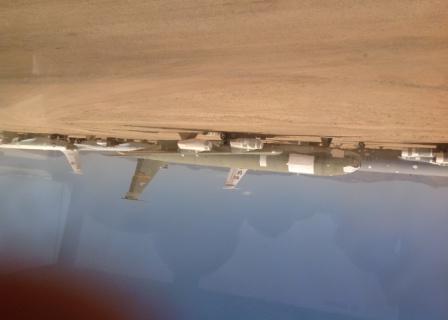
Finally, the mother ships from which the different X-15 aircraft were launched were modified B-52 Stratofortress bombers. The two aircraft are displayed in the Pima Air & Space Museum in Tucson (which we visited last May 2013) and again the Dryden Flight Research Center which is also located at Edwards AFB.

NB-52, modified Stratofortress to drop X-15.

NB-52, modified Stratofortress to drop the X-15.

1 Comment

Filed under Aerospace & Defence

Review of Boeing Current Market Outlook 2013

Last week, just ahead of Le Bourget air show, Boeing Commercial published its yearly update of the Current Market Outlook (CMO) for the next 20 years of commercial aircraft market (2013-2032).

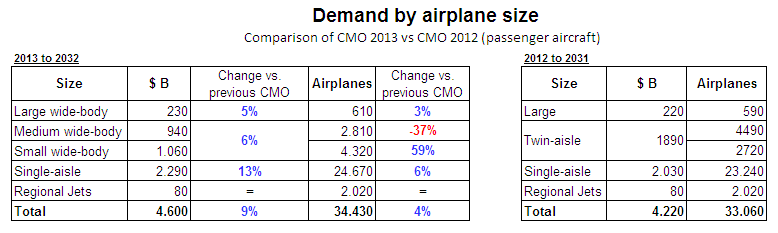
I just compared the figures for passenger aircraft of the last two years’ CMOs:

CMO 2013 vs 2012 comparison.

CMO 2013 vs 2012 comparison.

Some comments to it:

  • You can see that the total number of new aircraft delivered has slightly increased from 33,060 to 34,430, a 4%, which is consistent with the constant 5% traffic increase that Boeing predicts.
  • The volume (Bn$) increases by a larger percentage, 9% (380 Bn$)… this is due mainly to the double increase in:
    • (1) single-aisle aircraft expected sales 6,2% (+1,430 aircraft), and
    • (2) the average price list with which the list is computed, another 6.3% (from 87.3m$ to 92.8m$)
  • I am puzzled to see the the sudden change in the predicted mix of twin-aisle sales, between small and medium wide-bodies…
    • small wide-bodies: from 2,720 a/c in CMO2012 to 4,320 a/c in CMO2013, whereas,
    • medium wide-bodies: from 4,490 a/c in CMO2012 to 2,810 a/c in CMO2013
    • as you can see the combined figure slightly changes (7,130 vs. 7,210), however the distribution among the two categories is drastically changed. Why is that? A question to Randy Tinseth that he did not address in his blog when the CMO was unveiled.

I would tend to think that the move is done to push some market development based on some models (787) instead of others (777), but given that it is precisely now when the upgraded versions of the 777 are supposed to be pushed into the market I fail to see the logic behind this.

Find below the nice infographic that the guys from Boeing have put up together:

Boeing Commercial Aviation Market Forecast 2013-2032 infographic.

As always, I recommend going through the CMO, as you can learn a lot about the business: from global numbers, to growth, traffic figures, fleet distributions, forecasts, etc… You may find the presentation [PDF, 9.6 MB], the booklet [PDF, 3.0 MB] and the file [XLS, 0.4 MB] with all the data.

For a comparison between this CMO and the respective Airbus’ GMF we will have to wait until after the summer, when Airbus publishes its update. Until then, find here the comparison based on 2012 market studies.

10 Comments

Filed under Aerospace & Defence

B-52 Stratofortress, nuclear disarmament and The Boneyard

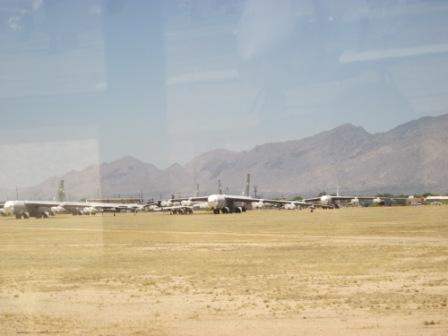
One of the oldest flying aircraft in the US air force is the bomber B-52 Stratofortress, built during the 1950s. Over 700 of them were built during a decade with only above 70 today being used in the active or reserve forces. The retired ones are either in museums or in The Boneyard.

Part of B-52 retired fleet.

Part of B-52 retired fleet.

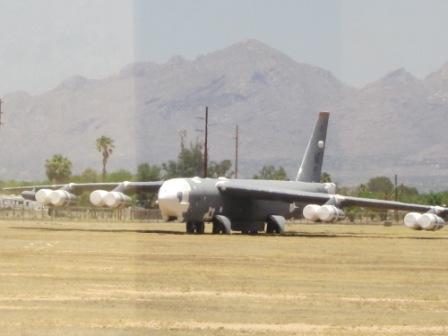
During the visit to AMARG, the guide explained us one historical anecdote taking the following picture as the departing point:

B-52 Stratofortress without horizontal tail plane.

B-52 Stratofortress without horizontal tail plane.

The curiosity of the picture: as you can see the aircraft has no horizontal tail plane (HTP). 

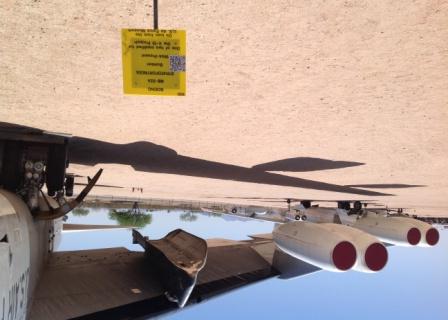
The story went as follows: as part of Arms Control and Disarmament agreements between the USA and USSR, the USA had to retire a certain number of B-52 aircraft from service (over 300 of them). At some point a soviet delegation visited The Boneyard at Tucson to witness the retirement of those A/C. However, they said that being the AF base right there, side by side of the boneyard, the USSR could not have any guarantee that those B-52s would not be immediately put back into active service just after the soviets had left the city, and thus required that Americans dismantled the HTPs from all B-52s that were to be retired as part of the agreements. In that way they could always check via satellite image whether they had those HTP on or off…

Later on I checked the story in the Wikipedia where you may see the whole background of the START agreement. Some of the aircraft were chopped into 5 pieces. Those you cannot see in the guided visit to Davis-Monthan AFB but you can see them in satellite image here:

Leave a comment

Filed under Aerospace & Defence, Travelling

The Boneyard

The US Air Force’s 309th Aerospace Maintenance and Regeneration Group (AMARG), known as “The Boneyard”, is one of the places that I had wanted to visit since many years ago. Luca and I visited it a couple of weeks ago.

The Boneyard is an aircraft and equipment storage facility located at Davis-Monthan AF Base near Tucson (Arizona). The are over 4,000 military aircraft stored at the place. Most of them come from the USA (not only from the air force, but from other services as well) but there are some aircraft from foreign countries. The aircraft are stored for several reasons and in different conditions.

  • Some of them are maintained waiting for a possible future use of them (be it with US armed forces or through some foreign military sale, that is the case of several old versions of C-130, F-16).
  • Other aircraft are kept so their parts can be used as spare parts for other active flying aircraft (e.g. C-130, KC-135).
  • Finally, there are aircraft which are stored waiting to be scrapped so the metal can be reused somewhere else.
KC-135 partly scrapped.

KC-135 partly scrapped.

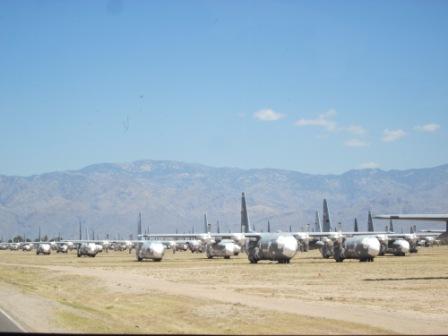
Hundreds of C-130.

Hundreds of C-130.

There are whole fleets of retired aircraft: C-141 Starlifter (retired once the C-17 took over their role), half of the C-5 Galaxy fleet (the A versions, due to budget constrains and fleet strategic decisions), the Vietnam-era helicopters Hueys and Cobras

The Boneyard can be visited with a guided tour organised by the Pima Air and Space Museum (I will write about this museum in another post).  The tour is made with a bus which goes through the Boneyard very slowly and making several stops (though guests cannot exit the bus). The guides are veterans from the US armed forces, who have flown or maintained some of those models that you get to see. The wealth of knowledge that they have about them, the anecdotes and stories that they tell during the tour are worth much more than the 7$ that the tour costs.

The place is impressive, overwhelming. Not only there are thousands of aircraft but the seeing of them fully aligned, whole fleets of different models helps you put things into perspective:

  • World commercial airliner fleet (over 100 pax) has about 16,000 aircraft vs. the 4,000 at The Boneyard.
  • The largest airline fleets have about 1,200 aircraft.
  • Spanish AF has 14 C-130 Hercules vs. the hundreds of them you see at The Boneyard.
  • The dozens of retired Lockheed C-5A Galaxy that you can see there have a combined payload capacity of over 5,000 tonnes… which is more than the complete payload capability of any other air force in the world except the US one…

You may want to take a look at satellite images from the Boneyard here:

6 Comments

Filed under Aerospace & Defence, Travelling

Air Force Flight Test Center Museum at Edwards AF Base

During the recent honeymoon trip to the USA, Luca and I managed to visit 5 aerospace museums, 3 airplane assembly lines, 2 US air force bases and 1 space observatory… be sure some of the coming posts will be related to that side of the trip.

Air Force Flight Test Center Museum at Edwards AF Base

Since we were going to visit California and we would be around the desert of Mojave I thought that we could make a detour to visit Edwards Air Force Base, where the Flight Test Center of the USAF is located.

The Flight Test Center has got a museum which is open to the public, for which identification is needed and no carry on items able to take pictures of videos are permitted. The museum is free and opens 5 days a week. On top of that there is a monthly guided visit of the air base, flight line included. This tour is offered only once a month and you have to subscribe with some time in advance.

Several dozens of aircraft have first flown at Edwards and that, together with Rogers dry lake is what makes the place so special.

First Flights Wall at Edwards AFB (public domain image).

Some very famous flights at Edwards: the Bell XS-1 which first reached the speed of sound with “Chuck” Yeager at the controls, the test campaigns of the YC-130 (Hercules), C-17 Globemaster III (and the prototype YC-15 from which it got many features), testing of the Space Shuttle, testing of today’s state of the art fighters F-22 and F-35… take a look at the wall to get an idea.

Rogers Dry Lake is by itself a national historic landmark. The lake formed thousands of years ago, and today it’s mostly dry along the year and the strength of the ground permits it to have several unpaved very long runways in its lakebed. The longest one being over 12 kilometers long. It also has the world’s greatest compass rose marked into the lake to help flight test pilots guide themselves. It was there, in the lake, where the now retired Space Shuttle would land in its return from space.

Rogers Dry Lake at Edwards (public domain image).

The exhibit at the museum displays a replica of the XS-1, the first 2 F-22 prototypes, an exhibit about the formation of the lake, the history of the base, some remarkable test pilots, etc. The outdoors display has as a highlight a Lockheed SR-71 Blackbird (a classic in US aviation museums).

Lockheed SR-71 Blackbird at Edwards (public domain image).

The area of the base is of 1,200 km2 (this is about 1/7th of the region of Madrid). The visit to it, museum included, lasts about 3 hours. There are veterans offering explanations at the museum and at one restoration hangar within the base. Our guided tour was led by a young aerial photographer, Jet Set  (what a name! :-)), who made if very enjoyable.

Along the flight line of the base, for the pleasure of European-based spotters (who don’t have the chance to see them often), were some test F-35s, F-22s, C-17s, Global Hawks, F-16s, etc. Apart from some aircraft flying around. I, however, missed seeing the B-2 that was somewhere “hidden” in the base (next time!).

Edwards AF Base entrance.

Edwards AF Base entrance.

Rosamond Dry Lake (a lake close to Rogers Dry Lake).

Rosamond Dry Lake (a lake close to Rogers Dry Lake).

YC-15

YC-15.

3 Comments

Filed under Aerospace & Defence, Travelling

US Air Force fleets evolution

In these days in which the sequester is being often in the media, this will be a very brief post to bring to the memory a study prepared by Mitchell Institute for Airpower Studies, founded by the Air Force Association, “ARSENAL OF AIRPOWER: USAF Aircraft Inventory 1950-2009” [PDF, 6.5 MB], published in November 2010.

I wanted to bring forward some comments and two graphics:

  • “To put matters into perspective, a single C-17 can carry the equivalent of 15 C-47 loads (as well as cargo that could never fit inside a C-47) and deliver that cargo anywhere in the world within hours without requiring en-route staging bases.”
  • “The average cost of a flying hour over the past decade is around $23,000 (in constant FY11 dollars), compared to about $11,000 in 1985 and roughly $4,800 in 1970.”
  • “For example, a single B-2 now armed with 80 Joint Direct Attack Munitions (JDAMs) could strike as many targets as five of the 75-aircraft 1991 Gulf War era packages.”
US Air Force fleet evolution 1950-2009.

US Air Force fleet evolution 1950-2009.

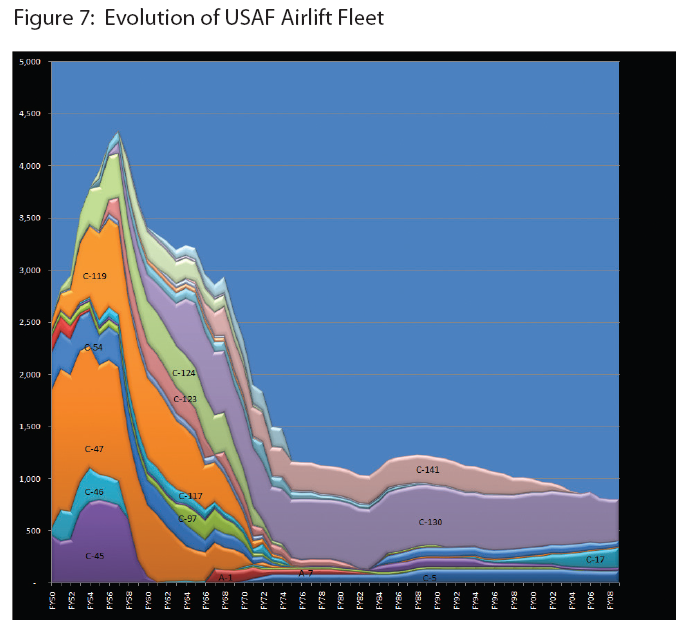
US Air Force Airlift fleet, 1950-2009.

US Air Force Airlift fleet, 1950-2009.

The keyword here is capability, not numbers.

I will come back to here in following posts.

2 Comments

Filed under Aerospace & Defence

Ray Conner on pricing and Boeing discounts

Reading in Leeham News and Comment aerospace blog about the appearance of Ray Conner, CEO of Boeing Commercial Airplanes, at JP Morgan aerospace conference I picked the following lines:

Joe Nadol (JN) of JP Morgan: Is there pricing pressure?

Ray Conner (RC): I think margin will be OK [for 737NG]. Some initial launch deals for MAX can be a little more aggressive, but we’re seeing that become more stable.

JN: MAX–I thought pressure would be more on late NGs than on the MAX.

RC: We were a little late getting into the marketplace with MAX and there was pricing pressure on NGs. We were about a year late so we were more aggressive than we would have been had we not been late.

For the last years I have been trying to estimate averages for the discounts Boeing applies to its commercial aircraft using as departing information Boeing year-end financial results, list prices, net orders, deliveries and services revenues. You can see the results for 2012, 2011, 2010 and 2009. In each of the posts you can see a detailed explanation of the methodology I followed.

Why do I comment this? Since 2009 I have noticed that the average discount has gone from ~38% (2009), 39% (2010), 41% (2011) to 45% (2012)!!

Find below the explanation I could find for that hike in the discount:

The explanation I can find for that increase shall be linked the built-in penalties for 787 (net orders for 2012 being -12 a/c) and 747 delays (1 single net order) into revenues plus the launch of a new aircraft, 737 MAX (forced by A320neo sales success in 2011).

How does it compare to Conner’s words?

6 Comments

Filed under Aerospace & Defence

KC-46 EMD contract 101

The US Government Accountability Office (GAO) has recently published a report about the KC-46 Tanker Aircraft [PDF, 1.2 MB]. In it the GAO reviews the situation of the program, measures introduced, costs, technology development, etc. In the first page it summarizes:

“The KC-46 program 2012 estimates for cost, schedule, and performance are virtually the same as last year’s, with the contractor running very close to the planned budget and schedule”.

On the technical side it points to several challenges: flight test plan, completion of engineering drawings, relocation of personnel and facilities related to defense equipment, etc.

However, in this post I wanted to focus only on the costs and contractual sides of the program, given the amount of articles that we could read about it during the past year. Several news have reported about the cost overruns in the program and about how these were to be born by Boeing.

The last time I read about the topic, the reported overrun was of about 1.2bn$ on a 4.4bn$ contract, out of which ~500M$ would be born by USAF and the remaining 700 M$ by Boeing (see articles from Bloomberg, Aviation Week, The Seattle Times…).

But, where do these figures come from?

One of the many things I like of the USA is the transparency in making lots of information and data available to the public, for example, budgeting information of the Air Force, GAO’s assessments, hearings at the Senate and House of Representatives Committees, etc. Thus, you can find:

Contractual framework

From the USAF budgeting material, page 675, under the paragraph “E. Acquisition Strategy“, the explanation of the different contracts structure for the KC-X program (the name of the program prior to the contract award) can be found:

“The KC-46 program released a final Request for Proposal (RFP) on 24 Feb 2010, and entered source selection on 9 Jul 2010. The KC-46 program held a Milestone B Defense Acquisition Board (DAB) on 23 Feb 2011, received approval to enter EMD from OSD AT&L on 24 Feb 2011, and awarded the KC-46 contract to Boeing on 24 Feb 2011 to develop and procure 179 KC-46 aircraft. The KC-46 contract procurement was conducted via a full and open competition per Federal Acquisition Regulation (FAR) Part 15, and resulted in a FY 2011 EMD Fixed Price Incentive Firm (FPIF) contract. The EMD phase will develop, build, and test four KC-46 aircraft, and will qualify receiver aircraft.

Production will begin in FY 2015 with two Low-Rate Initial Production (LRIP) lots (Firm Fixed Priced (FFP)) and then Full-Rate Production (FRP) options (FFP with Not to Exceed (NTE) + Economic Price Adjustment (EPA)). The LRIP and FRP options will be exercised following successful completion of Operational Assessments (OAs) for the LRIP decisions, and a successful completion of Initial Operational Test and Evaluation (IOT&E) for the FRP decision.”

Thus, so far only the Engineering Manufacturing and Development (EMD) contract  phase has been contracted, on February 24th Feb 2011 (you can see Boeing and DoD press releases).

Cost Assessment by GAO:

From the Government Accountability Office (GAO) assessment of the program, referred above:

“The current development cost estimate of $7.2 billion as reported in October 2012 includes $4.9 billion for the aircraft development contract and 4 test aircraft, $0.3 billion for the aircrew and maintenance training systems, and $2 billion for other government costs to include program office support, government test and evaluation support, contract performance risk, and other development risks associated with the aircraft and training systems. […]

Through December 2012, Boeing has accomplished approximately $1.4 billion (28 percent) in development work and has more than $3.5 billion (72 percent) in estimated work to go over the next 5 years. […]

Barring any changes to KC-46 requirements by the Air Force, the contract specifies a target price of $4.4 billion and a ceiling price of $4.9 billion at which point Boeing must assume responsibility for all additional costs. […]”

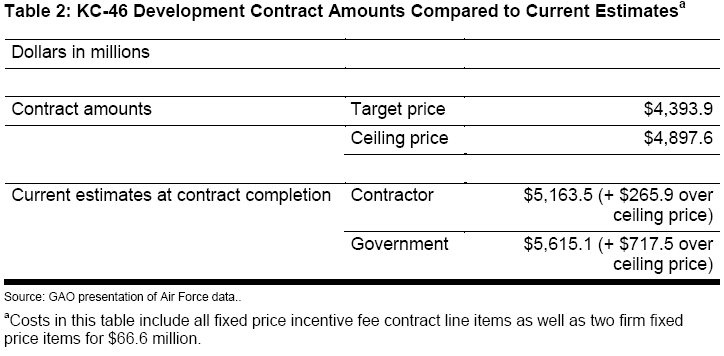
See the table below showing Air Force and Boeing contract amounts and estimates:
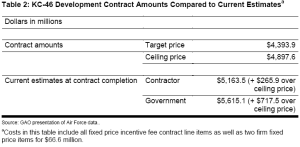
KC-46 EMD Contract & Estimates.

KC-46 EMD Contract & Estimates (Source: GAO).

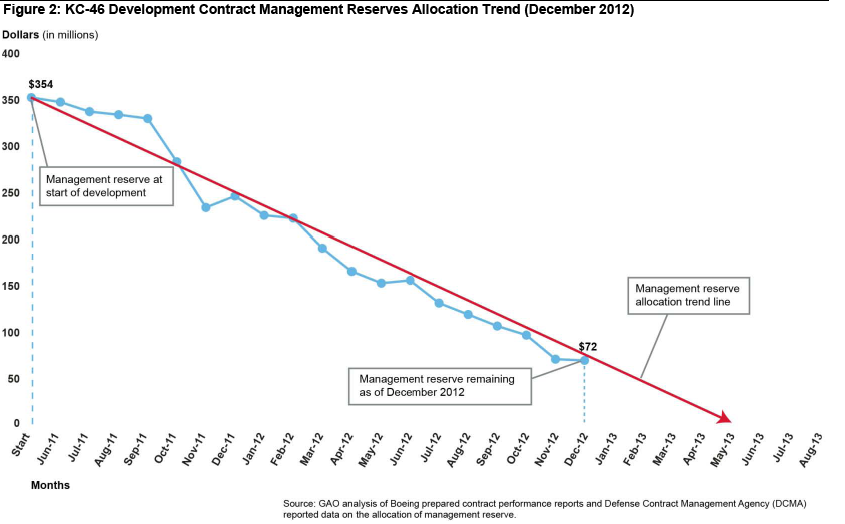
The report from GAO offers the following graphic referring to what they call “management reserves“:
KC-46 EMD Management Reserves (Source: GAO)

KC-46 EMD Management Reserves (Source: GAO)

This graphic shows well the rate at which Boeing has been supposedly burning its margins. However, it does not reflect at all the nature of the issue, related to the type of contract this “Engineering Manufacturing and Development” (EMD) contract: a Fixed Price plus Incentive Firm type of contract (FPIF).

Fixed Price Incentive Firm contracts

It is not easy to find good literature online about these types of contracts. The Wikipedia for instance does not have yet an article on FPIF contracts, but only on the calculation of the Point of Total Assumption. However, you can find a couple of good sites with explanations and examples of FPIF contracts here and here [PDF from the US Army].

Some concepts that we need to bear in mind are (definitions from the link above):

Target Cost (TC): The initially negotiated figure for estimated contract costs and the point at which profit pivots.
Target Profit (TP): The initially negotiated profit at the target cos
Target Price: Target cost-plus the target profit.
Ceiling Price (CP): Stated as a percent of the target cost, this is the maximum price the government expects to pay. Once this amount is reached, the contractor pays all remaining costs for the original work.
Share Ratio (SR): The government/contractor sharing ratio for cost savings or cost overruns that will increase or decrease the actual profit. The government percentage is listed first and the terms used are “government share” and “contractor share.” For example, on an 80/20 share ratio, the government’s share is 80 percent and the contractor’s share is 20 percent.
Point of Total Assumption (PTA): The point where cost increases that exceed the target cost are no longer shared by the government according to the share ratio. At this point, the contractor’s profit is reduced one dollar for every additional dollar of cost. The PTA is calculated with the following formula. [thus, PTA = (Ceiling Price – Target Price)/Government Share + Target Cost]

Where can we get these figures for the KC-46 EMD contract? Some of them are referred to in the different reports and budgeting materials (explicitly or implicitly) and others can be found in the following letter from US Senator John McCain to the DoD from July, 15 2011 [PDF, 400 KB].

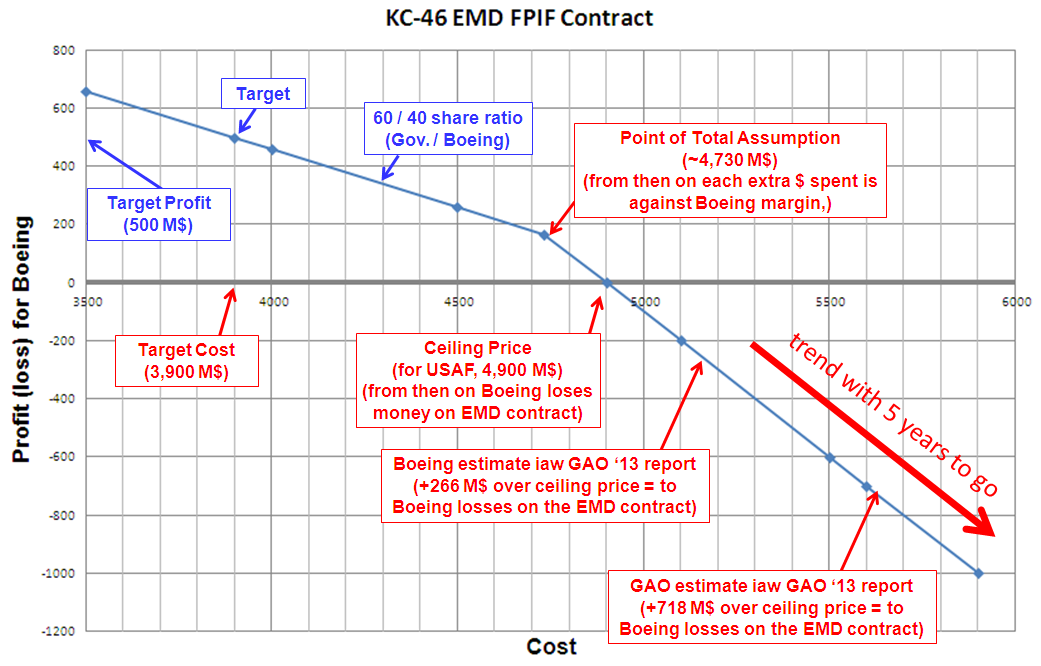
Thus for the KC-46 EMD contract we have:

  • Target Cost: 3.9 bn$.
  • Target Profit: 500 M$.
  • Target Price: 4.4 bn$
  • Ceiling Price: 4.9 bn$
  • Share Ratio: 60% / 40% (Government / Boeing).
  • Point of Total Assumption (calculated): ~4.73 bn$.

With this information we can produce the typical FPIF contract curve, which is the only thing which is missing in ALL the news, budgeting materials, GAO reports, etc., that I have read and is the most illustrative graphic to understand what is going to happen if the cost overruns keep piling and who is going to bear which amount of the cost from which point:
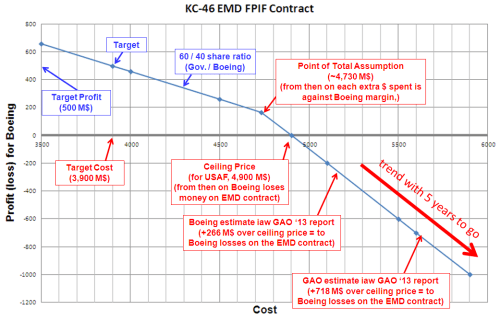
KC-46 EMD FPIF Contract.

KC-46 EMD FPIF Contract.

3 Comments

Filed under Aerospace & Defence

Quiz: How loaded do US Air Force transport aircraft operate?

Let me share with you one funny quiz I did for some colleagues at the office:

On average, how loaded do US Air Force transport aircraft, C-130 Hercules and C-17 Globemaster, operate? (as a percentage of their maximum payload capacity: let’s take the figures reported by the US Air Force, ~16.5 tonnes for the C-130 -“maximum normal payload”-and 77.5 tonnes for the C-17)

Before continuing reading below, take your chance in the poll below, where I offer 4 possible responses: 3 from my colleagues’ responses to the quiz plus the correct one:

Background. Before posing the quiz to my colleagues we were commenting on a piece of news of an Antonov 124 which had landed in Spain to load some equipment weighing 1,000 kg. The An-124 reported payload capacity is 150 metric tonnes. For those not being number-crunchers: that means using the one of the biggest cargo aircraft to load it up to 0.7% of its capacity.

After having read this last paragraph you may have changed your opinion as to which is the correct answer to the quiz.

I based the correct result on a news release from the US Air Force dating from the beginning of 2007. At that time I was working in Airbus Military strategy where I would like to pick up any number related to aircraft and play with it (the hobby has stayed). That release offered figures US Central Command air transport operations, including operations Enduring Freedom (Afghanistan) and Iraqi Freedom. Find the results from that short number play:

US Air Force average loads (in tonnes) for C-130 and C-17 during 2005 and 2006.

US Air Force average loads (in tonnes) for C-130 and C-17 during 2005 and 2006.

If you do the math, you will immediately get the right answer: C-130 Hercules, 22% and C-17 Globemaster, 17%.

“What a waste of resources!” you may think. A former senior colleague pointed to that result: “You buy a Mercedes to travel with the family and baggage, then on a Sunday when having to go out to get some bread or any week day when you go alone to work… when you get to the garage and find a Mercedes… Guess which car you take?”

1 Comment

Filed under Aerospace & Defence