Category Archives: Aerospace & Defence

Boeing commercial aircraft discounts (update for 2010)

Boeing released 2010 results last Wednesday. The company reported revenues in excess of 64bn$, 462 commercial deliveries and 530 net orders for its commercial aircraft. All these were widely reported by the media.

Last year I wrote in one post what was my estimation of Boeing discounts. In this post I wanted to update, if necessary, the figure I calculated for the average discount Boeing applies in its commercial aircraft in relation to the published list prices.

Most of the necessary information can be found in its website. Boeing list prices can be found here. With these list prices, the updated average list price per kg is now ~1,750$ (find the post I wrote last year about this).

The number of gross and net orders (after cancellations) year by year can be found here. Last year deliveries can be found here.

As in the post of last year:

  • I needed to make one assumption: new orders come with a 3% down payment in the year of the booking, while the remaining cost I assumed that was paid on the year of delivery (for simplicity I didn’t consider more intermediate revenue recognition milestones linked to payments, the 3% figure was taken from the AIAA paper “A Hierarchical Aircraft Life Cycle Cost Analysis Model” by William J. Marx et al.).
  • I also needed to estimate the figure Boeing Commercial Aviation Services revenues: the figure I have used is 2.5bn$ [1].

Having put all the figures together, the calculation is immediate. Boeing Commercial Aircraft revenues are the sum of:

  • the discounted prices times the delivered aircraft in the year,
  • less the down payment of the current year delivered aircraft, as the down payment was included in previous years results,
  • plus the down payment of current year net orders,
  • plus services revenues.

The discount figure that minimized errors last year was 38%. Using this figure, the error obtained this year in relation to Boeing Commercial Aircraft reported revenues is 2.8%. A little higher discount would reduce the error; the best estimate is now 39% (being the errors in revenues of: 1.3% for 2010, 1.45% for 2009, 1.7% for 2008 and 1.02% for 2007).

Thus, the updated discount for Boeing commercial aircraft is 39% (!). The price of Boeing aircraft per kg after the discount is then ~1,070$.

***

[1] The error in the estimate of the services revenues is negligible when calculating the magnitude of the discounts: an error of 1bn$ up or down in the figure used affects the error in the estimate of the discount in only 3%; or another way to see it: an error of 1bn$ up or down in the figure used for services would impact the discount value in just 2% to obtain the same error, e.g. 36% instead of 38%.
11 Comments

Filed under Aerospace & Defence

New entrants in the commercial aircraft business

In a previous post, I mentioned the new entrants in the large commercial aircraft business (Bombardier CSeries, Embraer, Russian MS-21, Sukhoi SuperJet, Comac C919, Mitsubishi…). Now that the latest market forecasts both from Airbus (Global Market Forecast) and Boeing (Current Market Outlook) are available, I wanted to briefly note how they are treating the segment that most of these entrants would enter: single aisle jet aircraft.

For example, Boeing in this year’s CMO already splits the single aisle between 90-175 passengers (where new entrants would fall into) and over 175 passengers (still the safe harbor?). In previous studies Boeing didn’t offer such sub-segmentation. On the other hand, Airbus hasn’t published yet such differentiation.

It is even more interesting to compare last year’s GMF and CMO with this year’s ones.

  • Airbus saw a demand for 16,977 single aisle aircraft in 2009 while in 2010 sees a demand for 17,870.
  • Boeing saw a demand for 19,460 single aisle aircraft in 2009 while in 2010 sees a demand for 21,150.

In other words Airbus has increased the single aisle market forecast in 893 aircraft, while Boeing has increased it in 1,690 aircraft… Both have made the forecasted pie bigger before it will have to be shared.

On average, they see ~1,300 more single aisle aircraft than what they saw last year… In the case that these extra aircraft was room made for new entrants, that would leave the new entrants a market share of 6.7% of the single aisle market… not much.

However, those entrants are not yet delivering in that segment and most of their deliveries would come at the second half of the 20-year period. By 2029, it could well be possible that their combined market share is around 10%… still not a big share, but already ~7bn$ yearly business (in 2010 dollars); a ~4.4bn$ after discounts, an amount the size of Embraer revenues (the 3rd company in commercial aviation, reason enough for them to enter the segment).

Boeing even concedes that of the 21,150 single aisle aircraft, 86% of them will be between 90-175 passengers, precisely the market sub-segment that will be ferociously fought.

Leave a comment

Filed under Aerospace & Defence

Commercial aircraft market size after discounts (update)

In an older post I already made an analysis of the aircraft discounts related to the published list prices (by the way, Boeing just raised its list prices 5.2% a couple of days ago). In that case, I used the revenues and deliveries of Boeing in the previous 3 years (38% discount was the result!).

Using that information, now that the latest market forecasts both from Airbus (Global Market Forecast) and Boeing (Current Market Outlook) are available, we can say that the real market size in the next 20 years will be in the order of 2,100bn$ (average of both forecasts in 2010 dollars).

Flow of airplanes

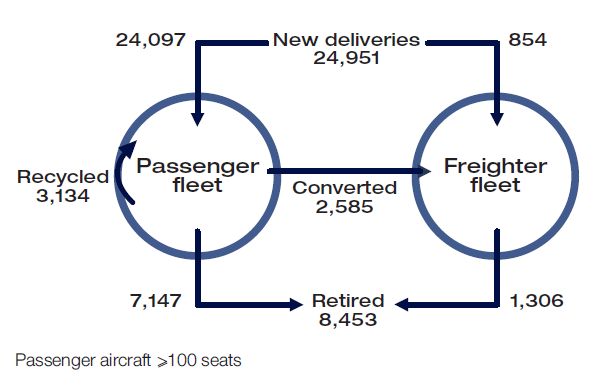
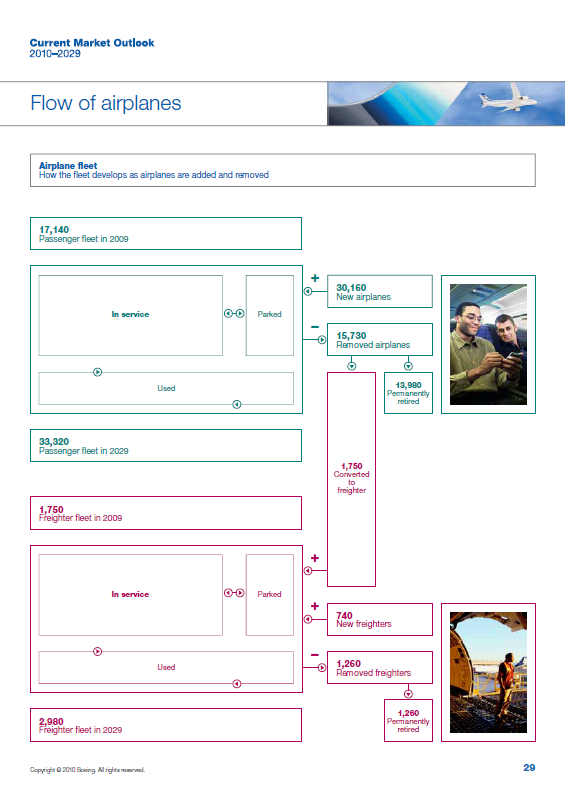
Another very interesting feature that Airbus published in last year’s GMF (it is not yet in this year’s publication) and Boeing used for this year’s CMO is a graphic showing the dynamics of aircraft. In it you may understand how from today’s fleet, adding new deliveries, retiring old aircraft, converting some from passenger to freight transport they arrive to the forecasted fleet in 2029.

I include below both graphics.

Leave a comment

Filed under Aerospace & Defence

Airbus vs. Boeing, comparison of market forecasts

Airbus announced on Monday its latest Global Market Forecast (PDF, 4.6MB) for the 20-year period 2010-2029. Media has already highlighted the main points: ~26,000 new aircraft will be delivered with a market value of ~3,200bn$.

Some months ago, Boeing published its equivalent study, the Current Market Outlook (PDF, 8.2MB) for the same period.

It is interesting to compare the two of them. In that way we can see how each other treat competitors’ products (mainly A380) and how they try to shape the market and send messages to it (point-to-point & hub-spoke).

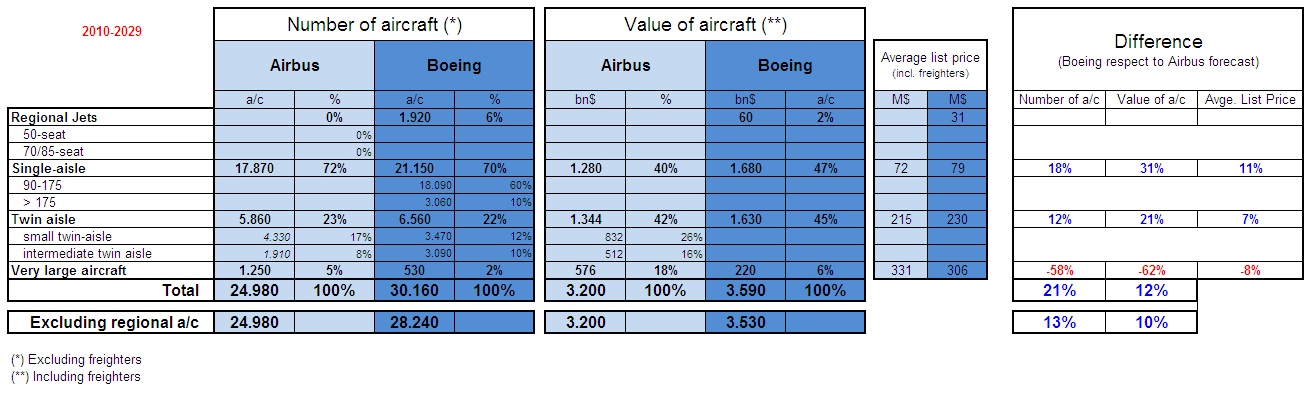
However, it is not easy to compare the studies as they use slightly different segmentations, disclose in different ways the value of aircraft for the segments (list prices) and is not always clear how to discount freighter aircraft from global figures. I dig for some time into those numbers and arrived to the following table:

Comparison of Airbus GMF and Boeing CMO 2010-2029.

Some comments on the comparison:

  • Boeing sees demand for 13% more aircraft with a 10% more value.
  • However, this higher demand is not applicable to all segments: Boeing sees ~60% less A380s or equivalent being delivered over the next 20 years, while 18% more single aisle (A320s) and 12% more twin aisle (A330/A350s).
  • Boeing plays down A380 potential, but sees a very similar number of RPKs (“revenue passenger kilometer”), that is, the number of paying passenger by the distance they are transported. Airbus forecasts for 2029 12.03 RPKs while Boeing forecasts 12.60 (in trillion).
  • The difference of less than 5% in RPKs means that out of the 13% difference in aircraft deliveries over 8% comes from the different business model each company is trying to push.
  • Finally, we can see that Boeing uses again higher average prices for smaller aircraft and a lower reference price for A380s.

Enjoy the two documents, differences apart, they gave a very good piece of information and insight about the market.

7 Comments

Filed under Aerospace & Defence

Nuestra Señora de Loreto

Alguna vez le he dicho a Luca o a algún amigo a modo ilustrativo “con unas alas suficientemente grandes y un motor suficientemente potente se podría hacer volar a tu casa, otra cosa es que fuese eficiente”.

El 10 de diciembre tuvo lugar la conmemoración de Nuestra Señora de Loreto, la patrona de la aviación. Hace unos años encontré algo de información sobre ella y el origen de este patronazgo, que rescato en este post para vuestro deleite, en español e inglés (distintas fuentes), ya que no tiene desperdicio.

Como podéis ver, ya en el siglo XIII unos ángeles probaron mi teoría del primer párrafo con la casa que la Sagrada Familia tenía en Nazaret.

“[…] una antigua tradición que arranca del siglo XIII, según la cual la casa de Nazaret que vio nacer y crecer a la Virgen, y en la que vivió la Sagrada Familia, fue trasladada por los ángeles, primero a Dalmacia (Croacia) y después a Loreto (Italia), en tiempos del Papa Celestino V.”

Siglos más tarde vinieron los motores, los hermanos Wright, los ingenieros, la aviación comercial… la mejora de la eficiencia.

1 Comment

Filed under Aerospace & Defence

The cost of flying low

Last 12th October, I came from Amsterdam to Madrid by plane. That day there was an air controllers strike in France. While flying, the pilot commented that the company had tried to re-route the flight in order not to lose the slot it had, this proved almost impossible so what they did was to fly at a lower level. The pilot explained that this was very “costly as the engines consume much more” at that lower level.

How much more? How costly was this measure? I wanted to check it out, and some weeks later I have made the numbers that I show here.

We flew in an Airbus A321. Since it was the early flight in the morning I assume it carried maximum fuel and the weight was limited by Maximum Landing Weight (75.5 tonnes, MLW), so the takeoff weight would be the MLW plus the fuel weight we would consume in the flight, in the order of 5,500 kg (an average of 2,400 kg/hour according to some operators). Thus I used a takeoff weight of ~81,000 kg.

When flying at a lower level, the air density is higher and this increases drag. Normally, planes in this route fly at ~ 33,000 ft or ~ 10,000 m. What flight level did we use? This I don’t know, so I took the worst situation: say we flew at FL210, or 21,000 ft (~ 6,400 m). We can find at the chart the Standard Atmosphere and see the difference in density at both altitudes (~ 0.53ρ0 compared to ~ 0.33ρ0).


Flight levels, image from Wikipedia.


Standard Atmosphere, image from Wikipedia.


Using the Breguet range equation, all other things being equal (same distance, same aircraft, same weight at the departure…), we can relate the weights and densities of the initial flight plan the company had and the one used after trying to re-route.


Breguet range equation.


The result I got is that by flying at FL210 instead of FL330 the aircraft would have consumed over 1,400 kg of fuel more, a whole 26% more.

I checked the prices for fuel at IATA (International Air Transport Association) and at the moment is 746$/mt. The 1,400 kg of extra fuel would cost about 1,050$ (~ 760€), or about 4.2€ more per passenger (assuming we were around 180 passengers).

8 Comments

Filed under Aerospace & Defence

My first visit to Poland (EADS PZL)

PZL (Państwowe Zakłady Lotnicze – State Aviation Works) was the main aircraft manufacturer in Poland. With the fall of communism, the company was divided and some years ago Airbus Military acquired for EADS part of it, which since then is called EADS PZL.

This week I visited EADS PZL facilities both in Warsaw (where they produce C-295 outer wings, most of Airbus Military electrical harnesses, PZL-130 Orlik trainer airplane…) and Mielec (where the aviation services unit is located) in which was my first visit to Poland ever.

Frankly, I found Warsaw a quite nice place to live even though we could visit the old town only by night. We especially liked the couple of good restaurants we visited: Fukier (apparently the restaurant of choice of Felipe Gonzalez, Madeleine Albright, Naomi Campbell and us, of course) and U Kucharcy (where traditional Polish food is cooked in between the tables where customers are seated).

EADS PZL ZUA, the aviation services unit in the South of Poland (Mielec) operates dozens of aircraft in fire fighting and agriculture missions in places ranging from Sudan, Iran, Egypt, Chile… This unit is made up of a different class of people; adventurous pilots and mechanics that learn a language in few weeks and off they go to their next assignment in another corner of the world living by the aircraft in tents at ad-hoc built “bases” close to forests. Enjoy this video of a PZL M-18 Dromader in a demonstration flight:

I loved this visit. It was impressive to see the tens of Antonov 2 and PZL Dromaders, and we were offered a flight around the skies of Mielec in a Piper Seneca V, which I had the chance of piloting for a while.

To my fellow EADS workers: if you have the chance of spending some time working for PZL, do not doubt it, go for it.

This slideshow requires JavaScript.

6 Comments

Filed under Aerospace & Defence, Travelling

Airbus Military private party

Last time I went to the night disco “Kapital” was some years ago, yesterday I went again as my company, Airbus Military, organized a private party for its engineers (with about 1,000 people attending) to celebrate the recent certifications of the A330 MRTT (multi role tanker transport) and the C-295 anti-submarine warfare (ASW).

“Madam, if a thing is possible, consider it done; the impossible? That will be done”, this quote from Charles Alexandre, vicomte de Calonne, was used by Javier Matallanos, Airbus Military Senior Vice President of Programmes, to describe what it is being done at the company in the last years. As he stated, we, in Airbus Military, have launched recently the first air-to-air refuelling aircraft in the history of Europe  and the only anti-submarine warfare aircraft in the last 40 years in Europe (he quoted the only other European attempt, UK’s Nimrod, which has ended in a cancellation as I posted some months ago, the previous programme is the Breguet Atlantic).

Both Matallanos and Miguel Angel Morell, SVP of Engineering and Technology, thanked families and partners of Airbus Military workers for their continuous support: “be proud of your partners, please, know that they are exceptional people as they are used to do the impossible and these examples (MRTT and ASW) we are celebrating today are only two of the many we could give account”.

Finally, even though at the time of the speeches the presence of the CEO of the company, Domingo Ureña, was excused due to personal reasons (aside of closing the A400M negotiation in the same day), the CEO indeed appeared at about 23:00 as we saw him at the fifth floor.

My kudos to the person who had the idea of organizing this event and to the ones carrying it forward. I look forward to some more initiatives like this in the future.

This slideshow requires JavaScript.

1 Comment

Filed under Aerospace & Defence

Is a hassle-free airport possible?

Some years ago on trip to India, I remember having passed through the security check just before getting into the airplane at Schiphol airport in Amsterdam. However in the subsequent flights I have taken from there I never saw this again… until last summer, on another trip to a non-Schengen destination, Tunisia.

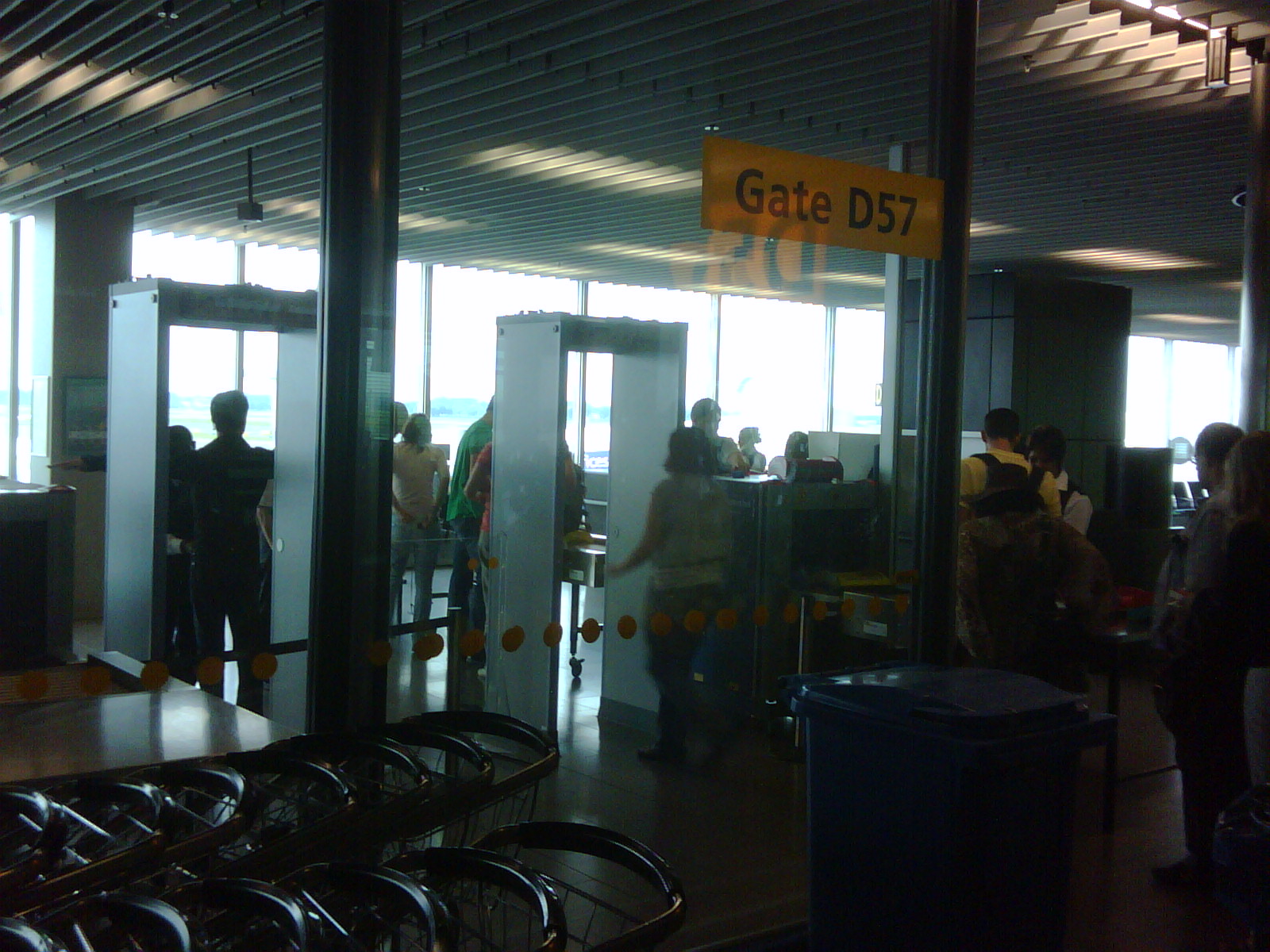
Here is the picture I took.

X-ray scanners and metal detectors at Schiphol, Amsterdam.

As you can see, in terminal 1 departures D of Schiphol airport, the security control is located just where each boarding gate is.

You can imagine how much this measure reduces the hassle passengers experience in airports. To take that flight, we arrived at the airport, dropped our luggage, showed our boarding pass and passport to an official (no long queue, no removing of personal belongings…), walked to our boarding gate and only there we made a small queue for the security control… The difference: that queue is composed of just the people who will come in your flight, you are seeing the airplane out there, there is no rush, they are seeing you, you are not missing the plane…

I tried to get the numbers from Madrid-Barajas airport but I did not find them (if any one has better estimates or a reliable source, please feel free to contribute), nevertheless, from having seen the different terminals I can figure out that:

  • It may have around 230 boarding gates among all the terminals (over 60 between T1, T2 and T3, around 90 in T4 and over 60 in T4S).
  • It may have no more 50 than x-ray scanners…

If you wanted to install 2 per boarding gate, you would need to invest in buying and staffing more than 4 times the number of x-ray scanners and metal detectors than the ones that there are now… It would be so easy… if just air traffic controllers did not suck up a whole 30% of AENA yearly costs [pdf, 741 Kb] (~1bn€)…

3 Comments

Filed under Aerospace & Defence

After the year 2015, there will be no airplane crashes

When I was writing in the previous post about Alberto Dubois idea of evolution being exponential I had in mind the book “Augustine’s Laws”, to which I have referred many times in this blog.

Today, I read a very good article in last week’s issue of The Economist, “Defence spending in a time of austerity”, which describes the current situation of defence budgets around the World and how it will affect many programmes…

The article itself is referring to the computing evolution depicted by Dubois and some other exponential trends identified by Augustine, such as the increased use of computer power and software.

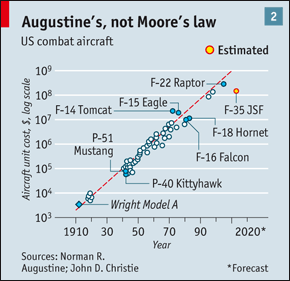
I especially liked the update of Augustine’s chart for the Law XVI which says:

“In the year 2054, the entire defence budget will purchase just one aircraft. This aircraft will have to be shared by the Air Force and Navy 3½ days each per week except for leap year, when it will be made available to the Marines for the extra day.”

Augustine's Law XVI chart, updated by The Economist.

Thus, in the last 25 years, since Augustine wrote his book, the business has not improved much. This situation provokes that different countries have to share weapons, e.g., C-17 transport aircraft (Strategic Aircraft Capability, operated for several countries from Hungary), SALIS (“Strategic Airlift Interim Solution”, chartering of ex-soviet An-124 to NATO countries)…

One of the most striking situations that may come to happen is that UK and France share two aircraft carriers. Carriers were considered essential to have control over oceans… however, if France is going to scale its fleet down to one single carrier: what would happen during the long months when it will be in overhaul?

Lately there have been much discussion about this sharing scheme, though it is still denied by officials. Consider that just back in 1940, the British Royal Navy destroyed much of the French fleet in the Operation Catapult.

Other interesting point is the trend towards using unmanned aircraft versus piloted ones. Already in the “Aircraft Investment Plan Fiscal Years (FY) 2011-2040” (PDF, 0.2MB) that the US Air Force submitted together with its FY11 budget request, it forecasted that the number of unmanned aircraft will almost triple in the next ten years, while the rest of fleets would be either just renewed or decreased.

Nevertheless, this may never come to happen if we take Augustine’s Law Number XIV:

“After the year 2015, there will be no airplane crashes. There will be no takeoffs either, because electronics will occupy 100 percent of every airplane’s weight”.

4 Comments

Filed under Aerospace & Defence