Category Archives: Books

De Feria en Feria

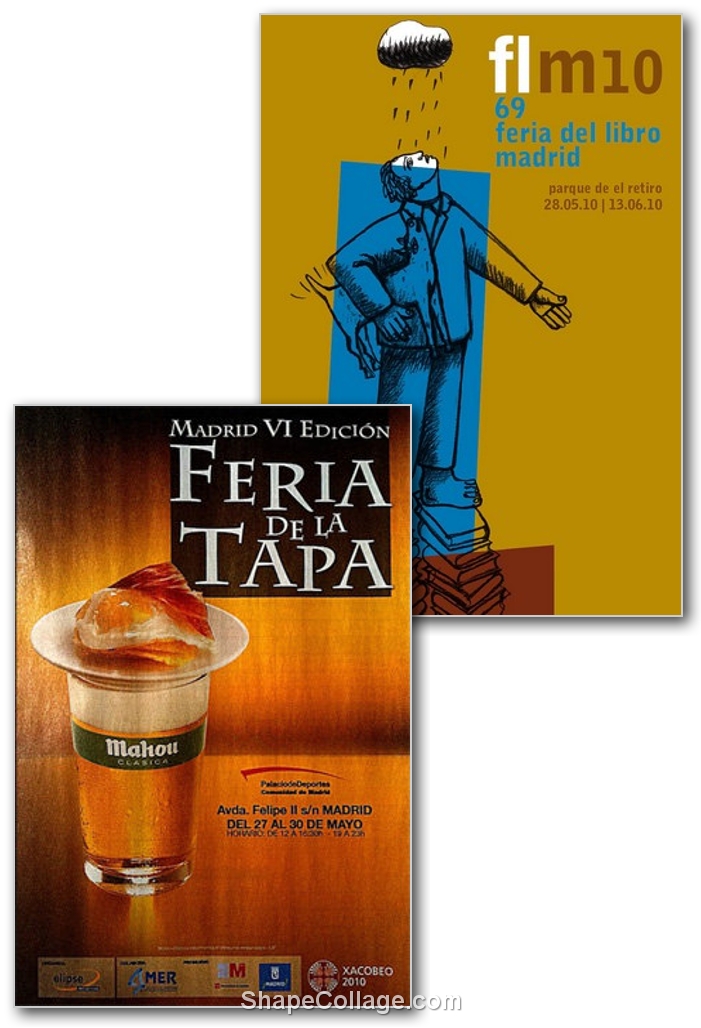
Last weekend, on top of attending family visits and a wedding, I could spare some time in two different fairs: the “VI Feria de la Tapa de Madrid” and the “LXIX Feria del Libro de Madrid”. Both experiences, as it was expected, were a success.

Posters of "VI Feria de la Tapa" and "LXIX Feria del Libro" of Madrid.

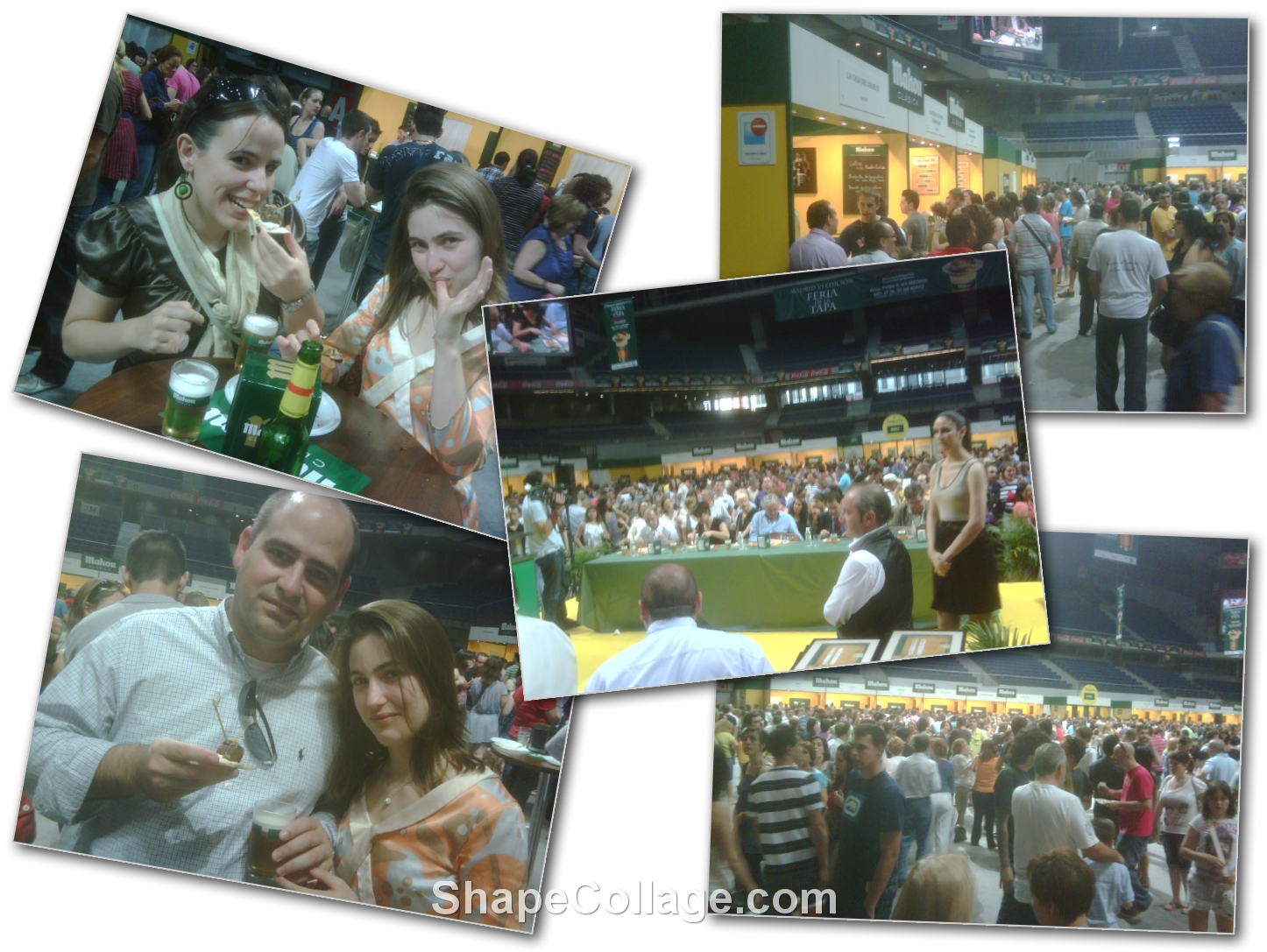
In the gastronomic fair I had lunch on Saturday and supper on Sunday, the day it closed. There were 38 restaurants and taverns from the Madrid region represented in the fair, and each one of them brought 4 or 5 different tapas. By chance, while we were there on Sunday evening it was taking place the contest to elect the best tapa… My first thought was “it’s not a bad contest to be judge”, later I thought it better… one thing is to take 6 or 7 tapas at your will and rhythm, and a very different one is to take 38 tapas in a row! Anyway, the judges didn’t look bad at all.

VI Feria de la Tapa.

On Sunday I went to the book fair (I will come more times this year, until June 13th) and I had another please surprise. During the first smooth walk along the stands I stopped by the one of Ecobook bookshop and I asked about a book just to see if they had it by chance, and, they did have it! The book is “Confusión de confusiones” (of which I had already referred to in another post).

This book was written by the Spanish Jose de la Vega and is the first book about the stock market. Once I finish it I’ll write more about it, now I leave here the link of a blog about it.

3 Comments

Filed under Books, Miscellanea

Ethical Banking

I attended yesterday a conference by Joan Melé at EOI Business School. It caught my interest by its title Dinero y conciencia: ¿A quién sirve mi dinero? (Money and conscience, who benefits from my money?), even though I didn’t know the presenter nor the bank he works for.

I want to make some reflections of yesterday’s experience:

  • The first one as a Toastmasters member: I applaud the decision of the speaker to stand up, not using notes or a power point presentation and managing to get the focus of the audience on him and his message for over an hour and half… we witness many conferences in which the experience is not so enjoyable.
  • The next reflection is to praise the move by EOI Business School towards web 2.0 made some months ago. As an alumnus of the school I must say that it’s very motivating to see the number of activities organized, the topics covered and it’s very convenient the way they are publicized in the different channels: EOI web and blogs, Facebook, streaming TV channel, Twitter… and because of that, because you can actually watch the whole of the conference or catch a glimpse of the main messages, I will just add very few ideas that I took for reflection and some sources the presenter cited.

Regarding money itself, the speaker structured his speech in the three main uses of money: to buy, to save and to donate.

  • When buying: he proposed the exercise of thinking “what”, “why” and “where” to see how our purchasing decisions affect others (low wages, pollution, exploitation…). He made the case for an economy based not so much in consumption of material things but cultural and intellectual ones: e.g. we happily pay 30 euro for a dinner, would be pay the same to be read poetry?
  • Regarding saving he noted the positive side of it: planning for future expenses. The other side of the coin being “fear of the day of tomorrow”: what will happen that we won’t be able to face? Nothing: Whatever comes, we will be able to face it. This reminds me to Charlie Munger comment on Berkshire Hathaway shareholders meeting when he said that he became comfortable […] after he realized he could survive hardship, “Maybe you should get your feet wet with a little more failure”. We lack some entrepreneurship…
  • The speaker did not want to go in deep about donating, except pointing that handing large inheritances to offspring can be more harmful than positive to them and society.

Some ideas to take away:

  • There are no leaders to solve our problems; it’s the turn of civil society to take action. It’s the time for the Globalisation of conscience.
  • The responsibility for what happens around us is ours, we need to first change ourselves.
  • We are the crisis of 3 billion people since dozens of years ago.
  • Need to bring back the role of banks as agents that relate people: savers with entrepreneurs in order to create wealth with profits as a by-product not as the one and only end.
  • Need to start and epidemic of courage and enthusiasm.

Finally, some reports, articles and documentaries he cited:

One final quote from Charlie Munger to end this post: “The secret to happiness is to lower your expectations.”

4 Comments

Filed under Books, Helping others, Investing, Movies, Toastmasters, Twitter & Media

Value investor: Joel Greenblatt

Last week, I watched an online interview by Steve Forbes to Joel Greenblatt, a value investor, author of the book: “The Little Book That Beats the Market”.

I read this book about two or three years ago and I remember it as a very enjoyable read (just about 150-200 pages). He proposes a formula to automate the stock picking process that would result from applying value investing principles by a person that doesn’t want to get too much involved.

During much of the interview he discusses how they have tested the formula, how it beat the market in this and that time, etc…

Summarizing, he admits that he based the formula in:

  • From Benjamin Graham: buying cheap.
  • From Warren Buffet: not only buying cheap, but buying a good company.
  • Last but not least: you need long periods of time, thus, patience.

This last requirement is what most speculators (vs. investors) lack of.

If you are interested in the formula, you may use it for free in his website.

Nevertheless, if I were you I wouldn’t stop there, but read “The Intelligent Investor” (especially chapters 8, 14 & 20)… the sooner, the better.

To my friends: if you are interested in Greenblatt’s book, I also got it, if you want to borrow it…

1 Comment

Filed under Books, Investing

International Day of the Book

Today is the commonly known as International Day of the Book. I learnt in the Wikipedia that it is actually called by UNESCO: “World Book and Copyright Day” (I wonder how the copyright part of it is celebrated…).

There, I also learnt that this tradition was originated in Catalonia, Spain, and that even though it is commonly stated that is the anniversary of the death of both Cervantes and Shakespeare (23rd April 1616), that is not correct as at the time England was using the Julian calendar instead of the Gregorian one, thus Shakespeare died 10 days later.

Recommendations. My contribution on this day is the recommendation of the 3 books of those I read last year that I liked the most:

  • “Augustine’s Laws”, Norman R. Augustine.
  • “A Random Walk Down Wall Street: The Time-Tested Strategy for Successful Investing”, Burton G. Malkiel.
  • “Particula Divina” (“God Particle”), Leon Lederman.

In the same way I would appreciate if you leave your recommendation of the books that you liked the most of those you have read recently in a comment to this post.

E-Books. Two weeks ago I read in The Economist an article about the publishing industry. It cited a study, from PwC, which estimated that consumer ebook sales in North America will have a share of 6% of the market in 2013 (up from 1.5% in 2009). That would be one out of every 16 people. However, I think I only know of one person reading e-books as of today (a member of Excelencia who spoke about it a year ago). Let’s see if we find more people doing so:

3 Comments

Filed under Books

Sao Paulo from the top of Banespa building

Banespa building is an important skyscraper in the financial center of Sao Paulo. Banespa stands for Banco do Estado de Sao Paulo, which now is owned by Banco Santander. The building was designed by a Brazilian architect, Plínio Botelho do Amaral, who was inspired by the Empire State Building. It was for 20 years the highest building in Sao Paulo, until surpassed by Edificio Itália.

Banespa Building (photo by Felipe Mostarda) and Empire State Building (photo by David Shankbone).

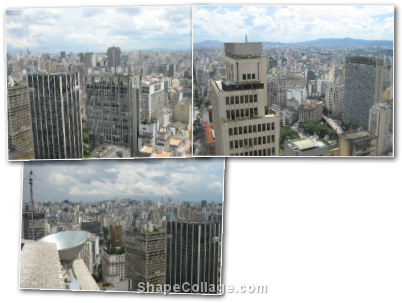
At the top of the building there is an observation deck from which you can see stunning views of Sao Paulo, with hundreds of skyscrapers in whichever direction you look at for kilometers and kilometers. Then you realize that you are in Sao Paulo, the 6th or 7th most populated city in the world (depending whether you look at the city limits or metropolitan area).

Sao Paulo skyline from Banespa observation deck.

Other famous observation decks that I visited recently were the one in the ESB and the Top of the Rock at the GE Building Rockefeller Center, there are some differences though:

  • Height: Banespa, 161 m; Rockefeller, 259 m; ESB, 443 m.
  • Number of floors: Banespa, 35; Rockefeller, 70; ESB, 102.
  • Construction finished in the year: Banespa, 1947; Rockefeller, 1939; ESB, 1931.
  • Observation deck ticket price: Banespa, free; Rockefeller, 20$; ESB, 20$ + 20$.

Race in New York. Let me share here with you a story about a race to build the tallest building that took place in the late 1920’s. I found this story in the book, “Tales of New York”, which I commented in a previous post.

Three buildings were being built at the same time, the 40 Wall Street, the Chrysler Building and the Empire State Building. Competition among them was fierce at the time, with names of big industrialists behind them. Plans were revised once and again. The first one in being finished was the 40 Wall Street in April 1930 which claimed the title of world’s tallest building at the time. Originally it was to be 840 ft but along the race the plan was revised to make it just 2 feet taller than the Chrysler building plan at the time 925 ft, at completion the 40 Wall Street height was increased to 927 ft.

During the last weeks of its construction loads of iron and steel were brought to the interior of the Chrysler building. People thought that it was part of the interior decoration, filled with metallic details and motives of the automotive industry. But once its rival building was finished, on a clear day in the morning a needle-like metallic structure was raised from the center of the top of the Chrysler building to the surprise of the population of New York. On May 27th 1927, the Chrysler building was finished, in the end measuring 1,046 ft, taking the title of tallest building from 40 Wall Street merely a month after.

Walter Chrysler had worked in the past together with the man behind the Empire State Building, John J. Raskob, then CFO of General Motors, one of the main competitors in the automotive industry. He wanted him to either fail in the pursuit of building the tallest skyscraper or becoming bankrupt if he made it. With 1,046 ft height the Chrysler was to be tallest than the Empire State Building when it would be finished, however in the year that took the ESB to be finished the design was subsequently changed measuring 1,454 ft when it was finally finished in 1931, taking the title of tallest building from the Chrysler just a year later.

Just to close the post…

  • nowadays the tallest building is the Burj Khalifa in Dubai with 828m (160 floors),
  • the tallest building in Europe is Commerzbank Tower in Frankfurt with 259m (65 floors) and very close to it is the Main Tower (200m) that hosts a very nice restaurant which is the only observation deck in the skyscrapers of the city,
  • the tallest in Spain is the Caja Madrid Tower with 250m (45 floors) which holds the 148th position in the list of highest skyscrapers.
  • another interesting point is to see the evolution of the title of “tallest skyscraper in the world”.

Leave a comment

Filed under Books, Travelling

FC Barcelona copying Real Madrid

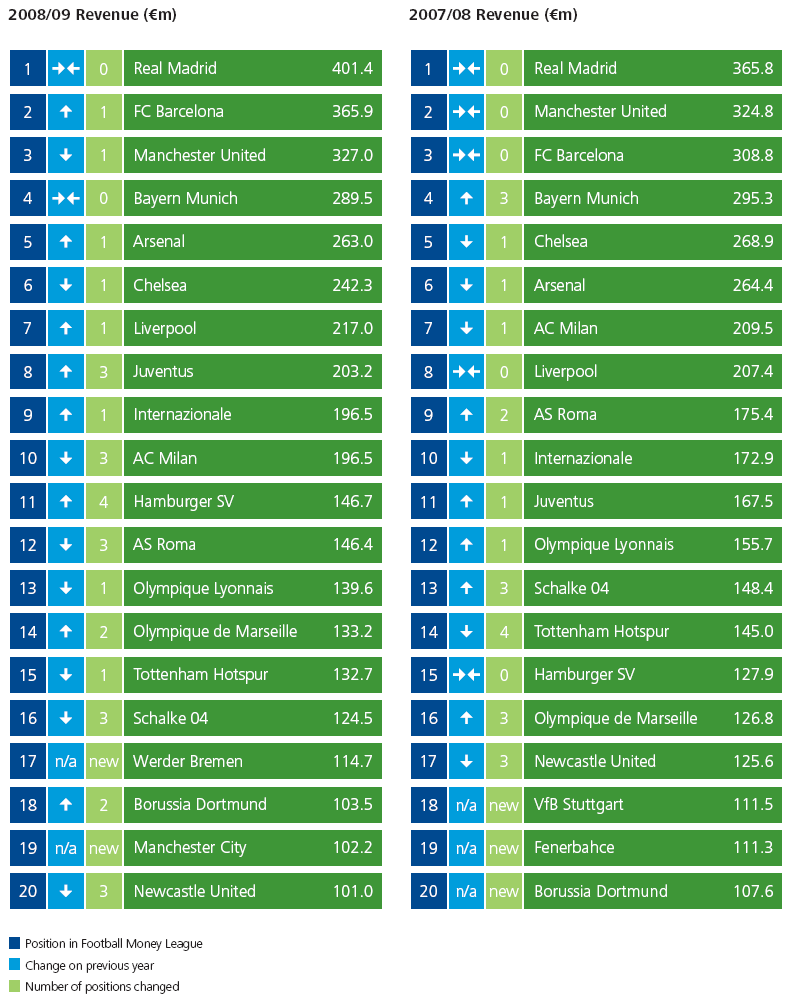
The Sports Business Group from Deloitte recently published its 2009 Football Money League report. It is a quite interesting report for football fans.  

The first remarkable table is that showing Real Madrid and Barcelona well ahead other European clubs. 
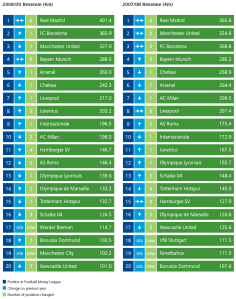
2009 Money League ranking.


I was reading parts of it and I was wondering… what is the difference between Real Madrid’s and Barcelona’s model? 

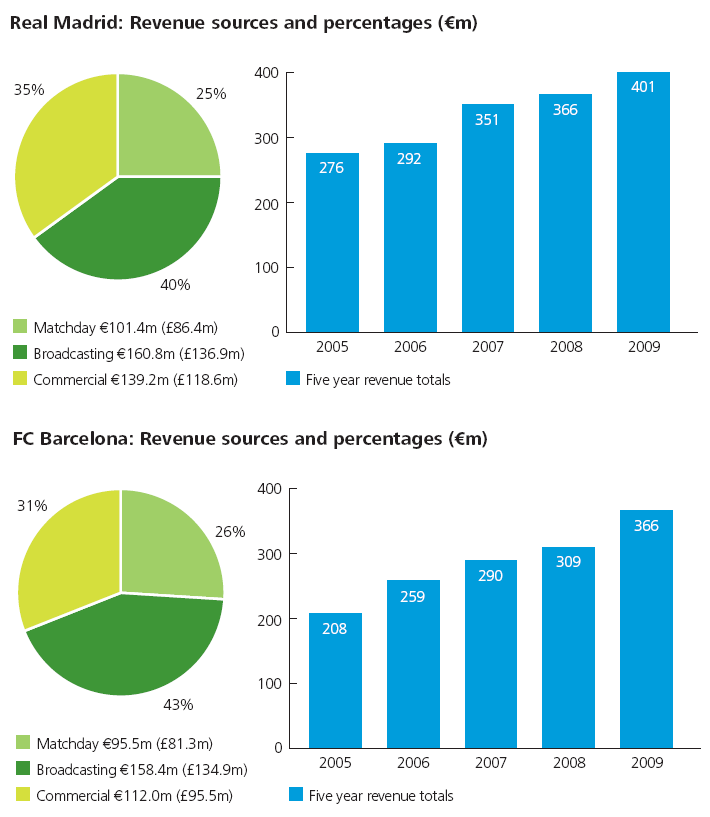
In the graphics below you may see the revenue sources for both clubs. The differences are minimal in two chapters: Matchday (6M€, 6% higher for Real) and Broadcasting (2.5M€, 1.5% higher for Real). The main difference comes from Commercial revenues: with Real Madrid earning 139.2M€, 27.2M€ more than Barcelona. The main driver for this difference are revenues generated by shirt sponsorship, which according to the report are worth 15-20M€ for Real while Barcelona is not charging Unicef for this concept. 
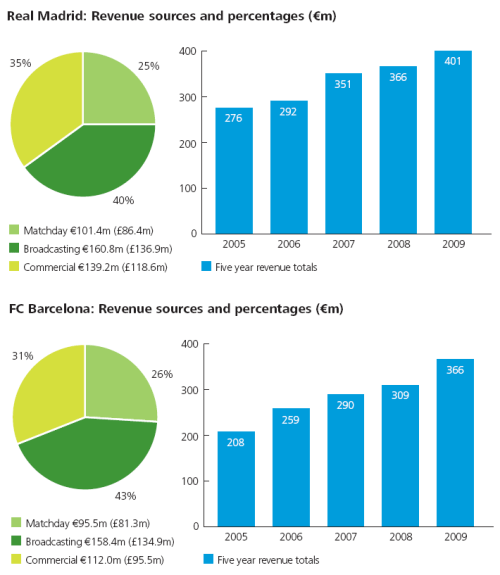
Real Madrid & FC Barcelona revenue sources.


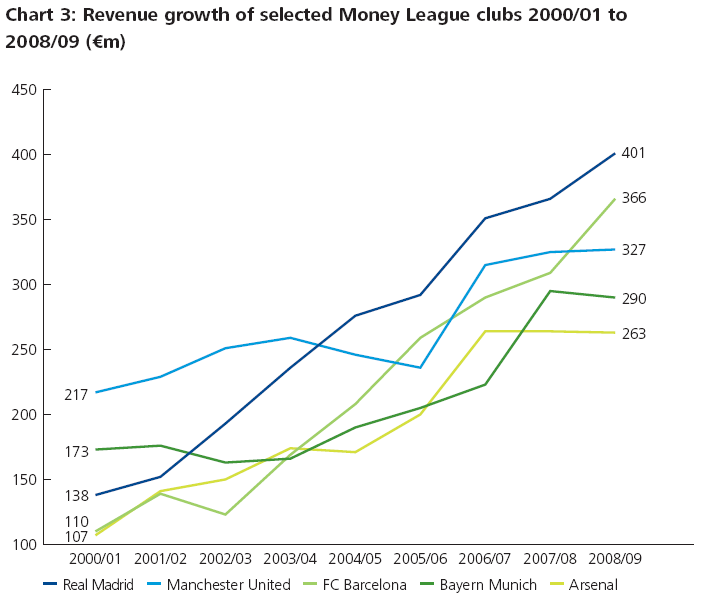
In this other graphic you may compare the skyrocketing revenue growth for both clubs. Real Madrid’s positive trend starting in 2000, when Florentino was elected President and Barcelona’s starting in 2003, when Laporta was elected President. 
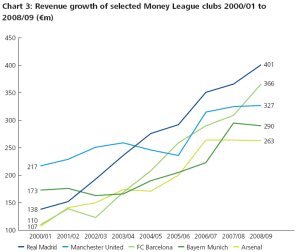
Real Madrid & FC Barcelona revenue growth.


David Allen and Raúl Eguía, from the Instituto de Empresa, published a very interesting study: “FC Barcelona: Changing the rules of the game” in October 2004. 

That report reviews the months before and after Laporta’s election as president, his campaign as candidate, his relations with different groups, his plans for Barcelona and the first year as president of the club. 

We can read some excerpts from interviews with members of his board of directors. For example, the Vice-chairman of the Social Area, Alfons Godall is quoted saying: “We had all the financial information about the club from 1996. This enabled us to put together a very specific analysis which led us to the conclusion that sports and economic management were closely related. It is very important to have a clear policy for salaries and signings, as well as for bringing in players from the youth teams. In short, to run a club like Barça you have to have a model and we had been working on such a model.” 

This sounds very familiar to the “Zidanes y Pavones” slogan from Florentino. 

We have often heard words from Barça’s president such as “chollo”, “pelotazo”, etc… describing the model of Florentino Pérez in Real Madrid. Let’s review the corner stone of Laporta’s first project in Barcelona: “At the beginning of December 2003, FC Barcelona reached an agreement with La Caixa, a bank which was to front a syndicated credit for €151 million48 together with other entities such as Banco Sabadell, Caixa Catalonia, Banco Popular, Banesto, Caja Mediterráneo (CAM), Cajamar and Deutsche Bank. The transaction, which was spread over seven years, would make it possible for the current sports project to go ahead and for the sports centre in the Barcelona town of Sant Joan Despí to be completed.” 

Leaving aside the demagogy of Laporta, can anyone tell me difference in the model of either club? See the famous “virtuous circle” of Barcelona… 

FC Barcelona's "circulo virtuoso".


The answer “the difference is point number 2: Great sports results” is too easy…
7 Comments

Filed under Books, Sports

Einstein’s: The World as I see it

Yesterday I finished reading Einstein’s book “The World as I see it” (in Spanish “Mi vision del Mundo” -205 pgs.-, Ed. Tusquets, from the original “Mein Weltbild”).       

I firstly came across this book many years ago in Casa del Libro, when searching for his books on special and general relativity. Then I wasn’t very interested in this book, I looked for science. Later on, I grew curiosity for it driven mainly by the desire to know what was his explanation of his connection with the Manhattan Project, his defence of Zionism, how he based his religious believes…     

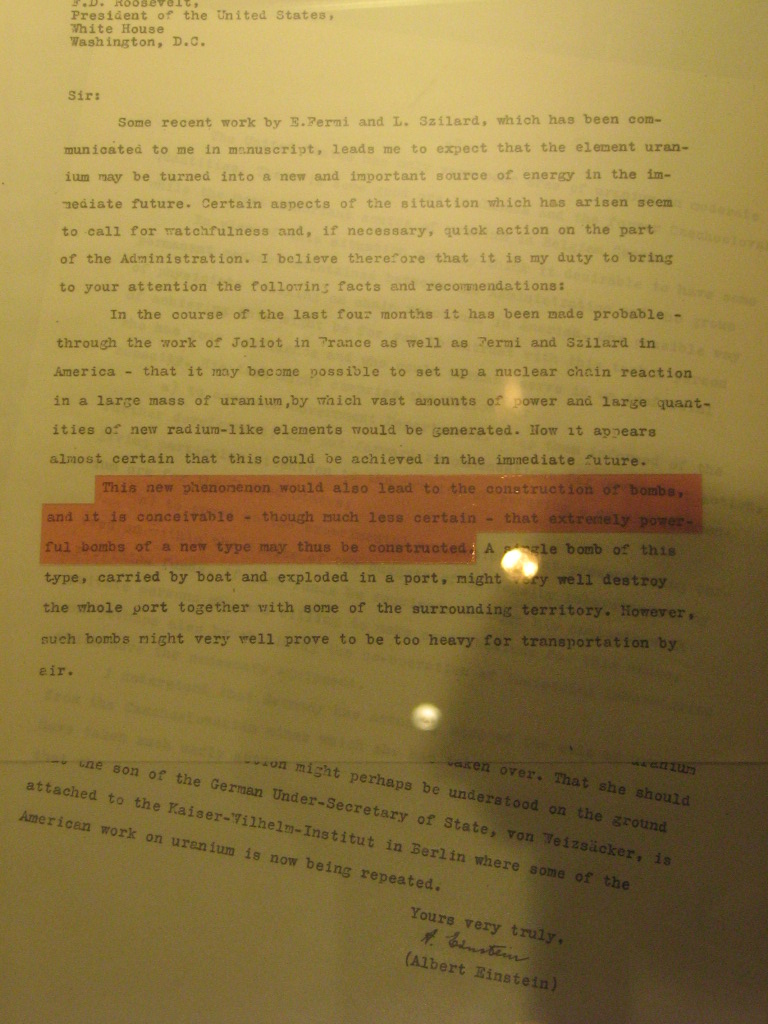
  • He explains his resolution for writing the letter to F. D. Roosevelt telling the necessity of conducting experiments to study the possibility of building the A-bomb. The only reason: the danger of the Germans working toward the same. He says he was completely conscious of the horrendous outcome for human kind but found no other way out despite his solid pacifism.

Einstein's letter to F.D. Roosevelt. Hiroshima Peace Memorial.


  •  In the book, there are several other letters and speeches in favour of pacifism, the creation of supranational organizations to which nations shall transfer sovereignty, the disarming of the nations, shows criticism against the creation of mandatory military service for the youth (he continuously called for insubordination) …
  • He explains in his book that he understands Judaism more as a tradition centred in moral issues concerning practical matters than a religion based on faith. He defends the creation of a nation for the Jews because of the hostility found in other countries, admits the nationalistic approach of that creation and says that if the situation was different he would be the first one in rejecting all forms of nationalism calling for a universal human community. He joined Zionism as a consequence of the anti-Semitism he found in Germany. The majority of his letters on this issue come from the ‘20s and ‘30s. Einstein died in 1955, before the Suez-Sinai and the Six-Day wars. 
  • Religion: he rejects the concept of a God that rewards and punishes every action of humans. He uses the term Cosmic Religiosity and writes:

“I am of the opinion that all the finer speculations in the realm of science spring from a deep religious feeling, and that without such feeling they would not be fruitful. I also believe that, this kind of religiousness, which makes itself felt today in scientific investigations, is the only creative religious activity of our time.”      

I definitely recommend the book; though I warn the reader that it is not an easy read, it is quite dense, there isn’t a spare word…

3 Comments

Filed under Books

A Tale of Two Cities…

I’ve just finished reading the book “Hidden Madrid. A walking guide”, by Mark & Peter Besas, two Madrileños originally from New York. The book is terrific. It has hundreds of tales, anecdotes, curiosities, pictures, etc… of the city of Madrid:

  • The origin of futbolin.
  • The suicide mission of Eloy Gonzalo at Cascorro.
  • The voices of Palacio de Linares (Casa de America).
  • The origin of Atocha.
  • The miracles of San Isidro.
  • The priviledges of Paco the dog…

Last month I read a similar book about New York, written by another New Yorker (this one originally from Ohio), John Keatts, “Tales of New York: Some Will Surprise You”.

We met John at the Circle Line boat tour around the island of Manhattan last December. He was our guide. He not only had a very pleasant voice but kept telling more and more facts, stories and anecdotes about the city and the persons who marked the history of NY during the 3-hour journey.

He mentioned that he had written a book with these stories and when we were leaving the boat, my partner Luca saw him handing his book to someone, so we decided to stop and buy it. Another terrific book. As he puts it in his web:

  • A poor farm boy who began a simple ferry boat service, and became a millionaire
  • A renowned bridge-builder whose work on a statue would change his life
  • A newspaper man who seized an opportunity
  • A man whose building forced our skyline upward…

And yet a month before I read “How to survive Holland”, by Martijn de Rooi. Another wonderful book explaining many facts (traditions, food, history, sightseeing, sports…) about the Netherlands delivered with some self-deprecating humour and irony.

All three books are strongly recommended.

1 Comment

Filed under Books, Travelling

Three centuries of confusion

Last Monday I was reading an article in FT by Tony Jackson: “Is China an investment sweet spot or a sour lesson?”.

Not that I am thinking about investing there, but in this article I started reading sentences which rang bells… “the long-run correlation between real growth in gross domestic product and real equity returns is in fact slightly negative”, “reminder of the futility of long-range forecasting”, “how to explain the underwhelming performance of emerging equities, besides a simple propensity to overpay for growth?”…

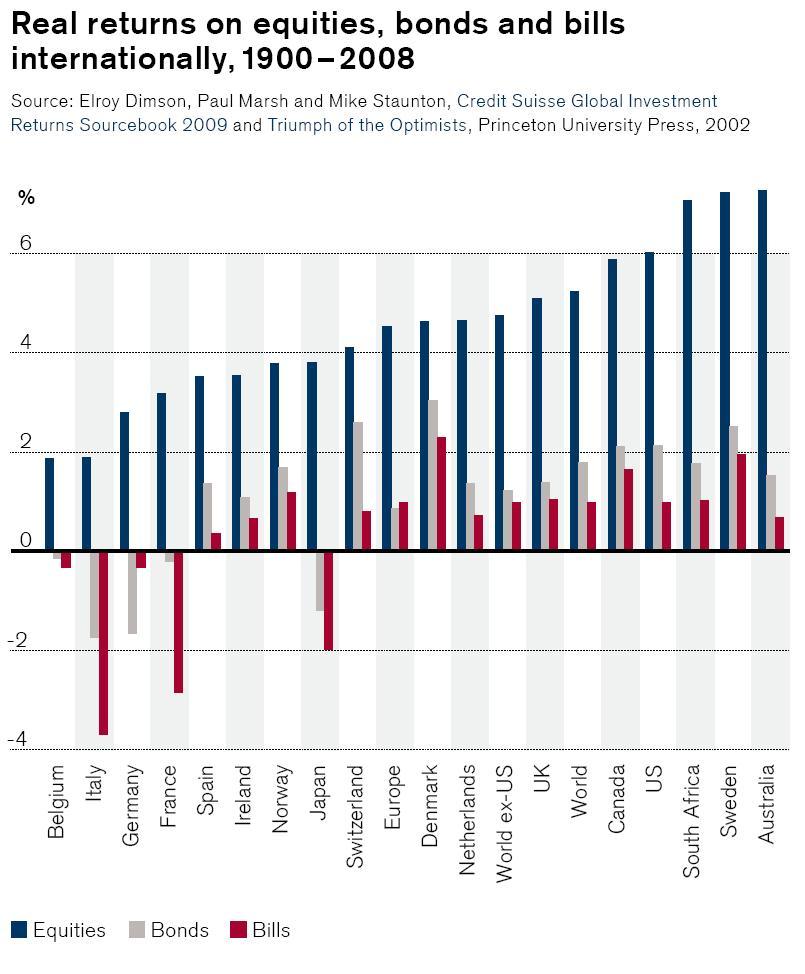
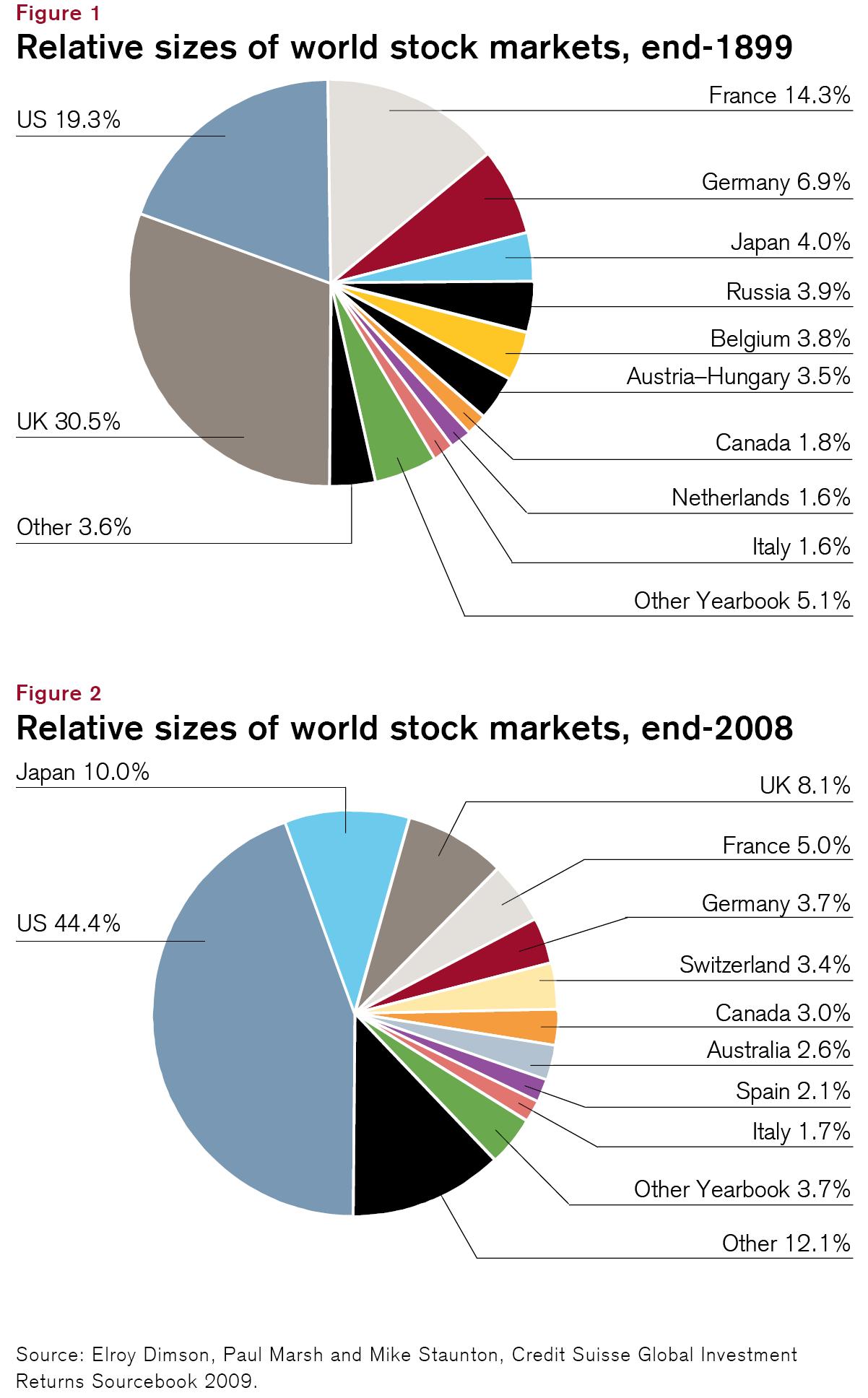
Nevertheless, the best I got from this articles it wasn’t those reflections but that it referred me to the Credit Suisse annual study from the academics Dimson, Marsh and Staunton. 

This annual study contains wonderful data and graphics. Let me share some of them.

Later on the report very well summarises what we have read and heard so many times from Graham and/or Buffet:

“Value stocks sell for relatively low multiples of earnings, book value or dividends. They may be mature businesses with an unexciting future, or they may have a depressed share price that anticipates setbacks. Growth stocks sell for relatively high valuation ratios, reflecting favorable prospects for the business, and their stock price anticipates cash flows that are expected to get larger in the future.

For larger US companies, over the longest available period (end-1926 to end-2008), the difference between the annualized returns on the Fama-French value and growth indexes is 2.5%. In other words, the premium for US value stocks, relative to large companies as a whole, is approximately +1.2%, while the «premium» for growth stocks is of the same magnitude but negative.”

Finally the report reviews the case for different countries and regions. Among them The Netherlands, where the stock exchange originated with Dutch East India Company. Here we find a reference to the book “Confusión de confusiones” by Jose de la Vega (1688), an Spaniard who wrote the first book ever on the stock exchange business. 

I will end this post with one quotation from the book: “What really matters is an awareness of how greed and fear can drive rational people to behave in strange ways when they gather in the marketplace.” (We have heard this lately from someone else as well).

2 Comments

Filed under Books, Investing

New marketing

Some weeks ago I attended the presentation of a book at EOI business school, “Claves del Nuevo marketing” (which can be downloaded in pdf freely).

At the moment of writing this post I have not yet read the book, though it seemed quite interesting: Eighteen different authors just gathered to write different chapters on their area of expertise.

The conference itself was quite entertaining. Two of the authors were commenting their views on metrics and on viral marketing.

They quoted some articles, videos and examples that I want to quickly refer here:

  • Article from Marshall Sponder & Cecilia Pineda Feret in Customer Intelligence, discussing the possible entry of Google on Social Media monitoring and what could this mean.
  • On viral marketing it was interesting the questioning of whether it really reaches that many people. We tend to think so, but does it really do so? Check out this funny video (in Spanish).
  • Another very interesting video: “Redes Sociales – ¿Revolución o Moda?” (the video is in English, “Social Networks – Revolution or Fashion?).

I’m just referring to these topics as discussing them at length would need many different posts. I hope you enjoy them.

That day, EOI was distributing the latest issue of the marketing magazine “Yorokobu”. I will comment in a near future different things I read there (e.g. 94wines…).

One last thing I wanted to share with you: my Lego. I had seen advertisements about cartoonfying yourself, but I found this one in the Yorokobu magazine even funnier. This is as close as I could get to myself.

Lego of myself

3 Comments

Filed under Books