Category Archives: Investing

Bill Clinton endorsing Kiva (video)

Some months ago, I gave a loan through Kiva to Fizuli Agdjabayov, a man who has a small transport business in Azerbaijan. Yesterday I got an email with the latest post of one of Kiva’s blogs about a visit of a Kiva fellow to Azerbaijan.

I especially liked the two videos that Yelena Shuster, the fellow, had prepared about her visit. I immediately thought about sharing these with you through the blog; this is what I am doing with this post. Enjoy the video:

I believe that seeing these fellows visiting the entrepreneurs in person is the best way to gain confidence about this system. By chance, on a trip to Peru, I could visit as well an entrepreneur that had received a loan through Kiva; then I wrote about that experience in a previous post in this blog.

The second best way to gain confidence on initiatives like Kiva is by seeing Bill Clinton endorsing them in an interview. I came across the following video while watching Yelena’s, in it Bill explains how Kiva works:

3 Comments

Filed under Helping others, Investing

Monkey Investors

Just a few weeks ago I wrote a post about the Wall Street Monkey. Remember that the story was based on Burton G. Malkiel’s book, “A Random Walk Down Wall Street”, where he suggested that a blindfolded monkey throwing darts to select stocks wouldn’t do worse than professional fund managers.

I watched yesterday TED Talk by Laurie Santos, “A monkey economy as irrational as ours”, where she explains how she studied whether our mistakes were due to a badly designed environment or badly designed minds.

She made several studies with apes, introducing the use of money to them… and she found that apes show the same irrational behaviours regarding risk taking as we humans do…

I loved especially the following passage around minute 16:30…

“… we can actually give the monkeys a financial currency and they do very similar things we do. They do some of the smart things we do, some of the kind of not so nice things we do like stealing and so on… but they also do some of the irrational things we do; they systematically get things wrong and in the same ways that we do.

This is the first take-on message of the top… if you saw the beginning of this and you thought: “…oh! until I go home and hire and put a monkey as financial advisor … they were cuter than ours…”, don’t do that: they’re probably gonna be just as dumb as the human one you already have!

At least, apes would charge us less… just a couple of grapes.

“A monkey economy as irrational as ours”, by Laurie Santos.

1 Comment

Filed under Books, Investing

Ask octopus Paul to invest for you

By now, everybody probably has heard about the octopus Paul picking winners of World Cup football matches. So far, it got right all the results of Germany. Today it picked Spain as winner of the final next Sunday. See the video of its memorable performance in CNN.

First thought: what a monumental charade this is! Second thought I had today at work: what if Paul was picking stocks for an investment fund?

The thought is not that out of the box: Burton G. Malkiel in his 1973 book, “A Random Walk Down Wall Street” (which I strongly recommend), suggested that a blindfolded monkey throwing darts to select stocks wouldn’t do worse than professional fund managers.

The Wall Street Journal went a step further and tried to prove the point. They did so organizing the 6-months Dartboard contest in 1988, a contest that continued along 14 years in more than a hundred 6-months periods. They didn’t use a monkey but the newspaper staff and they weren’t blindfolded. Nevertheless, the stock picks were quite random. See the explanation of that fun story in this article from Goergette Jansen a few months before the contest was to be finished in 2002.

So, how did the “monkey” do against the pros? Dartboard picks won the contest 39% of the times while pros won 61% of them. So, the pros got better results the majority of the time. Nevertheless, think that 39% of the times you would have been better off leaving your investments decisions to the darts, a monkey or octopus Paul (call it the way you want) than professional managers who get paid to maximize your returns… uh.

After those 14 years, pros racked up an average of 10.2% gain while the darts got a 3.5% gain (this is way better than my company-sponsored BBVA pension fund…).

So, next time you jokingly comment on Paul, think that you might as well ask him where to put your money and even get better results than when listening to the advice of the broker of your bank…

2 Comments

Filed under Books, Investing

Highest house prices in 300 years

I remember having seen this graphic in an article published in NRC Handelsblad (Dutch leading newspaper) on November 2007, “Highest house prices in almost 300 years”.

Highest house prices in almost 300 years, published in NRC Handelsblad, 10 Nov. 2007.

Now, some thoughts come to mind:

  • Once adjusted for inflation, we see the prices have moved during last 300 years in a range from 500k€ – 2.5 M€… so, the highest price is merely 5x the lowest price. In other words, house prices are relatively stable… Should it be otherwise? What worth/assets are extracted from a house?
  • If you would have put those 500k€ in the year 1650 in some stock or deposit that assured you a 1.5% above inflation, by the time the article was published, end 2007, you would have around 103 M€, 40 times the price of that house at highest housing peak in Dutch history… there will still be people considering houses a good investment.
  • Not to mention what would have happened to the family who had set up a business back in 1650 and had continued with it all along these 300 years.

Already that summer, in August 2007, we had a warning on the ongoing bubble in the stock markets…

Note: the translation of the graphic was provided by Google and later checked by Luca… (it wasn’t me, not yet).

6 Comments

Filed under Economy, Investing

Las casas son para invertir y no para vivir.

Como nota de humor en medio de la crisis, y para abundar en el argumento de que las casas no pueden ser un vehículo de inversión, pego el texto de un email que circulaba en verano de 2006 y que a mí me llegó a través de mi amigo Álvaro mientras estudiábamos en Sevilla:

“Me he decidido a coger mi máquina del tiempo y contaros como van las cosas por el futuro:

Afortunadamante no se han cumplido las previsiones de tantos agoreros burbujistas y la vivienda en España ha seguido subiendo un 17% anual durante los últimos 50 años, de este modo nos hemos convertido en el país mas rico del mundo, porque por ejemplo un ático en la castellana cuesta mas que el estado de California y el palacio imperial de Tokio juntos; claro que ya nadie vive en la Castellana ni en ningún otro sitio de Madrid, por que esas casas son para invertir y no para vivir.

Yo por ejemplo aunque trabajo en Madrid me he comprado un piso de 40 metros la mar de apañao en un pueblo del Norte de Burgos, que con la autovía queda a un paso; para pagar la hipoteca nos hemos juntado con otras tres familias: un notario casado con una catedrática de universidad, un subinspector de hacienda casado con una abogada del estado y un magistrado del supremo (subcontratado a traves de una ett) casado con una arquitecta. De este modo destinamos cinco sueldos a la hipoteca y uno para vivir; estamos contentisimos con la compra porque aunque al principio nos está costando un poco luego seguro que ni se nota, además desde que lo compramos hace un año ya ha subido un 17% y por si fuera poco la mujer del notario esta de buena que lo flipas.

Aunque profesionamente no me va mal (soy director general adjunto de una multinacional, aunque también subcontratado a traves de una ett) la verdad es que la inflación que sufrimos al ser el país mas rico del mundo hace que nos tengamos que apretar un poco el cinturón; de todos modos es cuestión de acostumbrarse, cuando tuvimos que empezar a comer chopped de lagartijas todos nos quejamos y ahora se le da vuelta y vuelta en la plancha y tan rico que queda. De cualquier forma, aprovechando que han bajado la edad laboral a los 10 años a ver si saco al churumbel del colegio y lo meto en la ett, que un sueldo mas seguro que ayuda para la hipoteca.

Mi sueldo es de 2.000 tochos netos, el tocho es la moneda que sustituyo al euro cuando nos echaron de la UE a patadas (que fea y que mala es la envidia) y se cotiza a un centimo de euro. En la caja fuerte del banco de españa ya no se guardan lingotes sino ladrillos, que en este país han demostrado ser un valor mucho mas seguro y rentable que el oro.

Tras las guerras atómicas provocadas por los propietarios de vpo de andalucía la población ha quedado reducida a 5 millones de españoles y 50 millones de ecuatorianos trabajando de paletas, se han seguido construyendo 800.000 viviendas anuales (la construcción supone ya el 98% del PIB) y ahora tocamos a unas 20 viviendas por habitante (casi todas vacías porque como dije son viviendas para invertir, no para vivir) . El 90% del suelo esta ya urbanizado y se plantea empezar a construir ciudades en el fondo del mar (no se puede vivir en el fondo del mar, así que serían ciudades solamente para invertir) . Esto es lo que en el mundo se conoce y admira como “el milagro español” y es objeto de numerosos estudios y tesis doctorales en el campo de la psiquiatría. Cada año nos visitan miles de estudiosos de la mente humana de todo el mundo. No me extrañaría que muchos de esos científicos se quedasen porque la verdad es que como en España no se vive en ningún sitio.

Y eso es todo lo que os puedo contar de lo que os espera; voy a ver si cazo unas lagartijas para cenar

Viajero del futuro”

2 Comments

Filed under Economy, Investing

A house is no investment

In a previous post I commented that in times of crisis it was much better to have your investment in real assets than in government bonds. I gave the typical examples given by Bestinver managers: real assets being portions of an enterprise (stocks), chairs, and pencils, even houses

While this is true in order to make sure you keep the value of your assets through the crisis period, it is another story when we are talking about investing as in “To commit (money or capital) in order to gain a financial return”. Then I dare to say that buying a house is no investment. When buying a house there are not goods or services produced for others in the hope of a profitable sale; so if someone buys it in the hope of realising some profit that is pure speculation.

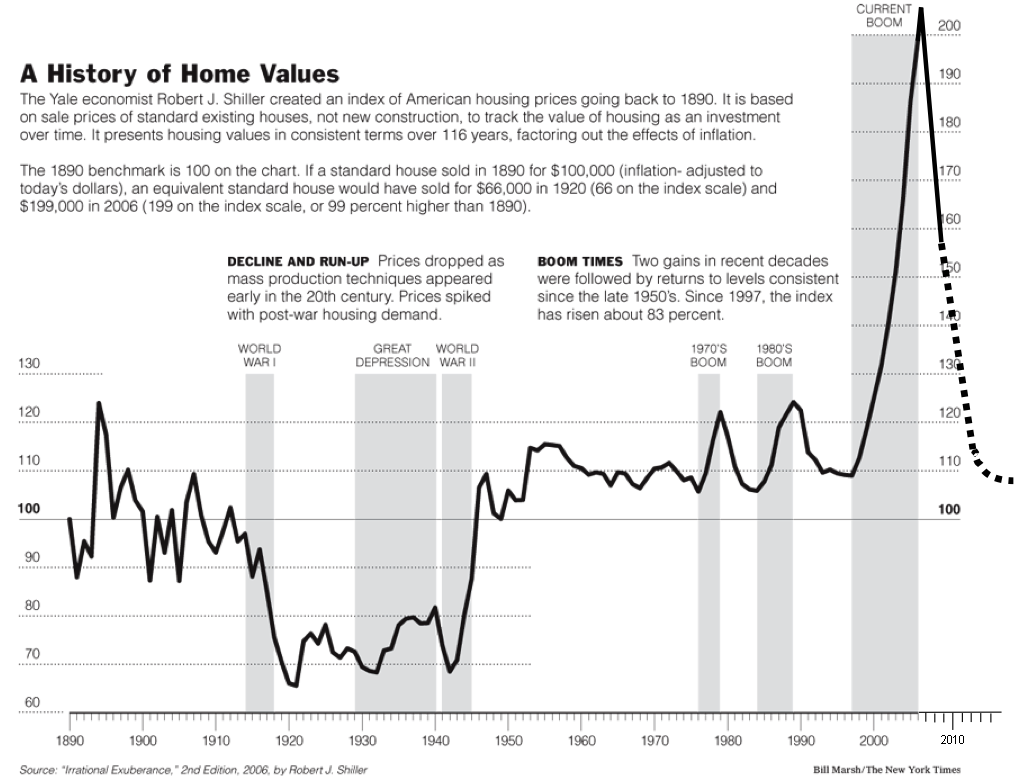
After having said this, I wanted to share two graphics from Case-Shiller Home Price Indices for American houses since 1890… In the first graphic you can see that after adjusting for inflation at the end of the 20th century, in absence of crisis and booms the value of a house was nearly the same than 100 years before, merely 10% higher. Why should it be higher if no goods/services are produced? Then you can see the boom that took place in the 2000’s up to mid 2006. That was pure greed and speculation.

Case-Shiller Home Price Indices for American houses, 1890-2006.

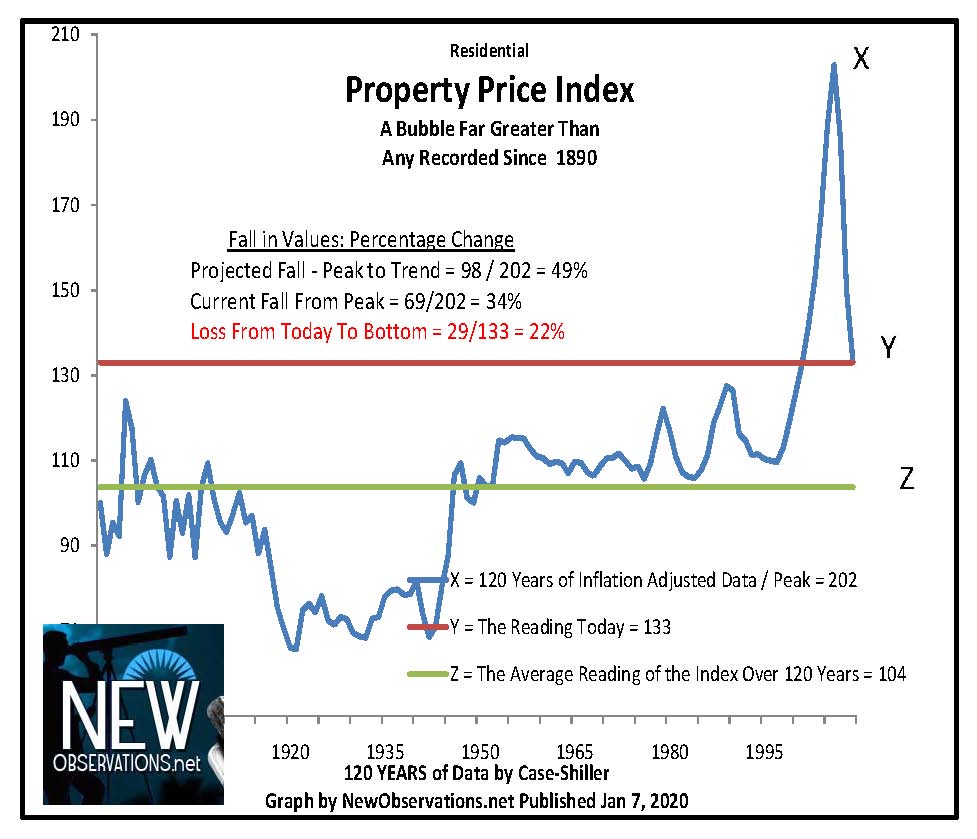
In the second graphic you may see the prediction made based on Case-Shiller Home Price Index. The prediction is pretty simple: there is no reason to forecast that homes prices have to stabilise at a higher point than the average of the past 120 years… other way to say that a home does not generate any value (still, it doesn’t destroy value either!).

Case-Shiller Home Price Indices for American houses, 1890-2009 and forecast.

4 Comments

Filed under Economy, Investing

Stocks vs. Bonds, 200 years

Some weeks ago I had two different conversations with friends. The issue: whether Greek bonds would be a good investment given the yields they are being offered at. I then argued that I didn’t think it was a safe investment, that many countries had defaulted payments, and as a value investor in the making I tried to explain that a much better investment would be to find out there some great stocks at a big discount.

I was also looking for some graphics to send them to prove the point. I had seen those graphics at the annual investors’ forum of the asset management firm Bestinver in different years. They represented how different the outcome of an investment would be for a person living either in Germany in the 1920-30’s or in Argentina in the last 15 years in case this person had invested in the stock market or in government bonds, supposedly safer.

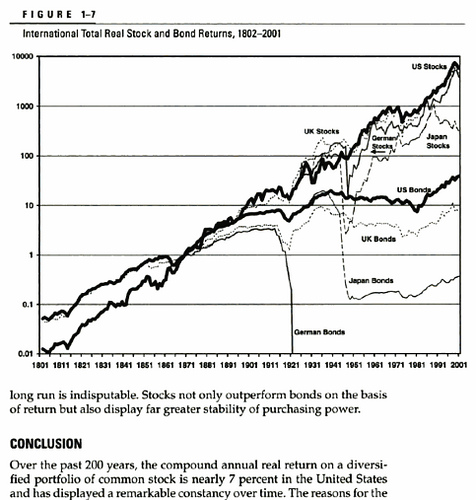
In both cases the investment is much better off when it’s composed of stocks, as they represent a portion of a real company that continues to operate after the crisis and the currency devaluation/hyperinflation period that typically follows. The value of the investment in bonds is suddenly reduced to nearly zero… At that time I didn’t find any of those graphics in the Net, but the other day I found a similar one. Here it goes (note the scale is logarithmic):

Stocks vs. Bonds, 200 years comparison.

Please, note the difference especially between German and Japanese bonds and stocks. But also with US and UK stocks and bonds the difference persists.

The managers of Bestinver year after year repeat the same example: in those situations is much better to be invested in real assets, be it portions of an enterprise (stocks), chairs, and pencils, even houses… all these are assets that once the crisis is over will retain the value they have. However the paper money has no value once the nominal value is devalued.

2 Comments

Filed under Economy, Investing

Starting up an airline?

Some days ago I came across a post in the blog of Randy Tinseth, VP Marketing  for Boeing Commercial Airplanes, where he explains the concept of StartupBoeing and invites entrepreneurs to take up the opportunity. StartupBoeing is a website which offers information to entrepreneurs in order to help them build their business plan or run their operations. As it is stated in the web itself:

“The StartupBoeing team assists entrepreneurs in launching new airlines. From concept through launch, StartupBoeing offers guidance, review, analysis, data, resources, contacts, and referrals to qualified startup airlines.”

The first thing I thought was “yes, there is the opportunity to lose your investment”. To be fair, Tinseth points at different moments the difficulty of the business and that it is tough to start-up an airline. Airbus does also have the same concept available to entrepreneurs, in this case is called: Start Me Up.

I looked for the last industry outlook from the International Air Transport Association (IATA), the industry association. The figures are appalling (see the table below):

IATA Financial results of the last decade.

Airlines around the world have lost during the last decade 50 billion dollars, with only 2 out of ten years with profits. On average the net profit, loss in this case, was -1.4% of the revenues (over 4 trillion dollars in the decade). Of course, there are airlines making profits, but the industry is not doing well (just remember the last achievements of G. Díaz Ferrán).

I then remembered this other comment from Warren Buffet about the airline industry since its inception:

“I made the comment that if a capitalist had been present at Kittyhawk back in the early 1900s, he should have shot Orville Wright. He would have saved his progeny money.

But seriously, the airline business has been extraordinary. It has eaten up capital over the past century like almost no other business because people seem to keep coming back to it and putting fresh money in.

You’ve got huge fixed costs, you’ve got strong labour unions and you’ve got commodity pricing. That is not a great recipe for success.

I have an 800 (free call) number now that I call if I get the urge to buy an airline stock. I call at two in the morning and I say: “My name is Warren and I’m an aeroholic.” And then they talk me down.”

So, yes, if you are considering whether to start-up an airline, do yourself a favour: call that 800 number, and put your cash somewhere else where it returns more than -1.4%…

The one thing we should definitely praise from these initiatives is the information resources available to the general public, something commented by readers of Randy’s blog and a purpose expressed in the Startup website as well:

“StartupBoeing.com also has a wider purpose as a resource to pass on information to our customers – and also as a resource for existing airlines, financial institutions, consultants and the leasing community. It’s a place for neutral industry data. We want to help make the industry healthy and make airlines safe, reliable and profitable.”

1 Comment

Filed under Aerospace & Defence, Investing, Marketing

Ethical Banking

I attended yesterday a conference by Joan Melé at EOI Business School. It caught my interest by its title Dinero y conciencia: ¿A quién sirve mi dinero? (Money and conscience, who benefits from my money?), even though I didn’t know the presenter nor the bank he works for.

I want to make some reflections of yesterday’s experience:

  • The first one as a Toastmasters member: I applaud the decision of the speaker to stand up, not using notes or a power point presentation and managing to get the focus of the audience on him and his message for over an hour and half… we witness many conferences in which the experience is not so enjoyable.
  • The next reflection is to praise the move by EOI Business School towards web 2.0 made some months ago. As an alumnus of the school I must say that it’s very motivating to see the number of activities organized, the topics covered and it’s very convenient the way they are publicized in the different channels: EOI web and blogs, Facebook, streaming TV channel, Twitter… and because of that, because you can actually watch the whole of the conference or catch a glimpse of the main messages, I will just add very few ideas that I took for reflection and some sources the presenter cited.

Regarding money itself, the speaker structured his speech in the three main uses of money: to buy, to save and to donate.

  • When buying: he proposed the exercise of thinking “what”, “why” and “where” to see how our purchasing decisions affect others (low wages, pollution, exploitation…). He made the case for an economy based not so much in consumption of material things but cultural and intellectual ones: e.g. we happily pay 30 euro for a dinner, would be pay the same to be read poetry?
  • Regarding saving he noted the positive side of it: planning for future expenses. The other side of the coin being “fear of the day of tomorrow”: what will happen that we won’t be able to face? Nothing: Whatever comes, we will be able to face it. This reminds me to Charlie Munger comment on Berkshire Hathaway shareholders meeting when he said that he became comfortable […] after he realized he could survive hardship, “Maybe you should get your feet wet with a little more failure”. We lack some entrepreneurship…
  • The speaker did not want to go in deep about donating, except pointing that handing large inheritances to offspring can be more harmful than positive to them and society.

Some ideas to take away:

  • There are no leaders to solve our problems; it’s the turn of civil society to take action. It’s the time for the Globalisation of conscience.
  • The responsibility for what happens around us is ours, we need to first change ourselves.
  • We are the crisis of 3 billion people since dozens of years ago.
  • Need to bring back the role of banks as agents that relate people: savers with entrepreneurs in order to create wealth with profits as a by-product not as the one and only end.
  • Need to start and epidemic of courage and enthusiasm.

Finally, some reports, articles and documentaries he cited:

One final quote from Charlie Munger to end this post: “The secret to happiness is to lower your expectations.”

4 Comments

Filed under Books, Helping others, Investing, Movies, Toastmasters, Twitter & Media

Value investor: Joel Greenblatt

Last week, I watched an online interview by Steve Forbes to Joel Greenblatt, a value investor, author of the book: “The Little Book That Beats the Market”.

I read this book about two or three years ago and I remember it as a very enjoyable read (just about 150-200 pages). He proposes a formula to automate the stock picking process that would result from applying value investing principles by a person that doesn’t want to get too much involved.

During much of the interview he discusses how they have tested the formula, how it beat the market in this and that time, etc…

Summarizing, he admits that he based the formula in:

  • From Benjamin Graham: buying cheap.
  • From Warren Buffet: not only buying cheap, but buying a good company.
  • Last but not least: you need long periods of time, thus, patience.

This last requirement is what most speculators (vs. investors) lack of.

If you are interested in the formula, you may use it for free in his website.

Nevertheless, if I were you I wouldn’t stop there, but read “The Intelligent Investor” (especially chapters 8, 14 & 20)… the sooner, the better.

To my friends: if you are interested in Greenblatt’s book, I also got it, if you want to borrow it…

1 Comment

Filed under Books, Investing