Category Archives: Sports

Fail moments in running events

Some of you may have seen the following picture:

Fernández pointing Mutai the finish line (source: Calleja, Diario de Navarra, via El País).

That is Spanish athlete Iván Fernández Anaya letting Abel Mutai win after the latter had stopped thinking the cross was already finished.

This kind of situations do not have always the same ending. See the video below:

After hours running, and coming to an end the poor guy in the lead takes a wrong turn off the route and is overtaken by 3 runners, not being able to retake the lead.

When I watched these situations I always thought “How can this be possible? Is the guy not seeing the road, is nobody telling him the coming mistake on time?”.

Now, I got the answer. Some times shit happens. I had today my epic-fail moment.

I was going to take part in the race Course des Rois, in Villemur-sur-Tarn, over 10km. I ran it last year so I was acquainted with the route, installations, etc. Thus I paid no much attention to the specific rules of the race.

I knew that the race started at 10:05 (*), so I warmed up beforehand. Then removed some clothes, drank some water and went to the start line. And started.

After some 300 metres I noticed that I was surrounded by many teenagers and middle-aged women instead of a big pack of middle-aged men, who are the average popular runner. Then I wondered: “am I running my race or the 5km one?”

At 500m I stopped and asked a volunteer from the organization: “is this the 5k or the 10k race?” to which he replied “I don’t know” (!!). Then I asked the next woman coming, and she confirmed that it was the 5k one!

You see! It can happen! There I was, running another race.

Luckily I noticed only 500m into it 🙂 Then I went back running moderately fast again, as I didn’t want the start of the 10km race to catch me in the middle of the two!

Fortunately in my case there were no cameras to make further fun of me! 😀 But see below the record of the GPS:
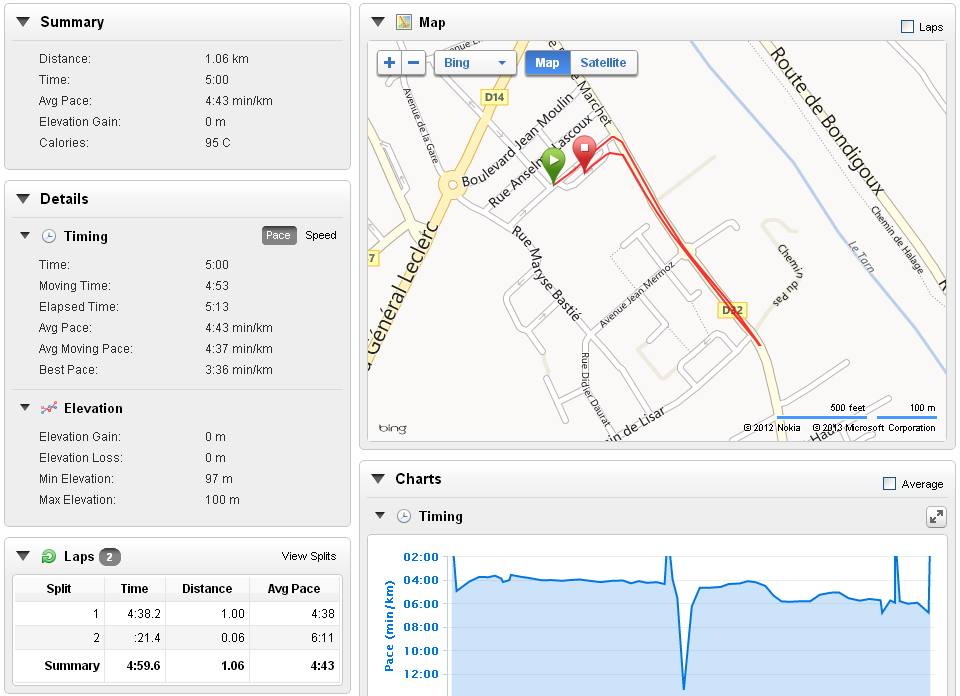
Fail: wrong start with the 5k race.

Fail: wrong start with the 5k race.

***

(*) My 10km race was indeed starting at 10:15am; if I had just read the rules of the race…
2 Comments

Filed under Sports

San Silvestre 2012

One more New Year’s Eve running the popular San Silvestre Vallecana.

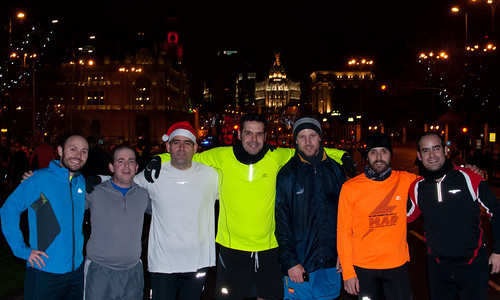
Year by year we’re creating a small community: Jaime, Pablo, KikeJon, Juanma and Abraham.

Compared to the last year, this time Gonzalo and Nacho could not run. Though the fact that the latter couldn’t, made it possible to have the great pictures he took of the rest of us in Calle Alcalá. Enjoy them:

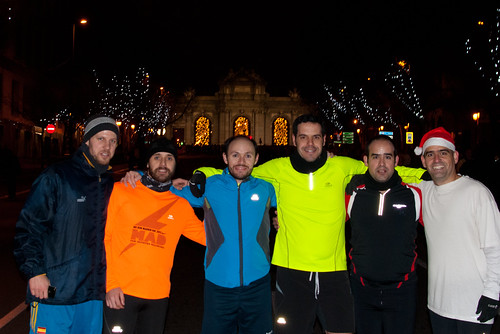
Kike, Jon, Pablo, Abraham, Jaime and I (picture taken by olemiswebs).

Pablo, Juanma, I, Abraham, Kike, Jon and Jaime (picture taken by olemiswebs)

Jaime was running his 14th San Silvestre in a row. Impressive! I was doing my 12th (I missed three along these years: one due to injury and other 2 being in NL). Pablo must have done around 5, Kike 3, like Juanma (?), this was the second for Jon and Abraham, I believe. But they’ll complete many more.

Numbers… the time was ridiculous: 1h7′. As usual it was impossible to run, and this time we had to fully stop twice in Vallecas due to runners’ traffic plus the long pause to make the pictures. I cannot attach the route as at the beginning of Xmas time I forgot my Garmin watch in Toulouse (Kike, Jon, if you read this, please, could you attach the records in the comments?).

Commenting on the difficulty to run in that race nowadays: I remembered our first San Silvestres back in the ’90s. Already then it was difficult to run, especially in Vallecas. I tried to find the results from the first one I ran and I couldn’t, but I found those of the 2nd, in 1999, already with Jaime. We then finished in around 55′ to 56′ net time and positions around 3,500 out of less than 5,000 finishers… about one tenth of today’s figures.

Due to the strike of underground metro workers, this time we came back from Vallecas to Jaime’s flat, close to Retiro… adding up some nearly 4km after the race.

***

PD: In last year post, I wrote that Luca wanted to have spent the past Christmas in some sunny island… well, one more year Madrid and its San Silvestre got it :-D.

2 Comments

Filed under Sports

First football match in Spain?

In the previous post I explained how I looked for some museum about the origin of football in Spain, which is regarded to have taken place in the province of Huelva, Spain.

The village of Rio Tinto claims such origin and it may well be so as it was there where the British colony working for Rio Tinto Company Limited established (at “Bella Vista” neighborhood).

The oldest football team in Spain is regarded to have been the Recreativo de Huelva (according to the Wikipedia originally known as Huelva Recreation Club), founded at the end of 1.889 by workers of the Rio Tinto mines and based in the city of Huelva, some 70 kilometres from Minas Rio Tinto.

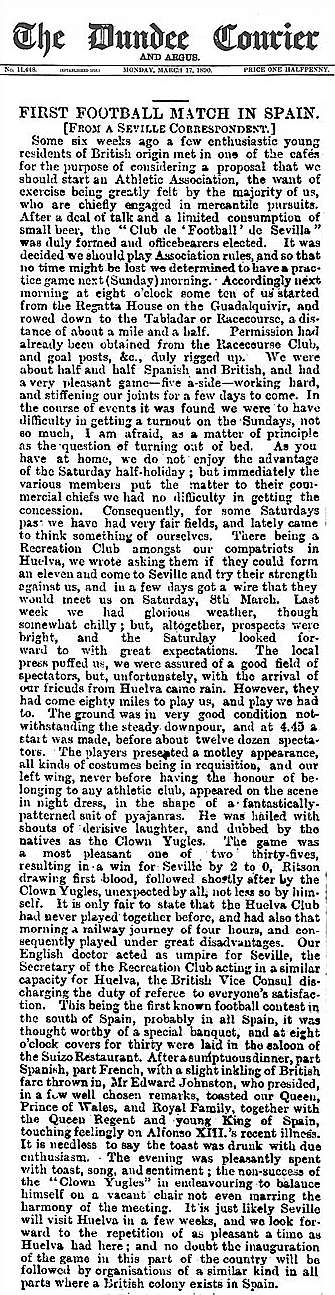
I found some months ago, in the Spanish sports newspaper Marca, the following picture from an article of the The Dundee Courier” (Monday, March 17, 1.890) covering the “first football match in Spain”.

It was supposedly played in Seville, at the Tabladar (close to Airbus Military factory nowadays), between the above mentioned Huelva Recreation Club and “Club de Football de Sevilla” (not related to the current Sevilla F.C.).

The article is an interesting read for its historic touch.

However:

  1. having been that Recreation Club from Huelva founded only in 1.889, by Rio Tinto workers,
  2. living many of the company workers at the village of Minas Rio Tinto, some 70 km from Huelva,
  3. having the workers other social clubs in Minas Rio Tinto (including Bella Vista) and
  4. being the company established in 1.873.

I’m afraid that probably the first match would have been played at Rio Tinto, not in Seville, and much earlier than in 1890.

At the mining museum of Minas de Rio Tinto, there is a small one-page text about the introduction of football by Rio Tinto Company Ltd. workers. In fact, in that text there is a mention of the celebration of a football match in 1.873 to celebrate the festivities of the local patron, San Roque.

But I am no historian, and thus would love to see some historian diving into that history and putting up the nice results in a museum in Rio Tinto :-).

Article of the “The Dundee Courier” (Monday, March 17, 1.890) covering the “first football match in Spain”.

Leave a comment

Filed under Sports

The origin of football in Spain

One of the sports introduced by the British working at the mine of Rio Tinto (post about the visit to it I made the last week here), was football.

Welcome to Minas Riotinto (“Birthplace of Spanish football”).

I didn’t expect anything special as I had not researched the topic beforehand but I hoped there would be something knowing that the origin was there. This was immediately confirmed as there is a signpost at the entrance of the village about the relation of it with football.

But then, there was nothing else but the statue you can find below in front of the local football club field (playing in who knows which division).

I asked at the mining museum whether there was something to be visited about football and its origin in Spain. There wasn’t. “The town hall has a project of building a local museum of football, but today there is nothing”. What a pity. I guess I am not the only person who when travelling is searching for this kind of places and memorabilia, thus I guess it could have some potential.

Statue celebrating the origin of Spanish football in Minas de Rio Tinto (Huelva).

It is not the first time that I get this disappointment. You may remember that I had the same feeling when searching for the roots of football at the Freemasons in London. I would love to see such museum like the one about golf in St. Andrews, I hope that one day I will be able to do so. To date, the closest to that is the one-page text below, found at the mining museum:

Page about the introduction of football in Rio Tinto by British RTCL workers.

4 Comments

Filed under Sports, Travelling

Hotel Room Sports (Creativity)

At the beginning of the year, as a yearly goal I decided to keep on learning new things. One of the actions I took was signing up for some courses (in Coursera platform).

The courses were great, the way of learning is very encouraging: with videos, small and bigger assignments, online forums, students from all over the world helping each other, aspiring career starters and retired people wanting to learn something new together in a global class.

I followed them for some weeks but finally I was unable to keep up with them and dropped. I felt frustrated for that.

Some weeks ago a friend forwarded some information about some other online course from Stanford University Venture Lab. I decided to follow a couple of them, including “A Crash Course on Creativity” taught by Tina Seelig.

Those of you who know me well might think “a course on creativity, how unlikely of Javier?”. Well, I decided to join it because I thought it could be fun… and some of the assignments are fun!

In this post I wanted to first raise awareness of this kind of free education and, secondly, to share the video I took last weekend in Seville for an assignment. Enjoy:

What was the assignment about?

“Your challenge is to use TWO HOUSEHOLD ITEMS of any type – to come up with a brand new SPORT. Use your creativity to generate something you have never seen before.

 You will be evaluated on your creativity and presentation. Deliver a drawing, photo, or video demonstrating the sport. Feel free to include a short description.”

8 Comments

Filed under Education, Personal development, Sports, Travelling

Berlin marathon breakfast run

One of the events that include some big marathons is a morning run the previous day, the so-called “breakfast run”.

When we ran the marathon in Paris, only our friend Serna attended that run. This time we went together and Luca and my brother Jaime waited for us at the end.

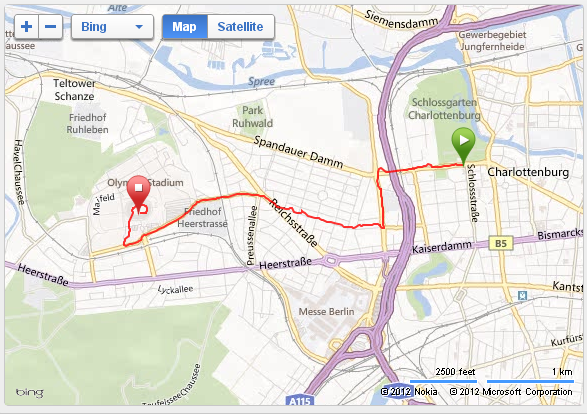
The run, a very easy run of almost 6 km, departed in front of the beautiful Palace of Charlottenburg and ended at the Olympia Stadion.

This stadium today hosts Hertha Berlin football matches, but it is better known as the stadium where the summer olympic games of 1936 were celebrated: the first ones televised, inaugurated by Adolf Hitler and the ones in which the athlete Jesse Owens won 4 gold medals.

See below some of the pictures we took during that morning run:

This slideshow requires JavaScript.

Hopefully the next time we’ll remember to bring either flags or a festive costume as many of the other runners typically do.

See the route we followed from the palace in Charlottenburg to the stadium as recorded by my Germin GPS:

Breakfast run route.

Finally, I found two interesting documents in relation to the stadium and the games:

  • The stadium plan [PDF, 1.7 MB] from today’s stadium website. In it you can see the location of the Maifeld (used for Hitler’s government celebrations and during the olympics for the equestrian events), the Bell Tower, the stadium and the Olympischer Platz.
  • The official report [PDF, 42.4 MB, 640 pages] of the games. It contains all kind of info about the International Olympic Committee at the time, hundreds of pictures of the Games and all of results of the different events.

1 Comment

Filed under Sports, Travelling

Berlin marathon

Last September 30th I completed the Berlin marathon together with my friend Serna and brother Jaime. This was the second marathon we ran together (the previous one being Paris 2012). The sixth one I ran.

Jose, Jaime and I in the runners’ fair.

The morning of the marathon I published a post in which I explained how I arrived at it in terms of training: I suffered an injury about 1.5 months prior to the race which didn’t allow me to practically train during the last month. Previously I had been training well and accumulating many kilometres.

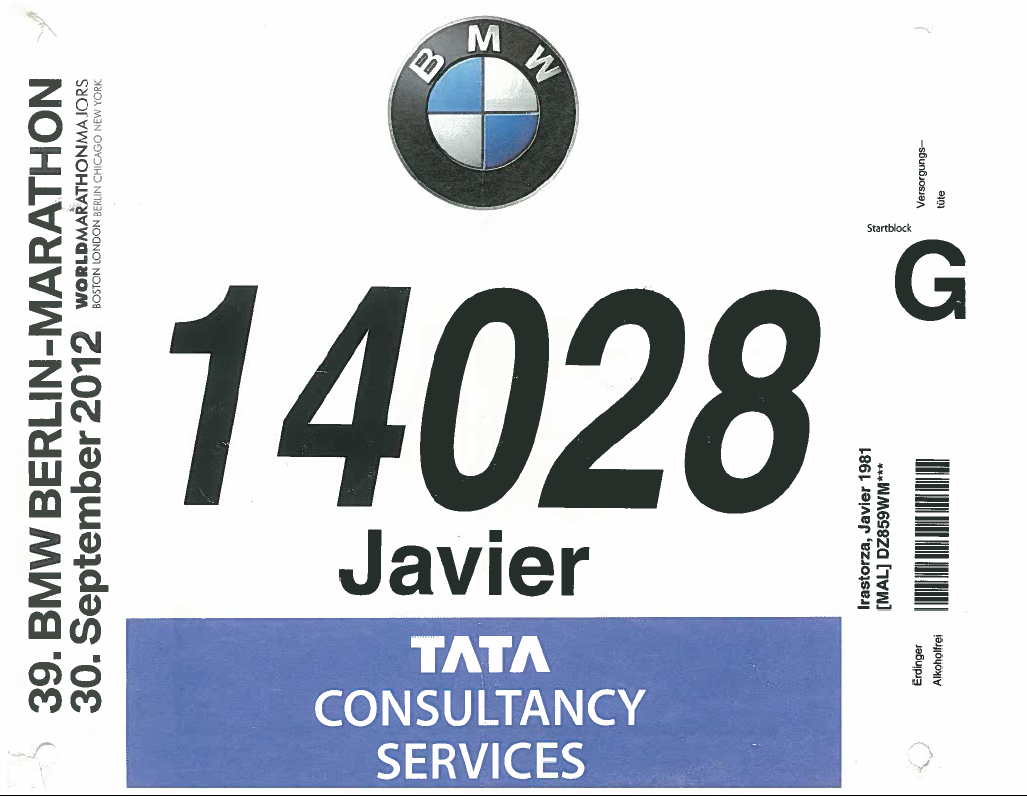
My bib number for the race:

My Berlin Marathon bib number: 14028.

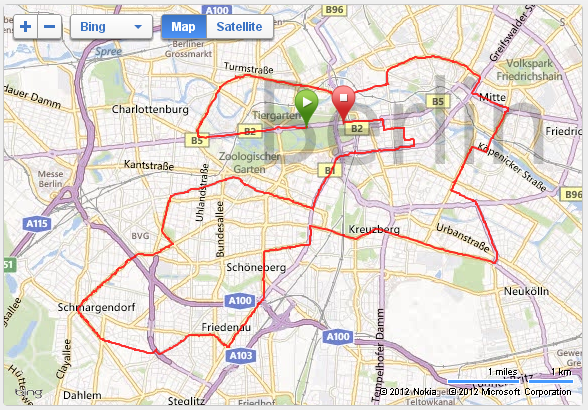
You may see the route of the marathon and my performance as recorded by my Garmin GPS here:

My Berlin Marathon Garmin records.

I started with a bracelet with references for a 3h40′ marathon, 5 minutes lower than in Paris. My plan was to start at that pace (5’13” per km) and keep it until I could. I was expecting that I would not be able to run the whole of it and that I would have to walk in case the Achilles tendon was hurting again. If that happened the later it occurred the better. Thus the faster I could go at the beginning the better for having to walk less distance at the end.

I did the half marathon in slightly above 1h47′, better than in Paris and was still feeling OK. Though at km 23 I started feeling hard to make kilometres under 5’20” (lack of speed endurance work and series in the last month)… I started to think of managing the margin I had built.

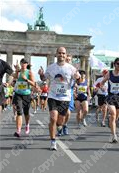
Finishing the marathon (km. 42).

However, 5 kilometres later I started to feel the ankle getting harder and some cramps in the quadriceps of the right leg (lack of kilometres and long runs in the last month). I then decided to slow down, otherwise I would have to start walking soon (when you get these cramps, the following step is feeling the muscle like a rock and not being able to run… experience from marathons 1 and 3).

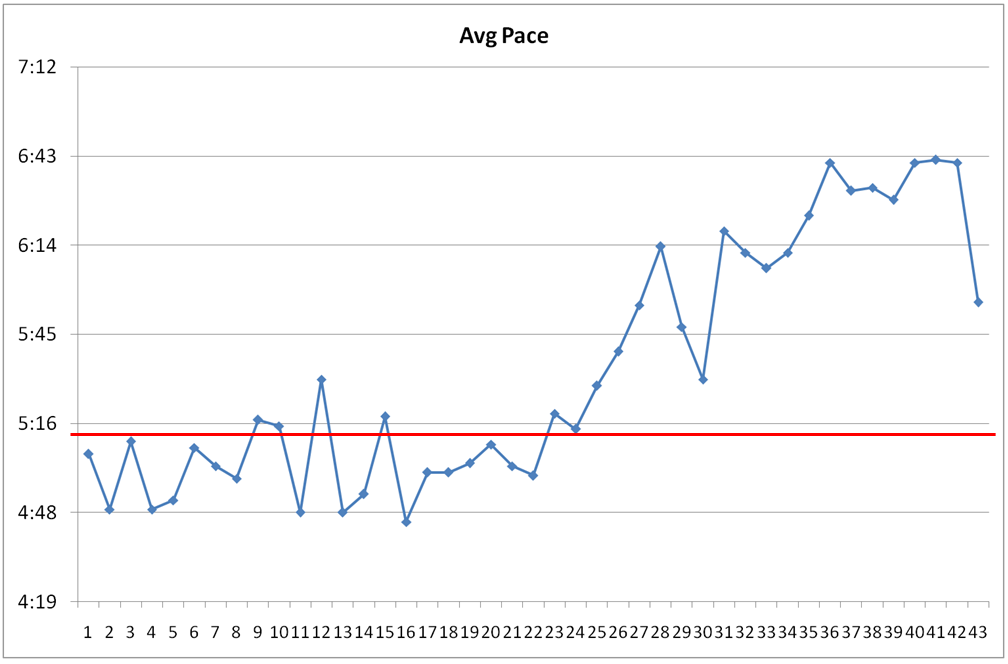
From then on I clocked 6′ per km, then 6’20”, 6’35”, 6’40″… but I was still quite happy as at every kilometre I was making the numbers in my head: “if I keep this pace, I can finish in 3h53′ “, then “3h55′ “… I finally clocked: 3h57’48”, but at all times I knew I could complete it and that I was going to be under 4 hours, thus I just kept on running and smiling.

See the analysis of Garmin records by kilometre below. You can see how the pace was at each stage as I explained it above.

My Berlin Marathon running pace per km (mm:ss).

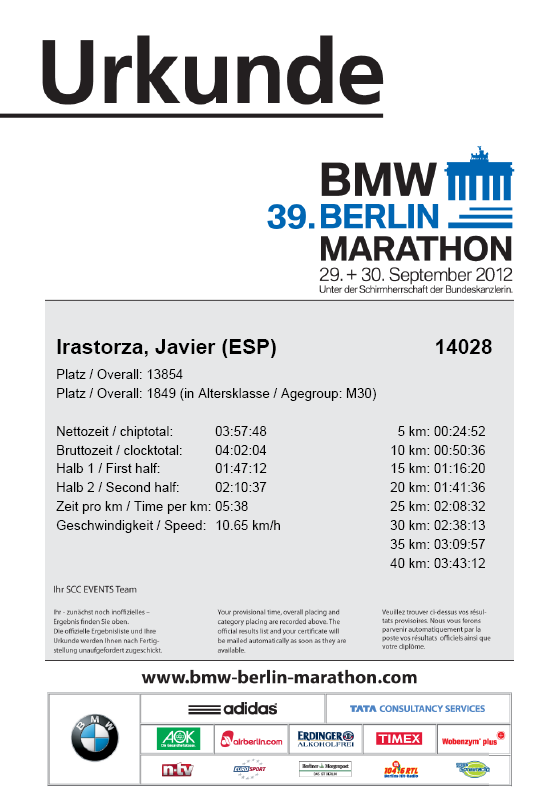
Two more pictures to complete this post: my finisher diploma and the detailed street map of the route.

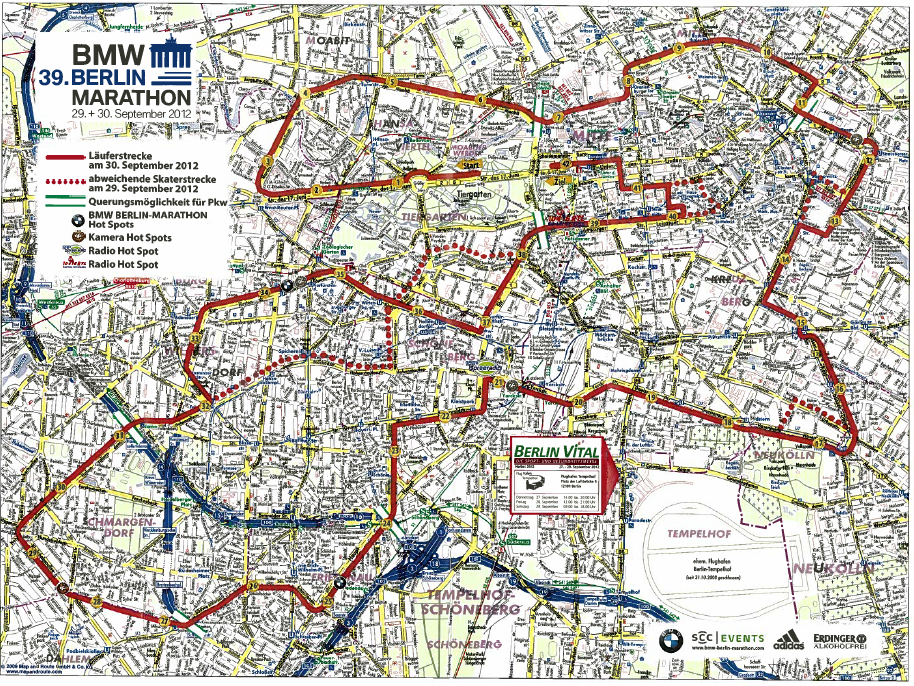
Berlin Marathon detailed street map.

Next stop: Maratona di Roma, 17th March 2013.

5 Comments

Filed under Sports, Travelling

Soccernomics

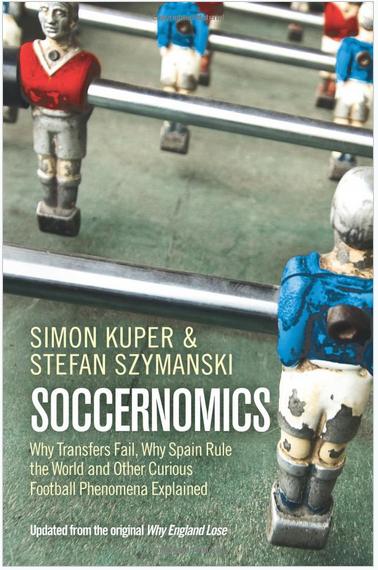
Soccernomics.

If you love football (soccer) and have read one of the books of the “Freakonomics” saga or any book from Malcolm Gladwell, then “Soccernomics“, by Simon Kuper and Stefan Szymanski (430 pgs.), will be a great read for you.

The book is written in the same style as the other books mentioned above: using economics’ techniques, plenty of data, statistics, citing several papers, studies, etc., in order to bring up uncovered issues about football or refocus the attention about other ones. Some examples:

  • Mastering the transfer market. Departing from the example of Billy Beane in baseball, described in “Moneyball“, by Michael Lewis (of which a movie was also made starring Brad Pitt), the authors show how pouring money in transfer markets doesn’t bring titles. The key issue is to have a balanced net investment (sales/acquisitions). In soccer the main example would be Olympique Lyon which will “sell any player if a club offer more than he is worth”, for which each player is previously assigned a price (much like value investing).
  • The more money is paid to players the better (in salaries). Instead of buying new expensive players it seems to make more sense to pay well and ensure the adaptation of the stars already playing for the team.
  • The market for managers is not yet very open (e.g. no black coaches in main European teams), thus many of them do not make a real difference. There was even an English team Ebbsfleet United who dispensed the coach and allowed subscribed fans to vote the player selection for each match.
  • The book, written at the beginning of 2012 forecasted that soon teams from big European capitals would win the Champions’ League, being those capitals: London, Paris, Istanbul and Moscow. Few months later Chelsea won its first one, let’s see the others.
  • The main factors for the success of football national teams seem to be the experience (international games played by the national team), wealth and population.
  • The authors give much weight to Western Europe dominance of football due to the interconnectedness of continental Europe. Explaining the rise of Spain in the ’90s and ’00s due to its growth in population, improved economy since joining the EU, more experience and exchanges of styles with coaches of other countries.
  • The authors claim that future national football will be dominated by countries such as Iraq, USA, Japan or China.

As you can see there are many different topics, all with some data to support them (even if sometimes you doubt about the consistency of their claims, e.g. their statements on industrial cities as dominating football, dictatorships, etc.). I marked many pages with some anecdotes or papers that I would like to read.

One final anecdote: tips given to clubs and teams in KO competitions in case they face a penalty shoot-out. In the Champions’ League final of 2008, Chelsea and Manchester United reached the penalties. An economist had given Chelsea a study of Manchester goal keeper and penalty-shooters. Once you read the book and the tips the economist provided (“Van der Sar tends to dive to the kicker’s natural side”, “most of the penalties that Van der Sar stops are mid-height, thus is better to shoot low or high”, “if Cristiano Ronaldo stops half-way in the run-up to the ball chances are 85% that he shoots to his natural side”…), it is quite interesting to actually see that penalty shoot-out and how the different players acted.

[Pay special attention at Van der Sar’s reaction at 09’40”, when it seems he noticed about Chelsea having been tipped]

I definitely recommend this book to football fans. I also recommend two other books about which I wrote in the blog some time ago: “How soccer explains the World” and “Historias del fútbol mundial“.

8 Comments

Filed under Books, Sports

Good morning, Berlin!

This morning, as this post is being published I’ll be starting the 39th Berlin marathon, together with my friend Serna and brother Jaime.

At mid-point through the training, beginning of August, I wrote a post about the good amount of kilometres I had been able to train in July. Two weeks later I got injured in the Achilles tendon when training in the hills of Torrelodones. I took a one-week rest and slowly re-started training. That week finished with a 10k race in Colomiers where I achieved a new PR in the distance but got pain in the same tendon again.

I took a 10-day rest and tried to run again: 3.5km, 7km and then 12km… but got the pain back and had to cancel my participation in Toulouse half marathon.

As you can see in the graphic below, the training season can be divided in 3 weeks of getting into the habit, 7 weeks of good training and 6 weeks of struggling to recover, plus few days of running and swimming.

Berlin training season. Kilometres run per week and average heart rate (bpm).

During the season I should have run over 1,000km, but in the end I have only completed 643km. This is more than I could run in preparation for the last marathon in Paris, but this time I arrive to the starting line without having run recently and the bunch of the training was done more than a month ago…

As Jaime says, this time the race will not be about the time, but just about trying to complete it… a day for the epic.

Lastly, I wanted to raise awareness about one thing I love of some races: the support of charities and NGOs. We subscribed to this marathon last year and, when doing so, each of us contributed with 42€ (1 € per km run) to the charities supported by the organization.

2 Comments

Filed under Sports

Cristiano Ronaldo, Di Stéfano y la tristeza

Viendo el revuelo producido por las declaraciones donde Cristiano Ronaldo decía que se encontraba triste, no pude más que recordar un par de anécdotas de Alfredo Di Stefano.

Una que recordaba haber leído en internet (“Corazón Blanco“) sobre un telegrama que Di Stéfano envió a Bernabeu que recupero:

Alfredo Di Stéfano regresaba a Argentina, sin fecha de vuelta. La Saeta Rubia envía un telegrama a Santiago Bernabéu, a modo de despedida. La misiva, cuyo original está bastante deteriorado y es casi ilegible, dice: “Don Santiago me voy a mi tierra, no sé si volveré pronto. Nunca en estos años se habló mucho de nosotros. Yo llevé la peor parte. Fue un fenómeno o un gamberro. Si no me acerqué a usted fue porque no quería que creyera que busque un puesto regalado. Por lo menos eso no me lo puede quitar nadie. Lo que gané siempre fue con esfuerzo. Observé que para estar bien con usted había que ser falso. Tuve muchas desilusiones y nadie me dio moral. Usted como padre me falló. Ahí se ve que nunca tuvo hijos porque los padres siempre perdonan. Si no vuelvo más le llegue a usted mi felicitación y mi recuerdo cariñoso. Un abrazo, Alfredo”.

Y la otra sobre su despedida del Madrid, anécdota que leí hace años en su biografía “Gracias, vieja” (libro que aprovecho a recomendar), y que se puede leer en el la web del diario As:

“Muñoz se aferraba a que había que vigilar a Facchetti y nosotros decíamos: ‘¿Y quién agarra a Amancio?’. Amancio era como la luz de rápido y estaba jugando fenomenal. Al final, ¿qué pasó? Que Facchetti no se fue arriba casi nunca en el transcurso del partido… Jugamos el encuentro con uno menos, pero Muñoz me mandó a la mierda y me echaron a mí del club porque lo mandé a la mierda yo también”.

Aquel encuentro fue histórico, puesto que fue la última ocasión oficial en la que Di Stéfano vistió la camiseta blanca. Días después, el Madrid disputó la semifinal de Copa ante el Atlético, pero Muñoz no incluyó a La Saeta en la convocatoria.

Leave a comment

Filed under Books, Sports