I am an angel

Last 23rd March the three Toastmasters clubs in Madrid organized a gathering at Hard Rock Cafe. The event was a great success with over 40 people attending it. John organized it including 3 prepared speeches, a book review, some table topics and an improvised theatre!

I gave a speech which I had created over a year before. That was my 9th speech in the way to obtaining the Competent Communicator award of Toastmasters. The objective: “Persuade with Power”.

I first gave this speech titled “Angels” on the 4th of February in 2009. Then I used it again for the Area spring contest and again in the Division conference in Lisbon that same year.

With some slight modifications I gave it again in the gathering. This is its script and more or less what I said…

“Do you believe in angels? I do. I do believe in angels. What if I tell you that I am an angel? Wouldn’t you be curious? Wouldn’t you like to hear about it? You will.

I believe in what are called “business angels”.

I guess that most of you have heard the term “business angel” at some point. For those of you who haven’t: business angels are investors who invest part of their money in small and medium start-up companies, helping entrepreneurs to set up their businesses.

In this speech I want to persuade you to become business angels. You may tell me “Javier, I don’t have a spare million to invest in companies”; neither do I.

Do you think that to be an angel… to help someone to start-up with their business, a lot of money is needed?

Microcredits are small loans given to the poor, to those entrepreneurs who lack collaterals and a credit history; this makes them not eligible for the traditional credit given by banks. We are talking about someone in Vietnam who runs a grocery shop or about Mariano Choque who makes handicraft in Peru and whom I met last summer in a trip to Peru.

Microcredits are generally considered to have originated with the Grameen Bank created by Muhammad Yunus in Bangladesh more than 30 years ago. It all started as a research project to examine the possibility of designing a credit delivery system to provide banking services targeted to the rural poor. For this contribution, Muhammad Yunus was awarded the Nobel Peace Prize in 2006.

Ok, this is the theory. Now, I told you I was an angel; do you think I am part of that Grameen Bank in Bangladesh? No, I’m not.

Today the internet has facilitated very much the process. Kiva.org is a US non-profit organization which links those poor entrepreneurs, in developing countries, with us, here in Europe.

Kiva presents us with a list of individuals who are requesting an amount to start or improve their business. There you choose in which project you want to invest and how much do you want to invest. Kiva was started in 2005, and now counts with over 600,000 users who have given credits worth over 120M$ to over 320.000 entrepreneurs.

What it’s more… think of this for a moment: we are talking about credits and not donations; this means that you will get the money back! Say you invested 100$; when you get them back what would you do with them? You can lend them again! Imagine how many people you can help with those same 100$. Isn’t it wonderful?

Let’s see possible concerns you may have:

  • Is Kiva profiting from it? No, as I said is a non-profit organization. Like Toastmasters. Of course, Kiva has operating costs, but these are covered with different donations than the money you lend to entrepreneurs.
  • How do we know the money reached the entrepreneur? Kiva works with several field partners who are the ones scouting the entrepreneurs, uploading the information about them and their projects and finally handing them the money.
  • What if the loan is not repaid? Indeed some loans are not repaid. Around 2% of them. To avoid this Kiva is classifying the field partners. They classify them according to the level of risk of the credits already given to entrepreneurs presented by the field partners. But then again… with investment in the stock market, what would you do to avoid losing your investment: you just diversify!
  • If you have more concerns or questions about the topic you may ask me after the other speeches.

As I said at the beginning, I believe in angels. I am an angel. And what is more important: each of one you here can give a loan that can change a life… each of you can become an angel.”
3 Comments

Filed under Helping others, Investing, Toastmasters

Lapa stairs in Rio de Janeiro… impressive.

I had already visited Rio de Janeiro in 2000. That time something went completely unnoticed to me: the stairs made by Selarón in Lapa neighbourhood. This piece of art started with the Chilean artist renovating the stairs in the street that run in front of his house 20 years ago. First he used tiles with the colours of the flag of Brazil. The stairs are still unfinished and according to the artist they will only be finished the day of his death.

The colours and forms created reminded me of creations by Gaudí in Barcelona, e.g. Parc Güell. It’s really a pleasure, it brings you the same warmth and the same smile of admiration to your face.

The stairs have something that I really found special and addictive: the artist is currently using tiles from different parts of the world, depicting:

  • countries (Croatia, Portugal, Costa Rica…),
  • cities (Toulouse, Berlin, DC…),
  • famous monuments of cities (Puerta de Alcalá – Madrid, tramway in Alfama – Lisbon, Torre del Oro – Seville, Mecca),
  • famous art crafts in the most prominent museums in the world (Van Gogh self-portrait, Nachtwacht – Rembrandt, Girl with a Pearl Earring – Vermeer, Guernica – Picasso…),
  • celebrities (Lady Di, The Beatles, Obama…),
  • stereotypes from countries (bullfighter, windmills, marijuana, cows),
  • commercial brands (Coca-Cola, Michelin…),
  • football clubs (Real Madrid, Betis…)

Trust me: once you start you can’t stop searching for the next tile, trying to frame it with the ones around, wondering whether the artist placed it there intentionally for some reason or not (is it casual that “Don’t mess with Texas” is close to “Afghanistan” or that “Lyon” is above “Real Madrid”…?), checking whether you have seen those places, monuments, cities… as I said above: it’s addictive!

Moreover, YOU can take part in the making of the craft. As explained in some tiles, you may send him by post an old tile from your city and he may place it in the stairs… your contribution may be immortalized in Rio de Janeiro! The artist promises to send you a picture of the tile once it’s placed in the stairs.

See the pictures of the artist coming to work and with Luca and me… doesn’t he remind you to another genius, Salvador Dalí?

Next time you happen to be in Rio, don’t miss it.

Enjoy the pictures:

This slideshow requires JavaScript.

Leave a comment

Filed under Travelling

3 wishes to Nosso Senhor do Bonfim

Just back from a two-week trip to Brazil, I’ll start with the first one of a series of posts. This one is about the last church we visited in Brazil: Igreja de Nosso Senhor do Bonfim (Our Lord of the Good End). This is the most famous church in Salvador de Bahia, therefore if you are interested in getting to know about its architecture, etc., you may check it on the Wikipedia.

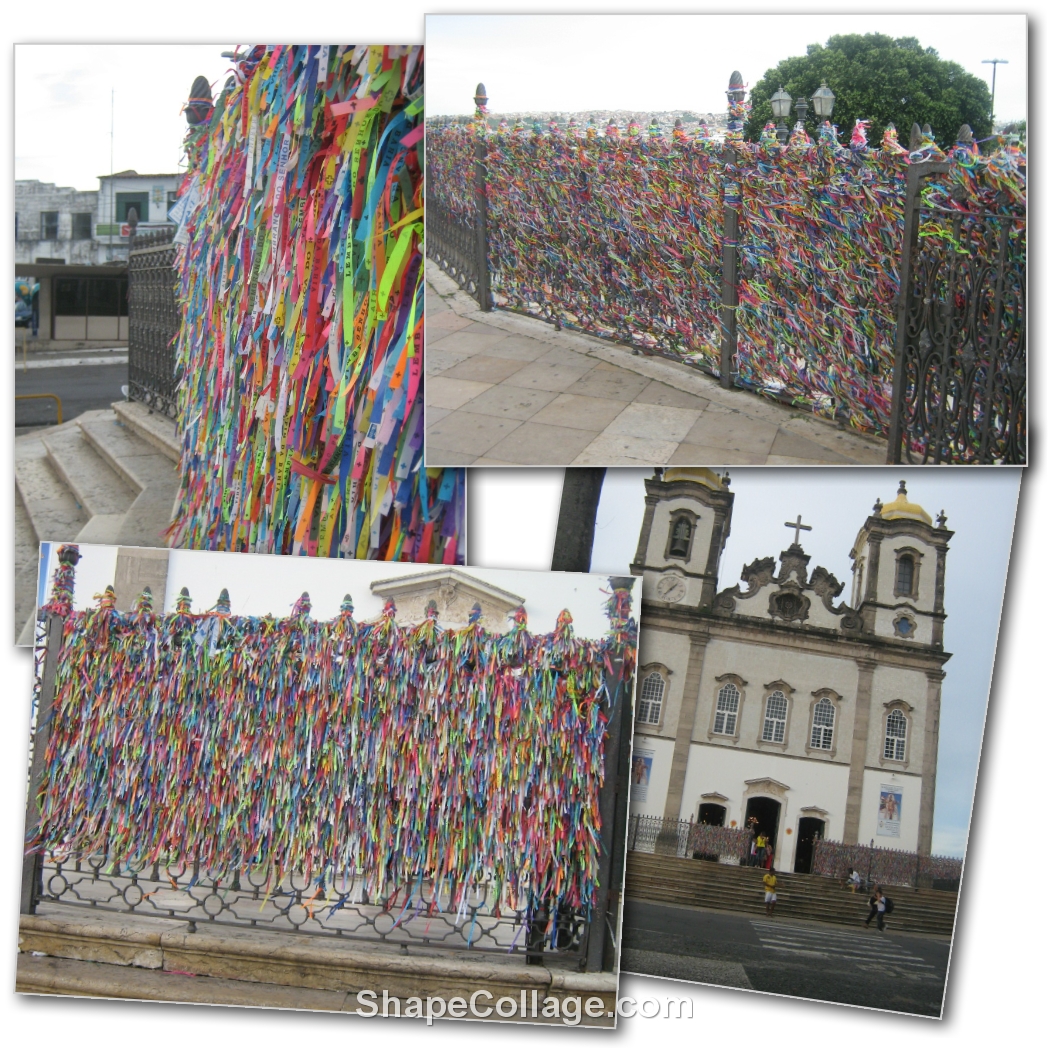
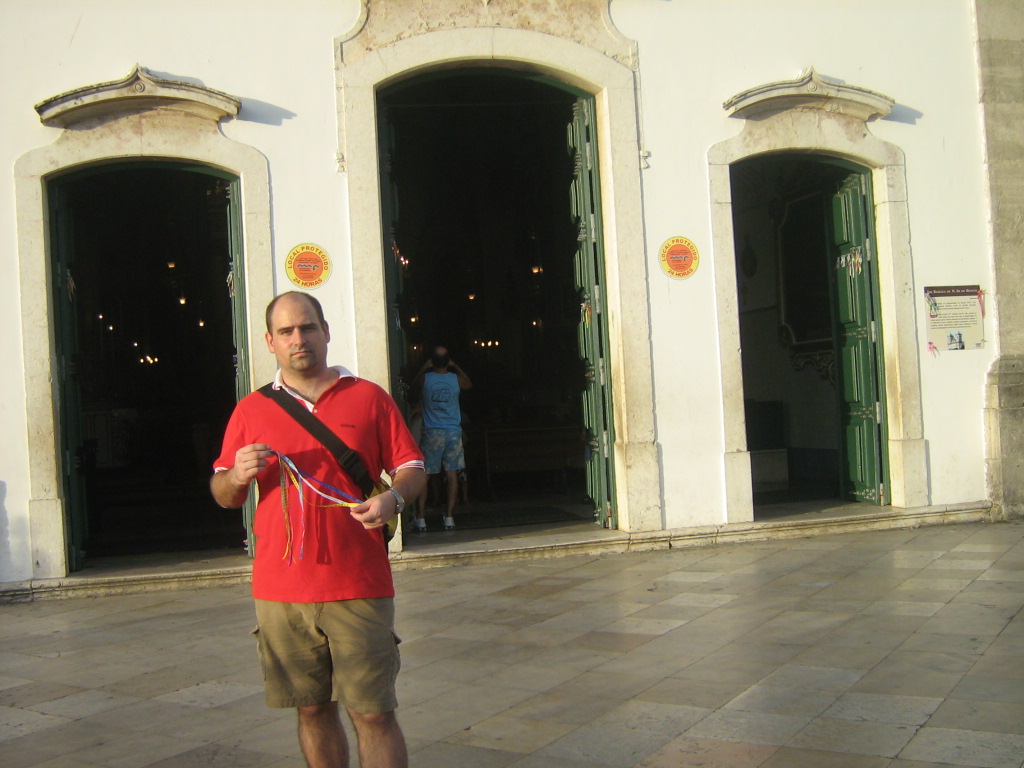
When you approach the church the first thing that catches your attention are the thousands of little ribbons (fitas) of multitude colours attached to the entrance. Beforehand you have been offered those ribbons everywhere around the city. Prayers come to Bonfim and together with their prayer they take one of the little ribbons, and attach it to themselves (or the entrance, the benches or the candles in the church…) making three knots. Supposedly they are granted one wish for each of the knots, and they shall not remove the ribbon until the wishes come true.

Igreja de Nosso Senhor do Bonfim.

We all have seen youngsters wearing this kind of ribbons with the same wish-that-comes-true bond. Nevertheless, I find it curious that it is connected to the church. But on the other hand, two other examples that I found years ago come to my mind.

The first one is from a visit to Estonia in 2003. In the Alexander Nevsky Cathedral, in Tallinn, the church also provided people with a piece of paper where to write their wishes to later deposit the paper in a box (after due payment, of course). I may still have somewhere at home one of those papers… obviously having taken the paper with me nothing was wished so nothing could be proved about the effectiveness Alexander Nevsky. I accept a scientific reprimand.

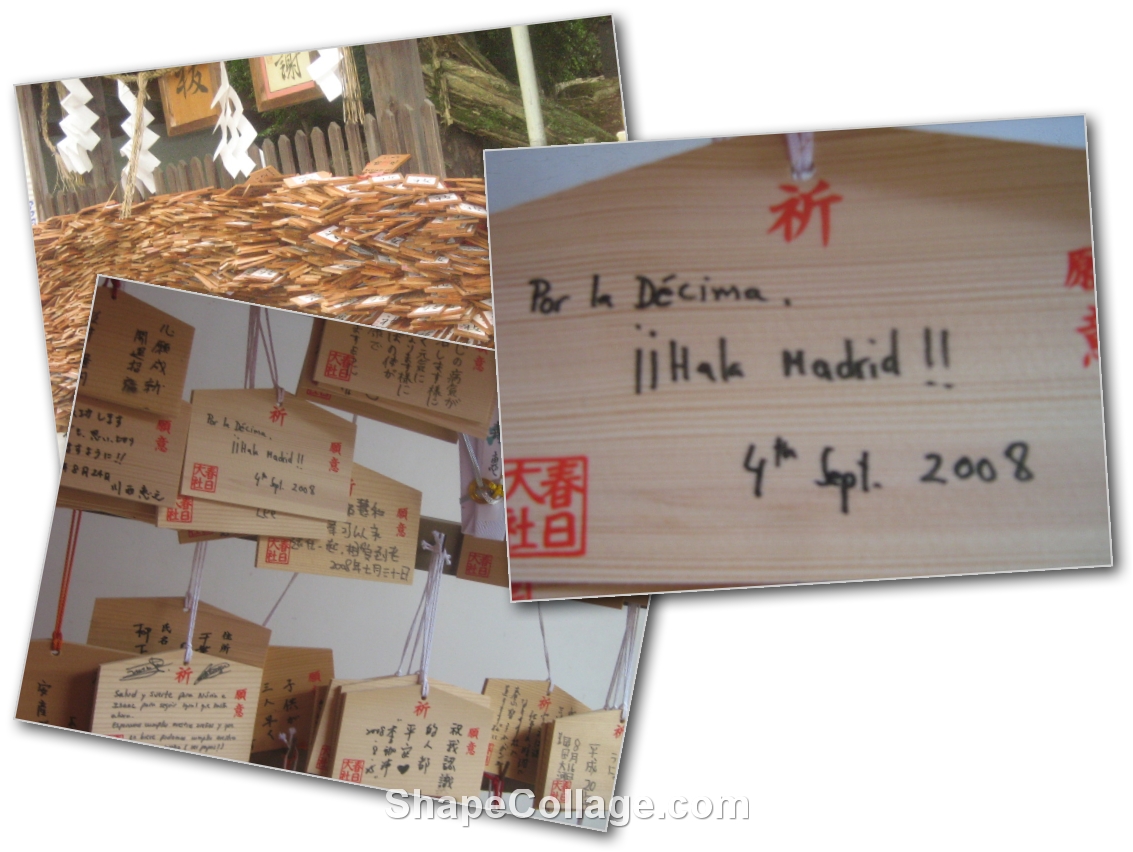
The other example is from Japan. There, close to Shinto shrines we can find Ema, or small wooden plaques where wishes are written upon and which are left hanging from special places destined to them. Again, you see thousands of them sometimes. I felt more scientifically obliged in 2008, so I used my chance to ask for only one wish; nothing personal, nothing related to love or richness (something that the genius of the lamp surely would have approved): I wished for Real Madrid to win the 2008/2009 Champion’s League… did I succeed? Well, that season Barcelona won the League, the Spanish Cup, Champion’s League, Spanish Super Cup, European Super Cup, and Club’s World Cup… not very effective.

Shinto wooden plaques, Japan.

The idea of asking for that wish started out as an exercise to prove the existence of God and at the same time checking to which confession He felt closer… but that is to be explained in another post.

Going back to our business of today: Every superstitious person will argue that my wish in Japan didn’t come true solely because of making it public before it happened, but that is what all Japanese do! Once bitten, twice shy: this time I have been more cautious. I took my fita do Bonfim and attached it to the entrance iron wall and will keep silence about those wishes until they come true. Will they?

Me and fitas do Bonfim.

Well, I have a basis to think they will. Take a look at the pictures of the Room of the Miracles below. This is a room within the church where people who have seen their prayers’ effect leave a picture of themselves with a thank you note, a poem, an explanation of the miracle that occurred to them… and even wax or wooden replicas of different parts of the human body that were healed by Senhor do Bonfim… (this view is bizarre to say the least).

The Room of the Miracles.

Leave a comment

Filed under Travelling

“Caimaneando”

Last year Luca and I went to Peru on holidays. One of the places we visited was the Amazon basin, where we stayed some days in the rainforest in a ecotourism lodge (Posada Amazonas) close to the river Tambopata.  

There we spent two days walking around the jungle, watching different species of animals and plants, going out in the middle of the storm, sleeping in the open air… everything in a place without electricity, hot water, internet and some other Western amenities, 3 hours by boat away from Puerto Maldonado the nearest city.  

Boat trip through Amazon basin.


We really liked that experience and we look forward to repeat it.  

In this post I mainly wanted to share some pictures of two quite different activities we did there. Fishing for piranhas and navigating down the river “caimaneando” or silently looking for caimans…  

Fishing piranhas.


Caimaneando in Tambopata river.

3 Comments

Filed under Travelling

Aerospace, a high-tech sector in Spain

Two years ago, there was a televised debate prior to the general elections in Spain. I remember I was watching it with friends and the incumbent president said “Spain is the leader country in the technology of air refuelling aircraft”. Since those friends watching the debate with me and I work in the aerospace sector we appreciated the comment.

Many things have happened since them, but one has not changed: aerospace sector is one of the most technologically intense in Spain.

For this post I am using mainly two sources: 2008 annual report from ATECMA (Asociación Española de Constructores de Material Aeroespacial, now replaced by TEDAEAsociación Española de Tecnologías de Defensa, Aeronáutica y Espacio; 2009 report is being cooked) and 2009 report from COTEC (a foundation for technological innovation, “Informe Cotec 2009“).

I already mentioned in a previous post the size of aerospace sector in Spain: 5,577M€ revenues in 2008. In the last 10 years aerospace revenues in Spain have trebled. In 2008 Spanish GDP was about 1,088 bn€, so aerospace sector weighed 0.51% of Spanish economy.

Aerospace sector revenues and R&D evolution.

Regarding the employment, there were 36.160 employees of which over 15,000 were graduates, engineers and managers; 41% of the workforce consists of highly qualified employees. The employment of the sector has been doubled in the last 10 years.

Aerospace sector has presence in 16 regions, with the highest contribution from Madrid (63% of revenues and 57% of employment).

Aerospace sector revenues and employment per region.

There were 335 companies: 6 employing over 1,000 workers and 318 SMEs.

The sector had a positive trade balance of 3.6bn€ (while Spain has a large negative trade balance, of about 100bn$ prior to the crisis, now around 70bn$, 4.5% of GDP).

Aerospace industry is a dual industry: companies involved in it develop both civil and military products. The weight of each depends on the different years, but on average Spanish aerospace industry is 60% civil and 40% military.

After this brief description of some facts (see ATECMA report for a more detailed view of the sector), I want to remark the technological intensity of the sector.

Aerospace sector invests about 10-15% of its revenues in R&D. This is by itself an impressive, figure: Spanish economy as a whole invested in 2007 1.27% in R&D, thus aerospace invests 10 times as much as the economy average. If we said that the weight of the sector was 0.51% of Spanish economy, the aerospace R&D represents 5% of national R&D investments. Even more, if we only count R&D executed by companies, aerospace R&D contributed with 8.5% of total private R&D.

I included in this post the report from COTEC because it makes a distinction among the different sectors dedicated to technology in Spain: manufacturing vs. services, and high technology vs. medium-high. It uses categories derived from INE (Instituto Nacional de Estadística), and there we see 6 sectors classified as “High Technology Manufacturing Sectors”:

  • Pharma
  • Office material and computers equipment
  • Electronics components
  • Radio, TV and communication devices
  • Medical, precision, optics devices and watches
  • Aerospace

R&D investments of high-technology sectors.

Combining the data from this report with data from ATECMA (using 2007 figures for comparison with COTEC), we reach the following findings:

  • Aerospace sector revenues represented 15% of high-tech manufacturing sectors.
  • High-tech manufacturing sectors invested 1.3bn€ in R&D in 2007, this is 4.5% of their revenues, or 10% of total R&D in Spain.
  • Aerospace sector R&D represented 49% of high-tech manufacturing sectors R&D (!).

Indeed, it seems a high-tech sector.

If you wish to compare Spanish A&D with other European countries, please see the ASD reports (AeroSpace and Defence Industries Association of Europe).

1 Comment

Filed under Aerospace & Defence

Speech about Minifutbol

Since I started the blog, I wanted to write about Minifutbol, a competition I play in Torrelodones. On March 17th I gave one speech about it at Toastmasters (supposedly a humorous speech), so what better way to explain what Minifutbol is that to share the script of that speech with you here:

“Mr Toastmaster, fellow members, guests,

This is the t-shirt of team with which I won last summer Minifutbol championship in Torrelodones… I am proud of it because that was the first championship I won in Minifutbol, I’m so proud that I’ll wear it here. I wear it here, because my partner Luca doesn’t allow me to wear it at home. She doesn’t like Minifutbol. On the awards ceremony after that tournament I was given a very big, shiny trophy… her reaction: “You’re not bringing this home! Not until you get rid of the rest of the trophies”. Once bitten, twice shy… now the trophy is somewhere hidden.

Fellow members, I want to tell you about Minifutbol, a kind of football being played in Torrelodones.

It all started 40 years ago with a group of friends in their twenties wanting to meet their old friends with the excuse of playing football matches.

Nowadays, in the village we are more than 600 people participating in it. We are divided in the following categories: “embryos”, “dummies”, “immature teens” (pavosos inmaduros), matures and veterans.

And there has always been a huge waiting list of people wishing to play, some applied in the 70s for the embryo category and still waiting and looking forward to join the veterans now.

As I told you, this T-shirt is of the team I played with last summer and won the summer tournament, now I am playing in another team. With this team we didn’t win the winter championship… no, we have been the last ones. We just won 2 matches out of 16… I don’t care, I’m even happy: in these competitions everybody gets a prize: I’ll be given a smaller trophy that will fit better in the living room of the house. Luca may not oppose this time.

Why did I switch teams? Minifutbol has a social ambition attached to it. There you get to know different people from the village. We switch teams every year and they are formed randomly: every year I inscribe myself individually and then by draw I’m placed in a team with other 7-8 players. At least this is what I’m told… actually, I never saw the draw taking place… It could be that each year my previous team is just getting rid of me.

Going back to the competition, we lost, ok, but let me tell you one rule of the competition that describes well the spirit of it: each player has to play at least a minimum of 10 minutes in every match. So it can’t happen that the best player of the team plays the whole of it and the worst doesn’t get to participate. In the case of our team we could say that we want everyone to feel part of the failure of the team.

Ok, failure is a strong word… let me put it in another way. What would you say is the most important thing in football, the success factor?… ok, so the more goals the better the match, the better the show. This year, I am in a team devoted the show, which in football means goals… we are so devoted to it that we try not to interfere with it; we have been scored 160 goals, about 10 goals per game. Sometimes we even had to score those goals ourselves. I had to score one myself.

Life goes on. In spring we play yet another tournament: the Cup. With the same teams we played in winter.

Now we have the chance to be the revelation team in the cup tournament… as you can imagine the pressure is very high among us, the expectations in us however are very low among the rest…

It never happened that the very worst team in the league has been able to win the cup.

I received the following message from the captain of the team trying to encourage us:

“Guys, I also think we can be the revelation team. Let’s do something that has never been done by anybody else, something never seen, something surprising and that will leave everybody with their mouths wide open…

… let’s play naked next Sunday.”

Mr Toastmaster.”

Of course, this post still leaves open the door to another post in which I talk about Toastmasters, but that one will come for sure.

That “next Sunday” indeed was 14th March, we didn’t play naked and we won the first match of the cup 11-5… sometimes you have to make up some facts in the speeches… the show is the show.

3 Comments

Filed under Sports, Toastmasters

“Playas” in Lima

At the time this post is published, Luca and I will probably be in one the following praias (beaches in English, playas in Spanish) in Rio de Janeiro: Leblon, Ipanema or Copacabana…

… let me share with you a picture of how playas looked like in Lima, Peru.

Playa grande, Lima.

3 Comments

Filed under Travelling

The real comfort starts from 300 kg seats

In a previous post we introduced some comparisons of aircraft by its price per kilogram. There, we could see a trend in bigger aircraft being cheaper in this per kg basis. This raises the question: do bigger aircraft require less weight per seat? Are they lighter in a kg per seat basis?      

This is what intuition seems to tell us; after all, once you have put in place the engines, wing, tail… what can be the difference between a larger or smaller fuselage…     

Let’s use the same sources we used in the previous post and take the typical seat configuration that the OEMs (Original Equipment Manufacturer) indicate for each aircraft model. We get the following table:     

Aircraft OEW (kg) per seat.


Our intuition wasn’t very successful again. In the upper part of the table we find the A320 family and 737s aircraft (those used by e.g. Easyjet and Ryanair in short-haul routes). In the bottom of the list we find the A380, A340, A330, 787, 777…, the biggest aircraft.     

We see that the average is about 400 kg per seat. Let’s compare this figure again with cars, with the same cars as we did in the previous post. We now get following table:     

Cars empty weight (kg) per seat.


It turns out that cars also need around 300-500 kg of structure per seat (an average for these ones of 360 kg). Since most cars carry 5 passengers, here it’s easy to see the trend: bigger cars employ more kilograms per seat.     

Let’s go for a closer comparison:     

  • Small for small: take the A321 with 253 kg/seat, it is quite similar to the Renault Megane with 230 kg/seat.
  • Large for large: take the A380 with 527 kg/seat, it is almost identical to the Audi Q7 with 527 kg/seat.

One step further: The A380 used so far is the 3-class configuration with 525 passengers, but wasn’t there a high density configuration with 853 passengers in a single class? (This matches well with the jargon: cattle-class…). This configuration gives us 325 kg/seat… this is again almost identical to the 329 kg/seat given for the Audi Q7 in “high density” configuration, obtained with the optional 3rd row of seats, which only adds 35 kg to the weight of the car. Aren’t these remarkable coincidences? Is it a constant of the universe? 🙂     

Let’s compare these results with buses, city buses and minibuses:     

Buses empty weight (kg) per passenger.


When we compare the figures of touring and city buses in an all-seated configuration we get again similar figures than planes and cars (~290 kg/seat ~ A320 family). If we take a fully loaded city bus we descend to the crude reality of mass transportation and complete lack of comfort (100 kg/seat; that is cattle-class…). We may notice as well that a minibus weighs less than a Q7 and carries twice or three times as many people.     

Let’s now see the train and subway. For this purpose, we’ll check the coaches R-142A and B of the subway of New York which are built by Kawasaki Heavy Industries (which a supplier for the Boeing787 as well). The train we’ll use is the AVE Series 100 of RENFE, built by Alstom, which was the first high-speed train ever used in Spain in 1992. See them in the following table:       

Subway and high-speed train weight (kg) per passenger.


The subway is below the levels of aircraft, but not that low as city buses. As far as the train is concerned: that’s another story, a luxurious experience (achieved with ~1,200 kg/seat) that can only be improved by Singapore Airlines Suites.     

Below we can see again a graphic with all modes of transportation compared, there we may spot some trends.     

Modes of transportation weight (kg) per passenger/seat.


We could say that comfort starts above 300 kg/seat… How heavy is your car?     

Different modes of transportation.

3 Comments

Filed under Aerospace & Defence

Afilador del siglo XXI

Hace unas semanas Bruno publicó un tweet con un enlace a un post sobre profesiones desaparecidas. Cuando vi el post, lo primero que pensé fue “a mi casa de Torrelodones sigue yendo el afilador”. 

Pues bien, este puente lo he pasado allí, y esta mañana me ha despertado dicho afilador. Con la misma musiquilla de siempre, una y otra vez… vas notando como se acerca y como se aleja. En la primera pasada no me ha dado tiempo a verlo, en la segunda, sí. Pero hete aquí mi sorpresa: ¡ya no va en bici! Ahora va en su vehículo comercial, con un cartel anunciando que es el afilador, la musiquilla será un grabación, resguardado del frío y la lluvia, puede que escuchando la radio… 

Afilador del siglo XXI

3 Comments

Filed under Miscellanea

Paper birds in NY

I guess all of us have many vivid images from the terrorist attacks on 9-11 in New York and of the days after. I guess some of them are of the hundreds of candles and pictures of the missing ones. Images such as the ones below:      

Images from Ground Zero.


That fence in the picture is at Saint Paul’s Chapel, just across from where the World Trade Center once stood. That chapel was as well the place where many of the people working in the site in those days found relief.     

Last December, Luca and I went to New York, and this chapel was among the places we wanted to visit. It was a very moving experience. Let me focus on one thing I found inside. In the following picture you see strings of colourful folded paper birds inside the chapel…     

Paper birds in Saint Paul's Chapel.


I didn’t know I would find this, so it immediately rang a bell, as it was something I had learnt not so long before.     

Japanese call to the tradition of folding papers origami. There, the most famous design is that of the Japanese crane, a long-necked bird.     

The first time I saw such paper birds was in the Hiroshima Peace Memorial park, in the summer of 2008.    

Hiroshima Peace Memorial park paper cranes.


Let me paste here the explanation given by Wikipedia on the legend of these paper crane birds:    

Legend says that anyone who folds one thousand paper cranes will have their heart’s desire come true. The origami crane has become a symbol of peace because of this legend, and because of a young Japanese girl named Sadako Sasaki. Sadako was exposed to the radiation of the atomic bombing of Hiroshima as an infant, and it took its inevitable toll on her health. She was then a hibakusha — an atom bomb survivor. By the time she was twelve in 1955, she was dying of leukemia. Hearing the legend, she decided to fold one thousand origami cranes so that she could live. However, when she saw that the other children in her ward were dying, she realized that she would not survive and wished instead for world peace and an end to suffering.     

A popular version of the tale is that Sadako folded 644 cranes before she died; her classmates then continued folding cranes in honor of their friend. She was buried with a wreath of 1,000 cranes to honor her dream. While her effort could not extend her life, it moved her friends to make a granite statue of Sadako in the Hiroshima Peace Park: a young girl standing with her hand outstretched, a paper crane flying from her fingertips. Every year the statue is adorned with thousands of wreaths of a thousand origami cranes.     

The tale of Sadako has been dramatized in many books and movies. In one version, Sadako wrote a haiku that translates into English as:     

I shall write peace upon your wings, and you shall fly around the world so that children will no longer have to die this way.  

This is how the cranes flew from Hiroshima to New York; unfortunately peace hasn’t reached that far.

1 Comment

Filed under Travelling