Europe Day

Today is the Europe Day or Schuman Day. To celebrate this I wanted to share some pictures and thoughts.

The first time I travelled abroad consciously was in 1995, on trip I made with an aunt, two cousins and my brother to Germany. I remember one picture we took of us on the Germany-Austria border (already then; the only thing indicating that we were coming to a different country was a signpost). I remember the act of crossing a border as something special.

Last Easter, on a trip to Brazil, we had to cross the border between Brazil and Argentina in order to see Iguaçu falls from Argentina. Again, this act of crossing borders felt special. When was the last time I had to cross a full-fledged border, with a police stand post in either side of the borderline? (The term “full-fledged” includes police, long queues, waiting for almost an hour…).

I have travelled abroad lately, but apart from controls in airports we normally don’t get to see this so often, at least not in Europe. The last time I went through this was between Croatia and Bosnia on a trip in 2007, nevertheless there was minimal infrastructure on that border. The previous time was on 2003, when I crossed the Estonia-Latvia border by bus or the Macedonia-Kosovo one on foot.

After having crossed the border, already in Argentina, I remember I made a comment to Juan Pablo, the driver (quite a Boca fan!), along the line of when would those borders in South America disappear… his reply: “that cannot happen; South America is really only two countries, Argentina and Brazil, and if that was to happen, the day after thousands of people from Peru, Bolivia would be coming here…”.

This slideshow requires JavaScript.

I remember having heard similar comments in Europe both in 2004 and 2007, when two waves of Eastern European countries entered the European Union…

I was looking through some numbers in the Wikipedia (with data from I.N.E.): amongst the 29 the main inflows of immigrants in the period 2001-2008 only 3 corresponded to immigration from the countries that became part of the Union during those years: Romania (1st), Bulgaria (9th) and Poland (16th). Of the 14 most numerous groups living in Spain there are again only 3 from Eastern European countries: Romania (2nd), Bulgaria (8th) and Poland (14th).

Leaving aside the discussion of the benefits of that immigration, I just wanted to see whether that fear had materialized. I don’t think so.

There will be a day in which Juan Pablo will cross the Brazil-Argentina line without any stops and then he may as well be surprised when he encounters a full-fledged border somewhere else.

4 Comments

Filed under Travelling

Ethical Banking

I attended yesterday a conference by Joan Melé at EOI Business School. It caught my interest by its title Dinero y conciencia: ¿A quién sirve mi dinero? (Money and conscience, who benefits from my money?), even though I didn’t know the presenter nor the bank he works for.

I want to make some reflections of yesterday’s experience:

  • The first one as a Toastmasters member: I applaud the decision of the speaker to stand up, not using notes or a power point presentation and managing to get the focus of the audience on him and his message for over an hour and half… we witness many conferences in which the experience is not so enjoyable.
  • The next reflection is to praise the move by EOI Business School towards web 2.0 made some months ago. As an alumnus of the school I must say that it’s very motivating to see the number of activities organized, the topics covered and it’s very convenient the way they are publicized in the different channels: EOI web and blogs, Facebook, streaming TV channel, Twitter… and because of that, because you can actually watch the whole of the conference or catch a glimpse of the main messages, I will just add very few ideas that I took for reflection and some sources the presenter cited.

Regarding money itself, the speaker structured his speech in the three main uses of money: to buy, to save and to donate.

  • When buying: he proposed the exercise of thinking “what”, “why” and “where” to see how our purchasing decisions affect others (low wages, pollution, exploitation…). He made the case for an economy based not so much in consumption of material things but cultural and intellectual ones: e.g. we happily pay 30 euro for a dinner, would be pay the same to be read poetry?
  • Regarding saving he noted the positive side of it: planning for future expenses. The other side of the coin being “fear of the day of tomorrow”: what will happen that we won’t be able to face? Nothing: Whatever comes, we will be able to face it. This reminds me to Charlie Munger comment on Berkshire Hathaway shareholders meeting when he said that he became comfortable […] after he realized he could survive hardship, “Maybe you should get your feet wet with a little more failure”. We lack some entrepreneurship…
  • The speaker did not want to go in deep about donating, except pointing that handing large inheritances to offspring can be more harmful than positive to them and society.

Some ideas to take away:

  • There are no leaders to solve our problems; it’s the turn of civil society to take action. It’s the time for the Globalisation of conscience.
  • The responsibility for what happens around us is ours, we need to first change ourselves.
  • We are the crisis of 3 billion people since dozens of years ago.
  • Need to bring back the role of banks as agents that relate people: savers with entrepreneurs in order to create wealth with profits as a by-product not as the one and only end.
  • Need to start and epidemic of courage and enthusiasm.

Finally, some reports, articles and documentaries he cited:

One final quote from Charlie Munger to end this post: “The secret to happiness is to lower your expectations.”

4 Comments

Filed under Books, Helping others, Investing, Movies, Toastmasters, Twitter & Media

Bits of the World in Brazil

While in Brazil last Easter, I read in my guide that in the city of Sao Paulo lived the largest Japanese ethnic group outside Japan. My first thought was: that’s not surprising; by heart I made the following reasoning “if Sao Paulo is among the six or seven biggest cities in the World and we exclude Tokyo and Chinese cities… there is a chance of 15-20% of it being Sao Paulo”.

Later on I was told that in Sao Paulo also lived the biggest communities of several other nationalities… yes, the same rationale could apply (I guess it would come a point where not every nationality could have their largest community abroad in Sao Paulo… but I found no way to prove that).

This may give us an idea of the diversity of the city as well as the country, Brazil… and that is something you keep feeling when you visit it… you suddenly see something and tell yourself “I have seen that somewhere else…”. Like if there were wormholes connecting different parts of the World… Be it music, food, architecture, clothing, traditions…

Let me focus on some examples:

The first two examples are related to Japan.

  • See the Japanese traditional gates (or Torii), both in Japan (this case in the island Miyajima) and in the Japanese neighbourhood in Sao Paulo.
  • Note the striking similarities of procedures used to push people into the subway coaches both in Sao Paulo and Tokyo (in this case I was later told by my sister that in a TV programme about Spanish living abroad it was commented that the metro of Sao Paulo was inspired by the one in Tokyo).

Japanese gates, Torii, in Sao Paulo and Miyajima.

People queueing in Sao Paulo and Tokyo subways.

The next striking example is one that I already posted about: the Banespa tower in Sao Paulo compared to the Empire State Building in New York (you almost wouldn’t notice the difference if it wasn’t for the height of ESB).

Banespa Building (photo by Felipe Mostarda) and Empire State Building (photo by David Shankbone).

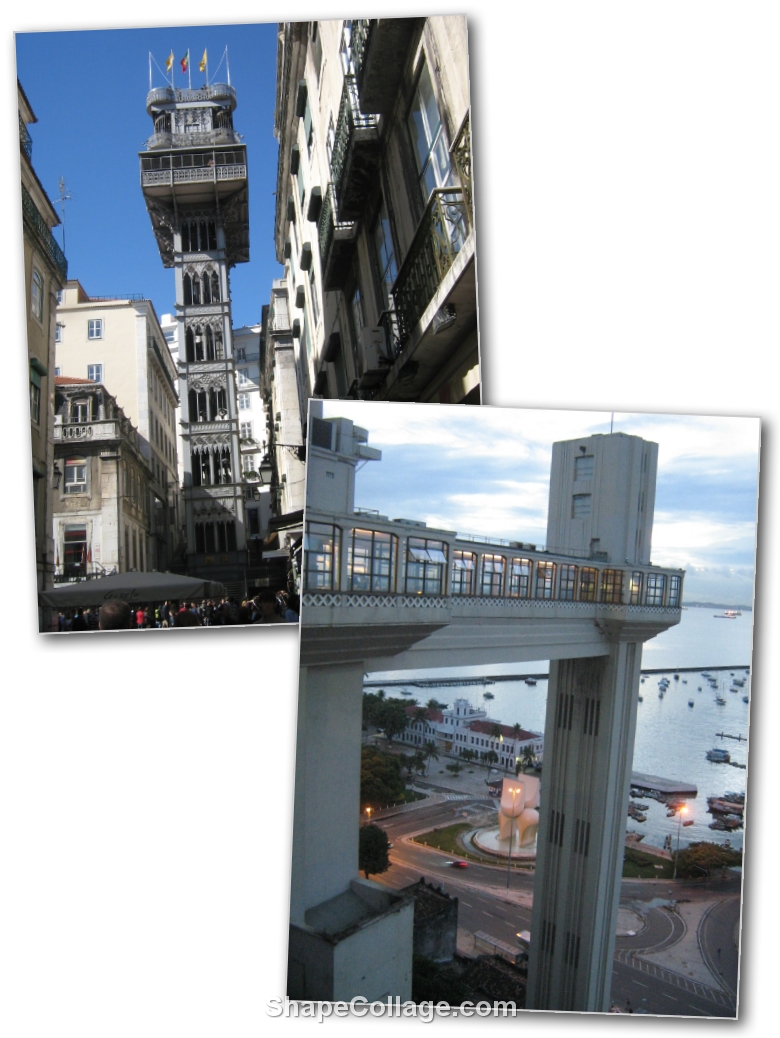
Other very similar example is found between two elevators: the Lacerda elevator in Salvador de Bahia and the elevator of Santa Justa in Lisbon… here the main difference is the queue and pricing… in Lisboa you may wait 30 minutes and pay over 1 euro, while in Salvador you wait less than a minute and pay 0,15 R$ (this is 6 euro cents!)…

Elevators of Santa Justa (Lisbon) and Lacerda (Salvador).

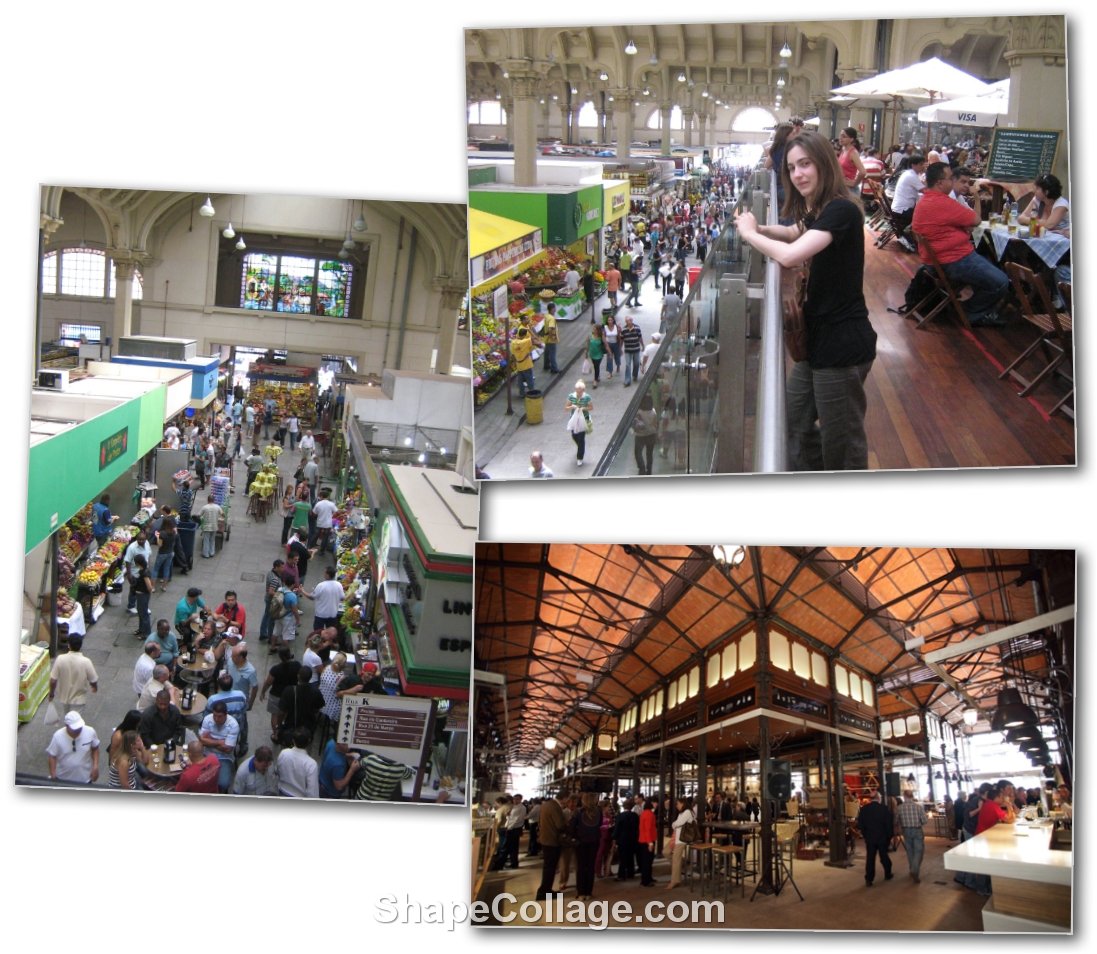
Similar experiences can be found as well inside two different markets: the Sao Paulo Municipal Market and Mercado de San Miguel in Madrid, the first one offering a wider variety of products (including good Spanish jamón in the “Emporio Arabe”?!?) and the latter a more upscale atmosphere. (If at the market in Sao Paulo, do not miss the codfish pastel and mortadella sandwich at Hocca bar!!).

Municipal markets in Sao Paulo and Madrid.

Lastly you all know the Cristo Redentor in Corcovado Mountain, Rio de Janeiro… there is a similar Christ in Lisbon, just at the opposite riverside from Praça do Comerço (though I admit that in this case it is in Lisbon where you think “oh, I’ve seen this somewhere else”).

Christs in Rio de Janeiro (being overhauled) and Lisbon.

3 Comments

Filed under Travelling

A different view of the World

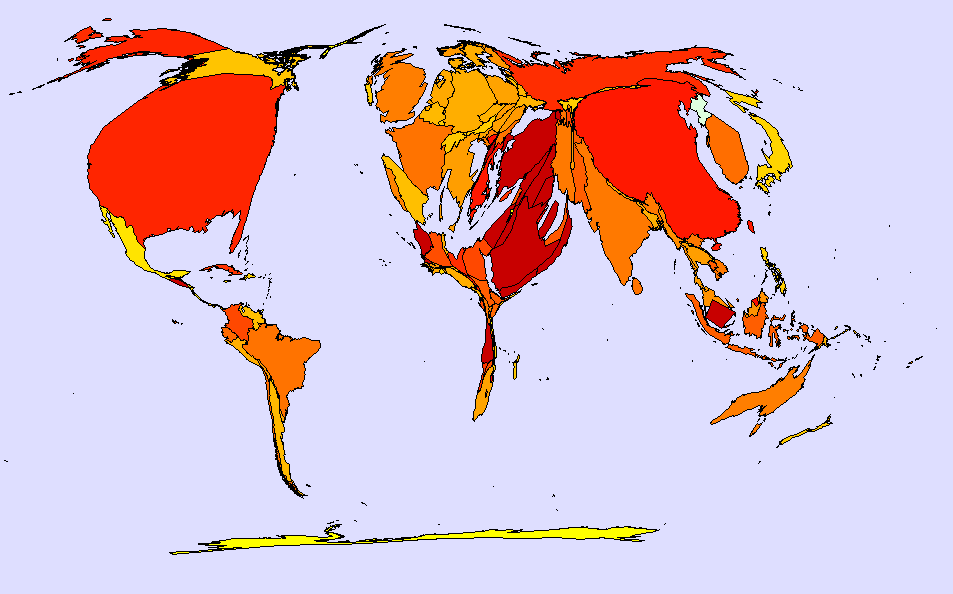
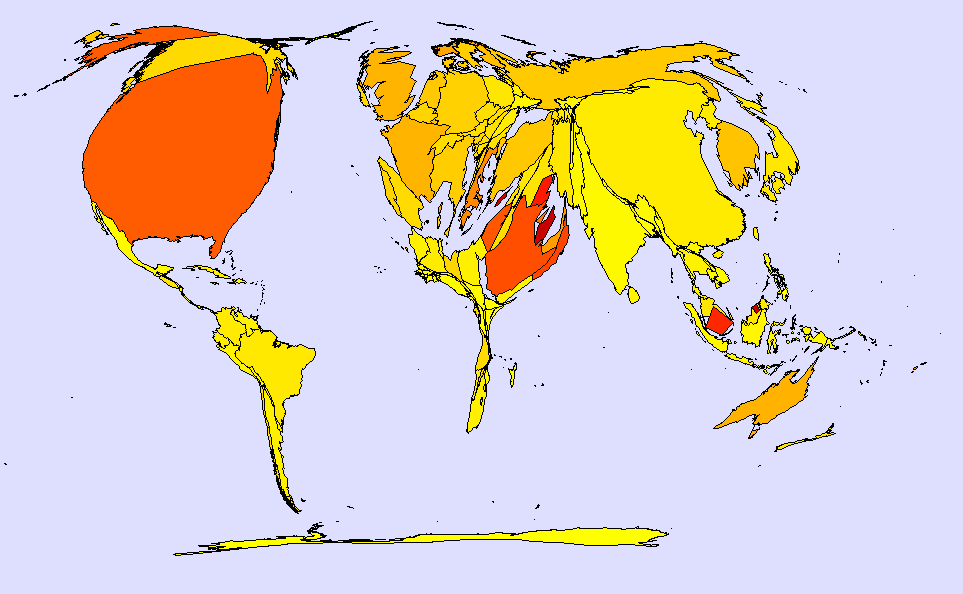
At work I often use different lists of countries by aircraft fleets, GDP, military expenditure, etc. Sometime ago I thought that it would be interesting to produce those kind of maps in which the area of the country represents the value of a variable: cartograms. Surfing through the internet you may find different websites with lots of cartograms to download, explanations about the method to produce them and even some applications that you may use to produce your own cartogram.

Today I have been playing with one of these applications. These are three of the cartograms I made:

  • In the first one: area represents GDP (in purchasing power parity) whereas colour shows GDP per capita (again in PPP).
  • The second one shows: military expenditure (PPP) as the area of countries whereas colour shows military expenditure as a percentage of GDP.
  • The last one has area representing again military expenditure (PPP) and colour showing military expenditure per capita (PPP).

Area showing GDP (PPP); colour showing GDP per capita (PPP).

Area showing Military Expenditure (PPP); colour showing Military Expenditure as percentage of GDP.

Area showing Military Expenditure (PPP); colour showing Military Expenditure per capita (PPP).

The data I used comes from extractions I made from the CIA World FactBook in 2007-2008, which used estimated data of different years, mainly 2006.

The application I used is made by MAPresso, and the quickest explanation on how to work with it I found it in this blog.

1 Comment

Filed under Aerospace & Defence

Video of Iguazu from a helicopter

In this post I want to write the least possible.

Enjoy the short video (5’20”) prepared in my first ever trip on helicopter (a Bell 206) around Iguazu falls… an unforgettable experience.

6 Comments

Filed under Aerospace & Defence, Movies, Travelling

Value investor: Joel Greenblatt

Last week, I watched an online interview by Steve Forbes to Joel Greenblatt, a value investor, author of the book: “The Little Book That Beats the Market”.

I read this book about two or three years ago and I remember it as a very enjoyable read (just about 150-200 pages). He proposes a formula to automate the stock picking process that would result from applying value investing principles by a person that doesn’t want to get too much involved.

During much of the interview he discusses how they have tested the formula, how it beat the market in this and that time, etc…

Summarizing, he admits that he based the formula in:

  • From Benjamin Graham: buying cheap.
  • From Warren Buffet: not only buying cheap, but buying a good company.
  • Last but not least: you need long periods of time, thus, patience.

This last requirement is what most speculators (vs. investors) lack of.

If you are interested in the formula, you may use it for free in his website.

Nevertheless, if I were you I wouldn’t stop there, but read “The Intelligent Investor” (especially chapters 8, 14 & 20)… the sooner, the better.

To my friends: if you are interested in Greenblatt’s book, I also got it, if you want to borrow it…

1 Comment

Filed under Books, Investing

International Day of the Book

Today is the commonly known as International Day of the Book. I learnt in the Wikipedia that it is actually called by UNESCO: “World Book and Copyright Day” (I wonder how the copyright part of it is celebrated…).

There, I also learnt that this tradition was originated in Catalonia, Spain, and that even though it is commonly stated that is the anniversary of the death of both Cervantes and Shakespeare (23rd April 1616), that is not correct as at the time England was using the Julian calendar instead of the Gregorian one, thus Shakespeare died 10 days later.

Recommendations. My contribution on this day is the recommendation of the 3 books of those I read last year that I liked the most:

  • “Augustine’s Laws”, Norman R. Augustine.
  • “A Random Walk Down Wall Street: The Time-Tested Strategy for Successful Investing”, Burton G. Malkiel.
  • “Particula Divina” (“God Particle”), Leon Lederman.

In the same way I would appreciate if you leave your recommendation of the books that you liked the most of those you have read recently in a comment to this post.

E-Books. Two weeks ago I read in The Economist an article about the publishing industry. It cited a study, from PwC, which estimated that consumer ebook sales in North America will have a share of 6% of the market in 2013 (up from 1.5% in 2009). That would be one out of every 16 people. However, I think I only know of one person reading e-books as of today (a member of Excelencia who spoke about it a year ago). Let’s see if we find more people doing so:

3 Comments

Filed under Books

Toastmasters Division H Conference

I have already mentioned Toastmasters quite a few times in the blog. From the Toastmasters International site:

“[…] Toastmasters International has grown to become a world leader in helping people become more competent and comfortable in front of an audience. The nonprofit organization now has nearly 250,000 members in more than 12,500 clubs in106 countries, offering a proven – and enjoyable! – way to practice and hone communication and leadership skills.

Most Toastmasters meetings are comprised of approximately 20 people who meet weekly for an hour or two. Participants practice and learn skills by filling a meeting role, ranging from giving a prepared speech or an impromptu one to serving as timer, evaluator or grammarian.

There is no instructor; instead, each speech and meeting is critiqued by a member in a positive manner, focusing on what was done right and what could be improved.

Good communicators tend to be good leaders.”

There are 15 Toastmasters clubs in Spain in Portugal (3 of them in Madrid!), with over 400 members. Next weekend (April 24th), we will gather in Porto for the Division conference. There, we will have several workshops, lectures and presentations delivered by prominent speakers; among them Ed Tate, World Champion of Public Speaking in 2000, and John Zimmer, four times European Champion of Public Speaking.

Even more interesting will be the contests that will take place there: Evaluation and International Speech contests. From our Area (Madrid and South of Spain) there will be four participants taking part in them: Jane Kinnear, Ruben Navarro, Damian Alcolea and Alexander Hristov.

I am sure they will make a great performance and above all they’ll learn a lot just by participating in the contest. The rest of us attending will enjoy two great contests in a memorable weekend!

Good luck!!

1 Comment

Filed under Personal development, Toastmasters, Travelling

Meet my avatar

Time ago I already introduced you to my Lego. Some weeks ago during a Gol flight in Brazil I was reading through the in-flight magazine when I found an article that talked about Meez among other things.

I was just playing with it little bit. Please, meet my avatar, “Javier in casual Friday” (just if I wore casual on Fridays…).

Meez 3D avatar avatars games

5 Comments

Filed under Marketing, Travelling

Sao Paulo from the top of Banespa building

Banespa building is an important skyscraper in the financial center of Sao Paulo. Banespa stands for Banco do Estado de Sao Paulo, which now is owned by Banco Santander. The building was designed by a Brazilian architect, Plínio Botelho do Amaral, who was inspired by the Empire State Building. It was for 20 years the highest building in Sao Paulo, until surpassed by Edificio Itália.

Banespa Building (photo by Felipe Mostarda) and Empire State Building (photo by David Shankbone).

At the top of the building there is an observation deck from which you can see stunning views of Sao Paulo, with hundreds of skyscrapers in whichever direction you look at for kilometers and kilometers. Then you realize that you are in Sao Paulo, the 6th or 7th most populated city in the world (depending whether you look at the city limits or metropolitan area).

Sao Paulo skyline from Banespa observation deck.

Other famous observation decks that I visited recently were the one in the ESB and the Top of the Rock at the GE Building Rockefeller Center, there are some differences though:

  • Height: Banespa, 161 m; Rockefeller, 259 m; ESB, 443 m.
  • Number of floors: Banespa, 35; Rockefeller, 70; ESB, 102.
  • Construction finished in the year: Banespa, 1947; Rockefeller, 1939; ESB, 1931.
  • Observation deck ticket price: Banespa, free; Rockefeller, 20$; ESB, 20$ + 20$.

Race in New York. Let me share here with you a story about a race to build the tallest building that took place in the late 1920’s. I found this story in the book, “Tales of New York”, which I commented in a previous post.

Three buildings were being built at the same time, the 40 Wall Street, the Chrysler Building and the Empire State Building. Competition among them was fierce at the time, with names of big industrialists behind them. Plans were revised once and again. The first one in being finished was the 40 Wall Street in April 1930 which claimed the title of world’s tallest building at the time. Originally it was to be 840 ft but along the race the plan was revised to make it just 2 feet taller than the Chrysler building plan at the time 925 ft, at completion the 40 Wall Street height was increased to 927 ft.

During the last weeks of its construction loads of iron and steel were brought to the interior of the Chrysler building. People thought that it was part of the interior decoration, filled with metallic details and motives of the automotive industry. But once its rival building was finished, on a clear day in the morning a needle-like metallic structure was raised from the center of the top of the Chrysler building to the surprise of the population of New York. On May 27th 1927, the Chrysler building was finished, in the end measuring 1,046 ft, taking the title of tallest building from 40 Wall Street merely a month after.

Walter Chrysler had worked in the past together with the man behind the Empire State Building, John J. Raskob, then CFO of General Motors, one of the main competitors in the automotive industry. He wanted him to either fail in the pursuit of building the tallest skyscraper or becoming bankrupt if he made it. With 1,046 ft height the Chrysler was to be tallest than the Empire State Building when it would be finished, however in the year that took the ESB to be finished the design was subsequently changed measuring 1,454 ft when it was finally finished in 1931, taking the title of tallest building from the Chrysler just a year later.

Just to close the post…

  • nowadays the tallest building is the Burj Khalifa in Dubai with 828m (160 floors),
  • the tallest building in Europe is Commerzbank Tower in Frankfurt with 259m (65 floors) and very close to it is the Main Tower (200m) that hosts a very nice restaurant which is the only observation deck in the skyscrapers of the city,
  • the tallest in Spain is the Caja Madrid Tower with 250m (45 floors) which holds the 148th position in the list of highest skyscrapers.
  • another interesting point is to see the evolution of the title of “tallest skyscraper in the world”.

Leave a comment

Filed under Books, Travelling