Tag Archives: Boeing

787 Break Even for Dummies

My previous two posts on Boeing 787 break even (original and further discussion) were generally well received, as far as the insight they provided on the matter and the way they treated the different variables at play.

From the feedback, I understand they were quite dense regarding the amount of information they conveyed and not so easy to grasp for the general public.

In this post I will try to apply the old adage “A picture is worth a thousand words” and show everything which was mentioned in the previous posts in just four graphics.

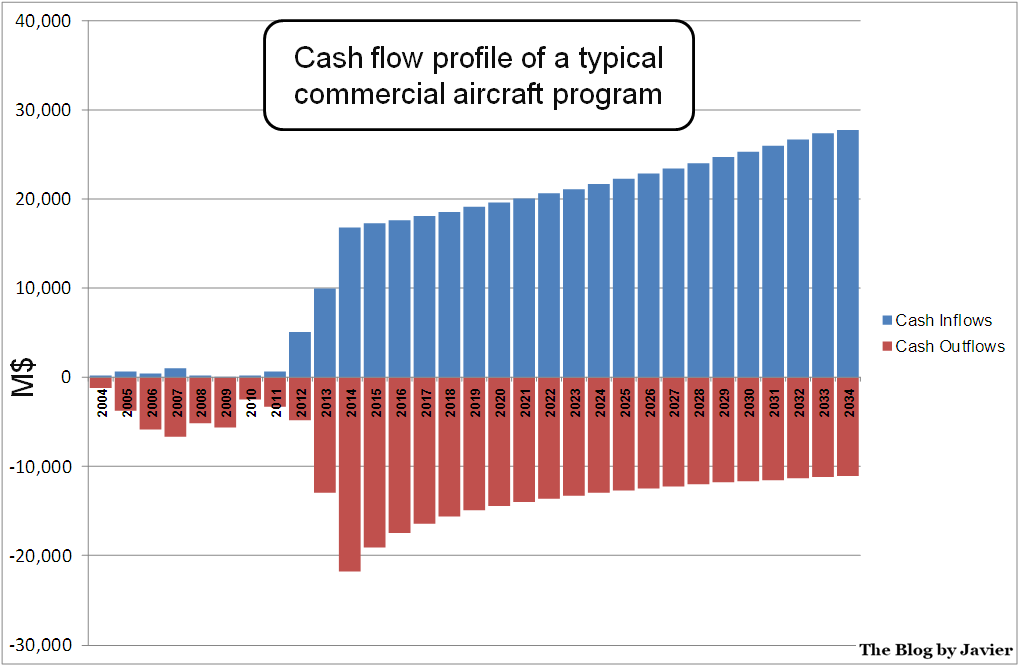
Forget the 787. Any new commercial aircraft program shows a similar cash flow profile, with initial cash outlays to cover the long the development period, a ramp-up of production and a learning curve effect once the series production advances.

Cash flow profile of a typical commercial aircraft program.

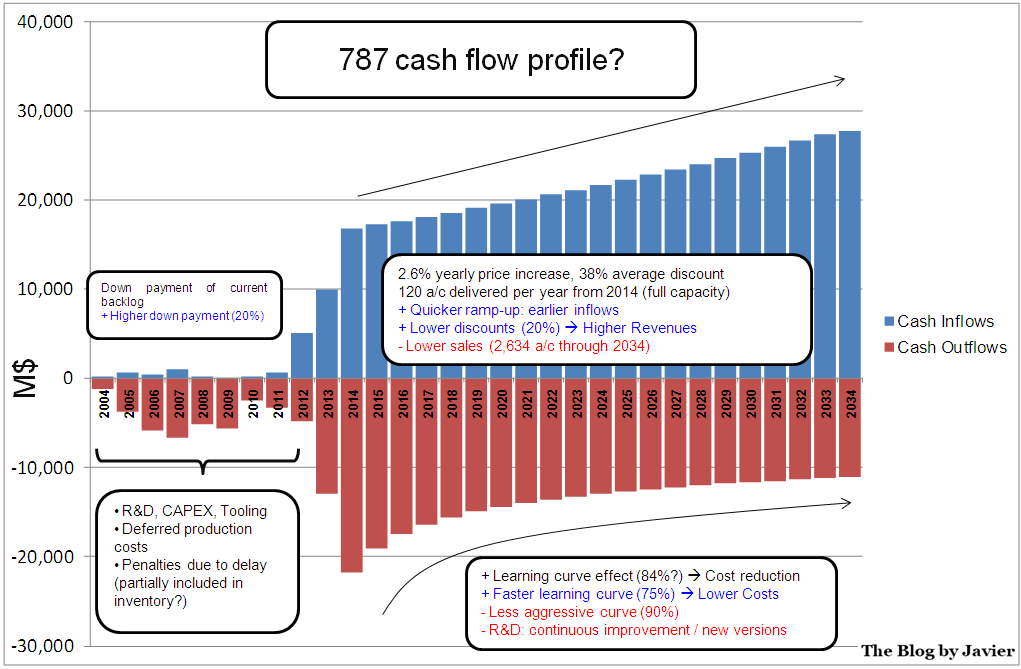
Take the case of the 787. The discussions made in the previous posts and the influence of the different variables are summarized in the different boxes of the next graphic.

787 cash flow profile?

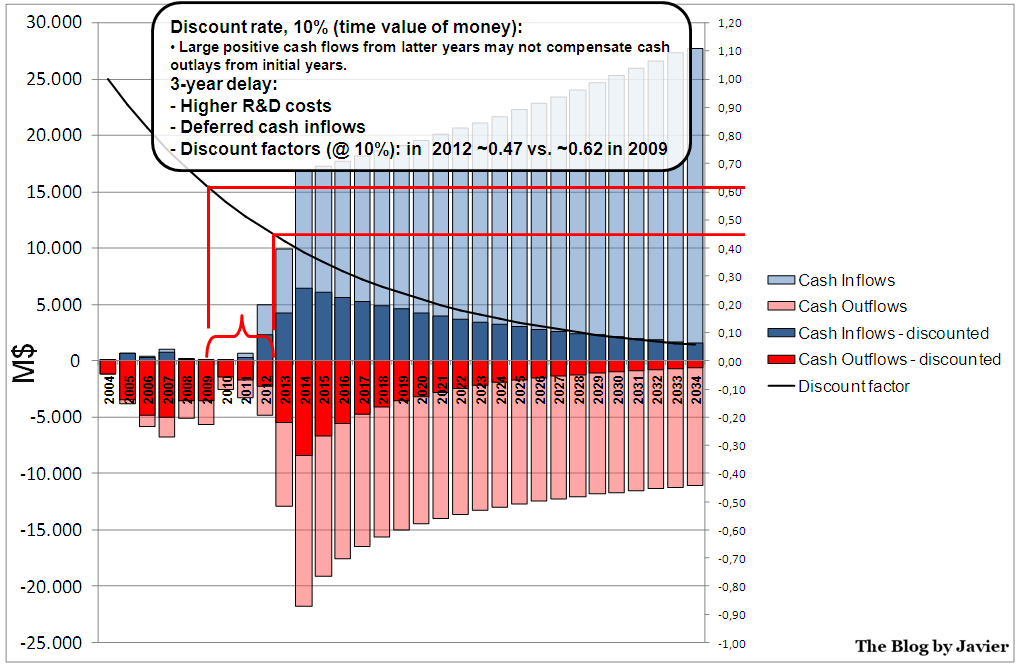
What is critical in a commercial aerospace program as an investment project? The long development period makes it difficult for the positive cash flows at the second half of the life cycle of the aircraft to compensate the initial cash outlays spent in R&D, capital investment and production of the first units. Why is that difficult? Due to the time value of money: A positive dollar of the tenth year will only compensate 39 cents of the first year (at a discount rate of 10%)…

787 cash flow profile affected by the time value of money.

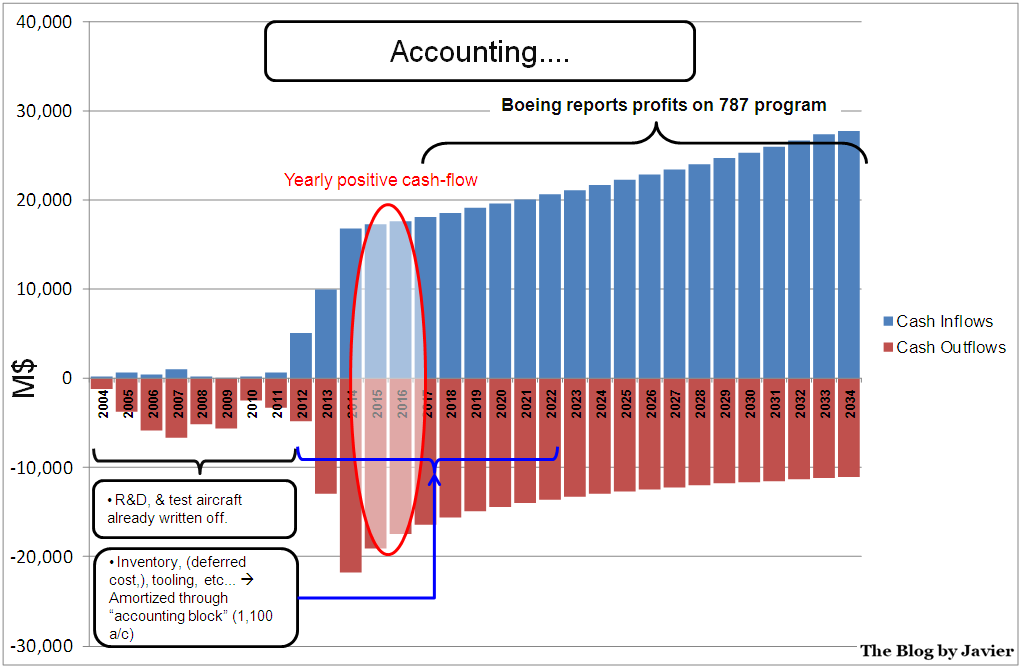
Let’s get back to the “accounting block”, what was going to happen around 2015, and whether the 787 would make profits for Boeing. In the yearly accounting, revenues are not discounted, thus the above discussion doesn’t apply. As soon as production costs plus amortization of initial investments are balanced by revenues, the 787 will make a profit for Boeing.

787 accounting block, profits...

After having shared all these plays with numbers and hopefully having shed some light over the issue, it is important to remind that these are just models and that what will finally happen will only depend on Boeing’s engineers, shop floor workers and sales teams.

“Not everything that counts can be counted, and not everything that can be counted counts.”

(Sign hanging in Einstein’s office at Princeton)

25 Comments

Filed under Aerospace & Defence

More on Boeing 787 break even

After the post I wrote the last week with an analysis of when could Boeing 787 break even (Will Boeing 787 ever break even?), I received some feedback in the form of emails, comments in the blog and comments in Scott Hamilton’s blog (Leehamnews) as he mentioned the analysis and linked to it.

I wanted to address some of those comments in a single piece for the benefit of all. Please, find them below.

A leading aviation analyst hinted that:

“In the case of the 787, it increasingly looks like the -8 will be an up-front version with poor pricing, but the -9 (and -10) are planned to make this problem better. […] So, your assumption of a consistent 38% discount  won’t happen, unless either Boeing fails to improve the 787’s performance or if the market doesn’t like the 787.”

This could be built into the model by allowing aircraft sold after the current backlog appear in the model as sold at a lower discount (e.g. 20% instead of 38%). The cash inflows due to the down payments would be increased soon, but since producing the existing backlog will take until sometime in 2019, the cash inflows from deliveries will be untouched until then. Result: that would bring break even about 2 years forward (2021 vs. 2023, in the case of 75% learning curve and 10% discount rate – what I would call “Boeing’s baseline”).

Another leading analyst suggested:

“I think the 5,000 market forecast is for the middle twin-aisle market as a whole, which includes A330, A350 and 777 (and even the almost-but-not-quite-dead 767). If I’m correct, I disagree with your figure above as too high. Clarification of the 5,000 is required for everybody.”

I reviewed Boeing’s commercial market outlook. In the next 20 years (2011-2030) Boeing sees deliveries of 6,610 twin-aisle passenger aircraft: 3,020 small and 3,590 intermediate.

In the previous post I mentioned that 2,634 were included as 787 deliveries, though that includes deliveries from 2031 to 2034, later than the period covered by this year’s CMO (480 a/c between 2031-34).

To compare apples with apples, between 2011 and 2030 I included 2,154 787s delivered, all those that 787 assembly lines could produce. That is 43% of the “addressable” 5,000 market or 33% of the 6,610 total market, including A330s, 777s (70-90 produced a year now), 767s (12-15 a year) and A350s… This figure, 2,154, could be optimistic in my opinion as well. If a lower figure should be used the situation for the break even would be worse.

I received some comments via Leehamnews blog:

The user KDX125 mentioned:

“[…] the current inventory of 18bn is distributed over 58 aircraft that are assumed to be WIP. But the amount should be limited to deferred production cost and unamortized tooling, which according to the 10-Q is ‘just’ ~11bn.”

The 10Q says (emphasis is mine):

“As of September 30, 2011 and December 31, 2010, commercial aircraft programs inventory included the following amounts related to the 787 program: $14,423 and $9,461 of work in process (including deferred production costs), $1,775 and $1,956 of supplier advances, and $1,770 and $1,447 of unamortized tooling and other non-recurring costs. As of September 30, 2011, included in work in process were deferred production costs related to the 787 program totaling $9,699.”

Those are the ~18bn$ I mentioned, which were mentioned in the conference call as well. We need to distinguish here between accounting and cash flows. For the accounting of the profit behind each aircraft, it may be true that unamortized tooling could be distributed among 1,100 aircraft, however all those are costs that have already meant an outflow of cash. What I tried to do is to see how much costs of the about 50 aircraft which are in different stages of production was included in those 18n$ in order not to double count cash outflows related to costs of aircraft delivered. In other words, if from those 18bn$, 1.8bn$ refer to tooling and shouldn’t be distributed as WIP of those ~50 aircraft, that means the cash flow profile would look even worse, not better.

Normand Hamel and others have mentioned:

“[…] not taken into account the penalties to the customers and various suppliers.”

That’s correct and I acknowledge this is a shortcoming of the model. I tried to base all assumptions in public references appearing either in Boeing’s website or reports or news in the media. I couldn’t find anything related to value and structure of those penalties and thus didn’t include them. I would welcome references regarding this point. Anyway, as it was mentioned, including penalties in the model would worsen the cash flow profile and delay break even.

Slinger raised the point:

“For the learning curves to work in this model one must now the relationship between labour cost and material cost, since the learing curve only applies to labour time. […]

I don’t know if this is factored in into the model but if not, it would make the forecast even more pessimistic.”

While it is true that generally the concept of the learning curve is applied to labour, C. Lanier Benkard (professor of Economics at Standford Graduate School of Business), in his paper “Learning and Forgetting: The Dynamics of Aircraft Production” [PDF], describes the learning process as follows:

“Learning may take on many different forms depending on the particular nature of production. In more capital-intensive industries such as chemical processing and semiconductors, learning primarily results from the fine-tuning of production techniques. In such industries, engineers and managers analyze current output and constantly make small changes to the process, with the result that productivity gradually improves. In labor-intensive industries such as aircraft and shipbuilding, learning primarily results from workers becoming more efficient at the tasks the perform through multiple repetition. Many industries may be subject to both types of learning. […]”

Since I haven’t found any source referring to different types of learning for labour and materials for the case of Boeing, I made the same simplification that professor Benkard does in his paper (emphasis is mine):

“If the Leontieff assumption in equation (2) were relaxed and instead production was assumed to be Cobb-Douglas in all inputs, the production only at the unit level would imply a labor-requirements equation similar to (4) with the addition of both the wage rate and materials prices […]”.

If this assumption was optimistic or if the learning related to the materials production was capitalized mainly by Boeing’s suppliers and not by Boeing itself, this would only make the cash flow profile worse and delay the break even date.

Finally, Garry Reinhardt in the comments section to my post asked:

“[…] is Boeing profit, going forward, being decreased or increased by each 787 delivered? And if it’s negative now, when will it reach zero (leaving out the previously paid for expenses)?”

I do not give stock recommendations. Anyway, this cash flow analysis shows that most of the cash outflows that make the case of the 787 (viewed in isolation) such difficult, were made in the past years and didn’t derailed Boeing then. The 787 development was supported by other Boeing programs. From now on what is missing is that unit production cash outflows are lower than cash inflows related to deliveries (penalties not taken into account), and that is something that should happen at sometime between 2014 and 2016, depending on the learning curve that Boeing achieves. Nevertheless, whether this is something already reflected or not in current Boeing price share, and whether this price is cheap enough or not is left to the individual investor.

Finally, thanks again for all your feedback, comments, criticism and especially to Scott Hamilton for his linking the post so that I could get more feedback.

12 Comments

Filed under Aerospace & Defence

Will Boeing 787 ever break-even?

Boeing 787, the Dreamliner, made its first commercial flight with Japanese airline All Nippon Airways between Tokyo and Hong Kong. The event has been widely covered in general and specialized press. One of such articles, in Bloomberg, was the spark of a conversation with a colleague that led to the following question: will the 787 ever bring value to Boeing? Will the net present values of all the cash flows related to the programme ever be positive?

After a conversation, I decided to try to answer to those questions, using information found in different sources across the internet.

Lately there has been much discussion in the media about what would be the Boeing’s “accounting block” size (finally it was announced to be 1,100 aircraft units). This concept refers to the number of aircraft upon which Boeing is going to spread the amortization of the work in process now in the balance sheet (around 18bn$ at 2011 Q3, according to Boeing), excluding R&D costs (which were already accounted for in previous years’ income statements).

While the concept has raised much attention, it is irrelevant to appraise the 787 as a long-term investment project, for which yearly cash flows, accordingly discounted for (to take into account the time value of money), shall be calculated. This time including R&D costs.

Together with the previous concept, last days’ news have often discussed the concept of “learning curve”. This is a concept typically used in aerospace industry and which will be central to the discussion of whether the 787 will be or not a success as an investment project.

Learning or experience curve

Let me introduce the learning curve effect by quoting directly from the Wikipedia:

“The rule used for representing the learning curve effect states that the more times a task has been performed, the less time will be required on each subsequent iteration. This relationship was probably first quantified in 1936 at Wright-Patterson Air Force Base in the United States, where it was determined that every time total aircraft production doubled, the required labour time decreased by 10 to 15 percent.” […]

“Learning curve theory states that as the quantity of items produced doubles, costs decrease at a predictable rate.”

The press has stated that Boeing’s targeted learning curve for this programme will be 75%, despite of having less control over the supply chain in comparison with previous developments. That means that every time production units have doubled, the unit cost will have decreased in 25% (if unit 100th costs 100, unit 200th shall cost 75).

In the last new aircraft development, the 777, Boeing reportedly experienced a curve of 84% (costs decreasing 16% every time production units doubled). In this exercise I will make use of different values for the learning curve in order to see its influence (90%, 84% -as with 777-, 80% and 75% – Boeing’s target).

Discounted cash flows

Due to the time value of money, i.e. the interest that could be earned by a given amount of money, it is important to evaluate the present value of the cash flows of the 787 project along its life-cycle. As the Wikipedia states it:

“Net Present Value is a central tool in discounted cash flow (DCF) analysis, and is a standard method for using the time value of money to appraise long-term projects.”

This basic concept of finance theory is rarely covered by the press.

The then-assistant professor of Economics and Public Affairs at Princeton University, U.E. Reinhardt, in his paper “Break-even analysis for Lockheed’s TriStar: an application of financial theory” (PDF, 2001), analyzed comprehensively the project of the TriStar making use of information that became public at a moment when Lockheed officials took part in Congressional hearings over a loan-guarantee needed by the TriStar programme (1971).

Reinhardt found that the figures that appeared in the media led one to consider that the programme cash flows were not discounted either to the time at the beginning of the project  or to the time of the congressional hearings, as prices and market numbers would had only produced a positive net present value if the discount rate had been in fact around 0%, that is “only if one assumes that the company was prepared to advance the enormous sums required for that project without asking for any positive return on this investment”.

Typically the discount rate used to evaluate different projects is the cost of capital of the company. For this exercise I have used different rates to see its influence in the results (0%, 5%, 10% and 12%, being the last two typical figures used in industry).

As a side note: Reinhard used as learning coefficient 77.4%, close to the optimistic 75% targeted by Boeing and lower than the disclosed 84% of the 777 case.

Data gathering

In order to build the exercise, different sets of data need to be collected. I will discuss them below, indicating the sources used and explaining the assumptions taken.

Number of aircraft produced

According to news reports, this year Boeing will deliver between 15 – 20 787 and 747-8, being about two-thirds of the latter. From that information I took that about 6 787s will be delivered in 2011. From then on, the ramp I used tries to replicate what the media is reporting.

Boeing intends to reach a rate of 10 aircraft per month by end 2013, thus from 2014 I assumed Boeing will produce 120 787s every year (as Boeing factors down time into calculation of the monthly rate).

According to Seattle Times, this week Boeing is increasing its rate from 2 aircraft per month to 2.5. Since between 2012 and 2013 this rate has to increase from 2.5 to 10, I assumed an average of 3 aircraft/month for 2012 and 6 for 2013.

Number of aircraft sold

Boeing publishes in its website the number of aircraft ordered each year. For this exercise, I took into account the net orders in the year of order.

In the last conference call, Boeing stated that it sees an addressable market for the 787 in the next 20 years of 5,000 aircraft (this number of aircraft reflects deliveries). As of today, Boeing has close to 800 orders. This backlog covers the production until somewhere in 2019, in order to keep the production line with a steady production rate, I assumed Boeing will sell the necessary aircraft to allow a steady state production of 120 aircraft per year until the end of the exercise in 2034. That would mean Boeing would have delivered 2,634 aircraft, a bit over half of the 5,000 aircraft that represents the addressable market.

Since Boeing has already sold close to 800 of those 2,634 aircraft, I assumed the rest will be sold evenly every year, or at a rate of 82 aircraft per year from 2012.

List price of the 787

Boeing publishes in its website the list prices of all its models. The list price of the 787 today ranges from 193.5 to 227.8 million USD, or about 211 M$ on average.

At the end of 2010, Boeing raised its list prices 5.2% on average. The previous raise had taken place in 2008, 2.6% in relation to 2007 prices, when they had been raised another 5.6% after two years.

From those numbers, I made the assumption forward and backward that on average Boeing raises its list prices about 2.6% per year.

Price discounts

I have already published two different posts about average Boeing price discounts for 2009 and 2010. A recent article from Flight Global confirmed the order of magnitude for the case of the A380. The discount rate I used for the exercise is 38%.

Another confirmation of the order of the discounts specifically for the 787 comes from the following analysis by Jon Ostrower, from Flight Global, who reports prices of 787 to be around 76M$ in 2004-2006, excluding engines, which were about 20-30M$ (a total of 96-106M$).

Taking the list prices above for those years and using the 38% discount for that period of 2004-2006 the real prices given by my model are in the order of 101-104M$, in the same order that Jon’s information.

Down payment

Here I used for the exercise the same assumption I had used to calculate Boeing discounts in previous posts: a single 3% down payment taken from the AIAA paper “A Hierarchical Aircraft Life Cycle Cost Analysis Model” by William J. Marx et al.).

Regarding down payments, I once received another input in my blog from the analyst Scott Hamilton (Leeham), where he mentioned several progress payments of 3-5% of the price of the aircraft so that at the time of delivery 30% of the aircraft had already been paid for. Simulating these payments complicates the model, but, since early cash inflows may have an impact in the break even analysis, I have checked the variation with different sizes of down payment (3%, 20%).

Costs

These are the main inputs needed for the whole analysis. Most of the non-recurring cost (NRC) have already been incurred, thus, there is little room for manoeuvre in there. However, regarding the recurring costs (RC), those are where Boeing has the chance to make the programme profitable.

NRC: Research & Development (R&D) and capital expenditures (CAPEX)

Seattle Times provided a detailed description of the incurred costs that Boeing had through end September 2011. The account was split in different categories of non-recurring costs (R&D, CAPEX, buying out partners) totalling over 16bn$.

RC: Inventory, advances to suppliers

In the same article there was another explanation about the recurring costs (inventory –work in process, supplier advances and others) incurred so far: up to 16.3bn$ by September. This last figure has risen to 18bn$ according to the last conference call given by Boeing.

In order to build the cash flow profile, it is necessary to know the cash flow profile of the costs described above. Since we have only information regarding some of those (buyout of partners, CAPEX for Charleston FAL) I needed to make an assumption for the rest.

In this case, I used the same cash profile used by B. Esty and P. Ghemawat (both then at Harvard Business School) in their paper “Airbus vs. Boeing in Super Jumbos: A case of failed Preemption” [PDF], where they performed a valuation analysis for then known as A3XX (now A380).

You may see in the following graphic the cash profile used up to now:
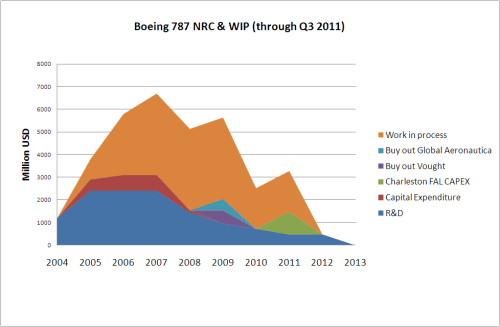
Boeing 787 costs through 2011 profile.

Regarding the recurring costs, the main finding to be done is the recurring cost of the aircraft at a certain point. Once we have a reference, we can play with the learning curve to see how the costs will be in the future or were in the past.

Different sources quote figures as 250-300M$ or even 400M$, but they do not explain whether that is the cost of a unit right now (e.g. serial number 44) or whether it is the average cost up to now (they do not indicate how many aircraft are included in that average either if that was the case).

The approach I followed was different.

Boeing has disclosed it has 18bn$ as WIP related to the 787, and from local press we know what is the state of production right now, thus, we can try to estimate what is the average cost of the aircraft already produced.

The aircraft delivered to ANA needs to be discarded as its portion of WIP has already been included in the income statement of Q3. We know that at Seattle FAL there are now serial numbers 46 (to be completed according to press) to 50 (just arrived, according to Jon Ostrower). Thus, within WIP there must be about 44 aircraft almost completed and another 5 about 98% completed (FAL value added is around 4% of RC).

As we do not know how many other aircraft are in process and at which stage each one, we need to make further assumptions. From the same article of Seattle Times we learnt the following:

“The first 40 out of the Everett factory required massive and repeated rework, and the next 10 to 20 also need modifications because of design changes after flight testing.”

That means that at least about another 20 aircraft are being manufactured when other aircraft are at FAL. We can assume an average stage of completion of 50% of costs incurred in each one.  With these assumptions, we gather that the 18bn$ correspond to about 58 aircraft in different stages of work in process (WIP).

This gives us an average cost of about 310M$ apiece, close to the figures mentioned by some sources. The difference is that now we have a reference of cost and aircraft unit or units for that cost (1 delivered + 44 finished + 5 at FAL + 10-20 WIP ~ 60-70 aircraft).

With this average cost and using the learning curve formulas, we can deduct the unit cost of the first unit produced, which will be different for each learning curve we select, and from which all the costs of future units will be calculated.

Side note: Both 80% and 75% curves yield lower unit costs than the aircraft price (with the 38% discount) by the year 2015, in line with what was disclosed by Boeing CFO James Bell during the conference call:

“Bell projected that the cost to build each Dreamliner will drop below the price paid by the buyer around 2015, providing positive cash flow for the first time.”

Analysis

With all the data gathered above, and the required assumptions made, we can build a comprehensive valuation analysis.

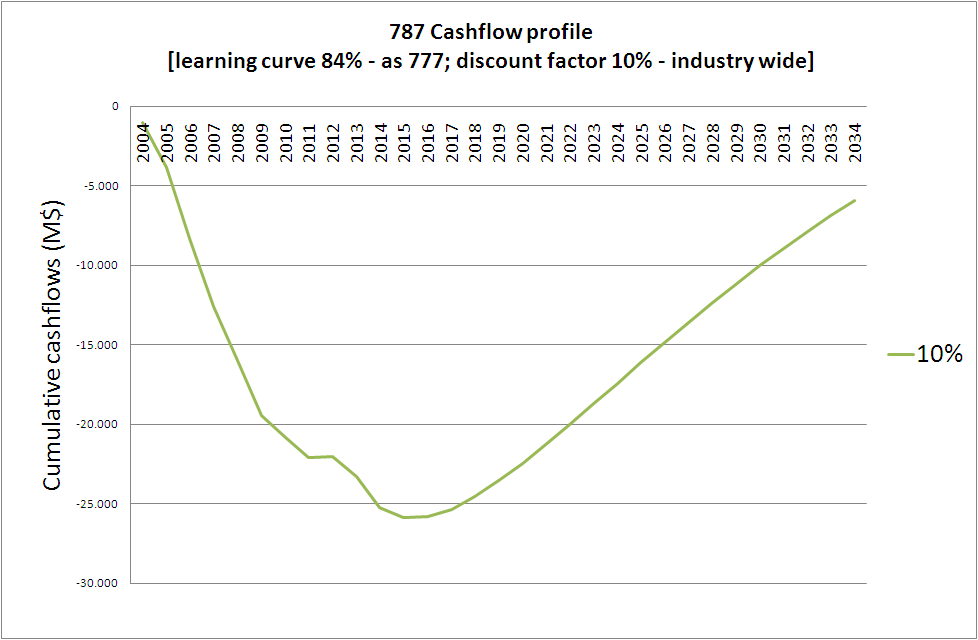
Boeing 787 will not break even before 2034

The first graphic that is shown is what I believe will be the real scenario for the 787: it will not break even in the first 30 years of the programme, discounting cash flows. It won’t break even before 2034. In this case, I used the learning curve of 84%, that which was reported as the real one for the 777, and which is more conservative than the targeted one, 75%. As discount rate for the cash flows I used 10%, which could be even considered a bit low.
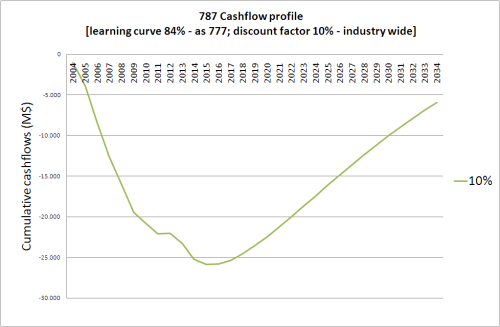
787 cash profile for a learning curve of 84 and discount rate of 10%.

When will then the 787 break even?

I continued the series for this set of reference parameters (84% curve and 10% discount rate) and break even would indeed happen, but not before 3650 units of the 787 have been delivered at the year ~2046. By then production rate would have had to slow down to about 6-7 aircraft per month as the backlog would have been already consumed, thus a new cost structure per unit produced could even make the mentioned date to be deferred even later.

Influence of the discount rate

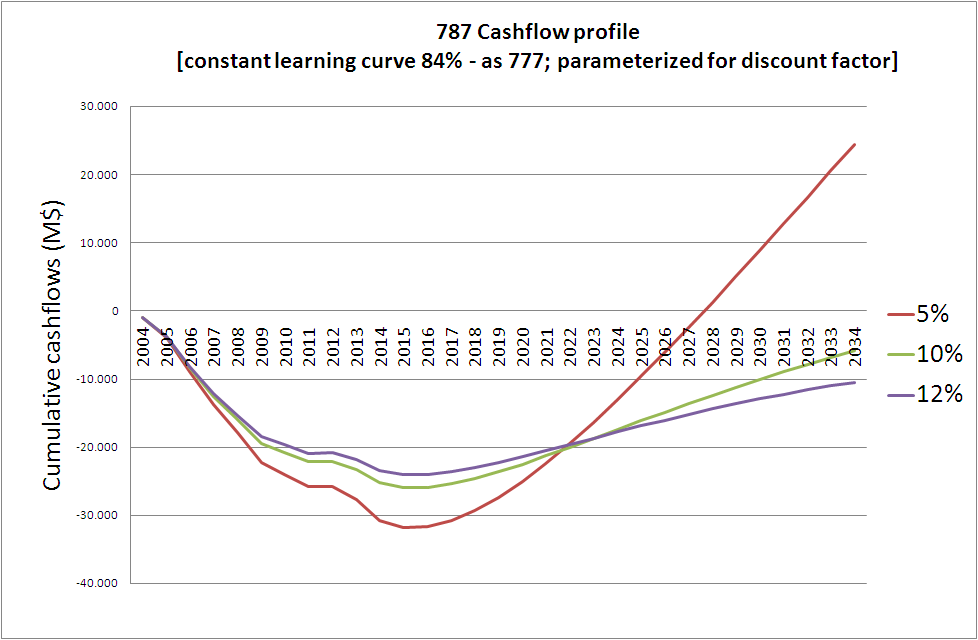
The discount factor could be assimilated with the cost of capital. The reference I used was 10%, but let see how the previous graphic would look like in the case the factor was lower 5% and a bit higher 12%.

787 cash profile for a learning curve of 84% and discount rate as parameter.

We can see that if the cost of capital was as low as 5%, the 787 would reach break even by around 2028, but in the case of 12% it would never break even within 30 years as well.

Influence of the learning curve

The learning curve I used was the one I believe is more realistic as previous Boeing’s experience has shown, 84%. But let’s see how it influences the valuation, now fixing the discount rate at 10% and using the learning curve as a parameter:
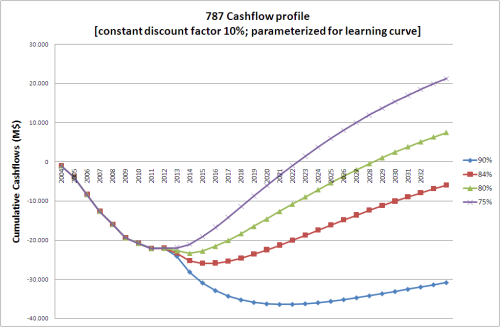
787 cash profile for a discount rate of 10% and learning curve as parameter.

We can see that if the curve is the 90% the outlook is much darker, however, for 80% the programme would break even within the first 30 years, at around 2029. If the curve is the one Boeing targets, 75%, the programme may break even at around 2023, in line with Boeing statement:

“The positive cash flow will gradually pay back the earlier production costs to finally break even on manufacturing the planes roughly 10 years from now, Boeing said.”

Influence of the discount in prices

I have used a 38% discount over prices. I feel quite confident that Boeing discounts are around that figure, nevertheless, let’s see what would happen to the reference case (84% curve) if discounts were just ~20%, about half of those used, which would make cash inflows much higher at the moment when deliveries start.

787 cash profile for a learning curve of 84%, discount rate as parameter and discount over price of 20%.

We can see that in that case, the break even would be within the first 30 years, at about 2024 already for a DCF discount rate of 10%. Nevertheless, I doubt that pricing power of Boeing will allow it to stop giving ~38% discounts.

Influence of the down payments

In the simplified case that the down payment at the time of ordering the aircraft wasn’t in the order of 3% but 20%, this would bring forward cash inflows especially related to the first 800 aircraft ordered and thus improve the business case. However, once the programme is in steady state it wouldn’t change much.

You may see that maximum cumulative negative cash flow for the 5% curve only reaches about ~19bn$ vs. ~32bn$ in the reference case. Also for the 5% curve the break even is brought forward 2 years (from 2028 to 2026).

787 cash profile for a learning curve of 84%, discount rate as parameter and down payment of 20%.

“Boeing’s view” on the matter?

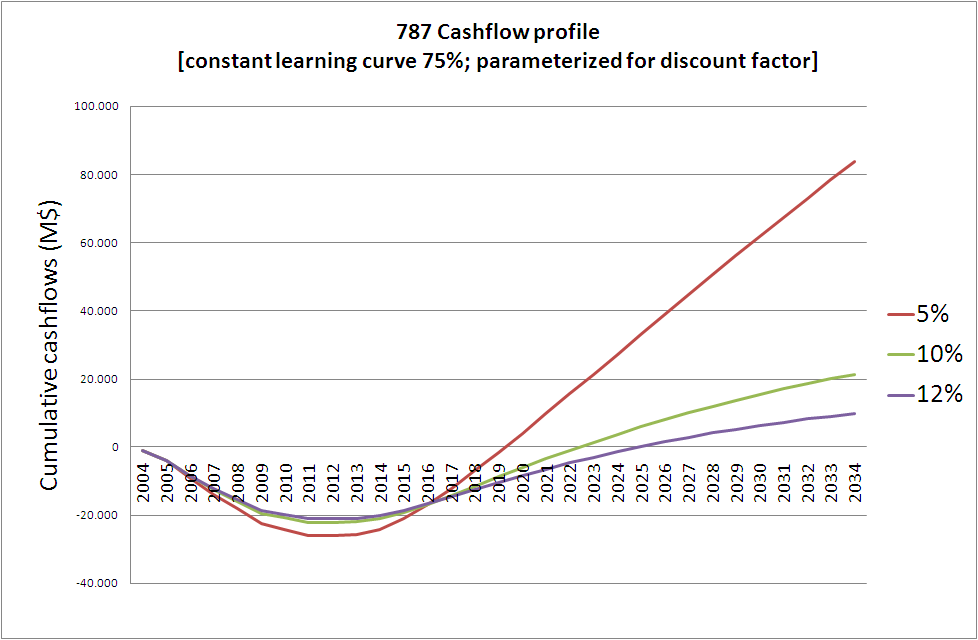
As we have discussed above, Boeing is targeting a learning curve of 75%, ambitious if compared to that of the 777, but not far from that used by Reinhard in his paper.
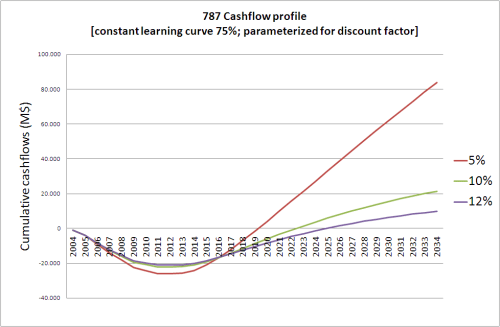
"Boeing's view": 787 cash profile for a learning curve of 75%, discount rate as parameter.

In this case, you may see that with a discount rate of 10% break even is reached in 2023. Again, as mentioned above, this is in line with Boeing’s comments in the conference call. Even for a discount rate of 12% break even would come within the next decade at around 2026.

This stresses the importance of the learning curve effect and cutting costs during the series production phase. Being in the state that the programme is now, with about -22bn$ cumulative cash flows through 2011, the only way to save it is through experience gained at the production sites.

The question then is: Will Boeing be able to achieve that 75% curve?

Side note: Let me now come back to the price discounts. I find that the results shown in the last graphic, with the curve Boeing intends to achieve (75%) and a discount rate for cash flows of 10%, as another confirmation of the discount used for prices of aircraft.

The model I built takes the 38% figure discounted from list prices, and I find it remarkable that with that figure the model predicts lower unit costs than aircraft discounted prices by 2015 (as mentioned by the CFO, James Bell) and predicts a programme break even at around 2023, about 10 years from now, as mentioned in the conference call. I take the last conference call as an implicit confirmation from Boeing of the discounts it applies to its 787s.

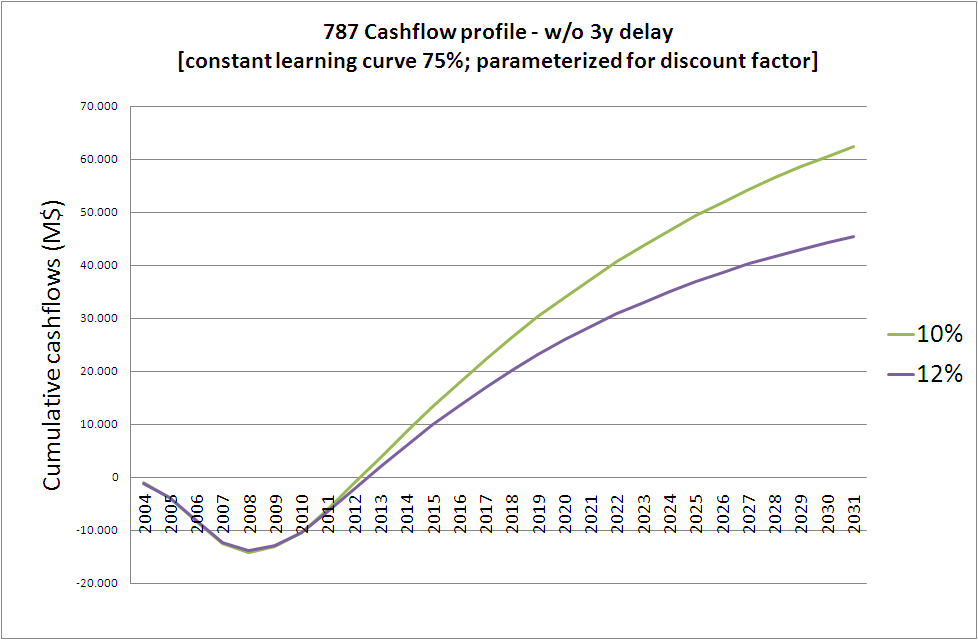
What has been the effect of this 3-year delay?

This is not easy to estimate, but I’ll give it a try.

Most of the assumptions remain constant. I believe that the delay has primarily deferred cash inflows from deliveries, extended R&D related to engineers working in the development for 3 years more sorting out problems and increased WIP of aircraft waiting in the production line. I will also remove cash spent in buying out partners, though this might be arguable as possibly the price of the buyout is cash neutral taking into account partners’ margins disappearing.

Below you may see the two graphics, one for the reference case (84% curve) without delay and the other for Boeing’s target (75%):
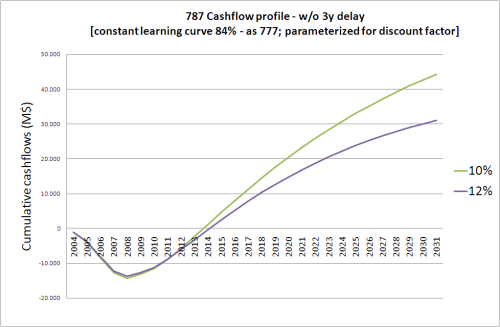
Effect of 3-year delay to 787 cash flows for learning curve of 84%.
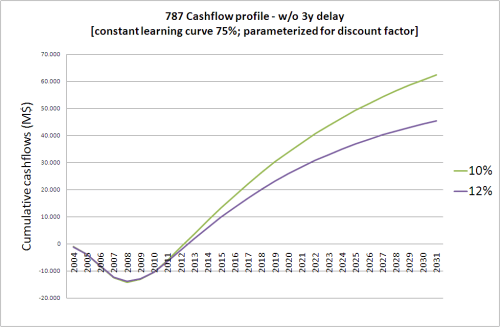
Effect of 3-year delay to 787 cash flows for learning curve of 75%.

You may see that even in the conservative scenario (84%) break even is reached in 2014 or 2015 depending on the discount rate. With the more aggressive learning curve, 75%, the prospect is even rosier: from 2013 for both discount rates the programme would have reached break even less than 10 years since its launch in 2004 and 10 years before what now seems to be Boeing’s target break even year, 2023.

This result clearly points out how much a delayed programme may hurt the business case of an aircraft development: from being a sound project to converting it into a nightmare that may never break even, jeopardizing future developments in terms of lack of financial and human resources available.

What is the “accounting block” size used for then?

As its name points out, this is a mere accounting issue. It permits Boeing to spread already incurred costs that have been capitalized (in the balance sheet, not in previous years’ income statements) among aircraft to be delivered in the future. Since Boeing has a backlog of almost 800 aircraft and believes it will sell over 2,500 aircraft, it has prudently opted to spread costs over 1,100 aircraft, allowing itself to start reporting profits on each aircraft delivered almost from day one (from about 2015 in fact), having a shinier income statement and the bonuses that come with it.

Finally, as Richard Aboulafia would put it:

“Yours, ‘Til The 787 Breaks Even”

31 Comments

Filed under Aerospace & Defence

What is the price of an A380?

Yesterday, it appeared in Flight International website, an article in which the price of an A380 was unveiled. Generally, aircraft real prices are never disclosed, that is why that was news. What it is normally published is the list prices for the different aircraft (here you may see Boeing’s list).

The article disclosed the price for an A380 acquired by Nimrod Capital LLC, which is to lease it to Emirates. The price: 234m$. Since the list price for the A380 is 375m$, that means it was purchased with a 38% discount, as the article says.

For obvious reasons, I will not comment on Airbus prices (*). Here, I just wanted to mention that, using a quite detailed approach, some time ago, I calculated which were Boeing’s discounts. I explained everything in a post.

I used the number of aircraft delivered per year, the net orders per year, all for a period of three consecutive years, and matched the list prices versus the revenues recognised in the yearly income statement published by the company in each of those years… I figured out which was the discount that minimized errors for the period of three years. Guess what was the result I came up with: 38% for the period 2007-2009 and 39% for the period 2008-2010.

(*) Disclaimer: I have never worked in anything related to aircraft pricing, sales or marketing in Airbus. Thus, I have no insider clue about its prices.

Leave a comment

Filed under Aerospace & Defence

Airbus vs. Boeing, comparison of market forecasts (2011)

Some days ago, John Leahy, Airbus COO Customers, unveiled at a press conference in London the new figures of 2011-30 Airbus’ Global Market Forecast (GMF, PDF 28.8MB).

Last year, I already published a comparison of both Airbus’ and Boeing’s forecasts (Current Market Outlook, CMO, PDF 3.2MB). You can find below the update of such comparison with the latest released figures from both companies.

Comparison of Airbus GMF and Boeing CMO 2011-2030.

Some of last years’ comments still apply:

  • Boeing sees demand for 15% more aircraft with a 21% more value (excluding regional a/c).
  • Boeing continues to play down A380 niche potential (57% less a/c than Airbus’ GMF), though it has increased its Very Large market forecast by 40 a/c, or 7.5% (Did Emirates new order at ILA change their minds?)
  • On the other hand, Boeing forecasts about 600 twin-aisle and 4,000 single-aisle more than Airbus, clearly pointing to its point-to-point strategy.
  • In terms of RPKs (“revenue passenger kilometer”), that is, the number of paying passenger by the distance they are transported, they see a similar future: Airbus forecasts for 2030 12.3 RPKs while Boeing forecasts 13.3 (in trillion).

The main changes from last year’s forecasts are:

  • Both manufacturers have drastically increased their single-aisle forecast: +1,300 a/c in the case of Airbus and +2,200 in the case of Boeing.
  • In general all numbers have been increased: single-aisle (as mentioned above), twin-aisle (between 50-150 more), large aircraft (between 40-80 more), value of aircraft and RPKs… it seems that for commercial aircraft manufacturers not only the crisis is passed but they see a rosy future lying ahead.

Again, I strongly recommend both documents (GMF and CMO) which, differences apart, provide a wealth of information of market dynamics. I am especially happy to have encountered this year again full version of Airbus GMF, not only a short one [PDF, 4.7MB].

7 Comments

Filed under Aerospace & Defence, Marketing

Beluga vs. Dreamlifter

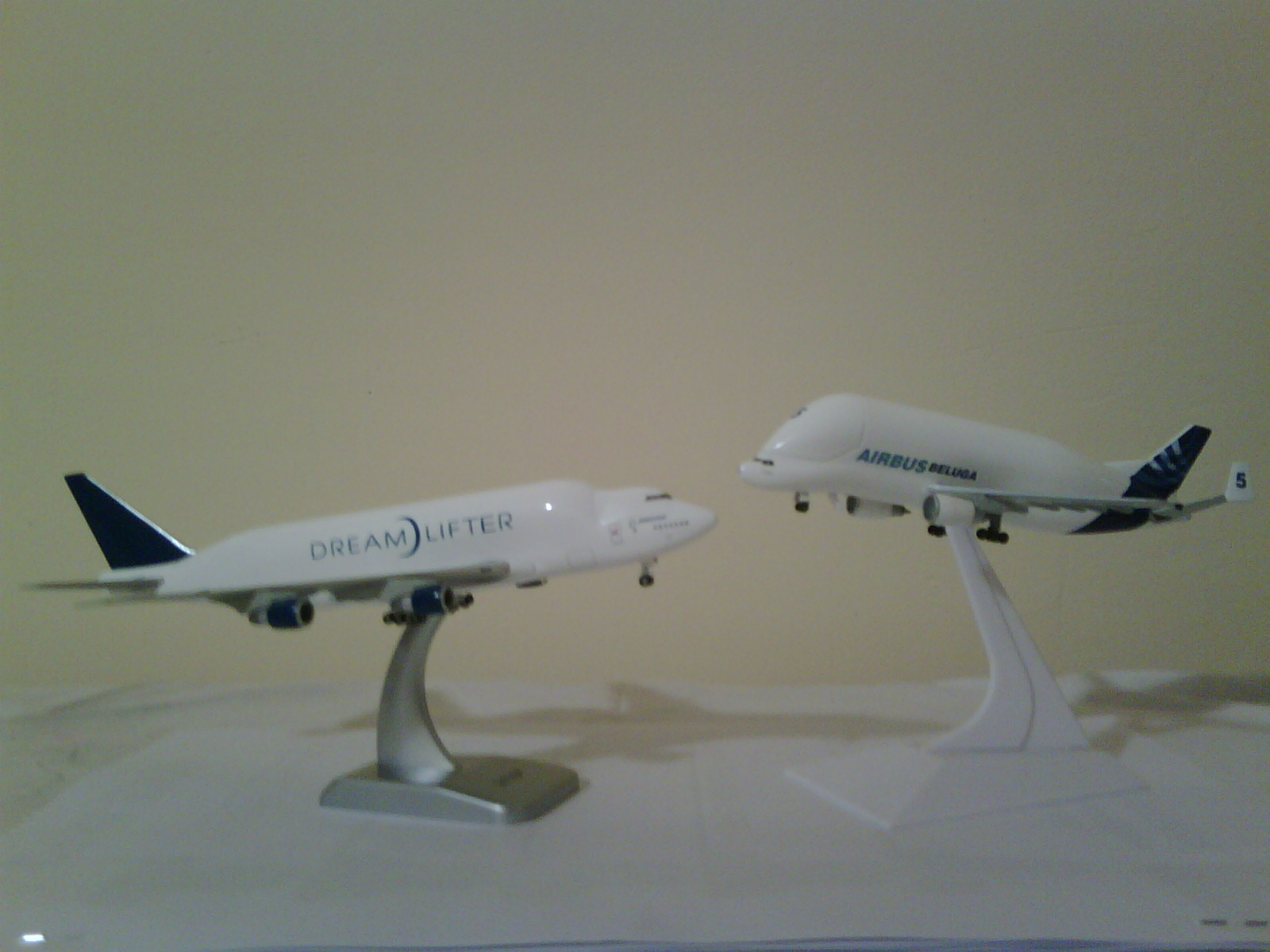
While looking at the small-scale models of aircraft at home, some days ago, I locked on the Beluga and the Dreamlifter (Airbus and Boeing transport aircraft to bring major components from one factory to another). I had become used to the sight of the Beluga but seeing then both together I realized that they are indeed bizarre.

While Airbus relied on the Beluga since years ago (and before, it used the Super Guppy; now resting at the museum by Airbus factory in Toulouse), Boeing only decided to modify 747s for this purpose to reduce transportation times in the 787 manufacturing.

In this post I didn’t want to make any technical comparison, just wanted to show this picture and ask: which one do you think is the prettiest (or the ugliest)? I haven’t made up my mind yet.

Dreamlifter vs. Beluga.

10 Comments

Filed under Aerospace & Defence

747

I attended a course at the AirBusiness Acedemy of Airbus some weeks ago. In one of the coffee breaks I hanged around in the building’s library and I found a book that I wanted to read, so I picked it: “747”, by Joe Sutter with Jay Spencer.

Joe Sutter is the engineer who led the engineering development of the Boeing 747, the Jumbo. The book, a biography of Sutter, covers all his life but it is mainly centered in the happenings, decisions, struggles, individuals, etc., involved in the development of the 747 and other aircraft.

I particularly liked the many engineering problems that he mentioned in the book, why & when they encountered them and how they overcame them: e.g. how they debugged the B 377 Stratocruiser, the decision of placing 737 engines under the wing, going for 4 main landing gears in the 747, etc., and the innovations that they introduced in commercial aviation with different aircraft: first pressurized aircraft (B 307 Stratoliner, with the issue they had with the vertical stabilizer), the jet engine mounted in pylons under the wings (with the B 367-80 prototype –now resting at the Air & Space museum at Dulles, DC- which evolved in the 707; configuration mainly used until today), the first wide-body aircraft (B 747), etc.

He also described many details about dealings with customers (e.g. Juan Trippe in Pan Am, Iraqi customers), competitors (including Russian delegations during Cold War), and colleagues at Boeing (with some heated discussions and internal politics, where he doesn’t save any detail).

As a curiosity, I finished the book while flying from Chicago to Frankfurt some days ago aboard a B 747, the first time I flew in one. I was sitting by the wing and took some pictures of the wing (first with a triple-slotted flaps) at different moments of the flight.

This slideshow requires JavaScript.

The book is a very interesting read which I recommend to anyone with passion for aircraft (engineer or not).

6 Comments

Filed under Aerospace & Defence, Books

Air traffic growth vs. aircraft orders

Taking the topic of the headline of this post I want to share some reflections on the commercial aircraft market.

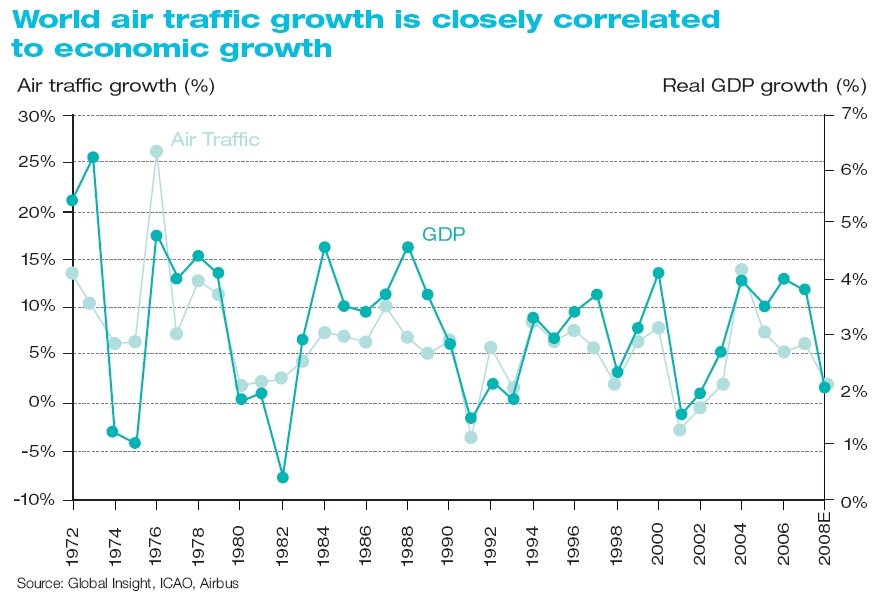
The first is how closely air traffic growth is correlated to world economic growth. This sentence and the following graphic are taken directly from the Global Market Forecast [PDF, 7.9MB] produced by colleagues at Airbus.

Air traffic growth vs GDP growth (source: Airbus).

You may see in the graphic the correlation (correlation coefficient above 0.7) and how the air traffic growth is however much more volatile than the economic growth. This is very intuitive. The better the economic situation the more business trips, family visits and holiday trips will take place. Nevertheless Airbus explains that in some situations and regions this is not enough to forecast traffic and thus they produce hybrid models.

Then, I wondered: how do airlines translate this growth in traffic into airplane orders?

I made some numbers and played with them. I gathered aircraft orders for both Boeing and Airbus in the last ~20 years, plus air traffic and GDP growth over the same period of time. Then, I tried to connect one with another and see how best they would correlate with each other. Even though correlation does not imply causation, it may indicate existence of such causal relations that it’s why I searched for such results.

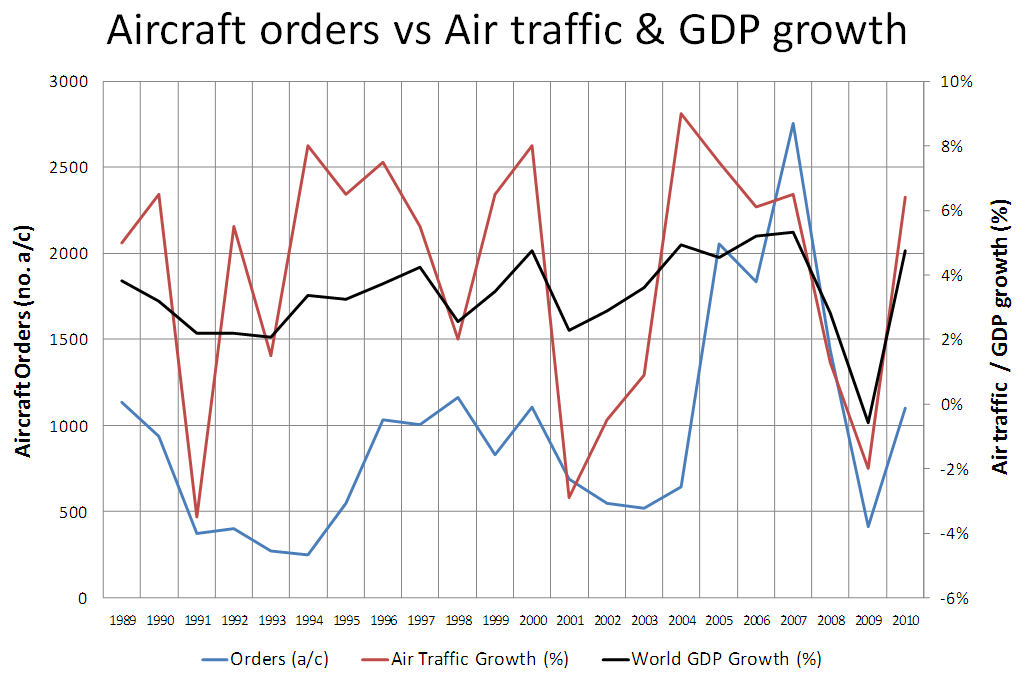
Here I plotted GDP growth (IMF), traffic growth (ICAO) and aircraft orders:

Aircraft orders vs. air traffic and GDP growth.

One could expect that airlines, after collecting first hand data of traffic growth plus the aggregate demand from industry sources (IATA, ICAO) and after applying their complex planning models would order aircraft from manufacturers. Thus, a correlation might be expected between traffic growth and aircraft orders. What we don’t know is whether airlines would place orders in the same year where the traffic growth actually takes place or there would be a lag (due to the airline analysis process, the negotiation with the manufacturer, arranging the financing, waiting for the next air show…).

The correlation results I got between these 2 variables are satisfactory though not that high. Matching data of the same year yields a 0.35 correlation coefficient. If however, we apply a 1-year lag in between air traffic growth data and orders the correlation is better, 0.44 (a lag of 2 years would worsen it down to 0.27 and so forth).

I found it curious that correlation between orders and GDP growth is much better! Matching data of the same year yielded a 0.61 correlation coefficient (which is rather high). A lag of a year would produce a still high 0.56 (2-year lag, 0.41; 3-year, 2.6…).

This was a striking result for me. After all, even though individual airlines do have complex models and experienced analysts behind them, taking the aggregate of the market, it seems that orders are placed less on data of traffic and more relying on data of economic growth, and rather soon, acting within the same year or a year later!

Who knows how the process within the airlines actually works… I can imagine thoroughly thought and thick studies coming from planning & analysis departments being put aside in the board room where one or two directors (more assertive than the average) convince the rest of the soundness of an operation based half in broad economic prospects (world GDP growth) and half in gut-feeling… wouldn’t surprise me much.

Leave a comment

Filed under Aerospace & Defence, Economy

Wrong forecasts

Close to midnight of past Thursday we learnt that the winner of the KC-X competition to provide the aerial refuelling aircraft to the US Air Force was Boeing. That was cold news for our company.

I had just tweeted the previous day my bet on the competition:

I never get it right...

To reach to that conclusion I had done some numbers for fun on a late Friday afternoon some months ago in a similar fashion than the defence analyst Scott Hamilton showed in his blog. It is clear that I got it completely wrong.

As I have often told to my friends and colleagues, I am extremely bad with these predictions, as I was already mistaken when the JCA and the previous KC-X competitions were decided…

A note of humour: as my brother points out in fact I am very reliable, you just have to bet to the opposite option of my forecast.

Another colleague told us yesterday “you look like economists explaining your miscalculations…”, as someone put it “it is already hard to explain the past, it is even more difficult to predict the future”.

Already looking forward to the next win.

3 Comments

Filed under Aerospace & Defence

A380, a game-changer

Probably you remember having seen in some magazines ads paid by airlines showing their luxury A380 cabins. Singapore Airlines was the first one in launching this kind of branding campaigns.

According to the definition by the Business Dictionary: Branding aims to establish a significant and differentiated presence in the market that attracts and retains loyal customers.”

Few days ago, I received an email with publicity from a company that operates the A380. As you can see, they go a step beyond: they now use the A380 not only for branding but for advertising a concrete product, a specific flight. In one of the destinations offered you may see a label indicating that the flight is served by an A380.

Ad: flight served by an A380.

From the Wikipedia: Advertising is a form of communication intended to persuade an audience to purchase or take some action upon products, ideas, or services.”

If they use it there must be a reason behind. I have heard from colleagues that, in fact, the companies already operating it in some of their routes are noticing that repeatedly the connections offered by an A380 show higher passenger load factor or occupancy rates than the same connections when offered by a different aircraft.

I have never seen anything like this before. It could have happened when the B-747 entered into service in the 70’s, but I was not here then; I didn’t witness it. It doesn’t happen now; not with the 747 nor with other aircraft. I certainly do not base my buying decisions, when I have to flight within Europe, on whether the airline operates a B-737 or an A320 (maybe I should!). But exactly this is happening in the case of the A380. And airlines are profiting from it.

In a previous post I wrote about the difference in current forecasts for the A380 that Airbus and Boeing report (Boeing has steeply reduced its reported forecast in the past decade). If the appeal of the aircraft continues to bring customers in, we could have a reason to believe that in end the orders figure of A380 maybe rather high. Only time and the market will let us know.

In its website, Airbus dubs the A380 as game-changer. One could expect this when a company is talking about one of its products, however when others are basing its branding and advertising on it, we seem to be really facing a game-changer.

Leave a comment

Filed under Aerospace & Defence, Marketing