Tag Archives: CMO

Aircraft market forecasts accuracy

In a previous post I wrote about how the predicted average aircraft size by Boeing in 1990 did not match the actual evolution of that average size since then. In a more general context, how accurate are these aircraft market forecasts? Especially taking into account that they forecast along a 20-year period.

I dug in the archives and found an article in Flight International‘s issue of 10-16 March 1993 which compared Airbus’ GMF and Boeing’s CMO (you can find 2012 comparison here). Some excerpts from that article:

  • “Boeing is projecting deliveries of 12,005 aircraft, worth $815 billion at current values, from 1993 to 2010.”
  • (Boeing) “The trend towards larger aircraft will accelerate so that, although single-aisle types will account for about two-thirds of all deliveries, they will comprise 74% of those up to 2000 and only 60% beyond.”
  • “Airbus Industrie has released an upbeat forecast, predicting market demand for 11,653 new jet airliners to be delivered during 1992-2011, up from the 11,500 deliveries predicted in 1991.”
  • (Airbus) “The manufacturer foresees an accelerating demand for widebodied aircraft, driving average airliner size from today’s 176 seats to 255 seats in 20 years.”
  • (Airbus) “The global jet-airliner fleet will grow to 10,000 by 1998 and to almost 15,000 by 2011.

Now, let’s see what was the fleet at the end of 2011. Seeing Airbus’ Global Market Forecast from 2012, the departing numbers are those of 2011 fleet.

  • Passenger aircraft: 15,556 a/c.
  • Freighter aircraft: 1,615 a/c.

Thus, 17,171 a/c at the end 0f 2011. The GMF from 1992 underestimated the 20-year market by slightly above 2,100 or nearly 15% error. Not a bad shot taking into account the time span used.

Let’s take a more recent example, this time from Boeing. In the CMO from 1997, we find the following chart showing Boeing’s forecasted fleet size and distribution for 2001, 2006, 2011 and 2016 year-ends.

1997 Boeing CMO year-end fleet forecasts for 2001, 2006, 2011 & 2016.

In 2012 CMO, Boeing offered figures of 2011 year-end fleet.

Fleet at year end 2011 according to Boeing 2012 CMO.

We can make a quick comparison:

Comparison of aircraft fleet at year-end 2011: 1997 forecast vs. actual (sources: Boeing CMO 1997 and 2012).

Some reflections:

  • The total fleet figure was missed only by 1%.
  • The single-aisle figure was missed only by 2%, though less larger single-aisle were acquired than expected.
  • Where the forecast is off mark is in both regional jets (underestimated) and twin-aisle, where there are almost 1,800 less aircraft in the current fleet than forecasted… another reason for Boeing to play down on A380 segment.

***

NOTE: Figures of current fleet from Boeing and Airbus differ. Some causes: Airbus does not include figures for regional jets, and definitions between large aircraft and twin-aisle vary from one company to the other. Other than that, figures for freighters are similar, 1,615 (A) vs. 1,740 (B), as they are for passenger single-aisles, 12,161 (A) vs 12,030 (B).

3 Comments

Filed under Aerospace & Defence

Aircraft average size: Boeing’s forecast in 1990 and following evolution

Boeing, in its Commercial Market Outlook forecast, currently downplays the potential of the A380. Two years ago, I wrote a post in which I collected some views from Boeing in 1996:

Most major aerospace companies agree that airlines will require 500 to 700 airplanes capable of carrying more than 500 passengers. Boeing forecasts 500 airplanes will be needed by the year 2015. […]”

Boeing later left a joint study with Airbus for the Very Large Commercial Transport (VLCT).

Going backwards further than 1996, I found in Flight International issue of 5-11 September 1990 the following chart showing Boeing’s estimate for the average size of airplanes up to 2005. It showed an ever increased average size:

Average aircraft size forecast made in 1990.

Seven years later, in the 1997 CMO Boeing forecasted as well an ever-increasing average aircraft size (though trimmed from 1990 forecast):

Average size evolution forecast (source: Boeing CMO 1997).

However, you may see the evolution since then in this other chart from Boeing’s CMO below:

Average aircraft size evolution 1991-2011.

In a following post I will compare how accurate these market forecasts are in general and by segment. As we will see, the general figures for fleet and for some segments were well predicted, not so for other segments.

3 Comments

Filed under Aerospace & Defence

Airbus vs. Boeing, comparison of market forecasts (2012)

Yesterday, John Leahy, Airbus COO Customers, unveiled at a press conference in London the new figures of the 2012-31 Airbus’ Global Market Forecast (GMF, PDF 5.6MB).

The last two years, I already published comparisons of both Airbus’ and Boeing’s forecasts (Current Market Outlook, CMO, PDF 3.0MB). You can find below the update of such comparison with the latest released figures from both companies.

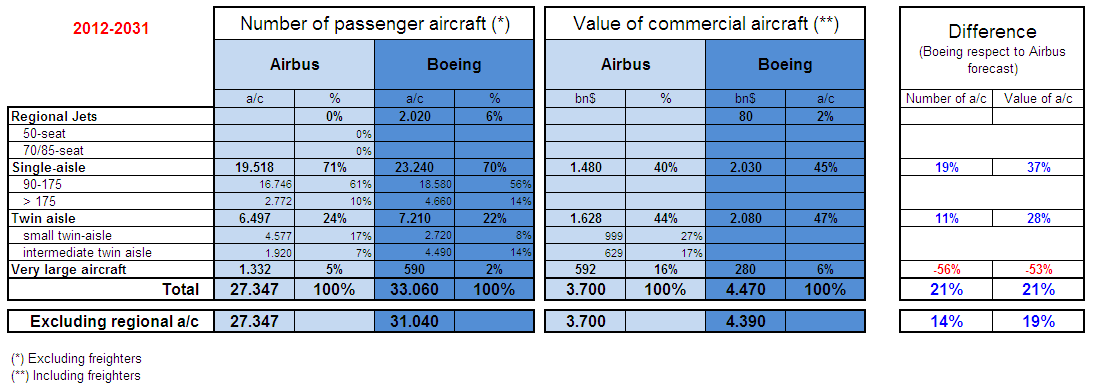
Comparison of Airbus GMF and Boeing CMO 2012-2031.

Some comments about the comparison:

  • Boeing sees demand for 14% more passenger aircraft (excluding regional a/c) with a 19% more value (including freighters).
  • Boeing continues to play down A380 niche potential (56% less a/c than Airbus’ GMF), though for second year in a row it has slightly increased its Very Large market forecast, this time by 20 a/c, or 3.5%.
  • On the other hand, Boeing forecasts about 200 twin-aisle and 4,200 single-aisle more than Airbus, clearly pointing to its point-to-point strategy versus the connecting mega-cities rationale presented by Airbus.
  • In terms of RPKs (“revenue passenger kilometer”), that is, the number of paying passenger by the distance they are transported, they see a similar future: Airbus forecasts for 2031 ~12.8 RPKs (in trillion) (a ~4% increase vs last year GMF) while Boeing forecasts 13.8 (also increased about 3%).

The main changes from last year’s forecasts are:

  • Both manufacturers have increased their passenger aircraft forecast in about 500 a/c, less dramatically than last year’s change.
    • In the case of Airbus it has increased the single aisle segment, probably reflecting the success of the A320neo launch.
    • In the case of Boeing, they decreased both single aisle (130 a/c) and small twin aisle (300 a/c), but increased the intermediate twin-aisle in 900 a/c… selling internally a new version of the 777?
  • Both manufacturers have increased the value of RPKs in 2031.
  • Both manufacturers have increased the volume (trn$) of the market in this 20 years, 12% Airbus (to 3.7trn$) and 10% Boeing (to 4.4trn$).

Some catchy lines for those who have never seen these type of forecasts:

  • Passenger world traffic (RPK) will continue to grow about 4.7% per year (5.0% according to Boeing). This is, doubling every ~15-20 years.
  • Today there are about 15,500 passenger aircraft around the world, this number will more than double in the next 20 years to above 32,500 a/c in 2031.
  • The A380 market equation: Urbanisation + Mega-cities + Wealth = VLAs (Very Large Aircraft, i.e. A380 and B747).
  • Emissions of aviation industry amount to 2% of man-made CO2 emissions.
  • Centre of gravity of world travel will have moved from the Atlantic Ocean (in 1971) to the Middle East (2031).
  • A key driver here is the propensity to fly of the people as the economies of their countries grow. This is captured well by the graphic below, a classic in the industry. This time, Airbus mentioned in the GMF that it has carried out a survey during summer asking 10,000 people around the world whether they expected to fly more in the future. This was true especially in China and India.

Trips per capita vs. GDP per capita (source: Airbus GMF).

Again, I strongly recommend both documents (GMF and CMO) which, differences apart, provide a wealth of information of market dynamics. The complete book from Airbus will be published online next week according to Chris Emerson (SVP for Future Programmes & Market Strategy).

In case you find it tough, to read those kind of booklets, you may take a look at the video of the press conference, a great class on global economy, world aviation, forecasting, trend spotting…

http://www.youtube.com/watch?v=ohtHBPZI5R0

11 Comments

Filed under Aerospace & Defence

More on Boeing 787 break even

After the post I wrote the last week with an analysis of when could Boeing 787 break even (Will Boeing 787 ever break even?), I received some feedback in the form of emails, comments in the blog and comments in Scott Hamilton’s blog (Leehamnews) as he mentioned the analysis and linked to it.

I wanted to address some of those comments in a single piece for the benefit of all. Please, find them below.

A leading aviation analyst hinted that:

“In the case of the 787, it increasingly looks like the -8 will be an up-front version with poor pricing, but the -9 (and -10) are planned to make this problem better. […] So, your assumption of a consistent 38% discount  won’t happen, unless either Boeing fails to improve the 787’s performance or if the market doesn’t like the 787.”

This could be built into the model by allowing aircraft sold after the current backlog appear in the model as sold at a lower discount (e.g. 20% instead of 38%). The cash inflows due to the down payments would be increased soon, but since producing the existing backlog will take until sometime in 2019, the cash inflows from deliveries will be untouched until then. Result: that would bring break even about 2 years forward (2021 vs. 2023, in the case of 75% learning curve and 10% discount rate – what I would call “Boeing’s baseline”).

Another leading analyst suggested:

“I think the 5,000 market forecast is for the middle twin-aisle market as a whole, which includes A330, A350 and 777 (and even the almost-but-not-quite-dead 767). If I’m correct, I disagree with your figure above as too high. Clarification of the 5,000 is required for everybody.”

I reviewed Boeing’s commercial market outlook. In the next 20 years (2011-2030) Boeing sees deliveries of 6,610 twin-aisle passenger aircraft: 3,020 small and 3,590 intermediate.

In the previous post I mentioned that 2,634 were included as 787 deliveries, though that includes deliveries from 2031 to 2034, later than the period covered by this year’s CMO (480 a/c between 2031-34).

To compare apples with apples, between 2011 and 2030 I included 2,154 787s delivered, all those that 787 assembly lines could produce. That is 43% of the “addressable” 5,000 market or 33% of the 6,610 total market, including A330s, 777s (70-90 produced a year now), 767s (12-15 a year) and A350s… This figure, 2,154, could be optimistic in my opinion as well. If a lower figure should be used the situation for the break even would be worse.

I received some comments via Leehamnews blog:

The user KDX125 mentioned:

“[…] the current inventory of 18bn is distributed over 58 aircraft that are assumed to be WIP. But the amount should be limited to deferred production cost and unamortized tooling, which according to the 10-Q is ‘just’ ~11bn.”

The 10Q says (emphasis is mine):

“As of September 30, 2011 and December 31, 2010, commercial aircraft programs inventory included the following amounts related to the 787 program: $14,423 and $9,461 of work in process (including deferred production costs), $1,775 and $1,956 of supplier advances, and $1,770 and $1,447 of unamortized tooling and other non-recurring costs. As of September 30, 2011, included in work in process were deferred production costs related to the 787 program totaling $9,699.”

Those are the ~18bn$ I mentioned, which were mentioned in the conference call as well. We need to distinguish here between accounting and cash flows. For the accounting of the profit behind each aircraft, it may be true that unamortized tooling could be distributed among 1,100 aircraft, however all those are costs that have already meant an outflow of cash. What I tried to do is to see how much costs of the about 50 aircraft which are in different stages of production was included in those 18n$ in order not to double count cash outflows related to costs of aircraft delivered. In other words, if from those 18bn$, 1.8bn$ refer to tooling and shouldn’t be distributed as WIP of those ~50 aircraft, that means the cash flow profile would look even worse, not better.

Normand Hamel and others have mentioned:

“[…] not taken into account the penalties to the customers and various suppliers.”

That’s correct and I acknowledge this is a shortcoming of the model. I tried to base all assumptions in public references appearing either in Boeing’s website or reports or news in the media. I couldn’t find anything related to value and structure of those penalties and thus didn’t include them. I would welcome references regarding this point. Anyway, as it was mentioned, including penalties in the model would worsen the cash flow profile and delay break even.

Slinger raised the point:

“For the learning curves to work in this model one must now the relationship between labour cost and material cost, since the learing curve only applies to labour time. […]

I don’t know if this is factored in into the model but if not, it would make the forecast even more pessimistic.”

While it is true that generally the concept of the learning curve is applied to labour, C. Lanier Benkard (professor of Economics at Standford Graduate School of Business), in his paper “Learning and Forgetting: The Dynamics of Aircraft Production” [PDF], describes the learning process as follows:

“Learning may take on many different forms depending on the particular nature of production. In more capital-intensive industries such as chemical processing and semiconductors, learning primarily results from the fine-tuning of production techniques. In such industries, engineers and managers analyze current output and constantly make small changes to the process, with the result that productivity gradually improves. In labor-intensive industries such as aircraft and shipbuilding, learning primarily results from workers becoming more efficient at the tasks the perform through multiple repetition. Many industries may be subject to both types of learning. […]”

Since I haven’t found any source referring to different types of learning for labour and materials for the case of Boeing, I made the same simplification that professor Benkard does in his paper (emphasis is mine):

“If the Leontieff assumption in equation (2) were relaxed and instead production was assumed to be Cobb-Douglas in all inputs, the production only at the unit level would imply a labor-requirements equation similar to (4) with the addition of both the wage rate and materials prices […]”.

If this assumption was optimistic or if the learning related to the materials production was capitalized mainly by Boeing’s suppliers and not by Boeing itself, this would only make the cash flow profile worse and delay the break even date.

Finally, Garry Reinhardt in the comments section to my post asked:

“[…] is Boeing profit, going forward, being decreased or increased by each 787 delivered? And if it’s negative now, when will it reach zero (leaving out the previously paid for expenses)?”

I do not give stock recommendations. Anyway, this cash flow analysis shows that most of the cash outflows that make the case of the 787 (viewed in isolation) such difficult, were made in the past years and didn’t derailed Boeing then. The 787 development was supported by other Boeing programs. From now on what is missing is that unit production cash outflows are lower than cash inflows related to deliveries (penalties not taken into account), and that is something that should happen at sometime between 2014 and 2016, depending on the learning curve that Boeing achieves. Nevertheless, whether this is something already reflected or not in current Boeing price share, and whether this price is cheap enough or not is left to the individual investor.

Finally, thanks again for all your feedback, comments, criticism and especially to Scott Hamilton for his linking the post so that I could get more feedback.

12 Comments

Filed under Aerospace & Defence

Airbus vs. Boeing, comparison of market forecasts (2011)

Some days ago, John Leahy, Airbus COO Customers, unveiled at a press conference in London the new figures of 2011-30 Airbus’ Global Market Forecast (GMF, PDF 28.8MB).

Last year, I already published a comparison of both Airbus’ and Boeing’s forecasts (Current Market Outlook, CMO, PDF 3.2MB). You can find below the update of such comparison with the latest released figures from both companies.

Comparison of Airbus GMF and Boeing CMO 2011-2030.

Some of last years’ comments still apply:

  • Boeing sees demand for 15% more aircraft with a 21% more value (excluding regional a/c).
  • Boeing continues to play down A380 niche potential (57% less a/c than Airbus’ GMF), though it has increased its Very Large market forecast by 40 a/c, or 7.5% (Did Emirates new order at ILA change their minds?)
  • On the other hand, Boeing forecasts about 600 twin-aisle and 4,000 single-aisle more than Airbus, clearly pointing to its point-to-point strategy.
  • In terms of RPKs (“revenue passenger kilometer”), that is, the number of paying passenger by the distance they are transported, they see a similar future: Airbus forecasts for 2030 12.3 RPKs while Boeing forecasts 13.3 (in trillion).

The main changes from last year’s forecasts are:

  • Both manufacturers have drastically increased their single-aisle forecast: +1,300 a/c in the case of Airbus and +2,200 in the case of Boeing.
  • In general all numbers have been increased: single-aisle (as mentioned above), twin-aisle (between 50-150 more), large aircraft (between 40-80 more), value of aircraft and RPKs… it seems that for commercial aircraft manufacturers not only the crisis is passed but they see a rosy future lying ahead.

Again, I strongly recommend both documents (GMF and CMO) which, differences apart, provide a wealth of information of market dynamics. I am especially happy to have encountered this year again full version of Airbus GMF, not only a short one [PDF, 4.7MB].

7 Comments

Filed under Aerospace & Defence, Marketing

New entrants in the commercial aircraft business

In a previous post, I mentioned the new entrants in the large commercial aircraft business (Bombardier CSeries, Embraer, Russian MS-21, Sukhoi SuperJet, Comac C919, Mitsubishi…). Now that the latest market forecasts both from Airbus (Global Market Forecast) and Boeing (Current Market Outlook) are available, I wanted to briefly note how they are treating the segment that most of these entrants would enter: single aisle jet aircraft.

For example, Boeing in this year’s CMO already splits the single aisle between 90-175 passengers (where new entrants would fall into) and over 175 passengers (still the safe harbor?). In previous studies Boeing didn’t offer such sub-segmentation. On the other hand, Airbus hasn’t published yet such differentiation.

It is even more interesting to compare last year’s GMF and CMO with this year’s ones.

  • Airbus saw a demand for 16,977 single aisle aircraft in 2009 while in 2010 sees a demand for 17,870.
  • Boeing saw a demand for 19,460 single aisle aircraft in 2009 while in 2010 sees a demand for 21,150.

In other words Airbus has increased the single aisle market forecast in 893 aircraft, while Boeing has increased it in 1,690 aircraft… Both have made the forecasted pie bigger before it will have to be shared.

On average, they see ~1,300 more single aisle aircraft than what they saw last year… In the case that these extra aircraft was room made for new entrants, that would leave the new entrants a market share of 6.7% of the single aisle market… not much.

However, those entrants are not yet delivering in that segment and most of their deliveries would come at the second half of the 20-year period. By 2029, it could well be possible that their combined market share is around 10%… still not a big share, but already ~7bn$ yearly business (in 2010 dollars); a ~4.4bn$ after discounts, an amount the size of Embraer revenues (the 3rd company in commercial aviation, reason enough for them to enter the segment).

Boeing even concedes that of the 21,150 single aisle aircraft, 86% of them will be between 90-175 passengers, precisely the market sub-segment that will be ferociously fought.

Leave a comment

Filed under Aerospace & Defence

Commercial aircraft market size after discounts (update)

In an older post I already made an analysis of the aircraft discounts related to the published list prices (by the way, Boeing just raised its list prices 5.2% a couple of days ago). In that case, I used the revenues and deliveries of Boeing in the previous 3 years (38% discount was the result!).

Using that information, now that the latest market forecasts both from Airbus (Global Market Forecast) and Boeing (Current Market Outlook) are available, we can say that the real market size in the next 20 years will be in the order of 2,100bn$ (average of both forecasts in 2010 dollars).

Flow of airplanes

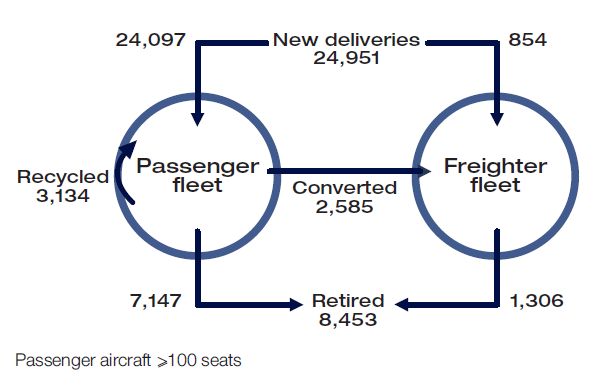
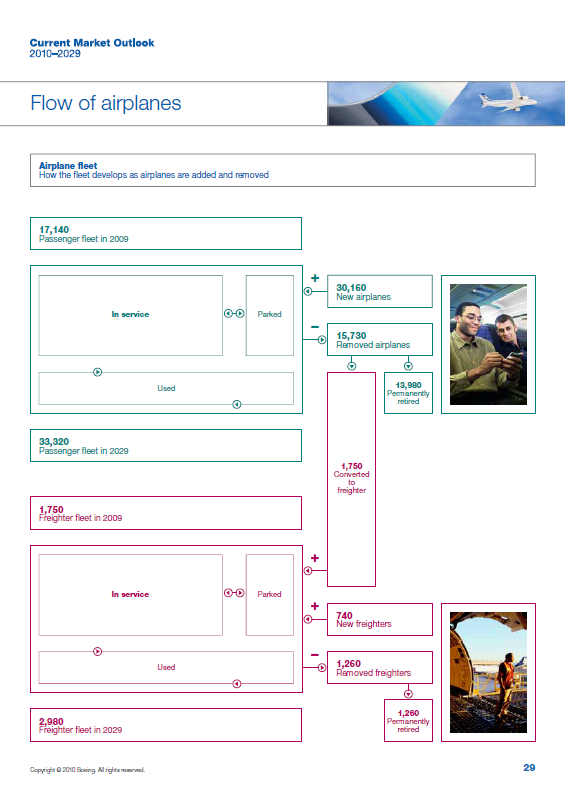
Another very interesting feature that Airbus published in last year’s GMF (it is not yet in this year’s publication) and Boeing used for this year’s CMO is a graphic showing the dynamics of aircraft. In it you may understand how from today’s fleet, adding new deliveries, retiring old aircraft, converting some from passenger to freight transport they arrive to the forecasted fleet in 2029.

I include below both graphics.

Leave a comment

Filed under Aerospace & Defence

Airbus vs. Boeing, comparison of market forecasts

Airbus announced on Monday its latest Global Market Forecast (PDF, 4.6MB) for the 20-year period 2010-2029. Media has already highlighted the main points: ~26,000 new aircraft will be delivered with a market value of ~3,200bn$.

Some months ago, Boeing published its equivalent study, the Current Market Outlook (PDF, 8.2MB) for the same period.

It is interesting to compare the two of them. In that way we can see how each other treat competitors’ products (mainly A380) and how they try to shape the market and send messages to it (point-to-point & hub-spoke).

However, it is not easy to compare the studies as they use slightly different segmentations, disclose in different ways the value of aircraft for the segments (list prices) and is not always clear how to discount freighter aircraft from global figures. I dig for some time into those numbers and arrived to the following table:

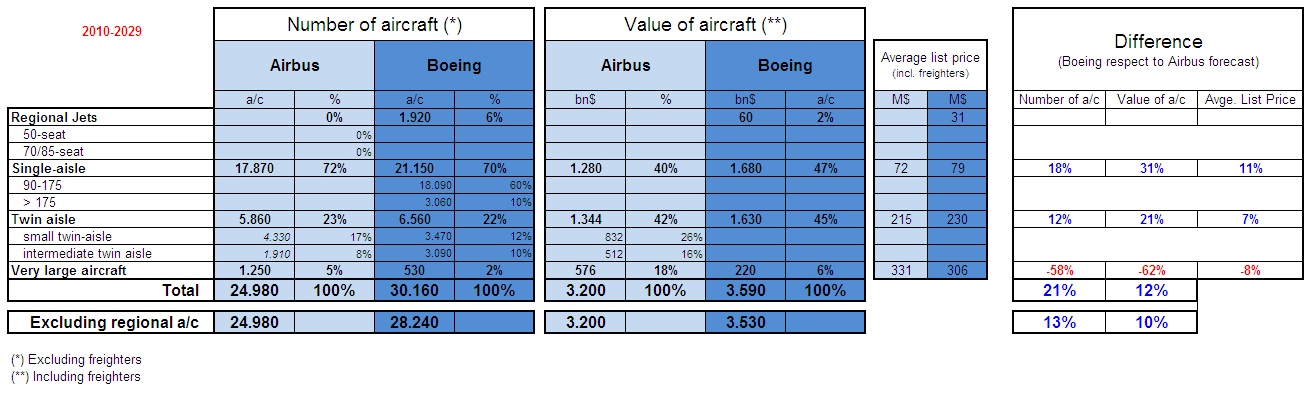
Comparison of Airbus GMF and Boeing CMO 2010-2029.

Some comments on the comparison:

  • Boeing sees demand for 13% more aircraft with a 10% more value.
  • However, this higher demand is not applicable to all segments: Boeing sees ~60% less A380s or equivalent being delivered over the next 20 years, while 18% more single aisle (A320s) and 12% more twin aisle (A330/A350s).
  • Boeing plays down A380 potential, but sees a very similar number of RPKs (“revenue passenger kilometer”), that is, the number of paying passenger by the distance they are transported. Airbus forecasts for 2029 12.03 RPKs while Boeing forecasts 12.60 (in trillion).
  • The difference of less than 5% in RPKs means that out of the 13% difference in aircraft deliveries over 8% comes from the different business model each company is trying to push.
  • Finally, we can see that Boeing uses again higher average prices for smaller aircraft and a lower reference price for A380s.

Enjoy the two documents, differences apart, they gave a very good piece of information and insight about the market.

7 Comments

Filed under Aerospace & Defence