Time to look back and reflect on how the year which is about to end developed. Brief recap of my 2025. (*)
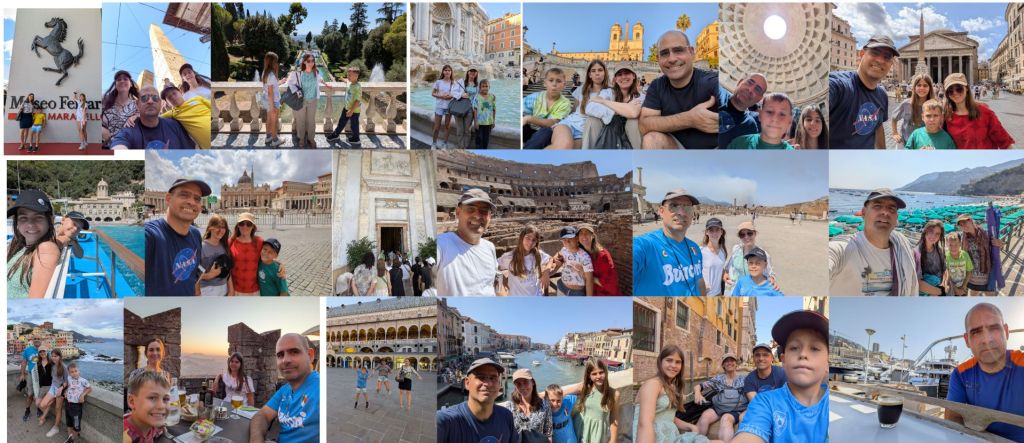
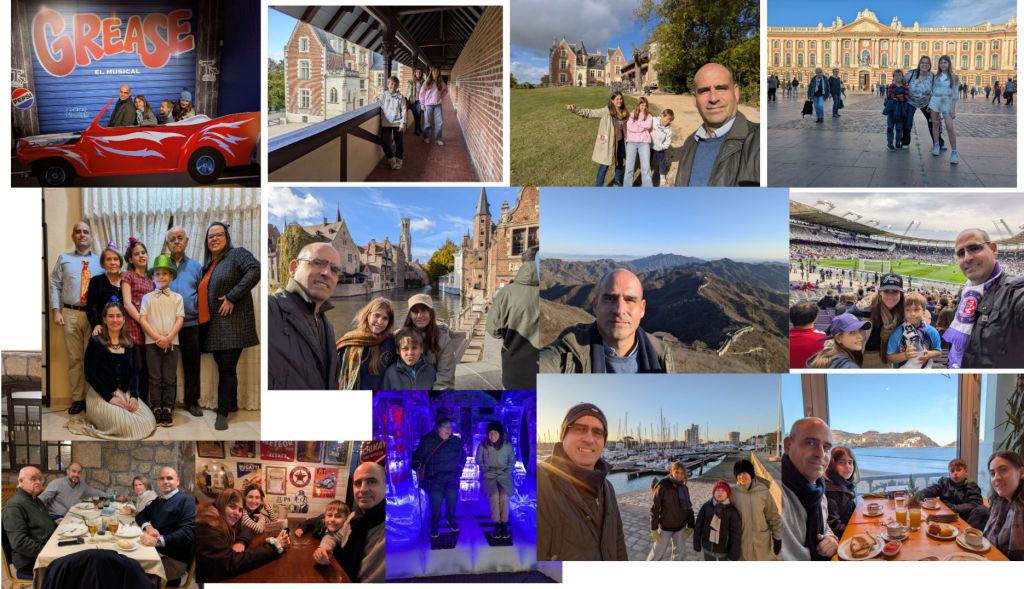
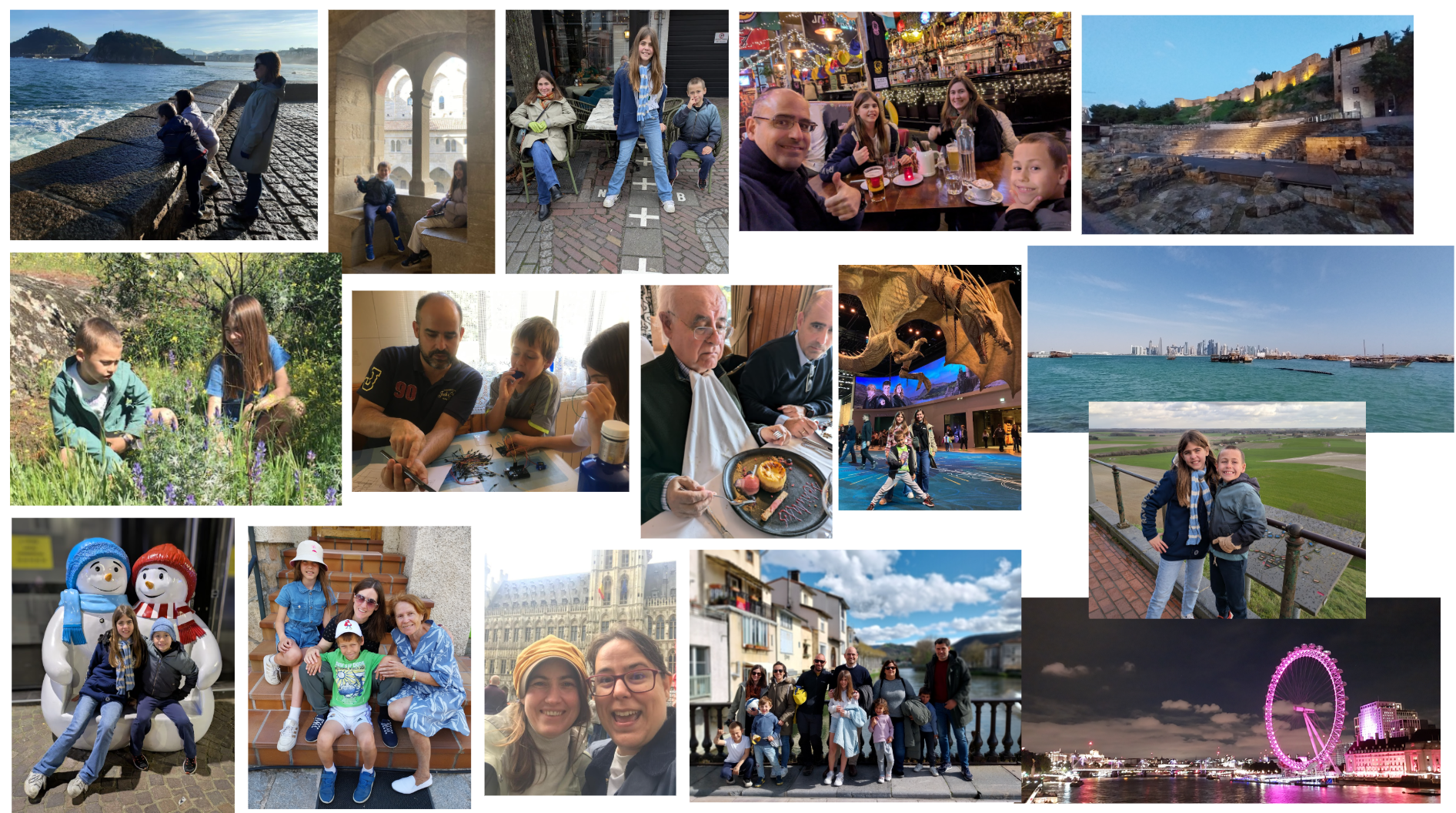
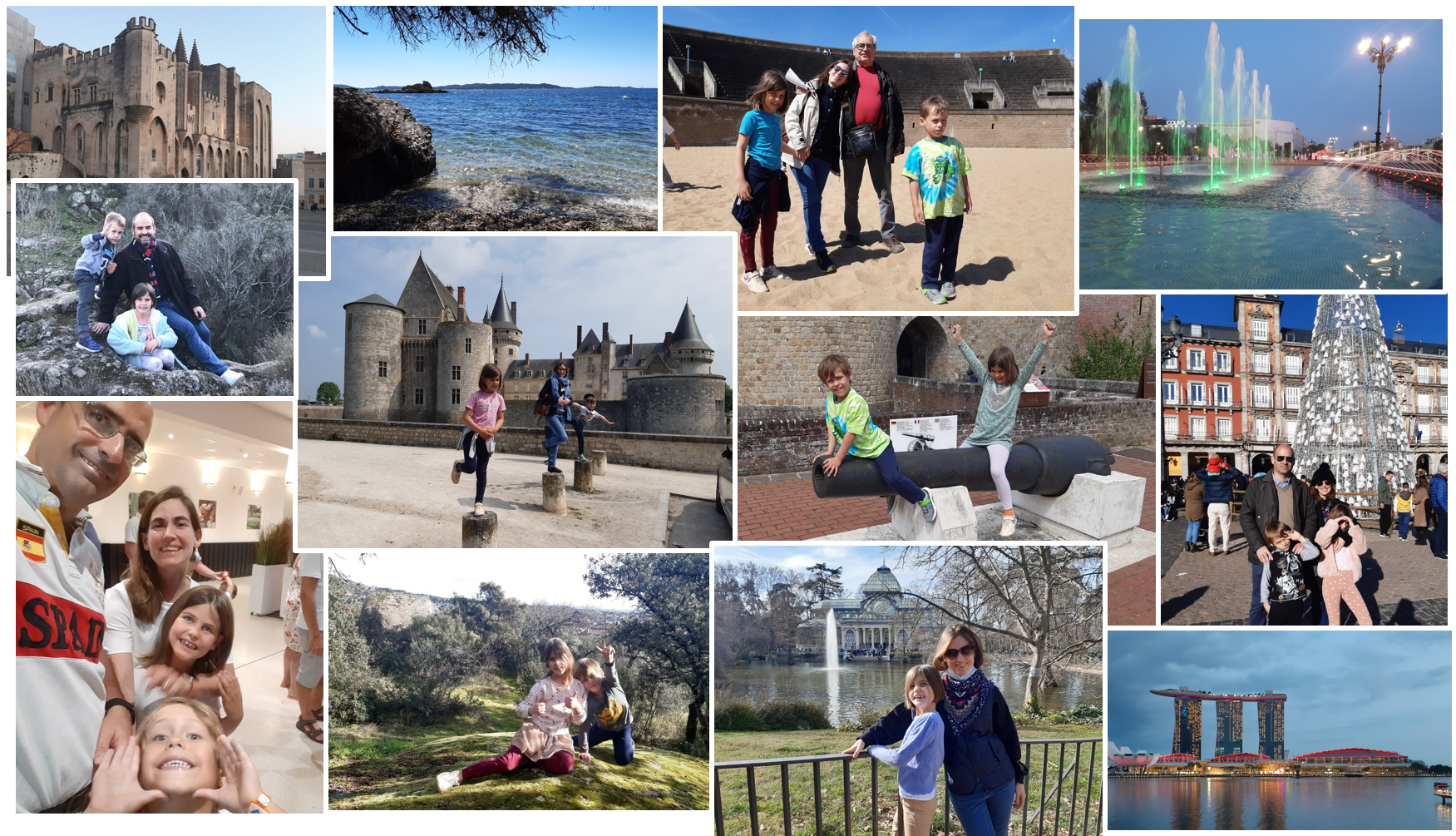
The main experience that we enjoyed together in this 2025 was the road trip we did to Italy during the summer holidays. We spent three weeks driving along the Cote d’Azur, Modena, Bologna, Roma, Orvieto, Assissi, Napoli, Pompei, Sorrento, Aquila, Attri, Loreto, Urbino, San Marino, Ravenna, Venezia, Padova, Verona, Milano… It was a trip full of museums, churches, cathedrals and basilicas (the 2025 jubilee in the Catholic Church and the Jubilee of Youth during our visit brought many young people with their chants and dances, it also enabled us to learn many things), beautiful landscapes, architecture, Roman ruins, bathing in different beaches (including an excursion and sleeping at a boat in the Port Hercule of Monaco), delicious food, lots of sun, a bit of running, and having fun with the kids.
Traveling in Italy.
Family. Andrea is now 12 years old and David, 9.
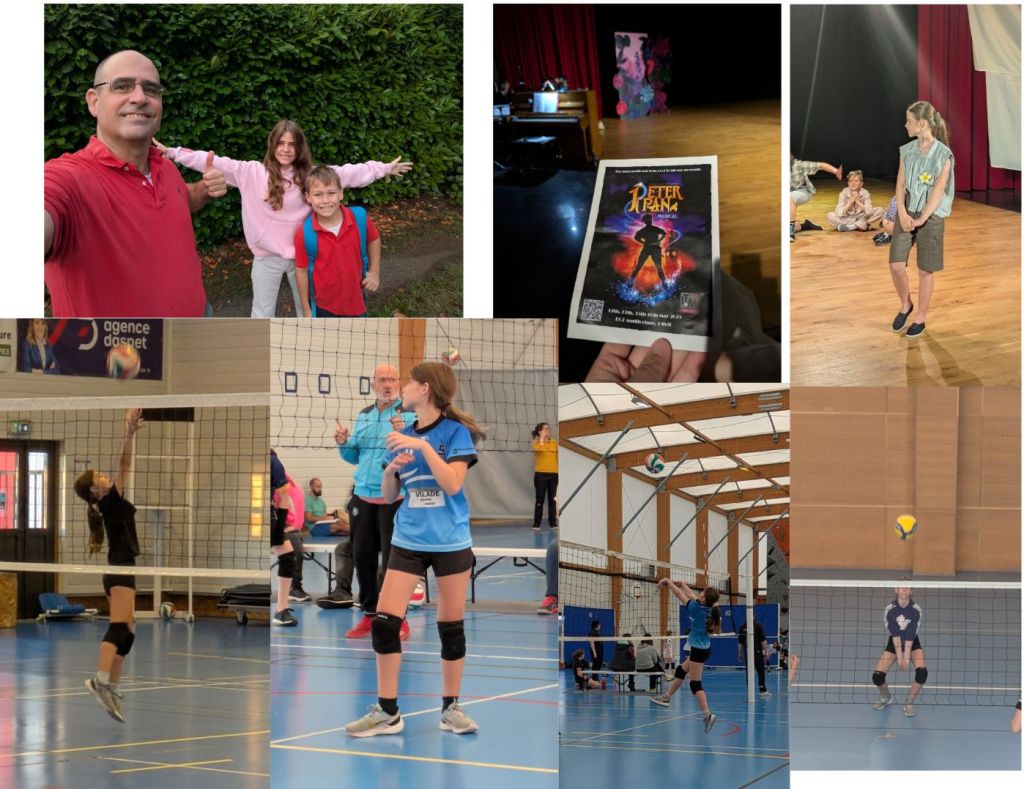
Andrea did very well in grade 6 and has also started grade 7 well, with very good marks. She especially enjoys Science, Maths and researching for her History assignments. She continues to take Spanish lessons, to play piano and volleyball in the village team. A highlight of her school year was the musical they put together in the school, Peter Pan.
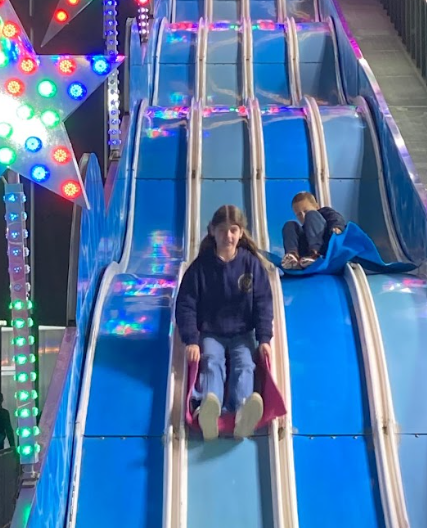
Andrea in 2025
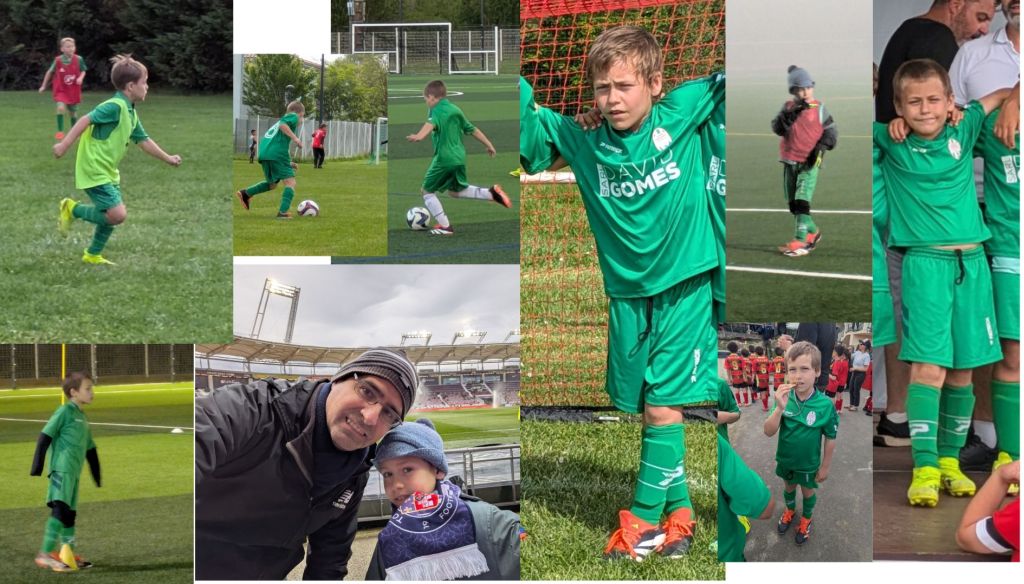
David now loves most of all football, playing it in the school, with the village team or in video games. He is also a very good student in his grade 4, where he enjoys Math and French. He is very helpful at home and he is now in his third year of Spanish lessons. They both spent several weeks alone with my parents in Madrid during school holidays, which they loved.
David in 2025
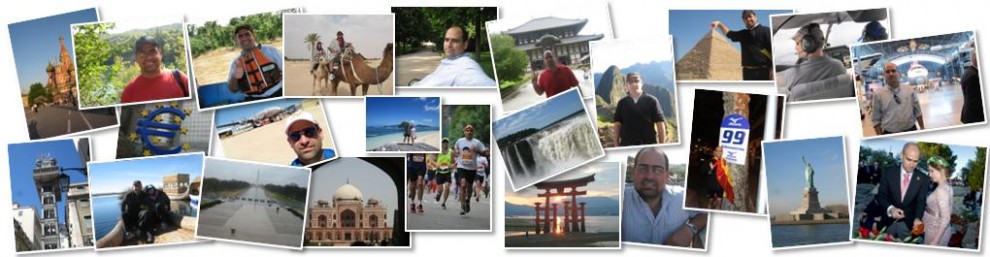
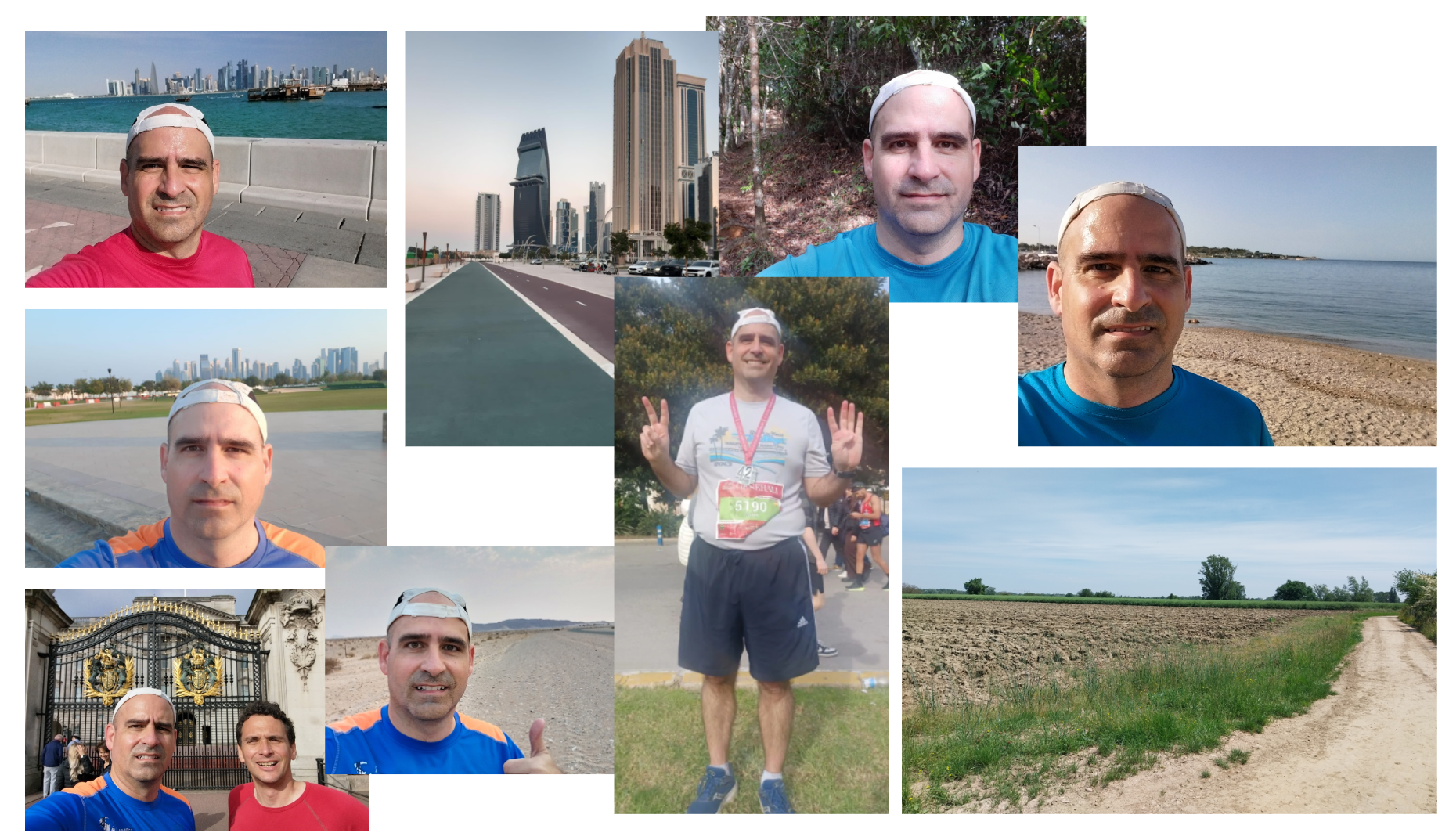
Running: My objectives for 2025 were to avoid injuries and to complete at least another marathon, and I managed to achieve both. I kept a good habit of running without pushing too much to avoid injuries, including adapting the marathon training plan I followed in the Autumn. I ran over 1,200km in 2025, not as much as I would have liked but at the level of 2024. Finally, on November 30th I completed my 25th marathon in Alicante.
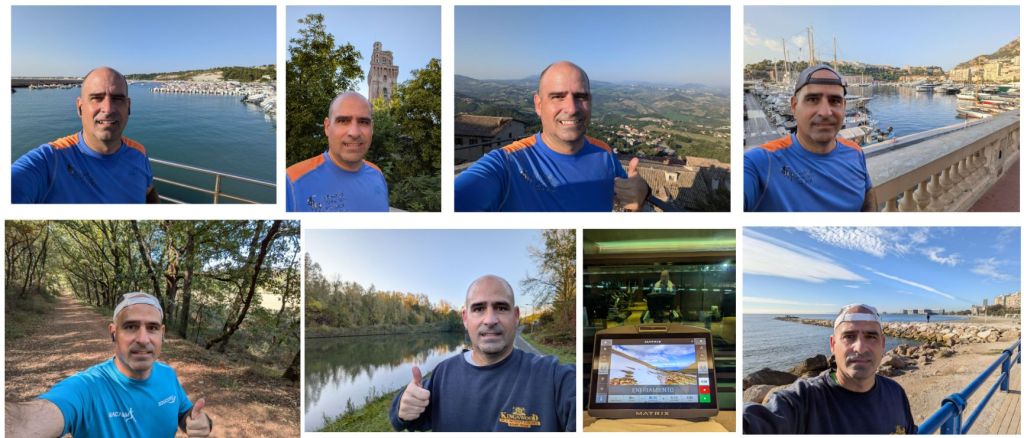
Following a mantra I try keep to the letter (when in good health), “the running shoes, always in the suitcase”, the year 2025 caught me running in: Torrelodones, Galapagar, La Grau-du-Roi, Cannes, Tuscany, Marcelli, San Marino, Padova, Monaco, Tournefeuille, Châteauroux, Péronne, Wijchen, Beijing, Shanghai, Shenzhen, Alicante, Elche and San Sebastián, plus the tens of times I trained in my village, in Blagnac and Toulouse.
Running in places.
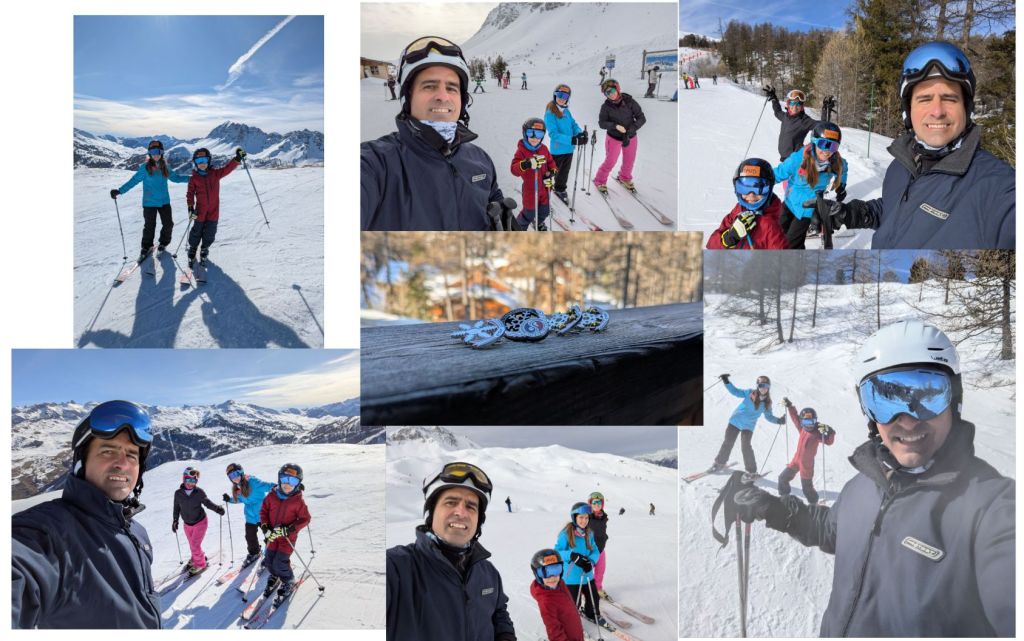
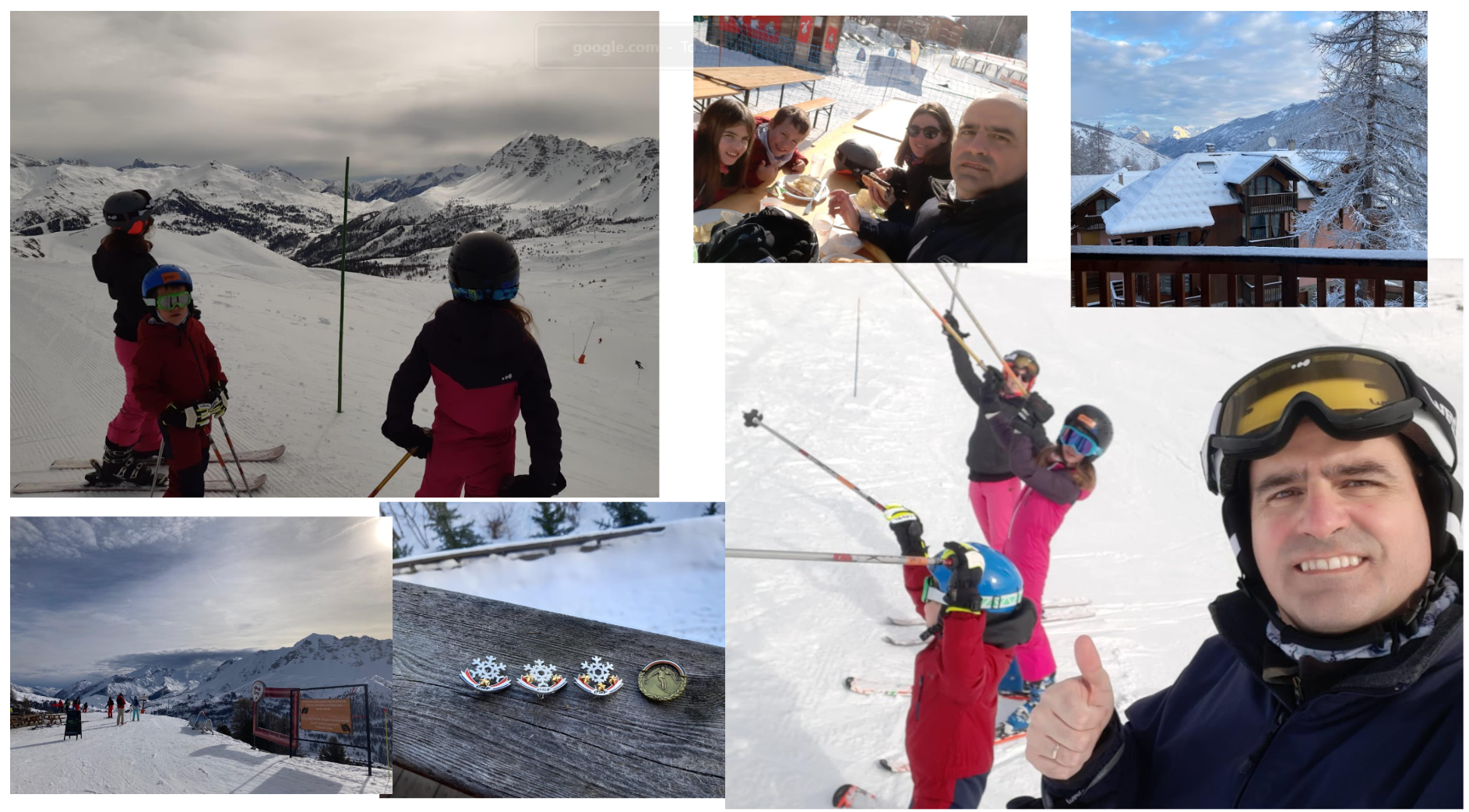
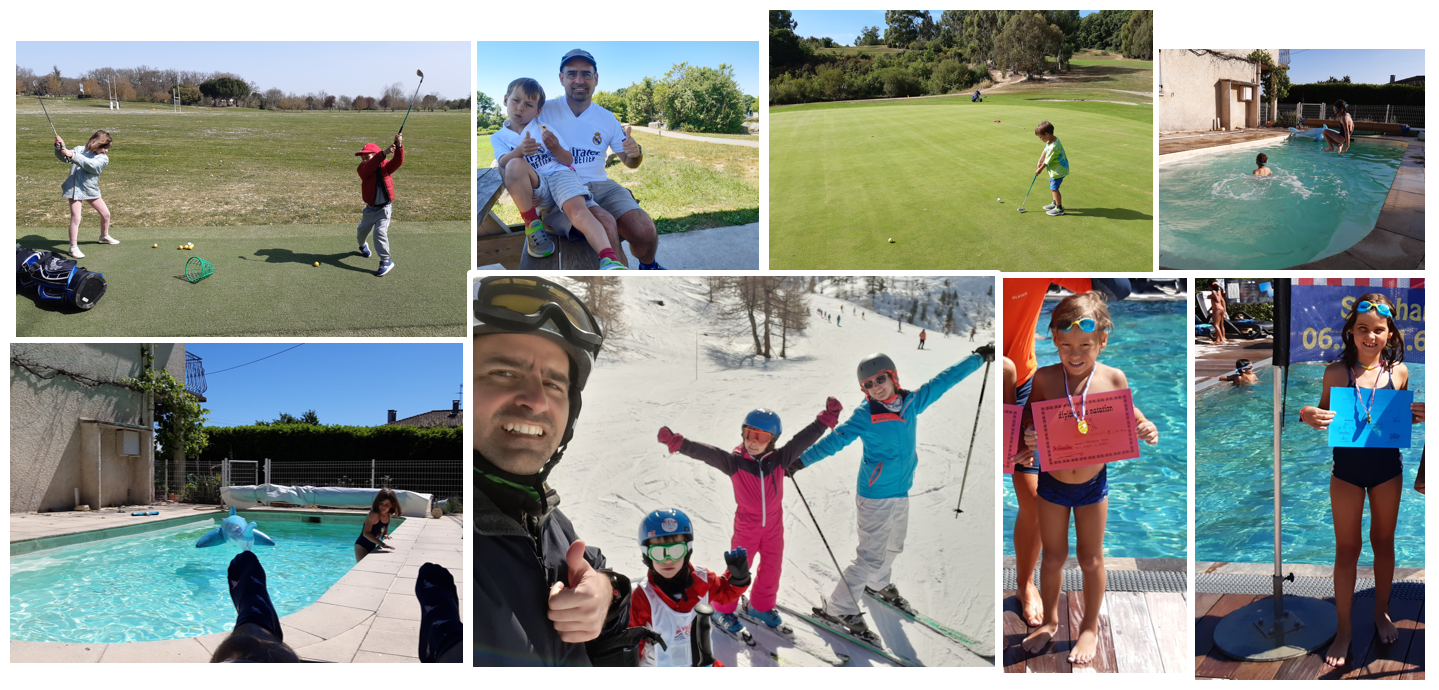
Skiing. In 2025 we went again with the family for a week to our favourite resort at Vars, in the Southern Alps. This year again we could enjoy much time skiing with the kids out of their skiing lessons. They are more daring and at ease especially skiing off tracks, and sometimes it’s difficult to keep pace with them. This year Andrea got her 3ème étoile medal and David his 2ème one (levels from the French ESF).
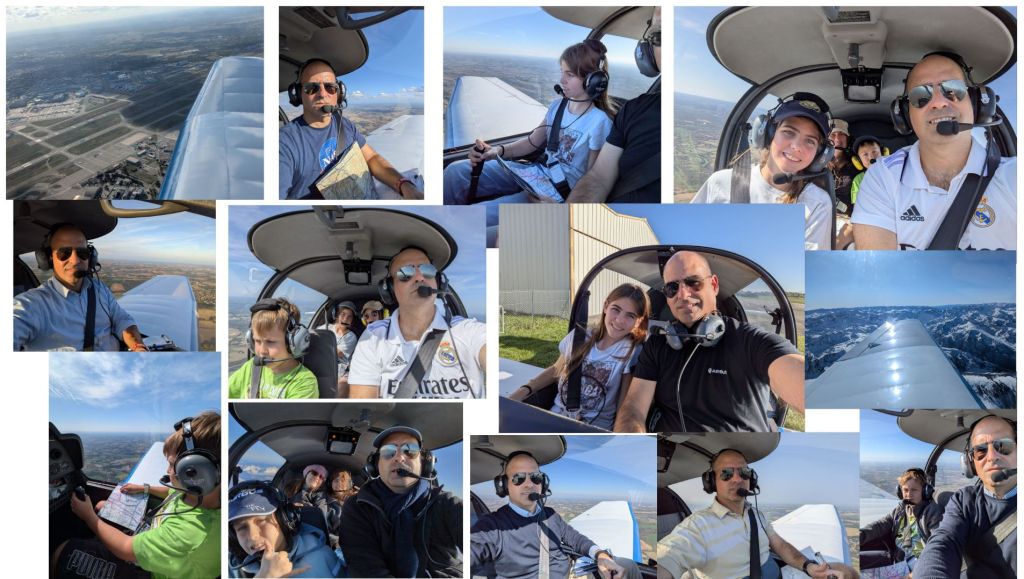
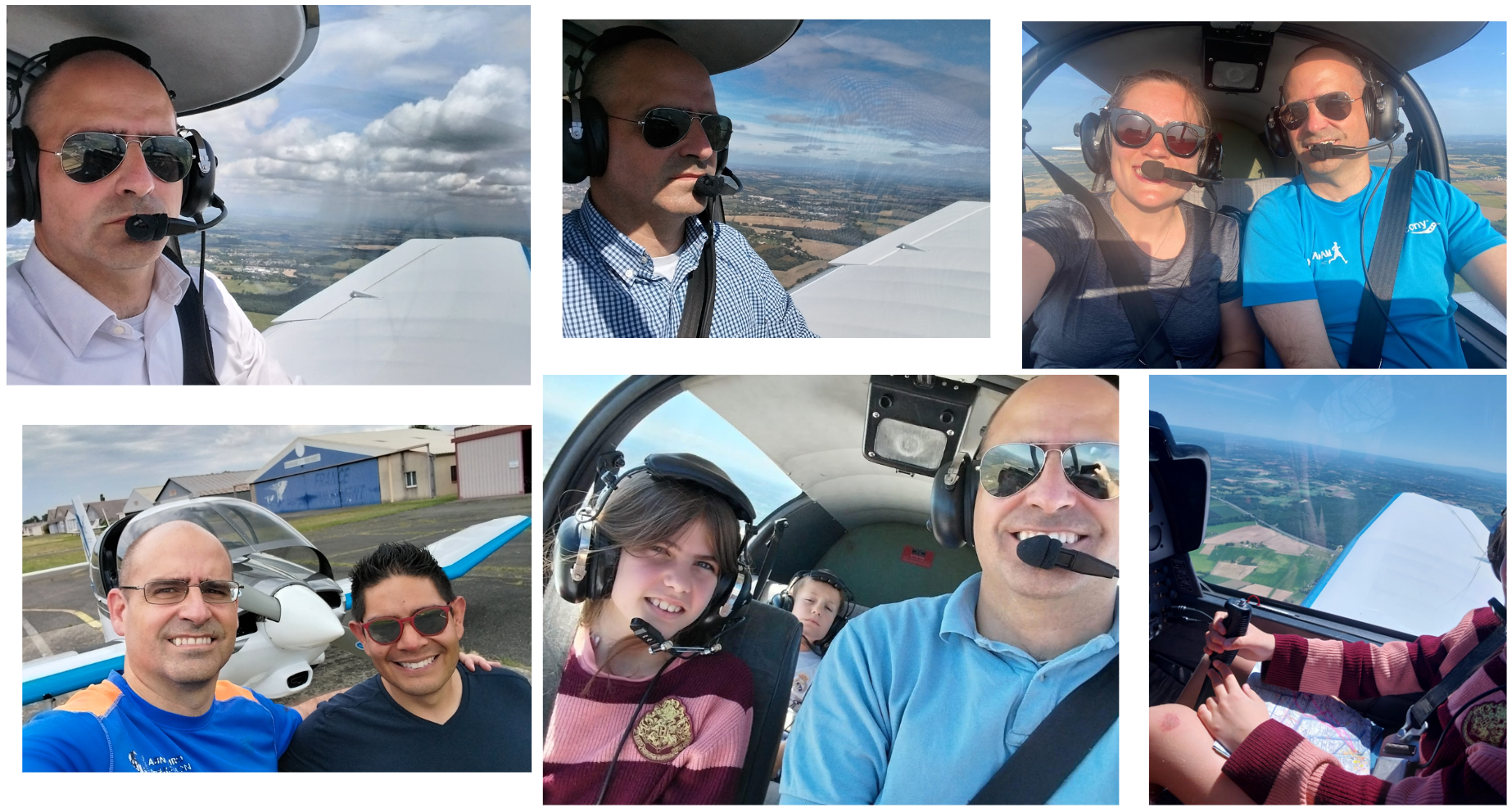
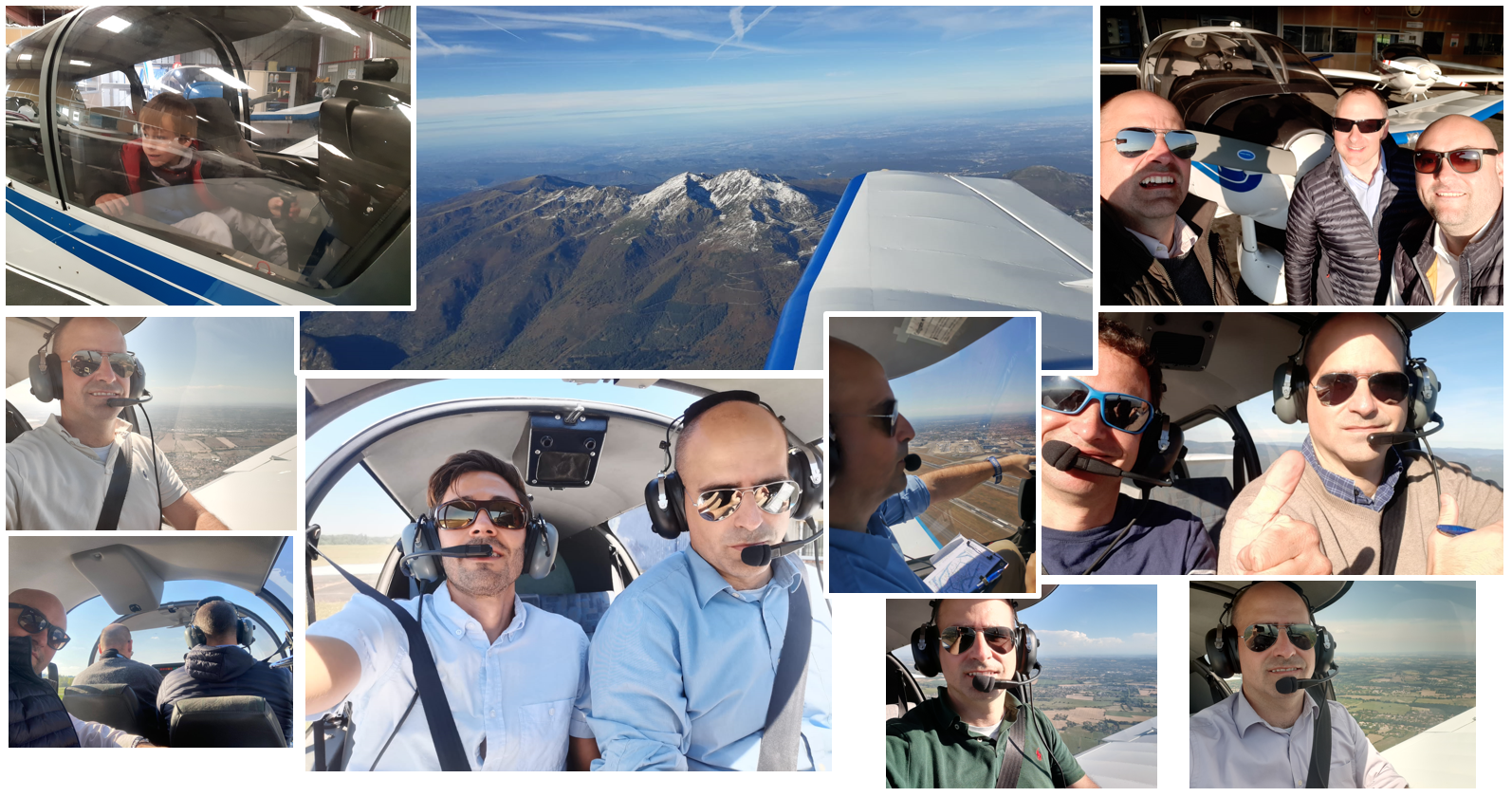
Flying. This year I managed to fly more than in 2024. I did some training flights and some others with the kids, including a nice flight excursion we did along the Lot and Dordogne valleys. In October I also had to renew my French language radio competence (FCL 055) and in November I renewed the licence by experience after flying with the instructor (SEP (single-engine piston) qualification).
In all, this year I have flown 13 flight hours, 12 flights and 30 landings. This takes my total experience to 228 flight hours and 369 landings since I started taking lessons back in 2011. Hopefully in 2026 we can take part in some excursions abroad.
Flying in 2025
Travelling. Apart from the unforgettable trip to Italy, in this 2025 either alone or with the family we continued to visit some new and old places: Aix-en-Provence, Vars, Saint-Rémy-de-Provence, Arles, Nîmes, Burgos, Bourges, Fontainebleau, Montargis, Paris, Amboise, Brugge, Dunkerque, Pierrefonds, Beijing, Shanghai, Guangzhou, Shenzhen, Chengdu, Elche, Alicante, Wijchen, Rijswijk, Saint-Quentin, La Rochelle, Bordeaux, San Sebastián…
Reading. In this 2025, I managed to read a bit more than last year, in all 17 books, mostly in Spanish with the rest split in English and French (2 books in each language). I’m also happy to have read other 5 books of the Great Books curriculum for the bachelor in arts of Saint John’s College, a list I have been using as a reference for years. For the detailed list of books, see the post I wrote about my 2025 reading list with a brief description of each one.
Other cultural activities:
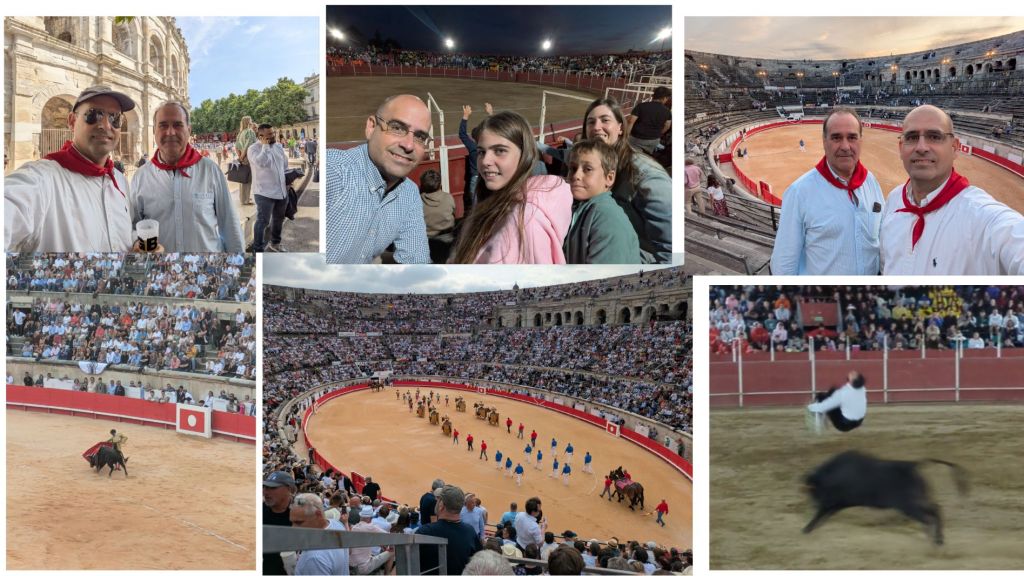
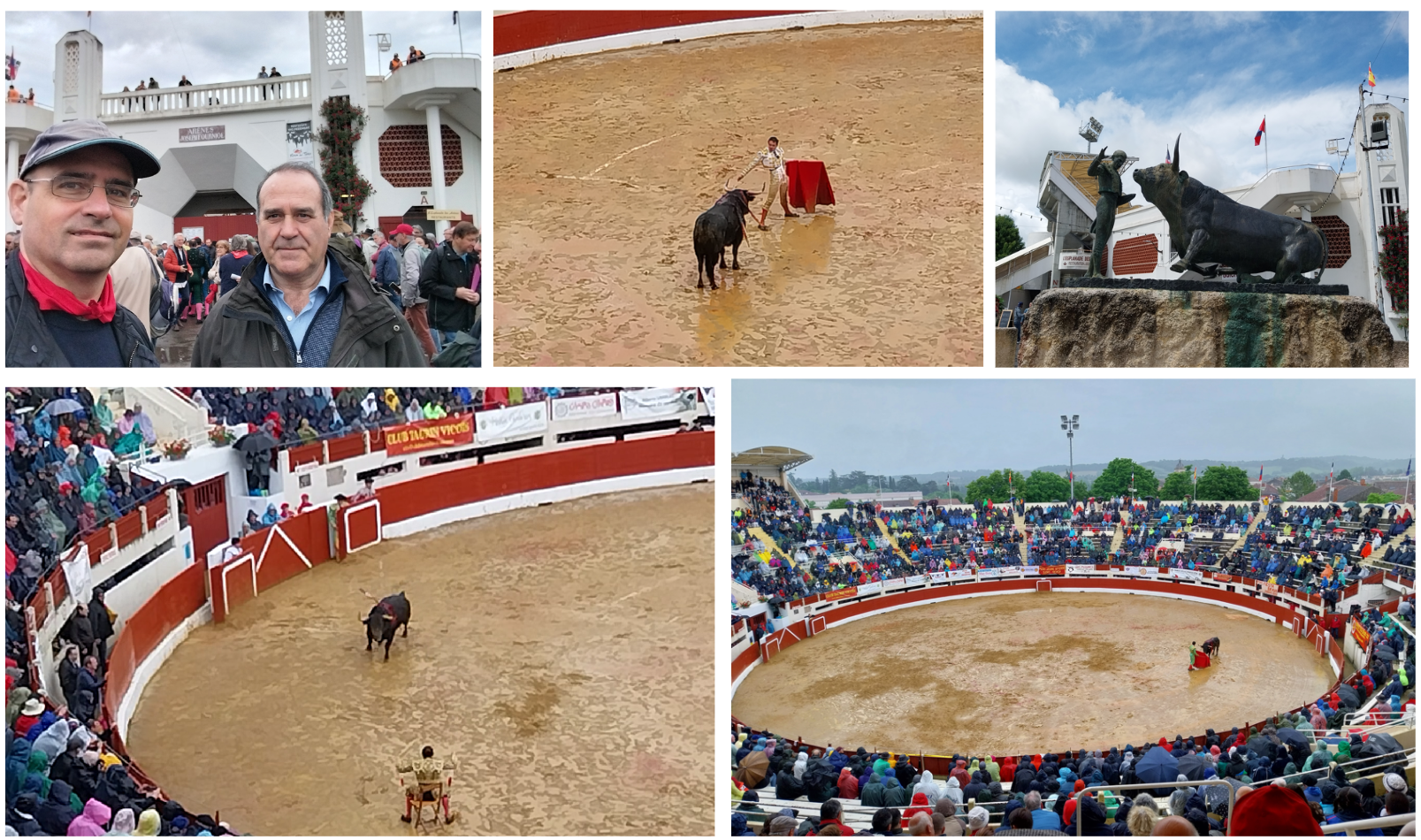
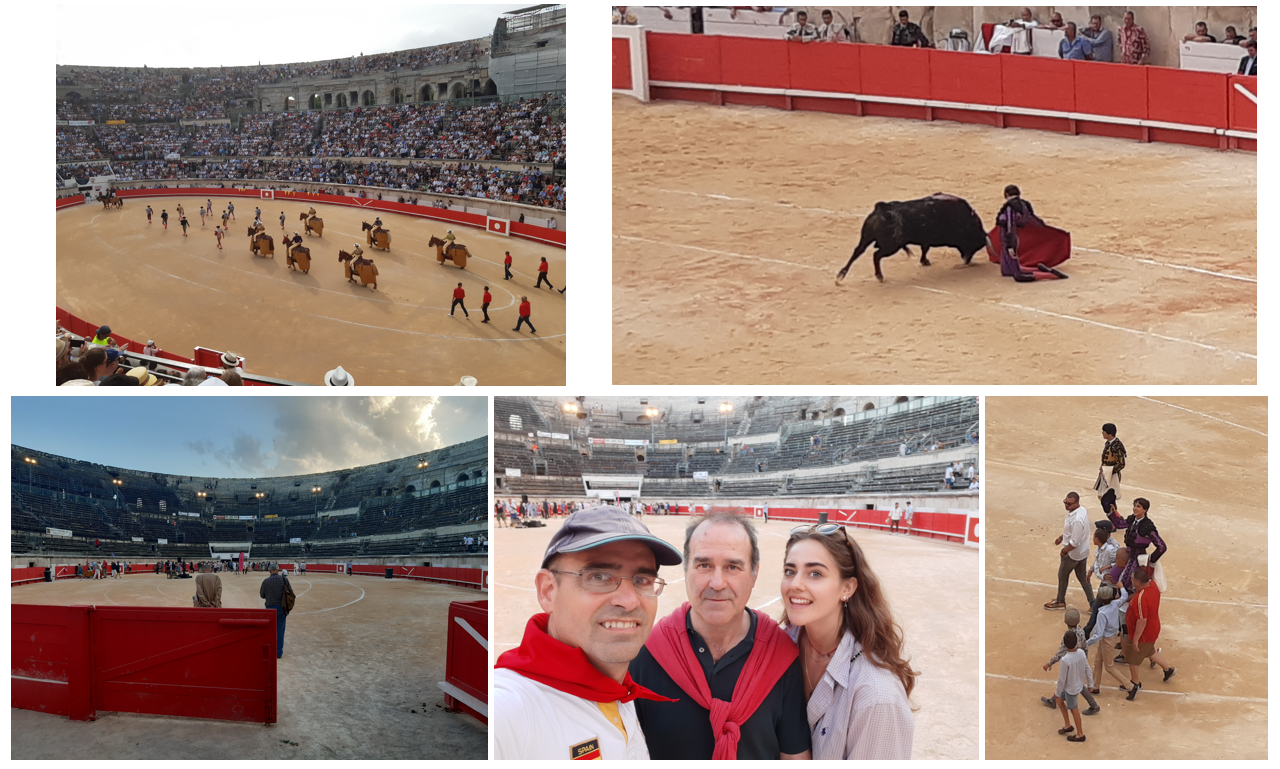
Bullfighting. This year again, together with Luismi, we went to Nîmes to attend its Feria de Pentecôte, in particular a corrida (same wording in French) with the following bullfighters: Morante de La Puebla (who had an incredible 2025 and retired in October; in Nîmes he did a good job but wasn’t lucky with the bulls), Talavante and the young Marco Pérez, the latter two were awarded 2 ears and exited through the puerta grande.
Later, in July we went with the family to a concurso de recortadores at Las Navas del Marqués (Ávila), a contest in which 12 men went into the arena one by one to dodge the bull when running towards them in impressive ways, including jumping over it. The winner was Paquito Murillo, who had been Spanish champion of that variety in the past.
I also renewed my membership to the foundation Toro de Lidia to keep supporting the art.
Theatre. We started the year with a great musical in Madrid, Grease (thanks to a wonderful invitation from my sister Beatriz!) and the Pantomime show in Pibrac where they played Rapunzel (which was hilarious). At the end of the school year we also attended the great show put up by the kids of the school with Peter Pan.
Other shows: we went with the family a few times to the cinema, with Formula 1 being the movie we liked the most. We also went to a concert of the string quartet Mascarade. We also went a couple of times to see matches from the Toulouse FC at the stadium, against Montpelier and Metz. Those were great fun especially for the kids. What we want to do in 2026 is to rather see the rugby team with the family and possibly more music concerts.
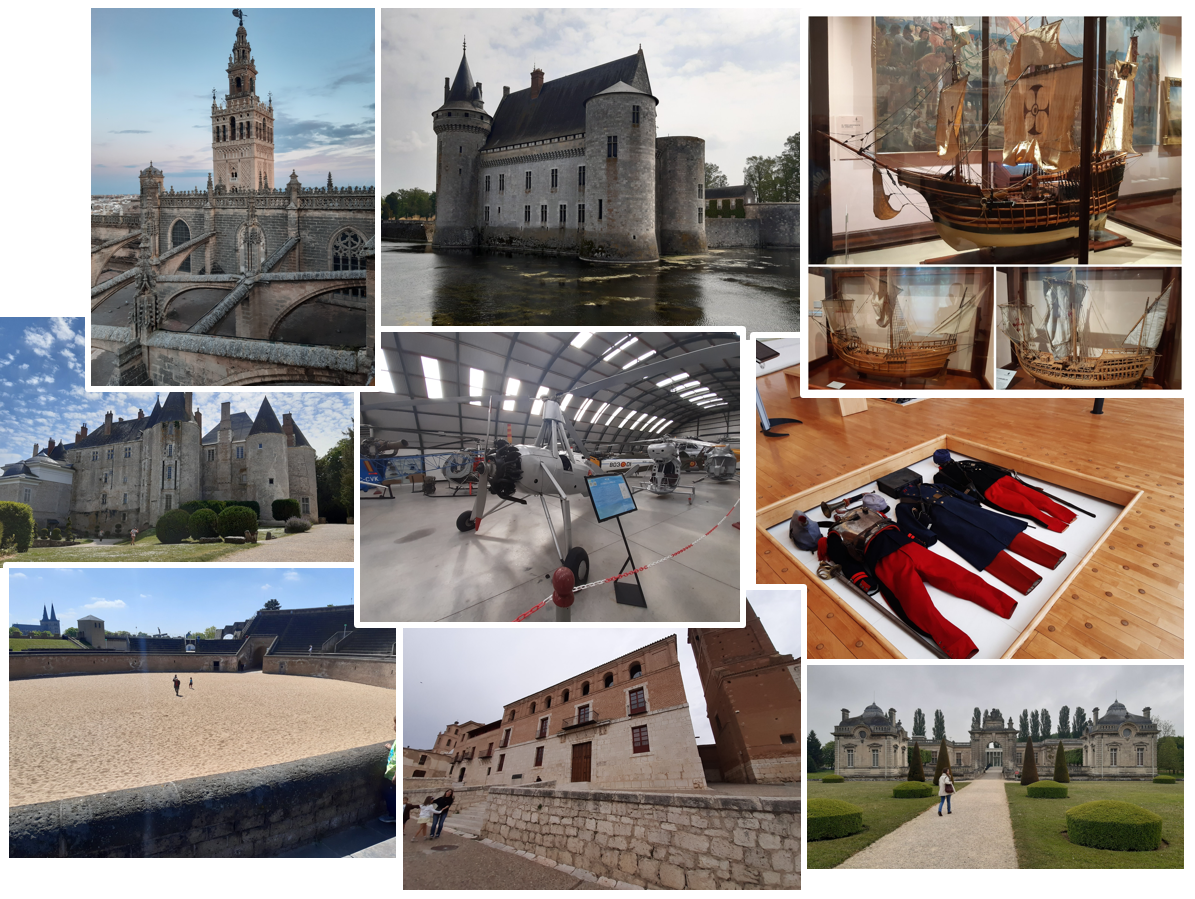
Museums. This year again we took benefit of every trip to visit as many museums and castles as we could (some of them were visited for a second or third time): Arles theater and amphitheater, Saint Remy Provence St Paul Mausole (where Van Gogh was interned), Palais Jacques Coeur and Cathédrale in Bourges, Château Fontainebleau, Panthéon, Notre Dame, Musée du Louvre and Les Invalides in Paris, Sainte-Marie-Majeure in Marseille, Abbazia di San Fruttuoso, Museo Enzo Ferrari Modena, Museo Ferrari Maranello, Basilica di San Petronio and Basilica di San Domenico in Bologna, Archiginnasio di Bologna, Lamborghini Museo in Sant’Agata Bolognese, Casa Museo Luciano Pavarotti, Basilica di San Francesco in Assisi, Abbazia di San Pietro in Perugia, Duomo di Orvieto, Villa d’Este in Tivoli, Pantheon, Chiesa di Sant’Ignazio di Loyola, Santa Maria sopra Minerva, Chiesa di Sant’Agnese in Agone, Musei Vaticani, St. Peter’s Basilica, Basilica di San Giovanni in Laterano and Scala Santa, Basilica di San Clemente al Laterano, Terme di Caracalla, Colosseum, Roman Forum and Palatine Hill, Basilica di Santa Maria Maggiore, Basilica di San Paolo fuori le mura, Catacombe di San Callisto, Napoli Sotterranea, Duomo di Napoli, Pompeii, Abbazia di Montecassino, Basilica di Santa Maria di Collemaggio in L’Aquila, Duomo di Atri, Santuario della Santa Casa in Loreto, Palazzo Ducale in Urbino, the towers Cesta and Guaita in San Marino, the Basilica de San Vitale, Galla Placidia, the Orthodox Baptistery, Sant’Apollinare Nuovo and the Basilica de St Francesco in Ravenna, the Basilica di San Marco, Correr Museum and the Palazzo Ducale in Venice, Château du Clos Lucé in Amboise (where Da Vinci lived his last years), Stadhuis and the Basilica of the Holy Blood in Brugge, Aviodrome museum, Museum Dunkerque 1940 Operation Dynamo, Château de Pierrefonds, Great Wall of China in Mutianyu, the Palacio de Altamira and Torre de la Basílica de Santa Maria in Elche, Aachen Rathaus, Netherlands ice sculptures Festival, Wonder van Empel, Château de Compiègne, Basilique Saint-Martin de Tours, Cathédrale Saint-André de Bordeaux.
Blogging. This is the 16th year since I started the blog in February 2010. This year I wrote just 9 blog posts, in line with the past years since 2020. It helps me to structure some ideas in some posts, to dig into some topics other times, and as a personal repository to which I come back every now and then. The blog received just over 20,800 visits, a bit more than in 2024 (in line with the past few years) and over 533,000 views since 2010.
Work. No changes in the scope of the work this year (A330neo product marketing since January 2023), neither in the team, so it was a stable year in that front.
Since 2023 the markets keep being quite active, and in 2025 we had a good year for the A330neo in terms of aircraft orders.
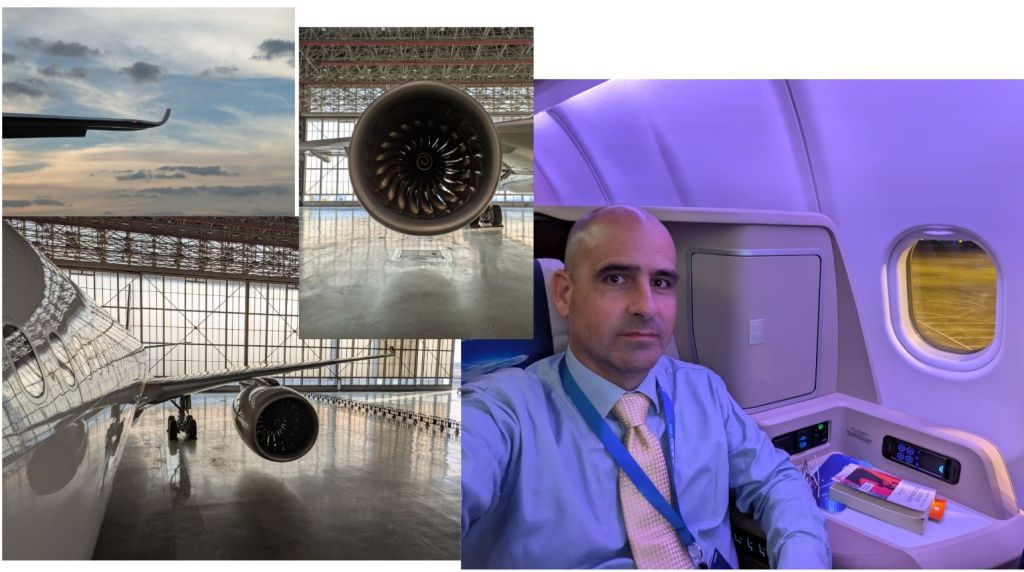
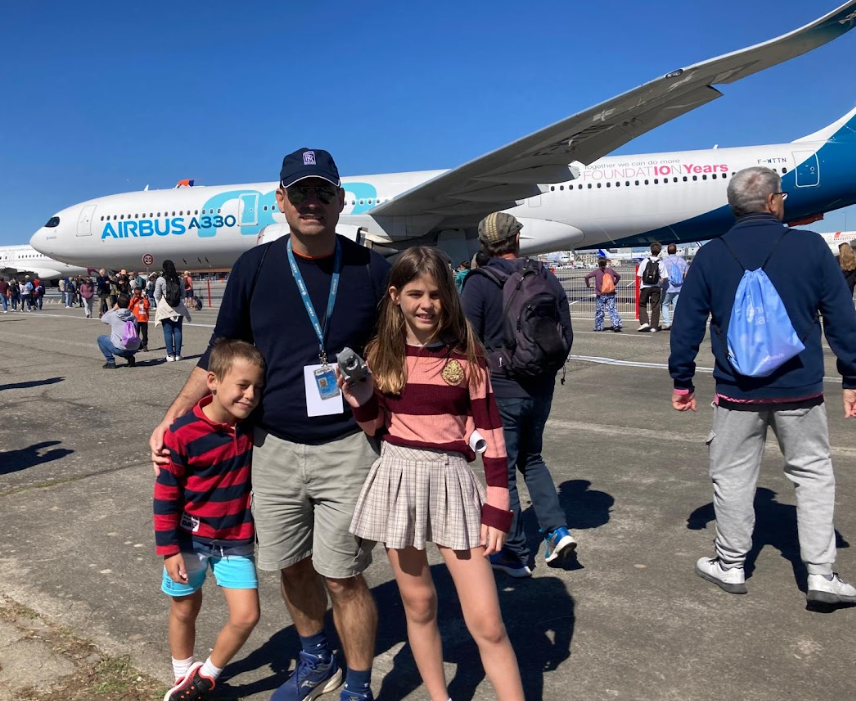
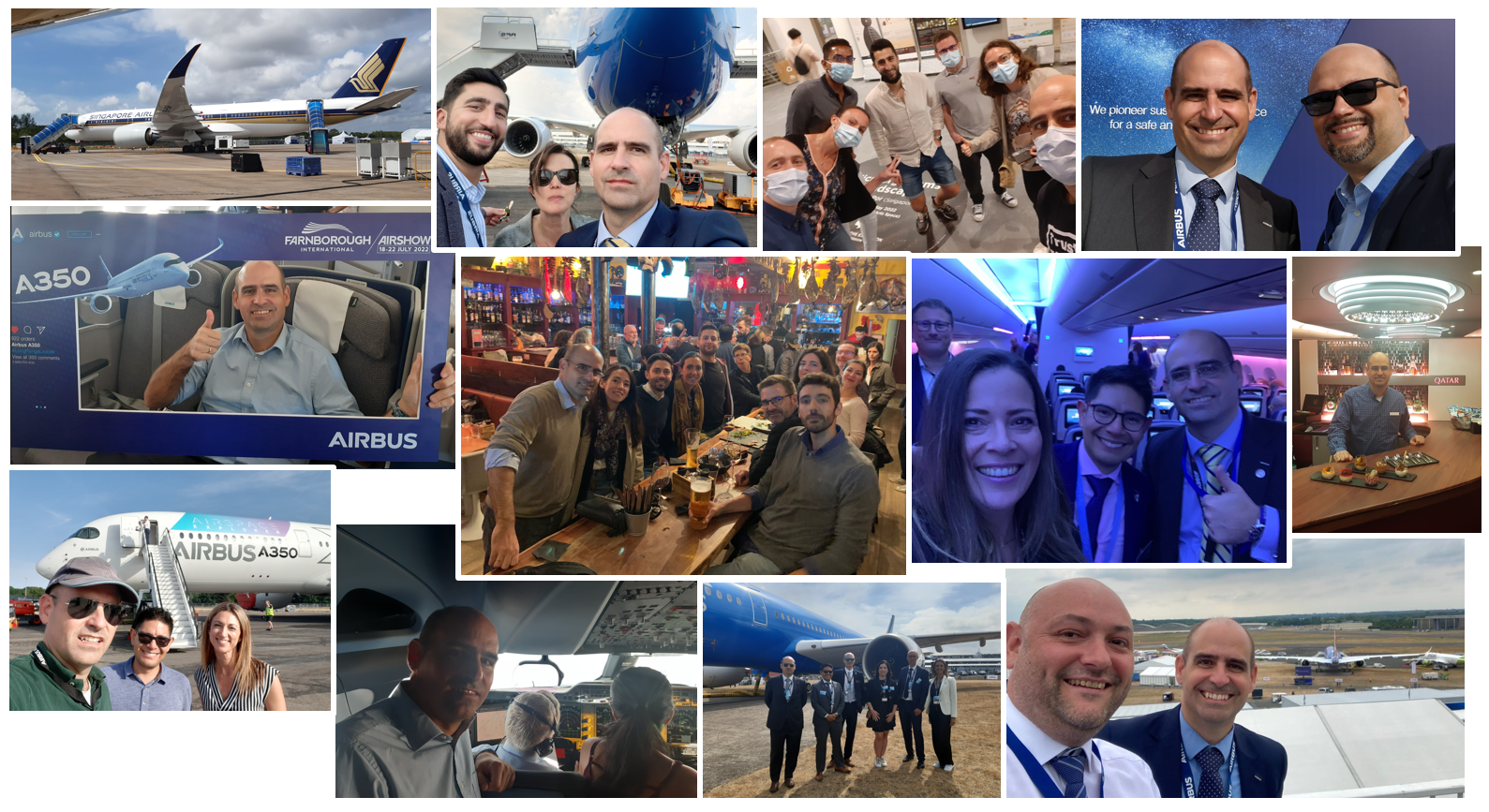
This year I had the opportunity to join a great demo tour where we rented the aircraft from an airline and we visited different pages to showcase the A330neo with colleagues from Airbus and Rolls-Royce to varied groups of customers or institutional representatives. That was a very intense week but full of new experiences. These included the first time I flew an airline’s A330neo! (I had only flown before the Airbus A330neo flight test aircraft).
Working on the A330neo.
Now it’s time to rest, celebrate with the family and hope for the best in 2026. For the moment we have just a few days in Madrid to enjoy with family and friends and a planned skiing week in Vars; hopefully that will be just the beginning of another memorable year.
Time to look back and reflect on how the year which is about to end developed. Brief recap of my 2024. (*).
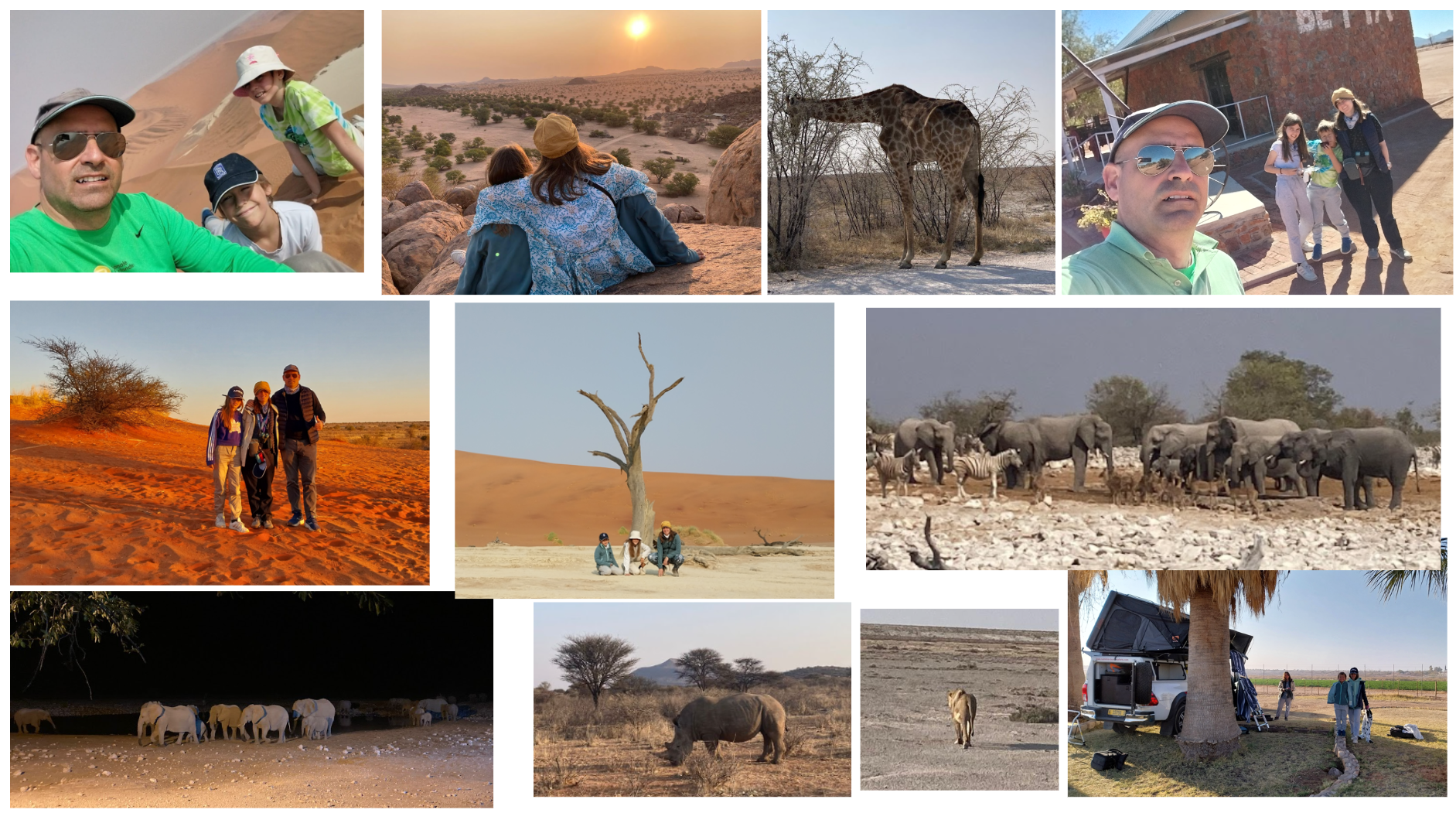
The main experience that we enjoyed together in this 2024 was the road trip we did to Namibia during the summer holidays. We spent over two weeks driving up and down the country along solitary and unpaved roads, through deserts, mountains, canyons, along the coast… We did a bit of camping and enjoyed great hotels and resorts. We did some boat excursions and various game watching safaris at different parks. An unforgettable trip.
Namibia
Family. Andrea is now 11 years old and David, 8. Andrea just started secondary and is proving to be a responsible and good student. She loves drawing, researching for her school homework and clothes. She now has her own smartphone and starting playing volleyball in the village team. She is in her 3rd year of Spanish lessons, which now she also studies in the school. This year she is volunteering to take part in the school play at the end of the year. David continues to enjoy building Lego sets, playing video games but most of all he loves football, which he is now playing with the village team. He is also a very good student in his grade 3, where he enjoys Math and French. He is very helpful at home and he is now in his second year of Spanish lessons. They’re both taking piano lessons and this 2024 they have spent several weeks alone with parents in Madrid during school holidays, which they loved.
Running: After an end of 2023 marked by injuries, I just wanted to get again into the running habit and completing another marathon, which I did! In all, I run just 1,250km in 2024, more than in 2023 but less than I would have liked. I still had some injuries now and then but I could cope with them and I ran the marathon of Malaga in December, my 24thmarathon.
Following a mantra I try keep to the letter (when in good health), “the running shoes, always in the suitcase”, the year 2024 caught me running in: Torrelodones, Miranda de Ebro, Brunei, Doha, Galapagar, Athens, London, Namibia (Sossusvlei, Swakopmund, Damaraland, Ethosa), Helsinki, Madrid, Málaga, the Netherlands (Wijchen), San Sebastián, plus the tens of times I trained in my village, in Blagnac and Toulouse.
Running around
Skiing. In 2024 we went again with the family for a week to our favourite resort at Vars, in the Southern Alps. This year again we could enjoy much time skiing with the kids out of their skiing lessons. They are more daring and at ease especially skiing off tracks, and sometimes it’s difficult to keep pace with them. This year Andrea got her 2ème étoile medal and David his 1ère one (levels from the French ESF).
Skiing in Vars (Alps)
Flying. This year I did not manage to fly as much as I wanted. I kept up with the recency requirements doing some training flights and some others with the kids. This year I also flew for the first time with Rodrigo and Harriet-Eve. I am sure that in 2025 I will have the chance to fly with more colleagues.
In all, this year I have flown just 5 flight hours, 7 flights and 15 landings. This takes my total experience to 215 flight hours and 339 landings since I started taking lessons back in 2011. In 2025 I will need to renew the SEP (single-engine piston) qualification, that will certainly require more flying in the coming months, hopefully with some excursions abroad.
Flying with friends and family
Travelling. Apart from the unforgettable trip to Namibia, in this 2024 either alone or with the family we continued to visit some new and old places: Brunei, Aix-en-Provence, Vars, Avignon, Doha, Paris (including another visit to the Parc Asterix which the kids loved), Madrid, Vic-Fezensac, Helsinki, London (including a great trip with the family to visit Harry Potter’s studios), San Sebastian, Málaga, Wijchen, Rijswijk, The Hague, Waterloo, Reims, Saint-Quentin, Poitiers, Bordeaux…
Traveling
Reading. In this 2024 I didn’t read as much as I would have liked to, but I managed to read 10 books with a good mix between reading in English, French and Spanish. I’m also happy for having read other 4 books of the Great Books curriculum for the bachelor in arts of Saint John’s College, I list I have been using as a reference for years. For the detailed list of books, see the post I wrote about my 2024 reading list with a brief description of each one.
Other cultural activities:
Bullfighting. This year again, together with Luismi, we went to Vic-Fezensac to attend its corrida concurso (same wording in French) with very strong bulls from different breedings. This year it was especially tough for the bullfighters as it was raining all the morning. Despite that, we saw a good show, with Sánchez Vara (that we had seen in previous occasions) and the Colombian Juan de Castilla who was awarded an ear, and left quickly after the 5th bull as he would be fighting in another corrida in the afternoon at Las Ventas (Madrid). I also renewed my membership to the foundation Toro de Lidia just a few days ago to keep supporting the art.
Bullfighting at Vic-Fezensac
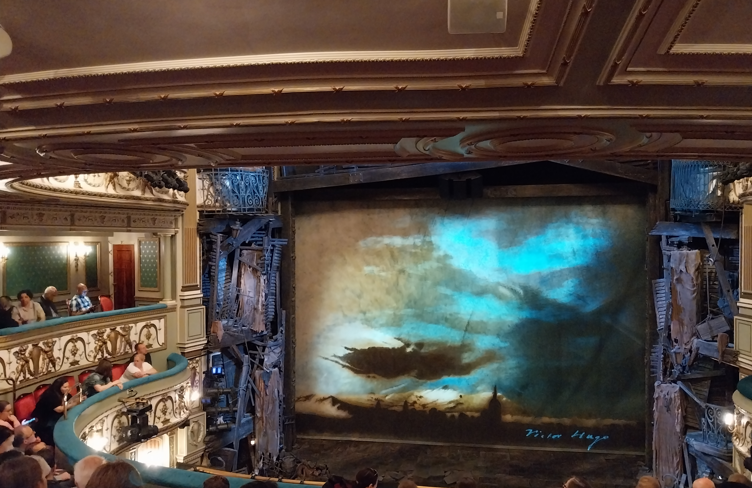
Theatre. We started the year with two musicals in Madrid: School of Rock (thanks to a wonderful invitation from my sister Beatriz!) and Fabiolo connection (which was hilarious). Luca and the kids then attended Aladdin by the Secret Pantomime Society in Pibrac. At the end of the school year we also attended the great show put up by the kids of the school with Shrek. I took the opportunity of a trip to London to attend Les Misérables (a great recommendation from by brother Jaime, and something I had been wanting to do since I read the book years ago).
Les Misérables in London
Cinema. After years of nearly not having gone to the cinema (small kids!) this year we have started to go more often, with or without the kids (5 or 6 times from memory?). My favorite movie this year was The Count of Monte-Cristo.
Museums. This year again we took benefit of every trip to visit as many museums and castles as we could, among them: Fondation (Victor) Vasarely (Aix-en-Provence), Palais des Papes and Pont d’Avignon, Kolmanskop ghost town (Namibia), Finish Aviation museum (Helsinki), Tower Bridge, British Museum, Tate Modern, Harry Potter Warner Bros studio London, Westminster Abbey, Casa natal Pablo Picasso, Museo Picasso, Roman theatre in Málaga, Alcazaba Palace and Castillo de Gibralfaro in Málaga, Centre Pompidou Málaga, Waterloo battlefield museum 1815, Kröller-Müller museum (NL), Escher in the Palace (The Hague).
Blogging. This is the 15th year since I started the blog in 2010. This year I wrote just 7 blog posts, in line with the past years since 2020. The blog received just over 20,700 visits, a bit more than in 2023 (in line with the past few years) and over 512,000 views since 2010.
Work. No changes in the scope of the work this year (A330neo product marketing since January 2023) but we have had quite a few changes higher up in the organization and more closely we bid our farewell to Anna and welcomed Andoni.
Since 2023 the markets have been very active. If in 2023 we at Airbus broke a new record of aircraft orders, this 2024 has also been very active and positive, with many sales and campaigns.
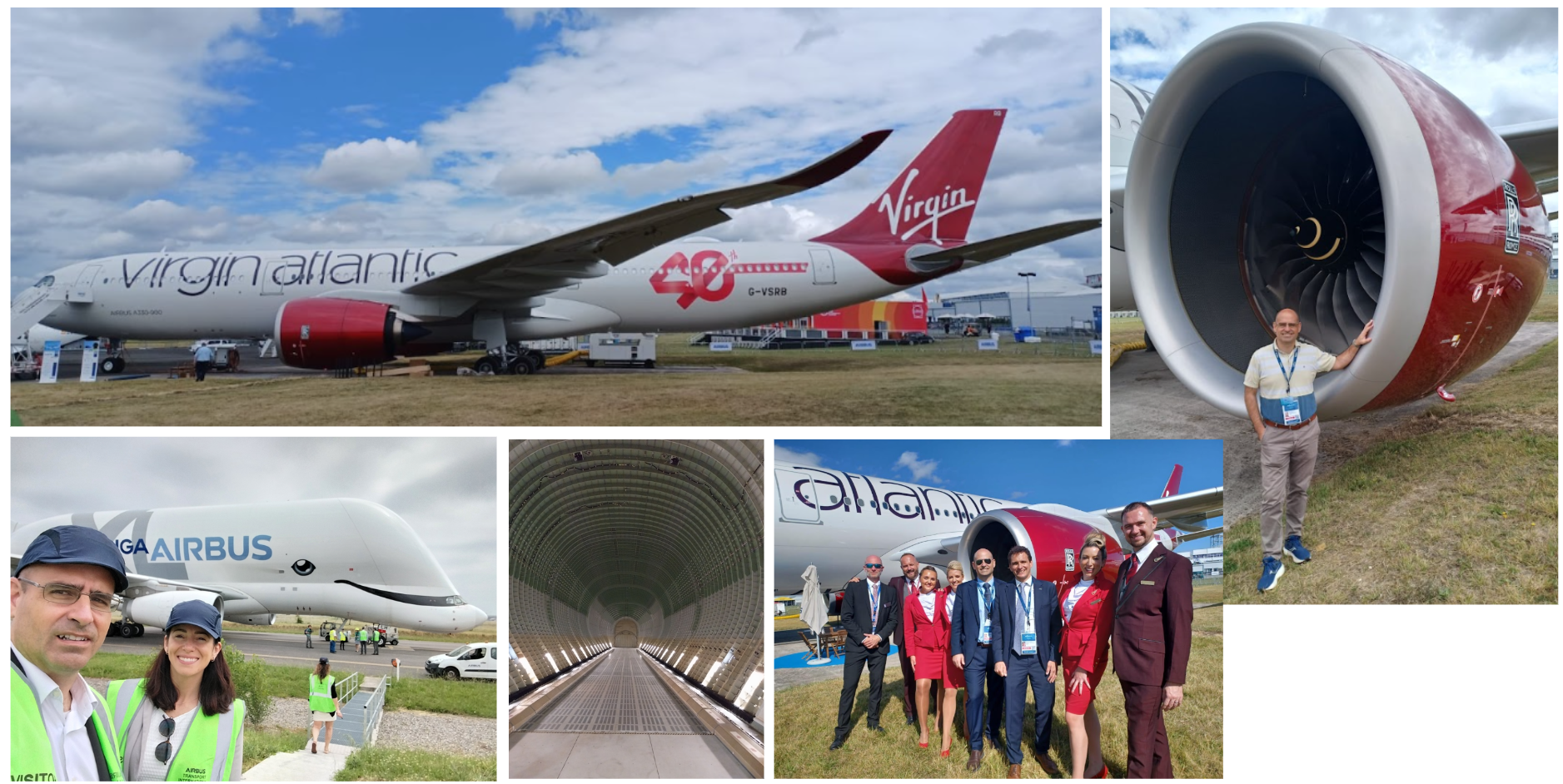
This year I had the opportunity to attend the Farnborough airshow, where I could showcase a Virgin Atlantic A330neo together with colleagues from Airbus and Rolls-Royce and the airline crews, at times showing the aircraft non-stop for hours to many different and varied groups of customers or institutional representatives.
Working in aviation means fun!
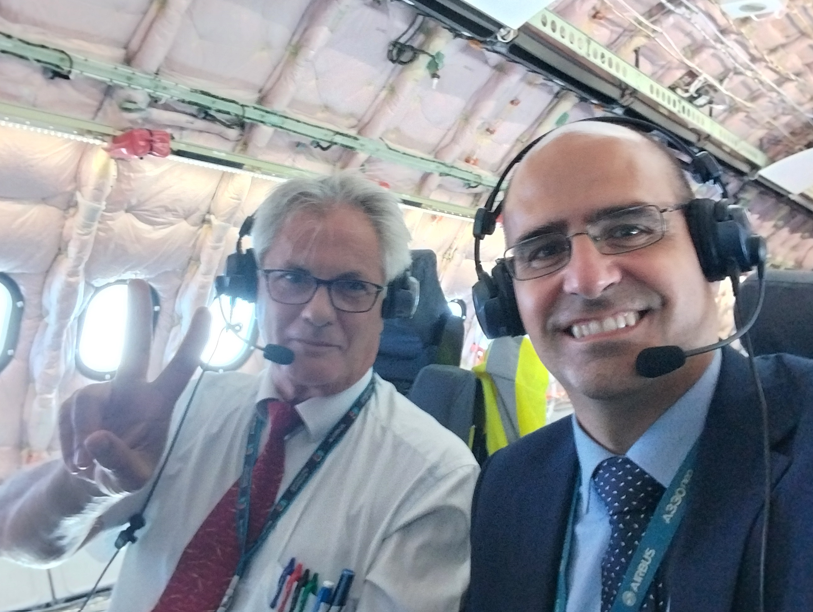
This year, on July 3rd I flew for the first time onboard an A330neo, with our flight test aircraft MSN 1795.
My first flight onboard the A330neo with Jose
In September came another highlight of the year with the organization of the Airbus Family Day, when we spent a whole day touring Airbus facilities in Toulouse with the kids.
2024 Family Day at Airbus in Toulouse
Not everything was positive in 2024: the father in law of one of my best friends passed away as did the father of my boss. The Russian invasion of Ukraine continues to create havoc in many families, in autumn we received a short visit from Lena and her family. Hopefully in 2025 that war comes to an end.
On the positive side, some family and friends had new babies and got married in this 2024!
Now it’s time to rest, celebrate with the family and hope for the best in 2025. For the moment we have just a few days in Madrid to enjoy with family and friends and a planned skiing week in Vars; hopefully that will be just the beginning of another memorable year.
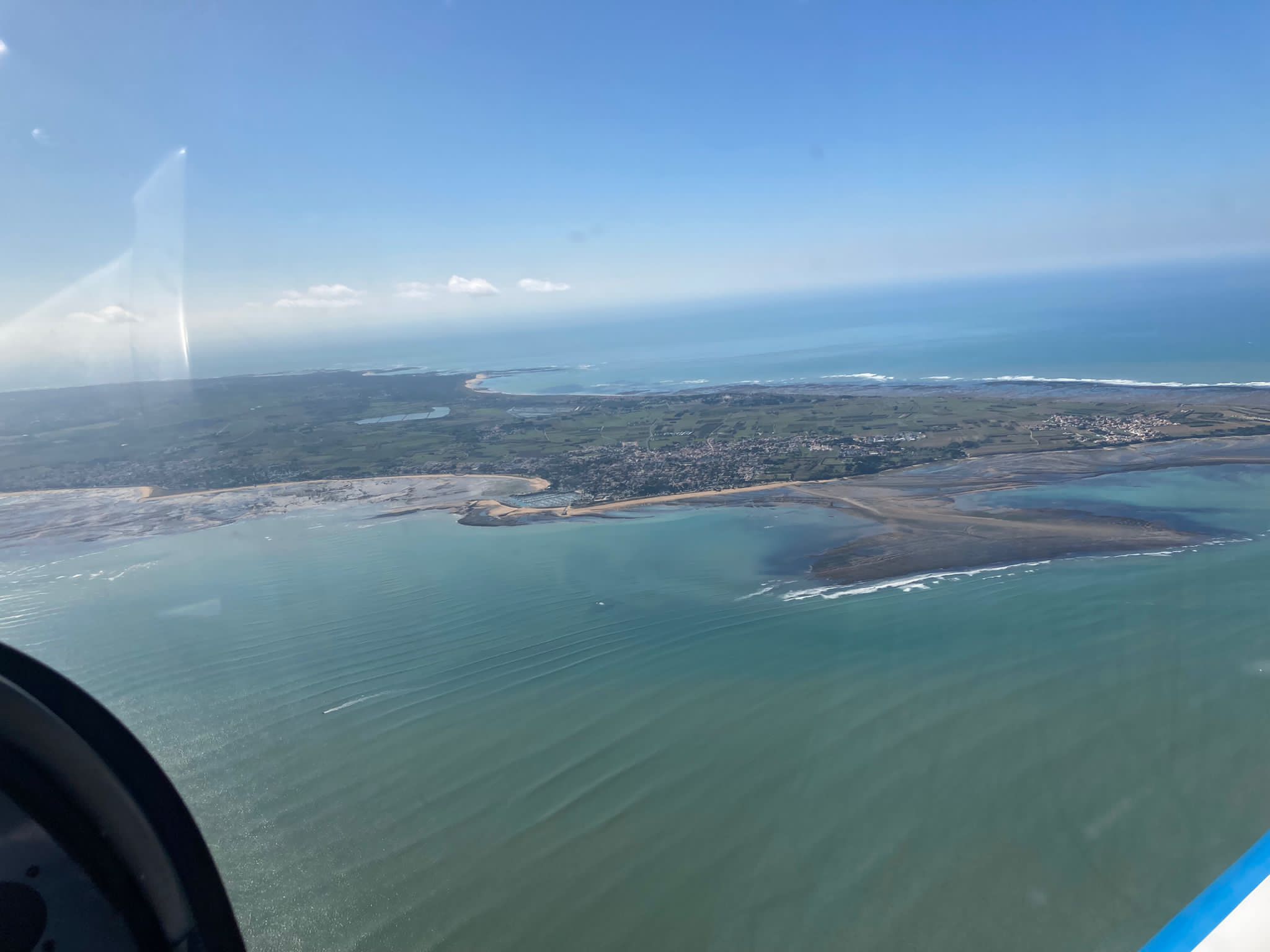
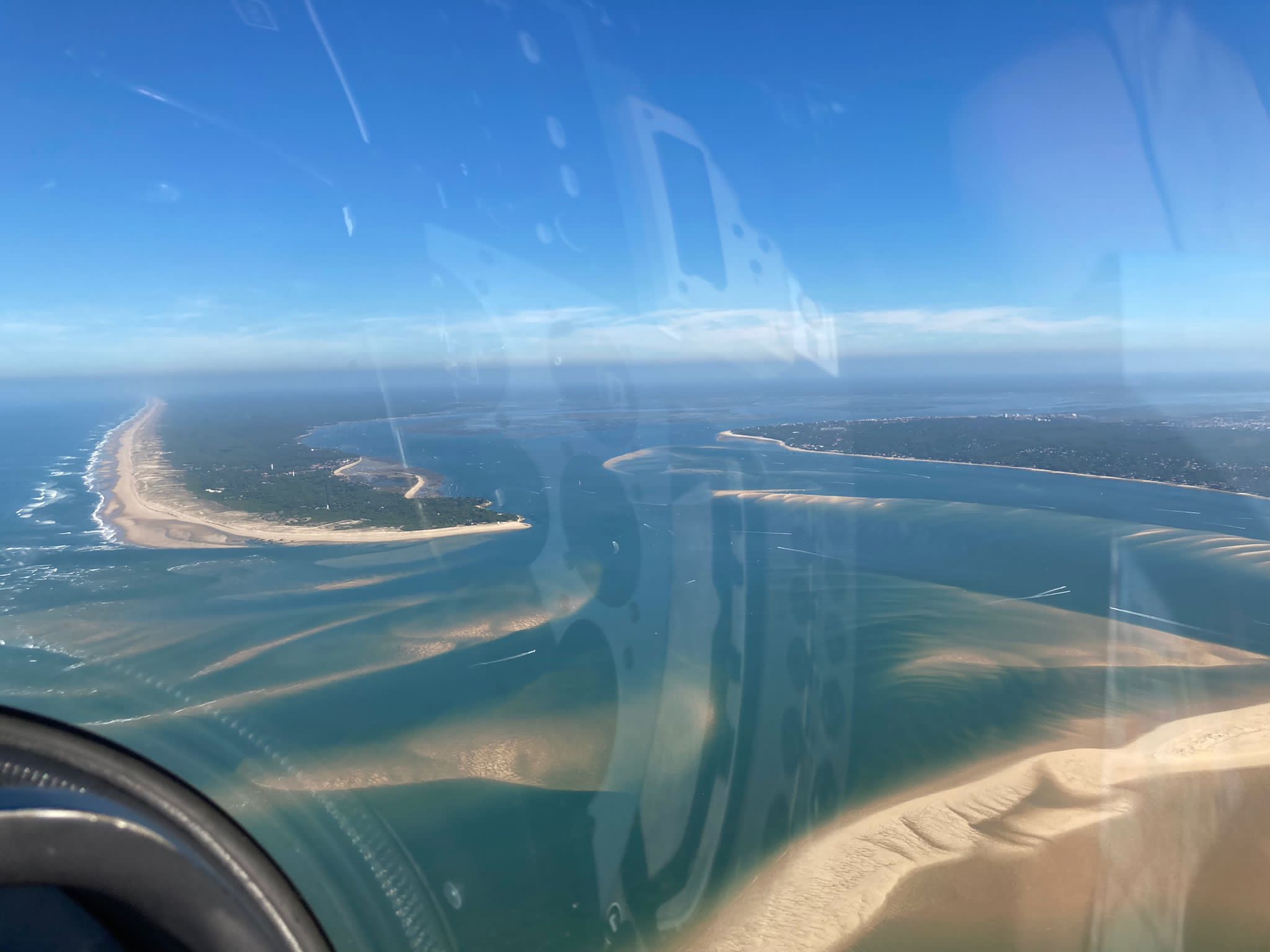
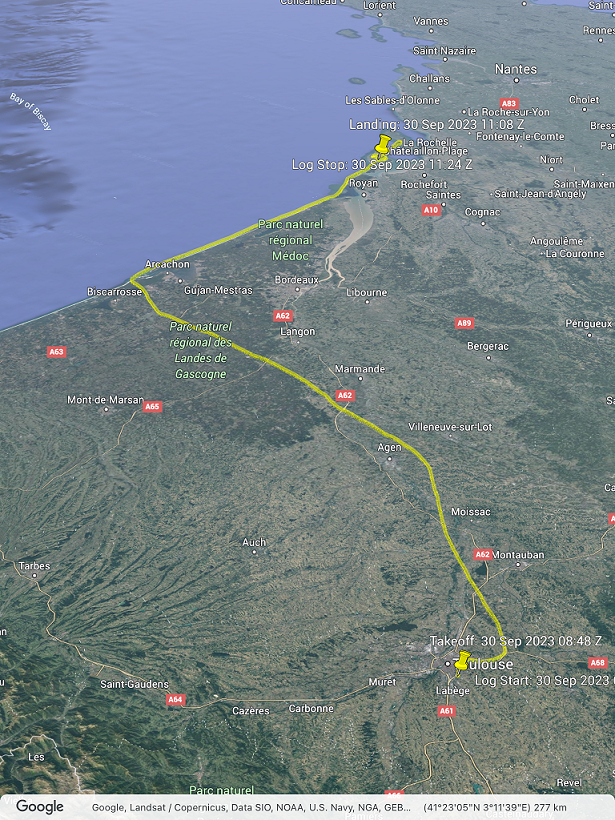
Last weekend, with Luca and our children, we took one of the aeroclub’s DR-400 to make a flight excursion from Toulouse (France) to l’île d’Oléron, a small island close to La Rochelle.
North side of l’île d’Oléron
I had often heard about this destination from different members of our Aviation Society, so we wanted to give it a try as an easy plan for the weekend. We departed on Saturday morning from Toulouse Lasbordes (LFCL), flew to Saint Pierre d’Oléron (LFDP) in about 2h30′ and stayed overnight in the island, to come back the following morning.
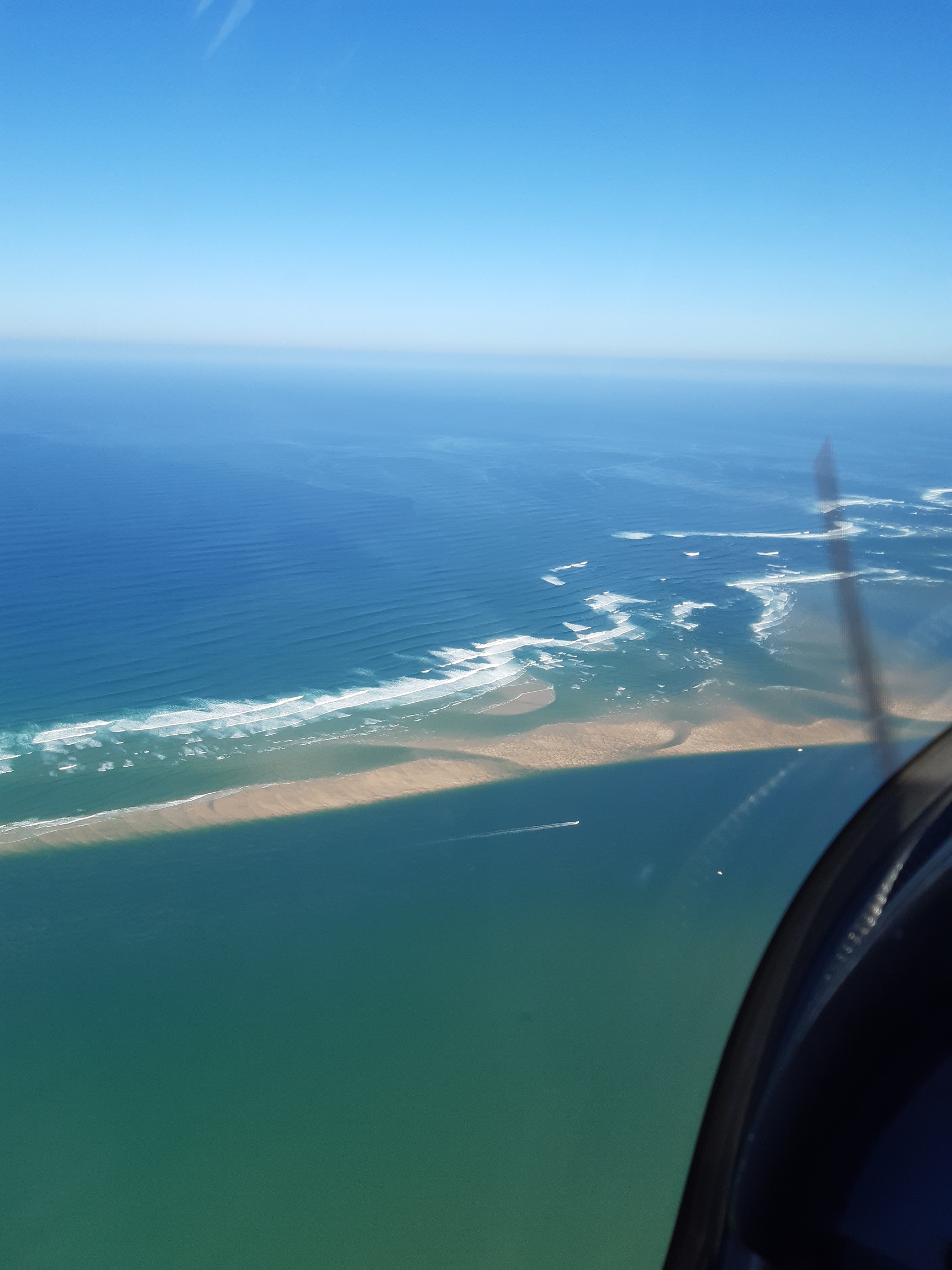
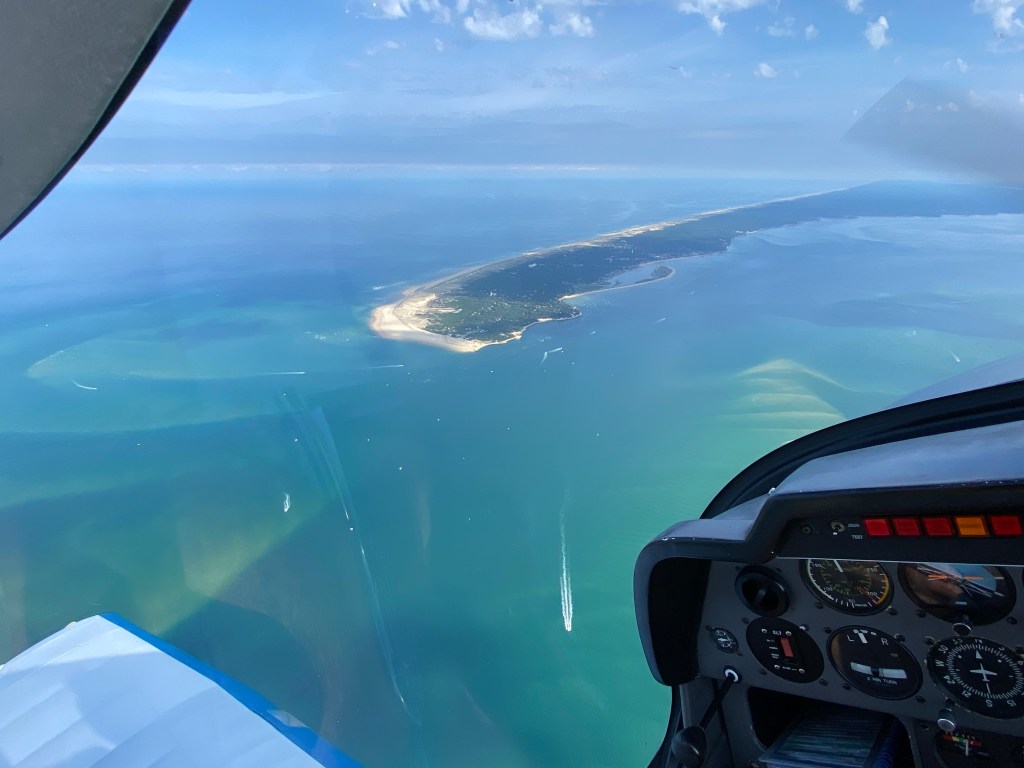
In both flights we flew by the Dune of Pilat and Cap Ferret in order to enjoy the views of the coastline from that point all the way to l’île de Ré.
Cap Ferret
For the preparation of the flights and the navigation we relied on SkyDemon (I took again just 1 month subscription for 15€) from an iPad Mini (using an external GPS connected to the iPad). SkyDemon provides the GPS logs that afterwards can be viewed in Google Earth.
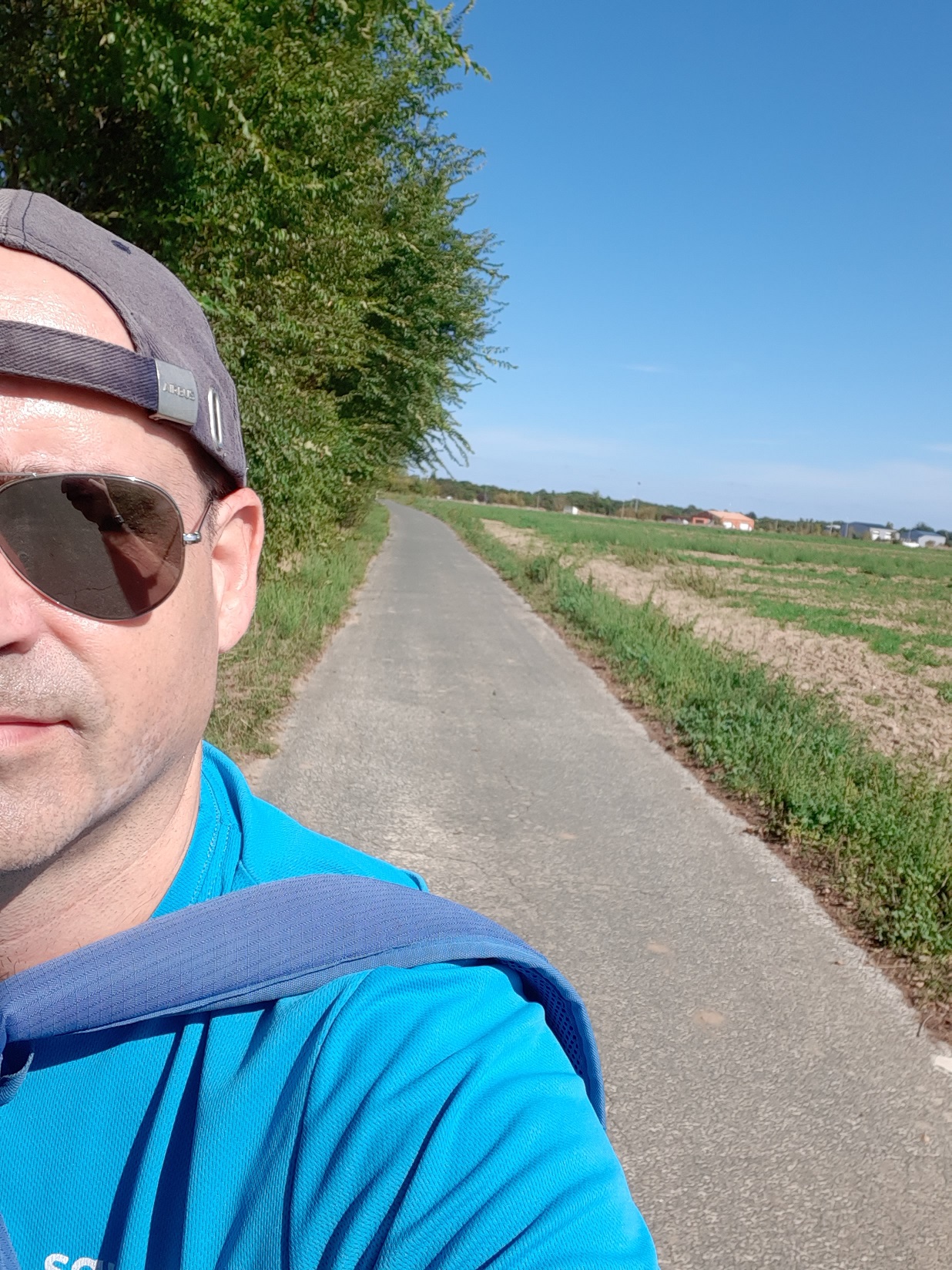
We did not reserve anything in advance, therefore upon arrival at the aerodrome we booked a couple of bikes at the aeroclub (20€ per bike per day; now I would suggest to book them in advance, as there were only 2 bikes left when we arrived) and a night at the hotell’Hermitage (very good breakfast, silent, nice warm swimming pool at the end of September and accepting payments with cheques vacances), close to the beach Sables Vignier Plage. We had packed light, just 3 light back packs, thus, we rode the bikes with the kids to the hotel and biked as well to and from the beach.
Biking to the hotel
Sables Vignier Plage
As an alternative airport I had selected La Rochelle, from which we could have taken a taxi to l’île de Ré. A third option would have been l’Île-d’Yeu which also has an aerodrome, but after a previous quick search in Booking.com I found that more hotel options with availability would be found at l’île d’Oléron. But I suggest to keep all options open, as if no hotels are found there, the other airports are at a short hop distance.
Saint Pierre d’Oléron (LFDP)
The kids preparing the airplane for the return flight
Time to look back and reflect on how the year which is about to end developed. Brief recap of my 2022. (*)
The personal memory from this 2022 was having my father back at home after nearly two months in hospitals, including a couple of days at the emergency room. He suffered a heat stroke at the end of June and only came back from it mid August. Those were testing times for him but also for the family, especially for my mother and brother who lifted the lion’s share of the caring for him during those months.
Family. Andrea is now 9 years old and David, 6. Andrea has been learning piano for most of the year, she enjoyed very much climbing, reading, singing in the school choir, drawing anddoing handcraft. She also started taking Spanish lessons once a week since the fall, on top of the Dutch lessons they both take every second week.
David is now nearly fluent in English and they both talk to each other in that language. He is improving with his reading and writing and very eager with maths. He started to play video games, is very fond of football and wants to help with anything, especially if it involves the use of tools (that probably comes from his maternal grand father).
Sports
Back to marathoning! After not having taken part in any marathon in 2020 and 2021 (breaking a 9-year streak), in 2022 I completed 2 marathons: Sevilla and Bucharest. Those were great and emotional experiences. With them I have now completed 23 marathons.
This year, together with some work colleagues we participated in a month-long sports (running and biking) challenge fighting against hunger in the spring and in the fall we ran the 15km-long Airbus charity run.
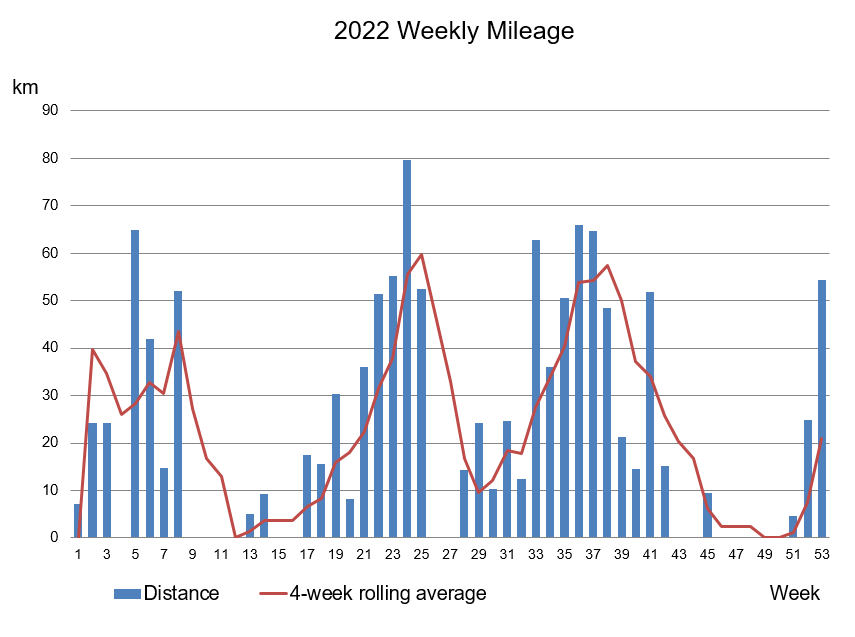
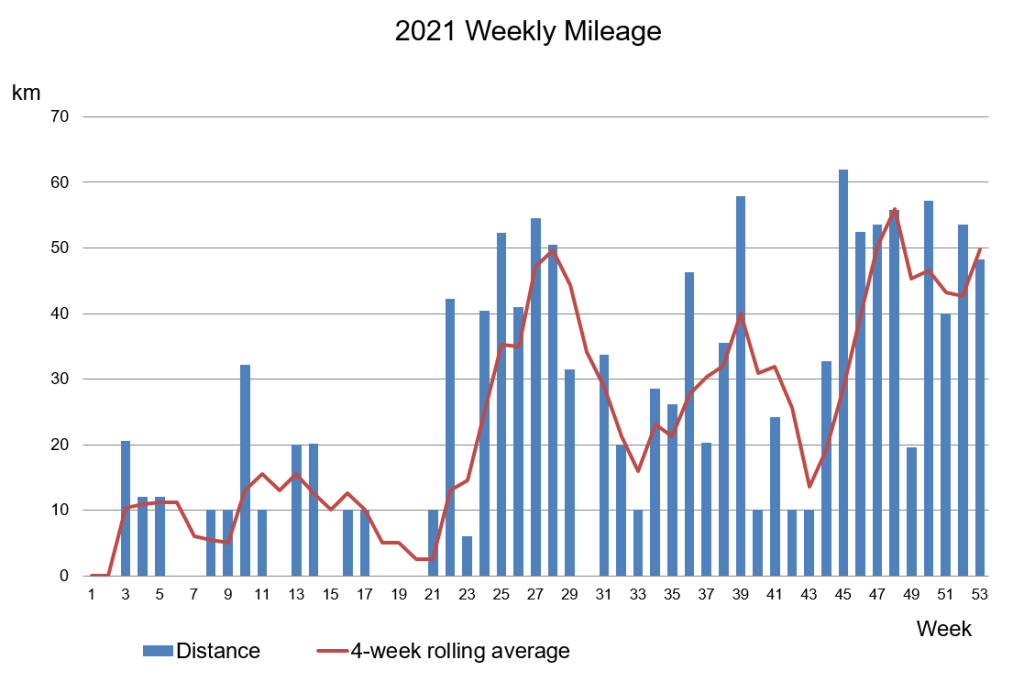
I ran 1,200km in 2022, around 100km less than in 2021. You can see below that I alternated periods of heavy training with some weeks of not running, due to illness, injuries, travelling or resting after the races.
Following a mantra I try keep to letter, “the running shoes, always in the suitcase”, the year 2022 caught me running in: Galapagar, Singapore, Seville, La Châtre-Langlin, Fontainebleau, Wijchen, Pontoise-lès-Noyon, Isla, Derby, Hamburg, London, Torrelodones, Almuñécar, Hyères and Bucharest, plus the tens of times I trained in my village, Blagnac and Toulouse.
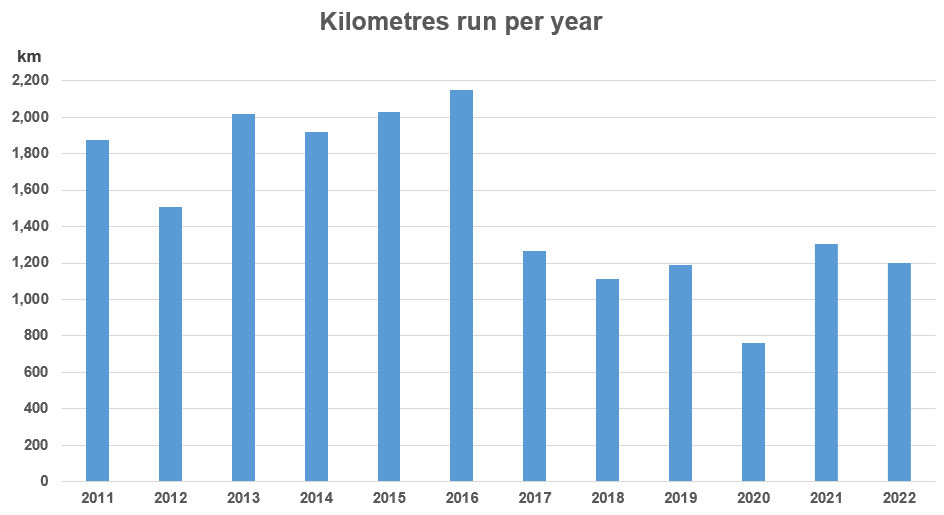
With those 1,200 kilometres run in 2022, this is the sixth year in a row that I struggle to add more mileage, as I used to do between 2011-2016… One would say whether it is due to the arrival of the second child (spring 2016), the moving of houses (summer 2017) or just getting older (!), but something has made it more difficult. Hopefully in 2023 I can break that trend.
Other sports:
Skiing. After the cancellation of our plan in 2021, in 2022 we could go back with the family for a week to our favourite resort at Vars, in the Southern Alps. If in 2020 it was the first time I descended some tracks with Andrea, in this 2022 it was the first time that the four of us descended some tracks altogether. That was a great experience. This year Andrea got her Flocon medal and David his Ourson one (levels from the French ESF).
Swimming. On top of enjoying the pool at home, this year we went to the beach at three different locations: Isla (North of Spain), Almuñécar (South of Spain) and the Presque-ile des Giens (France). The kids loved it. During the holidays, they also took some swimming lessons to improve their style.
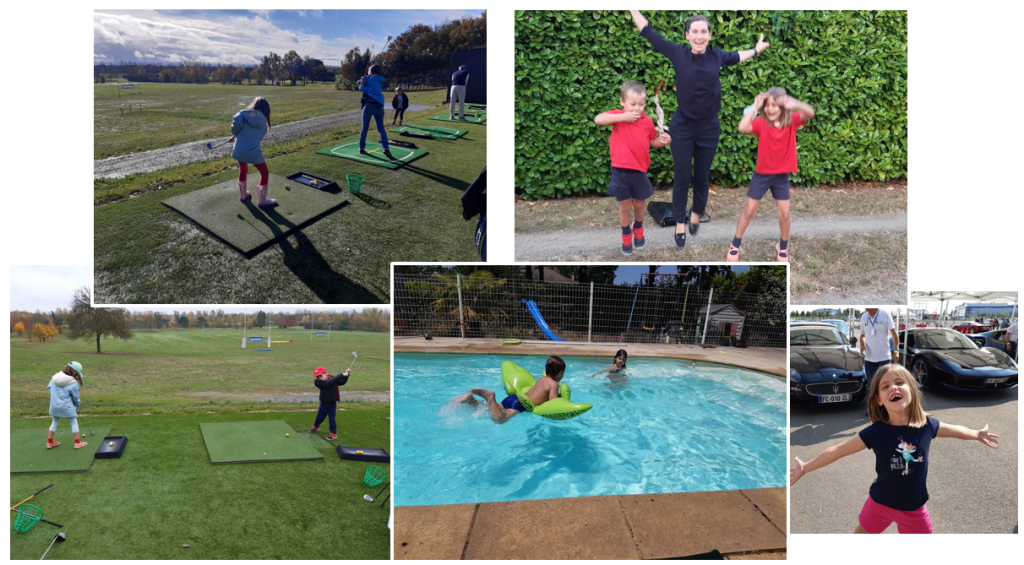
Golf. The whole family started taking golf lessons last year and for half of the year 2022 we continued doing so, though after the summer the kids wanted to quit.
Climbing. Both Andrea and David are very fond of climbing, so now, at almost every school holidays break they follow some climbing stage.
Real Madrid. Even if David and I did not have to play for it, we did enjoy watching a few football matches together supporting our favourite team all the way to winning the 14th Champions’ League, another memorable hapenning of this 2022.
Flying. Unfortunately, this year I haven’t flown much, just 7 flights and 13 landings (the least in 12 years of flying). This takes the total to just above 192 flying hours and 300 landings since I started taking lessons back in 2011.
Together with our Aviation Society we were planning some excursions for the summer time but for different reasons a couple of them were cancelled and I could not join another. Therefore all the flying this year has been around our South West region.
On the positive side:
I renewed the FCL055 qualification that allows me to speak in English to the ATC when flying abroad, this will permit me to attempt long excursions next year again.
This year I flew for the first time with a few colleagues: Iain, Scott, Emilio and Marcellin. I am sure that in 2023 I will have the chance to fly with more colleagues.
Travelling. After many restrictions during the pandemic, especially in 2020, in 2021 we started to travel more and in 2022 we had the chance to visit some new and old places: Singapore (first time for me), Spain (Seville, Santoña, Isla, Madrid (a few times), El Escorial, Bailén, Almuñécar, Las Navas de Tolosa, Tordesillas, San Sebastian), France (Gap, Vars, Avignon, Sully-sur-Loire, Fontainebleau, Péronne, Château de Blérancourt, Meung-sur-Loire, Nimes, Presque-ile des Giens (there we had great week at the beach in the French Riviera)), Germany (Xanten, Hamburg (first time for me, and where we were very warmly hosted by Burkhard!), Munich), the Netherlands (Wijchen), England (Derby, London (it was quite some time since the last time I was in London), Farnborough), Romania (Bucharest) and Pakistan.
In some of those trips we had the opportunity to meet some friends from the university and the high school that we had not seen in a few years. That opportunity to continue reconnecting felt good.
Work. The year 2022 marketing our Airbus widebody aircraft has meant lots of fun and a great learning experience. The everyday work is already quite interesting and exchanging with the team I learnt new things everyday.
This year, with the picking up of the aviation activity and the opening up of many countries, I had the opportunity to meet many of our colleagues working abroad, to give several presentations to customers about our products (remote or onsite), to welcome a few of them and show our A350 final assembly line, host in Toulouse and visit our colleagues from Rolls-Royce in Derby, fly with the press on one of our A350 flight test aircraft during the Airbus Summit, and especially take part in the air shows of Singapore and Farnborough, where I could showcase different A350s, from Singapore Airlines and ITA Airways, respectively. Those air shows have been real highlights of the year, at times showing the aircraft non-stop for hours to many different and varied groups of customers or institutional representatives.
These activities gave me the opportunity to fly for the first time on an A350 (!).
At the beginning of the year, one of our colleagues, Alex, switched departments and we reshuffled the activities within the team and that made it much more interesting, including the working hand in hand in particular with Raphael and Cedric.
At the end of the year, another of our colleagues, Florian, announced his departure and this offered another opportunity to grow. Following a recruitment process, in which a few colleagues participated, I was selected and from January 2023 I will change again the scope of the activity focusing now on the A330neo (back to it after having spent 4 years (2015-2019) working in its development!), working hand in hand with Anna and Raphael.
Reading. I started 2022 reading at a good pace until summer, then I got stuck with the second volume of Le Vicomte de Bragelonne and a series of trips interrupted my pace, and it took me months to recover it. In the end I completed just 13 books, the least since 2015 and read just above 4,800 pages, also the least in the last 6 years. For the detailed list of books, see the post I wrote about my 2022 reading list with a brief description of each book.
Other cultural activities:
Bullfighting. This year again together with Luismi, his family and my family we went to Nimes for a weekend to enjoy its Feria, and in particular to attend the corrida de toros with Roca Rey, currently the most successful bullfighter. The experience and his performance were simply splendid. Roca Rey performed together with José María Manzanares and Alejandro Marcos, and with bulls provided by García Jiménez. He was awarded three ears, hence, he was borne triumphantly aloft through the main gate, “Puerta de los Cónsules” at Nimes Roman amphitheater. The atmosphere in the city those days was ecstatic.
Museums. This year again we took benefit of every road trip to visit as many museums and castles as we could, among them: the Naval and Aviation museums in Madrid, the museum of the battle at Las Navas de Tolosa, the Great War musem at Péronne (finally! I had tried to visit it before but is always closed during Christmas), Château de Meung-sur-Loire, Château de Blérancourt (which includes the Franco-American museum), Château de Sully-sur-Loire, the visit of the roofs at Seville Cathedral and the Roman settlement at Colonia Ulpia Traiana (Germany).
Shows. In the past two years with the pandemic we had not gone to any show; in this 2022 I loved going to the cinema again, with some work colleagues to watch Top Gun Maverick (superb!) and the musical Malinche, about the conquest of Tenochtitlan, produced by the artist Nacho Cano, which was another great experience.
Blogging: This is the 13th year since I started the blog, but I didn’t manage to write much, only 5 blog posts in 2022. The blog received just above 21,200 visits in 2022 (the least since 2012) and over 473,000 since I started it in 2010.
Not everything was positive in 2022: a former work colleague passed away, so did the parents of other friends and colleagues, plus the Russian invasion of Ukraine which created havoc in many families, including the many refugees host in the region. Hopefully in 2023 that war comes to an end.
On the positive side, some colleagues and friends had new babies and got married in this 2022!
Now it’s time to rest, celebrate with the family and hope for the best in 2023. This year we will participate again in the San Silvestre Vallecana in Madrid running along tens of thousands of other runners in the evening of this December 31st as a farewell to the year. For the moment we have just a couple of planned trips for 2023, to the Netherlands and another skiing week in Vars, but hopefully many more activities will make it memorable as well.
Time to look back and reflect on how the year which is about to end developed. Brief recap of my 2021. (*)
If I had to pick a couple of personal and positive memories from this 2021 they would be:
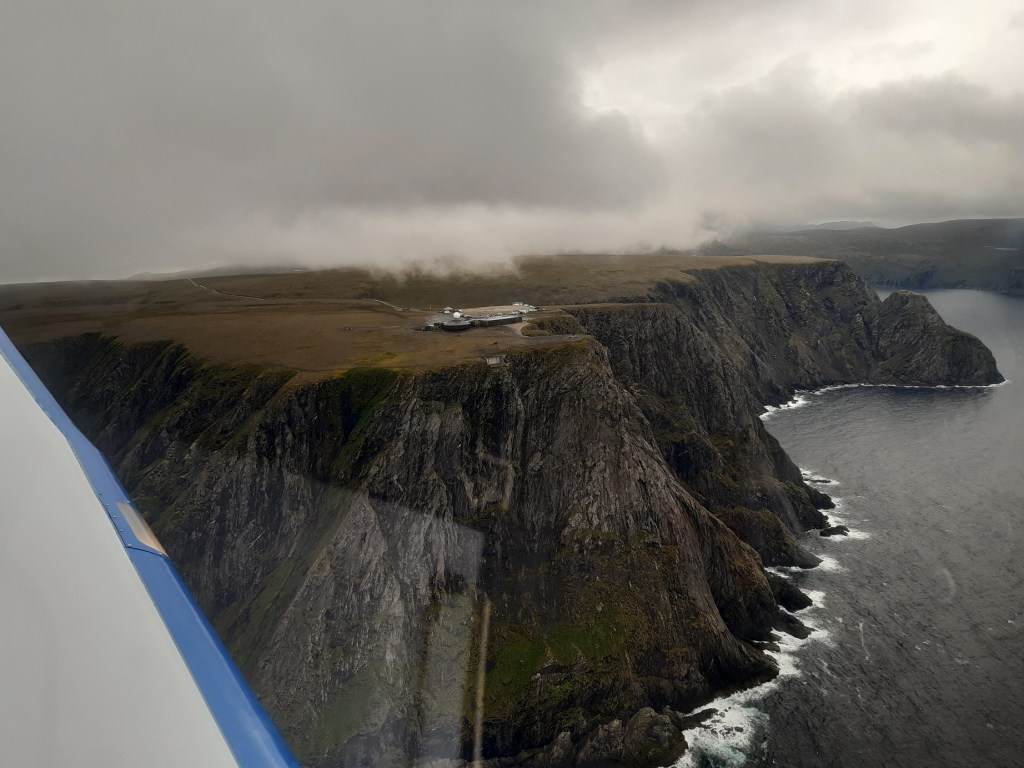
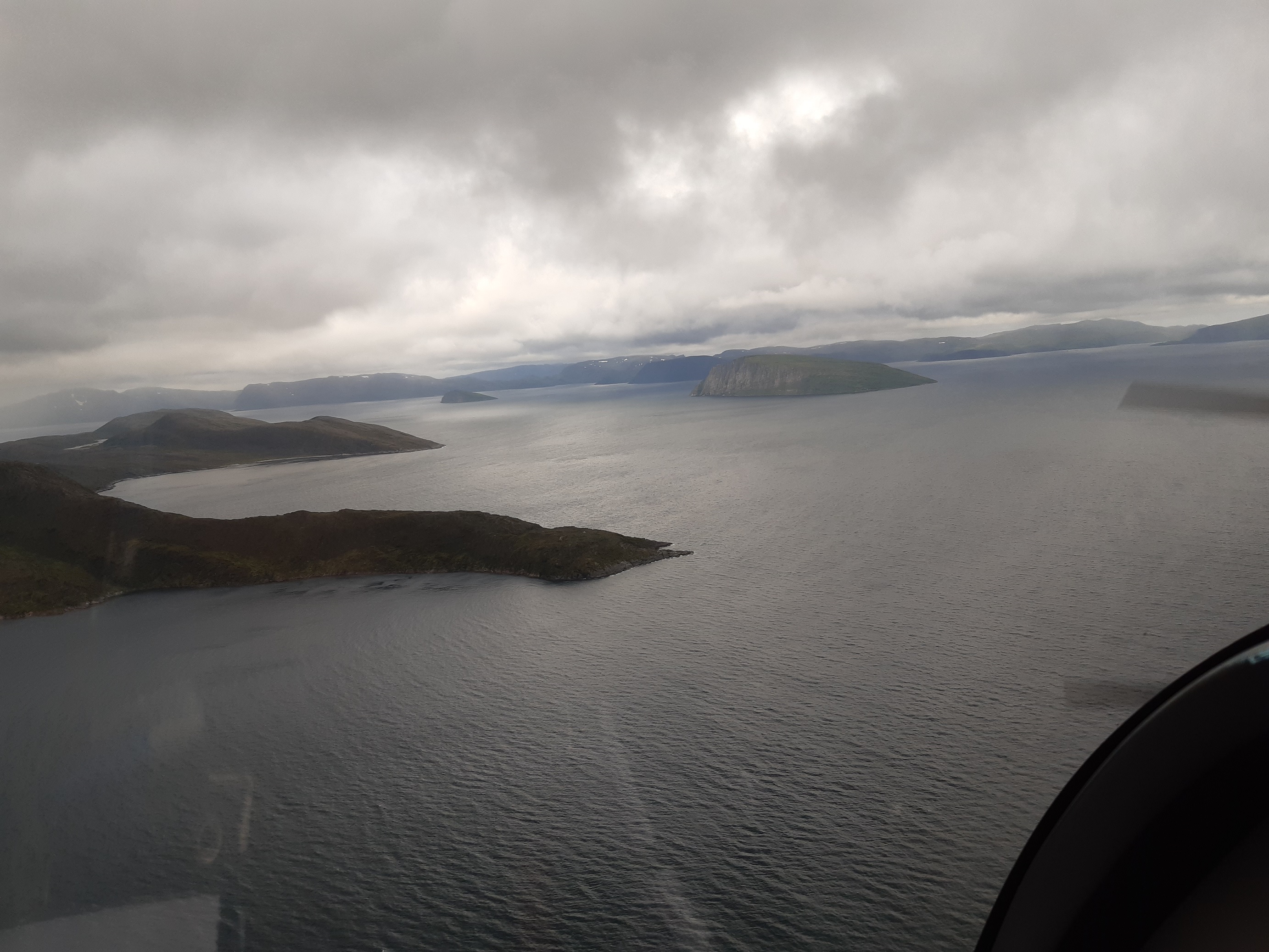
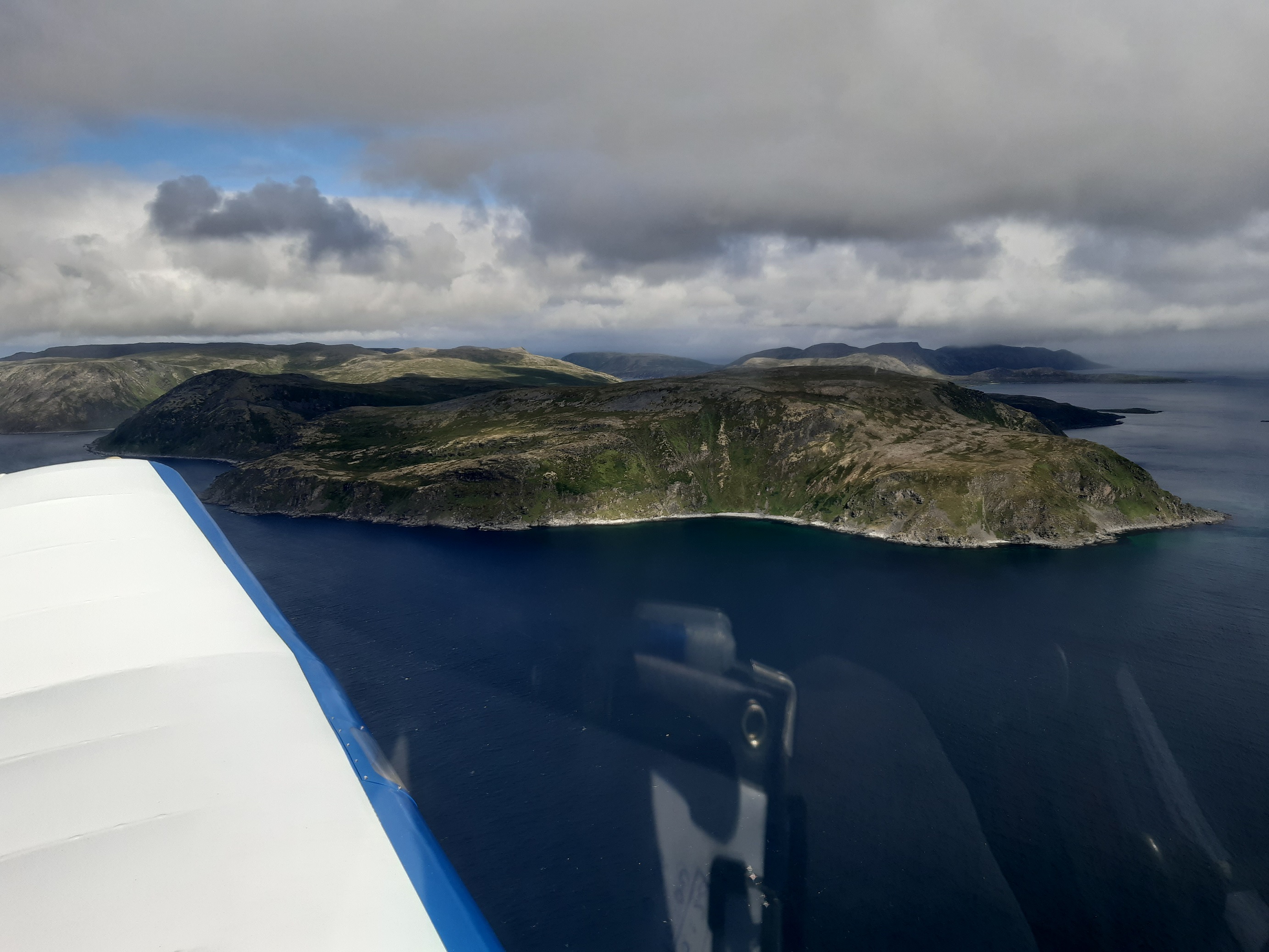
Flight excursion to Norway, when three general aviation planes went together from Toulouse to the North Cape in Norway. That was a great experience in which in we flew for over 46 hours in 7 flying days, with a maximum over 9 hours the last day. We completed 15 flights.
North Cape (Norway) from our plane
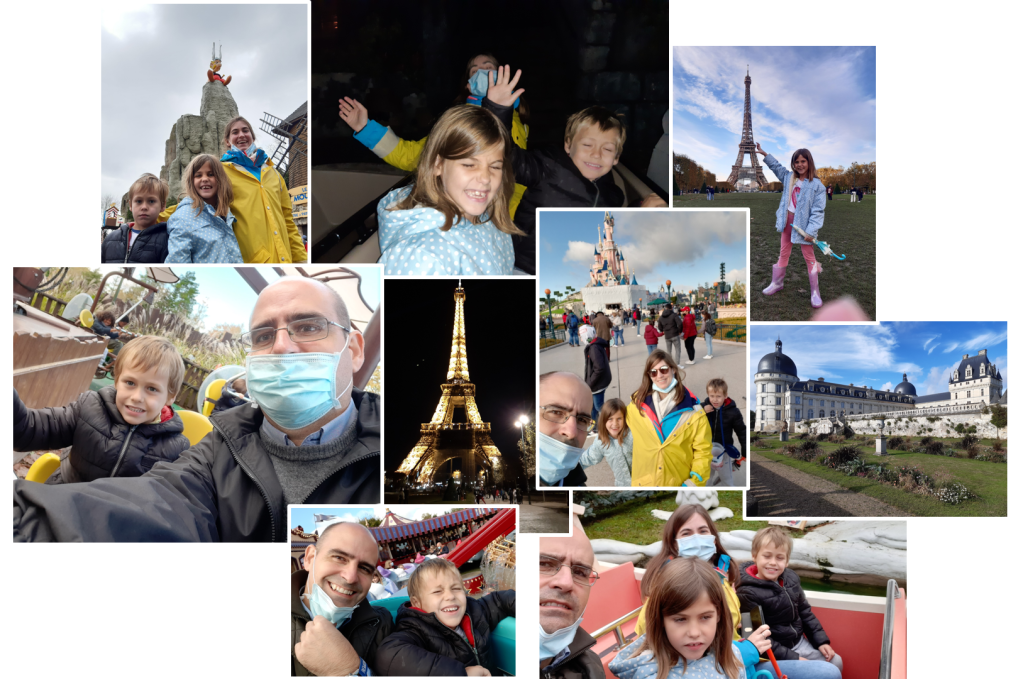
Family trip to Paris during the autumn school break, when we took the opportunity to visit with the kids the Eiffel tower, Disneyland park for a second time and the Parc Asterix for the first time. We had plenty of fun with the kids in those days.
Family: Andrea is now 8 years old and David, 5. Andrea has been learning piano for most of the year, she enjoyed very much climbing, reading, singing in the school choir or doing handcraft. David learned this year to ride his bike, he’s becoming confident with English language, and started to write, read and do some math. This year we couldn’t go skiing together to the Alps (as stations were mostly closed in France), so we just went skiing one day in the Pyrenees. On the other hand, since September we started taking golf lessons altogether, though what the kids enjoyed the most was the swimming season during the summer, even if this year the weather wasn’t the best for that purpose.
Reconnecting: in our experience 2021 has been a more relaxed year than 2020 was, even if not back to normal. We did not travel far but we made some trips and excursions, we met everyone of our closer family (we visited them and received visits at our place), started to reconnect with some cousins and several friends that we hadn’t seen in two or more years. It felt great.
Flying: Thanks to the aforementioned excursion to Norway this year I flew 30 flying hours, more than in any of the past 10 years. I also took part in another flight excursion to Biscarrosse flying for the first time with my colleague Thomas. During the excursion to Norway I flew for the first time with Jérémie and later with Andrea, the flight instructor with whom I renewed the license for two more years.
Running: even if I did not complete any single race in 2021 (even if I was registered in two) the year has been positive in this front. Following over a year of either not finding the motivation or not keeping the habit to run, since the end of May, the chatting about the sporting activities we had done the previous day(s) with a couple of work colleagues (Alex and Patrick) helped to build up the frequency of runs.
From then on, I exchanged with my brother on the idea of getting back into shape to start marathoning again in a not too distant future. With that I found myself with serious mileage cumulated from June to September (a bit less in end July and August due to different trips and visits). We then registered for the Sevilla marathon (taking place in February 2022) and started the 16-week training plan in November… in the end I have run over 1,300km in 2021, with less than 230km till the end of May and 920km in the second half of the year.
Travelling: After so many months of restrictions, in October 2021 I flew commercial for the first time in two years! I felt like a kid in a first flight. A month later, I flew again. Hopefully traveling becomes soon the norm again.
This year we visited some new and old places: Biscarrosse, Mazamet, Montpellier, Grignan, Lyon, Besançon, Colmar, Strasbourg, the Ligne Maginot at Schoenenbourg, Verdun, Hoge Kempen national park in Belgium (where we spent a few days with the family to celebrate the 50th anniversary of my in-laws), Maastricht (so many years ago since the last time!, where we met Luca’s friends for a wedding), Doncourt-lès-Conflans, Tønder (Denmark), Trondheim, Bodø and Alta (Norway), San Sebastián, Madrid (first beer in a terrace there in 2 years!), Chateauroux, Valençay, Paris (Disneyland again! and Parc Asterix), Orleans, Milano (18 years later!)…
Reading: I started 2021 reading at a good pace until summer holidays, then a couple of trips interrupted my rhythm and it took me months to recover it in the last two months. In the end I completed 20 books and read above 6,500 pages (about half of last year). For the detailed list of books, see the post I wrote about my 2021 reading list with a brief description of each book.
Blogging: This year in February was the 11th anniversary of the blog, but I didn’t manage to write much; only 8 blog posts in 2021. The blog received just above 22,000 visits in 2020 (the least since 2012) and over 450,000 since I started it in 2010.
Work: This year the commercial activity of the company started to pick up, so it became more interesting with more customer facing activities, including visiting them by both Luca and me, in our different roles (she switched jobs). And we even launched a new product, the A350F freighter aircraft.
Now it’s time to rest, celebrate with the family and hope for the best in 2022. This year again there will be no running the San Silvestre Vallecana in Madrid with tens of thousands of other runners in the evening of this December 31st (even if we subscribed to it), but a lonely ~10km run in our village. We have a couple of planned trips for 2022: to Sevilla for the marathon and another skiing week in Vars (hopefully this year is not cancelled!), let’s cross fingers so that we can accomplish those two plans and the many more that should follow.
Other than that, my wishes for 2022 are simple and basic: that the critically of the pandemic fades away in a short time and that the general public and economy can get to their normal lives.
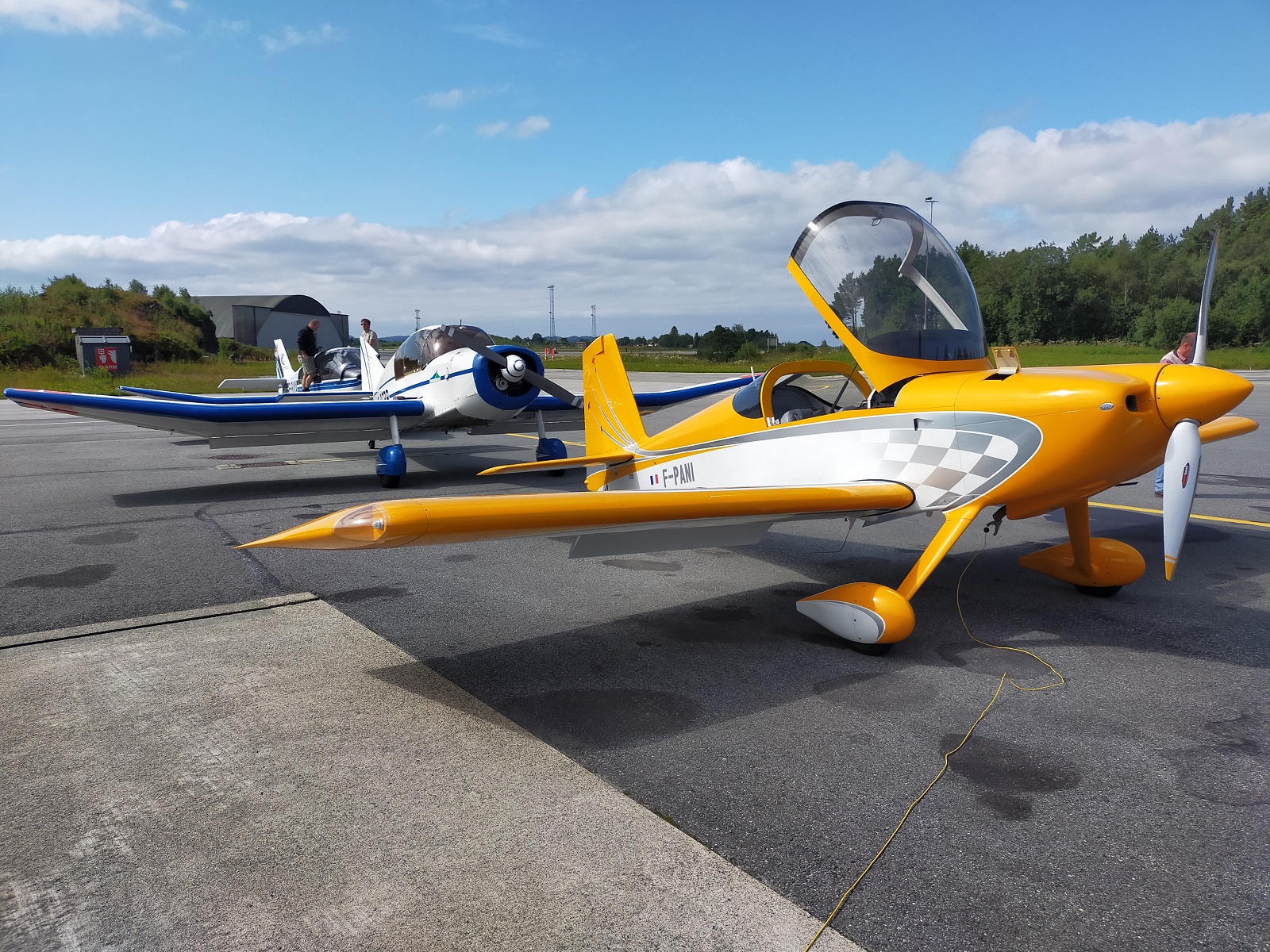
Two weeks ago, Jérémie and I took one of the aeroclub’s DR-400 airplanes (the 160hp F-GUYA) to make a flight excursion from Toulouse to the North Cape (Nordkapp, in Norway) as part of a “Fly out” organized by the Aviation Society of the Airbus Staff Council, together with 2 other aircraft, the F-BERB (with Norbert and Dominique, who organized the trip) and the F-PANI (with Anne and Nicolas).
At the beginning of the post I will focus on the different flights and share some pictures (taken either by me or Jérémie and Dominique, the ones with more quality) and at the bottom of the post I will leave some more technical details helpful for the preparation of such a trip.
We departed one day before the other airplanes to ensure that the engine hours of our airplane would not be consumed during a Saturday with good weather in Toulouse. However, North of Aurillac the weather was not so good so we waited until early in the afternoon to fly to Verdun. Even if not necessary we filed a flight plan and climbed to FL075 for most of the trip, to fly VFR on top of the clouds around the Massif Central and we just descended under the clouds some miles before the destination.
Once at Verdun we refueled the airplane, parked it for the night and booked a room at the Ibis budget hotel, which is however 5km from the aerodrome. A kind member of the local aeroclub gave us a lift to the hotel.
The morning after we did not have a transport to the aerodrome as apparently there were no taxis in the surroundings, so we had to walk to the airport; a hike that took us well over an hour with the bags and by some wheat fields.
We then made a short (~40′) flight to Doncourt, not without flying over some of the fields and memorial monuments of the WWI battle of Verdun. We then arrived to Doncourt, which has as A/A frenquency 123.500 and that was confusing as there are other aerodromes not too far using the same frequency, causing you to hear messages unrelated to the aerodrome you are about to land.
At Doncourt we refueled again and had a chat with a member of the local club. I went to pick some snacks from a local backery (less than 1km away) while we waited for the F-BERB. We then had a picnic at the aerodrome before departing for Tønder.
For the flight to Denmark we had to file a flight plan. We used a simple route based on the location of some VOR (DIK NOR BOT NDO). We were going to overfly Luxembourg and the whole of Germany. We climbed again to FL075 and were cleared (after the F-BERB) by the ATC (Langen radar) to fly through class C spaces around Cologne and Düsseldorf. Later, we listened in the radio that the F-BERB was descending to 3,000ft and below somewhere North of Bremen so we followed suit. From there and until nearly the border with Denmark the ceiling was at around 2,000ft, but since the ground is almost at sea level the flight was still comfortable. The West coastline of Schleswig-Holstein was wonderful.
Luxembourg, Essen, Duesseldorf
When we arrived at Tønder the F-PANI was already on ground and the F-BERB landed shortly after. Our flight plan had not been properly communicated and we were not expected, nor could refuel as we did not have local currency (DKK). We booked rooms in hotels in the village which was at walking distance. We then gathered at the Cafe Arthur and enjoyed our first dinner together as members of the fly out. There Dominique offered us a bottle of Saumur red wine that he had brought to celebrate that first night.
We woke up early as we wanted to be ready at the aerodrome at 7am to refuel the airplanes and had a 25-minute walk before to get to the aerodrome. The person in charge of the fuel station arrived a bit later but we were ready for departure at around 8am. We had filed another flight plan to fly to Bergen in Norway.
Flying over Denmark, despite its flatness, was nice, with the coast to the West, small crop fields and villages, including the coastal city of Esbjerg where my brother spent 2 weeks of the summer of 2002. We flew by the coast up until the village of Hanstholm (close to Thisted aerodrome) and then took a North West heading towards Norway with a transit of just above 30 minutes over the North Sea.
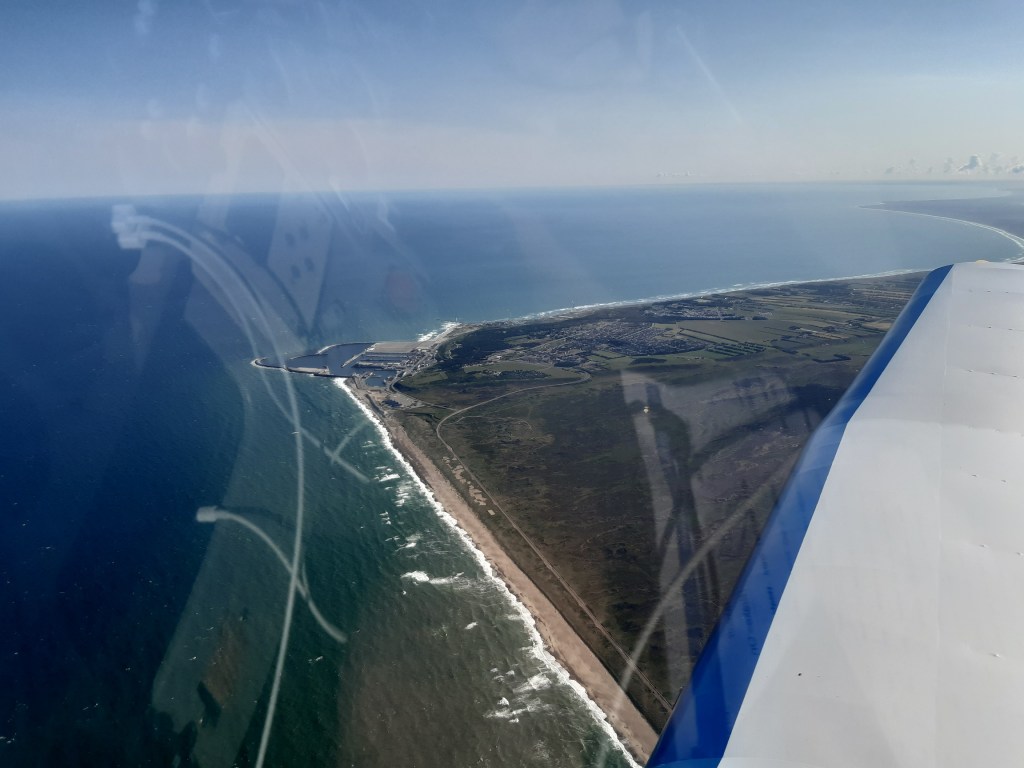
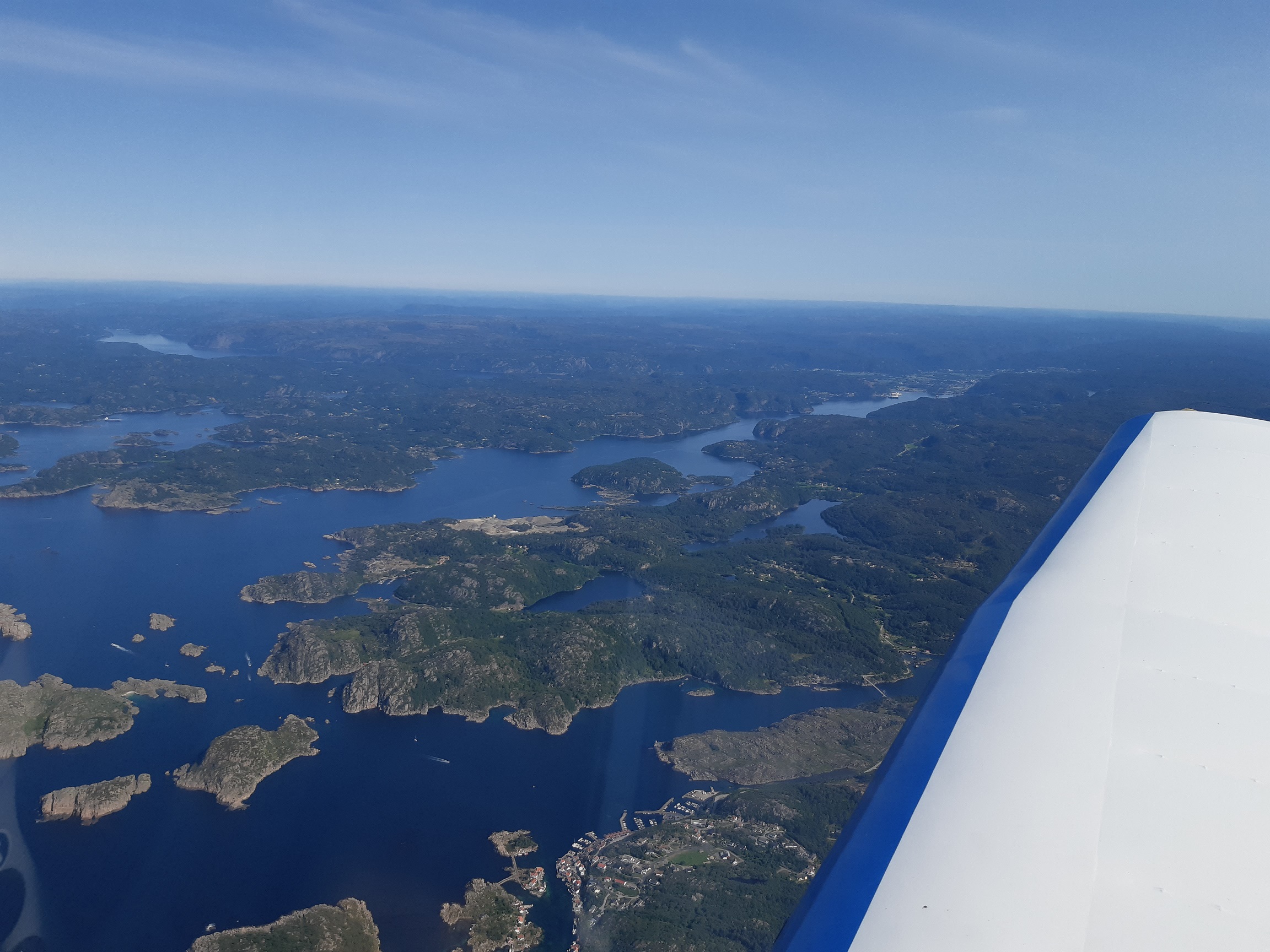
Once in Norway we continued flying along the Southern coast, overflying the airports of Farsund Lista, Stavanger Sola and Karmøy until we reached Bergen. During that flight of over 4 hours we enjoyed the good weather and the views.
At the tarmac in Bergen we spent some time between refueling and then waiting for the police to check our EU Covid-19 passport so that we were cleared to enter the country. We then purchased online the week pass covering the landing fees in all Norwegian airports, filed another flight plan and off we went for our next destination: Trondheim.
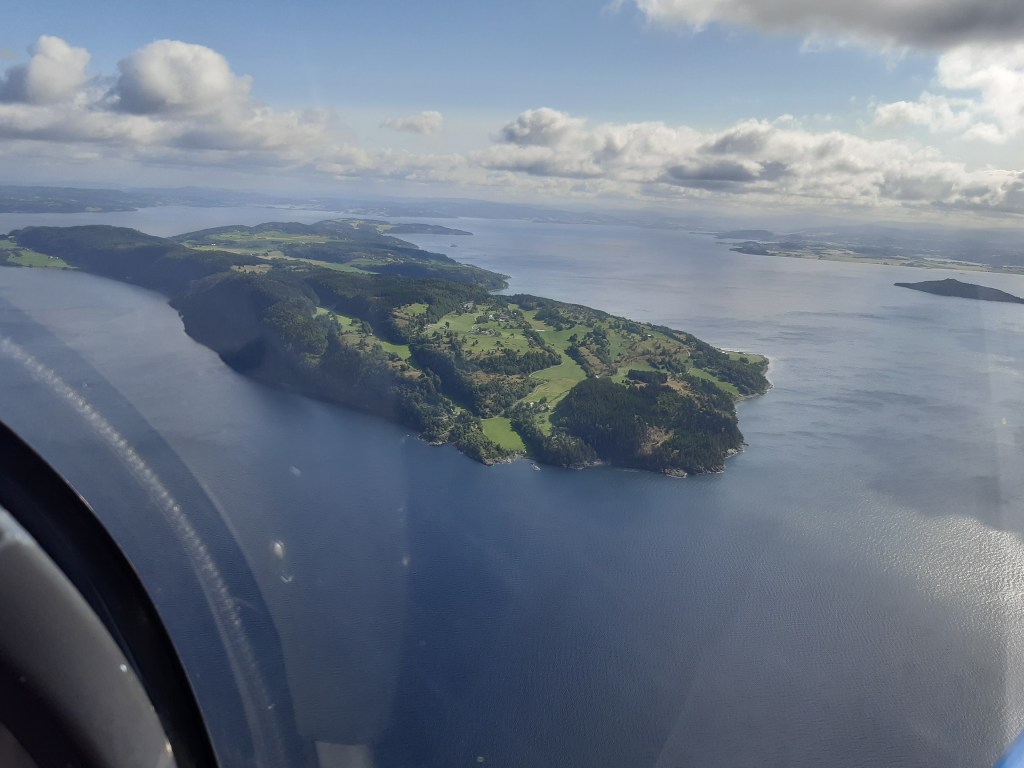
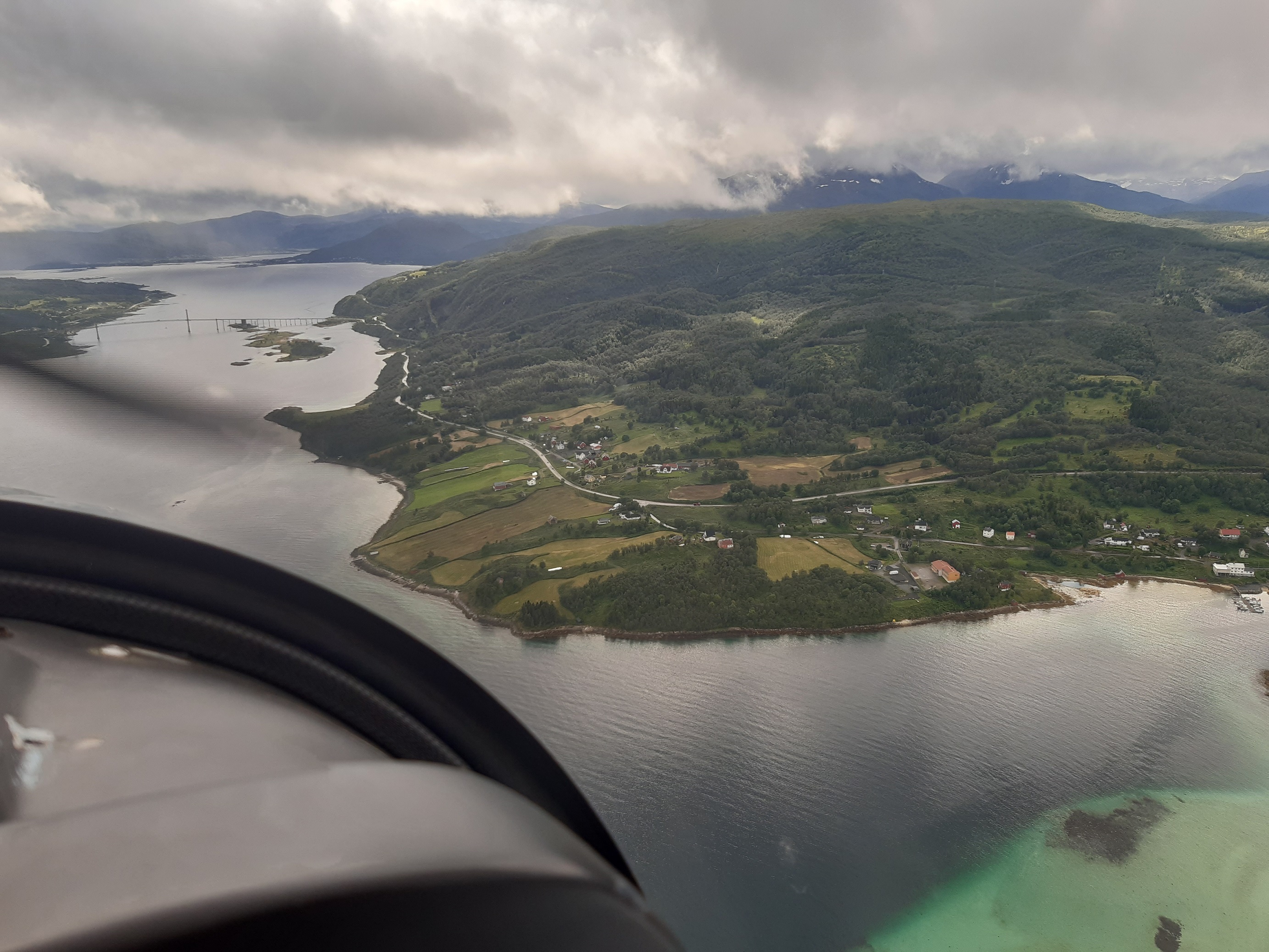
In that second flight, the sky was covered with clouds but the ceiling was not very low so it allowed for a relatively comfortable flight enjoying the views of the different islands. Once arrived at Trondheim we refueled, parked the plane, were taken in a small bus to the general aviation exit of the airport and walked to our hotel (Radisson Blu at the airport). We had dinner at the hotel restaurant and studied the weather which started to degrade.
Day 4 (July 20th) – Trondheim Værnes (ENVA) – Brønnøy (ENBN) – Bodø (ENBO) – Alta (ENAT)
In the first flight of the day we tried to reach Brønnøy overflying some fjords in the interior and flying over Namsos but before reaching that point there was no visibility and the F-PANI and us had to take a U-turn back to the fjord of Trondheim and get to the coastline overflying Orland airport. In flight we learnt that a NOTAM had been published informing that there was no Avgas that day at Brønnøy. Despite of that we landed there, which wasn’t easy as just when arriving there were some showers, so we had to hold first at the South and then changed our plan and approached the airport from the North West. At the airport we studied again the weather to the next airport where we could refuel, Bodø, a flight of just over an hour.
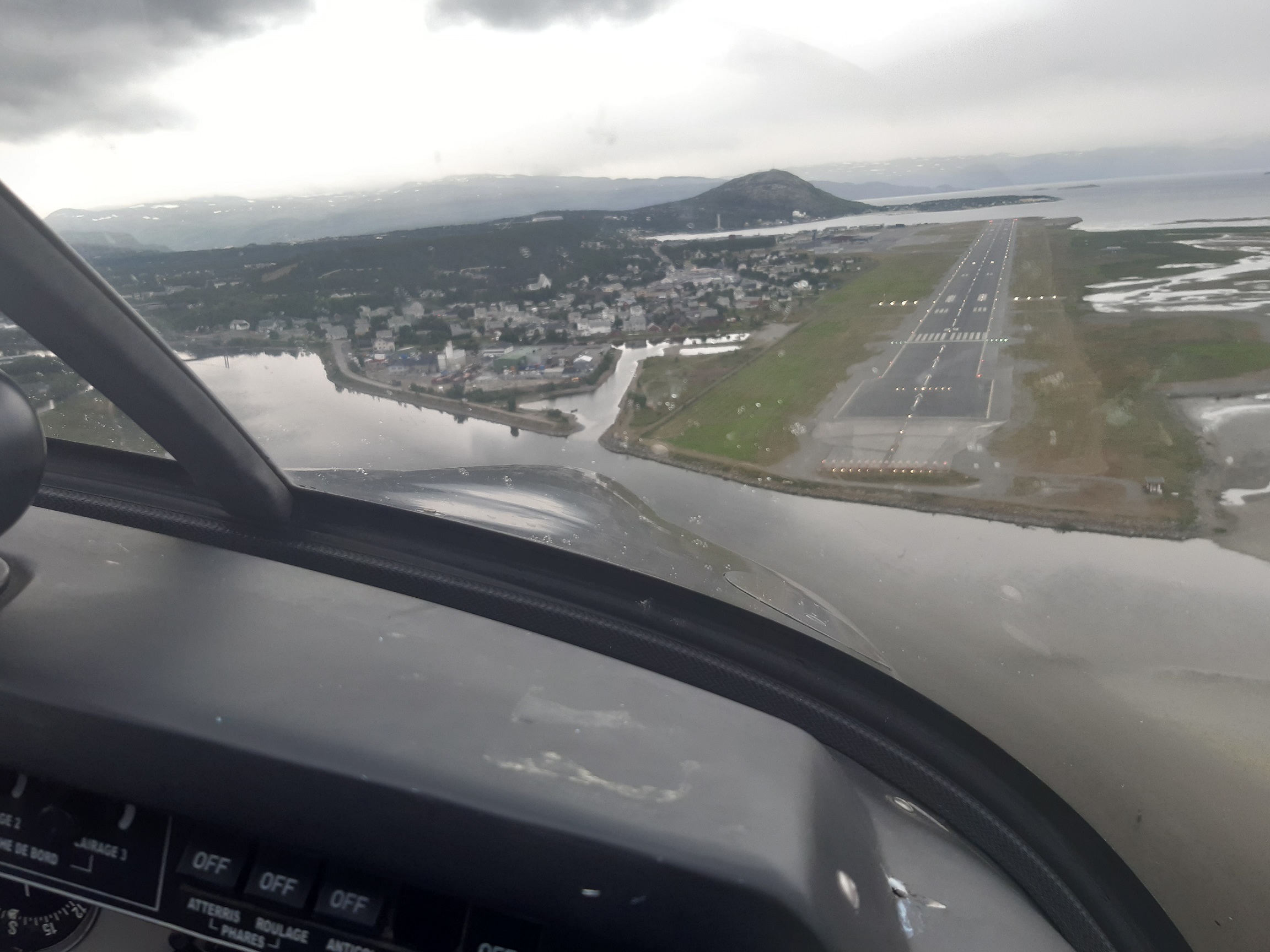
During the flight to Bodø we had a lower ceiling (at around 1,200ft, flying at below 1,000ft) and showers here and there. Though just at the airport the weather was clear. We landed, refueled, quickly ate some bananas and got ready for the next flight to Alta.
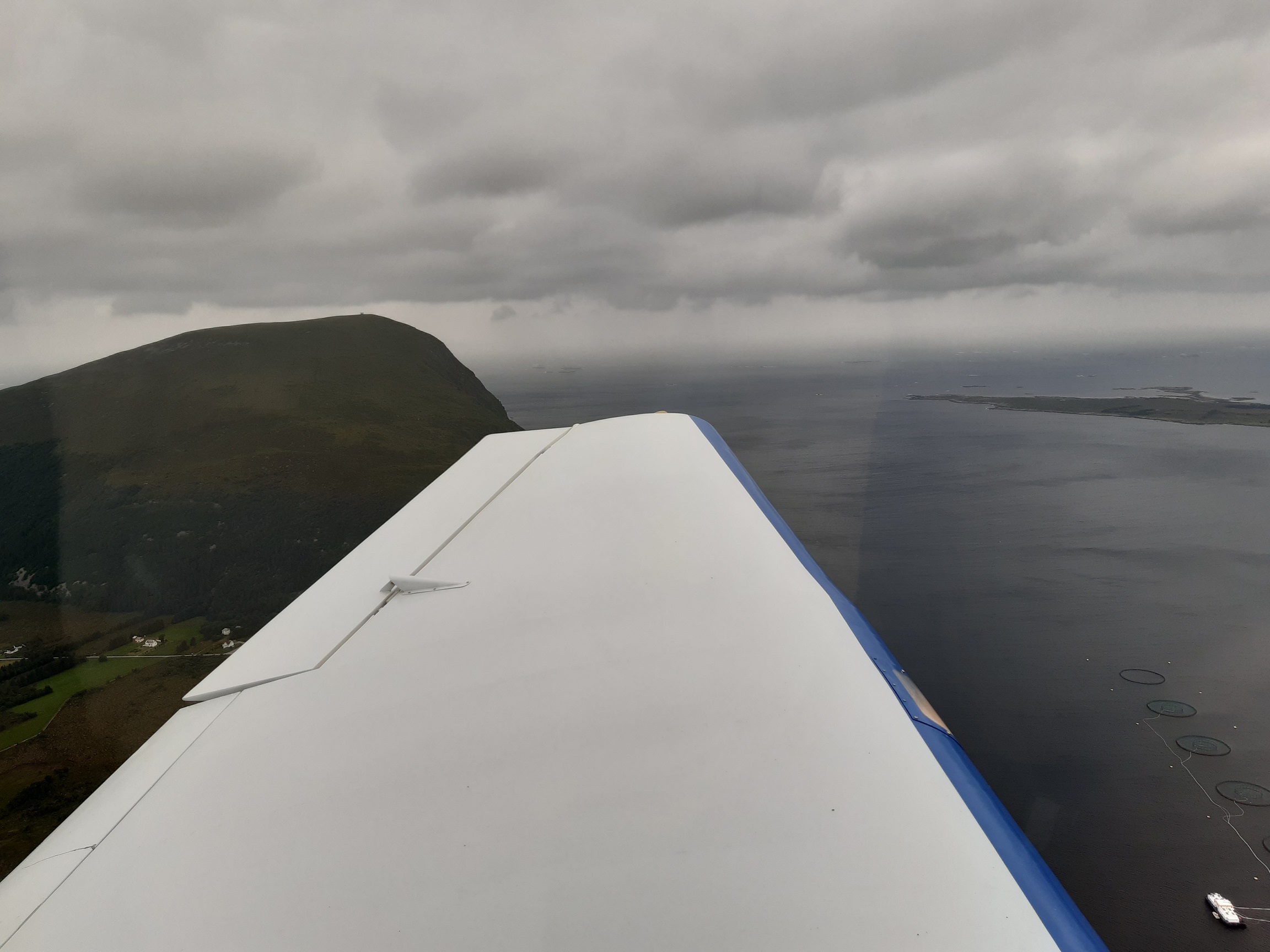
For the flight to Alta we would have liked to enjoy the view of the Lofoten islands, but seeing the weather and winds, we rather flew towards Leknes and then by the Western coastline of those islands. We passed by the West of Andenes. At that point the weather conditions were not very good, the flying was not easy. We counted with the help of the ATC and the messages exchanged between our 3 airplanes. Once we passed the latitude 70°, North of Tromsø, we got encouraging messages from the F-PANI, but as we were approaching Alta the weather was still not getting better, with very strong winds entering the Stjernsundet fjord to get to Alta. The airport in Alta was at the end of another fjord and at that point the wind was calmer and we landed.
The airport was closing so we just had time to get some help to get a taxi, book a room at the Scandic hotel and had dinner at Du Verden. The study of the weather during that dinner was not very positive, but we still gave us until the next morning to decide what to do the following day.
Day 5 (July 21st) – Alta
Before breakfast at 7am we looked at the weather and decided not to attempt to reach the North Cape that day, as the conditions were not very good with winds, rain and clouds. We booked another night at the hotel and the group split in two: Dominique and Norbert went to the airport to refuel the 3 planes, while the rest of us went to the museum of Alta to visit the Rock carvings (see related post). On the way there there was some rain but later on the sky became clear and we continued walking around for a total of more than 12km that day.
Back at the centre of the village we got some food for the plane (so we could have something to eat in the stops), we took a closer look at the iconic Northern Lights Cathedral and later met the group for dinner at a pizza restaurant, where again we studied the weather for the following morning, when we would attempt to fly by the North Cape followed by a flight to Tromsø.
Day 6 (July 22nd) – Alta (ENAT) – Alta (ENAT) – Bodø (ENBO)
We woke up early again, took breakfast together at 7am and got ready to go to the airport and wait for the weather to become more favorable. After about an hour, the F-BERB departed first by the fjord and then flying over the terrain to reach Porsangerfjord at the East and reach the North Cape from the South. A bit later the F-PANI and us left following the fjords (flying by Hammerfest) and reaching the North Cape from the West, took some pictures of it and then took heading for the South West.
The F-PANI flies much faster and at some point they reached a situation without visibility so they took a U-turn and so we did and both airplanes flew back to Alta, where we refueled again and stayed for some more time waiting for a front of clouds and rain to pass.
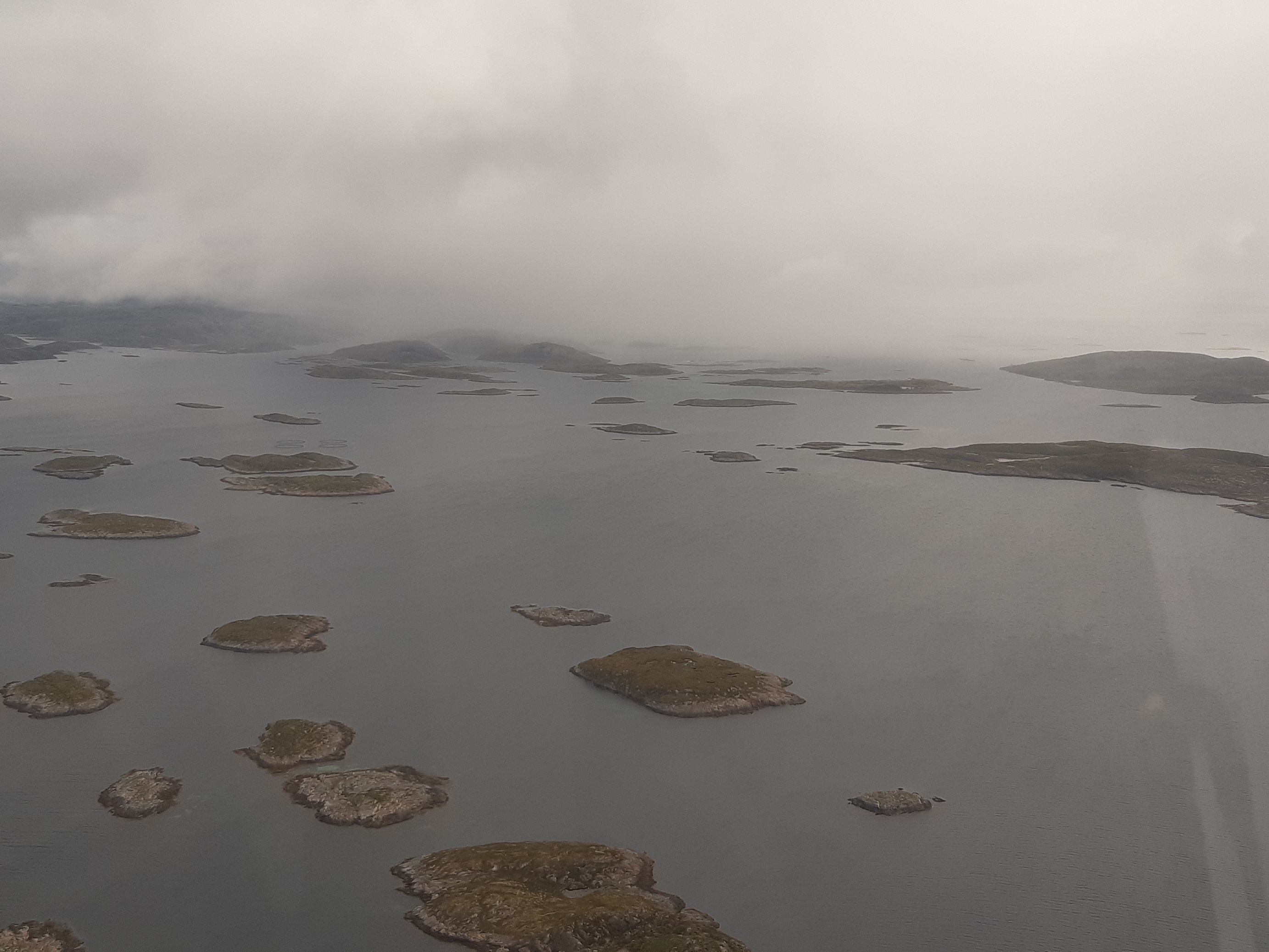
We then departed again, this time reaching the coast directly through the fjords to then follow the Western coast of the Lofoten islands on the way to Brønnøy. That flight was a very complex one. Already getting out of the fjords was difficult with very low ceiling, flying at 500ft, some showers, low visibility… flying with the help of the GPS to ascertain where the other side of the fjord or the next island would appear.
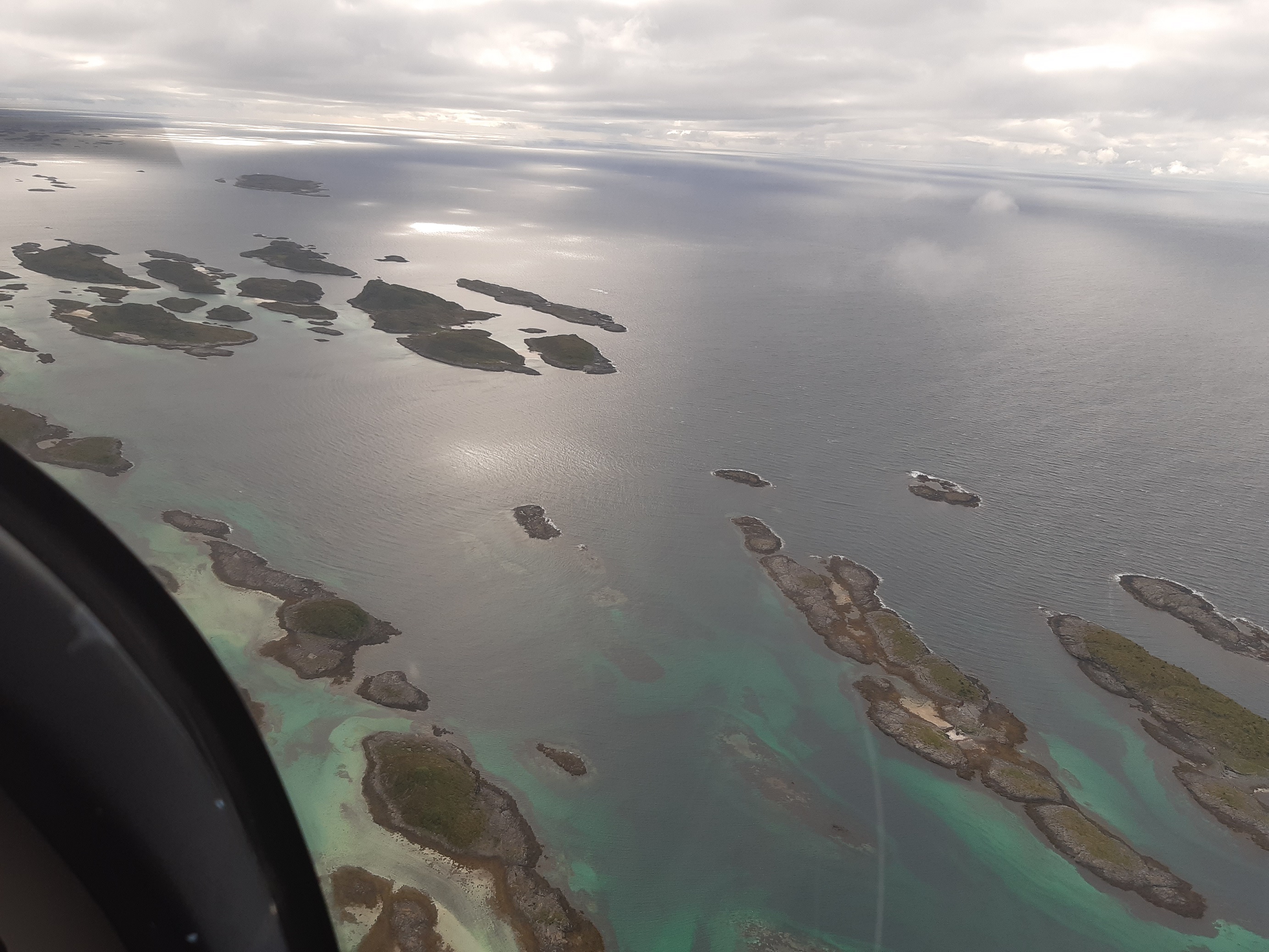
After 1h30′ the sky became somewhat clearer and just when we were going to fly West of Andenes airport we received a message from the F-BERB informing that the weather by the interior of the Lofoten islands was better and we could see some light from afar at that point so we changed plans and took heading for Evenes airport. We then enjoyed an hour of very pleasant flight over the islands and turquoise waters.
We flew past Bodø and exchanged some messages with the other airplanes about plans in Trondheim after refueling at Brønnøy only to find that some 40nm South of Bodø visibility was very bad and the ceiling very low. The difference now was that the area is full of small rocky islands, so at that point we made another U-turn and flew back to Bodø. The visibility at the airport was very low as well so we waited holding flying in circles at some 600ft for a few minutes about 20nm South of the airport until the controller offered to guide us to the airport under Special VFR.
We landed, refueled, called the tower by phone to thank the ATC for his help, booked a hotel by the harbor (Radisson Blu) and had dinner at Bjørk. Back at the hotel we studied the weather again and decided to go early to the airport to see if we could depart the following morning.
Day 7 (July 23rd) – Bodø
We reached the airport earlier than 7am to see if we could leave, but hesitated as the weather conditions were still quite degraded and were not getting better. After a couple of hours at the airport we gave up, called our colleagues at Trondheim (who then pursued their trip) and went back to book another hotel (Zefyr) and took the opportunity to visit the Norwegian Aviation Museum (see related post).
In the afternoon I went to rest at the hotel, while Jérémie went visiting around the city. For dinner we went to Burgasm (with a very comprehensive variety and customization of burgers).
Day 8 (July 24th) – Bodø
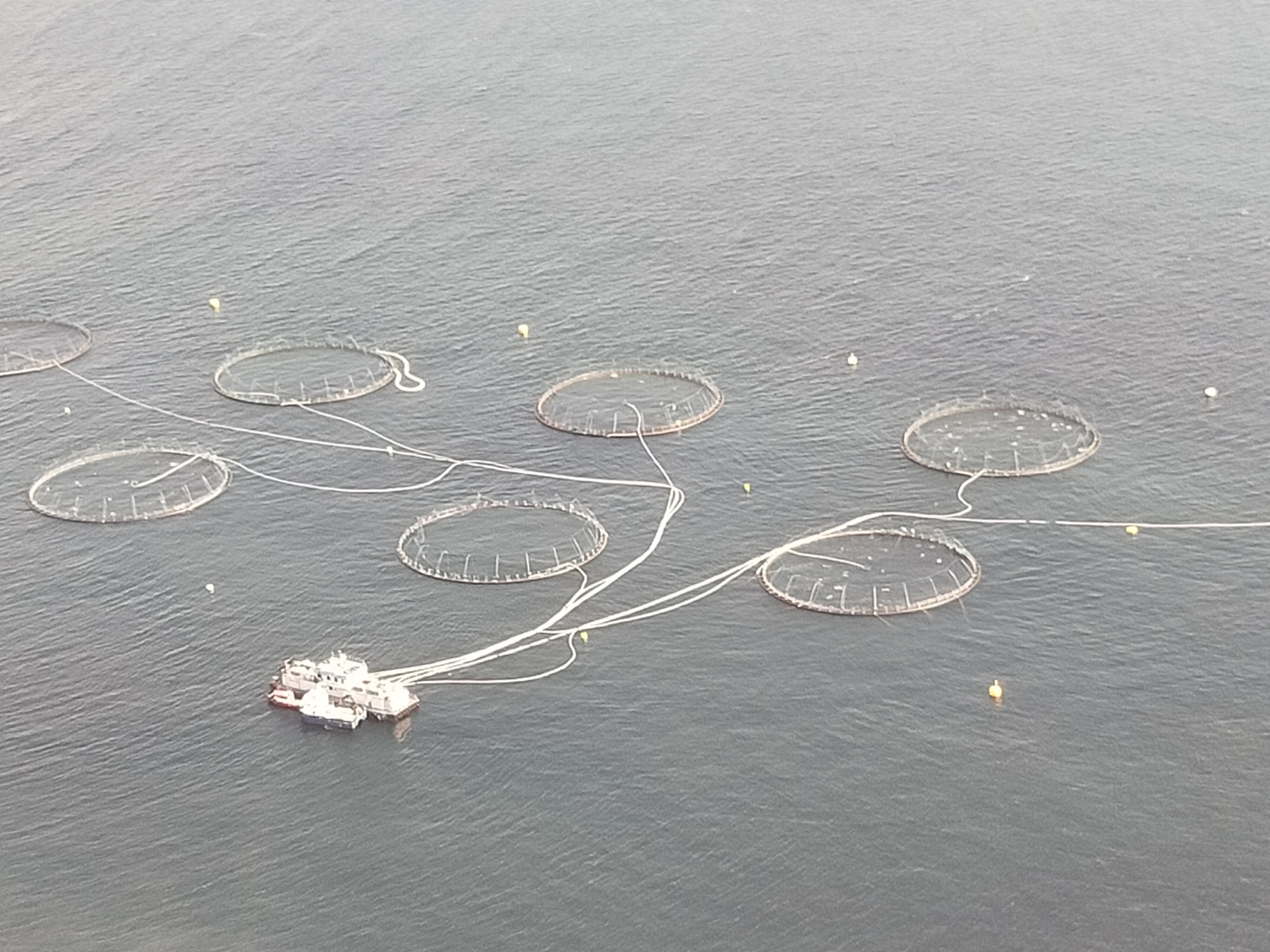
This day the weather was still pretty bad, as another low pressure front was coming from the South West and expected to hit the coast. We went to visit the Salmon centre by the harbor and then to the airport to move the airplane and align it with the strong winds that would blow later in the evening (and hopefully clear the local weather so that we could depart the following morning). That evening we had dinner at En Kopp, with very good fish dishes.
We left the hotel at 6am to try to be ready to fly at 7am and so we did. That day the weather was finally good, with just some clouds at 3,000ft around Bodø but clearing further South. We continued flying along the coast down to Brønnøy while climbing first to 4,500ft and then to 6,500ft in order to fly to the interior of the country, East of Trondheim, flying over Røros and approaching the TMA of Oslo Gardermoen from the North, flying by the East of the CTR and finally landing at Kjeller aerodrome (the first aerodrome built in Norway in 1912), where the weather was completely different, blue sky and hot temperatures.
Funnily enough, at the fuel station of Kjeller we met a local who had been in Toulouse learning to fly aerobatics and knew some members of one of the aeroclubs in Toulouse Lasbordes. We had lunch there, studied the weather again ahead of the crossing of the sea and the flight over Denmark, where storms were announced.
Shortly after we took off again from Kjeller, overflew Rygge and continued our flight to the South very close to the separation between the Norwegian and the Swedish FIR, while having the Swedish coast in sight for most of the time until we could see from afar the thin peninsula of Skagen in Denmark. This time we flew closer to the East of Jutland to avoid the storms that seemed to be more to the West. We left Aalborg to the West, then Billund and the ATC of Skrydstrup helped us in flying through some local cumulonimbus and showers, until we were finally in sight of Tønder.
At Tønder we met some of the members of the local club and later came the person in charge of the refueling station (as Norbert had called him to make sure they were aware of our arrival). This time we were able to pay in euros, so we refueled that same afternoon, before we were offered a lift to the Motel at the centre. We then went again to Cafe Arthur.
The following day would be a long one and the weather forecast wasn’t very good for Denmark or Luxembourg, but seemed OK to cross Germany. Following the example of the F-BERB we decided to go very early to the aerodrome to take off as soon as we could.
We woke up at 4:30am and left at 5:10 for the aerodrome. While walking the sky was clear, but when the aircraft was ready mist was taking over. When we were about to align on the runway we could not see further than half of it, so we went back to the parking, switched off the engine and waited a few minutes.
A bit later, when the mist seemed to have cleared a little bit and we had good visibility of the whole runway we tried again to take off and this time we went to the air leaving the low level mist below us and we continued our flight on top to the South, immediately crossing to Germany.
We flew at 4,500ft until Nordholz and then climbed to FL065 to have better visibility of the cities ahead of us. Later, ahead of reaching the class C spaces around Düsseldorf and Cologne the ATC gave us clearance and asked us to climb to FL070 to stay in VMC conditions, as around Cologne the clouds became more numerous and were quite abundant by the time we overflew Luxembourg.
Once we had crossed to the French air space we looked for a hole among the clouds so we could get below by flying down in circles making a downward spiral, and so we did, until we were below the ceiling at just around 1,000ft above ground level. We then informed the ATC of Strasbourg that we diverted to Doncourt instead of flying to Verdun, in order to land sooner instead of flying longer at that low altitude.
We then called the BRIA of Bordeaux to close the flight plan, refueled the plane, ate a little and studied the weather in France, which didn’t seem very good around the Massif Central nor West of it. After some careful study we guessed that the safest approach would be to make a small detour and fly South towards Toulouse by Dijon, Lyon, Nîmes, Montpellier and Carcassonne, and so we did.
We only encountered some showers before reaching Dijon, but further South the weather was good and we only had to watch out for some glider activity at some points around Lyon. We made a refueling stop at Alès Cévennes before getting ready for the last flight of the excursion.
Flying to Toulouse through the corridor of Montpellier – Carcassonne is something I had done a few times, so we just focused on staying alert as the day was getting long and we were becoming tired.
We finally landed at Toulouse Lasbordes, where Dominique and Norbert (who had arrived two days earlier) were waiting for us. They brought a bottle of champagne which we drank by the airplane still on the tarmac. They then helped us getting the airplane in the hangar, we said good-bye, continued cleaning the plane, filled in the papers… and savored the moment of what we had just accomplished: flying VFR all the way to the North Cape and back.
Trip preparation and tips
We flew for over 46 hours, the other plane departing from Toulouse did 43 hours. On flying days the average flying time was almost 7 hours per day, with a maximum over 9 hours the last day. We completed 15 flights.
We were stranded 3 days without flying, the other airplanes only 1, but the F-BERB in a similar excursion years ago also lost some 3 days. We also had to delay our departure by 4-5 days due to heavy rain in the North of France, Belgium and South of Germany around the targeted departure date. Thus, it would be prudent to budget in your calendar at least 10 days for the trip.
The excursion was mainly about flying, preparing flights, refueling, studying the weather (at dinners, breakfasts and refueling pauses). We only had time to visit the places when we were stranded. Thus, it is trip for dedicated aviation enthusiasts.
We opened an account at the Norwegian Avinor site. It’s free of charge and it contains all the aerodrome charts, AIP, weather information and a tool to file flight plans. In that site you’ll be able to get a week pass to cover all the landing fees for about 94€ (in July 2021).
For the preparation of the flights and the navigation we relied on SkyDemon (I took 1 month subscription for 14€) from an iPad Mini (however I used an external GPS connected to the iPad, this proved tricky for the battery management in the flights over 4 hours). The good resolution of SkyDemon was very valuable to fly along the coast when visibility was low.
Special attention needs to be paid to where you can refuel. About half of the airports in Norway do not have Avgas 100LL. Most of the ones that do have Avgas do not accept cash or credit card payment, but are divided into those which accept the Air BP card (which we had) and the ones accepting the Shell card (which we didn’t have, those part of the AFSN network – there was an AIP from just a few months before informing about that). Therefore we were effectively restricted to about one fourth of the airports (that is an element when thinking about flight planning and potential diversions, whether they may occur at the end or beginning of a flight). The best would be to depart with both the BP and the Shell cards.
All of the airports we landed were of moderate size with long runways.
The Norwegian ATC was quite helpful all along the trip and accommodated to many of our requests. When flying low sometimes we did not appear in their radar and sometimes the radio reception was poor, but those instances did not last long.
There was not much VFR traffic in the North, most of the other aircraft in the frequency were commercial aircraft from mostly Widerøe, Norwegian and SAS.
We did not make any hotel reservation in advance, only when landing at each airport in the afternoon, as we were not sure of whether we would be able to make it to the intended destination (a couple of times we didn’t). Once landed we made the reservations via booking.com.
The overall budget (including the cost of the flight hours including fuel (the largest cost by far), landing fees, hotels, meals, etc) for our plane has been around 9,500€ (less than 5,000€ per person).
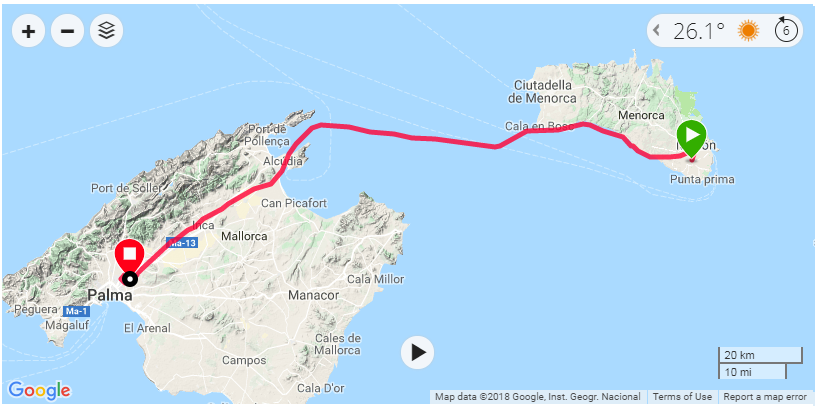
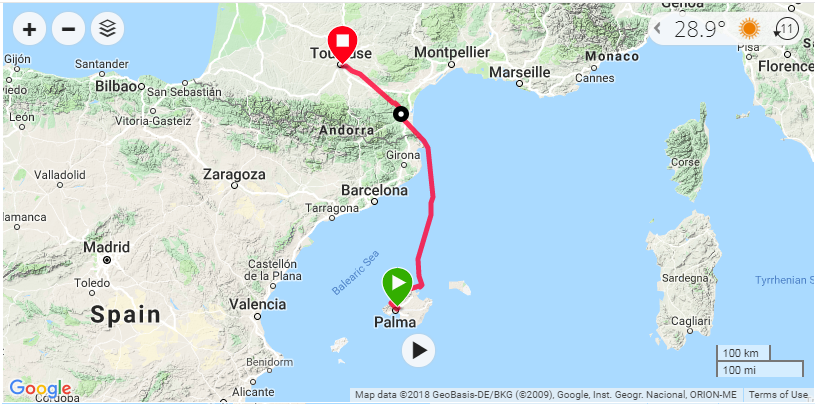
Last weekend, with Luca and our children, we took one of the aeroclub’s DR-400 to make a flight excursion from Toulouse (France) to the islands of Menorca and Mallorca, in Spain. The excursion was part of a “Fly out” organised by the Aviation Society of the Airbus Staff Council in which 5 aircraft would make the same trip.
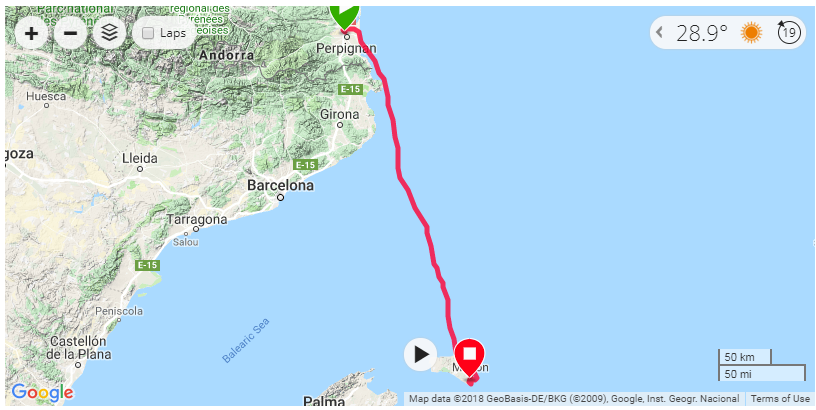
The main purpose of the flight was to visit Menorca, and we flew to Mallorca to refuel before coming back. It is an excursion that in the Society we had been trying to make since 2015 but we have had to cancel it due to bad or uncertain meteorological conditions several times. The flight includes a leap over the sea of about 1 hour from the East of Bagur (in Gerona) to the North of Menorca and, as there are no safe landing spots in that area, you want to have more or less certain good weather along the route both the day of the departure and return flights.
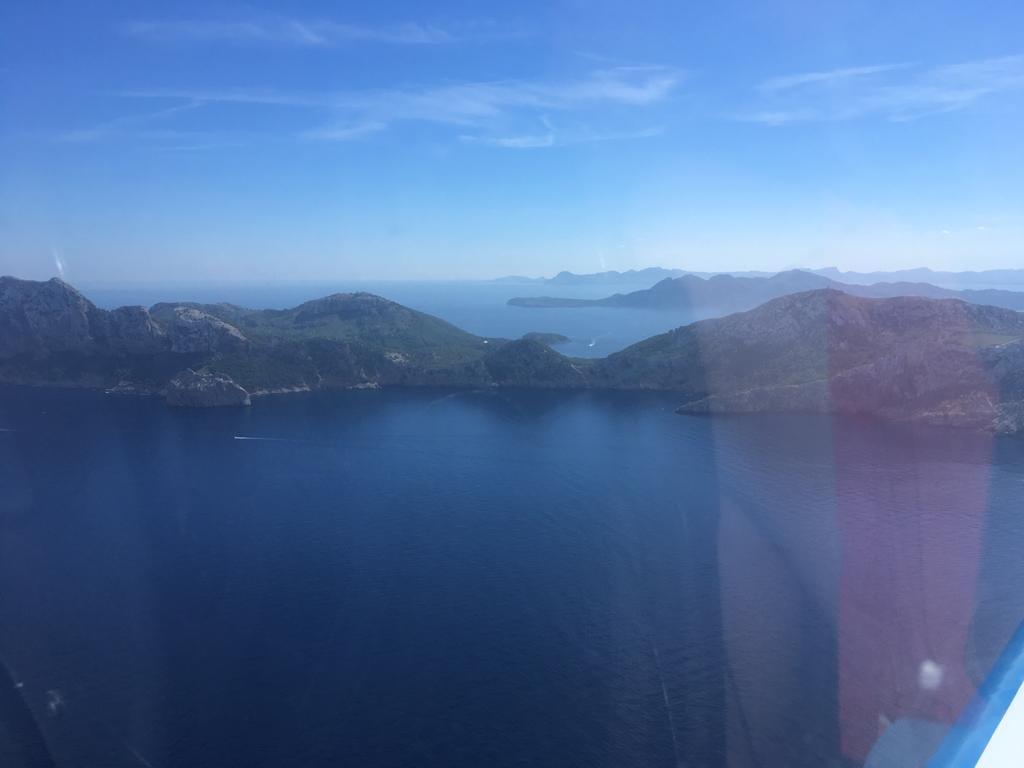
Cape Formentor, Alcudia & Cape Farrutx.
We made 4 flights.
Toulouse Lasbordes (LFCL) – Perpignan (LFMP)
Flight duration: 1h11’.
We included this first stop over Perpignan just to refuel the aircraft to the maximum before flying over the sea all the way through Menorca, so in case of bad weather or any other problem at the destination we could make a comeback to France or somewhere else in the Spanish coast. We selected Perpignan instead of other viable options such as Ampuriabrava for various reasons, among them lower cost of fuel and landing fees.
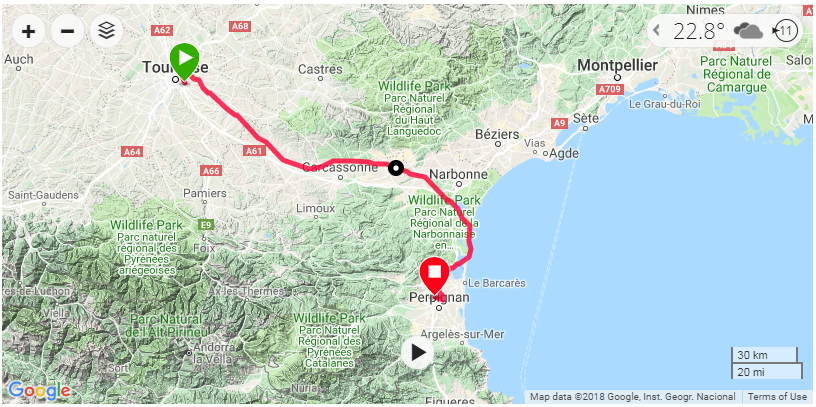
In the way to Perpignan the sky was overcast (OVC) at a low level around Carcassonne, and, as I did not want to fly on top for that leg, this forced us to fly just at 1000 ft above ground and to follow the highway to Narbonne rather than taking a more direct route to Perpignan over the mountains. You can see the route we followed above.
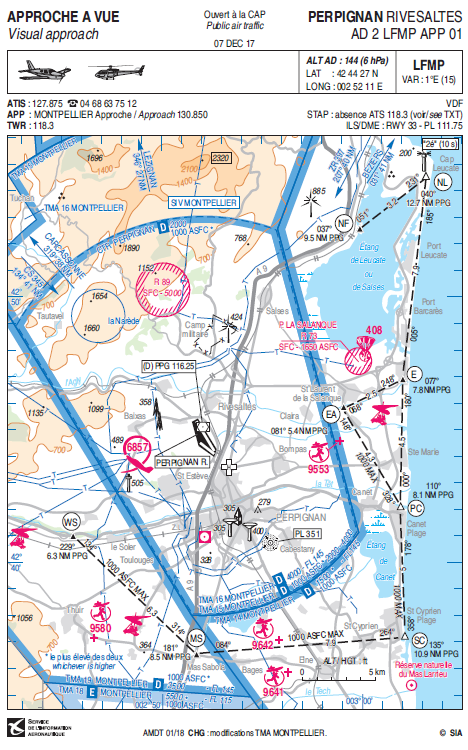
It was the first time I landed at Perpignan, but finding the field from the way points NL (in the coast) and NF was trivial. Once in the vicinity we integrated directly into the circuit for runway 31, closer to the fuel pump. There, we had a quick lunch and prepared for the following flight.
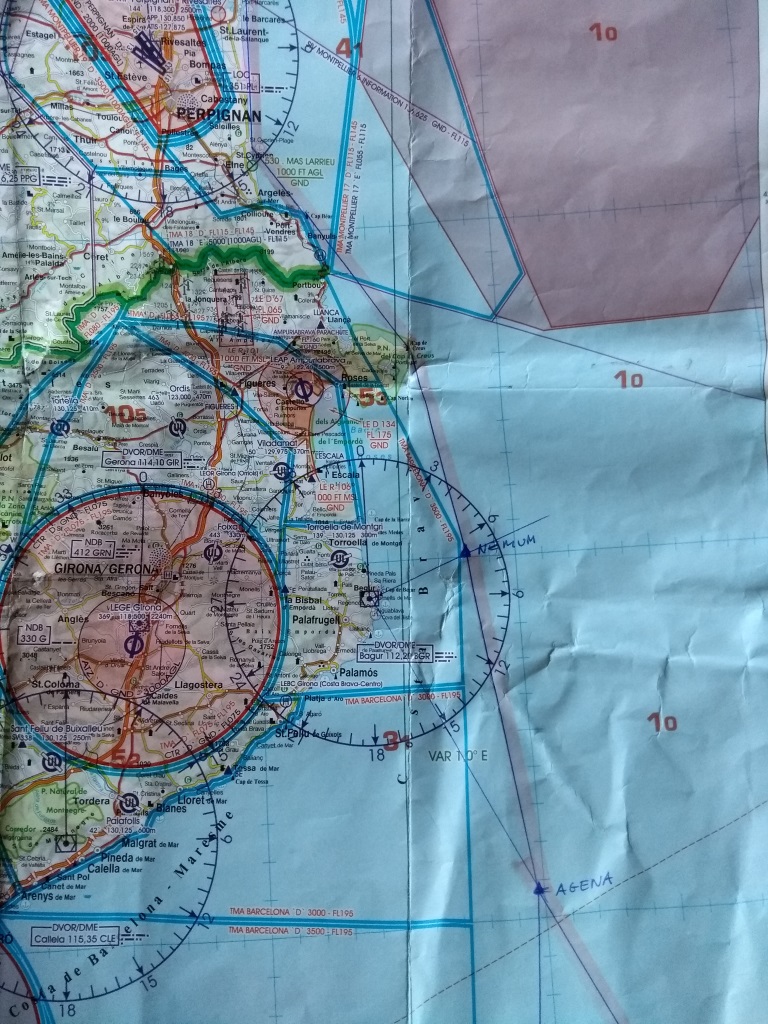
Just after the take-off from Perpignan we took a right turn towards the East and reached the coast South of waypoint EA. From then on we started climbing up to 5500 ft, the altitude selected for the flight over the sea (the highest, the better). In order to keep a high altitude you need to avoid the TMA from Barcelona, otherwise they may ask you to descend below 3000 ft. Thus, we went to the capes of Bear, then Creus and from then on South East heading to pass about 10 nm East of the VOR at Bagur. From then on we followed a series of IFR waypoints (NEMUM – AGENA – VERSO – TOSNU – SARGO).
Flying above the sea is not particularly eventful. You mainly need to maintain the altitude and attitude and the heading stable, as it is very easy to loose references with the difficulty to distinguish the horizon.
As far as radio communications are concerned: we were first transferred with the Gerona traffic control and then to the one of Barcelona. The communications were held in Spanish. Easy, as long as you have a flight plan and follow the announced route. Those frequencies were mainly used by commercial flights going to/from Barcelona or Palma, mainly Vueling flights. Also good to know is that as you fly away from Barcelona at some points you may not be heard by the control; no worries, keep going and sending the messages.
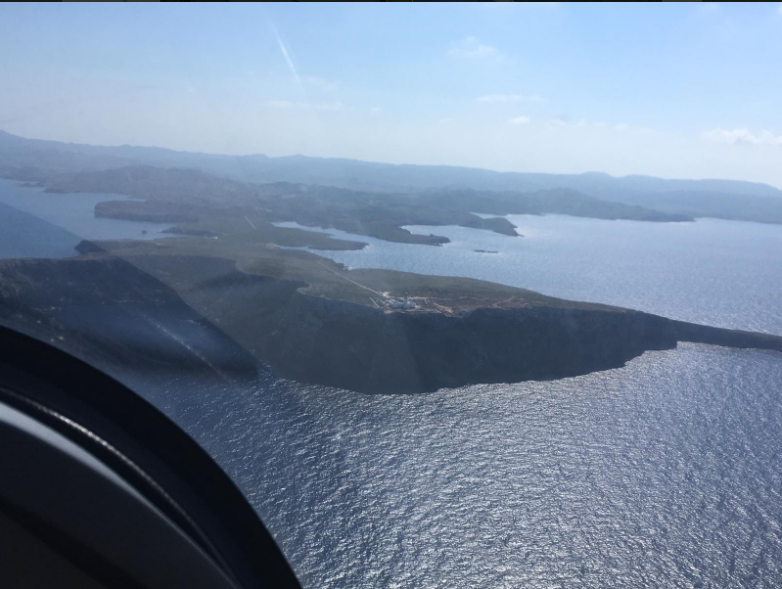
About an hour later we had in sight the North of the island of Menorca, the cape of Cavalleria. But before that, approaching the way point of SARGO (about 25 nm or 14 minutes from the shore) you need to descend down to below 2500 ft, though the control will ask to go down to 1000 ft AMSL as that is the limit of the air space class A around the main airport in Menorca, Mahon.
Cape of Cavalleria.
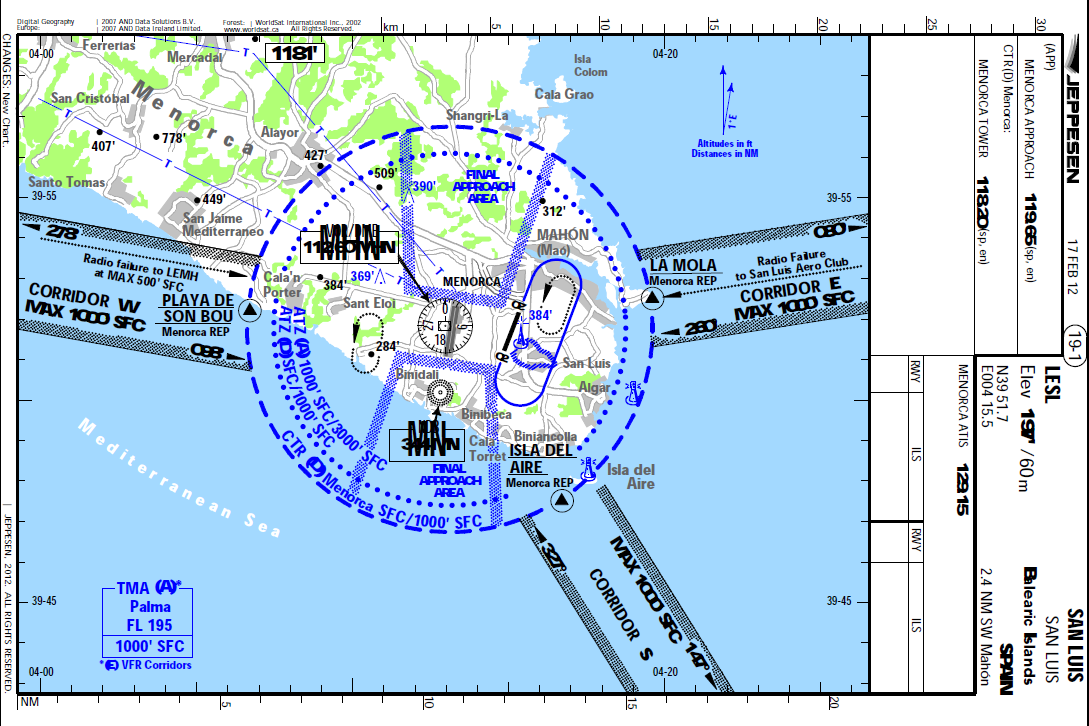
Once in sight of the shore we requested to follow the coastal line to the East down to the East Corridor for Mahon in order to reach San Luis from the East (the control had however proposed to surround the island around the West and South).
Following that route we took the opportunity to take some nice pictures of the coast, the lighthouses and the fortress of Isabel II at La Mola.
Cape of Favaritx.
Lighthouse of Favaritx.
Vickers guns at La Mola fortress.
La Mola fortress.
Lighthouse at La Mola fortress.
San Luis is a non-controlled aerodrome without radio. Therefore, you must stay connected to the frequency of Mahon and land at your discretion, with a circuit to the East of the runway (02/20). The aerodrome is managed by the Aero-club of Menorca. In their site you may find contacts and charts (old ones being in use). There are not official fees but a contribution is expected; 10 euros for landing, 5 for parking. These are paid at the restaurant by the apron, which serves very decent menus and where the staff will be happy to help you calling for taxi.
We spent the remaining of Friday afternoon and all Saturday enjoying the beach and the hotel’s pools, including a beer on Saturday night with the colleagues from the Society at a bar by the beach, Es Corb Mari (in Son Bou).
As the aerodrome of San Luis doesn’t have a fuel pump we could refuel at the main airport of Mahon, but as it requires to contract handling (with expensive fees) we preferred to fly down to Son Bonet (in Mallorca island), which landing fee is less than 7 euros, no handling contracting is required and there is free parking for a stay below 2 hours.
We filed the flight plan on the phone with Menorca airport (at this time the number for flight plans being: +34971157138). On ground, we were already connected to the frequency of Menorca and right after take-off we were cleared to turn West and cross the axis of the airport in our way to the West corridor which took us to the South coast of the island up to the cape and lighthouse of Artrutx.
At San Luis aerodrome.
Cala Coves.
Son Bou.
Lighthouse of Artrutx.
From Artrutx we flew over the sea towards the bay of Pollensa (making use of its VOR), in Mallorca, and then we flew within the inner side of the island following the road from Alcudia to Mallorca by way of Inca. When leaving Inca we passed with the frequency of Son Bonet (123.5) around which English is mainly spoken as there are quite a few helicopters flying in and out. Finding the aerodrome coming from the road was trivial and we easily integrated into the circuit for runway 23.
Inca.
At Son Bonet we paid the landing fees (~ 7 euro) and filed the flight plan at the small office by the parking. We refuelled (~3.05 euros per litre of Avgas 100LL) and had some lunch before the long flight to Toulouse.
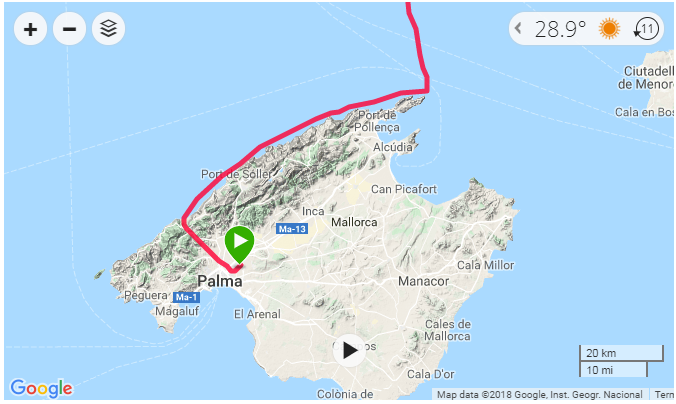
Once we were ready at Son Bonet, we got on board and departed from runway 23 again, took a right turn to the West during the climb to fly North of Son Moix on the way to Esporles to reach the coast of Tramuntana in order to fly along it up to the cape of Formentor.
In the past, we had visited several spots along the way of this coast on the ground. The landscapes are remarkable. This time we wanted to get a view of them from the plane, which was breath-taking.
Son Moix.
Soller harbour.
Lighthouse of Cape Gros.
Cape Formentor.
Lighthouse of Formentor.
Once we reached Formentor we took a heading to the North and followed another series of IFR waypoints (KENAS – SULID – AGENA – NEMUM) to reach the East of the above mentioned VOR of Bagur, cape of Creus and enter back into French air space. This time, as the weather was clearer than during the first flight of the excursion, we maintained 5500 ft altitude until we had exited the TMA of Carcassonne.
All the navigation logs were again prepared using the tool Mach 7, and during the flight we used the help of the AirNav Pro on the mobile phone (no tablet, though it would be easier). For Spain we had 1/1.000.000 chart from AIR MILLION (Editerra) and the 1/500.000 from Rogers Data. Neither of them has the IFR waypoints marked on them, so you need to write them down yourself in advance.
VFR aerodrome charts in Spain are retrieved from the site of ENAIRE, which in my opinion is less user friendly than the French equivalent. The charts themselves are comprised of too many different documents to handle; it is better to have a simple single PDF of 2-8 pages s in the French case for VFR. On top of that, not all small aerodromes have the information in ENAIRE, try googling about them or contact the local club.
Last Sunday, yet again, we took one of the aeroclub’s DR-400 airplanes to make another family flight excursion.
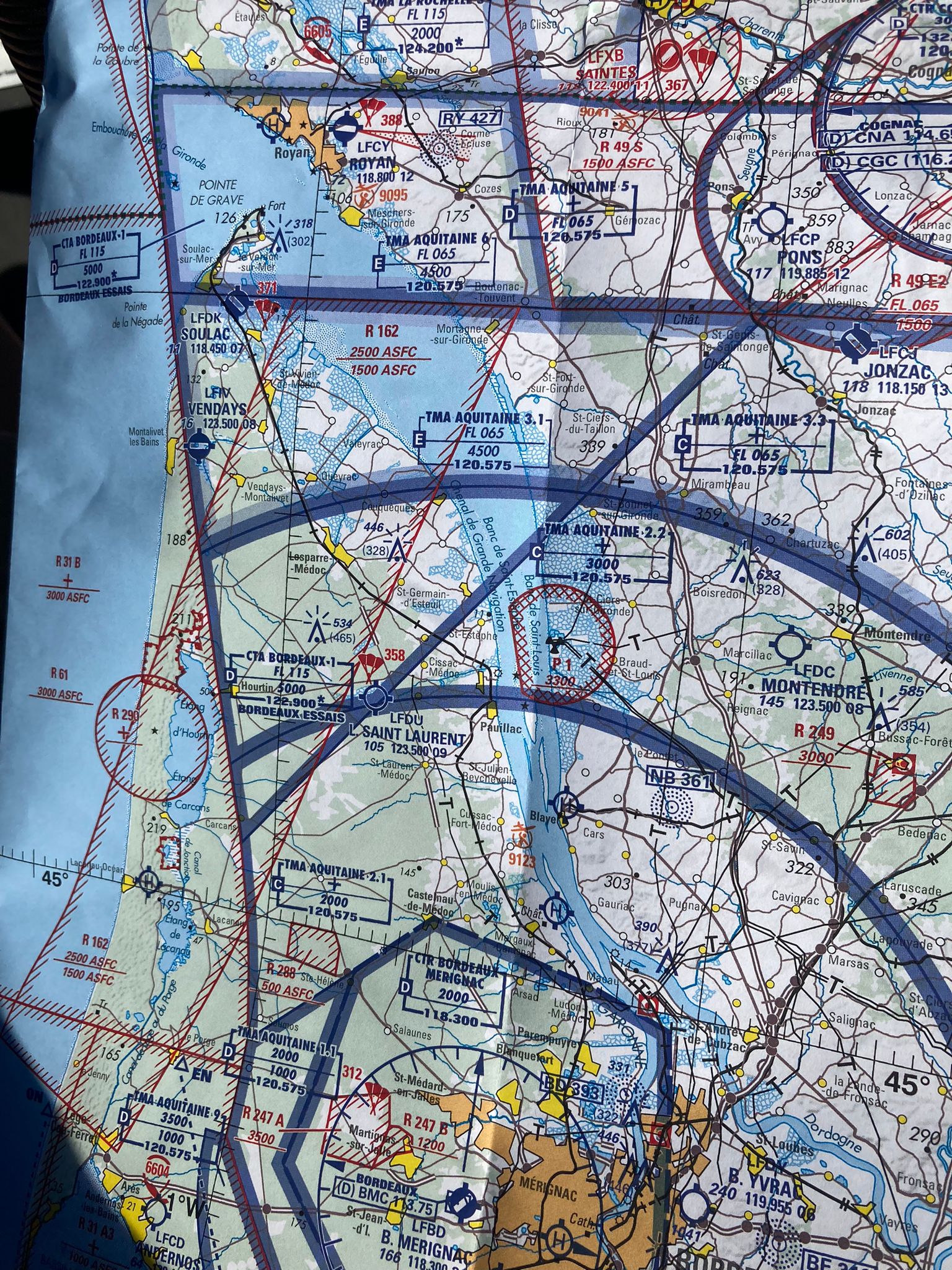
On the occasion of the previous excursion, last week, I introduced the phares aéronautiques, i.e., aeronautic lighthouses that were set up in 1920s to allow night flight navigation for l’Aéropostale courriers. Last week we spotted a couple of them to the South East of Toulouse. This time, we wanted to spot a couple of them to the North West of Toulouse, on the way to Bordeaux, in the villages of Canals and Malause.
Last week, we prepared quite well the spotting, checking in Google maps different views of what we would try to see from the airplane so that we could easily recognise them. This time, we prepared less, just marking a cross in the map with the approximate location of the phares and hoping that we would identify the lighthouses on the ground.
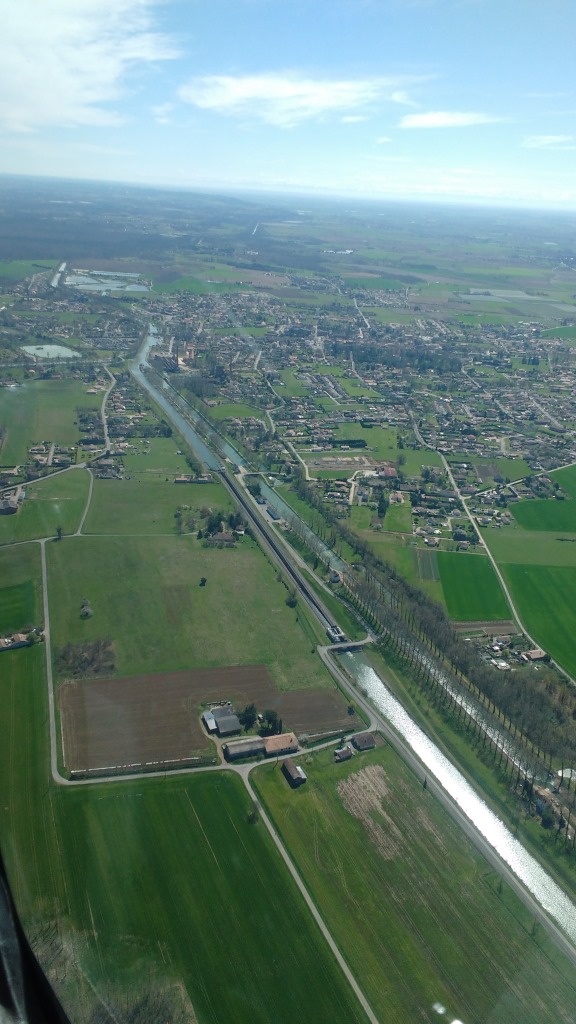
Well, the task proved as difficult as finding a needle in a haystack. We missed the phare of Canals in the first leg. We then continued over flying the Canal Lateral up to the water slop of Montech (1).
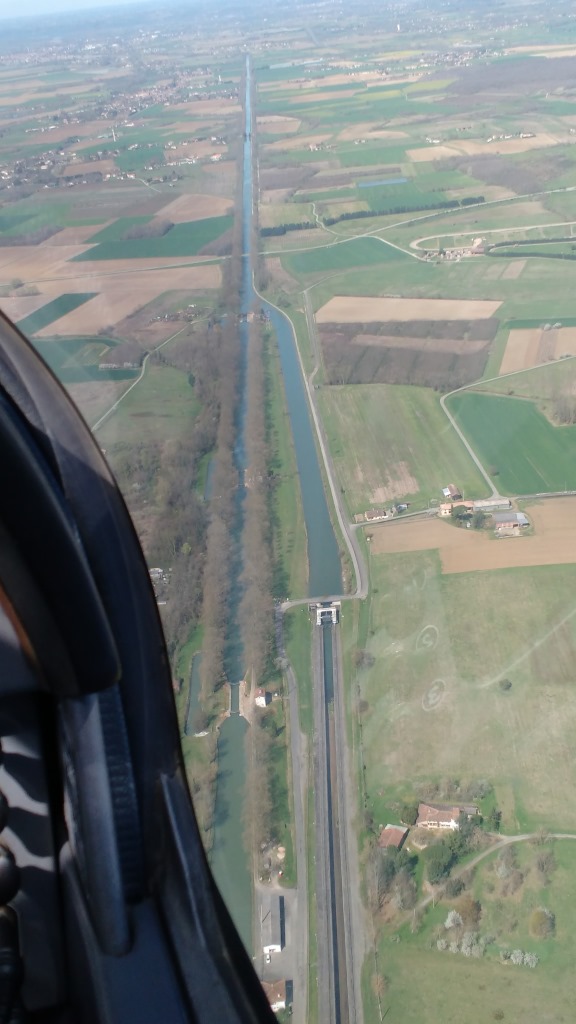
The navigation of this flight was rather simple, as once over the Canal Lateral we kept flying over it northward up to the Pont-Canal to the East of Moissac (2).
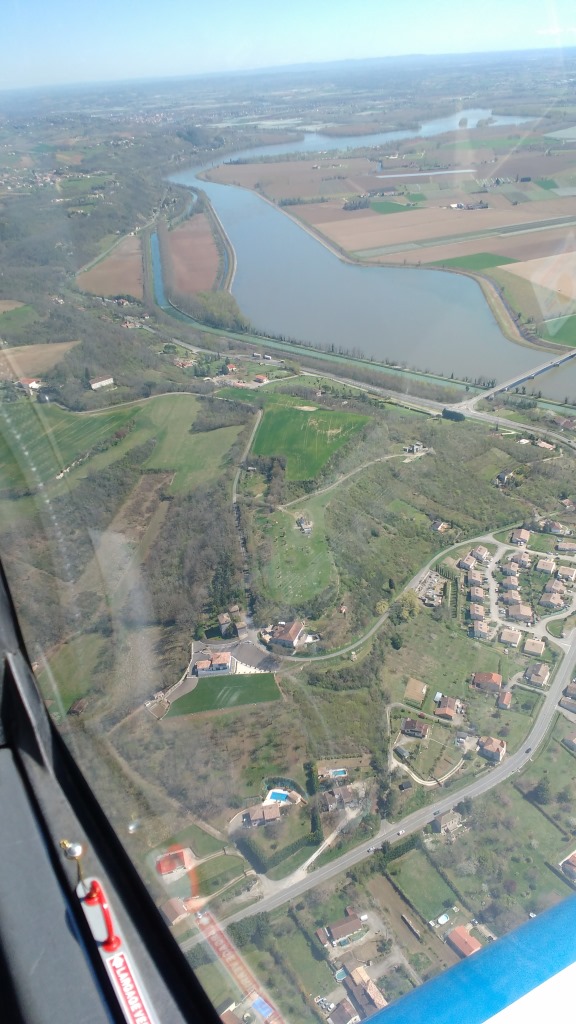
We then flew along the river Tarn until it flows into the Garonne and then the Garonne until Malause. We then knew that the phare would be to the North of the river, the canal, the railway and a secondary road. See it below.
If you haven’t been able to spot it, it’s OK. You’re not the only one. We didn’t spot it at first sight. We flew in circle to have a second chance. I reduced the speed from 190 km/h to 150 km/h, to see if at a slower speed we would see it better.
Saw it already? Not yet? Don’t worry, I didn’t either. But you see, I was at the controls, at the left side of the cockpit. But you… you have here a frozen picture, you’ve got no excuse not to see it. In fact, you’ve got the picture because Luca is starting to be a hell of a spotter.
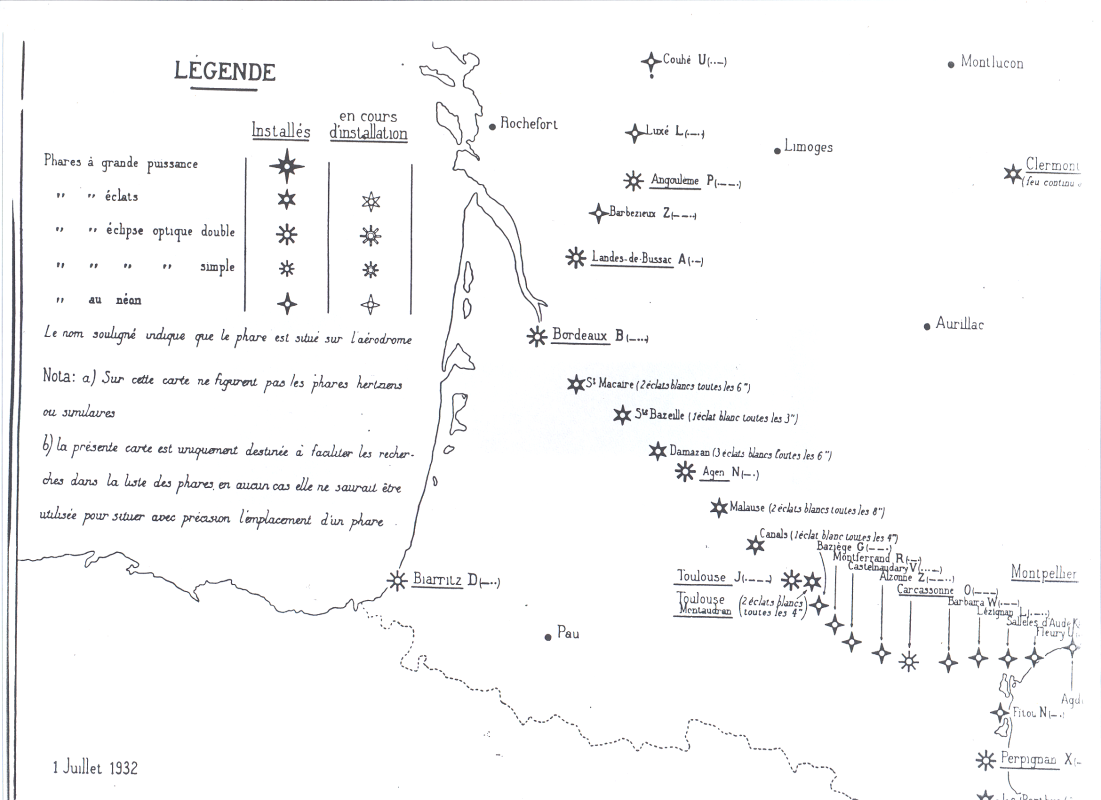
Once at home, I researched a little bit and found this local website about the phare(in French), with a couple of pictures, some data, history of these phares and a nice chart from 1932. It explains that the lighthouses started to be built in 1923 and that by 1932 there were 140 of them across France. This one at Malause was operated by the family Jolly until 1948/1949.
On the way back to the aerodrome of Toulouse-Lasbordes we passed by Moissac and Montech again and failed to spot the lighthouse of Canals again. Next time.
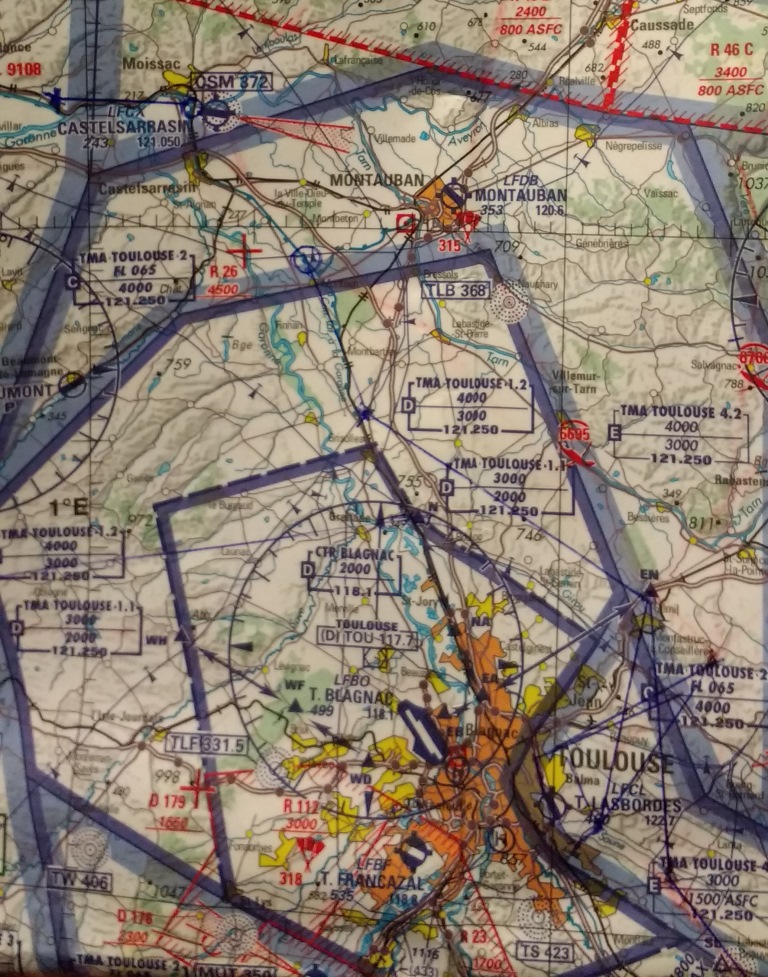
Finally, see below the navigation chart with the route followed marked on it. The total engine running time of the excursion: 1h15′.
—
(1) See here a post in which I described the concept of the water slope and a post about another flight excursion in which we took some more pictures of it.
Last Sunday, we took one of the aeroclub’s DR-400 airplanes to make another family flight excursion.
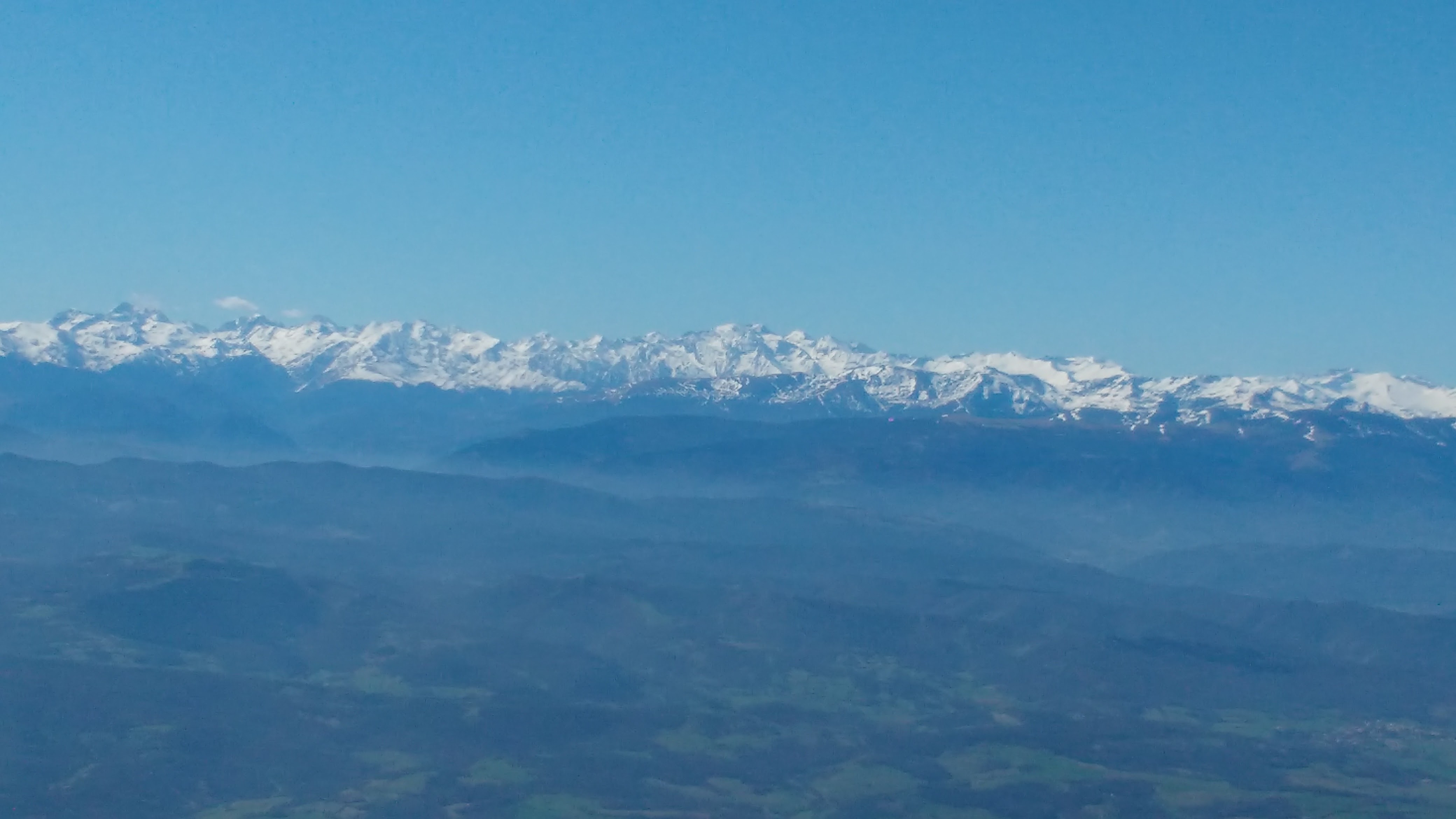
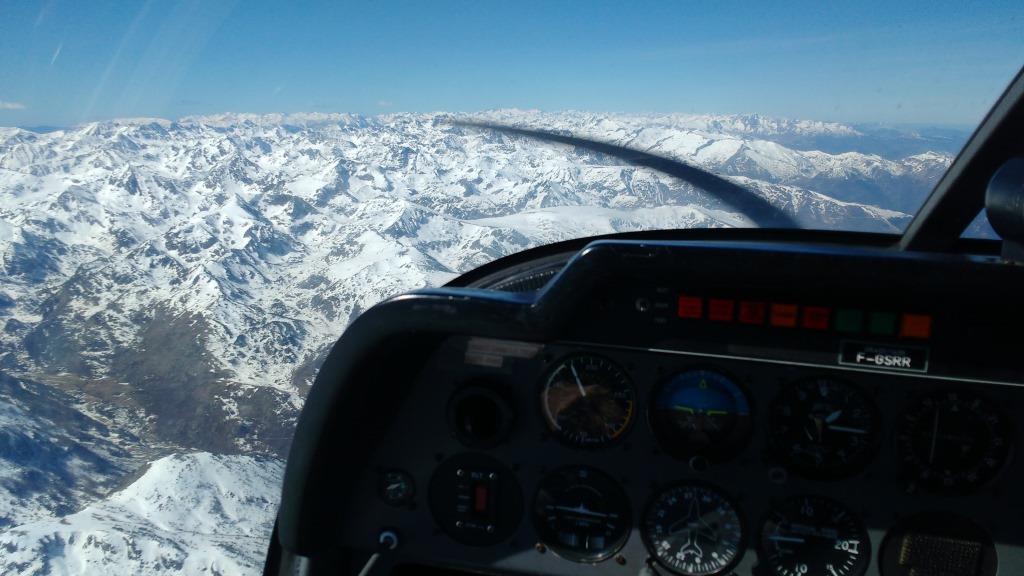
This time the purpose of the flight was twofold: (1) we wanted to spot a couple of phares aéronautiques, i.e., aeronautic lighthouses that were set up in 1920s to allow night flight navigation for l’Aéropostale courriers, close to Toulouse, and (2) we wanted to take benefit from a sunny day around Occitanie to make a tour around the snow-covered Pyrenees, something we already did about a year ago when we completed the route of the Cathar castles (see here a post about it).
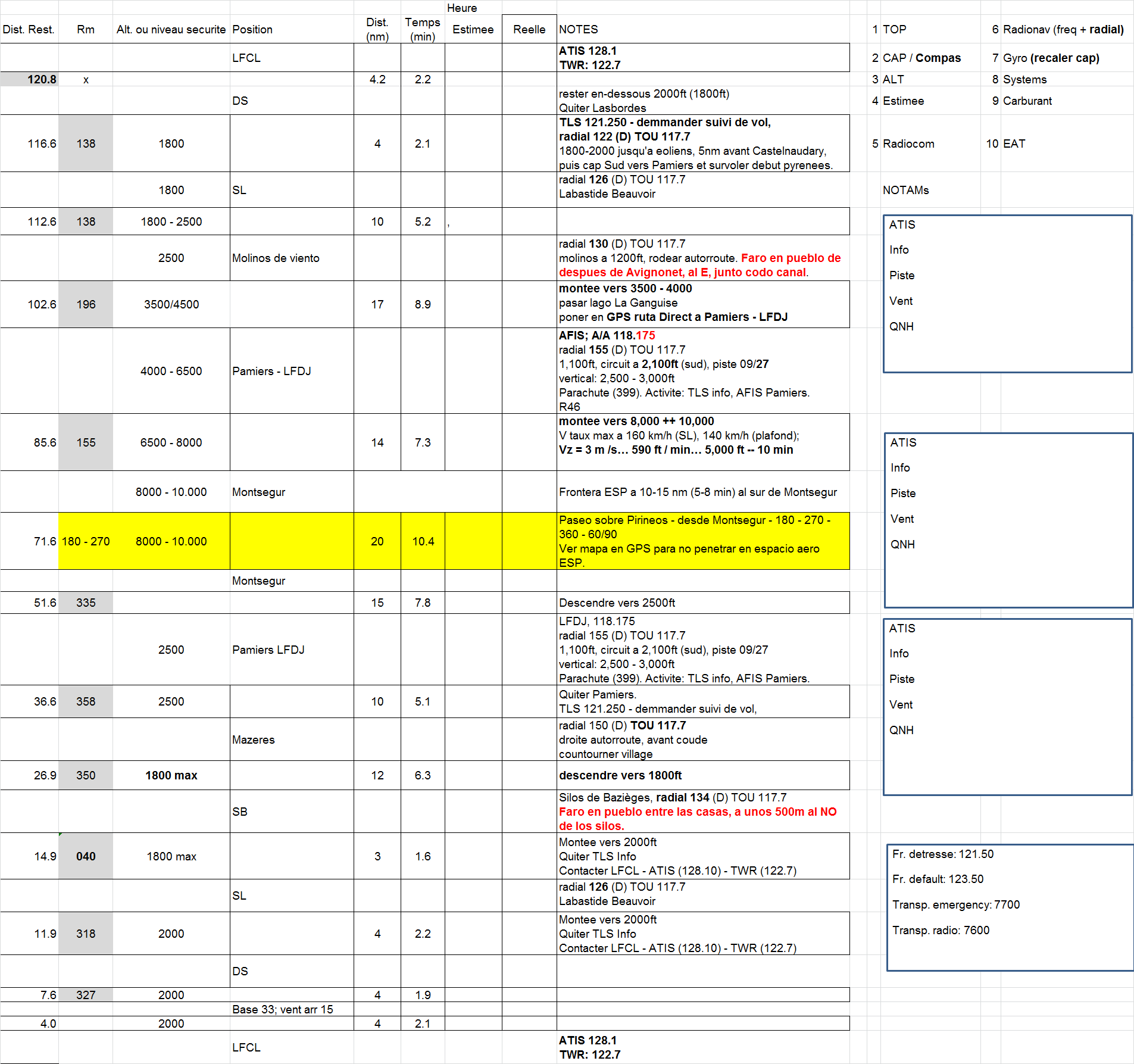
See below the quick reference paper navigation log prepared for the flight.
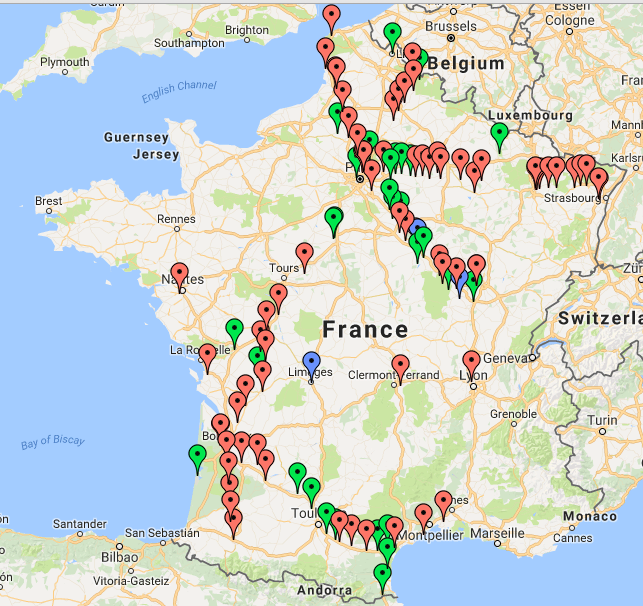
A few months ago, a friend of Luca, Tijmen, tipped us on the existence of these aeronautic lighthouses. See in this website a map with the precise location all of them had, including those still standing.
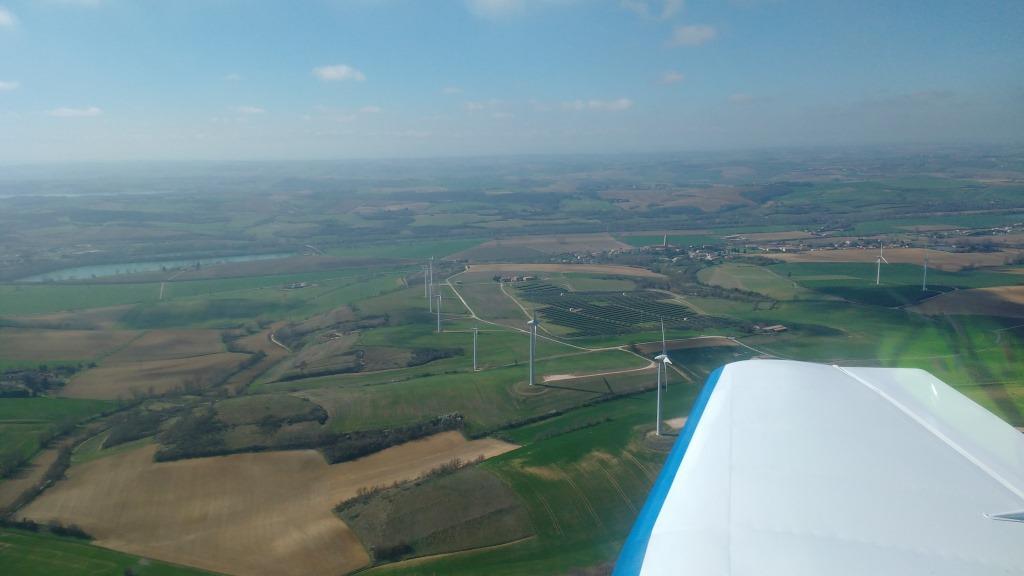
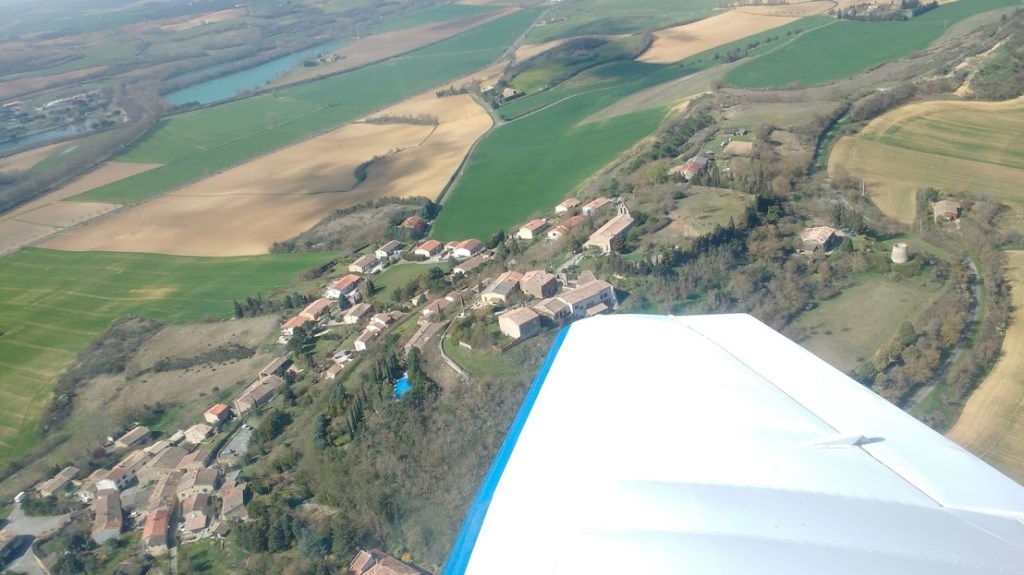
We succesfully spotted the 2 phares closest to the East of Toulouse-Lasbordes aerodrome, located in Montferrand (just to the East of the wind turbines by the A61) and Bazièges (just to the North of the silos marking the waypoint SB). See a picture of the first one below (2 houses to the left of the wing blue tip).
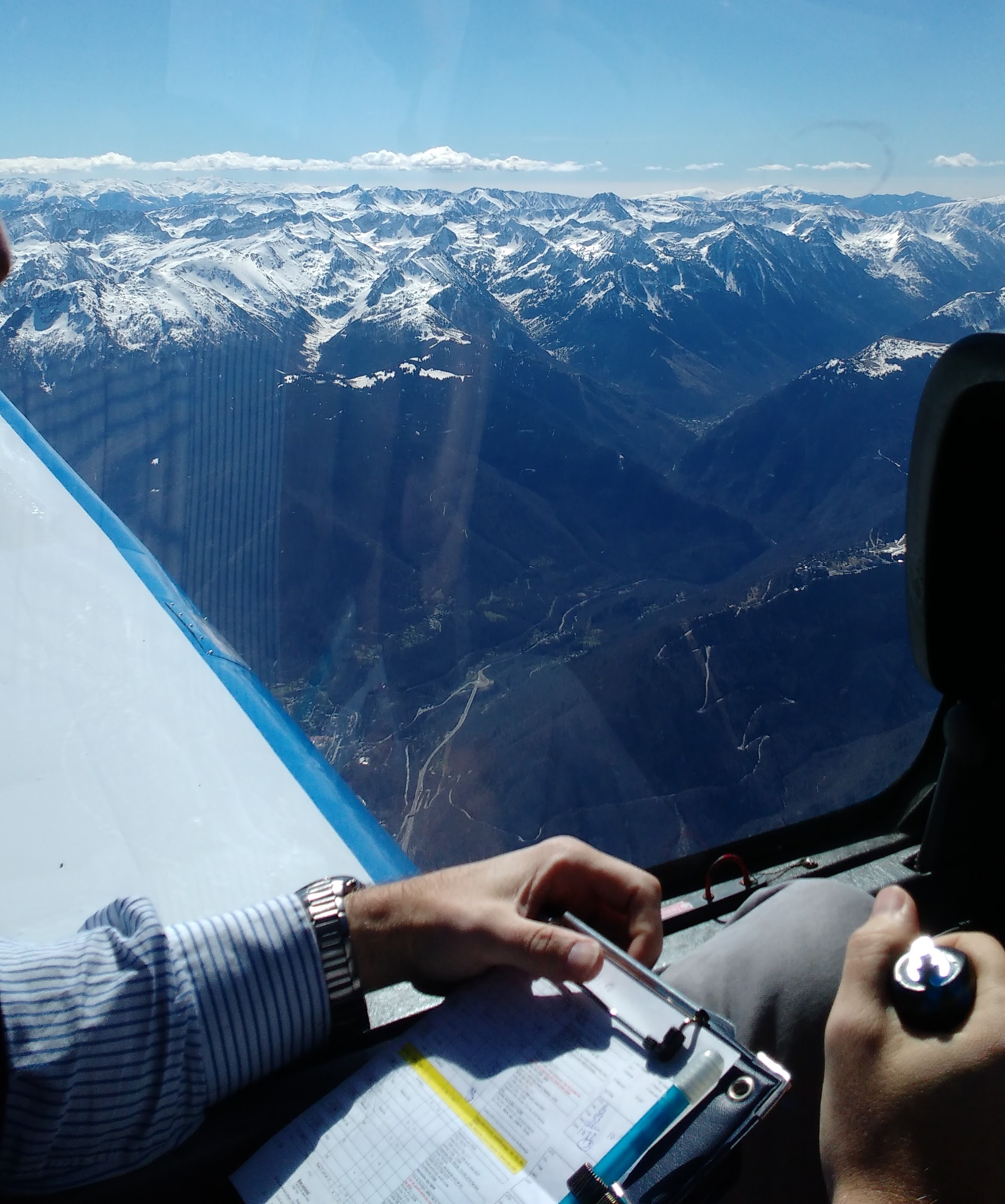
Once we had spotted the phare in Montferrand, we took to the South to start the climb to above 10,000 ft in order to fly over the Pyrenees.
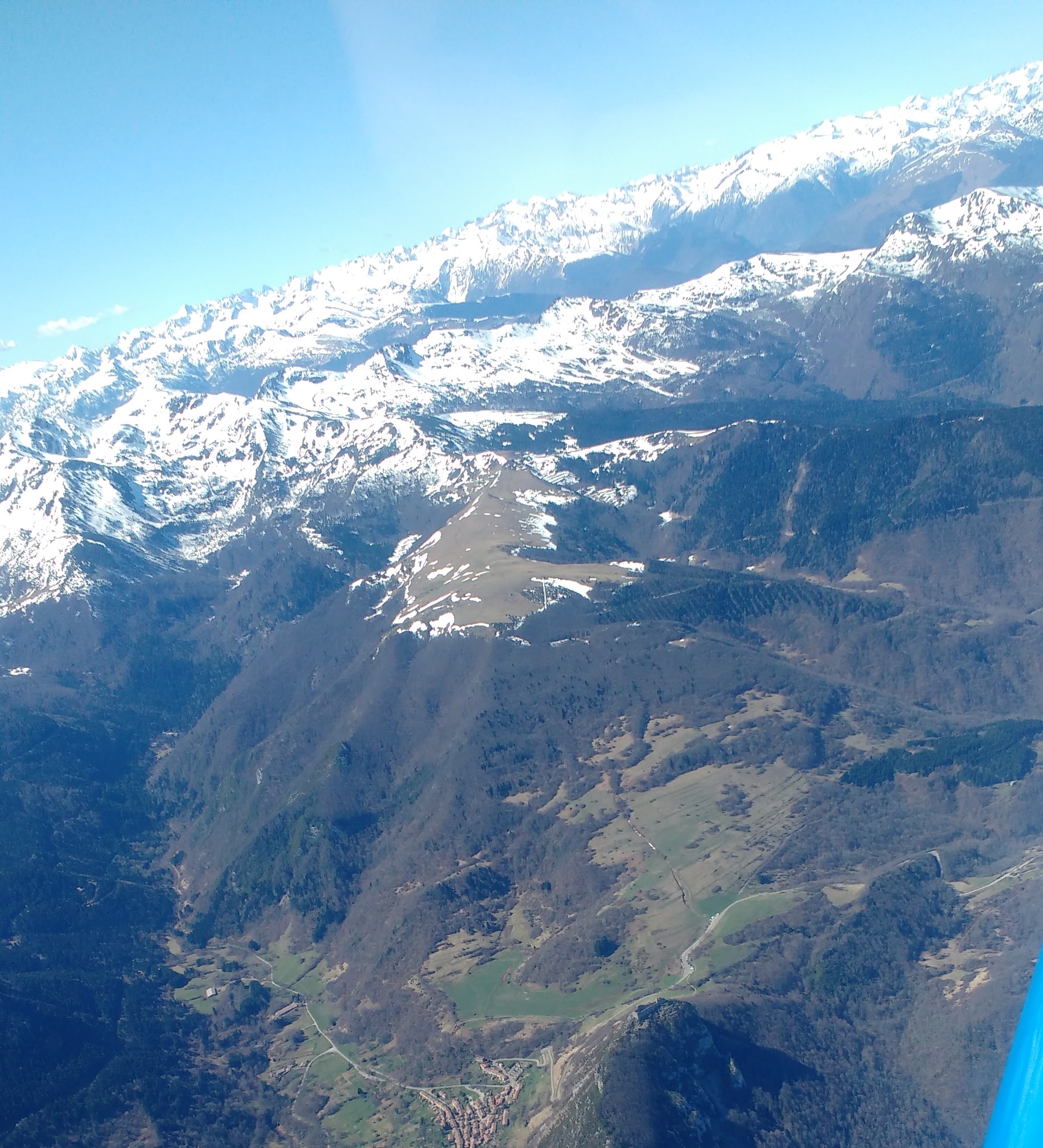
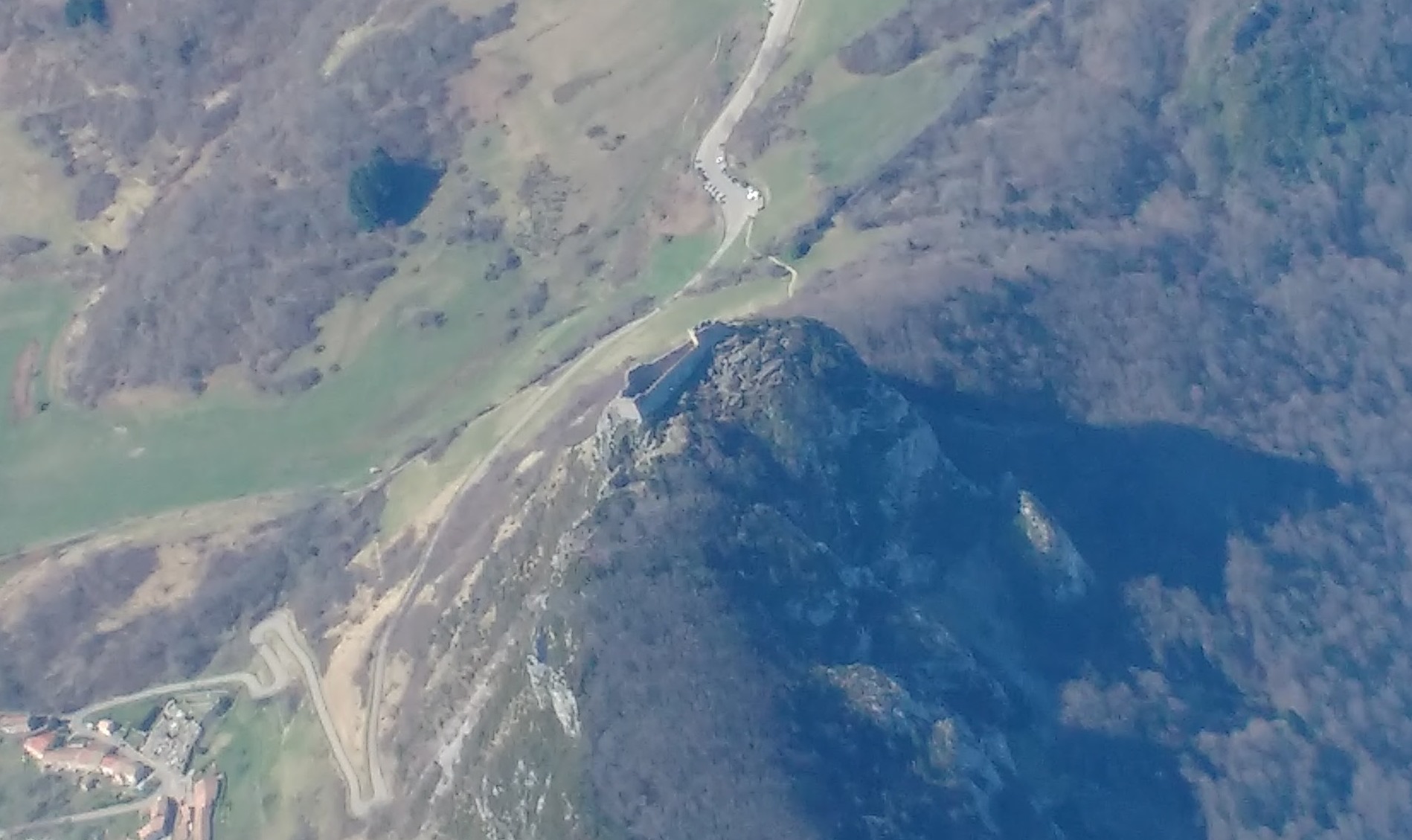
Approaching the Pyrenees, we flew over the old castle of Montsegur, which we had already seen before when we flew over the Cathar castles. See below a couple of pictures, in context and in detail.
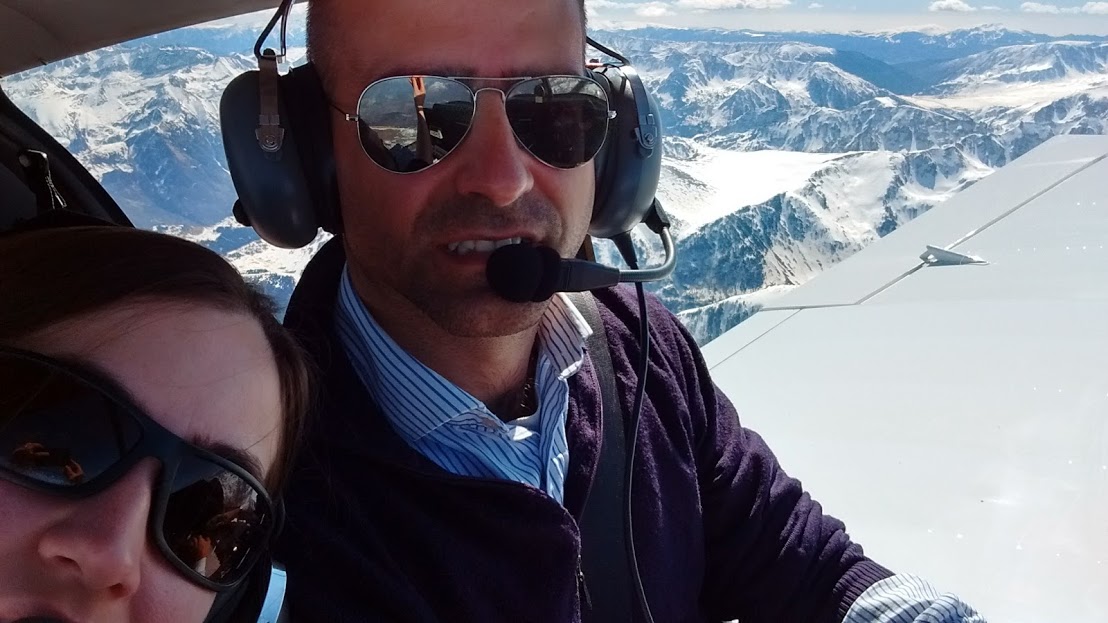
Once up there, we just enjoyed some minutes of flying around, spotting skiing stations, seeing possible routes through the mountains towards Andorra and Spain, enjoying the breathtaking views, taking a few pictures…
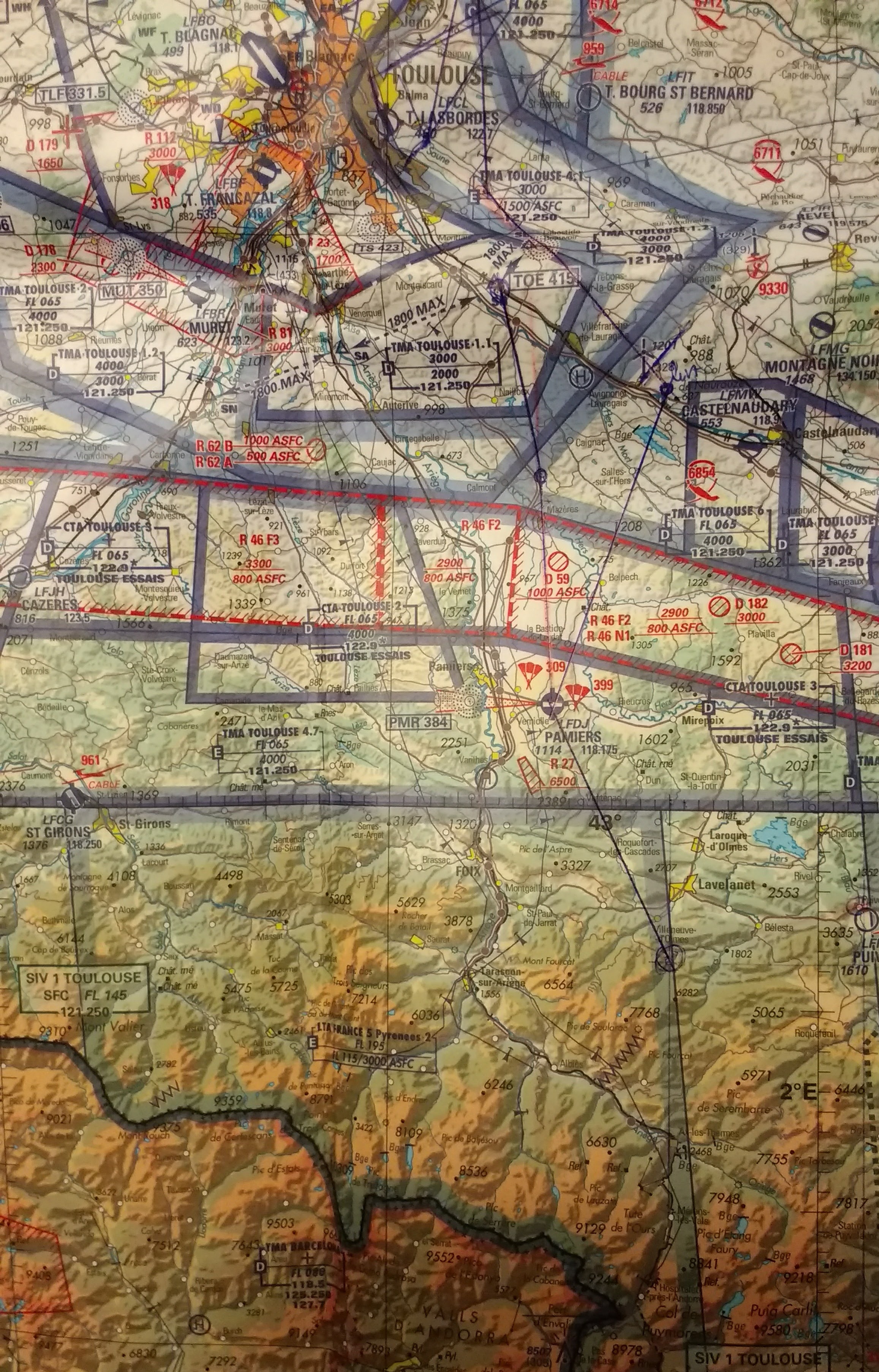
Finally, see below the navigation chart with the route followed marked on it and the navigation log as used. The total engine running time of the excursion: 1h28′.
A few days ago, I had a short Twitter exchange with a couple of friends on objectives. Sara mentioned that she was not setting objectives for the New Year. Nacho made a point of my objective tracking approach, which I detailed in a post in the blog back in 2011 (Personal mid-year review). Unfortunately (or fortunately) I do not follow such a thorough approach anymore (1), though I do set myself some personal yearly objectives, have them noted down, track them, etc.
In that post from 2011, I made reference to a previous post in which I commented on a HBR study and a post post by Sid Savara. The main takeaways from those readings were: have the goals in written, have plans towards achieving them and share the objectives with someone (at least with someone you have confidence with, not necessarily with everyone!).
In this post I quickly wanted to share some examples of the objectives I set to myself (2):
Reading: as I mentioned in a previous post in which I shared a summary of (my) 2015, I set myself a minimum objective of reading 10 books a year. I do not read any book for the sake of meeting the objective. It is rather that I have dozens of very much dear books in the shelves waiting to be read and I keep buying (and grabbing from my parents’ home) books that I think would teach me something or add some value. Ideally, I would like to read about 2 books a month. That would make over 20 books in a year, however, during some periods along a year I read less often, I found that I am not that fast reader (in English and French and neither in Spanish!) nor all the books that I pick are that easy or short, so I linger every year around the 10 books. Do I share the objective? Up to now, not explicitly, though I force myself to write at least a yearly post commenting the books I have read… thus, I do have to read them! Follow up: it is not very structured, though I know at any moment the books I have read along the year (I keep a record) and every now and then make some numbers of pages to be read per day, per week, in order to complete this or that book at a given point in time.
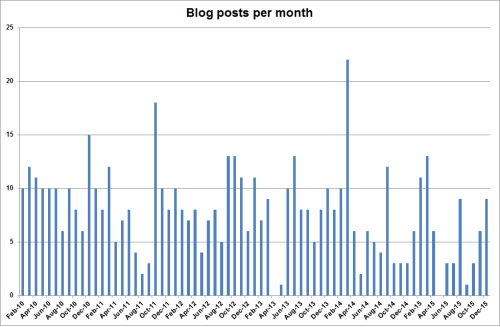
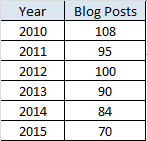
Writing: here I always remember a tip from Conor Neill, a professor at IESE, who says that we should strive to write something everyday, at least 500 words (see the blog post where he explains the benefits of doing so, Writing to reflect. Mindful leadership). In my case, apart from job emails, files, presentations…, I do not write (and reflect on) for this blog (or any other format) on personal interests everyday. Ever since I started the blog, back in February 2010, I intended to write regularly. What does that mean? Initially I aimed at publishing 8 posts per month, I lowered this target lately to about 6 posts per month. That would make about 70 a year. In 2015 I just met that target. Previously I had always been above 80 posts. See below the monthly production.
Speaking: on this front I was very consistent when I joined Toastmasters in December 2007, trying to give a public speech every two months. I kept being quite engaged until more or less mid 2012. I then dropped Toastmasters until I re-engaged myself in mid 2014 at the corporate club of Airbus in Toulouse. I am now trying to figure out the pace at which the club attendance allows and I am able to prepare myself to speak often (by speaking I refer to giving prepared speeches, as every two weeks in the club almost everyone gets to speak either with a role of evaluator, in table topics, etc). Thus, a vague objective (speaking regularly), not quantified, not yet in written, though shared.
Flying: for this objective scheduling is key. As I mentioned in the post where I shared my path to the private pilot license (PPL), it took me 4 years to obtain it mainly due to the difficulty in finding slots. From March 2015 (once I had passed the theoretical exam) I was more rigorous, always trying to have at least two slots scheduled with the instructor and airplanes booked at any point in time. This enabled that, even if many slots had to be cancelled due to weather conditions (or any other issue), I was more regular with the flying, I managed to obtain the license and fly over 19 hours. For the 2016, the goal is clear: to fulfil the requirements to maintain the license, that is 12 flight hours with 6 take offs and landings in the last 6 months prior to the license expiry date. On top of that, in order to carry passengers it is required to have completed 3 take offs and landings in the previous 90 days. Thus, the requirements by law help you in aiming at flying often. On the other hand, I was trained to fly on Robin DR 400 airplanes and another objective I have is to learn to fly another model, Diamond DA20 in order to have more flexibility with the scheduling of airplanes and be able to fly often… how often is often? At least a flight per month (ideally 2), about 2 flight hours a month… this objective, then, is well followed up with the aeroclub scheduling tools, navigation logs, etc.
Running: with the running I have many and varied objectives. From running (e.g.) 2,000 km in a year, to completing at least 2 marathons a year, to beating personal best times (PBs) in different distances (10k, half marathon and marathon), to other miscellanea objectives (e.g. running x days in a given week, y kilometres in a given week or month, running some special race, running a number of days while on holidays…). For the completion of marathons and aiming at PBs I do schedule training plans at the online tool provided by Garmin (the provider of the GPS watch I use). Thus, the objectives are clearly defined, shared (with Luca, colleagues, in social media) and well followed up.
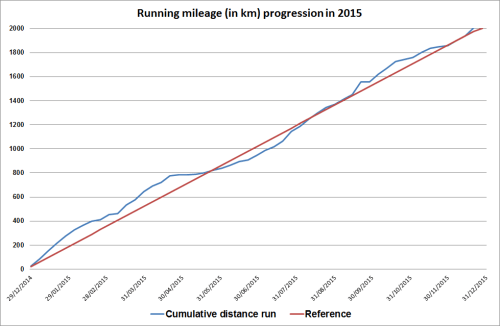
And it is here that I wanted to stress on the definition of the goal, its writing and its sharing. I will take the objective “running 2,000 km”. In 2014 I started to publish online in Twitter regularly both the goal and how I was progressing.
With the online tool I have the objective clearly written down and tracked, I know whether I am ahead or behind, the weekly or monthly mileage needed to attain the goal, etc. The sharing of the goal in my inner circles helps with the finding slots to run. The sharing of the goal more widely encourages and pushes oneself. See below how I reached the objective in 2015. You can see that while the training towards Seville (February) and Madrid (April) marathons lasted I was well ahead the reference. After those marathons took place I fell behind, even if I only fully stopped for a week after Madrid marathon. I kept running below the reference weekly mileage until the end of June, when I was 70km behind… I then subscribed for Millau (September) and started building up mileage for it, then extended the training up to Toulouse marathon (October), stopped only 3 days after it and, since then, I always was around or over the reference to attain the goal (even if I had to stop for over a week at the end of November due to a cold that got me down with severe throat ache).
***
It is clear that each one has a different approach and there is not a single one that fits us all. Many will not want to be constrained by fixed goals, nor be reminded of them by having them written, even less sharing some goal they are unsure to meet, not to talk about publishing it on social media! This is just how I go about trying to meet some personal objectives.
—
(1) At least not for every objective and plotting a global indicator.
(2) These goals are easy to share others are kept in the inner circles.







































 The Blog by Javier