Tag Archives: investing

Resist the bias to act

Some days ago I tweeted about the swings of Mr. Market lately. The consideration of the stock market as Mr. Market is a metaphor that we owe it to Benjamin Graham.

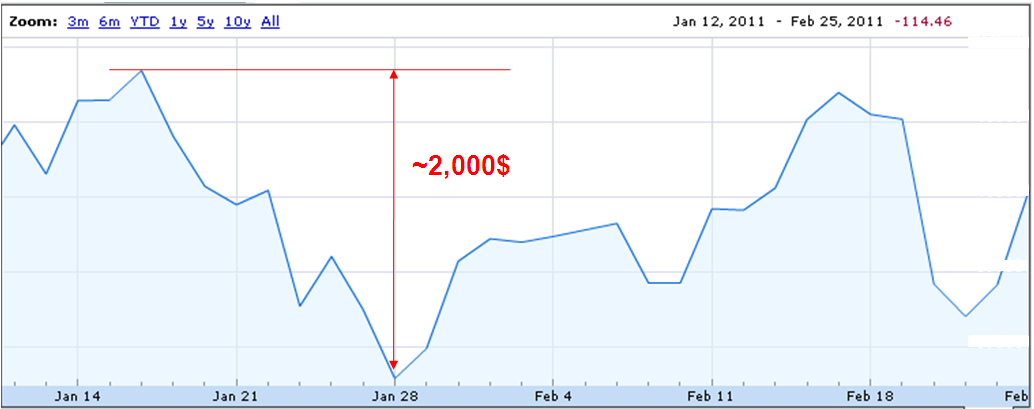
Since a picture is worth a thousand words, I wanted to share a snapshot of the swings of our “J&L” ( 😉 ) portfolio in the past few weeks. One could read the picture as “you have lost 114$ in the past weeks”. That same person on January 28th would have said “you’ve lost 2,000$ in the last 10 days”.

"Resist the human bias to act", Charlie T. Munger

In fact we have not lost a nickel in these weeks, since we haven’t sold any stock. I love a quote from Charlie T. Munger, Berkshire Hathaway vice chairman, which goes: “Resist the natural human bias to act”.

You actually don’t need to buy or sell stock when the market is in the mood. It is as easy as not doing it. You may buy only when you see a margin of safety and sell only when the stock has reached what you considered it to be at its intrinsic value.

You can see that in these 5 weeks we could have lost up to 2,000$ twice; we didn’t. The only tools we counted with: patience and not “listening to Mr. Market”.

Precisely today, it is published the letter of Warren Buffett to Berkshire shareholders. Whether you are planning to invest in stocks or only want to have a fun read, take a look at it.

2 Comments

Filed under Investing

My investment fund

After two years of investing for fun, I was troubled because neither the ING internet banking tool nor Google Finance enabled me to correctly monitor the profitability of our investments.

  • Google Finance shows each new addition of capital as an increase of assets (price) in the same way as if a particular stock had increased its market price. So after a year our portfolio showed an increase of 97%… but most of it was due to new additions of capital.
  • While with ING, each time we added some cash it lowered the profitability as it went directly to the denominator of the equation (the same happens with Google Finance “gain”).

I discussed this with Luca, read a little bit and then I found out that the best way would be to treat ourselves as a mutual open-ended fund (fondo de inversión). I had to define a net asset value per share (valor liquidativo de la participación) at the beginning of the period and then treat each addition of capital as an issue of new shares to ourselves.

After spending sometime digging in the files and emails of the past two years, reading a bit about how to treat these values, etc., from now on we can readily compare at any moment our “J&L investment fund” with any other fund, stock or index. So did I…

If we had a commercial mutual fund we would announce ourselves with something like:

  • In the year 2010 the gains of the fund were +22.8% compared to
    • S&P 500 ~ +13% (target index)
    • Dow Jones ~ +11%
    • NASDAQ ~ +17%
    • IBEX 35 ~ -17%
    • Euro Stoxx 50 ~ -10%
  • The gains of the fund since its creation in January 2009 have been +86.6%, with a compounded annual gain of +37.6%.

Not bad.

Nevertheless, if we compare it to the leading Spanish value investing fund managers from Bestinver, in 2010:

  • Bestinfond ~ +19%;
  • Bestinver Internacional ~ +26%;
  • Bestinver Bolsa ~ +5%

Since January 2009 both Bestinfond and Bestinver Internacional have fared better than “J&L”, though not Bestinver Bolsa.

Today, now that is already defined, the net asset value per share is 57.19€… however “J&L fund” is not yet that open-ended: it’s open to our own additions to the fund but not to third-party capital… maybe in a couple of years we go and set up an investment club or fund :-).

After reading Ben Graham’s book “Intelligent Investor” I wanted to give it a try with investing, this is why I invest in stocks myself, but, clearly, if you are tempted to follow third-party advice, rumours, tips, etc., you’ll be better off just investing in a low-cost index fund (a strategy described by Burton G. Malkiel’s book “A Random Walk Down Wall Street”) or take a look at the above-mentioned value investing managers.

NOTE: “J&L fund” numbers are pre-tax of capital gains, include dividends (after-tax) and are net of transaction costs & commissions.

10 Comments

Filed under Investing

Venture Capital & Crowdfunding

I started giving loans through Kiva almost two years ago. About at the same time, after gathering some savings, I started investing again in the stock market.

Last month, I attended TEDxMadrid, where Nicolás Alcalá explained how a movie he and his team are working on (“El Cosmonauta”) will be financed through crowdfunding. I then discussed with a friend that precisely I was looking for a similar approach, but applied to general businesses: a kind of Kiva for for-profit start-ups.

Subsequently, I first found Kickstarter about a month ago through Fred Wilson (@fredwilson). However, in Kickstarter the funders of projects are not entitled to equity in the venture nor a share of the future profits. The funders get some merchandising or recognition for the helping hand they have given, depending on the amount they have invested.

Then I found GrowVC.

From what I gathered, this is more or less what I was looking for: a way to invest some small amount of cash (~1,000$ a year) together with other funders into a larger pool that will act as a Venture Capital operation, sharing the future profits of the business that was funded.

With this post I wanted to share these initiatives with you and also to explain what I was looking for. Now, let me throw an open question to readers: anyone knows a similar concept that I may be interested in? If so, please, let me know.

(Bear in mind that I haven’t got, yet, hundreds of thousands of Euros to invest following this approach… the larger part is invested in a much more Graham-like defensive approach)

8 Comments

Filed under Investing

The Snowball, Warren Buffett bio (book review)

Last Christmas, my brother gave me “The Snowball: Warren Buffett and the Business of Life“, by Alice Schroeder. He completely hit on the spot, though I only started reading it during last August holidays (Luca also started reading it to the point that she ended up buying her own Kindle version of it!).

The book is a thorough review of Buffett’s life, including relationships with family & friends and investment decisions. I had previously read other books about Buffett, but they were merely about his investment “strategy” so to say, nothing compared to this one. To complete the book, the author made over 250 interviews, so you can imagine the many insights contained in it.

There are many lessons or just ideas that can be taken from this book. Let me just point the few I can recall at the moment of writing this post:

  • The Inner Scorecard: the idea of acting and valuing yourself according to what you care about and not according to what others’ deem important.
  • The concept of margin of safety: from Benjamin Graham (recommended reading “The Intelligent Investor“).
  • Circle of competence: the idea of looking for simple business that have an enduring competitive advantage (technology companies are not that simple).
  • Cigar butts: companies which are worth more “death than alive” (looking for cheap price to book).
  • Snowball: the idea that compounding interest acts as a snowball falling down the hill, the sooner you start the larger the ball will be down the road (thinking about retirement here).
  • The story of the genie: or that you should invest in your own health as your body is the only one you are going to be given in this life.
  • The Ovarian lottery and the idea that philanthropy achieves more if exercised now and trying to maximize its impact.

Throughout the book you get to learn about many great entrepreneurial characters (e.g. Rose Blumkin, Bill Gates); about the workings of the board of directors of some companies (e.g. Coca Cola, Berkshire Hathaway); about some of the most impressive falls in corporate history (e.g. Solomon Brothers, Long Term Capital Management); about several depressions, recessions and crisis; and above all you learn about what were the thoughts and calculations behind some of Buffett’s investments decisions since the early 1940’s to date.

I definitely recommend this book (700+ pgs.).

5 Comments

Filed under Books, Investing

Monkey Investors

Just a few weeks ago I wrote a post about the Wall Street Monkey. Remember that the story was based on Burton G. Malkiel’s book, “A Random Walk Down Wall Street”, where he suggested that a blindfolded monkey throwing darts to select stocks wouldn’t do worse than professional fund managers.

I watched yesterday TED Talk by Laurie Santos, “A monkey economy as irrational as ours”, where she explains how she studied whether our mistakes were due to a badly designed environment or badly designed minds.

She made several studies with apes, introducing the use of money to them… and she found that apes show the same irrational behaviours regarding risk taking as we humans do…

I loved especially the following passage around minute 16:30…

“… we can actually give the monkeys a financial currency and they do very similar things we do. They do some of the smart things we do, some of the kind of not so nice things we do like stealing and so on… but they also do some of the irrational things we do; they systematically get things wrong and in the same ways that we do.

This is the first take-on message of the top… if you saw the beginning of this and you thought: “…oh! until I go home and hire and put a monkey as financial advisor … they were cuter than ours…”, don’t do that: they’re probably gonna be just as dumb as the human one you already have!

At least, apes would charge us less… just a couple of grapes.

“A monkey economy as irrational as ours”, by Laurie Santos.

1 Comment

Filed under Books, Investing

Ask octopus Paul to invest for you

By now, everybody probably has heard about the octopus Paul picking winners of World Cup football matches. So far, it got right all the results of Germany. Today it picked Spain as winner of the final next Sunday. See the video of its memorable performance in CNN.

First thought: what a monumental charade this is! Second thought I had today at work: what if Paul was picking stocks for an investment fund?

The thought is not that out of the box: Burton G. Malkiel in his 1973 book, “A Random Walk Down Wall Street” (which I strongly recommend), suggested that a blindfolded monkey throwing darts to select stocks wouldn’t do worse than professional fund managers.

The Wall Street Journal went a step further and tried to prove the point. They did so organizing the 6-months Dartboard contest in 1988, a contest that continued along 14 years in more than a hundred 6-months periods. They didn’t use a monkey but the newspaper staff and they weren’t blindfolded. Nevertheless, the stock picks were quite random. See the explanation of that fun story in this article from Goergette Jansen a few months before the contest was to be finished in 2002.

So, how did the “monkey” do against the pros? Dartboard picks won the contest 39% of the times while pros won 61% of them. So, the pros got better results the majority of the time. Nevertheless, think that 39% of the times you would have been better off leaving your investments decisions to the darts, a monkey or octopus Paul (call it the way you want) than professional managers who get paid to maximize your returns… uh.

After those 14 years, pros racked up an average of 10.2% gain while the darts got a 3.5% gain (this is way better than my company-sponsored BBVA pension fund…).

So, next time you jokingly comment on Paul, think that you might as well ask him where to put your money and even get better results than when listening to the advice of the broker of your bank…

2 Comments

Filed under Books, Investing

A house is no investment

In a previous post I commented that in times of crisis it was much better to have your investment in real assets than in government bonds. I gave the typical examples given by Bestinver managers: real assets being portions of an enterprise (stocks), chairs, and pencils, even houses

While this is true in order to make sure you keep the value of your assets through the crisis period, it is another story when we are talking about investing as in “To commit (money or capital) in order to gain a financial return”. Then I dare to say that buying a house is no investment. When buying a house there are not goods or services produced for others in the hope of a profitable sale; so if someone buys it in the hope of realising some profit that is pure speculation.

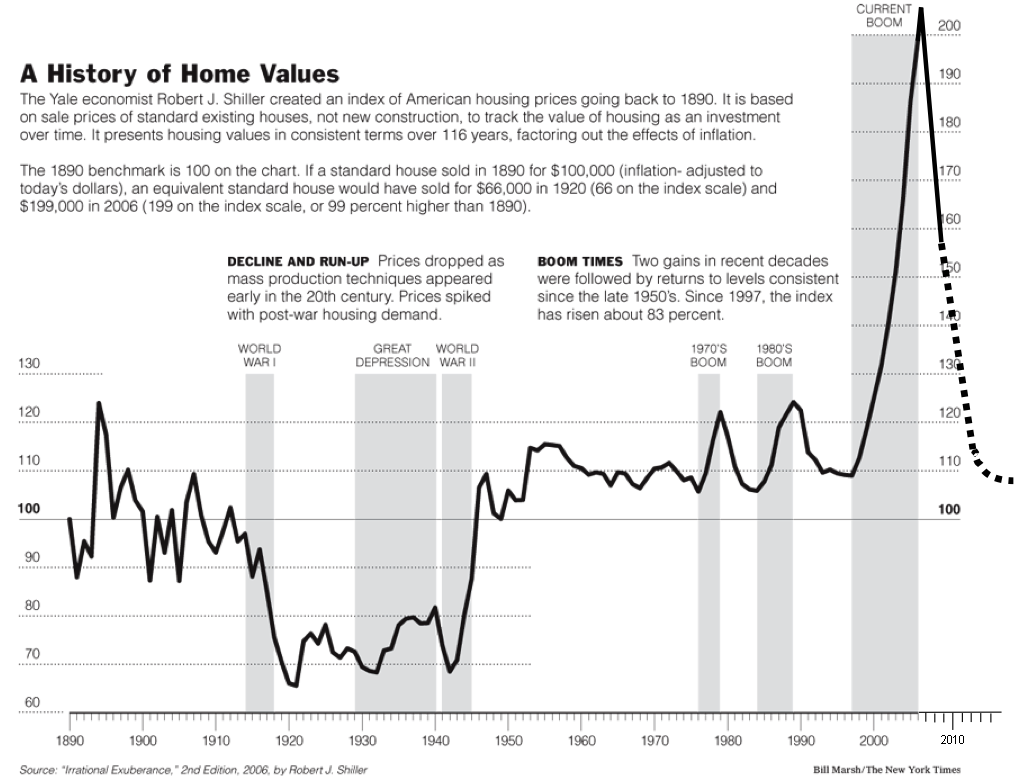
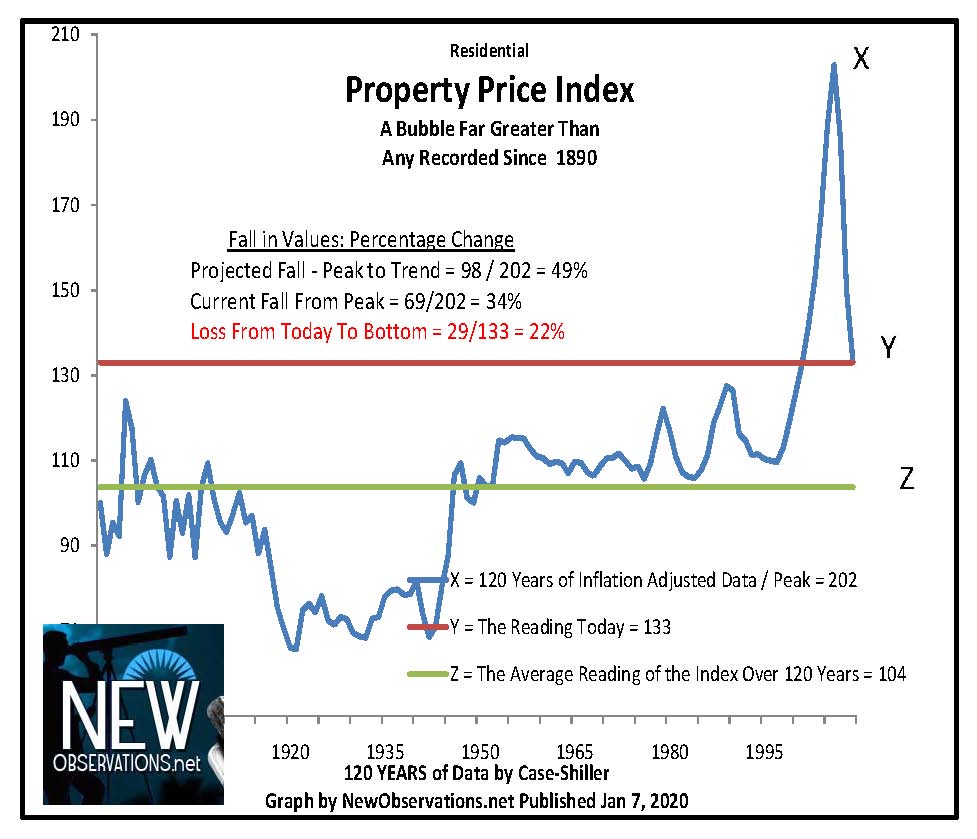
After having said this, I wanted to share two graphics from Case-Shiller Home Price Indices for American houses since 1890… In the first graphic you can see that after adjusting for inflation at the end of the 20th century, in absence of crisis and booms the value of a house was nearly the same than 100 years before, merely 10% higher. Why should it be higher if no goods/services are produced? Then you can see the boom that took place in the 2000’s up to mid 2006. That was pure greed and speculation.

Case-Shiller Home Price Indices for American houses, 1890-2006.

In the second graphic you may see the prediction made based on Case-Shiller Home Price Index. The prediction is pretty simple: there is no reason to forecast that homes prices have to stabilise at a higher point than the average of the past 120 years… other way to say that a home does not generate any value (still, it doesn’t destroy value either!).

Case-Shiller Home Price Indices for American houses, 1890-2009 and forecast.

4 Comments

Filed under Economy, Investing

Stocks vs. Bonds, 200 years

Some weeks ago I had two different conversations with friends. The issue: whether Greek bonds would be a good investment given the yields they are being offered at. I then argued that I didn’t think it was a safe investment, that many countries had defaulted payments, and as a value investor in the making I tried to explain that a much better investment would be to find out there some great stocks at a big discount.

I was also looking for some graphics to send them to prove the point. I had seen those graphics at the annual investors’ forum of the asset management firm Bestinver in different years. They represented how different the outcome of an investment would be for a person living either in Germany in the 1920-30’s or in Argentina in the last 15 years in case this person had invested in the stock market or in government bonds, supposedly safer.

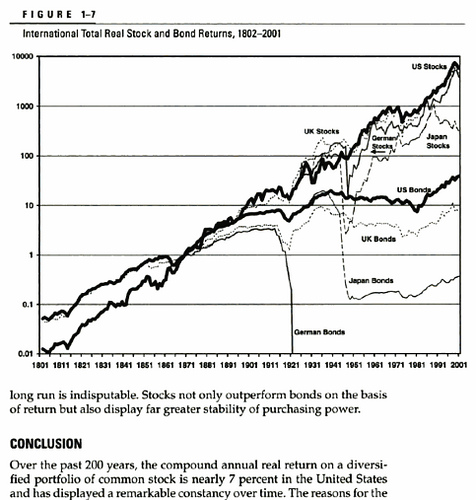
In both cases the investment is much better off when it’s composed of stocks, as they represent a portion of a real company that continues to operate after the crisis and the currency devaluation/hyperinflation period that typically follows. The value of the investment in bonds is suddenly reduced to nearly zero… At that time I didn’t find any of those graphics in the Net, but the other day I found a similar one. Here it goes (note the scale is logarithmic):

Stocks vs. Bonds, 200 years comparison.

Please, note the difference especially between German and Japanese bonds and stocks. But also with US and UK stocks and bonds the difference persists.

The managers of Bestinver year after year repeat the same example: in those situations is much better to be invested in real assets, be it portions of an enterprise (stocks), chairs, and pencils, even houses… all these are assets that once the crisis is over will retain the value they have. However the paper money has no value once the nominal value is devalued.

2 Comments

Filed under Economy, Investing