Category Archives: Books

Lincoln and U. S. Grant on the preservation of the Union

Yesterday I read an article about president Abraham Lincoln (here, in Spanish, by Mario Muchnik) that reminded me the words you can hear in the Lincoln Memorial at the Mall in DC where he stresses that is objective was not to end slavery but to preserve the Union. I went to look for the exact words (source here):

I would save the Union. I would save it the shortest way under the Constitution. The sooner the national authority can be restored; the nearer the Union will be “the Union as it was.” If there be those who would not save the Union, unless they could at the same time save slavery, I do not agree with them. If there be those who would not save the Union unless they could at the same time destroy slavery, I do not agree with them. My paramount object in this struggle is to save the Union, and is not either to save or to destroy slavery. If I could save the Union without freeing any slave I would do it, and if I could save it by freeing all the slaves I would do it; and if I could save it by freeing some and leaving others alone I would also do that. What I do about slavery, and the colored race, I do because I believe it helps to save the Union; and what I forbear, I forbear because I do not believe it would help to save the Union. I shall do less whenever I shall believe what I am doing hurts the cause, and I shall do more whenever I shall believe doing more will help the cause. I shall try to correct errors when shown to be errors; and I shall adopt new views so fast as they shall appear to be true views.

[Excerpt from a response letter from Lincoln to Horace Greeley]

These words reminded me of a passage by Ulysses S. Grant, the Union general (commanding general at the end of the civil war) and later 18th President, which I had read in his Personal Memoirs. I wanted to share it here:

Up to the Mexican war there were a few out and out abolitionists, men who carried their hostility to slavery into all elections, from those for a justice of the peace up to the Presidency of the United States. They were noisy but not numerous. But the great majority of people at the North, where slavery did not exist, were opposed to the institution, and looked upon its existence in any part of the country as unfortunate. They did not hold the States where slavery existed responsible for it; and believed that protection should be given to the right of property in slaves until some satisfactory way could be reached to be rid of the institution. Opposition to slavery was not a creed of either political party. In some sections more anti-slavery men belonged to the Democratic party, and in others to the Whigs. But with the inauguration of the Mexican war, in fact with the annexation of Texas, “the inevitable conflict” commenced.

As the time for the Presidential election of 1856—the first at which I had the opportunity of voting—approached, party feeling began to run high. The Republican party was regarded in the South and the border States not only as opposed to the extension of slavery, but as favoring the compulsory abolition of the institution without compensation to the owners. The most horrible visions seemed to present themselves to the minds of people who, one would suppose, ought to have known better. Many educated and, otherwise, sensible persons appeared to believe that emancipation meant social equality. Treason to the Government was openly advocated and was not rebuked. It was evident to my mind that the election of a Republican President in 1856 meant the secession of all the Slave States, and rebellion. Under these circumstances I preferred the success of a candidate whose election would prevent or postpone secession, to seeing the country plunged into a war the end of which no man could foretell. With a Democrat elected by the unanimous vote of the Slave States, there could be no pretext for secession for four years. I very much hoped that the passions of the people would subside in that time, and the catastrophe be averted altogether; if it was not, I believed the country would be better prepared to receive the shock and to resist it. I therefore voted for James Buchanan for President. Four years later the Republican party was successful in electing its candidate to the Presidency. The civilized world has learned the consequence. Four millions of human beings held as chattels have been liberated; the ballot has been given to them; the free schools of the country have been opened to their children. The nation still lives, and the people are just as free to avoid social intimacy with the blacks as ever they were, or as they are with white people.

[…]

During the eleven months that I lived in Galena prior to the first call for volunteers, I had been strictly attentive to my business, and had made but few acquaintances other than customers and people engaged in the same line with myself. When the election took place in November, 1860, I had not been a resident of Illinois long enough to gain citizenship and could not, therefore, vote. I was really glad of this at the time, for my pledges would have compelled me to vote for Stephen A. Douglas, who had no possible chance of election. The contest was really between Mr. Breckinridge and Mr. Lincoln; between minority rule and rule by the majority. I wanted, as between these candidates, to see Mr. Lincoln elected. Excitement ran high during the canvass, and torch-light processions enlivened the scene in the generally quiet streets of Galena many nights during the campaign. I did not parade with either party, but occasionally met with the “wide awakes” —Republicans—in their rooms, and superintended their drill. It was evident, from the time of the Chicago nomination to the close of the canvass, that the election of the Republican candidate would be the signal for some of the Southern States to secede. I still had hopes that the four years which had elapsed since the first nomination of a Presidential candidate by a party distinctly opposed to slavery extension, had given time for the extreme pro-slavery sentiment to cool down; for the Southerners to think well before they took the awful leap which they had so vehemently threatened. But I was mistaken.

The Republican candidate was elected, and solid substantial people of the North-west, and I presume the same order of people throughout the entire North, felt very serious, but determined, after this event. It was very much discussed whether the South would carry out its threat to secede and set up a separate government, the corner-stone of which should be, protection to the “Divine” institution of slavery. For there were people who believed in the “divinity” of human slavery, as there are now people who believe Mormonism and Polygamy to be ordained by the Most High. We forgive them for entertaining such notions, but forbid their practice. It was generally believed that there would be a flurry; that some of the extreme Southern States would go so far as to pass ordinances of secession. But the common impression was that this step was so plainly suicidal for the South, that the movement would not spread over much of the territory and would not last long.

Doubtless the founders of our government, the majority of them at least, regarded the confederation of the colonies as an experiment. Each colony considered itself a separate government; that the confederation was for mutual protection against a foreign foe, and the prevention of strife and war among themselves. If there had been a desire on the part of any single State to withdraw from the compact at any time while the number of States was limited to the original thirteen, I do not suppose there would have been any to contest the right, no matter how much the determination might have been regretted. The problem changed on the ratification of the Constitution by all the colonies; it changed still more when amendments were added; and if the right of any one State to withdraw continued to exist at all after the ratification of the Constitution, it certainly ceased on the formation of new States, at least so far as the new States themselves were concerned. It was never possessed at all by Florida or the States west of the Mississippi, all of which were purchased by the treasury of the entire nation. Texas and the territory brought into the Union in consequence of annexation, were purchased with both blood and treasure; and Texas, with a domain greater than that of any European state except Russia, was permitted to retain as state property all the public lands within its borders. It would have been ingratitude and injustice of the most flagrant sort for this State to withdraw from the Union after all that had been spent and done to introduce her; yet, if separation had actually occurred, Texas must necessarily have gone with the South, both on account of her institutions and her geographical position. Secession was illogical as well as impracticable; it was revolution.

Now, the right of revolution is an inherent one. When people are oppressed by their government, it is a natural right they enjoy to relieve themselves of the oppression, if they are strong enough, either by withdrawal from it, or by overthrowing it and substituting a government more acceptable. But any people or part of a people who resort to this remedy, stake their lives, their property, and every claim for protection given by citizenship—on the issue. Victory, or the conditions imposed by the conqueror—must be the result.

In the case of the war between the States it would have been the exact truth if the South had said,—”We do not want to live with you Northern people any longer; we know our institution of slavery is obnoxious to you, and, as you are growing numerically stronger than we, it may at some time in the future be endangered. So long as you permitted us to control the government, and with the aid of a few friends at the North to enact laws constituting your section a guard against the escape of our property, we were willing to live with you. You have been submissive to our rule heretofore; but it looks now as if you did not intend to continue so, and we will remain in the Union no longer.” Instead of this the seceding States cried lustily,—“Let us alone; you have no constitutional power to interfere with us.” Newspapers and people at the North reiterated the cry. Individuals might ignore the constitution; but the Nation itself must not only obey it, but must enforce the strictest construction of that instrument; the construction put upon it by the Southerners themselves. The fact is the constitution did not apply to any such contingency as the one existing from 1861 to 1865. Its framers never dreamed of such a contingency occurring. If they had foreseen it, the probabilities are they would have sanctioned the right of a State or States to withdraw rather than that there should be war between brothers.

The framers were wise in their generation and wanted to do the very best possible to secure their own liberty and independence, and that also of their descendants to the latest days. It is preposterous to suppose that the people of one generation can lay down the best and only rules of government for all who are to come after them, and under unforeseen contingencies. At the time of the framing of our constitution the only physical forces that had been subdued and made to serve man and do his labor, were the currents in the streams and in the air we breathe. Rude machinery, propelled by water power, had been invented; sails to propel ships upon the waters had been set to catch the passing breeze—but the application of stream to propel vessels against both wind and current, and machinery to do all manner of work had not been thought of. The instantaneous transmission of messages around the world by means of electricity would probably at that day have been attributed to witchcraft or a league with the Devil. Immaterial circumstances had changed as greatly as material ones. We could not and ought not to be rigidly bound by the rules laid down under circumstances so different for emergencies so utterly unanticipated. The fathers themselves would have been the first to declare that their prerogatives were not irrevocable. They would surely have resisted secession could they have lived to see the shape it assumed.

I travelled through the Northwest considerably during the winter of 1860-1. We had customers in all the little towns in south-west Wisconsin, south-east Minnesota and north-east Iowa. These generally knew I had been a captain in the regular army and had served through the Mexican war. Consequently wherever I stopped at night, some of the people would come to the public-house where I was, and sit till a late hour discussing the probabilities of the future. My own views at that time were like those officially expressed by Mr. Seward at a later day, that “the war would be over in ninety days.” I continued to entertain these views until after the battle of Shiloh. I believe now that there would have been no more battles at the West after the capture of Fort Donelson if all the troops in that region had been under a single commander who would have followed up that victory.

There is little doubt in my mind now that the prevailing sentiment of the South would have been opposed to secession in 1860 and 1861, if there had been a fair and calm expression of opinion, unbiased by threats, and if the ballot of one legal voter had counted for as much as that of any other. But there was no calm discussion of the question. Demagogues who were too old to enter the army if there should be a war, others who entertained so high an opinion of their own ability that they did not believe they could be spared from the direction of the affairs of state in such an event, declaimed vehemently and unceasingly against the North; against its aggressions upon the South; its interference with Southern rights, etc., etc. They denounced the Northerners as cowards, poltroons, negro-worshippers; claimed that one Southern man was equal to five Northern men in battle; that if the South would stand up for its rights the North would back down. Mr. Jefferson Davis said in a speech, delivered at La Grange, Mississippi, before the secession of that State, that he would agree to drink all the blood spilled south of Mason and Dixon’s line if there should be a war. The young men who would have the fighting to do in case of war, believed all these statements, both in regard to the aggressiveness of the North and its cowardice. They, too, cried out for a separation from such people. The great bulk of the legal voters of the South were men who owned no slaves; their homes were generally in the hills and poor country; their facilities for educating their children, even up to the point of reading and writing, were very limited; their interest in the contest was very meagre—what there was, if they had been capable of seeing it, was with the North; they too needed emancipation. Under the old regime they were looked down upon by those who controlled all the affairs in the interest of slave-owners, as poor white trash who were allowed the ballot so long as they cast it according to direction.

I am aware that this last statement may be disputed and individual testimony perhaps adduced to show that in antebellum days the ballot was as untrammelled in the south as in any section of the country; but in the face of any such contradiction I reassert the statement. The shot-gun was not resorted to. Masked men did not ride over the country at night intimidating voters; but there was a firm feeling that a class existed in every State with a sort of divine right to control public affairs. If they could not get this control by one means they must by another. The end justified the means. The coercion, if mild, was complete.

There were two political parties, it is true, in all the States, both strong in numbers and respectability, but both equally loyal to the institution which stood paramount in Southern eyes to all other institutions in state or nation. The slaveowners were the minority, but governed both parties. Had politics ever divided the slave-holders and the non-slave-holders, the majority would have been obliged to yield, or internecine war would have been the consequence. I do not know that the Southern people were to blame for this condition of affairs. There was a time when slavery was not profitable, and the discussion of the merits of the institution was confined almost exclusively to the territory where it existed. The States of Virginia and Kentucky came near abolishing slavery by their own acts, one State defeating the measure by a tie vote and the other only lacking one. But when the institution became profitable, all talk of its abolition ceased where it existed; and naturally, as human nature is constituted, arguments were adduced in its support. The cotton-gin probably had much to do with the justification of slavery.

The winter of 1860-1 will be remembered by middle-aged people of today as one of great excitement. South Carolina promptly seceded after the result of the Presidential election was known. Other Southern States proposed to follow. In some of them the Union sentiment was so strong that it had to be suppressed by force. Maryland, Delaware, Kentucky and Missouri, all Slave States, failed to pass ordinances of secession; but they were all represented in the so-called congress of the so-called Confederate States. The Governor and Lieutenant-Governor of Missouri, in 1861, Jackson and Reynolds, were both supporters of the rebellion and took refuge with the enemy. The governor soon died, and the lieutenant-governor assumed his office; issued proclamations as governor of the State; was recognized as such by the Confederate Government, and continued his pretensions until the collapse of the rebellion. The South claimed the sovereignty of States, but claimed the right to coerce into their confederation such States as they wanted, that is, all the States where slavery existed. They did not seem to think this course inconsistent. The fact is, the Southern slave-owners believed that, in some way, the ownership of slaves conferred a sort of patent of nobility—a right to govern independent of the interest or wishes of those who did not hold such property. They convinced themselves, first, of the divine origin of the institution and, next, that that particular institution was not safe in the hands of any body of legislators but themselves. Meanwhile the Administration of President Buchanan looked helplessly on and proclaimed that the general government had no power to interfere; that the Nation had no power to save its own life. Mr. Buchanan had in his cabinet two members at least, who were as earnest—to use a mild term—in the cause of secession as Mr. Davis or any Southern statesman. One of them, Floyd, the Secretary of War, scattered the army so that much of it could be captured when hostilities should commence, and distributed the cannon and small arms from Northern arsenals throughout the South so as to be on hand when treason wanted them. The navy was scattered in like manner. The President did not prevent his cabinet preparing for war upon their government, either by destroying its resources or storing them in the South until a de facto government was established with Jefferson Davis as its President, and Montgomery, Alabama, as the Capital. The secessionists had then to leave the cabinet. In their own estimation they were aliens in the country which had given them birth. Loyal men were put into their places. Treason in the executive branch of the government was estopped. But the harm had already been done. The stable door was locked after the horse had been stolen.

During all of the trying winter of 1860-1, when the Southerners were so defiant that they would not allow within their borders the expression of a sentiment hostile to their views, it was a brave man indeed who could stand up and proclaim his loyalty to the Union. On the other hand men at the North—prominent men—proclaimed that the government had no power to coerce the South into submission to the laws of the land; that if the North undertook to raise armies to go south, these armies would have to march over the dead bodies of the speakers. A portion of the press of the North was constantly proclaiming similar views. When the time arrived for the President-elect to go to the capital of the Nation to be sworn into office, it was deemed unsafe for him to travel, not only as a President-elect, but as any private citizen should be allowed to do. Instead of going in a special car, receiving the good wishes of his constituents at all the stations along the road, he was obliged to stop on the way and to be smuggled into the capital. He disappeared from public view on his journey, and the next the country knew, his arrival was announced at the capital. There is little doubt that he would have been assassinated if he had attempted to travel openly throughout his journey.

[Excerpt from U. S. Grant “Personal Memoirs”, CHAPTER XVI: RESIGNATION—PRIVATE LIFE—LIFE AT GALENA—THE COMING CRISIS]

Needless to say that I encourage the reading of U.S. Grant Personal Memoirs.

1 Comment

Filed under Books, Miscellanea

Hot, Flat, and Crowded

Hot, Flat, and Crowded, Thomas Friedman.

Hot, Flat, and Crowded, Thomas Friedman.

Thomas Friedman is an American journalist who writes for The New York Times. He is specialized in foreign affairs, especially the Middle East, for which he has received 3 times the Pulitzer Prize on international reporting and commentary. Friedman wrote “Hot, Flat and Crowded” in 2008. In it he tackled the environmental issue.

In 2005 he wrote “The World is Flat”, where he argued that technological revolution had leveled the playing field and made the world more connected, more competitive and collaborative.

In this book, he claims that as we are entering the “Energy-Climate Era” the world is getting hot (global warming), flat and crowded (soaring population growth), and clear action needs to be taken to address these issues. Government need to establish a clear regulatory framework, clear price signals to establish a market in which companies can innovate to solve the problems at hand.

The author included in the book dozens of references, quotes from conversations, excerpts of speeches from leading figures, and several examples. While reading it, I felt as if the author repeated himself often and that those ideas could have been conveyed in a shorter and more direct book (~480 pages in the version I have). Nevertheless, now, a few months later, going back through different marks and notes I made throughout the book I realize the great work and reference book that he put together. I would therefore recommend the reading of the book.

I wanted to share below some of the notes I made along the book, grouped by theme.

On climate change, its science, sceptics, denials…

Harvard’s John Holdren says “A charlatan can tell a lie in one sentence that a scientist needs three paragraphs to rebut”.

A good source: Pew Research Center on Climate Change report “Climate Change 101” series.

Even if forecasts are not 100% sure about future scenarios, as Andrew C. Revkin, the New York Times environment reporter, says:

Uncertainty is the reason to act”. When you perceive some risky situation in your life or business you try to insure yourself against it, you don’t adopt the position of sitting around and say “Gosh, no one can predict with any certainty when lightning is going to hit that forest…”

On the dependency of oil, what it provokes and why it is needed to reduce it.

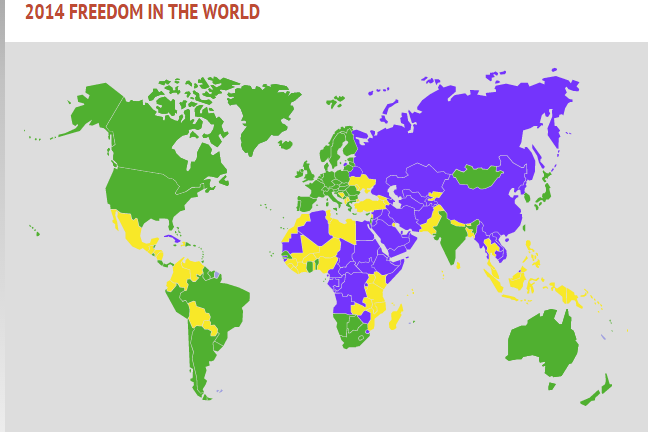
The reliance of the West in oil is helping finance a reversal of the democratic trends around the globe. What the author calls “the First Law of Petropolitics: As the price of oil goes up, the pace of freedom goes down and as the price of oil goes down, the pace of freedom goes up”.

[…]

“We are financing the US Army, Navy, Air Force and Marine Corps with our tax dollars, and we are indirectly financing with our energy purchases, al-Qaeda, Hamas, Hezbollah, and Islamic Jihad”.

After a conversation with Moises Naim, Friedman put this idea forward in an article for Foreign Policy magazine (“First Law of Petropolitics”, May-June 2006), in which he used reports “Freedom in the World” by the Freedom House and “Economic Freedom of the World Report” by Fraser Institute, to measure freedom.

Freedom in the World, by the Freedom House

Freedom in the World, by the Freedom House

A concept:

Dutch disease” refers to the process of de-industrialization that can come as a result of a natural resource windfall. The term originated in the Netherlands after the discovery of natural gas deposits in the 1960s. The influx of cash from oil make raises the nation’s goods prices making them uncompetitive to export markets and at the same time citizens buy low-cost imported manufactured goods, provoking the wiping out of the manufacturing sector.

A paper studying the same topic: “Does oil hinder democracy?” (PDF, World Politics, April 2001) by political scientist Michael L. Ross from UCLA. Using a statistical analysis of 113 states between 1971 and 1997 he found evidence of what he described as “resource trap”.

An old anecdote:

Saudi Arabian oil minister Yamani said to OPEC members in the 1970 “Remember, the Stone Age didn’t end because we ran out of stones.” It ended because people invented alternative tools made of bronze and then iron.

[I leave to you the making the connection with supply and pricing decisions from OPEC]

A reflection from former Secretary of State Condoleezza Rice stated before the Senate Foreign Relations Committee (April 5, 2006; transcript):

“I can tell you that nothing has really taken me aback more as secretary of state than the way the politics of energy is –I will use the word warping- diplomacy around the world. It has given extraordinary power to some states that are using that power in not very good ways for the international system, states that would otherwise have very little power.”

On the need to take action, to foster energy technology solutions, to create strong regulations, to create a market, etc.

A harsh view, from EcoTech founder Rob Watson:

Mother Nature is just chemistry, biology and physics. Everything she does is just the sum of those three things. She’s completely amoral. She doesn’t care about poetry or art or whether you go to church. You can’t negotiate with her, and you can’t spin her and you can’t evade her rules. All you can do is fit in as a species. And when a species doesn’t learn to fit in with Mother Nature, it gets kicked out […] every day you look in the mirror now, you’re seeing an endangered species.”

Jeffrey Immelt, CEO of General Electric, in a speech entitled “An American Renewal” (June 26, 2009), lamented the direction taken decades ago by businesses and politics:

“[…] Many bought into the idea that America could go from a technology-based, export-oriented powerhouse to a services-led, consumption-based economy – and somehow still expect to prosper”.

A positive note from John Gardner, founder of Common Cause:

“a series of opportunities disguised as insoluble problems”.

Different excerpts from Friedman’s book:

Mother Nature, the global community, your own community, your own customers, your own neighbors, your own kids, and your own employees are going to demand that you, your company, or your country pay “the total cost of ownership” for whatever you produce or consume, including “the costs that are near-term and long-term, direct and indirect, seen and hidden, financial, social, geopolitical, and environmental”.

[…]

A green revolution? Have you ever seen a revolution where no one got hurt? That’s the revolution we are having. In the green revolution we are having everyone is a winner, nobody has to give up anything, and the adjective that most often modifies “green revolution” is “easy”. That’s not a revolution. That’s a party. We’re actually having a green party. And, I have to say, it’s a lot of fun. […] It’s all about looking green. There are no losers. The American farmers are winners. They’re green. They get to grow ethanol and garner huge government subsidies for doing so, even though it makes no real sense as a CO2-reduction strategy. Exxon Mobile says it’s getting green and General Motors does too. […] I’m sure Dick Cheney is green […].”

[…]

Utilities business involves enormous sunk costs that must be recovered regardless of how much energy they sell. Utilities have vital interest in boosting electricity and gas sales to recover its fixed costs.

[…]

Price the road and clear the traffic”. If you want fewer CO2 emitters, charge people for emitting.

The International Energy Agency produced in 2000 a report “Experience Curves for Energy Technology Policy” that underscored the need of price signals from the government to quickly move down along the learning curve.

The lingering uncertainty about the long-term price of oil is also why some of the biggest energy companies hesitate to make big bets on green innovation.

[…] A strong regulation eliminates regulatory uncertainty and provides a powerful competitive incentive […] to innovate.

[…]

America needs an energy technology bubble just like the information technology bubble. It then quotes Bill Gates words at Davos in 1999 when asked whether there was an internet bubble: “Of course they’re a bubble. But you’re all missing the point. This bubble is going to attract so much new capital  to this Internet industry that it is going to drive innovation faster and faster.

[…]

We have been fooling ourselves with fraudulent accounting by note pricing those externalities with surcharges that reflect the true risks and costs that they entail.

Introduction of the concept “green hawk”. The author realized that outgreening could be a military strategy after learning of the “green hawks” movement in the US military in 2006. It all started with Major General Zilmer’s complains to the Pentagon that he needed alternatives for the diesel fuel powering electricity generators in Iraq. A study found that 90% of the diesel used at a forward operating base were employed in generation of electricity while only 10% in mobility, and 95% of that electricity was consumed to air-condition tents. A holistic view of the situation was needed. By employing different materials that provided better isolation to the heat, the Army could save fuel and thus costs and lives of soldiers trucking fuel up and down the Iraqi roads. Thus, as the articled I linked states: “oil is a tactical liability”.

Miscellanea.

An interesting note by Andrew Revkin in an article at The New York Times (September 15, 2009) “Contraception is greenest Technology”. This is linked to the “Crowded” in the title which I have barely addressed along the review, but it is worth noting that overpopulation coupled with energy usage and economic growth is a big threat to climate change.

He introduced at some point the “Green Building Rating System” developed by Leadership in Energy and Environmental Design (LEED), founded Rob Watson.

Conclusion

In the end Friedman’s call:

“The country needs to put in place what he calls the winning formula: REEFIGDCPEERPFPCA < TCOBOCG; a renewable energy ecosystem for innovating, generating, and deploying clean power, energy efficiency, resource productivity, family planning, conservation, and adaptation < the true cost of burning coal, oil, and gas.”

And a reference to this classic, the speech by 12-year-old Severn Suzuki at the 1992 Earth Summit in Rio de Janeiro.

“If you don’t know how to fix it, please stop breaking it!”

Personal note: Luca and I visited Peru in 2009. In that trip we spent some days in the Amazon. Friedman and his family apparently had been in the same place in June 2006: in Peru’s Rio Tambopata, to visit a research station. I liked the description of one of the things we loved of that experience:

Listen to the rain forest symphony outside. “It sounded like one of those dissonant pieces of modern music: a cacophony of birds, red howler monkeys, wild pigs, frogs, and insects making bizarre clicks, snorts, croaks, chirps, wails, and whistles…”

3 Comments

Filed under Books, Economy

The Roaring Nineties


The Roaring Nineties, Joseph E. Stiglitz.

The Roaring Nineties, Joseph E. Stiglitz.

Joseph E. Stiglitz (1) served and later chaired the  Council of Economic Advisers (CEA) during the Clinton Administration from 1993 to 1997. He was awarded the John Bates Clark Medal (1979) and he Nobel Prize in Economics (2001). After leaving the CEA he moved to the World Bank. He taught in the past at Stanford and now teaches in Columbia University. He also served at the OECD and several other positions to which he has been appointed throughout his career.

Stiglitz wrote “The Roaring Nineties” in 2003 to offer an insider’s view of economic policy making and the economic boom and bust of the nineties. I loved the book. I use to make some annotations and marks in the books I read. I counted the ones I made reading this book: 52.

Stiglitz is frank in admitting that all the focus that the Clinton administration had at the beginning of the term in passing laws to improve the living of the disfavored ones was suddenly put aside due to the mantra of deficit reduction. He openly regrets it several times throughout the book and offers some criticism on the administration he took part in and others before and after. Especially Reagan’s and Bush II’s.

Now, in 2014, there are many who brag about their seeing of the bubble that caused the financial crisis which burst between 2007-2009. It would be rather easy to see what they really said beforehand. See what Stiglitz published in 2003:

The huge tax cuts of 2001 and 2003 were larger than the country could afford. The surplus of 2% of GDP of 2000 was converted in short order to a deficit of 5% of deficit – a huge turnaround in a short space of time. Americans were not saving enough to finance this deficit, and so the country, in effect, turned to the rest of the world. The country is living well beyond its means, borrowing more than a billion and a half dollars a day. […]

Households took on more debt because interest rates were low and they could afford it. But as interest rates inevitably rise as the economy strengthens, households will find it difficult to service their debt. This will be further aggravated in the years to come as large budget deficit means interest rates will be higher than they otherwise would be, putting an extra burden on the country. Many households will be forced into bankruptcy. Many will be forced to rein in their consumption. There is a strong risk that the real state bubble will break, or at the very least, prices will stagnate […] What is clear, however, is thar the Bush-Greenspan strategy, entailing greater reliance on low-interest rates and mortgage refinancing to maintain the economy through the period 2001-2004, and tax cuts for the rich, providing far less stimulus to the economy than would have been provided by investment tax credits or tax cuts for the poor, was a risky one, and has put the future of the American economy in jeopardy.” (emphasis is mine)

The risk then became an issue, which is still lasting 10 years later. This comes just in the preface of the book. Stiglitz specialization is information asymmetry. He gives some examples of such asymmetry in different passages of the book when analyzing errors, incentives, etc., in accounting, auditing, special interest agendas.

Let me quote some of the gems I had marked in his book:

“[…] one of the reasons that the invisible hand may be invisible is that it is simply not there”

“[…] “Voodoo” economics of Reagan, who somehow believed that by cutting taxes you could raise tax revenues […]”

“Developing countries were told to open their markets to every imaginable form of import […]. Meanwhile, we maintained stiff trade barriers and large subsidies of our own on behalf of U.S. farmers and agribusiness, thereby denying our market to the farmers of the Third World. […]

These were not the only examples of what struck those abroad as blatant hypocrisy.”

“We scolded the developing nations about their disrespect for intellectual property laws that we, too, had scorned in our days as a developing nation. (The United States didn’t get around to protecting the rights of foreign authors until 1891)”

“[…] the folly of the Reagan tax cuts. […] a theory scrawled on the back of a napkin, called the Laffer curve – after Arthur Laffer, who then was at the University of Chicago- which claimed  that as taxes got higher and higher, people worked less hard and saved less […]”

“Over the years, I have become convinced that the confidence argument is the last refuge of those who cannot find better arguments; when there is no direct evidence that deficits directly promote recovery or adversely affect growth, then they do so because of confidence.”

“Fiscal responsibility was supposed to be the province of the conservative Republicans, but after twelve years of fiscal profligacy, a tax cut that Reagan said would pay for itself through energizing the economy but did not, it was left to Clinton to do the dirty work, without the help of the Republicans, who voted unanimously against Clinton’s deficit reduction plan. Their opposition confirmed the more diabolic interpretation of the Reagan tax cuts. They didn’t really believe in supply-side economics, the theory that the tax cut would spur the economy so much that tax revenues would actually increase. Instead, they knew that there would be shortfalls, and they hoped that the shortfalls would force a cutback in government spending. The true agenda was thus to force large cutbacks in the size of government […]”

“[…] the IMF was founded, under the intellectual aegis of Keynes: to provide with the money necessary for expansionary fiscal policy in an economic downturn. But the IMF has forgotten its original mission […]”

“The New Economy-the innovations which continue to fuel the productivity growth and form the basis of this country’s long-run strength depend on the advances of science, on researches at universities and research labs, who work sixteen-hour days and more in the tireless search to try to understand the world in which we live. These are the people we should have been rewarding, and encouraging.”

I think that with these excerpts you get a glimpse of the directness of the book. It touches economic policies, creative accounting and accounting standards, conflicts of interests, incentives, the case study of Enron, employment, the role of central banks, the danger of quick adoptions of deregulation, corporate hypocrisy, globalization…

I strongly recommend the reading of this book (about 380 pages).

(1) You may follow him in Twitter.

3 Comments

Filed under Books, Economy

El amor en los tiempos del cólera

El amor en los tiempos del cólera.

El amor en los tiempos del cólera.

Cuenta Gabriel García Márquez que al escribir “El amor en los tiempos del cólera” se inspiró en parte en el romance de sus padres (“La única diferencia es que mis padres se casaron. Y tan pronto como se casaron, ya no eran interesantes como figuras literarias”) y otro de unos ancianos que mantuvieron su amor en secreto durante décadas.

La novela fue publicada en 1985, tres años después de que recibiese el premio Nobel de literatura (ver discurso de aceptación del premio).

Seguramente la obra más aclamada de García Márquez sea Cien años de soledad, pero a mí me ha gustado bastante más “El amor en los tiempos del cólera”: una novela romántica que describe la relación durante toda una vida entre principalmente tres personajes: Fermina Daza, su marido, Juvenal Urbino, y su eterno pretendiente, Florentino Ariza.

Personalmente, parte de la narrativa y descripciones en “Cien años de soledad” se me hicieron pesados, en “El amor en los tiempos del cólera” ha sido al contrario. Largas páginas con densos párrafos se pasan en un suspiro gracias a la cantidad de figuras retóricas que usa García Márquez y hacen de la lectura un juego. En múltiples ocasiones me he encontrado después de leer un pasaje admirando el juego de palabras que acababa de hacer el autor.

Otro de los aspectos que me ha gustado del libro ha sido la personalidad y franqueza de los personajes, principalmente de Fermina Daza.

Como siempre, cuando leo un libro lo dejo lleno de páginas marcadas, pasajes subrayados, etc., os dejo algunos aquí para incitaros a la lectura.

“- Déjame aquí -dijo-. Sí había jabón”

[Juvenal Urbino a su esposa, después de llevar meses sin hablarse y durmiendo en habitaciones separas por una estúpida discusión, se retracta de su posición inicial aun sabiendo que tenía razón con tal de quedarse en la cama de matrimonio]

***

“… por su carácter, las cartas de ella eludían cualquier escollo sentimental y se reducían a contar incidentes de su vida cotidiana con el estilo servicial de un diario de navegación. En realidad eran cartas de distracción, destinadas a mantener las brasas vivas pero sin poner la mano en el fuego, mientras que Florentino Ariza se incineraba en cada línea.”

***

 “Escapó por milagro de una ejecución sumaria acusado de ser un espía que mandaba mensajes en clave de sol…”

[Habiéndose decretado el toque de queda a Florentino lo encuentra y detiene una patrulla militar cantando a Fermina]

***

 “Y algo que había de ser desde entonces la razón de su vida: la convenció de que uno viene al mundo con sus polvos contados, y los que no se usan por cualquier causa, propia o ajena, voluntaria o forzosa, se pierden para siempre. El mérito de ella fue tomarlo al pie de la letra.”

[Florentino Ariza a la viuda de Nazaret]

***

“… lo primero que le preguntaron en el puerto fue cómo le habían parecido las maravillas de Europa, y ella resolvió muchos meses de dicha con cuatro palabras de su jerga caribe:

–       Más es la bulla.”

[Fermina Daza. Esto me recuerda al pensamiento que me viene cuando alguien pregunta por Madrid, qué visitar en pocos días, qué tiene de especial, etc.]

***

“… y solo entonces había comprendido que un hombre sabe cuándo empieza a envejecer porque empieza a parecerse a su padre”

***

“… lo volteó al derecho y al revés con su sabiduría de perro viejo, lo paró de cabeza, lo subió y lo bajó, lo volvió a parir como nuevo, le hizo trizas sus virtuosismos teóricos, y le enseñó lo único que tenía que aprender para el amor: que a la vida no la enseña nadie.”

[Ausencia Santander a Florentino Ariza, quien estaba escribiendo un libro de instrucciones para enamorados]

***

“Sólo ellas sabían cuánto pesaba el hombre que amaban con locura, y que quizás las amaba, pero al que habían tenido que seguir criando hasta el último suspiro, dándole de mamar, cambiándole los pañales embarrados, distrayéndole con engañifas de madre para aliviarle el terror de salir por las mañanas a verle la cara a la realidad.”

***

“… se había enredado más pronto de lo que ella creía en una maraña de convenciones y prejuicios de su nuevo mundo. Al principio tenía una frase ritual para afirmar su libertad de criterio: “A la mierda el abanico que es tiempo de brisa”.” [Fermina Daza]

***

Era un marido perfecto: nunca recogía nada del suelo, ni apagaba la luz, ni cerraba una puerta.” [Sobre Juvenal Urbino]

***

“… le contó que había estado esa tarde con su confesor, temió quedarse ciega de rabia. Desde el colegio tenía la convicción de que la gente de la iglesia carecía de cualquier virtud inspirada por Dios. […] Pero que su esposo le hubiera permitido al confesor inmiscuirse hasta ese punto en una intimidad que no era solo la suya, sino también la de ella, era algo que iba más allá de todo.

–       Es como contárselo a un culebrero de los portales – dijo.

Para ella era el final” [Fermina Daza]

***

“… la aterrorizaba la voracidad con que los objetos iban invadiendo los espacios de vivir, desplazando a los humanos, arrinconándolos, hasta que Fermina Daza los ponía donde no se vieran. […] escondía el desorden”

***

“Sin embargo, el rápido progreso de la aviación era un peligro real para todos. Ella trató de consolarlo: los buques existirían siempre, porque no eran muchos los locos dispuestos a meterse en un aparato que parecía ser contra natura.” [Floretino Ariza y Fermina Daza sobre los aviones.]

3 Comments

Filed under Books

The Early History of the Airplane

"The Early History of the Airplane", by Orville and Wilbur Wright (The Project Gutenberg).

“The Early History of the Airplane”, by Orville and Wilbur Wright.

Few weeks ago I read “The Early History of the Airplane”, by Orville and Wilbur Wright (find it in The Project Gutenberg). It is a short book or rather a compilation of 3 articles by the brothers (30 pages in the e-reader version I used). The 3 articles are:

  1. The Wright Brothers’ Aeroplane, by Orville and Wilbur Wright.
  2. How We Made the First Flight, by Orville Wright.
  3. Some Aeronautical Experiments, by Wilbur Wright.

In these articles they provide some insight into how they became attracted to the problem of heavier-than-air self-powered controlled flight, what were the difficulties they faced, what schools of thought there were at the moment (1), who influenced them, what results and experiments from others they relied upon, the experiments they performed, the results at which they arrived… and, yes, they describe their first and subsequent flights.

I would recommend the book to anyone interested in the field or the historic event, with the sole warning that the book sometimes goes a bit on the technical side (though nothing that cannot be endured for just 30 pages!).

Let me share some passages of the book to offer some insight into the quest:

“[…] yet we saw that the calculations upon which all flying machines had been based were unreliable, and that all were simply groping in the dark. Having set out with absolute faith in the existing scientific data, we were driven to doubt one thing after another, till finally, after two years of experiment, we cast it all aside, and decided to rely entirely upon our own investigations. Truth and error were everywhere so intimately mixed as to be undistinguishable. Nevertheless, the time expended in preliminary study of books was not misspent, for they gave us a good general understanding of the subject, and enabled us at the outset to avoid effort in many directions in which results would have been hopeless.”

We have to bear in mind that the problem was yet to be solved, they were exploring uncharted territory… what route to take?

“To work intelligently, one needs to know the effects of a multitude of variations that could be incorporated in the surfaces of flying machines. The pressures on squares are different from those on rectangles, circles, triangles, or ellipses; arched surfaces differ from planes, and vary among themselves according to the depth of curvature; true arcs differ from parabolas, and the latter differ among themselves; thick surfaces differ from thin, and surfaces thicker in one place than another vary in pressure when the positions of maximum thickness are different; some surfaces are most efficient at one angle, others at other angles. The shape of the edge also makes a difference, so that thousands of combinations are possible in so simple a thing as a wing.

We had taken up aeronautics merely as a sport. We reluctantly entered upon the scientific side of it. But we soon found the work so fascinating that we were drawn into it deeper and deeper. […]”

On the other hand, one may think that after all combustion engines were already in use in cars, propellers were used in ships…

We had thought of getting the theory of the screw-propeller from the marine engineers, and then, by applying our tables of air-pressures to their formulas, of designing air-propellers suitable for our purpose. But so far as we could learn, the marine engineers possessed only empirical formulas, and the exact action of the screw-propeller, after a century of use, was still very obscure. As we were not in a position to undertake a long series of practical experiments to discover a propeller suitable for our machine, it seemed necessary to obtain such a thorough understanding of the theory of its reactions as would enable us to design them from calculations alone. What at first seemed a problem became more complex the longer we studied it. With the machine moving forward, the air flying backward, the propellers turning sidewise, and nothing standing still, it seemed impossible to find a starting-point from which to trace the various simultaneous reactions. Contemplation of it was confusing. After long arguments we often found ourselves in the ludicrous position of each having been converted to the other’s side, with no more agreement than when the discussion began.”

Nevertheless, they managed to overcome all those difficulties in just 2 years…

“The first flights with the power machine were made on December 17, 1903. Only five persons besides ourselves were present. These were Messrs. John T. Daniels, W. S. Dough, and A. D. Etheridge, of the Kill Devil Life-Saving Station; Mr. W. C. Brinkley, of Manteo; and Mr. John Ward, of Naghead. Although a general invitation had been extended to the people living within five or six miles, not many were willing to face the rigors of a cold December wind in order to see, as they no doubt thought, another flying machine not fly. […]”

… but it flew!

These are all excerpts from only the first of the three articles included in the book. There are many more things for you to discover in the book about the engine constraints, the control and stability of the machine, the position of the pilot, the rail system used for the take-off run

(1) The two schools being distinguished by at which side of the problem they dedicated the attention: power flight (Langley, Maxim) versus soaring flight (Lilienthal, Mouillard and Chanute).

NOTE: For enthusiasts of aviation history, some other books or studies the brothers went through:

  • “Bird Flight the Basis of the Flying Art” and articles by Otto Lilienthal.
  • “Empire of the Air”, Louis Pierre Mouillard.
  • “Progress in Flying Machines”, Octave Chanute.
  • “Experiments in Aerodynamics”, by Samuel Pierpont Langley.

2 Comments

Filed under Aerospace & Defence, Books

Weapons of mass miscommunication

With the advent of the Internet, the email has become one of the main ways of communication both in personal and professional environments. I won’t deny the simplicity of conveying ideas, instructions, files, etc., in an email. However, I have often referred to emails as weapons of mass miscommunication.

What do I have in mind when I state that? Emails that need several clarifications, wrong interpretation of emails either or both in the spirit and the letter, emails that go unnoticed, emails that waste reading time of too many people, etc.

While reading “Seeking Wisdom: From Darwin to Munger”, by Peter Bevelin, I thought of another good weak point of emails when reflecting on the following passage on the disadvantages of scale in large institutions:

[…] as you get big, you get the bureaucracy. And with the bureaucracy comes the territoriality which is again grounded in human nature. And the incentives are perverse. For example, if you worked in AT&T in my day, it was a great bureaucracy. Who in the hell was really thinking about the shareholder or anything else? And in a bureaucracy, you think the work is done when it goes out of your in-basket into somebody else’s in-basket. But, of course, it isn’t. It’s not done until AT&T delivers what it’s supposed to deliver. […]

(excerpt from the Lecture by Charles T. Munger to the students of Professor Guilford Babcock at the University of Southern California School of Business on April 14, 1994)

SendThink back of emails and how often we may think that some piece of work is completed when we have clicked on the “Send” button. But it’s not. Not only the work might not be done, but the communication might not even have taken place even if we think so. And it will not happen until the receiver at the other end of the channel has gotten the message and gone through it. Then, the above-mentioned criticism to emails apply (unclear message, clarifications, wrong interpretations…). Thus, no matter how much effort it costs to us breaking the inertia and comfort of our quiet work place, it is much better to accompany an email with a quick immediate follow-up phone call ensuring that the communication actually happens and explaining what is expected from the receiver.

1 Comment

Filed under Books, Personal development & HR

Bean counters turned risk managers

In a previous post I wrote about the Titanic as an example of disaster of project management, drawing from a conference I attended.

At the end of the post I reminded the theory of safety in systems seen as layers of cheese with some holes in them. The speaker did not enter into risk management, but rather in communication, teamwork and leadership, nevertheless she acknowledged the side of risk management to the case.

"What management is", by Joan Magretta.

“What management is”, by Joan Magretta.

While reading the book “What management is”, by Joan Magretta, I recently came across the case of the Ford Pinto which I did not know:

In the 1970s, the Ford Pinto taught the nation the basics of cost-benefit analysis. The car had a design flaw in the gas tank that caused at least fifty-nine deaths. Rubber liners would have fixed the problem at a cost of $137 million. But careful calculations of the benefits – all costs associated with those burned and killed down to the flowers at the funeral – only added up to $49.5 million. Cost-benefit analysis said it just didn’t pay to redesign the Pinto. The lesson at the time seemed pretty clear, and many baby boomers grew up suspicious about management and its methods. […] (excerpt from “What management is”)

You may see in the article of the Wikipedia here more references to the case, including an apparently famous article at the time, Pinto Madness, which appeared in the Mother Jones magazine. Some excerpts from that article:

Because assembly-line machinery was already tooled when engineers found this defect, top Ford officials decided to manufacture the car anyway […]

For more than eight years afterwards, Ford successfully lobbied, with extraordinary vigor and some blatant lies, against a key government safety standard that would have forced the company to change the Pinto’s fire-prone gas tank. […]

Ford waited eight years because its internal “cost-benefit analysis,” which places a dollar value on human life, said it wasn’t profitable to make the changes sooner. […]

I place myself the same question again: Have we progressed since then?

And again: Today we like to think that yes. More requirements regarding safety are put into projects. Regulations are passed to ensure safety. Risk management is used as part of project management to ensure that the kind of decisions taken at the time of the Ford Pinto today they are taken without overlooking the risks behind them.

However, I wanted to remark this time the need and criticality of placing safety at the driving seat of cost-benefit analysis, of evaluating risks and mitigations, budget reductions, targets setting, etc. As Charles Munger uses to say all these frameworks and mental models together may create a lollapalloza effect, that is the confluence of incentives and biases acting together may result in the overlooking of serious risks which down the road (after the fact) would seem impossible to have been overlooked (as in the cases of the Titanic or the Ford Pinto).

I believe this takes the utmost importance especially in an industry like aerospace, where the words “safety first” cannot be just a phony industry mantra.

3 Comments

Filed under Books

Time Value of Money

In courses about finance in the past, as part of job-related investment projections, for personal investments and as part of exercises related to posts in this blog I have discounted cash flows several times. Discounted? To those not initiated: it is about the time value of money.

Many course of finance start with the explanation of time value of money. You can find Wikipedia’s article here.

I recently came across the most descriptive and ancient (to my knowledge) explanation of the concept.

A bird in a hand is worth two in the bush”, Aesop, 600 B.C.

Seeking Wisdom: From Darwin to Munger, Peter Bevelin.

Seeking Wisdom: From Darwin to Munger, Peter Bevelin.

I found it while reading “Seeking Wisdom: From Darwin to Munger”, by Peter Bevelin, in which the author retrieved a passage from Warren Buffett’s 2000 Letter to the Shareholders of Berkshire Hathaway [PDF, 93KB, pg. 13]

Leaving aside tax factors, the formula we use for evaluating stocks and businesses is identical. Indeed, the formula for valuing all assets that are purchased for financial gain has been unchanged since it was first laid out by a very smart man in about 600 B.C. (though he wasn’t smart enough to know it was 600 B.C.).

The oracle was Aesop and his enduring, though somewhat incomplete, investment insight was “a bird in the hand is worth two in the bush.” To flesh out this principle, you must answer only three questions. How certain are you that there are indeed birds in the bush? When will they emerge and how many will there be? What is the risk-free interest rate (which we consider to be the yield on long-term U.S. bonds)? If you can answer these three questions, you will know the maximum value of the bush ¾ and the maximum number of the birds you now possess that should be offered for it. And, of course, don’t literally think birds. Think dollars.

Aesop’s investment axiom, thus expanded and converted into dollars, is immutable. It applies to outlays for farms, oil royalties, bonds, stocks, lottery tickets, and manufacturing plants. And neither the advent of the steam engine, the harnessing of electricity nor the creation of the automobile changed the formula one iota — nor will the Internet. Just insert the correct numbers, and you can rank the attractiveness of all possible uses of capital throughout the universe.

Leave a comment

Filed under Books, Investing

Confusion of Confusions

Shuffling books among shelfs at home a few days ago, I came across “Confusión de Confusiones” by José de la Vega (Confusion of Confusions in English). This is a book I had referred to a couple of times in this blog but I never wrote about it.

José de la Vega was born in the province of Córdoba in Spain in around 1650. The family, Jewish, moved to today’s Netherlands to profess its faith. In 1688, he wrote Confusión de Confusiones, the oldest book ever written about the stock exchange business. The book takes the form of a dialogue between a shareholder, a philosopher and a businessman.

I read a hard cover Spanish version of the book edited by Macanaz. The editors did a great job. The book includes a ~30-pages dictionary at the end translating old Spanish words, Latin words, providing explanations for characters and places mentioned, etc. It also includes a 5-pages recap of the main advises José de la Vega provides to investors along the book.

The Amsterdam stock market at that time suffered from all the ailments that stock markets suffer today: hysteria, bulls and bears, irrationality, information asymmetry, etc. It is worth noting that the stock market at that time consisted of: one single trading place, Amsterdam, and one single company, the Dutch East India Company (Vereenigde Oost-Indische Compagnie, VOC). This may lead to think that everything should be quieter at that time, but as the author notes (1):

[…] you shall know that the Shares have three stimuli to go up and another three to go down: the status of India, the disposition of Europe and the gambling of the Shareholders. Thus, very often the news do not produce any benefit, because they take the flows to another direction.

The health of the business, the mood in the market place and the selling and buying of investors and speculators. That is all that it takes to provoke the financial ups and downs that in the end cause stock market crashes.

About the place and the way the market operated, he explained (extract from Google digitized English version, public domain, which however omits some paragraphs):

Extract from "Confusión de Confusiones".

Extract from “Confusión de Confusiones”.

To conclude with the comments on the book I will include here some of the advises from the author, first in Spanish so the readers of the blog who understand it can capture the language and then translated:

“Los necios, que de todo se afligen, de todo se lamentan, de todo se desesperan.”

“Los que están con la soga en la garganta no tienen otro cortejo que de verdugos.”

“¿Qué vale no arriesgar la hacienda, si se pierde el Alma?”

“Si el que compra algunas partidas, ve que bajan, rabia de haber comprado, si suben, rabia de que no compró más; si compra, suben, vende, gana, y vuelan aun a más alto precio del que ha vendido, rabia de que vendió por menor precio; si no compra ni vende, y van subiendo, rabia de que habiendo tenido impulsos de comprar, no llegó a lograr los impulsos.”

“En acciones no se debe dar consejo a nadie, porque donde está encantado el acierto, mal puede lucir airoso el consejo.”

“La máxima de los accionistas veteranos, es No casarse con las Acciones.”

“En perdiendo esperar, en ganando recoger.”

“Es ignorancia haberos dejado engañar, porque precediendo para la constancia tantos avisos, no pueden tener descargo los errores.”

“No quieren apercibir esta filosofía los inquietos, y como son aire, y es aire lo que tratan, para fabricar torres en el aire, juzgan que cuanto más se mueven más se exaltan, cuanto más se agitan más se calientan, y cuanto más se calientan más crecen.”

“Quien tal hace, que tal pague.”

“El punto no estaba en ver cómo se había de entrar, sino en considerar cómo se había de salir.”

… (see translations below (2))

Each of those sentences would suggest a topic for a whole post in itself; advisors, frequent trading, bubbles, short-term view, banks bail outs, etc…

The book is great, however it is quite difficult to read. Jose de la Vega lived in 1688 and was a philosopher; be prepared for the language he uses and the use of ancient History episodes to illustrate his explanations.

Finally, researching for this post I learned in the Wikipedia that the Federation of European Securities Exchanges (FESE) awards each year a prize honouring De la Vega to authors of outstanding research related to the securities markets in Europe. You can see here the list of winners of the prize.

Curiously enough, the 2013 prize went to Sophie Moinas from Toulouse School of Economics, for her paper “Liquidity Supply across Multiple Trading Venues” (jointly with Laurence Lescourret).

(1) Translations are mine, as I noted the book I have is a Spanish version of it.

(2) Translations of the advises:

“Fools, they grieve about everything, lament everything, despair with everything.”

“The ones with the rope in the throat are not courted by anyone but executioners.”

“What is it worth not to bet the house, if the soul is lost?”

“The one who buy some shares, if they, is angry at having bought, if they go up , is angry because he did not buy more; if he buys, they go up, sells, wins, and the share fly even higher than the price at which he sold, he is angry for having sold at a lower price; if he neither bought nor sold, and he sees the shares going up, he is angry because having had buying impulses, he failed to buy.”

“Regarding shares one should not give advice to anyone, because where success is haunted, it is difficult that the advice looks graceful.”

“The mantra of veteran shareholders, is Not marry the Shares.”

“When losing wait, when winning collect.”

“You have been an ignorant for having let yourself fooled, because preceding such a record of warnings, there can not be excuse for errors. “

“The restless do not want to embrace this philosophy, and like the air they are, and air is what they trade, to build castles in the air, they judge that the more they move the more exalted they are, the more agitated they are more over heated they become, and the more hotter they become they grow more.”

“He who does that, he who shall pay that.”

“The point was not in seeing how to enter in it, but in considering how to exit.”

1 Comment

Filed under Books, Investing

The NSA, the Use of Spies and The Art of War (Sun Tzu)

I reviewed yesterday the book The Art of War (by Sun Tzu) from the point of view teamwork, communication and leadership as that was the interest I had when I have read it this second time. However, there was another chapter that called my attention given the ongoing NSA spying scandal (PRISM surveillance programme) disclosed by The Guardian and The Washington Post in 2013, that was the last on of the book “The Use of Spies“:

Raising a host of a hundred thousand men and marching them great distances entails heavy loss on the people and a drain on the resources of the State. […] There will be commotion at home and abroad, and men will drop down exhausted on the highways. […] Hostile armies may face each other for years, striving for the victory which is decided in a single day. This being so, to remain in ignorance of the enemy’s condition simply because one grudges the outlay of a hundred ounces of silver in honors and emoluments, is the height of inhumanity. One who acts thus is no leader of men, no present help to his sovereign, no master of victory. Thus, what enables the wise sovereign and the good general to strike and conquer, and achieve things beyond the reach of ordinary men, is foreknowledge. Now this foreknowledge cannot be elicited from spirits; it cannot be obtained inductively from experience, nor by any deductive calculation. Knowledge of the enemy’s dispositions can only be obtained from other men.

Hence the use of spies, of whom there are five classes: (1) Local spies; (2) inward spies; (3) converted spies; (4) doomed spies; (5) surviving spies. When these five kinds of spy are all at work, none can discover the secret system. This is called “divine manipulation of the threads.” It is the sovereign’s most precious faculty. Having local spies means employing the services of the inhabitants of a district. Having inward spies, making use of officials of the enemy. Having converted spies, getting hold of the enemy’s spies and using them for our own purposes. Having doomed spies, doing certain things openly for purposes of deception, and allowing our spies to know of them and report them to the enemy. Surviving spies, finally, are those who bring back news from the enemy’s camp.

Hence it is that which none in the whole army are more intimate relations to be maintained than with spies. None should be more liberally rewarded. In no other business should greater secrecy be preserved. Spies cannot be usefully employed without a certain intuitive sagacity. They cannot be properly managed without benevolence and straightforwardness. Without subtle ingenuity of mind, one cannot make certain of the truth of their reports. Be subtle! be subtle! and use your spies for every kind of business. If a secret piece of news is divulged by a spy before the time is ripe, he must be put to death together with the man to whom the secret was told.

Whether the object be to crush an army, to storm a city, or to assassinate an individual, it is always necessary to begin by finding out the names of the attendants, the aides-de-camp, and door-keepers and sentries of the general in command. Our spies must be commissioned to ascertain these. The enemy’s spies who have come to spy on us must be sought out, tempted with bribes, led away and comfortably housed. Thus they will become converted spies and available for our service. It is through the information brought by the converted spy that we are able to acquire and employ local and inward spies. It is owing to his information, again, that we can cause the doomed spy to carry false tidings to the enemy. Lastly, it is by his information that the surviving spy can be used on appointed occasions. The end and aim of spying in all its five varieties is knowledge of the enemy; and this knowledge can only be derived, in the first instance, from the converted spy. Hence it is essential that the converted spy be treated with the utmost liberality.

[…] Hence it is only the enlightened ruler and the wise general who will use the highest intelligence of the army for purposes of spying and thereby they achieve great results. Spies are a most important element in war, because on them depends an army’s ability to move.

And then comes the scandal, the reaction of global leaders subjected to espionage, of private companies, etc.

2 Comments

Filed under Aerospace & Defence, Books