
Category Archives: Books

The Snowball, Warren Buffett bio (book review)

Last Christmas, my brother gave me “The Snowball: Warren Buffett and the Business of Life“, by Alice Schroeder. He completely hit on the spot, though I only started reading it during last August holidays (Luca also started reading it to the point that she ended up buying her own Kindle version of it!).

The book is a thorough review of Buffett’s life, including relationships with family & friends and investment decisions. I had previously read other books about Buffett, but they were merely about his investment “strategy” so to say, nothing compared to this one. To complete the book, the author made over 250 interviews, so you can imagine the many insights contained in it.

There are many lessons or just ideas that can be taken from this book. Let me just point the few I can recall at the moment of writing this post:

  • The Inner Scorecard: the idea of acting and valuing yourself according to what you care about and not according to what others’ deem important.
  • The concept of margin of safety: from Benjamin Graham (recommended reading “The Intelligent Investor“).
  • Circle of competence: the idea of looking for simple business that have an enduring competitive advantage (technology companies are not that simple).
  • Cigar butts: companies which are worth more “death than alive” (looking for cheap price to book).
  • Snowball: the idea that compounding interest acts as a snowball falling down the hill, the sooner you start the larger the ball will be down the road (thinking about retirement here).
  • The story of the genie: or that you should invest in your own health as your body is the only one you are going to be given in this life.
  • The Ovarian lottery and the idea that philanthropy achieves more if exercised now and trying to maximize its impact.

Throughout the book you get to learn about many great entrepreneurial characters (e.g. Rose Blumkin, Bill Gates); about the workings of the board of directors of some companies (e.g. Coca Cola, Berkshire Hathaway); about some of the most impressive falls in corporate history (e.g. Solomon Brothers, Long Term Capital Management); about several depressions, recessions and crisis; and above all you learn about what were the thoughts and calculations behind some of Buffett’s investments decisions since the early 1940’s to date.

I definitely recommend this book (700+ pgs.).
5 Comments

Filed under Books, Investing

Is talent really worth it? (Book review)

I am subscribed to The Economist since about 3 years ago. It not only provides with very interesting articles every week and lots of new ideas, but from time to time I am asked to take part in surveys. As a way to show appreciation they normally offer a study, a book, etc…

The latest book that I received from them and read is “Pay check. Are top earners really worth it?”, by David Bolchover.

The book is ferocious critique of CEO’s and finance workers’ pay. The average CEO in the USA earned in 1980 42 times the average blue-collar salary, while by 2000 this multiple increased to 531 times!

The book makes a clear difference between entrepreneurs, true generators of wealth, and the top management of multinational companies. He argues that there are three necessary conditions to award a high pay to the CEO:

  • Enough revenues available.
  • The CEO should have a measurable and substantially positive impact in the company (e.g. like one could defend the impact of a sports star within a team).
  • We would need to demonstrate beyond reasonable doubt that his abilities are extremely rare making him difficult to replace (could Jordan be replaced in Chicago Bulls?).

More often than not, this is not the case.

The favourite excuse being used to award exorbitant salaries is the scarcity of “talent”. The origin of the “talent” ideology seems to be the 1998 article from McKinsey “The War for Talent”.

Some of the extreme cases cited in the book…

  • Lehman Brothers CEO at the time of bankruptcy, Dick Fuld, who in his 15 years as CEO pocketed $466 million ($34M in 2007) before filing the largest bankruptcy in history (with $613 billion in debts), placing him as the worst CEO in American history according to Portfolio magazine.
  • Oil companies BP and Shell which both CEOs missed the objectives in 2008 yet still managed to be handed the undeserved bonus by the compensation committee from each company!

The author states that today, the main enemy of capital is… “talent”, those undeservingly taking the money away from shareholders and calls for shareholder activism to revert this situation and bring the money to whom it belongs (us, the shareholders… either directly or through investment and pension funds…).

I do recommend this book (~125 pgs.).

3 Comments

Filed under Books, Economy, Investing, Personal development

Management Gurus (book review)

According to the Wikipedia a guru is someone “regarded as having great knowledge, wisdom and authority in a certain area, and who uses it to guide others”. The term comes from Sanskrit (गुरु), where gu means darkness & ru means light.

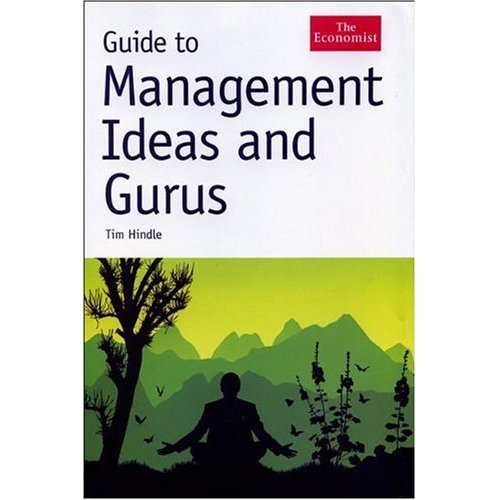
I mention this because during these last holidays I read a book about gurus, “Guide to Management Ideas and Gurus“, by Tim Hindle (322 pgs.).

Guide to Management Ideas and Gurus, Tim Hindle.

About two years ago The Economist used to send within a weekly alert a profile about a management idea and one guru, all of them coming from this book. Since then I had wanted to buy this book, which I found last June at a Schiphol airport book shop.

The book first reviews about a hundred management ideas, e.g., benchmarking, core competence, kaizen, lean production, SWOT analysis… Later it provides a short profile of over 50 authors or gurus, from Taylor and McGregor to Peter Drucker, Tom Peters, C.K. Prahalad… From each idea and author you get two pages. It is a good refresher of different concepts you may have studied and also helps relating some ideas and authors to others, interlinking them.

Along the book there is also bibliography related to each idea and from each author. In total I guess there are over 200 books and papers suggested. Also, it is very handy that from each author the book gives two or three notable quotations, from which you can get a quick idea of what is going to come. So now, after reading it I have a book with lots of marked pages, underlined parts and books and papers to look for.

I wanted to extract some ideas from three of those “gurus”:

  • C. Northcote Parkinson a naval historian famous for his book “Parkinson’s Law“, which can be stated as “Work expands to fill the time available for its completion”.
  • Laurence Peter a Canadian teacher famous for his book “The Peter Principle“, which can be phrased as “In a hierarchy, every employee tends to rise to his level of incompetence”.
  • Robert Townsend a former director of American Express famous for his book “Up the Organisation” with a more clarifying subtitle “How to Stop the Corporation from Stifling People and Strangling Profits”, where he is harsh on the vanity and stupidity of executive leaders.
  • Though not a “guru” from the ones profiled in the book, Scott Adams “Dilbert” comic strip is cited in at least a couple of times, take a moment to check it.

You can be sure that I have marked these three books in the to-read list.

4 Comments

Filed under Books, Personal development

Skunk Works

It is known by nearly everyone in aviation industry the Lockheed Martin department: Skunk Works. It has its own website and it is were many planes have originated since World War II. We all have heard about the strict security rules and stories about how suddenly new aircraft were unveiled. Other companies have tried to establish similar departments; Boeing with its “Phantom Works” and EADS with its “Innovation Works”.

However, it was not until during my last holidays that I came to know the origin of the word, reading the book “Guide to Management Ideas and Gurus“, by Tim Hindle.

The name skunkworks originates from a cartoon series called “Li’l Abner” by Al Capp. The story is explained as well in the Wikipedia:

“[…] The “Skonk Works” was a dilapidated factory located on the remote outskirts of Dogpatch, in the backwoods of Kentucky. According to the strip, scores of locals were done in yearly by the toxic fumes of the concentrated “skonk oil”, which was brewed and barreled daily by “Big Barnsmell” (known as the lonely “inside man” at the Skonk Works), by grinding dead skunks and worn shoes into a smoldering still, for some mysterious, never specified purpose. […]”

Sometimes industry names come from the least expected place.

4 Comments

Filed under Aerospace & Defence, Books

Monkey Investors

Just a few weeks ago I wrote a post about the Wall Street Monkey. Remember that the story was based on Burton G. Malkiel’s book, “A Random Walk Down Wall Street”, where he suggested that a blindfolded monkey throwing darts to select stocks wouldn’t do worse than professional fund managers.

I watched yesterday TED Talk by Laurie Santos, “A monkey economy as irrational as ours”, where she explains how she studied whether our mistakes were due to a badly designed environment or badly designed minds.

She made several studies with apes, introducing the use of money to them… and she found that apes show the same irrational behaviours regarding risk taking as we humans do…

I loved especially the following passage around minute 16:30…

“… we can actually give the monkeys a financial currency and they do very similar things we do. They do some of the smart things we do, some of the kind of not so nice things we do like stealing and so on… but they also do some of the irrational things we do; they systematically get things wrong and in the same ways that we do.

This is the first take-on message of the top… if you saw the beginning of this and you thought: “…oh! until I go home and hire and put a monkey as financial advisor … they were cuter than ours…”, don’t do that: they’re probably gonna be just as dumb as the human one you already have!

At least, apes would charge us less… just a couple of grapes.

“A monkey economy as irrational as ours”, by Laurie Santos.

1 Comment

Filed under Books, Investing

World War III

Beginning of June I bought at Schiphol airport the book “The Next 100 Years; A Forecast for the 21st Century”, by George Friedman (author of “America’s Secret War”). I receive sometimes at the job reports and articles by Stratfor, the intelligence and forecasting firm that George Friedman founded. This was one of the reasons that raised my attention, the other were the headlines that could be read in the front page “2020: China Fragments”, “2050: Global war”…

Cover of "The Next 100 Years".

Friedman’s book tells us that when thinking about geopolitics we should be aware of:

  • Experience tells us that we should expect the unexpected.
  • We should not be confused by passing chaos and cyclical crisis.
  • Humans and countries are not that free when taking decisions, but they see limited their options by several constrains. He goes looking for such constrains.

If he had written the book in 1900 he would have pinpointed the following three things as defining for the century:

  • Collapse of European Imperial System
  • Quadrupling of World’s population
  • Revolution in transportation & communications.

Now, at the beginning of the XXI century he guesses the three defining issues will be:

  • The rise of American power
  • The end of the population explosion
  • The development of technologies to deal with a declining population.

You may wonder “the rise of American power?”, yes he makes the case that North American power has just started and it’s here to last: technology, economic power, control of the World’s seas (US Navy), military power, access to both Atlantic and Pacific oceans…

As he says, the USA “had the ultimate aim of preventing any major power in Eurasia. The paradox, however, is as follows: the goal of these interventions was never to achieve something –whatever the political rhetoric might have said- but to prevent something. […] Its goal was not to stabilize but to destabilize. […] The USA has no interest in winning a war outright.”

With this in mind, he explores what may happen in the next hundred years: Russia trying to reassert  itself, China fragmenting, Poland, Turkey & Japan as rising powers, some of them starting a global war, space-based power generation, Mexico challenging the US…

3 Comments

Filed under Books

Ask octopus Paul to invest for you

By now, everybody probably has heard about the octopus Paul picking winners of World Cup football matches. So far, it got right all the results of Germany. Today it picked Spain as winner of the final next Sunday. See the video of its memorable performance in CNN.

First thought: what a monumental charade this is! Second thought I had today at work: what if Paul was picking stocks for an investment fund?

The thought is not that out of the box: Burton G. Malkiel in his 1973 book, “A Random Walk Down Wall Street” (which I strongly recommend), suggested that a blindfolded monkey throwing darts to select stocks wouldn’t do worse than professional fund managers.

The Wall Street Journal went a step further and tried to prove the point. They did so organizing the 6-months Dartboard contest in 1988, a contest that continued along 14 years in more than a hundred 6-months periods. They didn’t use a monkey but the newspaper staff and they weren’t blindfolded. Nevertheless, the stock picks were quite random. See the explanation of that fun story in this article from Goergette Jansen a few months before the contest was to be finished in 2002.

So, how did the “monkey” do against the pros? Dartboard picks won the contest 39% of the times while pros won 61% of them. So, the pros got better results the majority of the time. Nevertheless, think that 39% of the times you would have been better off leaving your investments decisions to the darts, a monkey or octopus Paul (call it the way you want) than professional managers who get paid to maximize your returns… uh.

After those 14 years, pros racked up an average of 10.2% gain while the darts got a 3.5% gain (this is way better than my company-sponsored BBVA pension fund…).

So, next time you jokingly comment on Paul, think that you might as well ask him where to put your money and even get better results than when listening to the advice of the broker of your bank…

2 Comments

Filed under Books, Investing

Book review: La Hermandad de la Sabana Santa

I was given “La Hermandad de la Sabana Santa”, by Julia Navarro, last Christmas as a present. I had seen it in bookshops for years and even though I liked the synopsis at the back I never bought it because I had lots of books in the to-be-read list. But now that I had it, I took it with pleasure to have an easy read in between more demanding ones (for it is in Spanish among other reasons).

The plot is around some detectives and art experts who are investigating accidents around the Sacred Shroud in Turin, and the find themselves following the thread of the Knights Templar… is it enough? Doesn’t it ring a bell? I found this novel very similar to “The Da Vinci Code”. I checked it, and Dan Brown’s book dates from 2003, while the one from Navarro is from 2004.

Honestly I found this book much simpler than “The Da Vinci Code”: its descriptions, dialogues, the thoughts of the characters… On the positive side: how the plot advances in several parallel timelines in the 1st, 13th and 21st centuries and how they all merge in the last frenzied 200 pages.

If you haven’t yet read “The Da Vinci Code”, I would read it first rather than “La Hermandad de la Sabana Santa”, however if you have read the former and you liked the genre go for the latter as well, and finally, if you read the former and had enough of it… better find another book.

Leave a comment

Filed under Books

Book review: How Soccer Explains the World

I was given the book “How Soccer Explains the World” as a present by Luca & her mother about 2 months ago. They bought it in the London bookshop Daunt Books, and it came with a bookmark of the shop… impressive. Take a virtual tour around the book shop, it definitely deserves a stop in the next visit to London.

The book… since I have been questioned about it many times: no, soccer does not explain the World. However, it is a very interesting book drawing parallels about historical moments in recent history and how they were connected with football issues going on at the moment in the same places.

The first chapter for example tells about Serbian paramilitary groups, their connection with football and how they were instrumental in the Yugoslavian wars. In that chapter you read lots of names that ring a bell from having followed football recently: Obilic, Arkan, the great Red Star of 1991 (Prosinecki), Ognjenovic (a singing of Real Madrid), Zvonimir Boban… all these names let the reader connect with the story. In my case, having been in these locations and having good friends from both Serbia and Croatia increased the interest of it.

Luca & I attending the game Dinamo Zagreb vs. Medimurje (Croatian league) in 2007... because Dinamo offered an open-doors day after having made a good selling of tickets against Werder Bremen the previous week...

There are other chapters that may draw the attention of many: a whole chapter dedicated to F.C. Barcelona (the favourite team of the writer, Franklin Foer… an American, you see), other to Celtic-Rangers rivalry, disdain for soccer in the USA, Ajax, racism in football…

I recommend this book, especially in times of a World Cup.

3 Comments

Filed under Books, Sports, Travelling

Book review: Pirate Latitudes

I bought this book together with some others in the Books & News shop of Schiphol airport in Amsterdam in a recent trip to NL. I have read about this book sometime ago as it had been discovered in the computer files of Michael Crichton after his death.

I had read most of his last books so I was determined to buy this last one as soon as I would find it and so did I.

I found this book quite different from his last novels (Next, State of Fear, Prey…), but still, it was a quite entertaining reading about pirates in the Caribbean hunting treasures, fighting warships, storms, hurricanes, aborigines…

I would remark its very vivid descriptions everything related to sailing, firing cannons, the Caribbean, etc. One more thing I liked it about it is that it leaves the reader rested with all vengeances possible, well taken. I do recommend the book (387 pgs.).

Lastly, I found out in the Wikipedia that there will probably be a movie about this book by Steven Spielberg and even most intriguing: there is yet another novel by Crichton coming posthumously in 2012!

3 Comments

Filed under Books