Category Archives: Miscellanea

Implications of the independence of Kosovo in the case of Crimea

From the onset of the current crisis in Ukraine and the increased presence of Russian forces in Crimea I am having in mind the same word: Kosovo.

I was reading in today’s article from the Wall Street Journal, “A Defiant Putin Endorses Crimean Bid to Secede“, the following:

“The steps taken by the legitimate leadership of Crimea are based on the norms of international law and aim to ensure the legal interests of the population of the peninsula,” Mr. Putin said Sunday in the calls, according to a statement from the Kremlin.

I admit that when Kosovo unilaterally declared its independence in 2008 I did not follow in detail the case, other than knowing the basics and Spain’s opposition to it. It was only last year that I got to know a bit more the details of the case due to the fact that my sister Beatriz, pursuing a Masters programme on  International Security and Law at the University of Southern Denmark, wrote a paper about it and asked her brothers to review it.

I am sure that I miss many of the nuances of the case, but my feeling is that the way that case was handled is backfiring at the moment. When I read Putin’s declaration, “based on the norms of international law and aim to ensure the legal interests of the population of the peninsula“, I see some of the details I will try to summarize below.

A rather complete article about the case can be found here in the Wikipedia.

Let’s start from the beginning. In 1999 and in view of the crisis going on for already 2 years in Kosovo, “Determined to resolve the grave humanitarian situation in Kosovo, Federal Republic of Yugoslavia, and to provide for the safe and free return of all refugees and displaced persons to their homes […]”, the United Nations Security Council adopted the Resolution 1244 (1999) [PDF 24KB, 8 pages]. I invite you to go through it. Here I recall some passages to relate it to the current situation in Crimea:

Reaffirming the commitment of all Member States to the sovereignty and territorial integrity of the Federal Republic of Yugoslavia […]

Reaffirming the call in previous resolutions for substantial autonomy and meaningful self-administration for Kosovo […]

(e) Facilitating a political process designed to determine Kosovo’s future status, taking into account the Rambouillet accords (S/1999/648);

(f) In a final stage, overseeing the transfer of authority from Kosovo’s provisional institutions to institutions established under a political settlement; […]

[excerpts from United Nations Security Council Resolution 1244 (1999), PDF 24KB]

On the reference to the Rambouillet accords (S/1999/648):

3. The Federal Republic of Yugoslavia has competence in Kosovo over the following areas, except as specified elsewhere in this Agreement: (a) territorial integrity, […]

[from page 10. Rambouillet Accords (S/1999/648), PDF 3.4MB, 86 pages]

Fast forwarding 7 years (from the Wikipedia):

International negotiations began in 2006 to determine the final status of Kosovo, as envisaged under UN Security Council Resolution 1244 which ended the Kosovo conflict of 1999. Serbia’s continued sovereignty over Kosovo was recognised internationally. The vast majority of the province’s population sought independence.

Fast forwarding 2 more years (from the Wikipedia):

The 2008 Kosovo declaration of independence was adopted on 17 February 2008 by the Assembly of Kosovo

At that point Serbia requested the United Nations General Assembly to seek an opinion from the International Court of Justice (ICJ) on the case, obviously thinking that the ICJ would rule against the declaration of independence. The resolution was passed with 77 countries voting in favor (including Russia, Brazil, India, China, Norway, Spain, Indonesia, Mexico, South Africa…), 6 against (including United States, Albania and some islands from the Pacific ocean) and 74 countries abstaining (including most of Western Europe, Canada, Japan…).

The article of the Wikipedia on the case includes some of the points raised by each country. I find it interesting to bring forward the points from:

United States:

The United States invites the International Court of Justice to leave the declaration of independence intact as an expression of the will of the people of Kosovo, either by refusing to comment on its legality, or by determining that the international law does not prohibit declarations of independence. The declaration of independence did not violate any principle of territorial integrity because under international law, only states must comply with this principle, and not internal entities. […]

Russia:

  • General international law prevents Kosovo from declaring independence, bearing in mind that the people of Kosovo do not enjoy a right to self-determination.
  • Russia rejects claims coming from those countries who support the unilateral declaration that international law “does not regulate independence declarations”, and reminds that the UN Security Council declared Northern Cyprus and Rhodesia’s independence to be illegal, since secession is forbidden outside the colonial context. […]
  • Resolution 1244 cannot be overturned by a decision of UN secretary-general’s envoy Martti Ahtisaari to end the negotiations and recommend independence as the only solution. Quoting the words of Kosovo Albanian representative Skënder Hyseni, who said that the negotiations were led on “whether or not Serbia will accept Kosovo’s independence”, Gevorgian said that Ahtisaari’s failure does not mean that the process has been concluded.
  • We often hear that international law is no law, that it does not apply to precedents, and that power is the law. This case is a chance to demonstrate that international law is in effect.

As requested, the International Court of Justice gave its advisory opinion on the case [PDF 190 KB, 31 pages], and found that:

THE COURT,
(1) Unanimously,
Finds that it has jurisdiction to give the advisory opinion requested;
(2) By nine votes to five,
Decides to comply with the request for an advisory opinion;
(3) By ten votes to four,
Is of the opinion that the declaration of independence of Kosovo adopted on 17 February 2008 did not violate international law.

… to the dismal of Serbia, Russia and others (1). I strongly recommend reading, or skimming through, the summary of the advisory opinion.

While reading the article prepared by my sister, I must confess that the (dissenting) opinion that I sided the most with was from Judge Koroma (2).  You may find it here [PDF 139KB, 22 pages]. I especially enjoyed this paragraph:

19. In addition to resolution 1244 (1999), the Court has considered whether the unilateral declaration of independence has violated certain derivative law promulgated pursuant to it, notably the Constitutional Framework and other UNMIK regulations. It concludes that the declaration of independence did not violate the Constitutional Framework because its authors were not the Provisional Institutions of Self-Government of Kosovo and thus not bound by that Framework. The jurisprudence of the Court is clear that if an organ which has been attributed a limited number of competences transgresses those competences, its acts would be ultra vires […]. However, the majority opinion avoids this result by a kind of judicial sleight-of-hand, reaching a hasty conclusion that the “authors” of the unilateral declaration of independence were not acting as the Provisional Institutions of Self-Government of Kosovo but rather as the direct representatives of the Kosovo people and were thus not subject to the Constitutional Framework and UNMIK regulations. That conclusion simply cannot be correct, since the unilateral declaration of independence was adopted in the context of resolution 1244 (1999) and the Court has acknowledged that the question posed by the General Assembly is a legal question and that resolution 1244 (1999) is the lex specialis and applicable in this case.

I love that expression, “sleight-of-hand”.

I also fail to see how if the resolution 1244 (and the Rambouillet Accords), recognized the sovereignty of Serbia over Kosovo and called for an agreed future status, the unilateral declaration of independence taken by an Assembly created by the Provisional Institutions of Self-Government of Kosovo which was a result of resolution 1244 can suddenly be considered as not acting as the Provisional Institutions of Self-Government of Kosovo and not subject to the Constitutional Framework and UNMIK regulations.

We may call Putin whatever words, we may find him opportunistic, etc., but when Russia stated before the UN General Assembly in 2009 “We often hear that international law is no law, that it does not apply to precedents, and that power is the law. This case is a chance to demonstrate that international law is in effect”, and saw how the ICJ opined afterwards, it can only be taken as a logic conclusion that now Russia finds “The steps taken by the legitimate leadership of Crimea are based on the norms of international law and aim to ensure the legal interests of the population of the peninsula”.

Some times politics and international law can get really entertaining. 

You reap what you sow.

(1) Kosovo has been recognised to date by 108 out of 193 (56%) United Nations member states, though not including Brazil, India, China, Russia, Argentina, Iran, Israel, Mexico, South Africa, Spain, etc. 

(2) To make the riddle even more tricky: Judge Koroma, a natural from Sierra Leone, studied law at the Kiev State University… I would love to hear his opinion today on the case.

3 Comments

Filed under Miscellanea

Penosa encuesta de Metroscopia

Me encuentro hoy en El País con la siguiente encuesta “Autoubicación ideológica de los electores”:

Fuente: Metroscopia para El Pais,

Fuente: Metroscopia para El Pais,

Dicha encuesta va acompañada de un artículo (“¿Hay espacio más allá?”) firmado por Jose Pablo Ferrándiz, sociólogo y vicepresidente de Metroscopia. Y por lo que parece, mal profesional.

Viendo la encuesta me llama la atención que indiquen que hay 342.967 electores de extrema derecha (10), los mismos que prácticamente extrema izquierda (1) o derecha (9). Miro en detalle los números y veo que han preguntado exactamente a 100 personas.

La encuesta indica que la población de electores es de algo más de 34 millones de personas. Me llama la atención lo pequeño de la muestra, y me pregunto por la confianza de la muestra que han tomado, y así que se lo pregunto

https://twitter.com/javierirastorza/status/431536329625579520

Como no espero respuesta, decido hacer los números.

[Por cierto, cuando digo arriba “mal profesional”, en parte lo digo porque ya es poco profesional no adjuntar los datos de la muestra: número de encuestados, nivel de confianza e intervalo de confianza… pero veremos que no los incluye por algo]

Usando un simple calculador podéis ver que para un nivel de confianza típico de entre 95% y 99% con una población de más de 34 millones de electores, el hecho de haber cogido una muestra de solo 100 personas hace que el intervalo de confianza esté entre + / – 10-13%.

Es decir, lo que Jose Pablo no nos dice es “un 10% de los electores se ubica en el centro derecha (6) con un intervalo de confianza de más o menos 10%, podrían ser 0% o 20%, vaya usted a saber. Esa es la frase que echo en falta en su artículo donde llega hasta el punto de desgranar como se califica un 2% o 6% de la población (más menos 10%...)

El último detalle que me ha encantado es la nota del final: “* La diferencia hasta 100% corresponde a no sabe y a no contesta”. Lo gracioso es que las cifras de porcentajes que han dado sí que suman 100%, y por tanto la nota final sobra. Todo el mundo ha contestado y el único que no sabe aquí es Jose Pablo.

¿A quién debemos poner en solfa? ¿A El País? ¿A Metroscopia? ¿A su vicepresidente Jose Pablo Ferrándiz? ¿Al becario? ¿…?

NOTA: Al final dudo de si con los 100 encuestados se han limitado a preguntar a “electores” y aleatoriamente. Capaces de haber preguntado a menores de edad, extranjeros, y solo a familiares y amigos…

1 Comment

Filed under Miscellanea, Twitter & Media

The most (and least) read of the first 400 posts

A classic post of the blog: a recap at each hundredth post dedicated to show which were the most and least read of the first 400 posts. (1)

Since I started the blog in February 2010, the blog has received over 118,000 visits and hundreds of comments.

Find below the list of the top 10 and bottom 10 posts:

1. Impuestos en Francia vs. España
2. Will Boeing 787 ever break-even?
3. 787 Break Even for Dummies
4. Mi adiós a Ibercaja
5. Impuestos en Francia vs. España (actualización 2012)
6. Monaco GP Walking Tour
7. Airbus vs. Boeing, comparison of market forecasts (2012)
8. Airbus vs. Boeing, comparison of market forecasts (2011)
9. Patek Philippe Caliber 89
10. Beluga vs. Dreamlifter

390. Ballesteros (the movie)
391. “Caimaneando”
392. From climbing to merely walking
393. De Feria en Feria
394. Not just another letter
395. The Art of War
396. Lowell Observatory
397. Casablanca
398. Book review: Pirate Latitudes
399. International Day of the Book

Let’s see what I’ll write in the next 100 posts…

(1) I wrote three just posts when I reached the first 100200 and 300 posts in the blog.

NOTE: the box in the right showing “Current Top Posts” shows the most read ones in the last two days, not the all-time most read ones (the ones above).

2 Comments

Filed under Miscellanea

Livonian, an endangered language

The Livonian is a language of the Finnic family, closely related to Estonian and spoken in the region of Livonia, in the North of Latvia and South of Estonia. I first came across the language in March 2003, during a students’ exchange in the framework of the European Commission Youth programme organized by the students associations of AEGEE Zaragoza and Tartu (Estonia).

During that exchange, in one of the evenings we attended an especially arranged concert in a small bar. The place looked like a cellar. The group of music was introduced to us as the only group singing in the Livonian language. I now wonder whether that group was “Tuļļi Lum“. Sincerely, I cannot remember the name of the group that played that night, other than being presented as the only band singing in Livonian. On the other hand, Tulli Lum was already existing then and the singer studied music in Estonia… who knows.

The Livonian is an endangered language. In 2003, it was introduced to us as being spoken by no more than ~120 people in the World. Today the Wikipedia mentions that the last known native Livonian speaker, Grizelda Kristiņa, died in 2013. Livonian may be spoken as a second language by over 200 people, just about 40 of those with a level of B1 or upper.

In that night in 2003, we were explained that the language was being supported by some European institution funds. It was 10 years ago, I cannot recall the details. I guess they referred to the European Bureau for Lesser-Used Languages (EBLUL). The EBLUL was a NGO set up to promote linguistic diversity and languages. It was founded in 1982 and had close ties with both the European Parliament and the Council of Europe, and was funded by both the European Commission and local and regional governmental organisations.

The European Bureau for Lesser-Used Languages was closed by a decision of its Board of Directors on January 27, 2010. The main official reason given was that “the funding mechanism of such an organisational model [was] not suitable in current circumstances”.

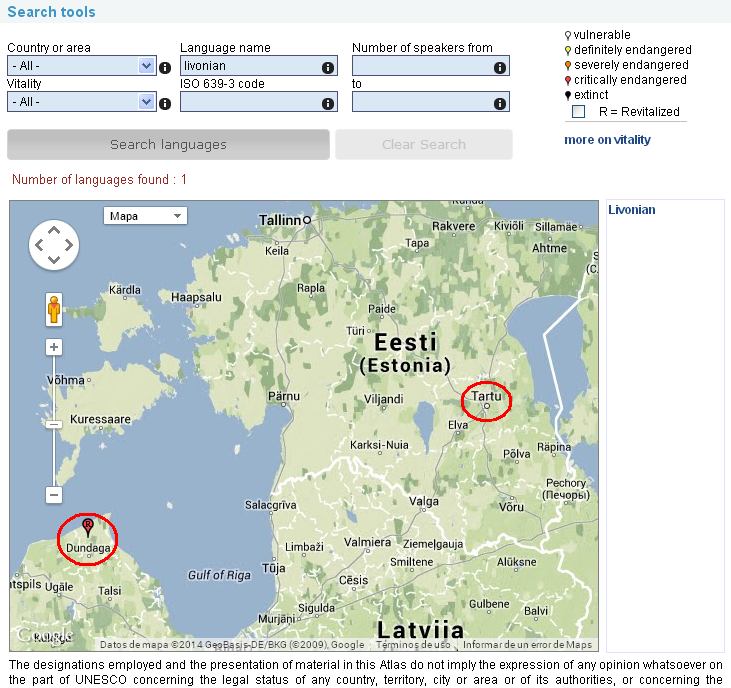
I came across Livonian again when playing with the UNESCO Atlas of the World’s Languages in Danger, which I discovered via Twitter. See a screenshot from the tool below, with the situation of Livonian, “critically endangered” and “revitalized”.

Livonian, UNESCO Atlas of the World's Languages in Danger.

Livonian, UNESCO Atlas of the World’s Languages in Danger.

I found this tool from UNESCO interesting. I suggest you try it out a bit.

In respect to Livonian:

  • I am happy for those people who played music for us that night back in 2003 that the language seems to be revitalized, though I have no way to measure or sense that.
  • On the other hand, and despite of the criticism that my position may create, and as I have mentioned in several conversations in the past: I see no wrong in letting the language die. I do not see the purpose in pumping public European funds so that a language can be taught to non-native students at some universities. I am almost glad to see that the EBLUL has closed down and clearly understand why “the funding mechanism of such an organisational model [was] not suitable in current circumstances”.

Surely, this is my opinion and I respect those who believe that each and every language should be preserved no matter what costs in the name of culture, historical heritage, and you name it. In UNESCO’s words:

Every language reflects a unique world-view with its own value systems, philosophy and particular cultural features. The extinction of a language results in the irrecoverable loss of unique cultural knowledge embodied in it for centuries, including historical, spiritual and ecological knowledge that may be essential for the survival of not only its speakers, but also countless others.

My view: I am a native Spanish speaker thanks to some language evolution that meant that once almighty Latin is no longer spoken outside of the Vatican City, plus the extinction of who knows how many ancient languages spoken by my ancestors.

It especially strikes me the language used by UNESCO: “ecological knowledge that may be essential for the survival of not only its speakers, but also countless others.” I guess it’s quite the contrary. Had a certain language been so essential to the survival of its speakers and its extinction would have not taken place (or am I getting something wrong with what evolution means?). 

Luckily, the same evolution process has happened in all parts around the world: allowing over 400 million of people to speak Spanish as a mother tongue and allowing us to fairly understand each other in several corners of the world.

Language is the human capacity for acquiring and using complex systems of communication, and a language is any specific example of such a system.

2 Comments

Filed under Miscellanea, Travelling

Carta abierta a “La mujer de la terminal”

Carta abierta a “La mujer de la terminal”:

No es la primera vez que nos vemos. El pasado 29 de diciembre nos volvimos a encontrar en la terminal. Esta vez fue en la T4. Hablo del aeropuerto Barajas, cuál si no. Nuestros anteriores encuentros habían sido en la T1; el último hace unos 5 años, el primero hace 7… Tú seguramente de no te acordarás de mí. Confieso que yo casi te había olvidado, pero el pasado día 29, al escuchar tus palabras, tuve un déjà vu instantáneo. Me acordé de ti, pero apenas te dediqué dos palabras.

En nuestro último encuentro yo actué como si fuese con prisa. Me acompañaban Luca y Andrea (sí, en estos años me he casado y he sido padre)  y en un primer instante no tuve el arrojo de darte más conversación. Me arrepentí casi inmediatamente. Luego te estuve buscando con la mirada por si te volvía a ver. Para no volver a olvidar tu cara. Quién sabe si para mantener otra breve conversación. En algún momento pensé hasta en hacerte una foto. Para no volver a olvidar tu cara.

Al principio pensaba que eras malagueña. El último día dudé. Quizá sea asturiana, me dije. No, no es por el acento. Tienes unos 40 años. El pelo, moreno. Estatura, en torno a un metro sesenta. El último día llevabas un abrigo blanco. Hace tanto tiempo, que ya no recuerdo como ibas vestida las veces anteriores. No sé cómo te llamas, pero sí a qué te dedicas.

Las tres veces que te dirigiste a mí me hablabas en primera persona del plural. Nunca llegué a conocerle a él o a ellos, ni quiero. Solo quiero hablar de ti. Además, una parte de mí me hace dudar de su existencia.

Cuando pienso en ti veo a una persona que vive al día, sin ataduras, sin equipajes. Una persona que cuando va al aeropuerto no se fija en los horarios sino en las personas que se cruzan en su camino. Una persona que vive sin prisas y que a su vez no para de moverse. A veces envidio esa actitud. Te confieso que yo siempre llego con prisa. En los últimos años habré perdido ya unos 4 ó 5 vuelos. Y tú, sin embargo, con esa tranquilidad que te caracteriza no creo que nunca hayas perdido ninguno. Te envidio.

Este último encuentro me ha dado una nueva esperanza. Me he prometido a mí mismo que la próxima vez te dedicaré la atención que mereces. Con esta carta quiero hacer público mi compromiso. Basta ya de excusas y respuestas monosilábicas. Suelo pasar por la T4 dos o tres veces al mes, por favor, volvámonos a encontrar…

  • Perdona, ¿habláis español?
  • Sí.
  • Es que hemos perdido el vuelo a Asturias. Es por si tenéis un poco de dinero.
  • No, gracias.

Esta fue nuestra conversación. Las dos veces anteriores, en 2006 y en torno a 2008, en la T1, esta mujer había perdido el vuelo a Málaga (las 2 veces). Entonces era más precisa: pedía 20 euros para ir a Atocha y comprar un billete de tren (las 2 veces).

En 2006 me pregunté a mi mismo ¿y porque si dice que quiere ir en tren no se va a pedir dinero a Atocha? En seguida supuse que era un engaño. No llevaba equipaje. Hablaba en plural, pero sin nadie que la acompañase.

En 2008 de nuevo vino con la misma historia, “hemos perdido el vuelo a Málaga, necesitamos 20 euros para coger un tren en Atocha”. Tenía el recuerdo de la primera ocasión demasiado reciente.

En 2013 ya lo había olvidado. Esta vez me sorprendió. ¿Asturias? Esta vez no habló de tren ni de Atocha. Seguía sin llevar equipaje y sin ir acompañada.

Otra curiosidad que me surge es, si todo lo que te ha ocurrido es haber perdido el vuelo (cosa que a mí me ha pasado en varias ocasiones), ¿qué te impide ir a comprar otro con tu dinero? Nunca me has mencionado ni que te hayan robado (claro, eso haría que la gente te ayudase a buscar a la policía presente en el aeropuerto), ni que hayas perdido la cartera, ¿por qué habrías de necesitar dinero?

Imagino que los que vamos al aeropuerto a coger un vuelo (y no a timar a gente despistada) vamos… despistados, y no reparamos en estos detalles. Algunos de nosotros se sentirán relacionados con tu situación, apresurados por el tiempo y te darán incluso esos 20 euros.  Desde luego, si en 7 años has seguido haciendo esto, es que no te va del todo mal.

Cuenta conmigo para el próximo encuentro. La próxima vez te dedicaré más tiempo. Espero darte conversación mientras saco el móvil. Acto seguido intentaré hacerte una foto para colgar en este blog. Te ruego que no te enfades conmigo (quizá te ofrezca 20 euros por sacarte esa foto…). Y de paso a ver si me entero de si eres malagueña o asturiana, o madrileña…

2 Comments

Filed under Miscellanea

Confidence in institutions: UK vs. Spain

Evaluation of institutions, entities and social groups (source: Metroscopia for El País, 25/08/2013).

The Spanish newspaper El País published yesterday a survey it had commanded to Metroscopia about the confidence that Spanish people had in different institutions (see the complete article, in Spanish, “Por qué no se hunde España“). See a summary of the results in the graphic to the right.

Following an exercise during a training module last year, I published a post discussing a similar survey which is yearly made in Britain by the consultancy Ipsos Mori, the Veracity Index (see in the link results from 1983 to 2011).

I thought that it could be interesting to show the results of both surveys side by side to try to spot some commonalities and some differences of how the different groups and institutions are perceived in Britain and in Spain. I did the comparison even if the questions used for the survey are not exactly the same in both cases and if one survey dates from 2011 and the other from 2013. See the comparison in the picture below.

Another difference is that the Spanish survey is including up to 36 different groups versus 16 being evaluated in the UK, but this is not impacting the comparison as each group is rated individually.

Let’s see the similarities:

  • 4 institutions / groups are very well-regarded in both countries, with a rating over 70% in both cases: doctors, teachers, professors and scientists.
  • 4 institutions / groups are very badly regarded in both countries, with a rating of around 30% or lower in both cases: unions, business leaders, government and politicians.

The biggest differences:

  • 3 groups are much better perceived in Spain than in the UK: the police, civil servants and journalists.
  • 2 groups are much worse perceived in Spain than in the UK: judges and clergyman/priests (especially bishops).
Comparison of confidence polls in Britain (2011) and in Spain (2013) (sources: Ipsos and Metroscopia for El País).

Comparison of confidence polls in Britain (2011) and in Spain (2013) (sources: Ipsos and Metroscopia for El País).

How would you rate these groups? (my rating is published in the post from some months ago)

Leave a comment

Filed under Miscellanea

Our daughter is born!

Some months ago we announced that we were expecting a baby, today we proudly announce that yesterday, 11th August 2013, at 18:38, our daughter was born in Toulouse.

The delivery went moderately smooth (my words, better wait to hear Luca’s) and both mother and child enjoy good health at the moment, recovering in the clinique.

Family Irastorza Van Veen with the coolest newcomer: Andrea (design from uncle Jaime).

Family Irastorza Van Veen with the coolest newcomer: Andrea (design from uncle Jaime).

Andrea weighed 3,610 grams at birth and measured 50cm tall.

Connie, inscribed today in the Toulouse registry as Andrea Irastorza Van Veen, seems to have light grey/blue eyes, already shows passion for aviation and Real Madrid, and asked us to thank you all for the interest and good wishes, and said that is looking forward to meeting you in the following days, weeks, months and years.

22 Comments

Filed under Miscellanea

Pregnant

Dear readers, I am pregnant!

Well, to be precise, it is Luca who is expecting a baby!

Stork bringing the baby to Toulouse (design by Jaime, future uncle).

Stork bringing the baby to Toulouse (design by Jaime, future uncle) (1).

If everything goes well, junior will enter into service by the beginning of August (I cannot guarantee that there won’t be delays…). Engineering and Programme Management (I) have done their job, now it’s up to Industrial and Delivery Centre (Luca) to complete the project (we swear that Procurement was not involved!).

—-

(1) Clarification for those not coming from Spain: the tradition there says that children are not only brought by a stork, but also that it brings them from Paris.

(2) We accept suggestions for the name, both female and male. Even more, we’re even thinking of setting up a contest; but please suggest a name only if you think it can top “Javier”.

(3) For those worried about the legal framework surrounding the coming child: we are already PACSed AND engaged

25 Comments

Filed under Miscellanea

The best (and the worst) of the first 300 posts

This post is a classic of the blog: A hundredth post dedicated to show which were the most and least read of the first 300 posts. (I wrote two just posts when I reached the first 100 and 200 posts in the blog).

Since I started the blog in February 2010, the blog has received over 65,000 visits and hundreds of comments.

Find below the list of the top 10 and bottom 10 posts:

1. Will Boeing 787 ever break-even?
2. Impuestos en Francia vs. España
3. 787 Break Even for Dummies
4. Airbus vs. Boeing, comparison of market forecasts (2011)
5. Patek Philippe Caliber 89
6. Mi adiós a Ibercaja
7. Airbus vs. Boeing, comparison of market forecasts
8. Beluga vs. Dreamlifter
9. More on Boeing 787 break even
10. FC Barcelona copying Real Madrid

290. The origin of football in Spain
291. Opera with subtitles
292. “Caimaneando”
293. Resist the bias to act
294. Studios are more profitable than flats
295. Casablanca
296. De Feria en Feria
297. From climbing to merely walking
298. International Day of the Book
299. Book review: Pirate Latitudes

Comparing the lists to the previous 2 years ones: 7 posts of the 10 most read ones in 2011 are still there while only 2 remain from the most read after the first 100 posts. On the least read ones: 6 were in the list after 200 while only 3 in the list after 100.

Let’s see what I’ll write in the next 100 posts…

NOTE: the box in the right showing “Current Top Posts” shows the most read ones in the last two days, not the all-time most read ones (the ones above).

6 Comments

Filed under Miscellanea

Foie gras poêlé

The picture below represents an all time high of my kitchen:

Cooking foie gras.

In fact it means an all time high of me in any kitchen. I have known the recipe since almost 2 years now. It took us 1 minute to cook it.

After this all time high, I am seriously considering to never cook again.

Leave a comment

Filed under France, Miscellanea