Category Archives: Miscellanea

Torrelodones: iniciativas vecinales

El pasado 10 de junio se emitió el reportaje “Reiniciando España: La Política” en “Salvados”. Aparte de los mensajes que transmiten, me llamó la atención y gustó porque en él se hablaba de Torrelodones.

En primer lugar entrevistan a Manuel Milián Mestre, ex-diputado y uno de los fundadores del PP, que admite que por su rebeldía y posiciones morales por encima de los intereses del partido tuvo que dejarlo.

Hace una radiografía de la política en los grandes partidos demoledora. Deja una serie de frases escuchadas en un partido y otro que dan una buena imagen de lo que se prima en ellos: “el que se mueve no está en la foto”, “el que me desafía la paga”, “el que se vuelve una mosca cojonera acaba perdiendo la batalla”. Define la situación actual como “darwinismo político”, “en el partido triunfan los oportunistas en este momento, se imponen los mediocres”, “áurea mediocritas”, de la meritocracia a “el codazo y el amiguete”…

A continuación se entrevista a la alcaldesa, Elena Biurrun, de una asociación de vecinos que se hizo con la alcaldía. Este hecho ya mereció un artículo en el New York Times hace algo más de un año. Durante la entrevista se mencionan una serie de hechos que muestran la desvergüenza a la que llegan los políticos con el dinero público: comidas y desayunos protocolarios, coche blindado con chófer, clientelismo. Revisando la política de gastos en su primer año consiguieron un superávit de 5,4 M€. Menciona la alcaldesa que se redujo el sueldo en un 20% hasta 49.500€ brutos anuales, pero es que en el mismo pueblo en 2007 el alcalde en aquel momento en el primer pleno se subió el sueldo un 30% hasta 91.445€, solo por detrás del entonces alcalde de Barcelona, y muy por encima del de Madrid o la presidenta de la Comunidad de Madrid y también por encima del presidente del gobierno.

http://www.youtube.com/watch?v=DUg3E32jc3A&feature=relmfu

La alcaldesa anima a ciudadanos de otros municipios a emprender iniciativas similares, asociarse y defender lo público. En este sentido siempre me ha llamado la atención la poca predisposición que hay en España al asociacionismo, a participar en distintas iniciativas, a dedicar un tiempo voluntariamente para trabajar desinteresadamente en algo por el beneficio común. En el caso de Holanda, sin embargo, esto sí se hace y es muy valorado por la población y las empresas. Es casi una obligación social el pertenecer a alguna o varias asociaciones, es normal que los estudiantes dediquen casi un año en medio de sus estudios universitarios a volcarse trabajando para alguna asociación. No nos vendría mal tomar ejemplo.

Minifútbol

Alguna vez he escrito en este blog sobre el Mini. Voy a retomarlo en este post sobre Torrelodones y la participación ciudadana, especialmente estos días en que el Minifútbol ha celebrado su 40º cumpleaños.

La historia del Mini se puede leer con detalle en su página web, pero básicamente se puede resumir en que nació en 1971 cuando una serie de amigos de la infancia comenzaron a organizar una competición en la finca de uno de ellos para poder reunirse en las tardes de verano. Con algunos periodos de interrupción, el Mini continúa hoy organizando un serie de campeonatos de fútbol para todas las edades, ambos sexos, en verano y en invierno.

Hay algo que distingue al Mini de cualquier otra competición futbolística, y es su carácter social, que se traduce en su decálogo. En este post quiero destacar algunos de los puntos que marcan el Minifútbol:

  • Lo importante son los compañeros, los de tu equipo y el rival, por ello en cada competición cada jugador se inscribe individualmente y con un sorteo se determina la composición de cada equipo. Cada año jugarás con 7 u 8 personas distintas, permitiéndote conocer a más gente del pueblo y jugar contra antiguos compañeros.
  • Todo jugador debe participar un mínimo de tiempo en cada partido.
  • No hay lugar a comportamientos antideportivos ni duras entradas, para lo cual se han introducido una serie de modificaciones en el reglamento.
  • La asistencia a los partidos como signo de compromiso con el grupo.
  • El voluntariado de la organización.

Y para acabar este post, tras alabar estas 2 iniciativas vecinales de Torrelodones, os dejo un extracto de un chotis sobre Torrelodones, interpretado por los vecinos Camilo Sesto y Rocío Dúrcal dentro de otra iniciativa que surgió hace unos 14 años cuando se editó un CD con canciones sobre el pueblo.
Leave a comment

Filed under Miscellanea, Sports

Engaged

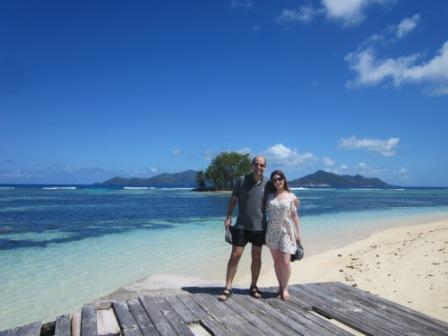
Some of you already know it, to the rest: Luca and I are engaged.

Finally engaged.

The wedding is foreseen sometime in the Spring 2013. News will follow.

8 Comments

Filed under Miscellanea

Ballot papers in France

Today there is the first round of the Presidential elections in France. According to the latest polls, it seems that Hollande is going to win with Sarkozy coming second and the two going to the second leg of the elections.

After my flying class today, I took the opportunity to go to one of the “bureau de vote” installed at the city hall in Capitole square. As I did 7 years ago while living in Aachen (then with the election between Merkel and Schröder), I wanted to check first-hand how the voting works here in France.

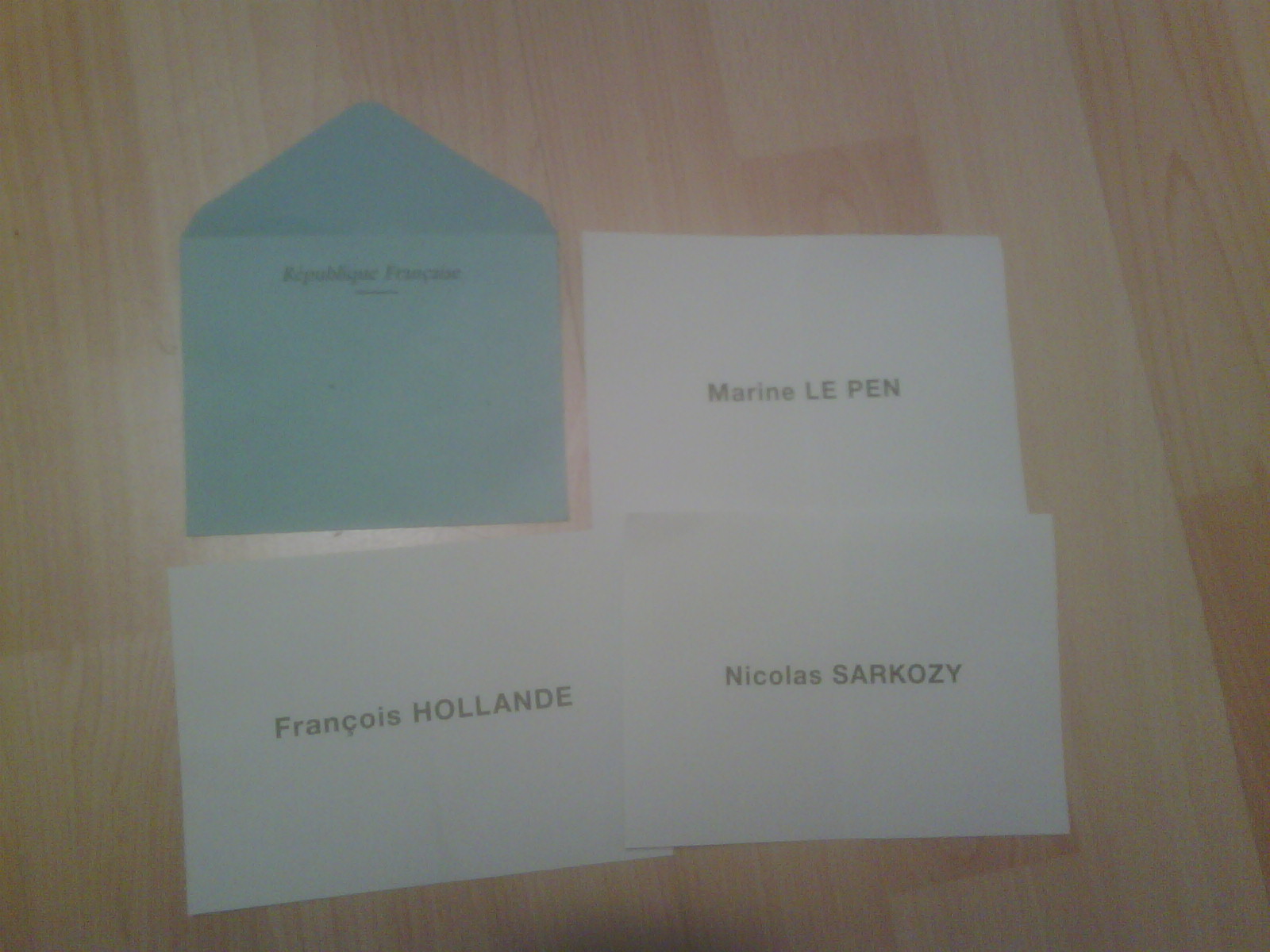
Well, it is very simple and very much like in Spain, even simpler. There were just 10 small stacks of ballots, one stack per candidate. The ballots are much simpler than in Spain. Just white papers with the name of the candidate. No name of the party, no fancy logo of the party. The envelope: simpler as well, just a small blue envelope reading “République Française”, nothing mentioning like “Presidential election 2012”, first or second round…

French Presidential election 2012: Ballot papers.

It raised my attention that there were many isoloirs, these cabins with curtains where you decide which ballot you place in the envelope. There are those as well in Spain. I did this detour today with a colleague coming from the Spanish Basque Country, he mentioned that in his village people also uses those cabins. However, in the village where I come from in Madrid, people almost never uses them. While I agree that their presence is a must, the need to use them is sad.

Finally, the rest of the process is the same. The voter comes to the table, hands her ID to the president of the table, the name is checked in the list and the voter places her vote in the urne.

1 Comment

Filed under France, Miscellanea

Why do I prefer Coke

Some weeks ago I read an article about why do we prefer Coke over Pepsi by the blogger Farnamstreet (1). It mentioned a marketing initiative by Pepsi some years ago, “The Pepsi Challenge”, in which blind test were organized to see whether consumers preferred one or the other. Pepsi consistently advantaged Coke in the tests.

The article mentions other studies in which it is explained why nevertheless Coke still outsells Pepsi. In the end it seems to be due to the powerful brand Coca Cola has created along history and its association with happiness and satisfaction. This is an extreme case of what Warren Buffett describes as moat:

Definition of ‘Economic Moat’

The competitive advantage that one company has over other companies in the same industry. This term was coined by renowned investor Warren Buffett.

Investopedia explains ‘Economic Moat’

The wider the moat, the larger and more sustainable the competitive advantage. By having a well-known brand name, pricing power and a large portion of market demand, a company with a wide moat possesses characteristics that act as barriers against other companies wanting to enter into the industry.

My preference for Coke

Luca and I did this kind of blind test about 4 years ago when we lived in Madrid. We had heard of these tests and I was sure I could distinguish one from the other.

Normally, I never buy Pepsi (except when you order a “cola” at some place where there is no Coke). For the test we purchased both Pepsi and Coke, and placed them in the fridge for a while. Then I got blinded. Luca took them out of the fridge and poured each in a different glass (same kind of glass) with ice cubes. Then she offered me one glass. I tasted it.

“Ok, I don’t even need to test the other one, this is Pepsi”, I said. Then, I thought “well let’s try the other to confirm my choice”. I tasted the other glass… then I tasted again the first one. I ended up completely lost. I couldn’t tell one from the other. I finally changed my initial decision.

I was wrong in the test. Since then, I have told some friends about the experiment. Most of these friends claim they would indeed distinguish one from the other. They would probably even state that they prefer Coke due to its flavour (of course, I have no friend who prefers Pepsi! Who does?)…

After having done the test, no doubt I continue to buy Coke, but now I am aware that it is partly due to some behavioural trick being played within my mind, the kind of trick explained in the article.

(1) Farnam Street being the street in Omaha where Berkshire Hathaway HQ are located.

NOTE: You may want to read this case by Charlie T. Munger, Berkshire Hathaway vice chairman, about the compounding effects that led to the tremendous success of this carbonated water drink. The essay was part of a lesson he gave at USC Business School in 1994 and appears in his book “Poor Charlie’s Almanack”.

3 Comments

Filed under Economy, Marketing, Miscellanea

Mathematical beauty

Reading science books for the general public, you’ll often find physicists talking about elegance, beauty and words of the like describing laws or theories.

The Wikipedia has an entry for “Mathematical Beauty”. Another entry says “Many mathematicians talk about the elegance of mathematics, its intrinsic aesthetics and inner beauty. Simplicity and generality are valued. There is beauty in a simple and elegant proof […]”.

The Spanish journal El Pais is publishing each week a mathematical challenge to its readers to commemorate the 100th anniversary of the Spanish Royal Mathematics Society.

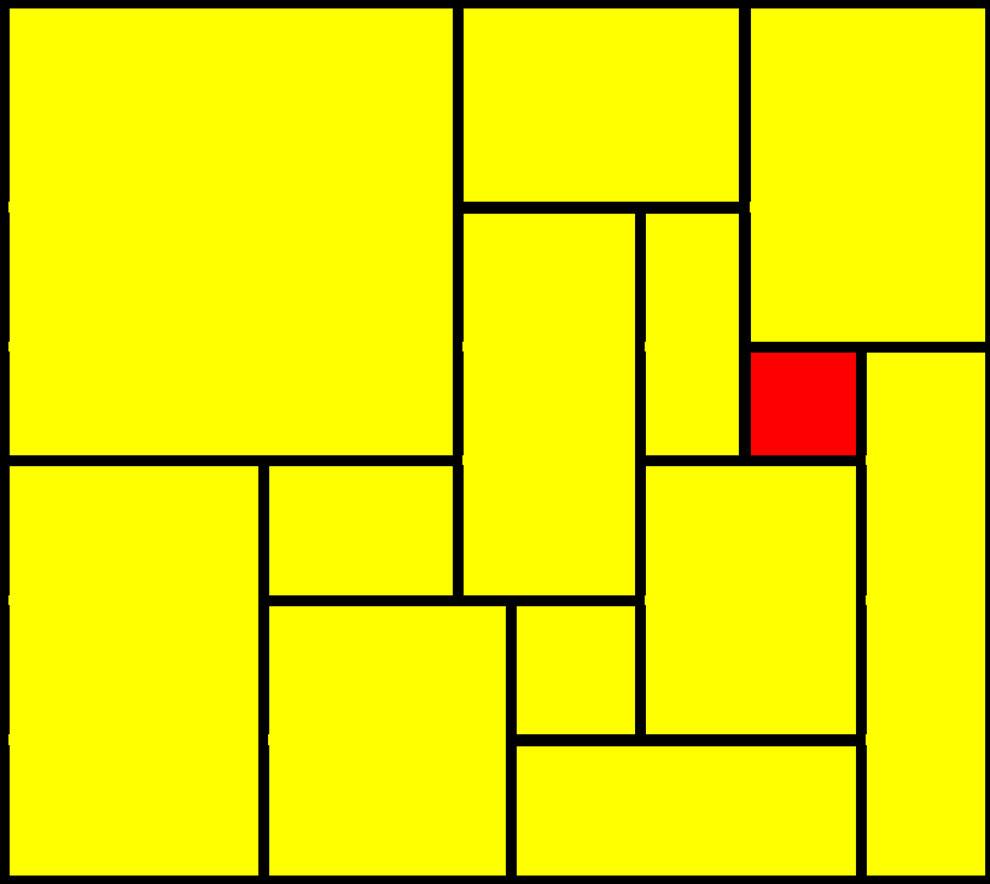
Last week’s challenge was to solve the sides of the different inner squares that compose the following rectangle, knowing that the red one has a side of 3.

Rectangle made of squares (the squares are deformed in the image).

You may argue that the inner figures are not squares but rectangles; this is because the sizes have been disguised to hide the solution to the problem. The relative positions however have not been twisted. You may read the explanation here.

How did I approach the problem?

I used as many unknown variables as needed, and related them with as many equations as needed, ending up with a linear system of 14 equations. Not difficult to solve with Excel. You may see the process and the solution below.

Rectangle with 14 variables

My approach to the problem...

When I watched the solution proposed by the mathematician I had an “aha” moment. I immediately recognized the beauty in the way she solved it. You may see a video with her solution in the here (in Spanish – 6 minutes).

Instead of filling the problem with variables and equations, as I did, she reduced them to really the minimum needed: 2 variables (x and y)  and 2 equations:

(3x -y + 3) + x = 3 + (2x + y + 12) or x = y + 6

(10y – x + 3) + (4y – x) = (3x -y + 3) + (2x – y + 3)

I guess that not being a mathematician I did not care much about the simplicity I employed, knowing that the tools I counted with would not have had any problem in dealing with the calculation… a different mindset :-).

Solution.

2 Comments

Filed under Miscellanea

¿Son las circunscripciones provinciales o la Ley D’Hondt?

Tras las elecciones de ayer, he leído en varios sitios simulaciones de cómo hubiese sido el resultado “si”…

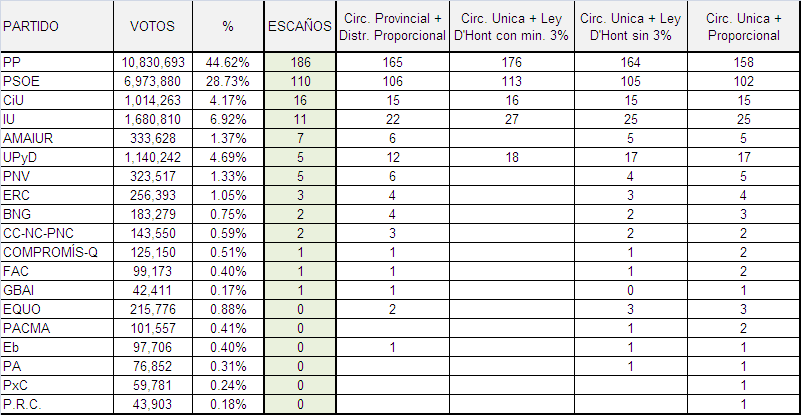
Las cifras que más han circulado por internet son las que resultarían si hubiese circunscripción única en vez de por provincias y si el reparto fuese proporcional, no según la Ley D’Hondt. Esta distribución es la que dejaría al PP con 158 escaños, al PSOE con 102, etc (*).

Me he puesto a hacer los números en detalle para ver el efecto de cada una de las variables, ya que pensaba que la circunscripción por provincias tendría mucha más influencia que la distribución proporcional. Y tiene más influencia, pero no mucha más.

En la tabla de debajo se pueden ver como quedarían los resultados si:

  • Las circunscripciones fuesen las que son, pero el reparto dentro de cada provincia fuese proporcional, no según la Ley D’Hondt.
  • Hubiese una circunscripción única, pero se mantuviese el mínimo de 3% y la aplicación de la Ley D’Hondt para el reparto de escaños.
  • Hubiese una circunscripción única, se retirase el mínimo de 3% y se mantuviese la aplicación de la Ley D’Hondt para el reparto de escaños.
  • Hubiese una circunscripción única y el reparto de escaños fuese proporcional, no según la Ley D’Hondt.

Variación del número de escaños según el método de reparto (elecciones 2011, Congreso).

Viendo la influencia de cada variable, se ve que lo que más perjudica a los partidos nacionales minoritarios (IU, UPyD, Equo, que entiendo que son por los que la gente pone el grito en el cielo) son las circunscripciones por provincias. Solo centralizando los votos ya tendrían la representación que las informaciones les adjudican (25, 17 y 3), se aplicase la Ley D’Hont o no.

Si por el contrario, se mantuviesen las circunscripciones provinciales (que son las que hacen que unos votos cuesten mucho y otros menos, ya que IU y UPyD obtienen muchos votos en provincias donde solo PP y PSOE obtienen representación) pero el reparto dentro de ellas fuese proporcional, los mismos partidos mejorarían sustancialmente respecto a cómo han quedado (22, 12, 2), pero se dejarían 9 escaños entre los 3.

Por último, aunque la gente suele hacer comparaciones con Amaiur, CiU, PNV, por razones obvias, no son estos los partidos que están muy sobrerrepresentados. En cualquiera de los casos CiU obtendría entre 15 y 16 escaños, Amaiur entre 5 y 7, PNV entre 4 y 6.

(*) En una versión de la misma aparece el PP con 160 y el PSOE con 103, debido a que han adjudicado esos 3 escaños arbitrariamente a esos partidos, en vez de a PACMA, FAC y GBAI como corresponde según sus votos.

9 Comments

Filed under Miscellanea

Writing without using “e”

About a month ago I said that on occasions you would find a post which original motivation would link to Plinky; a portal that throws away thoughts for blog posts… this is a post of that kind.

Plinky, calls for writing a small story of 100 words without using a non-consonant you saw in an old post that was just most common in this linguistic communication I am using in my blog. Now, I am at about four fifths of finishing this task; I just lack two strings of words to bring this post to a final and assuaging: This was tough!

… off to a following post :-).

3 Comments

Filed under Miscellanea

Mi adiós a Ibercaja

Llevaba tiempo queriendo cerrar una cuenta de Ibercaja por varios motivos: cobran por las tarjetas, cobran por las transferencias realizadas por internet, hace años me colaron un seguro de vida al pedir un crédito para irme de Erasmus, tiene pocas oficinas, etc.

Hasta ahora no había cerrado esa cuenta porque seguía pagando un préstamo, y no quería cancelar el préstamo porque al principal que me quedaba por pagar le podía sacar una rentabilidad mayor invirtiéndolo que el interés que me cobraba la caja. Pero en junio terminé de pagarlo.

Hace unos días transferí casi todo el dinero restante a ING. Pregunté si seguía necesitando la cuenta de Ibercaja asociada, y me confirmaron que no, que al tener la cuenta Nómina de ING con sus tarjetas (gratuitas) asociadas no era necesario. La comercial de ING me ofreció que ellos me realizaban la gestión de cerrar la cuenta de Ibercaja: “No, gracias, prefiero ir en persona”. Para eso había dejado 22,53€.

Esta mañana, antes de ir al trabajo, he pasado por la oficina más cercana (c/ Francisco Silvela, Madrid).

–  Hola, venía a ver cuánto dinero hay en la cuenta.

–  22,53€.

–  Perfecto, quería retirarlo.

–  ¿22 euros ó 22,53?

–  22,53€.

El hombre de la caja recoge el dinero, hasta el último céntimo y me lo da.

–  Tiene que firmar aquí.

–  Ahora quería cancelar esta tarjeta que me han enviado, que no he pedido ni activado y me dicen que me quieren cobrar 17€ ahora en octubre.

Comprueba unas cosas en el ordenador, me señala otros dos papeles donde debo firmar…

–  Y, por último, quería cerrar la cuenta.

[El orden de retirar primero el dinero, cancelar luego la tarjeta y por último cancelar la cuenta era premeditado: para evitarle la tentación de inventarse un “cargo por cancelación” dado que él vería que ya no quedaba dinero y para que fuese lo más parecido a una muerte anunciada]

–  … No puede ser, tiene que ir a su oficina (Las Rozas, a 22km de Madrid).

–  ¿Cómo que tengo que ir a un pueblo donde no vivo ahora para cerrar una cuenta? Deme una hoja de reclamación que voy a poner una queja.

–  Espere… voy a llamar a la oficina de Las Rozas a ver si me autorizan.

Esperamos a que llegue el fax… A quienes vivimos en Madrid, esto de tener que ir de Madrid a Las Rozas puede no parecer tan extraño, pero ¿si hubiese abierto la cuenta en Sevilla? Me parece estúpido pretender que cada persona haya de ir a cerrar una cuenta donde la abrió… En Ibercaja parecen serlo.

Llega el fax:

–  Usted tenía un seguro de vida… ¿relacionado con un préstamo?

–  Sí, me obligaron a abrirlo. No lo quiero.

–  Además, tiene una libreta.

–  No lo sé, si en algún momento la tuve no sé donde está.

–  Necesito que traiga la libreta, si no, no podemos cerrar la cuenta.

[Este fue el mejor momento… me costó no reírme: ¿qué debía pensar el cajero? “Si le retengo unos días hasta que encuentre la libreta, igual se lo piensa, recapacita y quiere volver a ser nuestro cliente”… esto es como entienden el servicio al cliente – ni que hablar de no cobrar por realizar transferencias, ni por las tarjetas, horarios de apertura, horarios de atención telefónica, etc.]

–  No me ha entendido: no tengo esa libreta ni se la voy a traer.

–  … Bueno, si un día la encuentra corte la banda magnética…

Firmé un último papel y salí del banco sonriente.

Aunque muy pocos, hay días en que el ir a un banco o caja puede hacer que tu día empiece de la forma más feliz.

29 Comments

Filed under Miscellanea

The most profitable roulette

Last weekend I attended Riaza’s local festivities with some friends who have a house there. Riaza is a small and beautiful village in the province of Segovia famous for its main square.

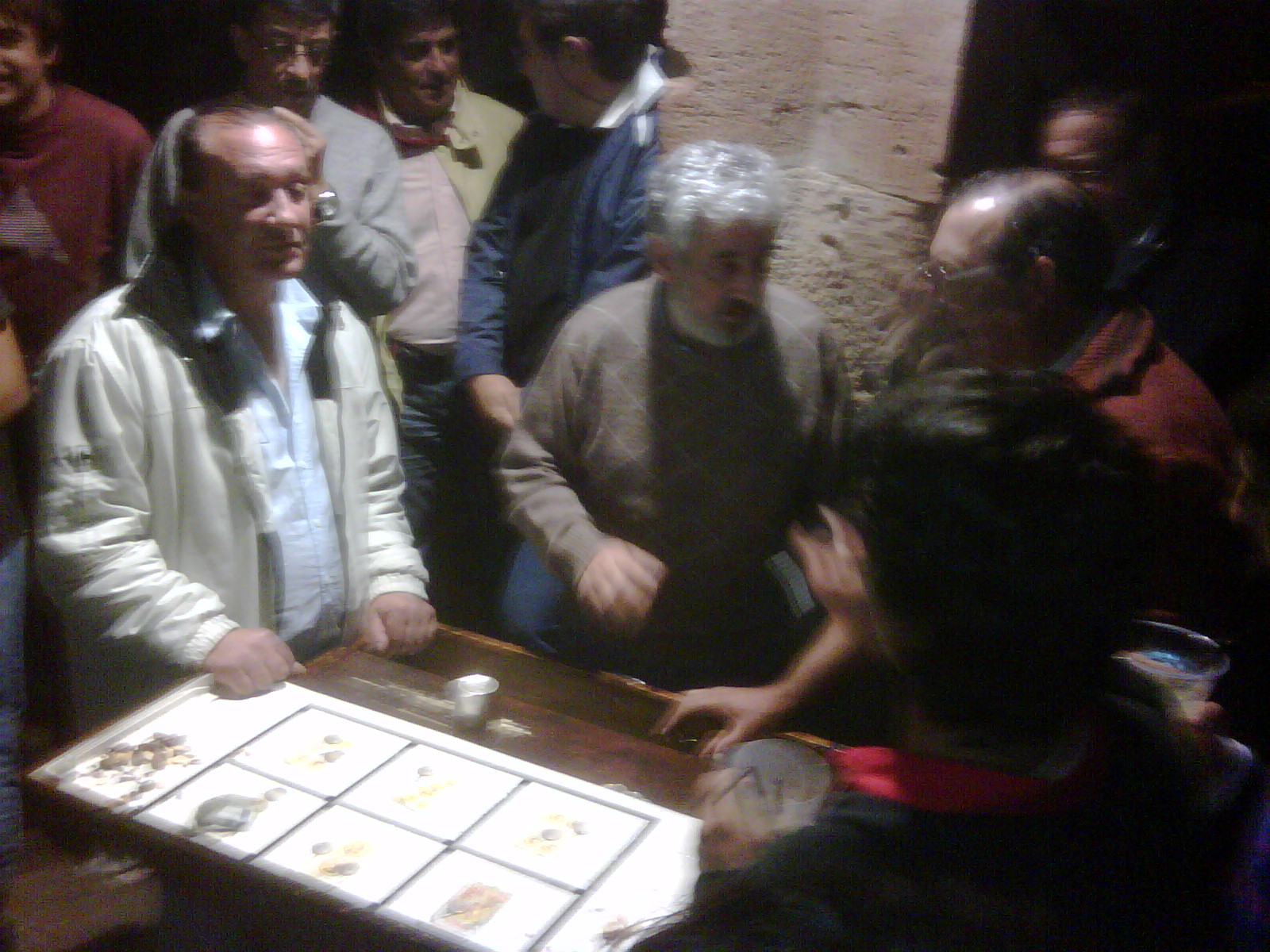
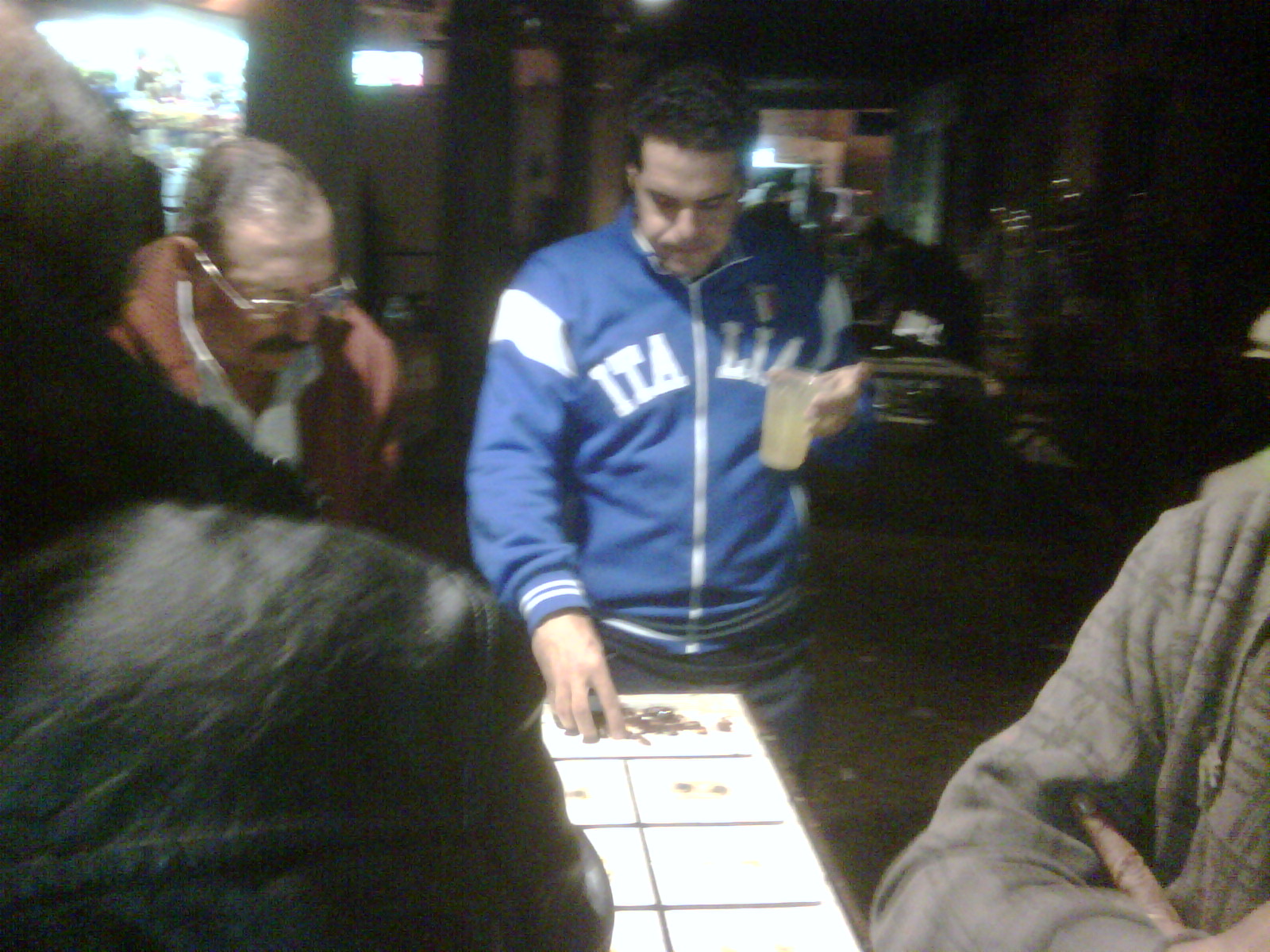
One of my friends raised to me the issue of a game being organized by some locals. It was a kind of casino roulette, but very much simplified…

Instead of 36 numbers plus zero, there were only six. Instead of using an actual roulette, they used just a six-sided die and small cup. Instead of casino coins, bets were placed directly with cash, starting from one euro. Instead of using a green clothed table they used a small wooden board with the images of 6 Spanish playing cards; with numbers 1 to 6.

Prize. We did not know how they came up with the amount of the prize, but it was perfectly established to maximize their benefits and attract as many players as possible. In case you bet for the right number, they gave you 4 times the amount you bet plus your stake, i.e., you bet 1 euro and are lucky, you then walk away with 5 euros.

If they had offered more money, the expected value for the organizers would have been zero or a loss. Have they offered less (e.g., to just double the bet) and not so many people would have been tempted by the game.

Offering 4 times the stake to the players, means  to them a mathematical expectation of -0,17 € for a one-euro bet. For the organizers means the opposite: a business with an expected profit of 17% of all the amounts at stake.

Compare this to the business of a casino with a French roulette, with 37 numbers, in which the expected profit for the casino is 2.7% (where the prize for hitting the number is 35 times the amount you bet). This local game is 6 times more profitable than the casino!

The next question is: how much money could they make out of it? I first saw them at 2:30 am of Sunday morning. At 3:30 am they were still there, though at 4:30 am they were not. Let me assume they hold the village-casino for about 8 hours a day (from 20 pm to 4 am, being conservative, i.e., assuming they are not out there during most of day time).

The highest amount we witnessed at the table at one single round was in excess of 40 € (including a 20€ note), but I assume they had some collaborators among the crowd. The lowest amounts were around 6-8 euro per round. Let’s assume the average to be around 10€ per round.

Each round we witnessed lasted very short time: less than a minute, though we did not measure it. Let’s assume there was exactly a minute, and that they kept that rhythm during the 8 hours…

  • They would have earned about 1.67€ per round.
  • About 100€ per hour (33€/hour per person, taking into account that they were three organizers).
  • 800€ per day.

By organizing the game for four or five days during the festivities they managed to take home their monthly salaries for the three of them out of this simple game.

Some times it is surprising how easy a business can be.

4 Comments

Filed under Investing, Miscellanea, Travelling

Opera with subtitles

Last Saturday I went to the Opera with my Dutch family. We went to see “La Clemenza di Tito”, by Mozart, at the Lucent Danstheater in The Hague.

I used to go often to concerts with my parents when I was teen, when they would buy season tickets. From last Saturday’s experience, I wanted to comment on a feature of the theatre that I had never seen before: at the theatre, in The Hague, there was a screen displaying a Dutch translation of the dialogues sang by the opera singers at the play.

When I attended with my parents we had to previously read the programme in order to follow the plot as (1) it isn’t easy to follow dialogues when they are sung and (2) they sang in Italian. Now, all you have to do is to sit comfortably and listen to the music while reading the plot much as if you would watch a movie in original version with subtitles. Dutch society is one step beyond regarding pragmatism.

See in the scheme of the theatre where the screen is located (as you may imagine I couldn’t take pictures of the screen).

Drawing of Lucent theatre.

2 Comments

Filed under Miscellanea