Category Archives: Travelling

Flight excursion to Najac

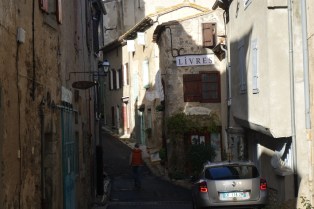
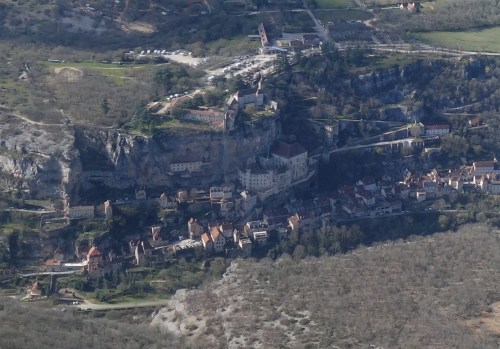
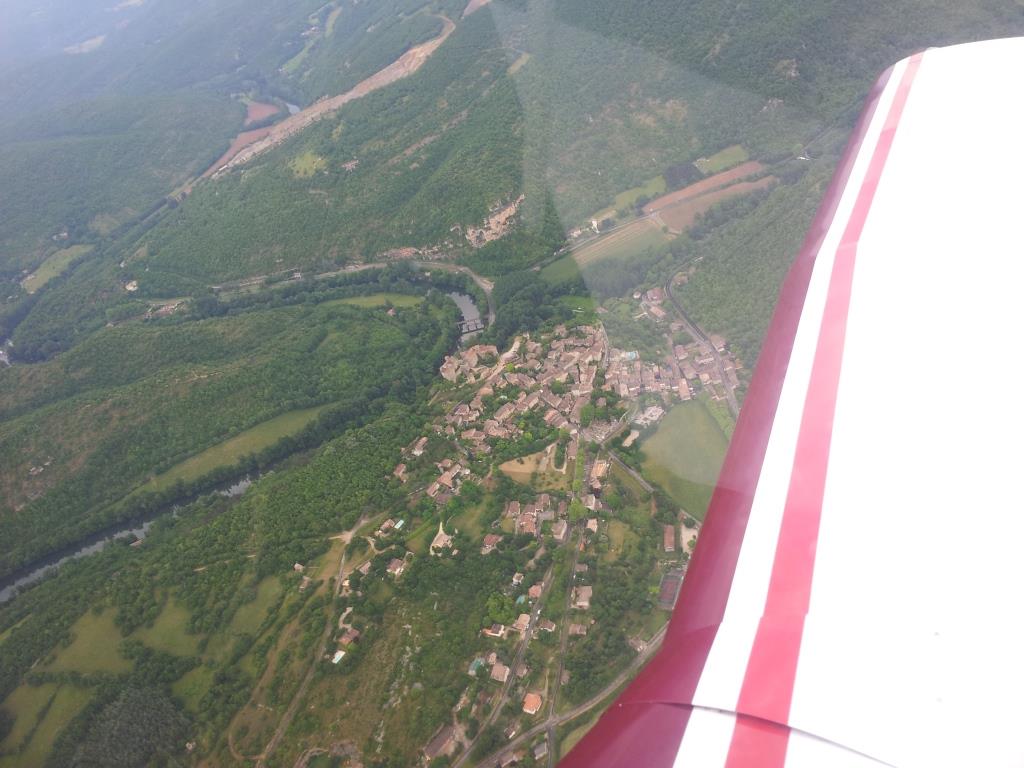
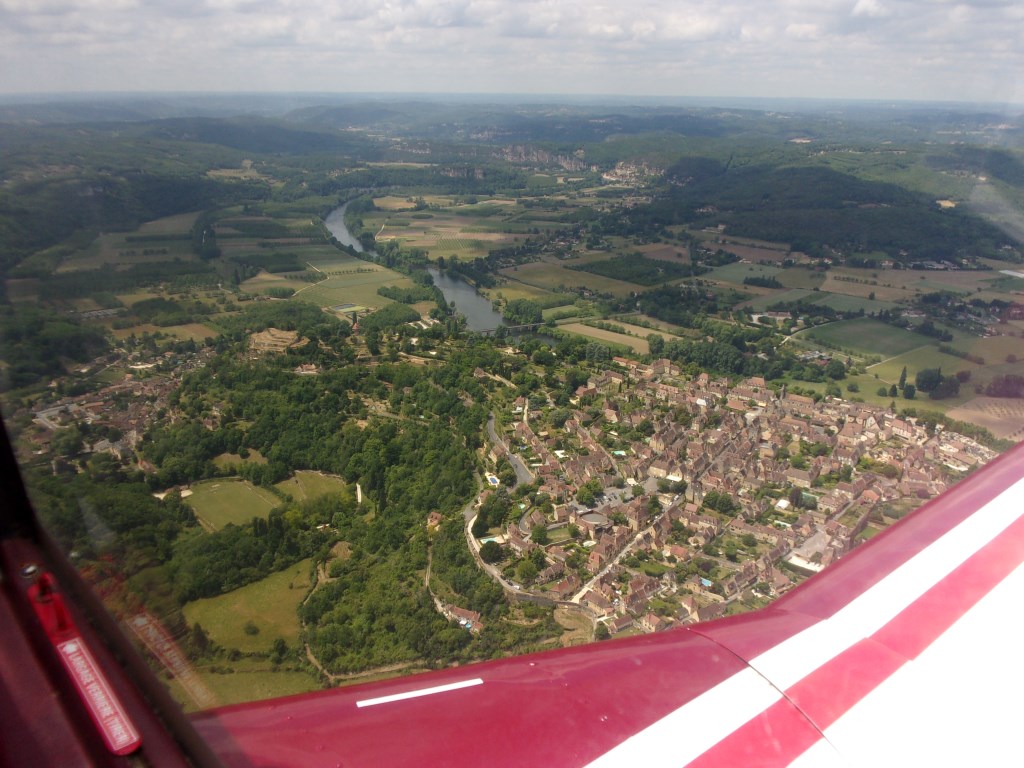
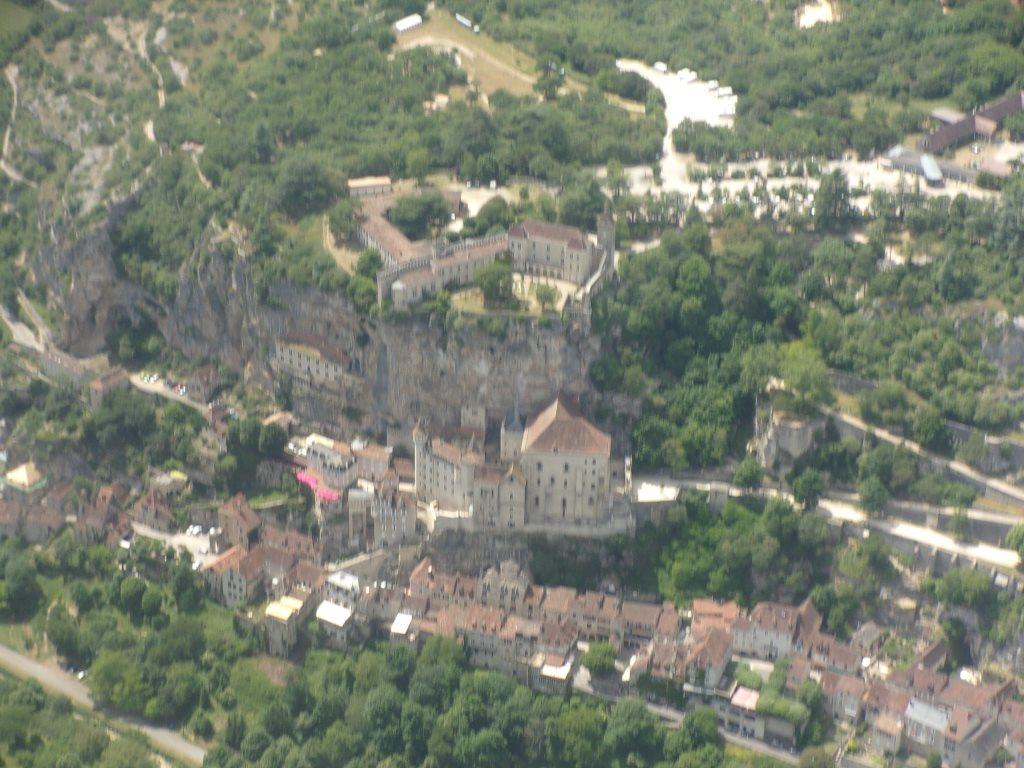
I discovered Najac literally by flying over on the way to Villefranche des Rouergues (LFCV) during a flight lesson with my instructor back on July 17th, 2014. That day, when I came back home, I immediately told Luca: “we have to go on an excursion to Najac“.

We did.

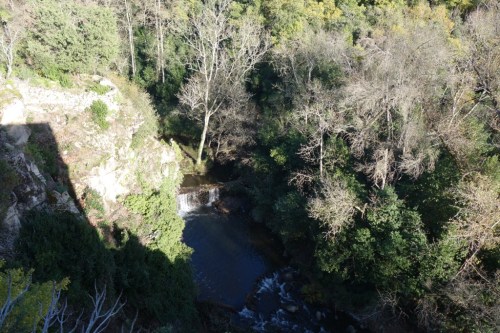
Back in April 2015 we made a weekend excursion doing a night stop over in Najac and visiting other nice villages (mainly) around the Tarn river. Luca wrote two nice posts about them with plenty of bright pictures: Najac and Route verte (including Castelnau-de-Montmiral, Puycelci, Bruniquel and Saint Antonin Noble Val).

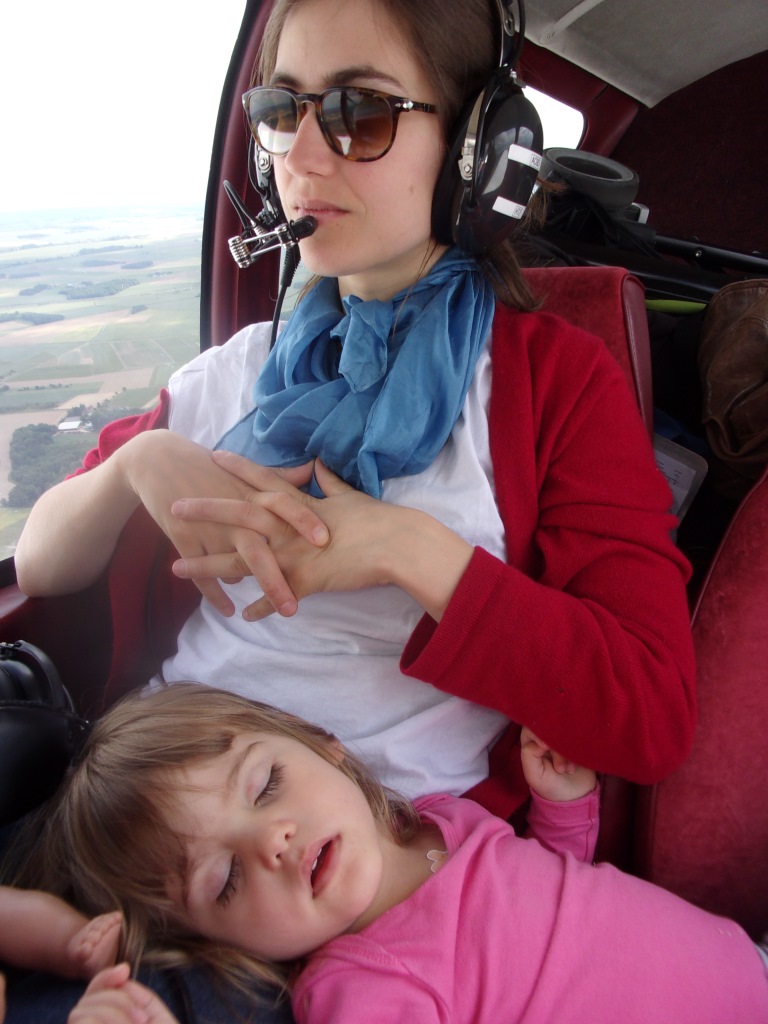
Time passed, and I got my private pilot licence last November (1) and for the first flight with passengers (Luca and Andrea) we decided to go again to Najac.

On the way to Najac we would fly by Cordes-sur-Ciel and on the way back we would partially follow that route verte by St. Antonin de Nobleval, Bruniquel, Puycelci… basically the same trip but up above in the air.

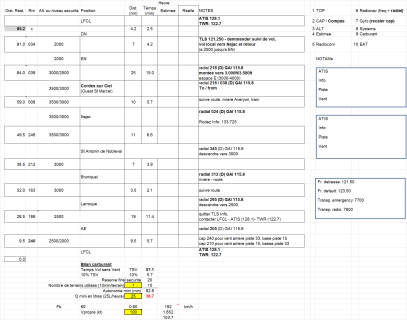
The flight would be short, as estimated when preparing the navigation. It would take about 57 minutes of flight time plus around 10% to take into account the wind, some more minutes for the integration back in Lasbordes… about 1 hour and 10 minutes (2).

Navigation log prepared for the trip Toulouse Lasbordes – Najac.

Navigation log prepared for the trip Toulouse Lasbordes – Najac.

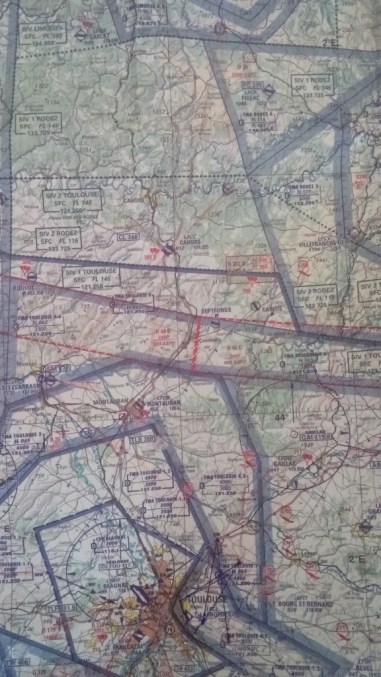
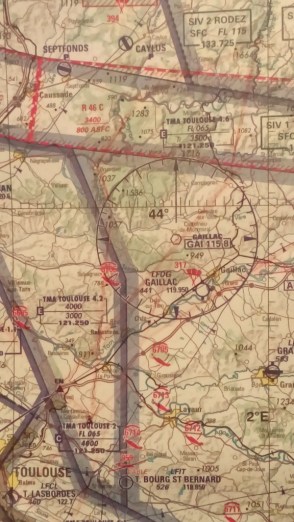
Find below a view of the chart to have an idea of the circuit:

Chart view of Toulouse Lasbordes – Najac.

Chart view of Toulouse Lasbordes – Najac.

Let me share some pictures of the villages and a video taken by Luca:

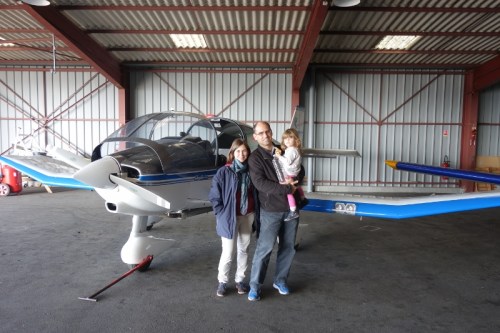
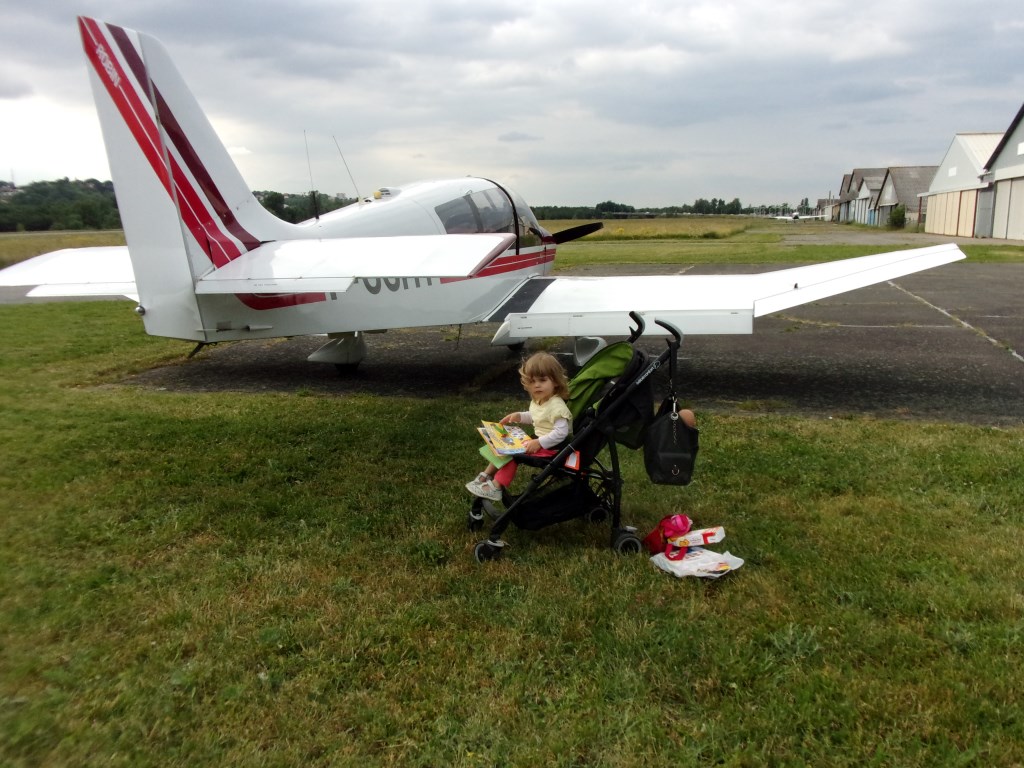
Family picture at Lasbordes.

Family picture at Lasbordes.

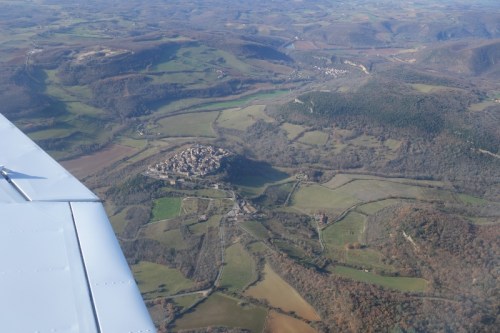
Puycelci.

Puycelci.

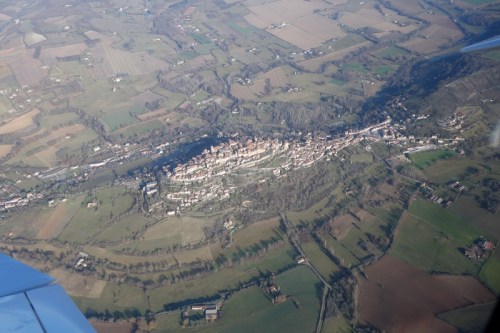
Cordes-sur-Ciel.

Cordes-sur-Ciel.

(1) As described here “My path to the private pilot licence (PPL)“.

(2) In the end it took 1.37 engine hours (or 1h22′), a bit more than estimated… due to  departing Southbound and not having found Cordes-sur-Ciel straight away plust some time spent in circling villages.

2 Comments

Filed under Aerospace & Defence, Travelling

El Bait Shop, the best bar in America (Des Moines, Iowa)

Today’s Iowa caucuses made me remember some anecdotes of a trip we made five years ago which took us through Iowa. I already wrote a post about the visit we made to the Iowa Aviation Museum, but I had not yet written about El Bait Shop, arguably the best bar in America.

After driving all the way from Chicago, we stopped for the night of Thursday 28th April 2011 in Des Moines, Iowa. While changing clothes in our room at the Rodeway Inn motel, by the interstate 80, I went through some flyers and recommendations for tourists. One caught my attention: “the best bar in America” (1).

Some minutes later we left for Des Moines downtown and after some driving and walking around we looked for the bar, which wasn’t easy to find. Once inside the first thing that catches your attention is the amount of beer taps, 180!

El Bait Shop 180 beer taps.

Some of El Bait Shop’s 180 beer taps.

The bar itself is comfortable, with a very good service, quite cheap and with nice music. After receiving some tips from one of the waiters we decided to pick a couple of “beer flights” to taste some 12 different beers (accompanied with some food) (2). See below the flights.

Beer "flights".

Beer “flights”.

El Bait Shop offers many more beer options than the 180 that are in the taps. They change the beers on the menu on a monthly basis, continuously incorporating new brands. You can check the menu today, and you can see below the menu in April 2011.

I want to call the attention on the fact that most of the beers on offer, almost all, are brewed in America, by small breweries producing all kinds of varieties. When you read in the menu “German Hefeweizen” you do not see Paulaner… you see brands from Oregon, Texas or California. When you see “Belgian Ales & Belgian Style Ales” only 3 out of 22 on offer come from Belgium.

The experience was great. A nice surprise in the middle of a road trip. That’s serendipity.

(1) When reading the tip I also thought that the claim might be overrated. Not so after visiting the bar. I invite you to Google “best beer bar in America” or something similar, I bet you’ll find El Bait Shop among any top bar list.

(2) No need to mention that the beer flight I took was “Flyin’ High”.

Leave a comment

Filed under Travelling

Corrida Camarguaise (bullfighting / toros)

Hace unos meses viajamos a La Camargue, y en particular al pueblo Saintes Maries de la Mer. En esa visita tuvimos la oportunidad de asistir a una corrida de toros, pero a una “corrida Camarguaise“, que es diferente a una corrida de toros “andaluza” (como dicen en Francia).

Durante la corrida hice una serie de fotos y videos que se pueden ver más abajo para entender mejor el breve resumen de las cosas que percibimos, aunque estoy seguro de que no llegué a entender todas sus particularidades.

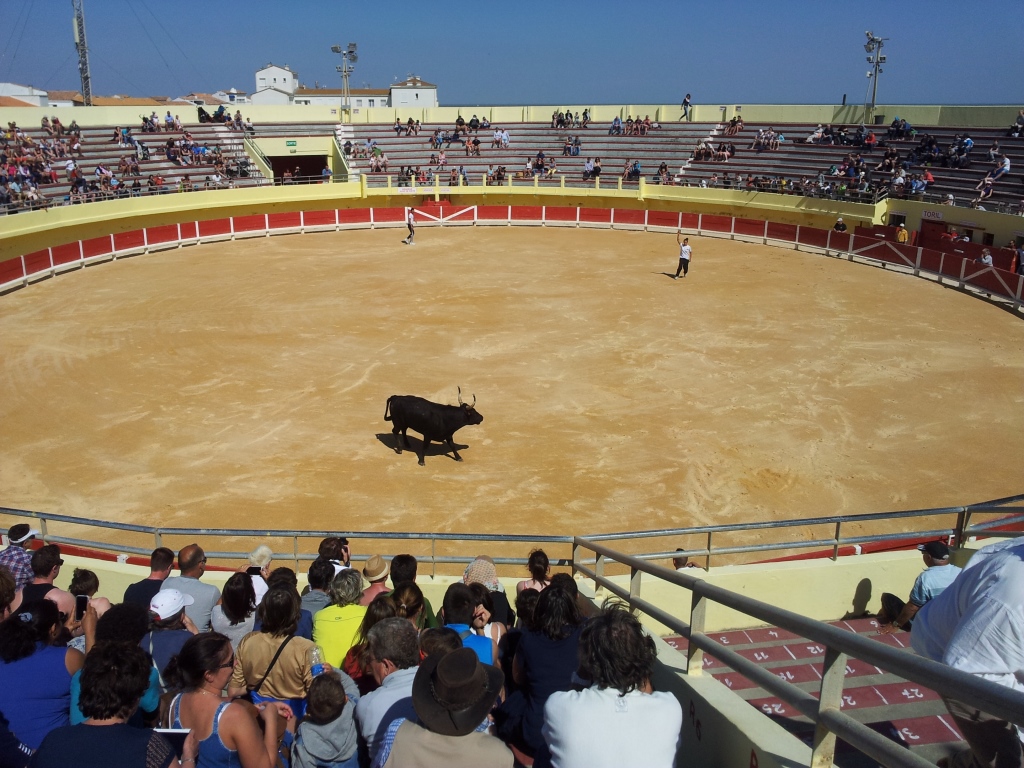
En una corrida camarguesa, no hay un matador, ni banderillas ni picador. El toro no muere. De hecho se parece más a lo que en España llamamos concurso de recortes; aunque tampoco es igual, es mucho menos vistoso y espectacular (al menos la que tuvimos la oportunidad de presenciar).

En la corrida camarguesa que presenciamos, un pequeño grupo se enfrenta al toro por turnos. En este caso eran como tres recortadores (raseteurs), vestidos de ropa deportiva (no un traje de luces), que por turnos partían en carrera para pasar por delante del toro, y si tenían la oportunidad hacerse con uno de los trofeos que lleva el toro en la sien, entre los cuernos. Estos trofeos son pequeñas cintas de papel, que el raseteur debe coger en carrera con la ayuda de un garfio.

Corrida camarguesa en Saintes Maries de la Mer.

Corrida camarguesa en Saintes Maries de la Mer.

Por cada trofeo que cojan, el raseteur obtiene una puntuación y un premio en metálico. Ese premio depende de las aportaciones de los negocios locales y asistentes a la corrida, que financian la fiesta. De hecho, durante la corrida, hay un locutor que va anunciando los nombres de distintas empresas y la cantidad dineraria que aportan. Al cabo de unos segundos el locutor indica en cuanto está la suma en ese instante. Conforme la suma aumenta mayor es el incentivo de ser el primero en coger los trofeos.

Además de los 3 raseteurs (pueden ser más), estos estaban acompañados de un equipo de ayudantes (peones) que tenían como misión el llamar al toro, orientarlo y posicionarlo en el ruedo. También el ganadero tenía su labor. Puede ser porque la barrera en esa plaza fuese de menor altura de la que tienen las plazas en España; el hecho es que el toro saltó varias veces la barrera y corrió por el pasillo entre la barrera y la grada. Entonces, era el ganadero, el que, con la ayuda de una vara, reconducía al toro a una de las puertas de acceso a la plaza.

En resumen, un espectáculo curioso, con un cierto parecido a un concurso de recortes.

1 Comment

Filed under Miscellanea, Travelling

Running in the Incles’ valley (Andorra)

Last weekend, we took the opportunity of July 14th being a national holiday in France to make a short 4-day trip to Andorra. We selected Andorra, in the middle of the Pyrenees Mountains, in order to escape from the hot weather of Toulouse.

On Saturday and Sunday we did some activities including trekking, but with Andrea being just below 2 years it was difficult to cover any meaningful distance.

As I always do, I took my running gear in the suitcase just in case. And on Sunday evening I decided to go out for a run on Monday early morning…

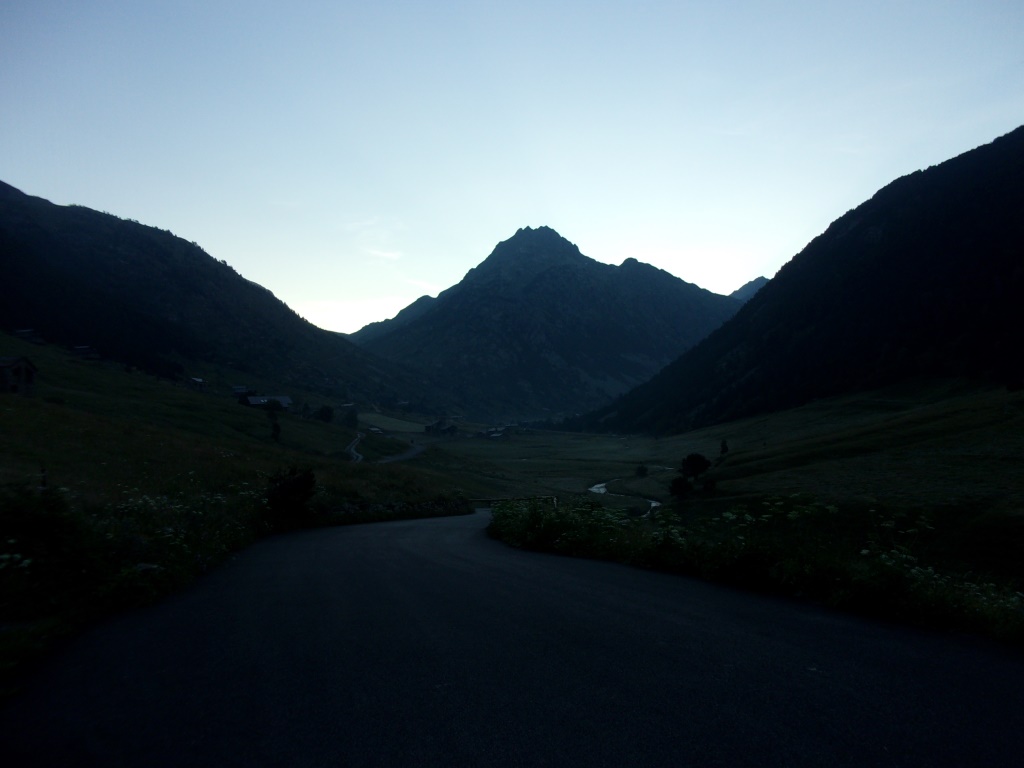
Beginning of the run / trail, at 6h40am.

Beginning of the run / trail, at 6h40am.

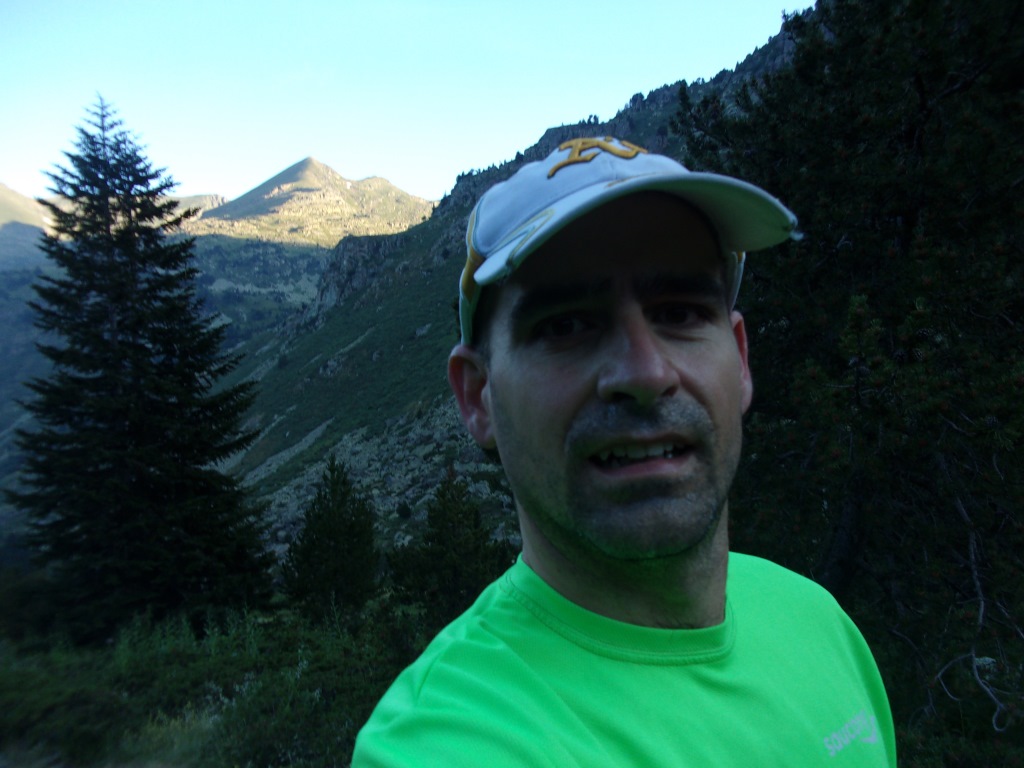
… I woke up at 6am, quickly dressed, ate a toast, some orange juice and took the car to go from our rented apartment in El Tarter to the beginning of the Incles river valley. From there a short 3-km route (“easy”) departs to the end of the road CS-270 where the “bar d’Antoine” is located. The previous day we had done that stretch by a touristic electric bus, and it was that hop that triggered the idea. I parked the car and just equipped with the running gear, a baseball cap (Oakland Athletics), a 400mL plastic bottle of water in one hand and a photo camera in the other, I went to complete that Incles’ valley route followed by another one “Lakes of Siscaro” (“medium”) and back.

In all it was just over 13.3km, with about 800m of positive climb (an average slope of +18% in the last 3.8 kilometres to the summit), reaching up to 2560m, leaving the Siscaro lakes (at an altitude of 2325m) behind to complete the climb up to the mountain ridge to see what was at the other side. It took me about 1h20’ to climb (the 2 routes estimated at 45’ + 1h45’) and 1h10’ to come back, in all 2h27’. I made several short stops to take pictures, videos, talk to a Frenchman who was enjoying a morning sandwich at the top of the climb and to take a refreshing bath at one of the lakes in the way back.

Climb elevation of the run.

Climb elevation of the run.

Map of the Incles valley.

Map of the Incles valley.

On the way up, I only saw a man waking up at the Siscaro refuge (~2140m) and the above-mentioned Frenchman at the very top. Other than that the experience was running and climbing for almost 7km alone in the mountains just listening to the water, birds and some other animal, while watching to the changing colours and lights of the dawn. It felt a little bit like the character of the movie “Into the wild.

At some point climbing at ~7h30am.

At some point climbing at ~7h30am.

On the way down, apart from falling twice, it was much lighter if not easier. I crossed paths with several fully-equipped mountaineers who at about 9am still had ahead of them some 3 to 6 hours of trek (if wanted to complete the same route than I did).

View at the other side of the ridge.

View at the other side of the ridge.

When I got back to the parking lot at the bottom of the valley, I changed t’shirts, drank from a bottle of water I had left in the car and felt like “when is the next such solitary mountain climb?”

This slideshow requires JavaScript.

P.S.: Finally, I just wanted to share this video I made for a friend, Maicol, just before taking a bath at the lake.

2 Comments

Filed under Sports, Travelling

Fly Out: Les Châteaux de la Loire

Last weekend we took part together with my friend Raphaël and about 20 other members of the Airbus Aviation Society of Toulouse in a Fly Out (1) to Les Châteaux de la Loire. 7 aircraft departed from different airfields around Toulouse to reach Angers, some on Friday evening, some on Saturday morning. From then one we would enjoy some joint activities. In a nutshell:

  • On the way to Angers (LFJR, 2h50′ flight), we flew over some very beautiful villages such as Bruniquel, Saint Cirq Lapopie, etc.
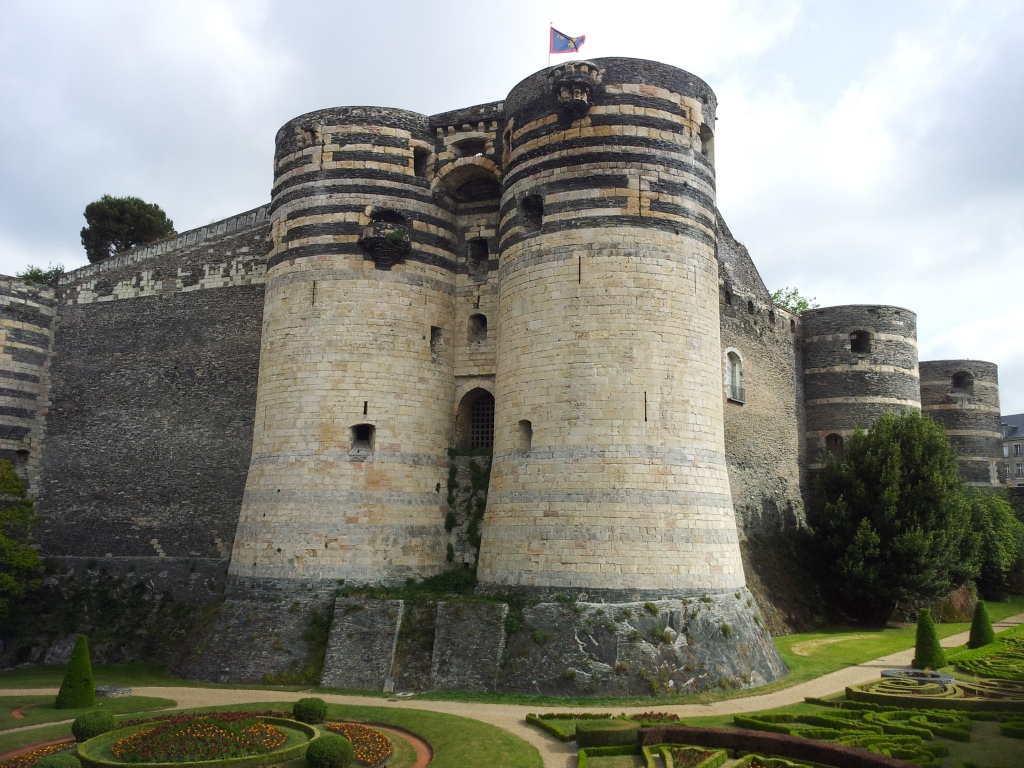
  • On Saturday morning, in Angers we visited the castle and walked around the city. We then visited the museum Espace Air Passion.
  • We then took our aircraft and flew over dozens of castles along the Loire valley, from Angers to Chambord and back to Amboise (LFEF).
  • In Amboise we had an evening event with the local aeroclub.
  • The morning after and due to worsening meteorological conditions we decided to skip the “ground” visit to the Chenonceau castle (next time) and depart early back to Toulouse. In the way we stopped for lunch at Sarlat-Dome (LFDS) where we were very warmly welcome by some members of the local aeroclub.

I believe than rather than wandering with long texts explaining all of these experiences it is better to share some of the pictures we took and let you fly along with us with some captions:

Waiting for the departure time at Toulouse Lasbordes (LFCL)

Waiting for the departure time at Toulouse Lasbordes (LFCL).

Dashboard of the Robin DR-48 we flew (F-GGHT).

Dashboard of the Robin DR-48 we flew (F-GGHT). (2)

Bruniquel.

Bruniquel.

Saint Cirq Lapopie.

Saint Cirq Lapopie. (3)

La Roque Gageac.

La Roque Gageac.

Beynac et Cazenac.

Beynac et Cazenac.

Rapha, concentrated in his piloting.

Rapha, concentrated in his piloting.

Arriving at Angers (LFJR) rather late.

Arriving at Angers (LFJR) rather late.

If you arrive at Angers airport in the evening, you'd better know the theory if you want to get out.

If you arrive at Angers airport in the evening, you’d better know the theory if you want to get out.

Château d'Angers, founded by the Counts of Anjou.

Château d’Angers, founded by the Counts of Anjou.

"Apocalypse Tapestry" at Angers castle.

“Apocalypse Tapestry” at Angers castle.

Visiting the museum "Espace Air Passion" at Angers airport.

Visiting the museum “Espace Air Passion” at Angers airport. (4)

"Why is Rapha at the controls again, daddy? When do I get to pilot?!"

“Why is Rapha at the controls again, daddy? When do I get to pilot?!”

Chenonceau.

Chenonceau.

Chambord.

Chambord.

Andrea, a born flyer, and Luca, getting over it.

Andrea, a born flyer, and Luca, getting over it.

Great evening event organized by the "Aéro-club Les Ailes Tourangelles".

Great evening event organized by the “Aéro-club Les Ailes Tourangelles”. (5)

Our commandan de bord, Raphael preparing the next flight.

Our commandant de bord, Raphael preparing the next flight.

The fellows from the "Aeroclub du Sarladais" got out those table, parasols and chairs for us to have lunch with them.

The fellows from the “Aeroclub du Sarladais” got out those table, parasols and chairs for us to have lunch with them. (5)

Relaxing at Sarlat-Dome aerodrome (LFDS).

Relaxing at Sarlat-Dome aerodrome (LFDS).

Initial climb at Sarlat-Dome (LFDS), wonderful view of the Dordogne valley and Dome village.

Initial climb at Sarlat-Dome (LFDS), wonderful view of the Dordogne valley and Dome village.

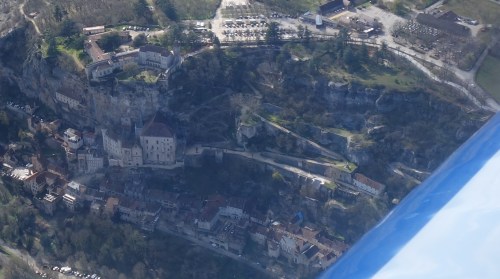
Rocamadour.

Rocamadour.

(1) The term we use for an organized activity in which several aircraft depart together with a common destination.

(2) Check out about the DR-48 here.

(3) Recently selected as the most beautiful village of France.

(4) Be sure that I will dedicate another post about this museum.

(5) If you plan to fly either to Amboise Dierre or Sarlat-Dome, do not hesitate in contacting the local aeroclubs (Les Ailes Tourangelles and Aeroclub du Sarladais, respectively), they will give you a more than warm welcome!

4 Comments

Filed under Aerospace & Defence, France, Travelling

Letters from Nikita Krushchev to John F. Kennedy during the Cuban Missile Crisis

Reading about the recent Munich Security Conference 2015, mainly focussed on the tensions over Ukraine and the clashes between Russia and the West, and within Western countries, namely Germany and the United States, I was reminded of the Cuban Missile Crisis of 1962, under the presidency of Kennedy.

During our last visit to the USA, we visited Boston and made a very enlightening visit to the Presidential Library of John F. Kennedy. Among other things, I was very much attracted to the section on the Missile Crisis, and I took sometime reading the letters exchanged between Soviet Union’s premier Nikita Krushchev and US president Kennedy. They can be found in the “Office of the Historian” of the US Department of State.

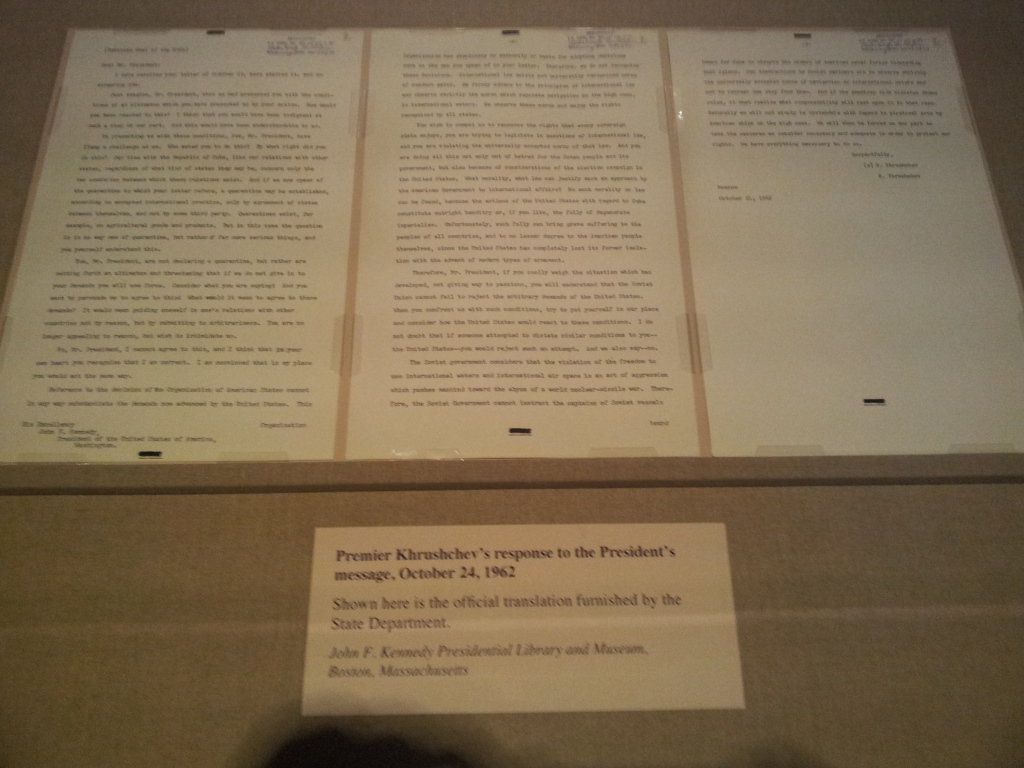
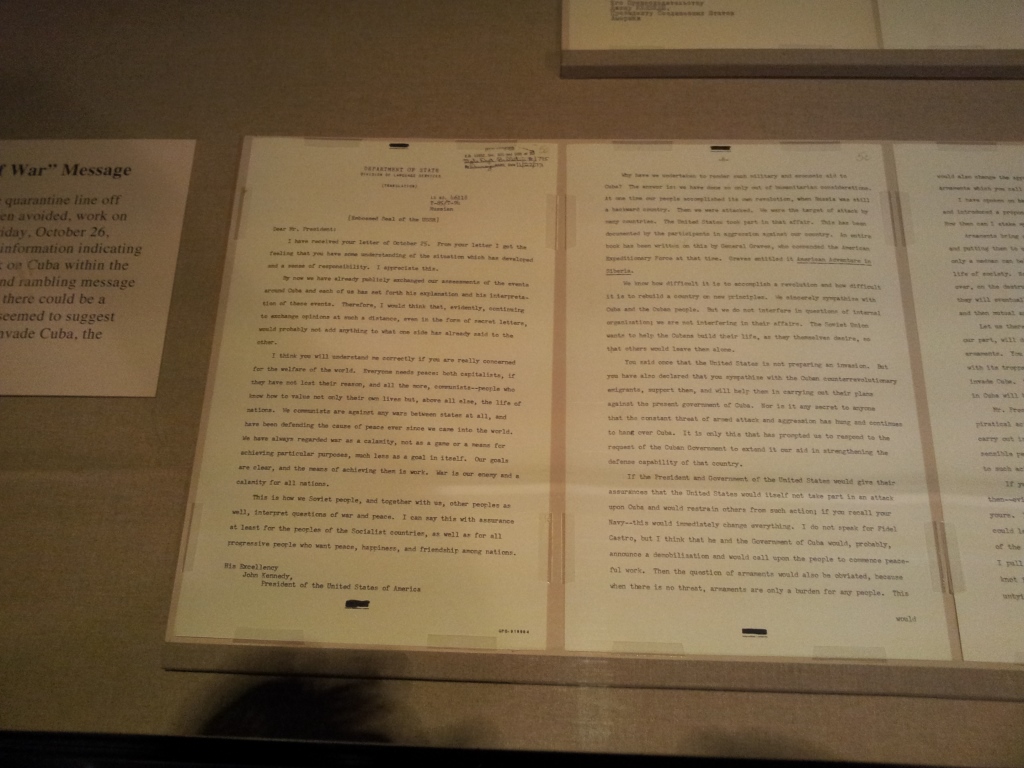
Seeing the image that Vladimir Putin enjoys today in the West, I can imagine the image that Krushchev must have had in the Western world at that time. I wanted to share in this post two of the letters that Krushchev sent to Kennedy during those tense days of October 1962. I found it interesting how the communication channel remained open in those moments. For each of the letters, I will share a picture of the letter (taken at the presidential library) and the transcript of the letter (from the USA Department of State site mentioned above) where the emphasis is mine.
Letter From Chairman Khrushchev to President Kennedy. October 24, 1962.

Letter from Krushchev to Kennedy, October 24, 1962.

Letter from Krushchev to Kennedy, October 24, 1962.

DEAR MR. PRESIDENT: I have received your letter of October 23, have studied it, and am answering you.

Just imagine, Mr. President, that we had presented you with the conditions of an ultimatum which you have presented us by your action. How would you have reacted to this? I think that you would have been indignant at such a step on our part. And this would have been understandable to us.

In presenting us with these conditions, you, Mr. President, have flung a challenge at us. Who asked you to do this? By what right did you do this? Our ties with the Republic of Cuba, like our relations with other states, regardless of what kind of states they may be, concern only the two countries between which these relations exist. And if we now speak of the quarantine to which your letter refers, a quarantine may be established, according to accepted international practice, only by agreement of states between themselves, and not by some third party. Quarantines exist, for example, on agricultural goods and products. But in this case the question is in no way one of quarantine, but rather of far more serious things, and you yourself understand this.

You, Mr. President, are not declaring a quarantine, but rather are setting forth an ultimatum and threatening that if we do not give in to your demands you will use force. Consider what you are saying! And you want to persuade me to agree to this! What would it mean to agree to these demands? It would mean guiding oneself in one’s relations with other countries not by reason, but by submitting to arbitrariness. You are no longer appealing to reason, but wish to intimidate us.

No, Mr. President, I cannot agree to this, and I think that in your own heart you recognize that I am correct. I am convinced that in my place you would act the same way.

Reference to the decision of the Organization of American States cannot in any way substantiate the demands now advanced by the United States. This Organization has absolutely no authority or basis for adopting decisions such as the one you speak of in your letter. Therefore, we do not recognize these decisions. International law exists and universally recognized norms of conduct exist. We firmly adhere to the principles of international law and observe strictly the norms which regulate navigation on the high seas, in international waters. We observe these norms and enjoy the rights recognized by all states.

You wish to compel us to renounce the rights that every sovereign state enjoys, you are trying to legislate in questions of international law, and you are violating the universally accepted norms of that law. And you are doing all this not only out of hatred for the Cuban people and its government, but also because of considerations of the election campaign in the United States. What morality, what law can justify such an approach by the American Government to international affairs? No such morality or law can be found, because the actions of the United States with regard to Cuba constitute outright banditry or, if you like, the folly of degenerate imperialism. Unfortunately, such folly can bring grave suffering to the peoples of all countries, and to no lesser degree to the American people themselves, since the United States has completely lost its former isolation with the advent of modern types of armament.

Therefore, Mr. President, if you coolly weigh the situation which has developed, not giving way to passions, you will understand that the Soviet Union cannot fail to reject the arbitrary demands of the United States. When you confront us with such conditions, try to put yourself in our place and consider how the United States would react to these conditions. I do not doubt that if someone attempted to dictate similar conditions to you—the United States—you would reject such an attempt. And we also say—no.

The Soviet Government considers that the violation of the freedom to use international waters and international air space is an act of aggression which pushes mankind toward the abyss of a world nuclear-missile war. Therefore, the Soviet Government cannot instruct the captains of Soviet vessels bound for Cuba to observe the orders of American naval forces blockading that Island. Our instructions to Soviet mariners are to observe strictly the universally accepted norms of navigation in international waters and not to retreat one step from them. And if the American side violates these rules, it must realize what responsibility will rest upon it in that case. Naturally we will not simply be bystanders with regard to piratical acts by American ships on the high seas. We will then be forced on our part to take the measures we consider necessary and adequate in order to protect our rights. We have everything necessary to do so.

Respectfully,

N. Khrushchev

Telegram From the Embassy in the Soviet Union to the Department of State. October 26, 1962.

Letter from Krushchev to Kennedy, October 26, 1962.

Letter from Krushchev to Kennedy, October 26, 1962.

Dear Mr. President:

I have received your letter of October 25. From your letter, I got the feeling that you have some understanding of the situation which has developed and (some) sense of responsibility. I value this.

Now we have already publicly exchanged our evaluations of the events around Cuba and each of us has set forth his explanation and his understanding of these events. Consequently, I would judge that, apparently, a continuation of an exchange of opinions at such a distance, even in the form of secret letters, will hardly add anything to that which one side has already said to the other.

I think you will understand me correctly if you are really concerned about the welfare of the world. Everyone needs peace: both capitalists, if they have not lost their reason, and, still more, Communists, people who know how to value not only their own lives but, more than anything, the lives of the peoples. We, Communists, are against all wars between states in general and have been defending the cause of peace since we came into the world. We have always regarded war as a calamity, and not as a game nor as a means for the attainment of definite goals, nor, all the more, as a goal in itself. Our goals are clear, and the means to attain them is labor. War is our enemy and a calamity for all the peoples.

It is thus that we, Soviet people, and, together with US, other peoples as well, understand the questions of war and peace. I can, in any case, firmly say this for the peoples of the Socialist countries, as well as for all progressive people who want peace, happiness, and friendship among peoples.

I see, Mr. President, that you too are not devoid of a sense of anxiety for the fate of the world understanding, and of what war entails. What would a war give you? You are threatening us with war. But you well know that the very least which you would receive in reply would be that you would experience the same consequences as those which you sent us. And that must be clear to us, people invested with authority, trust, and responsibility. We must not succumb to intoxication and petty passions, regardless of whether elections are impending in this or that country, or not impending. These are all transient things, but if indeed war should break out, then it would not be in our power to stop it, for such is the logic of war. I have participated in two wars and know that war ends when it has rolled through cities and villages, everywhere sowing death and destruction.

In the name of the Soviet Government and the Soviet people, I assure you that your conclusions regarding offensive weapons on Cuba are groundless. It is apparent from what you have written me that our conceptions are different on this score, or rather, we have different estimates of these or those military means. Indeed, in reality, the same forms of weapons can have different interpretations.

You are a military man and, I hope, will understand me. Let us take for example a simple cannon. What sort of means is this: offensive or defensive? A cannon is a defensive means if it is set up to defend boundaries or a fortified area. But if one concentrates artillery, and adds to it the necessary number of troops, then the same cannons do become an offensive means, because they prepare and clear the way for infantry to attack. The same happens with missile-nuclear weapons as well, with any type of this weapon.

You are mistaken if you think that any of our means on Cuba are offensive. However, let us not quarrel now. It is apparent that I will not be able to convince you of this. But I say to you: You, Mr. President, are a military man and should understand: Can one attack, if one has on one’s territory even an enormous quantity of missiles of various effective radiuses and various power, but using only these means. These missiles are a means of extermination and destruction. But one cannot attack with these missiles, even nuclear missiles of a power of 100 megatons because only people, troops, can attack. Without people, any means however powerful cannot be offensive.

How can one, consequently, give such a completely incorrect interpretation as you are now giving, to the effect that some sort of means on Cuba are offensive. All the means located there, and I assure you of this, have a defensive character, are on Cuba solely for the purposes of defense, and we have sent them to Cuba at the request of the Cuban Government. You, however, say that these are offensive means.

But, Mr. President, do you really seriously think that Cuba can attack the United States and that even we together with Cuba can attack you from the territory of Cuba? Can you really think that way? How is it possible? We do not understand this. Has something so new appeared in military strategy that one can think that it is possible to attack thus. I say precisely attack, and not destroy, since barbarians, people who have lost their sense, destroy.

I believe that you have no basis to think this way. You can regard us with distrust, but, in any case, you can be calm in this regard, that we are of sound mind and understand perfectly well that if we attack you, you will respond the same way. But you too will receive the same that you hurl against us. And I think that you also understand this. My conversation with you in Vienna gives me the right to talk to you this way.

This indicates that we are normal people, that we correctly understand and correctly evaluate the situation. Consequently, how can we permit the incorrect actions which you ascribe to us? Only lunatics or suicides, who themselves want to perish and to destroy the whole world before they die, could do this. We, however, want to live and do not at all want to destroy your country. We want something quite different: To compete with your country on a peaceful basis. We quarrel with you, we have differences on ideological questions. But our view of the world consists in this, that ideological questions, as well as economic problems, should be solved not by military means, they must be solved on the basis of peaceful competition, i.e., as this is understood in capitalist society, on the basis of competition. We have proceeded and are proceeding from the fact that the peaceful co-existence of the two different social-political systems, now existing in the world, is necessary, that it is necessary to assure a stable peace. That is the sort of principle we hold.

You have now proclaimed piratical measures, which were employed in the Middle Ages, when ships proceeding in international waters were attacked, and you have called this “a quarantine” around Cuba. Our vessels, apparently, will soon enter the zone which your Navy is patrolling. I assure you that these vessels, now bound for Cuba, are carrying the most innocent peaceful cargoes. Do you really think that we only occupy ourselves with the carriage of so-called offensive weapons, atomic and hydrogen bombs? Although perhaps your military people imagine that these (cargoes) are some sort of special type of weapon, I assure you that they are the most ordinary peaceful products.

Consequently, Mr. President, let us show good sense. I assure you that on those ships, which are bound for Cuba, there are no weapons at all. The weapons which were necessary for the defense of Cuba are already there. I do not want to say that there were not any shipments of weapons at all. No, there were such shipments. But now Cuba has already received the necessary means of defense.

I don’t know whether you can understand me and believe me. But I should like to have you believe in yourself and to agree that one cannot give way to passions; it is necessary to control them. And in what direction are events now developing? If you stop the vessels, then, as you yourself know, that would be piracy. If we started to do that with regard to your ships, then you would also be as indignant as we and the whole world now are. One cannot give another interpretation to such actions, because one cannot legalize lawlessness. If this were permitted, then there would be no peace, there would also be no peaceful coexistence. We should then be forced to put into effect the necessary measures of a defensive character to protect our interests in accordance with international law. Why should this be done? To what would all this lead?

Let us normalize relations. We have received an appeal from the Acting Secretary General of the UN, U Thant, with his proposals. I have already answered him. His proposals come to this, that our side should not transport armaments of any kind to Cuba during a certain period of time, while negotiations are being conducted—and we are ready to enter such negotiations—and the other side should not undertake any sort of piratical actions against vessels engaged in navigation on the high seas. I consider these proposals reasonable. This would be a way out of the situation which has been created, which would give the peoples the possibility of breathing calmly. You have asked what happened, what evoked the delivery of weapons to Cuba? You have spoken about this to our Minister of Foreign Affairs. I will tell you frankly, Mr. President, what evoked it.

We were very grieved by the fact—I spoke about it in Vienna—that a landing took place, that an attack on Cuba was committed, as a result of which many Cubans perished. You yourself told me then that this had been a mistake. I respected that explanation. You repeated it to me several times, pointing out that not everybody occupying a high position would acknowledge his mistakes as you had done. I value such frankness. For my part, I told you that we too possess no less courage; we also acknowledged those mistakes which had been committed during the history of our state, and not only acknowledged, but sharply condemned them.

If you are really concerned about the peace and welfare of your people, and this is your responsibility as President, then I, as the Chairman of the Council of Ministers, am concerned for my people. Moreover, the preservation of world peace should be our joint concern, since if, under contemporary conditions, war should break out, it would be a war not only between the reciprocal claims, but a world wide cruel and destructive war.

Why have we proceeded to assist Cuba with military and economic aid? The answer is: We have proceeded to do so only for reasons of humanitarianism. At one time, our people itself had a revolution, when Russia was still a backward country. We were attacked then. We were the target of attack by many countries. The USA participated in that adventure. This has been recorded by participants in the aggression against our country. A whole book has been written about this by General Graves, who, at that time, commanded the US Expeditionary Corps. Graves called it “The American Adventure in Siberia.”

We know how difficult it is to accomplish a revolution and how difficult it is to reconstruct a country on new foundations. We sincerely sympathize with Cuba and the Cuban people, but we are not interfering in questions of domestic structure, we are not interfering in their affairs. The Soviet Union desires to help the Cubans build their life as they themselves wish and that others should not hinder them.

You once said that the United States was not preparing an invasion. But you also declared that you sympathized with the Cuban counter-revolutionary emigrants, that you support them and would help them to realize their plans against the present Government of Cuba. It is also not a secret to anyone that the threat of armed attack, aggression, has constantly hung, and continues to hang over Cuba. It was only this which impelled us to respond to the request of the Cuban Government to furnish it aid for the strengthening of the defensive capacity of this country.

If assurances were given by the President and the Government of the United States that the USA itself would not participate in an attack on Cuba and would restrain others from actions of this sort, if you would recall your fleet, this would immediately change everything. I am not speaking for Fidel Castro, but I think that he and the Government of Cuba, evidently, would declare demobilization and would appeal to the people to get down to peaceful labor. Then, too, the question of armaments would disappear, since, if there is no threat, then armaments are a burden for every people. Then too, the question of the destruction, not only of the armaments which you call offensive, but of all other armaments as well, would look different.

I spoke in the name of the Soviet Government in the United Nations and introduced a proposal for the disbandment of all armies and for the destruction of all armaments. How then can I now count on those armaments?

Armaments bring only disasters. When one accumulates them, this damages the economy, and if one puts them to use, then they destroy people on both sides. Consequently, only a madman can believe that armaments are the principal means in the life of society. No, they are an enforced loss of human energy, and what is more are for the destruction of man himself. If people do not show wisdom, then in the final analysis they will come to a clash, like blind moles, and then reciprocal extermination will begin.

Let us therefore show statesmanlike wisdom. I propose: We, for our part, will declare that our ships, bound for Cuba, will not carry any kind of armaments. You would declare that the United States will not invade Cuba with its forces and will not support any sort of forces which might intend to carry out an invasion of Cuba. Then the necessity for the presence of our military specialists in Cuba would disappear.

Mr. President, I appeal to you to weigh well what the aggressive, piratical actions, which you have declared the USA intends to carry out in international waters, would lead to. You yourself know that any sensible man simply cannot agree with this, cannot recognize your right to such actions.

If you did this as the first step towards the unleashing of war, well then, it is evident that nothing else is left to us but to accept this challenge of yours. If, however, you have not lost your self-control and sensibly conceive what this might lead to, then, Mr. President, we and you ought not now to pull on the ends of the rope in which you have tied the knot of war, because the more the two of us pull, the tighter that knot will be tied. And a moment may come when that knot will be tied so tight that even he who tied it will not have the strength to untie it, and then it will be necessary to cut that knot, and what that would mean is not for me to explain to you, because you yourself understand perfectly of what terrible forces our countries dispose.

Consequently, if there is no intention to tighten that knot and thereby to doom the world to the catastrophe of thermonuclear war, then let us not only relax the forces pulling on the ends of the rope, let us take measures to untie that knot. We are ready for this.

We welcome all forces which stand on positions of peace. Consequently, I expressed gratitude to Mr. Bertrand Russell, too, who manifests alarm and concern for the fate of the world, and I readily responded to the appeal of the Acting Secretary General of the UN, U Thant.

There, Mr. President, are my thoughts, which, if you agreed with them, could put an end to that tense situation which is disturbing all peoples.

These thoughts are dictated by a sincere desire to relieve the situation, to remove the threat of war.

Respectfully yours,

N. Khrushchev

October 26, 1962.
You may continue reading the letters on October 27, 1962, both from Krushchev and Kennedy, which commence to unravel the situation.

1 Comment

Filed under Travelling

Bonifacio

Reading today about the speech of Greece prime minister Alexis Tsipras in which he mentioned the claim on WWII reparations:

a moral obligation to our people, to history, to all European peoples who fought and gave their blood against Nazism

I was first drawn to the simile of the 50-year-old movie “The Guns of Navarone“, which portrayed the effort of Allied forces during the WWII to destroy a German fortress in an island in the Aegean Sea.

I then remembered that I had indeed visited the filming location of The Guns of Navarone, far from Greece, in the Southern most village of Corsica: Bonifacio.

I visited Bonifacio by land, sea and air back in 2012, when I travelled with a colleague and his flight instructor to Corsica.

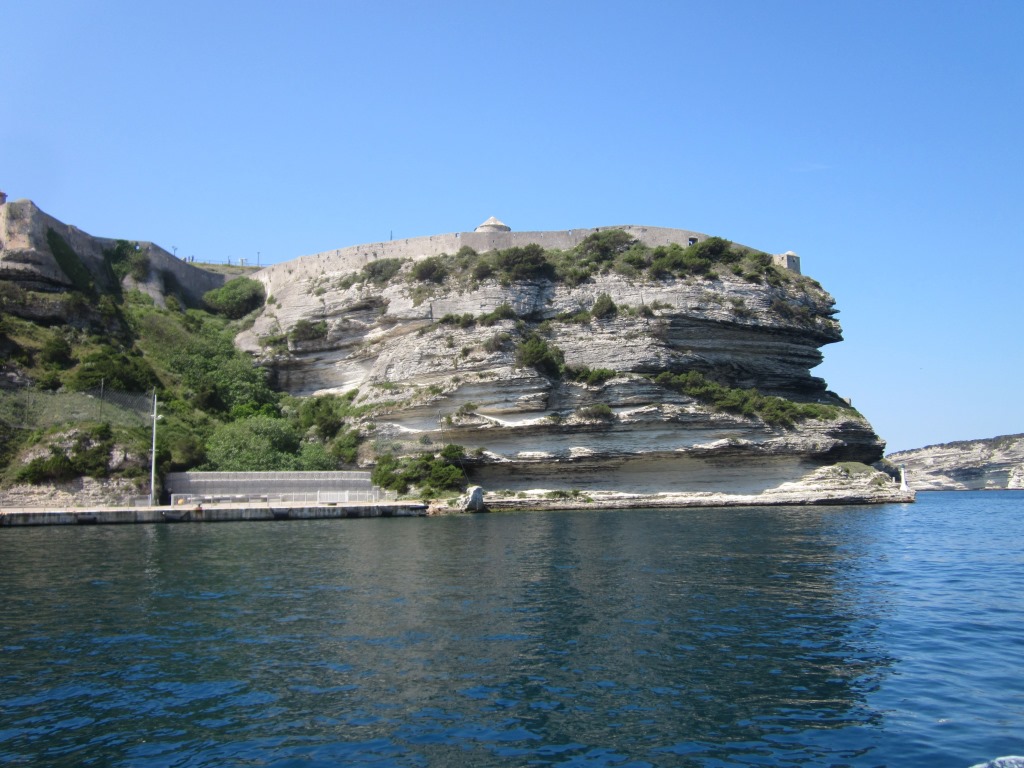
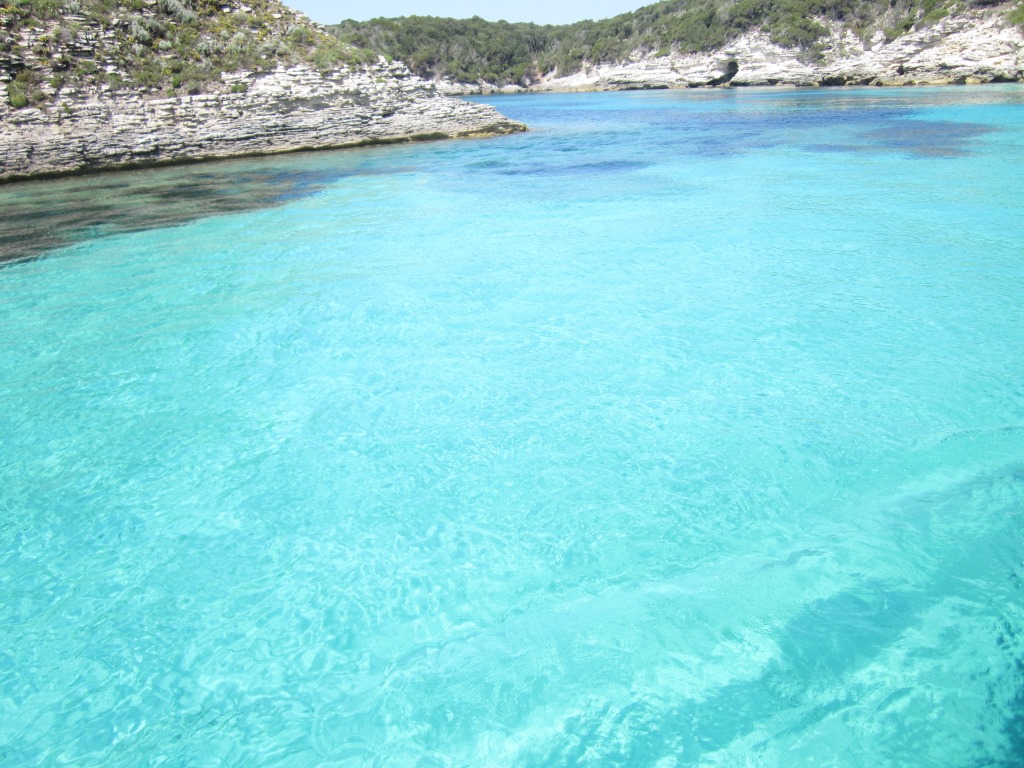
Bonifacio is very beautiful. It has a small and protected bay, few beaches and most of the city stands on the top of the cliffs facing the Mediterranean sea. As you can imagine, due to its location it has a history plenty of battles fought and of having been part of different kingdoms and empires. We first visited the village by boat (~about 1 hour), then took a 1.5-hour walk covering every corner and finally we over flew it the day after before returning back to metropolitan France.
I just wanted to share below some pictures of the nice spots in Bonifacio:


Bonifacio from the bay.

Bonifacio from the bay.

???????????????????????????????

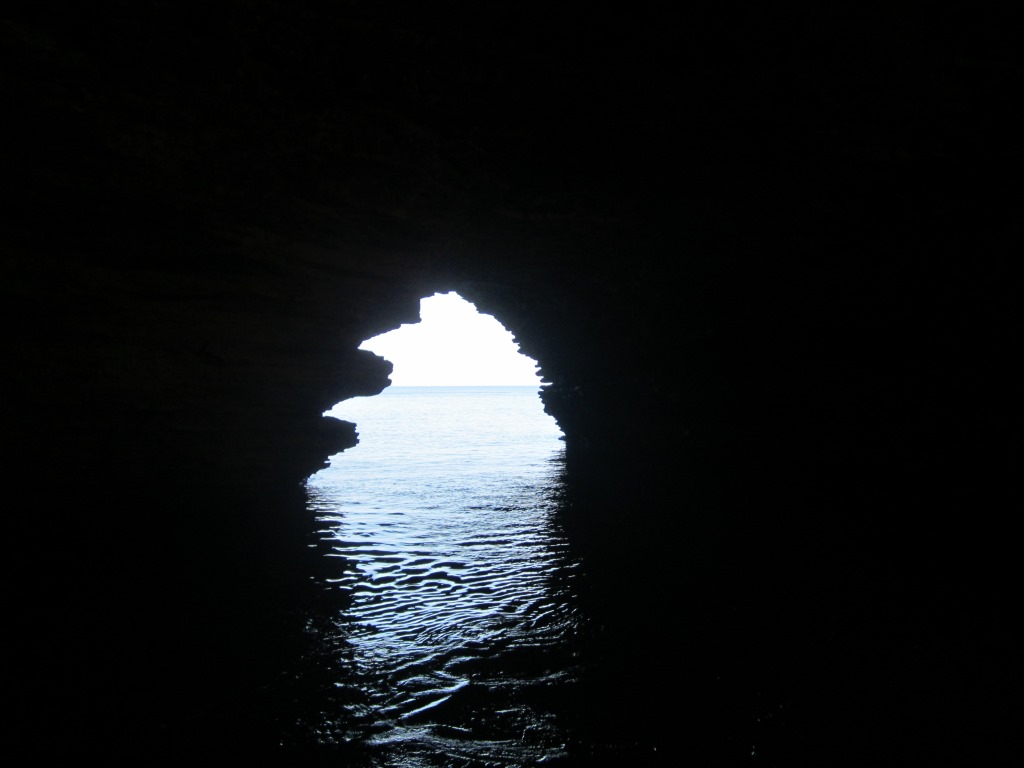
"Napoleon's hat" cave from the sea.

“Napoleon’s hat” cave from the sea.

???????????????????????????????

???????????????????????????????

Film location of "The Guns of Navarone" from the sea (1/2).

Film location of “The Guns of Navarone” from the sea (1/2).

Film location of "The Guns of Navarone" from the sea (2/2).

Film location of “The Guns of Navarone” from the sea (2/2).

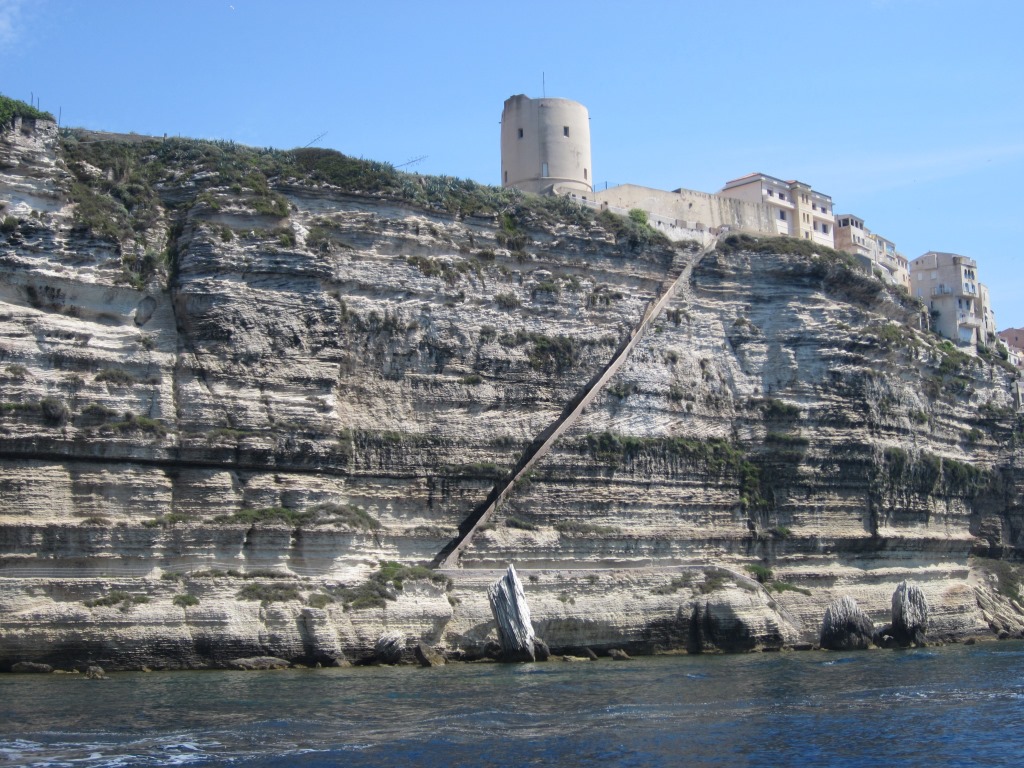
  "Stairway of the King of Aragon", legendarily carved out of the steep cliff face before Bonifacio in a single night during Alfonso V's siege of the town.

“Stairway of the King of Aragon”, legendarily carved out of the steep cliff face before Bonifacio in a single night during Alfonso V’s siege of the town.

???????????????????????????????

???????????????????????????????

Place where Napoleon stayed.

Place where Napoleon stayed.

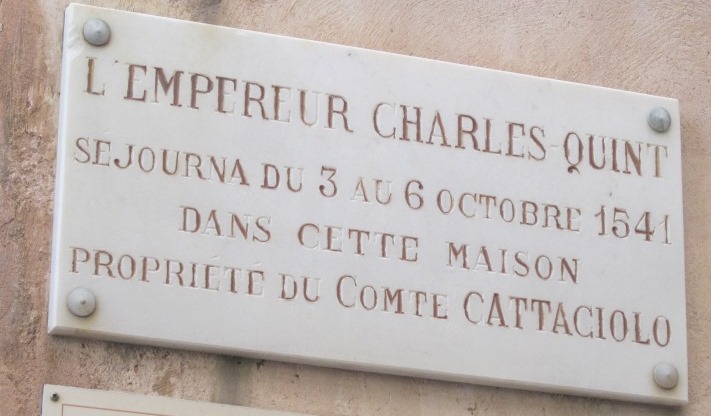
Place where emperor Charles V stayed.

Place where emperor Charles V stayed.

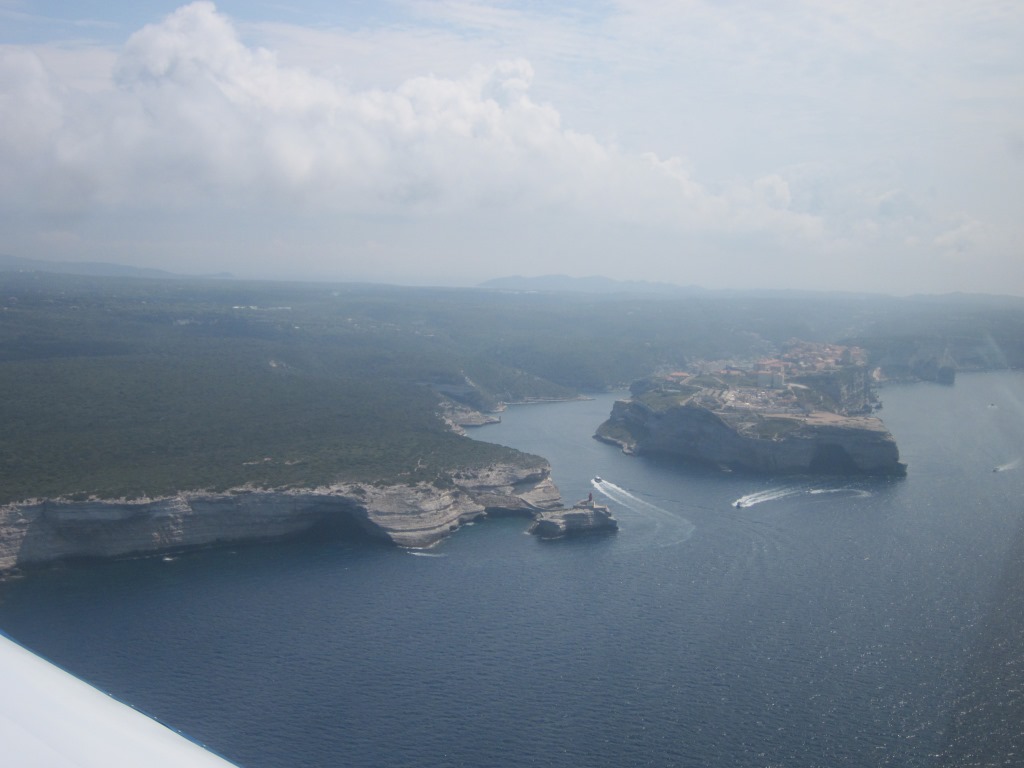
Approaching Bonifacio.

Approaching Bonifacio by air.

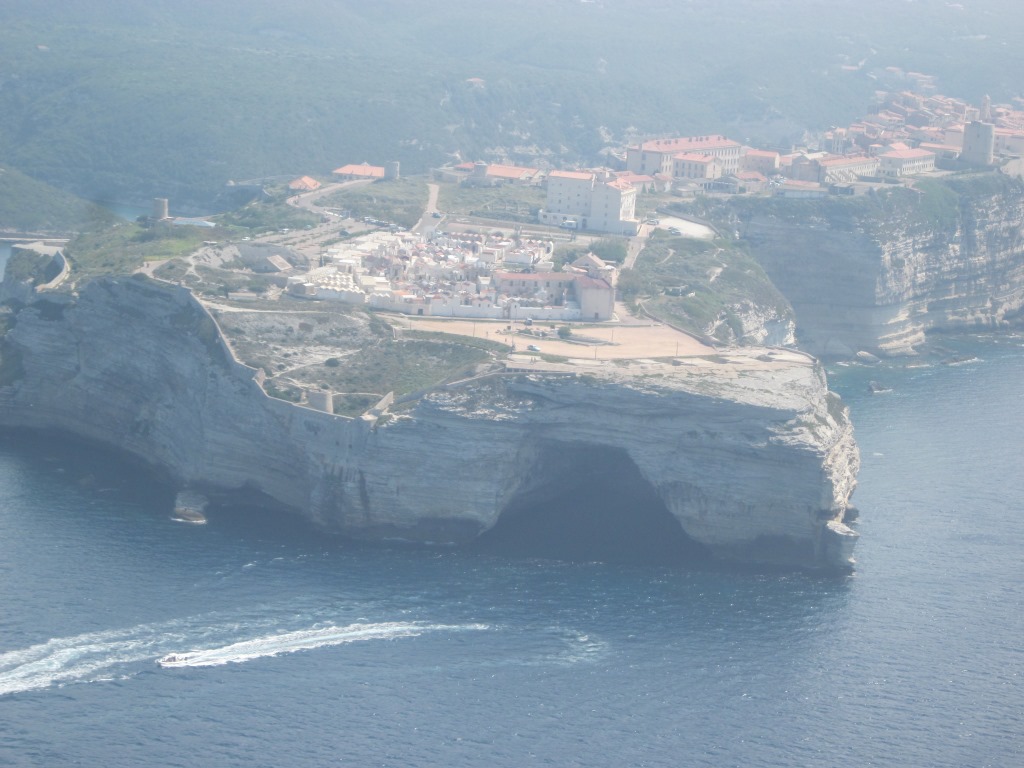
"Napoleon's hat" cave from the air.

“Napoleon’s hat” cave from the air.

Film location of "The Guns of Navarone" from the air.

Film location of “The Guns of Navarone” from the air.

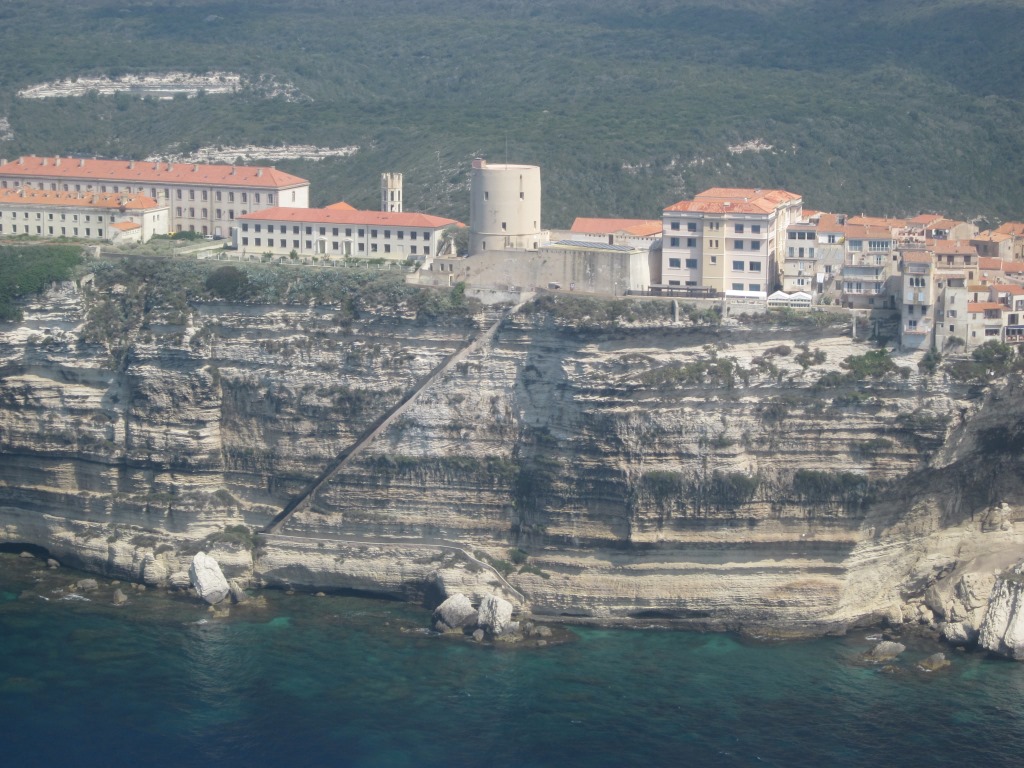
  "Stairway of the King of Aragon" from the air.

“Stairway of the King of Aragon” from the air.

???????????????????????????????


Leave a comment

Filed under France, Travelling

Shopping in Soviet times

I have been to Moscow about 5 times, all of them in the 2000s, long after the fall of the Soviet Union in 1991. I have not been in Cuba or any other communist country. I however remember the stories that a former boss I had, now retired, used to tell about when he indeed often visited Moscow in the Soviet era.

One of those anecdotes involved the shops of the GUM market in the Red Square (Glavnyi Universalnyi Magazin; “main universal store”), then a department store and now a private shopping mall hosting all the Western luxury brands.

In his experiences, he used to describe the full employment, low labour productivity and poor service received in those shops. He said something along the line:

“… to make the most simple purchase you would have to deal with a dozen attendants. The one who opened the door for you, the one to whom you asked about the product, the one to whom you said you wanted to buy it, the one who would pack it, the one who put it in the bag, the one who checked you out, the one… It took a long time and dozens of interactions to purchase the simplest thing. One thing is for sure, that way full employment was assured”

In a recent viPad miniisit to the US, in Philadelphia, it occurred to us that we could buy an iPad mini and thus we approached the local Apple store on a Tuesday evening.

“You need to wait 30 minutes to be attended”

We left the shop and decided to come back the morning after. We did.

“We will be able to attend you in 15 minutes”

More than 15 minutes passed by, but in the end we succeeded in buying the product. Not without seeing flocks of Apple employees wandering around:

The guards at the entrance (outside and inside the entry door), the ones who just noted down your name (though later on nobody addressed you by your name), the “trainers” (who came in pairs, “no, we cannot take your order, we’re just making customers familiar with the products”), the ones at the “genius bar” (answering specific questions – do not bother them with the purchasing process), the one who brought the iPad from the back of the shop to the cashier, the one who cashed you out…

“Do you want it packed for a gift?” “No, please!” (at that point we only wanted to get out as soon as possible, who knows how many Apple middle men are necessary to wrap colourful paper around a box!)

I think that in 2014, an Apple store is the closest I have found to the communist era of shopping (1).

(1) No wonder that the products themselves are made in China.

Leave a comment

Filed under Travelling

Sarajevo, Gavrilo Princip and the assassination of Archduke Franz Ferdinand

Yesterday, June 28th, marked 100 years since the assassination of Archduke Franz Ferdinand of Austria and his wife in Sarajevo. The event triggered the start of World War I. On this occasion, I wanted to read the Wikipedia article about the assassination to be refreshed the sequence of events.

The sequence of events and the ambush that was prepared are dramatic. A group of six terrorists waiting in the quay to kill the archduke with guns and bombs. A first bomb being thrown to the car but bouncing off from it to the ground and exploding seconds after under the following car of the convoy injuring about 20 people. After this first attempt the procession sped ahead and the killing was frustrated. However, at the time of returning from the Town Hall and in the way to the hospital which was the purpose of the visit of the archduke to Sarajevo, the events turned even more dramatic…

After learning that the first assassination attempt had been unsuccessful, Princip thought about a position to assassinate the Archduke on his return journey, and decided to move to a position in front of a nearby food shop (Schiller’s delicatessen), near the Latin Bridge. At this point the Archdukes’ motorcade turned off the Appel Quay, mistakenly following the original route which would have taken them to the National Museum. Governor Potiorek, who was sharing the second vehicle with the Imperial couple, called out to the driver to reverse and take the Quay to the hospital. Driver Lojka stopped the car close to where Princip was standing, prior to backing up. The latter stepped forward and fired two shots from a distance of about one and a half metres (5 feet) using a Belgian-made 9×17mm (.380 ACPFabrique Nationale model 1910 semi-automatic pistol

Gavrilo Princip was the Bosnian Serb who fired the gun in this conspiracy. He was sentenced to 20 years imprisonment together with many other conspirators, some of which were sentenced to death. The house where Princip lived could be visited as part of a museum for some time but in the subsequent war was destroyed. The ground from which Princip fired had some steps as memory, but they were also destroyed in the 90s. Today, there is only a plaque in the wall in the place from which Princip shot the archduke death. We visited the place back in the summer of 2007. I wanted to share 2 pictures from those iconic places.

Plaque at the point from which Gavilo Princip shot Franz Ferdinand.

Plaque at the point from which Gavrilo Princip shot Franz Ferdinand.

Latin Bridge.

Latin Bridge.

Sarajevo is a wonderful city despite of having been devastated by so many wars. However, at the time we visited the place, there was not much to see in relation to this historic event. Nevertheless, in different museums the different pieces of the story can be seen: the car and the gun can in Vienna, the bullet, in Czech Republic.

Leave a comment

Filed under Travelling

Swimming with dolphins in Mauritius

Mauritius is an island nation some 2,000 km off the East coast of Africa, in the Southern hemisphere, about 1/4th the size of the region of Madrid. Most of its surface is covered by sugar cane fields and a national park. The beaches are splendid. A major part of its coast is surrounded by coral reef. The service by Mauritians is terrific.

We have just come from spending a relaxing week over there and in this blog post I wanted to share one experience that marked me from this trip: swimming with dolphins in open waters.

One of the excursions offered was to go one day very early in the morning to take a boat off from Tamarin port in order to spend about 2 hours swimming with dolphins. One tourist from our group asked “what are the chances of actually seeing dolphins?”, “over 95%” confidently said the tour operator who tried to sell the different packages.

As the experience promised to be unique we went for it. And unique it was.

After having driven for almost 2 hours to cross the island, at 7am we were in the boat already seeing dolphins. We put on the snorkelling kit: flippers, mask and tube and off to the water.

At first, the anxiety made me lose my breath. After less than one minute you get used to it. In less than 2-3 minutes you get to locate the dolphins just by seeing their fins some meters away. Then you start swimming trying to chase them. “Look down!” said the guide. Once, you look down, you get to see some dolphin swimming some meters below. Then 2, 3, 4… and off you go swimming along with them. With the flippers it doesn’t even cost a lot of effort to keep pace with them. Soon enough you see yourself surrounded by over 10 dolphins. You think that they are not more than 20 centimetres away, you extend your arm but cannot touch them. They’re probably not far away, but not that close either. They swim on the surface, breath and go down some metres under the surface. You follow them from up above until they come up again. This sequence is repeated once and again. Until at some point you lose that group. Back to the beginning. You locate some dolphin, swim towards it and then find a group… it went on and on for almost 2 hours.

See a video we took and some pictures below (1).

This slideshow requires JavaScript.

If you ever have the chance, do not miss it.

(1) In Youtube you may find much better videos taken with cameras under the water surface.

1 Comment

Filed under Travelling