Dear Congressman, send the C-27Js to The Boneyard

I read yesterday the following article from Aviation Week & Space Technology: “U.S. Coast Guard Patrol Aircraft May Fall To Cuts“. Part of the article stated the obvious, that the Coast Guard modernization programs may fall also victims of the budgetary pressures faced elsewhere in the Department of Defense or Department of Homeland Security. However, the following passage caught my attention:

“While the results of the portfolio review, started in April, remain to be seen, the Coast Guard has not given up on gaining new equipment. Obama administration officials are looking at transferring at least 14 newly built Finmeccanica C-27J transports from the Air Force, which has controversially declared them “excess” to its needs. As CRS reported, if the Coast Guard were to receive 14 or more C-27s, it could stop procurement of EADS HC-144A maritime patrol aircraft (MPA) at the halfway point, with 18 aircraft, saving $887 million.”

I was amazed, since:

The rationale behind was the potential saving of up to 800M$ in acquisition costs (not buying the remaining 18 out of 36 aircraft which originally made up the Deepwater program) and getting some 14 C-27J instead…

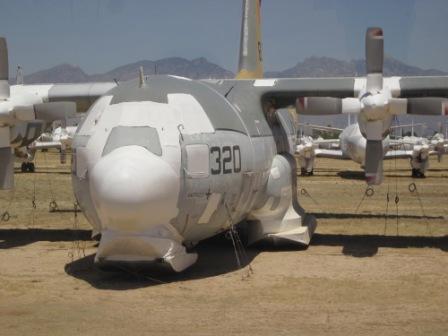
If I were an US Congressman looking for savings across the US Armed Services, I would have it clear: instead of interfering with sound acquisition programs, I would simply get those C-27Js already acquired, send a couple of them to museums and the rest to The Boneyard in Davis-Monthan Air Force Base, to lay there forever close to their older brothers the C-27As and avoid any cost-ineffective operating and maintenance expenses on them…
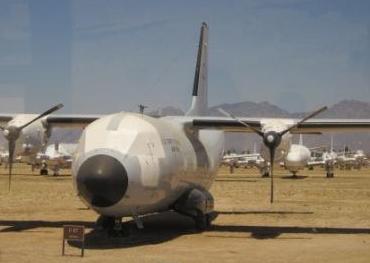
The only cost-effective C-27s are in the desert (or already scrapped).
The only cost-effective C-27s are in the desert (or already scrapped).
2 Comments

Filed under Aerospace & Defence

Manzanar War Relocation Center

During our honeymoon, on the way back from visiting Edwards AF Base, we decided on the spot not to take again highways 58 and 5 to San Francisco, but to go North by the Eastern part of Sierra Nevada and cross the whole of Yosemite National Park the following morning. With this new route we would drive more miles, give away a hotel reservation in Fresno but we were able to see the Red Rock Canyon State Park (famous for scenic rocky formations, featured in several films), Mount Whitney (with 4,421m the highest point of the Lower 48), Mono Lake (a terminal lake famous for its alkaline water) and Manzanar…

Manzanar War Relocation Center

Manzanar is the site where one of the concentration camps where thousands of Japanese and Americans with a Japanese origin were imprisoned during World War II. Manzanar is one black spot in the US history, let me quote from the Wikipedia:

Dr. James Hirabayashi, Professor Emeritus and former Dean of Ethnic Studies at San Francisco State University, wrote an article in 1994 in which he stated that he wonders why euphemistic terms used to describe camps such as Manzanar are still being used.

Let us review the main points of the debate. Over 120,000 residents of the U.S.A., two thirds of whom were American citizens, were incarcerated under armed guard. There were no crimes committed, no trials, and no convictions: the Japanese Americans were political incarcerees. To detain American citizens in a site under armed guard surely constitutes a “concentration camp.” But what were the terms used by the government officials who were involved in the process and who had to justify these actions? Raymond Okamura provides us with a detailed list of terms. Let’s consider three such euphemisms: “evacuation,” “relocation,” and “non-aliens.” Earthquake and flood victims are evacuated and relocated. The words refer to moving people in order to rescue and protect them from danger. The official government policy makers consistently used “evacuation” to refer to the forced removal of the Japanese Americans and the sites were called “relocation centers.” These are euphemisms (Webster: “the substitution of an inoffensive term for one considered offensively explicit”) as the terms do not imply forced removal nor incarceration in enclosures patrolled by armed guards. The masking was intentional.

I didn’t know about the imprisonment of Japanese Americans in American soil during the war until I came to Manzanar. During the same trip, we also had the chance to learn more about that topic in those times in Seattle at Pike Place Market, from where many Japanese Americans were first dispossessed from their shops and assets and then sent to concentration camps like Manzanar. 

After learning about this, I guess that the months after the bombing of Pearl Harbor (December 7, 1941) surely must have been very dramatic in the USA, and that political upheaval felt in DC must have been tremendous. Not only how to respond to that attack but to which extent were they safe in American soil, the suspicions or paranoia that people must have felt, the man haunts that must have happened, the incomprehension felt by those Americans…

On February 19, 1942, President Franklin D. Roosevelt signed Executive Order 9066, which authorized the Secretary of War to designate military commanders to prescribe military areas and to exclude “any or all persons” from such areas. The order also authorized the construction of what would later be called “relocation centers” by the War Relocation Authority (WRA) to house those who were to be excluded. This order resulted in the forced relocation of over 120,000 Japanese Americans, two-thirds of whom were native-born American citizens. 

Today is a National Historic Site that can be visited from dawn to sunset, on foot or by car, following a defined route which guides you through where the different parts of the camp were located, of which only a handful are standing or have been re-constructed.

This slideshow requires JavaScript.

—

See also some pictures from the other spots that I mentioned we saw during that day:

This slideshow requires JavaScript.

1 Comment

Filed under Travelling

Sequoia National Park

When planning our honeymoon, with main destination California, it early became clear that other national parks were optional but the must visit would be the Sequoia National Park.

The schedule of the trip was tight and we were not up to long walks or hiking routes, however, with a good map and a car we could reach many of the sights in the west part of the park (be aware that within the park there are no gas stations, so you better fill up the tank beforehand).

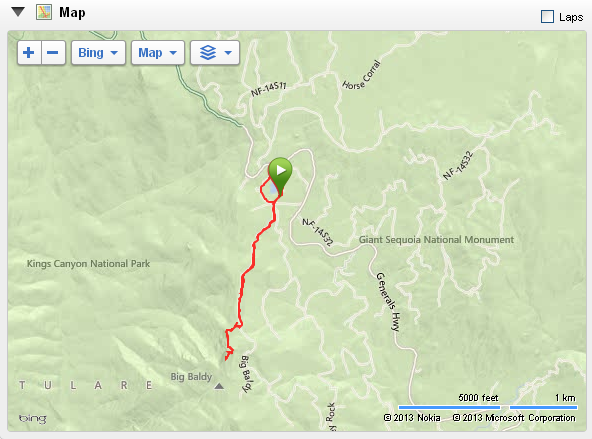
We slept over at Montecito Sequoia Lodge and before breakfast I took the opportunity to run in the forest. It wasn’t a long run, just 8km, but it was wonderful though the climbing part was tough as I went up until Big Baldy (2,503m) where the 360º sights of snow-covered mountains and valleys were superb (it’s a pity that I did not take the photo camera for that morning run).

Run from Montecito Lodge to Big Baldy.

Run from Montecito Lodge to Big Baldy.

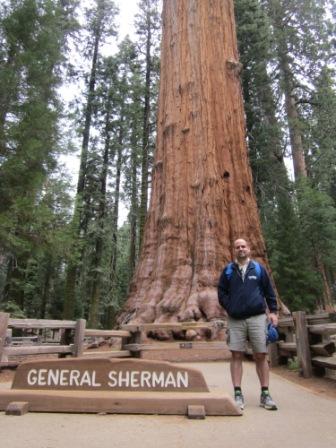
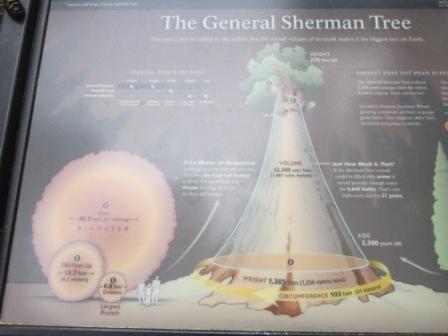
After breakfast, we spent the day driving through the park seeing most of the highlights of the park and dozens if not hundreds of sequoia trees. The biggest one is the General Sherman Tree, if not the oldest nor the tallest nor the widest (as there are other trees claiming those records).

General Sherman Tree.

General Sherman Tree.

It is the biggest by volume, with 1,487 cubic metres, with an estimated age between 2,300-2,700 years and about 1,900 metric tones of estimated mass (that is 10 times the weight of a blue whale or almost 200 times that of an elephant). You can see some explanation about the tree in the sign post from the park pictured below:

Sherman tree explanation.

General Sherman tree explanation.

There are many other stunning sequoia trees living or fallen, that make the visit to the park special, even if at the end of the day you end up not deviating the sight from the road to see one more sequoia.

Apart from the trees, there are many other worthy things to do or to see, including the stunning views from Moro Rock, or the different meadows you could walk by.

Enjoy some other pictures we took at the park:

This slideshow requires JavaScript.


—

P.S.: By the way, Luca had just learn before this trip that you need not to go to California to see sequoia trees, but that in the region of Cantabria (Spain) you can see them as well! At the Monte Cabezón.

Leave a comment

Filed under Sports, Travelling

Bubba Gump Shrimp Company

If in a previous post I described the feast of garlic we had in The Stinking Rose, now I will tell you about the shrimp feast we had in Bubba Gump Shrimp Company restaurant.

The restaurant is part of a franchise with about 40 restaurants in the world, half of them in the USA and the other half overseas (for the readers of the blog living close to one of them, this post will be nothing surprising).

If you were wondering: yes, the restaurants are named after the movie Forrest Gump. We learnt from the Wikipedia that just one year after the release of the movie, the idea came up and the licensing and setting up such a restaurant chain began.

When I saw the movie I didn’t particularly like it very much. I thought it was too much of it. But then after some years I caught some sympathy for the character of Forrest because of being yelled “Run Forrest” at some times by someone thinking very funny of himself when you passed-by running and he was drinking some beer with his friends.

So, during the last trip to California I didn’t hesitate in trying out one of these restaurants, and we visited the one at Pier 39 in San Francisco. I loved the experience! (No need to say that I have always loved shrimps…)

Before entering the restaurant the chances are that you may take some picture as the one below (this one is from the Universal Studios restaurant, though):

Bench alike the bus stop of the movie Forrest Gump.

Bench alike the bus stop of the movie Forrest Gump.

The restaurant is fully decorated with images and memorabilia from the movie. I had not watched the movie in years, but it was nice to be reminded of it in that way. Catching up passages when seeing pictures, reading catchy sentences…

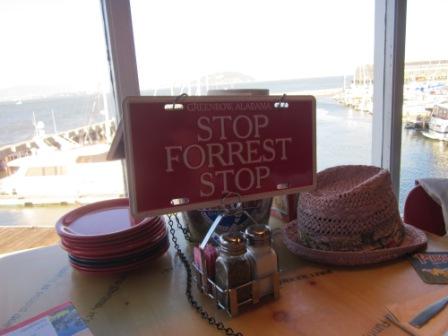
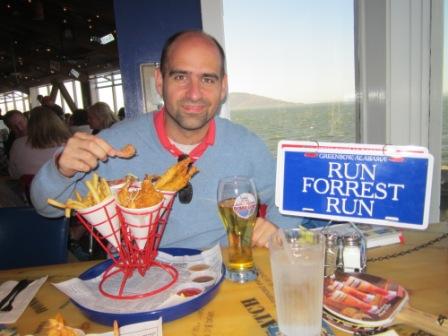
Some of those catchy phrases have turned into very useful things. E.g., in some restaurants it’s hard to catch the eye of an elusive waiter, no matter whether you want to order, to pay, or to ask anything. If they want to, the waiters will manage to avoid making eye-contact with you. In Bubba Gump restaurants this stress is eliminated by the introduction of two signs with the texts “Stop Forrest Sop”, to call for the waiter, and “Run Forrest Run”, to let him know you are OK.

"Stop Forrest Stop" signpost to call for a waiter.

“Stop Forrest Stop” signpost to call for a waiter.

Shrimp feast at Bubba Gump restaurant.

Shrimp feast at Bubba Gump restaurant.

Another thing that we kind of liked was the small quiz presented to us by the restaurant manager: she asked some 5 questions about the movie for us to earn the already ordered meal! (I think we failed the test, but they allowed us to eat anyway :-)).

Finally, I admire the fact of having built up a whole franchise based just in a passage from a movie. You may think of the many movies with which you could try that (e.g. a “007 Martini Bar” where all cocktails from James Bond movies are prepared and the place is decorated with memorabilia from the movies) but then I cannot recall having seen such opportunities being chased.

1 Comment

Filed under Travelling

Eating garlic at The Stinking Rose

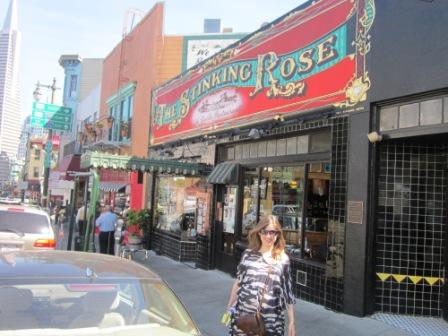
Looking for a book shop in San Francisco we saw the exterior of The Stinking Rose restaurant:

The Stinking Rose, at 325 Columbus Street (San Francisco).

The Stinking Rose, at 325 Columbus Street (San Francisco).

It first caught Luca’s attention, and we went to check the menu and whether there was any description in the guide (which there was). The restaurant is a garlic restaurant started by an Italian some decades ago, meaning that all their dishes included garlic! I loved that and immediately tried to persuade Luca to get in.

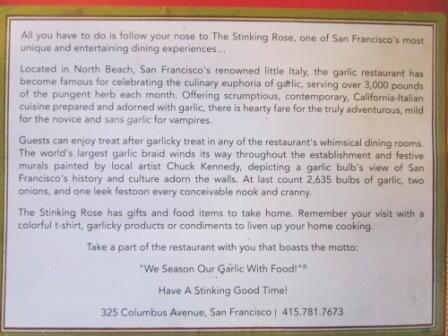
I think that instead of giving a thorough description of the restaurant by me I can show you the description of the restaurant made by them:

Description of the restaurant.

Description of the restaurant.

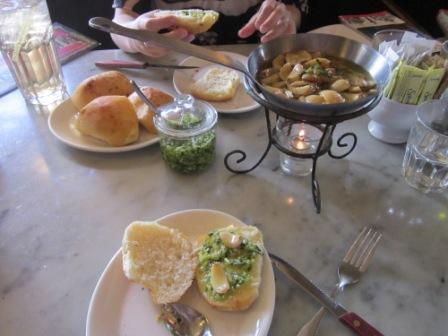
Have you seen that sentence: “We Season Our Garlic with Food”? Take then a look at the first dish we ordered: garlic bread, with minced garlic with herbs plus garlic…

A good starter.

A good starter.

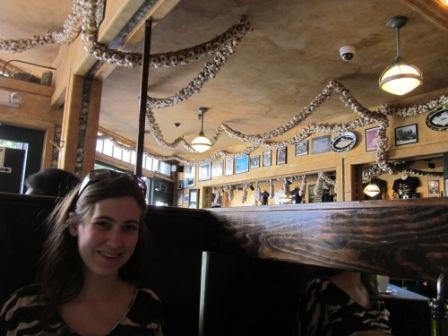
Finally, take a look at how the interior is decorated with garlic bulbs all over the place (it reminds me to “Museo del Jamón” in Spain):

Garlics all over the place!

Garlic bulbs all over the place!

I guess that many of the readers will think “yuck!”, as Luca did at the beginning. Well, this is because you have never tried it… do so the next time you are either in San Francisco or Los Angeles.

2 Comments

Filed under Travelling

Mid-year running recap

At the beginning of the year I had just a few objectives in relation to running:

  • Reach 2,000km run along the year.
  • Reach personal best times in 10k, half marathon and marathon.
  • Run 2 marathons.

Now, just one week after mid-year it’s a good moment to take a look at how these months have gone regarding the running part:

I have already run 2 marathons (Rome and San Diego) though in none of them I was under 3 hours 45 minutes. In Rome I was close to it (a minute slower) but didn’t reach it. I will even run a 3rd marathon this year in Athens next November (health permitting).

So far, even if I have run more races in 6 months than ever (10 races), I only attempted one half-marathon, in La Latina district (Madrid) which is not the best circuit to attempt a PB; I didn’t achieve it.  I clocked 1:44:49 vs. the 1:42:30 I did in Toulouse in 2011.

I have run 3 races of 10 kilometres. In the first one of the year I was short of only 6 seconds to beat my PB (46:14) clocking 46:20. One of the other two was a cross and the third one was the Corrida Pedestre de Toulouse, where the distance is not even 10k but 9.64km and despite of that I was not in the rhythm to do any PB.

In relation to the mileage: in the first 6 months I ran 920 km, a bit less than 1,000km, but not a difference that I can’t make up for in the second half of the year.

Some stats to close the post:

  • 920 km run from January 1st to June 30th.
  • 206 km run in races in this time (22.4% of the distance).
  • 86 hours and 58 minutes running in this 6 months.
  • 19 hours and 46 minutes running in races in this time (22.7% of the time –> long trails).
  • Over 80,000 Calories burnt.

Leave a comment

Filed under Sports

Chaudes-Aigues and Trail des Capucins

Some weeks ago Luca and I spent a weekend in the Central Massif in France, a plateau the size of Castile and Leon, with an average height of around 600m.

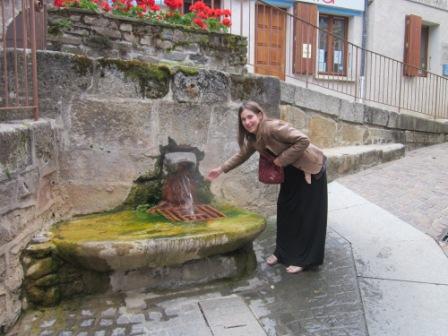
On Friday we went to Chaudes-Aigues where we wanted to spend the saturday in a spa. The village, in the region of Auvergne, has less than 1,000 inhabitants, a couple of hotels and restaurants and its famous for its hot springs. With over 30 different springs starting from 45ºC to 82ºC, the latter is supposed to be one of the hottest ones in Europe (if not the hottest as proudly announced in the signpost close to it).

spring

Luca by the 82ºC hot spring in Chaudes-Aigues (arguably the hottest in Europe… the spring as well).

Another curious thing of Chaudes-Aigues is a network of hot water going through private houses built back in the year 1,332, which is still working today though only in those original houses.

On Sunday morning, we woke quite early to cover the distance to Nasbinals, another little commune in the region of Aubrac where I wanted to run a ~18km trail.

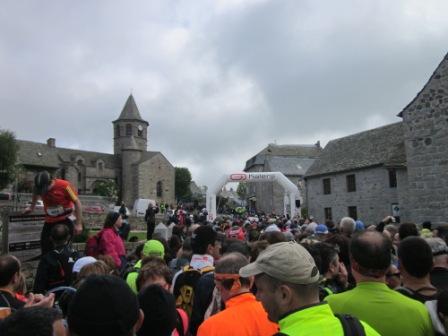
Start line of the trail.

Start line of the trail.

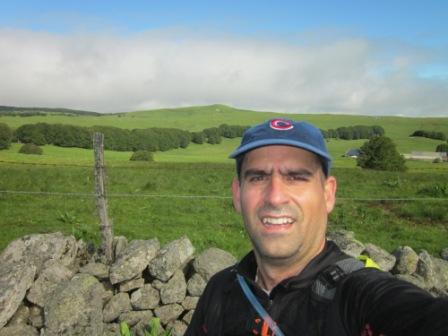
I started the trail in the back of the pack so I took the first kilometres without stress trying to run with the crowd and only overtaking other runners where possible and moderately easy. In that way I could enjoy at some points the views offered by the circuit of the trail, which at points was through closed forests but at some others was through open countryside.

Fields of Aubrac.

Fields of Aubrac.

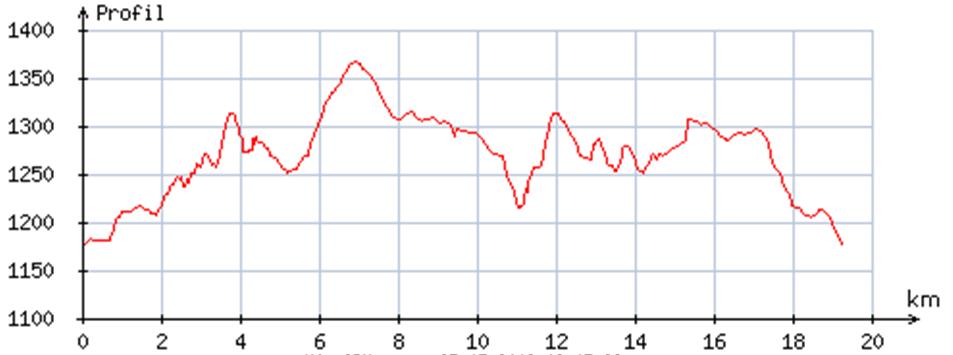
I was running with the water bag and carried some vanilla-flavoured energetic gels, so I did not have any problems with supplies, I didn’t need to use those provided by the organization. One good point of the trail is that the route was very well marked, however, the measuring of the distance wasn’t. The trail was supposed to be 18 kilometres long, and when my GPS-watch indicated 17.75km I saw a signpost saying “Arrivée 2 km”. In the end I measured 19.60 km, but I guess the organization knows this, as in their own web, when showing the altitude profile, the distance they have measured is clearly over 19km.

Profile of the race “Trail des Capucins” (over 19km instead of the announced 18km).

Profile of the race “Trail des Capucins” (over 19km instead of the announced 18km).

It is not such a big issue, though you may have been managing your strength resources to have a last good kilometre and instead you find out that there are still 2 more to go! It would be as easy as to announce the trail as a 19km or 19.6km instead of 18km.

In the end it took me over 2 hours and 12 minutes, and ended the 255th out of 810 runners. A good run for a Sunday morning.

Even if not of very good quality, you can find below a short video I recorded around the 8th kilometre to give a glimpse of how these trails are:

I uploaded the video

Leave a comment

Filed under France, Sports, Travelling

Spraylat

Some of you may have wondered why all aircraft windows and so many other parts in the pictures I showed in previous blog posts about The Boneyard are covered with white paint?

C-130 Hercules covered with spraylat (note that it is fitted with skis for Artic and Antartic operations).

C-130 Hercules covered with spraylat (note that it is fitted with skis for Arctic and Antarctic operations).

To protect heat-sensitive parts from the desert high temperatures these parts are covered with two different coatings: the first layer being a dark paint while the second layer is the characteristic white one, reflecting sunlight and heat. The paint is a vinyl plastic called spraylat after the company that produces it, Spraylat Corporation.

You may check the detail of Aerospace Maintenance and Regeneration Group (AMARG) storage processes in the following two links from the Wikipedia and “AMARC experience” (“AMARC” being the previous name for AMARG).

Leave a comment

Filed under Aerospace & Defence

Commercial airplanes discounts review

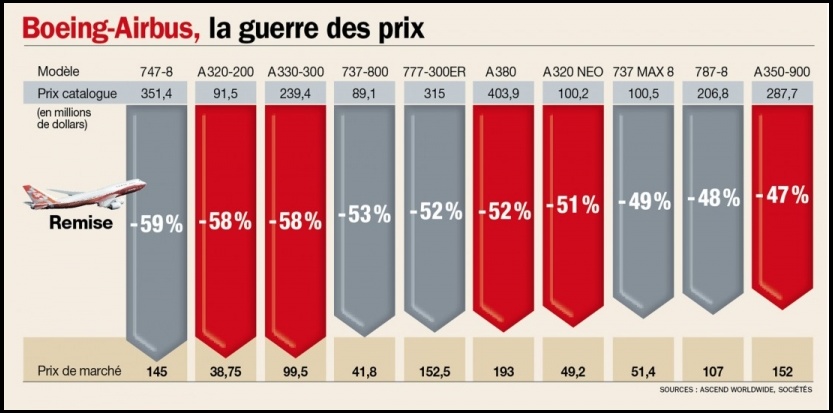
Last week, ahead of the start of the Le Bourget air show, the French portal Challenges.fr, published an article “Le vrai prix des avions d’Airbus et de Boeing” with an interesting graphic showing a comparison of the prices after discounts of commercial aircraft both of Boeing and Airbus.

Find the graphic below:

Commercial aircraft discounts according to "Challenges".

Commercial aircraft discounts according to “Challenges”.

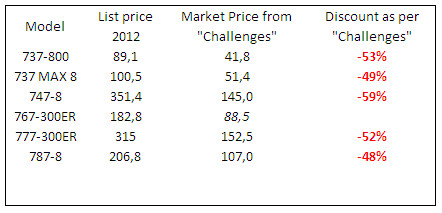
In order to make the graphic, Challenges quotes as sources the consultants of “ASCEND Worldwide” (which has the industry-reference database of world commercial aircraft fleets) and unnamed companies (airlines such as American, Delta or Southwest, as per declaration of analysts quoted in the article).

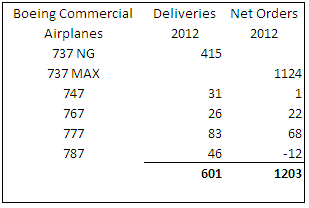
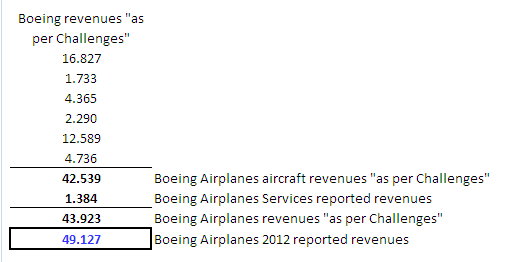
I have published in this blog yearly estimates for the average discount that Boeing applies to its aircraft. Find here the latest of that blog posts. In that post I arrived to an estimated average discount of 45%. Thus, when I read the article by Challenges I first thought “too high, to be average prices”. I thus run the reverse calculation: departing from Challenges “market prices” I calculated what would have been Boeing Commercial’s 2012 revenues (1).

Boeing 2012 deliveries and net orders.

Boeing 2012 deliveries and net orders.

Boeing prices as per Challenges (767 added with the same discount as the 777-300ER).

Boeing prices as per Challenges (767 added with the same discount as the 777-300ER).

Boeing Airplanes revenues "as per Challenges".

Boeing Airplanes revenues “as per Challenges“.

Having run the numbers, I find the estimated value of 2012 revenues for Boeing Airplanes as too low (44bn$ vs. the reported 49bn$) using aircraft “market prices” as published by Challenges, as I first thought. I guess that the figures that Challenges published refer to the higher discounts having recently been applied, to the biggest customers making the biggest orders, such as those mentioned in the article (American, Delta or Southwest).

Thus, I would not take them as average or market price, those are the prices that a few can get.

—

(1) A couple of considerations must be made: Challenges does not publish any market price for 767s (the same discount of the 777-300ER was used), and does publish only one price of 737NGs or 777s; thus the result will not be very accurate.

4 Comments

Filed under Aerospace & Defence

Wide-body mix in 15 years of Boeing CMOs

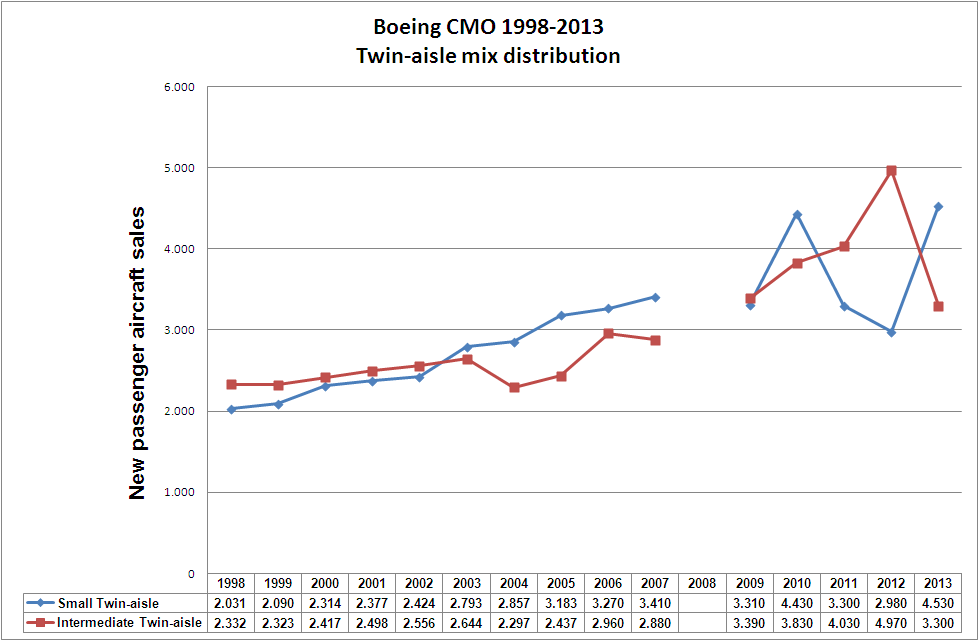
A couple of days ago I wrote about the publishing by Boeing of its Current Market Outlook for 2013-2032. In that post I made a very brief review of it, and mentioned that I was puzzled by the change in the predicted mix of twin-aisle sales, between small and medium wide-bodies. To recall the numbers:

  • small wide-bodies: from 2,720 a/c in CMO2012 to 4,320 a/c in CMO2013, whereas,
  • medium wide-bodies: from 4,490 a/c in CMO2012 to 2,810 a/c in CMO2013.

Since I keep a collection of CMOs from years back, I decided to compare the figures of this wide-bodies mix along the last 15 years…

Twin-aisle mix distribution (Boeing CMO 1998-2013).

Twin-aisle mix distribution (Boeing CMO 1998-2013).

Seeing at the graphic (made using Boeing figures):

  • During the first 5 years (1998-2003) the trends are quite constant.,
  • From 2003 to 2007, the mix is reverted, possibly to favour the launch of the 787.
  • In 2008 the CMO did not provide the split.
  • From 2009 to 2013, you can see that both trends in the forecasts are erratic… why? Only Boeing knows.

9 Comments

Filed under Aerospace & Defence