Well, to be precise, it is Luca who is expecting a baby!
Stork bringing the baby to Toulouse (design by Jaime, future uncle) (1).
If everything goes well, junior will enter into service by the beginning of August (I cannot guarantee that there won’t be delays…). Engineering and Programme Management (I) have done their job, now it’s up to Industrial and Delivery Centre (Luca) to complete the project (we swear that Procurement was not involved!).
—-
(1) Clarification for those not coming from Spain: the tradition there says that children are not only brought by a stork, but also that it brings them from Paris.
(2) We accept suggestions for the name, both female and male. Even more, we’re even thinking of setting up a contest; but please suggest a name only if you think it can top “Javier”.
The names Wilbur, Orville (“Orvilla” as per request of the mother), Georges (Guynemer), Amelia… are already in the shortlist.
(3) For those worried about the legal framework surrounding the coming child: we are already PACSed AND engaged…
I am following relatively closely the news related to the grounding of Boeing 787 world fleet due to the recent issues that 2 of the operating aircraft had in service. I was wondering how much could Boeing be penalised by this situation.
Then, a couple of days ago I started seeing estimates (up to 5bn$?!), so enjoying playing with numbers as I do, I wanted to make up my figures before reading the explanation I am looking for somewhere else. Let me share the number play with you.
I have read news pointing at a solution based on new batteries, which certification could extend until 2014! Well, hopefully it doesn’t take that long, but since we don’t know for how long the fleet is going to be grounded and we also don’t know what the final fix is going to be, what I am interested at this moment is in trying to guess the cost per day of the grounding of the fleet.
Let me explain the assumptions I am going to take and where do they come from:
average seating: 210-250 seats for -8 (a/c delivered) and 250-290 for -9 (seating numbers from Boeing; deliveries from Wikipedia).
revenue per passenger: here, instead of doing an extensive research, I based the calculation on a previous research made by Air Insight for a report about Air India potential claim for 787 delays (the article is from one year ago).
$234 per flight hour for first class (using a 75% load factor),
$136 per flight hour for business class (80%),
$67 per flight hour for economy class (85%).
seating per class: using the information from United as reported by SeatGuru for the
787-8: 36 + 72 + 111 (1) (for a total of 219 pax).
flight hours per day: Air India was flying between 11 and 11.78 FH/day according to Air Insight. Ethiopian was said to be flying about 14 FH/day. I’ll take an average of 12 flight hours per day.
With all these assumptions, the daily cost of B787 grounded fleet is: ~12.3 millon dollars / day.
Partial results of the calculation are:
average revenue per flight hour, ~20,500$;
average daily revenue of a 787, ~245k$.
Taking into account that the fleet has been grounded for already 2 weeks, the cost so far is in excess of 170m$, not much compared to Boeing earnings (to be released today). But if the solution and certification process takes really until 2014, this cost would be in the order of 4.5bn$ (close to the 5bn$ figure pointed by Jefferies & Co. analyst).
Final remarks. Remember that this number play just tries to guess what is the revenue loss from not flying 787s. It doesn’t take into account the cost of fixing the problem, or whether the same routes are flown by other aircraft models and to what extent Boeing might or might not be penalised (in relation to revenue loss? profit loss?). This number play also does not take into account potential financial impact on further deliveries being postponed.
***
(1) Taking estimate of revenues and load factors from Air India and seating numbers from United already introduces some error.
Note: After completing this post, I saw the following similar estimate in Reuters published 2 weeks ago: 1.1m$ per day for a fleet of 17 a/c, the case of ANA.
EADS announced last month, on the 5th of December an overhaul of its Governance and Shareholding Structure. See the press release in which it was announced.
That press release had 7 key points. Each of them would deserve a long discussion. To be honest, I have had long discussions about some of them with colleagues.
The week after the release was made public, I had lunch with a couple of former colleagues, both former strategists and now retired. When discussing together our impressions of the changes and implications, we first talked about the share buy-back (part of the emphasis is mine):
2. Share buy-back
Subject to market conditions and to the approval of the Extraordinary General Meeting, EADS intends to implement a share buy-back program and subsequent cancellation of up to 15 percent of the outstanding EADS shares, divided into two equal and simultaneous tranches bearing the same terms and conditions:
– A first tranche of up to 7.5 percent, which shall be open to all of EADS’ shareholders, other than the parties to today’s agreement; and
– A second tranche of up to 7.5 percent, which shall be reserved exclusively for Lagardère SCA up to 5.5 percent. If the size of the tranche is higher than 5.5 percent, SOGEPA and SEPI will have the right to tender the remainder (based on their pro rata ownership of EADS shares unless they agree otherwise). In the event that SOGEPA and SEPI do not exercise their right, Lagardère SCA could take up to the full amount of the tranche. Finally, in the event that this tranche is not fully tendered by the above parties, Daimler AG will have the right to participate up to the full unused amount of the tranche.”
I have already shared on a previous post Buffett’s view about share buy-backs, thus I will not comment further about in this post.
Then, my senior colleague raised attention to another part of the release, to which I had not paid much attention the first time I read it:
“Certain specific French and German national security interests will be protected through the creation of “national defence companies” holding sensitive military assets, and including the rights of France and Germany to consent to three outside directors to the board of their respective “national defence companies”. Two of such directors of each “national defence company” shall be members of the EADS Board.”
In the release it is explained that France, Germany and Spain have agreed on a capped government shareholding and will have reciprocal pre-emption rights. The composition of the Board of Directors is changed, to 12 directors, with at least 8 independent and 4 coming from these “national defence companies” (2 from each).
Just as a remark, there is no Spanish “national defence company” holding sensitive military assets. There is not an agreement on any director coming from any such Spanish company, though some of the 8 independent ones could be Spanish.
As my former colleague said, let’s play attention to these moves, especially to the second kind of moves. We are going to at least learn a lot and even enjoy the process. Strategy 101 at play in EADS.
—-
PD: To put the icing on the cake, let me finish the blog post as the press release is finished:
***************
“In the context of this change of governance, and in a separate agreement with the French State, subject to the consummation of the above transactions, EADS has undertaken to consult with the French State before exercising its voting rights at the general meeting of shareholders of Dassault Aviation and has granted the French State a right of first offer / first refusal in case of the sale of all or part of its stake in Dassault Aviation.
The parties to today’s agreement are EADS, Daimler AG, DASA, Lagardère SCA, SOGEPA, Sogeade, KfW and SEPI.”
I was reading last weekend Warren Buffett’s 1980 letter to Berkshire Hathaway shareholders, when I encountered the following passage about shares buy back by a company (emphasis is mine):
“One usage of retained earnings we often greet with special enthusiasm when practiced by companies in which we have an investment interest is repurchase of their own shares. The reasoning is simple: if a fine business is selling in the market place for far less than intrinsic value, what more certain or more profitable utilization of capital can there be than significant enlargement of the interests of all owners at that bargain price? The competitive nature of corporate acquisition activity almost guarantees the payment of a full – frequently more than full price when a company buys the entire ownership of another enterprise. But the auction nature of security markets often allows finely-run companies the opportunity to purchase portions of their own businesses at a price under 50% of that needed to acquire the same earning power through the negotiated acquisition of another enterprise.”
Then, sometimes, we see companies that decide to hold excess cash while waiting for opportunities of what to do with it, or to protect themselves against uncertainty, etc. Some do as Buffett says and buy back at minimum prices. Others do the contrary, they buy back shares at maximum prices.
There is always an explanation to taking one option or the other, even if the final reason is not always told, understood…
It is 4 years now since Luca and I started investing together. This is the 3rd year publishing this post in which I explain how our investments fared along the year. In previous years’ post I had explained how we had adopted for our personal investments the same approach mutual open-ended funds have.
Brief recap for newcomers:
As I explained last year, we had to define a net asset value per share (valor liquidativo de la participación) at the beginning of the period. This net asset value per share rises and decreases as the aggregate share prices of the stocks in the portfolio rise or decrease. When an investment fund informs about its yearly results it is referring to the performance of this net asset value per share.
Each time that there is an addition of capital (new investments, in this case by Luca or me) it is treated as an issue of new shares to ourselves. It doesn’t matter that we are the only “shareholders”. Depending on whether the net asset value has increased or decreased we are acquiring the new shares at a higher or lower price than we acquired the previous ones. Exactly as it works in a fund.
Let’s go to this years results: How did the year 2012 go?As last year, this is going to be a humbling exercise .
In 2012 we have not been very active investors, not doing many transactions nor adding lots of funds to the investments (with a wedding in sight we had a preference for cash). We mainly held previous investments and sold a couple of positions which already earned what we expected (1).
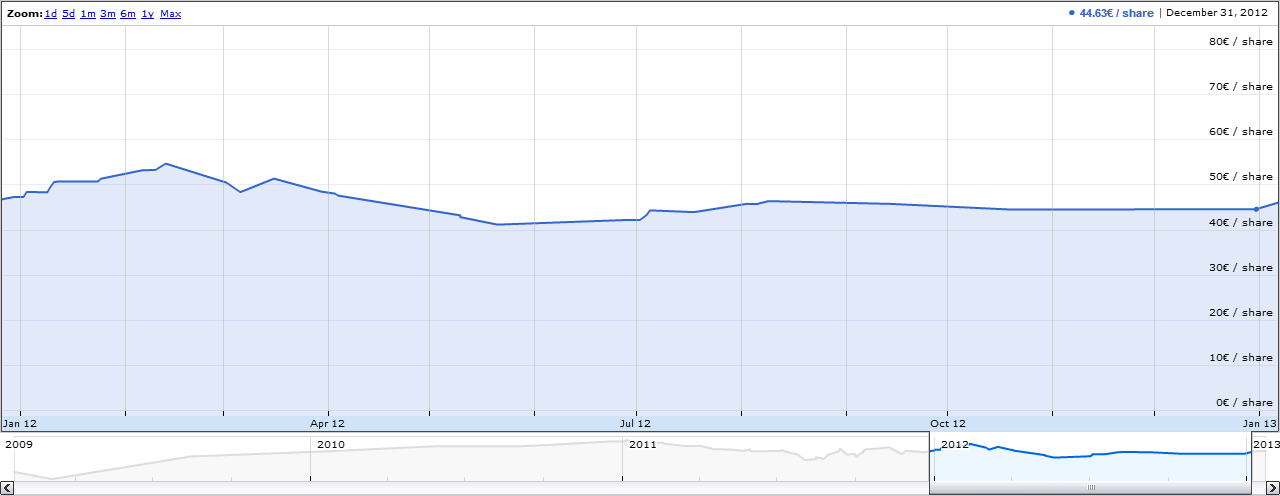
During 2012 I took note of the fund value about 30 times, so we could get an idea of how the fund evolved. As you may see in the graphic below, the net asset value per share at the beginning of 2012 was 47.28€ while at the end it fell to 44.63€, that is -5.6%. This was the performance of the fund in 2012 (again not good enough to sell subscriptions to the fund! ).
How does it compare with the main indexes?
S&P 500 ~ +13.41% (this is the target index)
Dow Jones ~ +7.26%
NASDAQ ~ +15.91%
IBEX 35 ~ -4.6%
Euro Stoxx 50 ~ +13.65%
The gains of the fund since its creation in January 2009 have been+53.69%, with a compounded annual gain of +11.3% (remember this always refers to the net asset value per share – marked by the first 2 positive years – and cash gains cannot be directly derived from the net asset value performance times the total assets).
Two years ago, I introduced the comparison with leading Spanish value investing fund managers from Bestinver (2). Let’s do the exercise again:
Bestinfond ~ +16.52%;
Bestinver Internacional ~ +16.89%;
Bestinver Bolsa ~ +14.88%.
All in all, 2012 has been a good year to present general results, except in Spain and for us, due to some shipping and mining stocks that didn’t fare well in 2012. Let’s see how they go in the coming years.
I’ll keep you informed next year of this year’s results.
—–
(1) Unhappily we are not any longer shareholders of Pzifer, with its bluish star pill…
(2) Disclaimer: Since sometime in 2011, we have also positions in Bestinver (which we increased in 2012), though I don’t get any fees for promoting it in the blog. (Our positions with Bestinver are excluded from the calculations of “J&L” fund to allow for clean comparisons).
NOTE: “J&L fund” numbers are pre-tax of capital gains realized, include dividends (twice taxed) and are net of transaction costs & brokerage commissions.
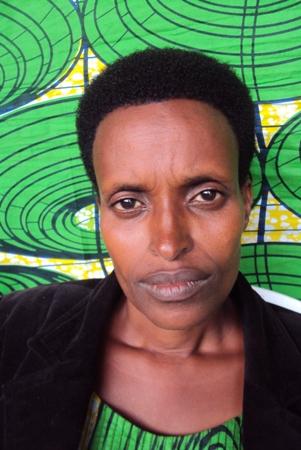
Few days ago I gave my 100th micro credit with Kiva. This particular credit went to Philomene:
Philomene (image from Kiva).
“Philomene is 48 years old, married and has five children, ages 8 to 19. Her husband is a builder. She wants a loan to buy more fruits to sell, such as yellow bananas and passion fruit. The profits from savings will be used for paying children’s school fees.”
I got to know about Kiva from my friend Bruno at the end of 2008. I immediately liked the idea and I gave my first loan through it soon after, in January 2009.
The idea is very simple: giving micro credits via internet to small entrepreneurs in developing countries. Kiva facilitates the process establishing a website to channel the funds and creating network with local organizations which will disburse the money and collect repayments.
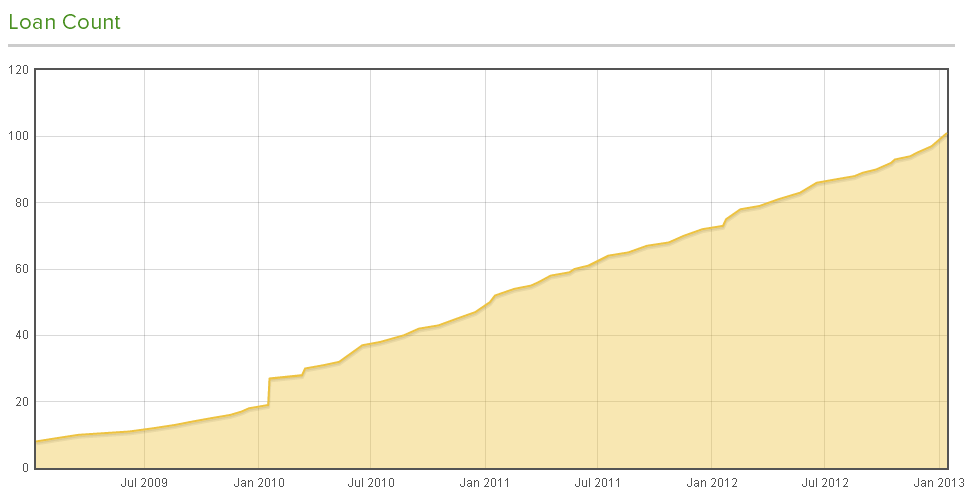
Since what you give is a credit, when it is paid back you can re-lend the money, thus, the same 25$ may be used by several entrepreneurs along the years. See my case:
Loan count since 2009.
The fact that I have given 101 credits of 25$, doesn’t mean I have dedicated 2,525$ in these 4 years. I have dedicated to Kiva just above 550$. With them I was able to lend and re-lend up to above 100 credits. Now I still have close to 400$ in outstanding credits (being re-paid), after having donated some 130$ to Kiva to help with their operating costs and having lost just 28.19$.
I want you to take a second to think what do those 28$ lost mean. The default rate along these 4 years in my case has been 1.5%, this is close to nothing. Take into account Western countries mortgage default rates: close to 10% in Spain, and though lower in USA it reached over 5% a few years back.
Of all the loans that should have already been paid (75) just 3 ended with a loss. In one I lost less than half of the 25$ and in other 2 thirds. The entrepreneurs came from Africa and I am not upset by not having gotten back 28$ from them. I just hope that their situation improved since the time they were forced to default. With the 3rd credit which ended in loss, I lost 0.06$… due to currency exchange, meaningless.
Do you want to know some more statistics?
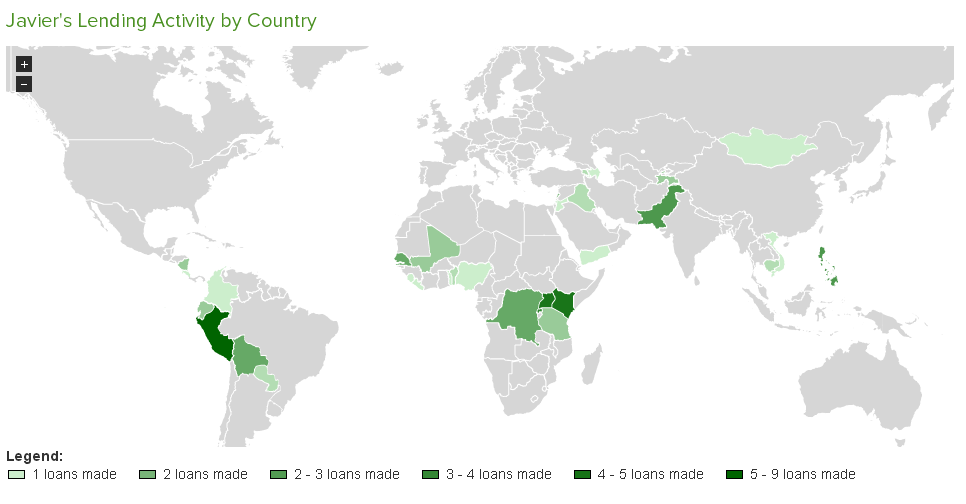
See below a map with coloured countries being the ones in which a recipient of one of my credit lives:
Regarding sectors: agriculture takes 30.7% of my credits, followed by food (22.8%), manufacturing (13.9%), retail (10.9%), education (6.9%)… (I would like to give more credits for education, but within Kiva there are not so many displayed; to cover that need I collaborate with another organization, Vittana).
I told you that I was introduced to Kiva by a friend. I also sent many invitations and some gift cards to friends; 6 of my friends accepted them.
These were my first 101 loans. Loans that change lives…
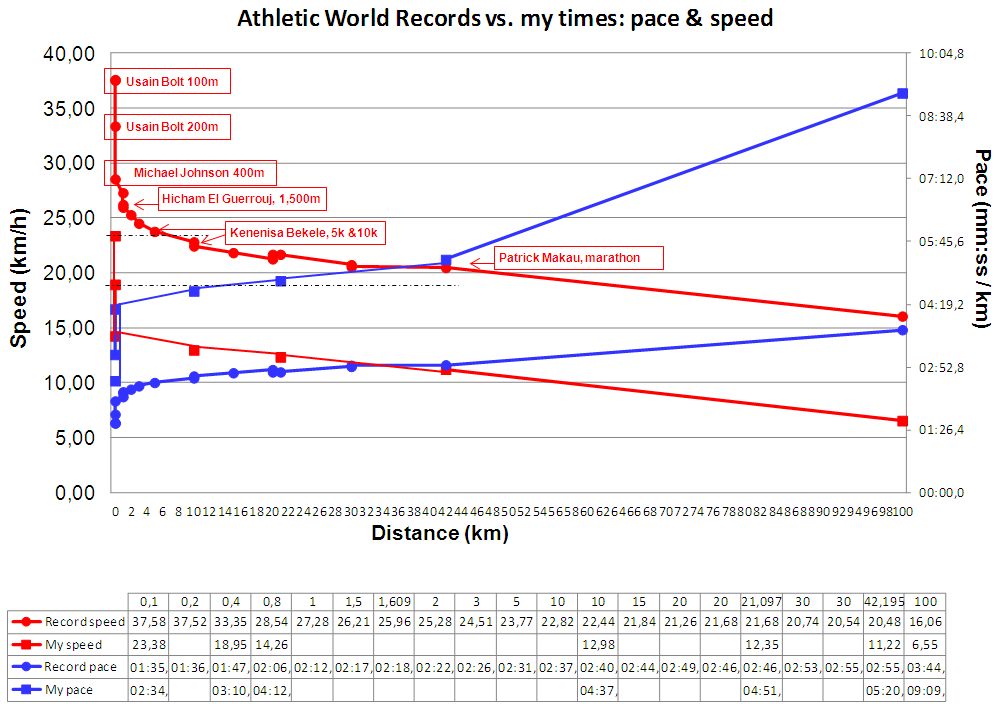
I have many times commented with friends and acquaintances how impressive professional athletes are, what does it mean running a marathon in barely over 2 hours…
Many amateurs (not to mention sedentary people) would not keep up pace much longer than 100 metres. Each time I have made this comment to someone I had to verbally make some numbers for my interlocutor. I am sure these verbal calculations were not always well understood and digested. Following the adage “an image is worth more than a thousand words”:
Athletics World Records vs. my times
Red lines show speed (in km/h; decreasing as race distances get longer). Blue lines show pace (in mm:ss / km; increasing as race distances get longer). I have included a table so you can compare the numbers.
I took athletics world records from the Wikipedia. You can find my times in the page “Races” of this blog. I only added a tag to the records that most of you will recognise, as they were achieved by well-known super stars.
There are many catches in the graphic. Two impress me the most:
I could have kept up the pace of Patrick Makau in his marathon world-record-beating performance for 100 metres… but not for 400m! (see black dotted lines).
How once we enter into aerobic exercise, we’re able to almost keep up speed despite distance increases. The difference in speeds between Bekele’s 5k (23.77 km/h) and Makau’s marathon (20.48 km/h) is only 3.25 km/h!
***
NOTE: I am not a particularly fast runner, thus don’t take the times and paces and interpret them as if no amateur runner could keep up pace for more than 100m… some will keep it up somewhat longer. I just wanted to share the idea.
January is the month of the year in which I take some time during a weekend to select which charities and non-profits I will donate some money (1). Let me introduce you to the 9 NGOs I have selected this year:
Kiva: this is a micro lending portal. This is the first non-profit to which I made a contribution. This is not truly a charity, as here you give loans to small entrepreneurs in developing countries. I have talked about in the blog sometimes. This year, for the 4th year in a row, I have added some more funds.
Vittana: another micro lending portal. This one is specialized on credits for education purposes, very similar to Kiva in its conception. This year, for the 3rd year in a row, I have added more funds, to help some students study nursing and engineering.
Médecins sans Frontières: I started donating cash to MSF in 2010 while still living in Spain, in 2011 I became member of the French branch. This year I learnt what you can afford with just 100€:
Oxfam: another well-known NGO. Oxfam mission is “to find lasting solutions to poverty and injustice”, this is the 3rd year I help them :-).
Anti-Slavery: Can you stand slavery today? In the XXI century? I cannot. This is why since 3 years ago I am contributing to this NGO which works to eliminate all forms of slavery around the world.
Fundación Hombres Nuevos. My father retired in autumn 2011. In January 2012 he was packing to spend 5 months in Bolivia working in the field teaching some underprivileged children maths, language… or just helping them do their homework. I think that only my sister had such a good opportunity in the past 2 decades!
My father discovered this foundation in a TV documentary about 2 years ago:
That sparkled again a vocational aspiration he had since completing his studies and he went on to fulfil it. I’ll try to get him to write about it… stay tuned.
Brief comment about the foundation: It was founded by Nicolás Castellanos who received the prize “Premio Príncipe de Asturias a la Concordia” in 1998 along with Vicente Ferrer or Muhammad Yunus (who later received the Nobel Peace Prize and is credited with the invention of micro credits).
Wikipedia: When was the last time you checked the Wikipedia? How often do you check it? Wikipedia’s self-description:
“Wikipedia is a multilingual, web-based, free-content encyclopedia project based on an openly editable model. The name “Wikipedia” is a portmanteau of the words wiki (a technology for creating collaborative websites, from the Hawaiian word wiki, meaning “quick”) and encyclopedia.”
For the second year running I contributed to #keepitfree.
Gapminder: you might have seen some talk from Hans Rosling, its founder. Gapminder is “a non-profit venture – a modern “museum” on the Internet – promoting sustainable global development and achievement of the United Nations Millennium Development Goals”, or better “Fighting the most devastating myths by building a fact-based world view that everyone understands”.
Have you got 13 minutes? Why don’t you check this video about “Religion and babies” and let his performance convince you?
Finally, let me introduce you to the new addition to my list of NGOs:
Fundación Khanimambo. I was introduced to it by two friends, Nacho and Alberto. I loved the message of the NGO: “¿Necesitas sonreír? Déjate ayudar“ (Do you need to smile? Let us help you). It’s wonderful, the children from Praia Xai Xai, Mozambique, want to donate happiness to people worried and stressed in the rich countries. To do that, they need some money to enlarge their school, buy more pencils, papers, etc… Let them convince you (less than 2 minutes):
Final reflection:
I understand that in these times of economic stress many will not have the opportunity to spare some funds needed by their own families to help others in need. For those of us who have a job, I truly recommend you to take some moments and go through some websites of different NGOs, charities, non-profits, scientific endeavours… I am sure you will find an initiative that will resonate with you. Go and direct some funds to it. You might feel a bit wary the first time. It’s OK. Spend 25$, 50€… (it’s only the cost of a dinner with your partner). You will not only help someone in need, you will feel much better after having done it.
If not for them, do it for you :-).
***
(1) I already published two similar posts in 2011 and 2012. In previous year I had set first 0.7% and then 0.9% of my net income as the minimum bar; this year I increased the contribution to 1.1%.
Fernández pointing Mutai the finish line (source: Calleja, Diario de Navarra, via El País).
That is Spanish athlete Iván Fernández Anaya letting Abel Mutai win after the latter had stopped thinking the cross was already finished.
This kind of situations do not have always the same ending. See the video below:
After hours running, and coming to an end the poor guy in the lead takes a wrong turn off the route and is overtaken by 3 runners, not being able to retake the lead.
When I watched these situations I always thought “How can this be possible? Is the guy not seeing the road, is nobody telling him the coming mistake on time?”.
Now, I got the answer. Some times shit happens. I had today my epic-fail moment.
I was going to take part in the race Course des Rois, in Villemur-sur-Tarn, over 10km. I ran it last year so I was acquainted with the route, installations, etc. Thus I paid no much attention to the specific rules of the race.
I knew that the race started at 10:05 (*), so I warmed up beforehand. Then removed some clothes, drank some water and went to the start line. And started.
After some 300 metres I noticed that I was surrounded by many teenagers and middle-aged women instead of a big pack of middle-aged men, who are the average popular runner. Then I wondered: “am I running my race or the 5km one?”
At 500m I stopped and asked a volunteer from the organization: “is this the 5k or the 10k race?” to which he replied “I don’t know” (!!). Then I asked the next woman coming, and she confirmed that it was the 5k one!
You see! It can happen! There I was, running another race.
Luckily I noticed only 500m into it 🙂 Then I went back running moderately fast again, as I didn’t want the start of the 10km race to catch me in the middle of the two!
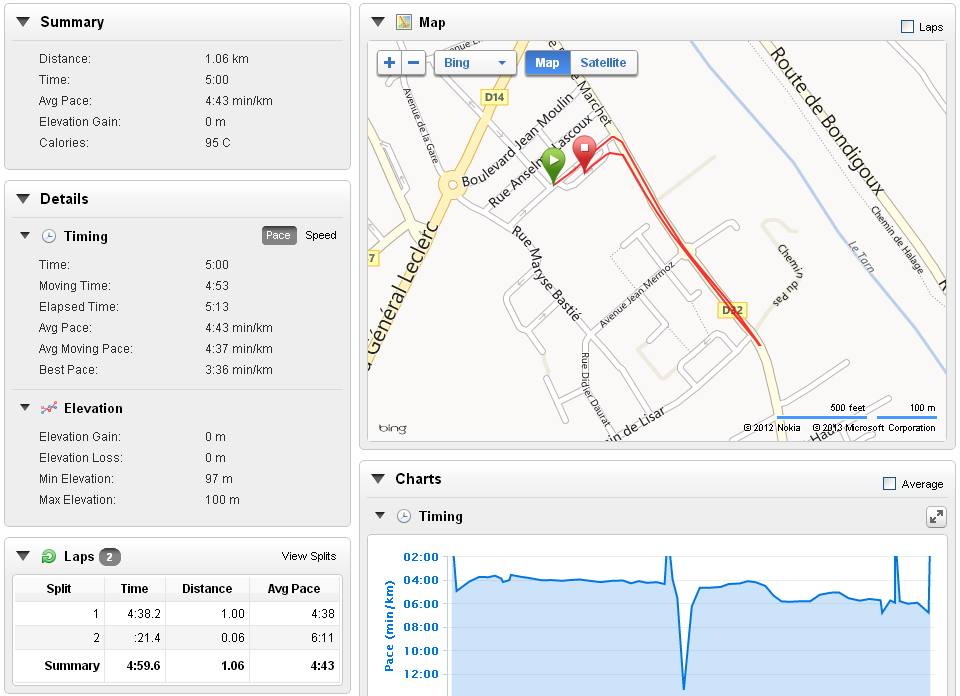
Fortunately in my case there were no cameras to make further fun of me! 😀 But see below the record of the GPS:
Fail: wrong start with the 5k race.
***
(*) My 10km race was indeed starting at 10:15am; if I had just read the rules of the race…
I started this blog in February 2010 as theblogbyjavier.wordpress.com . Sometime later I purchased an upgrade from WordPress acquiring the domain theblogbyjavier.com (initially for 25 $ per year, a bit expensive, though comfortable), that is why you don’t see the wordpress even if the blog is hosted in WordPress.com .
Among the conditions of WordPress to provide free hosting is that no advertising shall be included in the blog. However, you might have seen some advertisements at the bottom of the posts along these years. “How can that be?” When WordPress mentions no advertising, that means no ads included by the blogger (i.e. me), but WordPress has been indeed including ads from time to time. This is made if the blogger is not purchasing the option “No Ads“, for 30$ per year. I did not purchase it.
Some weeks ago I received an inquiry from a British advertising agency asking whether I would be interested in selling some advertising space. I knew it was against WordPress conditions and this blog is not aimed at being a profitable operation, thus I would not accept the offer. Nevertheless, I exchanged a couple of emails with the agent to know more about the proposal.
The offer consisted of including a link behind a word in one of my blog posts (a single word in a single post). The link would direct the reader to the advertised company. This is what they call unobtrusiveadvertising (it is funny that at the same time, a Spanish leading blogger, Enrique Dans, also wrote a post criticizing this kind of advertising practices in “¿En pleno 2012 y aún con estas tonterías?“ – in Spanish).
The proposal for that single link exceeded 100 $. This surprised me. I had previously researched how much one could expect to earn via Google AdSense depending on the traffic of a website, and the order of magnitude for a blog with the traffic of this one was below 100 $ per year.
Once I had left the offer aside, I took a look again about advertising possibilities within WordPress conditions, and I found out about a new program: WordAds.
This beta program had been running for over a year. Bloggers could apply for it and they would be accepted into it if the blog met some conditions. I applied. Few days later I got the confirmation that theblogbyjavier.com was accepted into the program as I announced it in Twitter:
My blog was accepted to the http://t.co/nDwcTiQJ WordAds beta program. I plan to explain it in a post soon.
The reader, you, will find some ads at the end of some posts. The same that happened beforehand, as I had not purchased the “No Ads” option. The only difference: now, I will earn some cash out of them. I don’t expect (nor intend) that sum to be big, but it will hopefully pay for the 26$ a year that the domain costs now. I will further comment when I start to see revenues.


 .
.