As part of my effort to learn French, I was reading some passages of “Le Petit Prince” last weekend. There was one that directly struck me:
Les grandes personnes aiment les chiffres. Quand vous leur parlez d’un nouvel ami, elles ne vous questionnent jamais sur l’essentiel. Elles ne vous disent jamais: “Quel est le son de sa voix? Quels sont les jeux qu’il préfère? Est-ce qu’il collectionne les papillons?” Elles vous demandent: “Quel âge a-t-il? Combien a-t-il de frères? Combien pèse-t-il? Combien gagne son père?” Alors seulement elles croient le connaître. Si vous dites aux grandes personnes: “J’ai vu une belle maison en briques roses, avec des géraniums aux fenêtres et des colombes sur le toit…” elles ne parviennent pas à s’imaginer cette maison. Il faut leur dire: “J’ai vu une maison de cent mille francs.” Alors elles s’écrient: “Comme c’est joli!
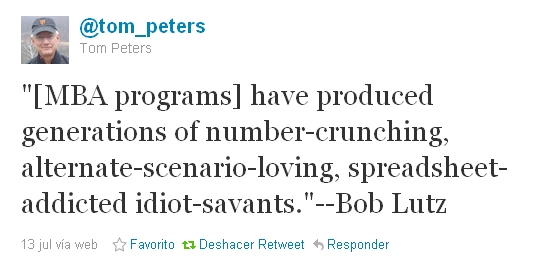
Some days before I had seen the following tweet by the management guru Tom Peters:
Having said this, I can only confess that I am one of those. One of those old people, grande personne, that loves numbers, crunching numbers, spreadsheets, etc…
If you asked me something about for example my drive to the job every morning, I wouldn’t say “Oh, it’s beautiful, there are lots of trees, you can smell this or that”, no, no…
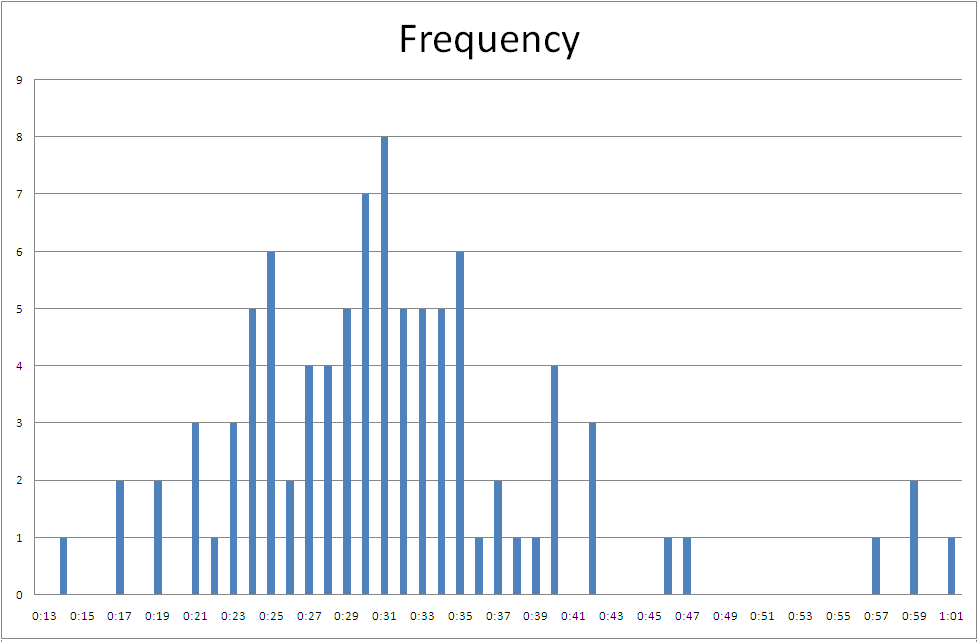
I would tell you: “it takes door-to-door an average of 31 minutes -which coincidentally is the exact time most repeated-, I depart at 8:35am on average, I have tried 3 different routes and route number 3 seems to be about 4 minutes shorter on average than the other 2 routes, I found out that it is as good to be an early comer to the office than to arrive at about 9:30am, while the worst time to leave home is about 8:15am… Tuesdays are the worst days normally, taking on average about 5 minutes more than Wednesdays, the best day”. Numbers.
And I would have said all these because during the last 7 months I had been taking note of the all the numbers related to those trips, crunching them in a spreadsheet, etc, etc…
Como muchos de vosotros sabéis, mi hermano Jaime es seguidor del F.C. Barcelona mientras que yo lo soy del Real Madrid. Hace años, discutiendo en broma le decía a veces “el Madrid no bajará nunca, y si lo hiciese, la Federación tendría que cambiar la Primera División por la Segunda… la Primera sin el Madrid no tiene sentido”. Una fanfarronada, diréis.
La realidad supera la ficción. Mirad lo que está ocurriendo en Argentina con el River Plate tras su descenso:
Quilombo por el descenso de River Plate.
Por cierto, River es mi equipo favorito en aquel país ;-).
Hoy, como cada 25 de julio, es la festividad de Santiago apóstol. No sé bien porque, pero mientras salí a correr recordé una anécdota del viaje a Perú en 2009 que me pareció oportuna compartir hoy.
A la representación del apóstol Santiago se le da también el nombre de “Santiago Matamoros“, por sus supuestas intervenciones en favor de los cristianos en batallas contra los musulmanes en la Edad Media. Pues bien, visitando la catedral de Cuzco, o Basílica de la Vírgen de la Asunción, nos encontramos con un cuadro del apóstol Santiago donde ya no mata moros sino indios mal llamados incas (aunque yo de historia no sé mucho, entiendo que Inca era solo el rey del imperio). De hecho allí lo llamaban Santiago “Mataindios” o “Mataincas”.
Además de ser “¡Santiago!” un grito de guerra por entonces, supuestamente el apóstol oportunamente apareció para echar una mano a Pizarro y los suyos cuando estaban siendo acechados en su intento de conquistar la fortaleza de Sacsayhuamán.
Qué gran acierto y simplicidad por parte de la Iglesia el utilizar el mismo santo y retórica que había dado éxito en España para evangelizar América…
Como no se podían sacar fotos dentro del templo, no tengo ninguna que mostrar del interior donde se vea dicho cuadro, aunque podéis encontrarlas fácilmente en Google.
I already wrote that my childhood dream job was to be an astronaut and that led to pursuing aerospace studies. In the same post I recalled a small toy of the Challenger Space Shuttle and how this toy contributed to that dream. Well, this post is just an homage paid to the Space Shuttle, or officially the NASA Space Transportation System, STS.
The last mission of the STS is scheduled for next Friday, July 8th. When the Atlantis is supposed to make the last lift-off for the mission STS-135 which, after 12 days, will end the 30 years of Shuttle flights.
During our last visit to the USA, Luca and I had the chance to see one of the Space Shuttle vehicles at the National Air & Space Museum (NASM). The vehicle at display there is the Enterprise.
I already mentioned in that post there that the Enterprise is the only vehicle of the fleet which never went to outer space. It was used for training purposes, to let the astronauts train the gliding descend they would have to make once the vehicle re-entered in the atmosphere. Thus, some parts of that vehicle are dummies.
The Enterprise hasn’t got the same thermal protection tiles since it wouldn’t need them, however its surface replicates the tiles with some kind of rubber ones so the flow of air around them would be the same as in the other vehicles. Another difference is in the engines at the back. The 3 engines that the Shuttle has at the back are its orbital maneuvering system, which allow it to adjust its orbit (they’re not atmospheric engines to propel the Shuttle in its flight back to Florida). Again, since the Enterprise would never go to outer space it wouldn’t need to adjust its orbit and the engines it has are just dummies to provide the same distribution of weight and forms in the vehicle.
I also mentioned in the previous post about the visit to NASM that the vehicle was going to be named Constitution until a public campaign achieved its goal of naming it Enterprise after the spaceship featured in Star Trek.
Find below some pictures of the Enterprise at NASM:
This slideshow requires JavaScript.
The Economist features this week 3 articles about the Space Shuttle program. I found parts of them very critic of the costs of the program, but nevertheless they give a somewhat complete picture of the history of the Space Shuttle and what may lay ahead for space exploration.
The different Shuttle vehicles (and other related materials) will be distributed among several museums and educational institutions. The Enterprise will leave the NASM and will go to the USS Intrepid in NYC while the Discovery will be hosted at NASM. You may find other locations in this article.
Finally, NASA just unveiled last Friday a wonderful documentary (80 minutes) about the history of the program: its launch, the vast engineering undertaking, the first mission, the Challenger and Columbia accidents, the improvements that the accidents brought, etc. To close the circle, the documentary is narrated by William Shatner, an actor of Worldly fame as he featured James T. Kirk, captain of the USS Enterprise in Star Trek. See a small trailer of the video:
PD: In the full length video, in the images shown of the mission STS-95 which brought John Glenn back to Space at age 77, appears Pedro Duque a Spanish astronaut that coincidentally was my teacher at the aerospace engineering school.
I’ve lost count of how many John Grisham novels I have read, but they’re over a dozen. They all look the same: legal thrillers, young lawyers, similar location (South USA states), etc., and yet they’re grabbing your attention from start to finish. I guess that the guy picked the formula some 20 years ago and knows how to exploit it (the formula even calls for books of about 450 pages, with about 12 pages per chapter…).
This last one I read, “The confession“, is no exception to the rule. The plot: an innocent man in death row is about to be executed when the confessed killer pops up out of nowhere and will try to stop the execution and around them: a small firm led by an energetic single lawyer, and some despicable characters including a detective, district attorney, governor, hysterical mother of a victim, etc. The result: a rollercoaster of emotions and engaging novel. I even ended a couple of times with headache due to the anger produced by what I was reading!
About 2 weeks ago I gave a speech at Rosemasters club about the performance of clubs and its relation with the amount of members they have. My assignment was to give a 5-7 minute fact-finding report and then handle a 2-3 minute Q&A period. You may find the video and the script of the speech below.
In this post I just wanted to share a couple of graphics I produced while preparing the speech (one of the graphics is used in the speech) which I find quite revealing for Toastmasters club and district officers.
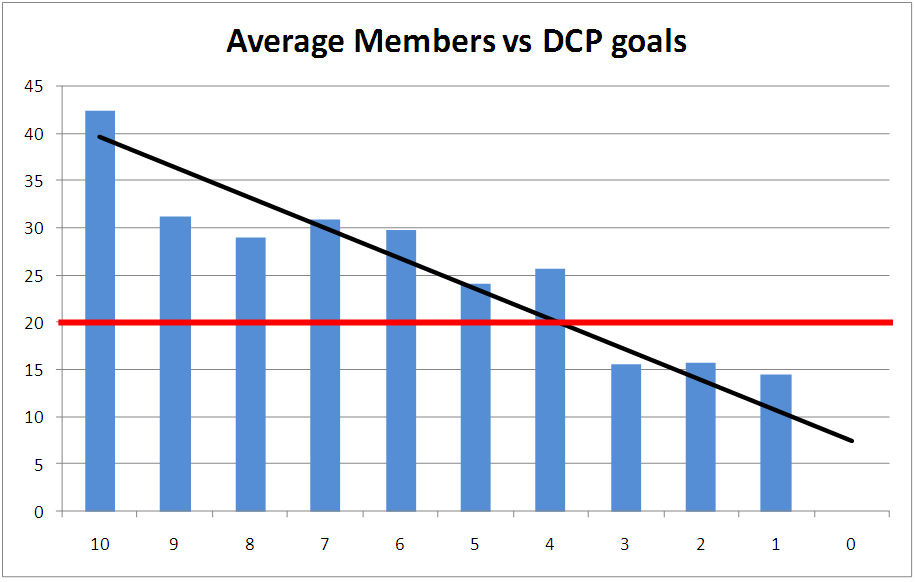
I took the figures of Toastmasters District 59 clubs at the end of the period 2009-2010 (173 clubs) and checked goals achieved within the DCP program per club versus the members they had at the end of the period. Excluding the clubs chartered within that same year (for which it’s complex to achieve many of those goals in less than a year), I found a clear trend that the more members the club has, the more goals it achieves.
Average members in a club vs. DCP goals achieved (D59 2010).
This fact is so simple that no fact-finding was needed, but I wanted to check whether there was a real difference in membership between average clubs (those meeting 4, 5, 6 goals), good clubs (achieving 7, 8, 9) and the top ones (reaching 10). And the answer is yes. Top clubs have in average over 40 members. Good ones have around 30, while average ones have around 25.
Thus, I believe that clubs should not be content with reaching 20 (as DCP requires) or 25 members. Their goal should to reach around 40 members and ensure they have the highest quality. In that way they would also be on the safe side and resist any sudden loss in membership. Clubs having that many members may face issues of finding slots for members to take active roles in meetings, I guess that the preferable solution is to have extra meetings (meet weekly).
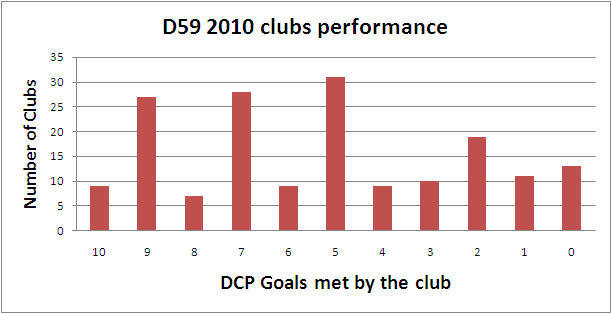
The other interesting graphic shows to what extent incentives shape reality. As Toastmasters officers know, clubs are distinguished when they reach 5, 7 or 9 goals out of 10. A club that achieves 6 goals gets the same recognition than a club reaching 5 (the same applies to a club reaching 8→7, or 10→9). So you can see how officers push members in order to achieve either 5, 7 or 9 goals and how most of the clubs reach exactly those numbers and just a few end up the year with an even number of goals.
Number of clubs with a given DCP performance (D59 2010).
—
Video of the speech:
—
Script of the speech:
What do you think this represents?
Mr TM, fellows,
I joined TM in 2007. At that time, there were 3 clubs in Madrid: Standing Ovation, Excelencia and TM Madrid, which is the club I joined. Why did I join? Because I saw a great atmosphere, listened to 3 different prepared speeches, good evaluations… I thought “this is a club I want to be part of”.
We can say that the Quality of the club was high.
In this speech I will try to show you that in Toastmasters Quantity leads to Quality. I will go through personal experience, a bit of history and some statistics.
6 months after joining the club I became an officer, I was the VP education. Then I started taking note of the number of members and guests that came to every meeting, I did this for 2 years… I can tell you that as this number grew, the meetings were getting better, etc.
Let me now tell you something about Toastmasters.
In Toastmasters there is a system for evaluating clubs. This system is called the Distinguished Club Program, the DCP. It measures several things: how many members achieve CC, AC, how many new members come into the club, etc… The DCP tries to measure the Quality of the club.
There are 10 goals in the DCP that clubs should try to achieve. If a club reaches 5 or 6, it is recognised as Distinguished Club. If a club reaches 7 or 8 goals it gets a higher recognition. If a club reaches 9 or 10 goals is awarded the maximum recognition: President Distinguished Club.
Now let’s see how Rosemasters was doing these years.
Rosemasters was founded in October 2008. That 1st year ended with 22 members and achieved 3 DCP goals. The 2nd year it was already recognised as Distinguish Club, for having achieved 5 goals, and finished with 22 members. This year, in its 3rd year of existence, it has already achieved 7 goals and can achieve 9, with 20 members. For this it will be recognised as Select Distinguished Club or President.
What this club is doing is remarkable. Let me show you why:
I gathered statistics from all 173 clubs existing at last year end in Europe.
Best performing clubs, with 10 goals, had above 40 members.
Clubs with a result like Rosemasters this year (7, 8, 9) had on average have 30 members.
Clubs which achieved 4, 5 & 6 goals had ~25 members.
The weak clubs had ~15 members.
Let’s now look at clubs of the size of Rosemasters: between 18-22 members. They do not achieve as many goals as this club as achieved; this is why what this club has achieved is remarkable.
Why do I tell you this about Quality and Quantity of members?
As I said at the beginning: I believe that in Toastmasters Quantity leads to Quality. I believe that to make sure that this club continues to be healthy, that we continue to enjoy good meetings, we need more members.
I believe that finding members is a collective effort, it cannot be just an action for the VP Membership or the VP of Publicity; we all need to bring friends, family, colleagues from the work…
We should try to have at least 30 members, and then retain them. How to do that? We can discuss I in another speech. But remember in Toastmasters Quantity leads to Quality.
In this post I just wanted to share a couple of thoughts that I discussed with my father and older brother some months ago on the welfare state that we enjoy in Europe.
Luca and I went on a holiday trip to Japan 3 years ago. There, while in Kyoto and thanks to a cultural association, we enjoyed an activity consisting of spending the afternoon and evening with a Japanese family at their place.
The Takatori family lived in the centre of Kyoto (a wonderful city). He was an engineer who worked for a big electronics company (I forgot the name), thus I imagine that he earned a decent salary. The family lived in a 40-50 sqm flat, without bedrooms for the teenage children as they slept in futons in the living room. The Takatoris had no car and travelled either by bike or public transport every where.
At some point in the conversation we talked about travelling, holidays, etc., and then I asked him how many holidays did he had? “120 days.” I was surprised, “120 days?!?” He explained it better: “There are 120 days a year in which I don’t work, including weekends”… I started making the numbers: since the year has 52 weeks, 104 days are weekends, these left only 16 days off for Mr. Takatori, including bank holidays. This was in Japan and a medium class family.
I take it that in the rest of East Asia the conditions will be lower and work ethics will be at par with Japan (think of Chinese shops opening schedules in Europe).
When I compare that with Europe: 35 hour work-week (in France), a collective bargaining agreement with 211 working days a year (or 154 non-work days as Takatori viewed it – since weekends are the same here and in Japan, that means we enjoy 34 days more of holidays, or 7 more full weeks!), subsidies for a myriad of things, retirement at 60 (in France, with protests when raised to 62)… well, there’s simply no comparison.
Sure, the system we have here is something to be proud of, but then again, will it last? It’s not like the Takatoris of Japan, China, South Korea, etc., will refrain to: work an hour or a day more, lower a dollar in a price, retire a year later, etc., so we can continue to enjoy our welfare state.
Will it last? I have no answer, it escapes my power of analysis, but if I were you, I’d start saving yesterday.
Hace unos meses leí el libro “Todo va a cambiar”, de Enrique Dans (profesor del Instituto de Empresa y blogger), que recomiendo.
De este libro en particular me gusta la diversidad de temas que trata y el enfoque positivo, divulgador que tiene con cada uno de ellos: neutralidad de la red, copyright, impacto de las nuevas formas de comunicación en las empresas y las personas, políticas de comunicación de empresas e instituciones, relaciones con clientes, soluciones a problemas desde las nuevas tecnologías, generación de contenidos, web 2.0…
Para aquellos que lean regularmente su blog, este libro no aporta grandes novedades, se trata más bien una recolección amplia y ordenada de las visiones que el autor tiene sobre varios temas de los que regularmente escribe en el blog.
Especialmente anima a que la gente experimente, use redes sociales, escriba un blog, se haga una cuenta en twitter, etc. Además ofrece varios consejos para padres con hijos pequeños sobre cómo afrontar el acceso de estos a la red de una forma natural, lejos de intentar prohibir el uso de la misma.
Unos meses después de haber leído el libro, los capítulos sobre el impacto en la sociedad de las nuevas tecnologías cobran mayor relevancia tras haber visto los muchos movimientos originados y / o amplificados tanto en los países árabes como en España antes y después la últimas elecciones municipales y regionales.
Como dice el autor al final del libro: no es que todo vaya a cambiar, sino que todo ya ha cambiado…
Por cierto, ante la pregunta ¿debo tener/abrir un blog? La respuesta del autor, que comparto, es: si todavía no lo tienes la respuesta es sí.
Finalmente, quería dejar un enlace a otro post escrito por un amigo en el blog de los Jefotecs donde también dan su visión sobre algunos de los temas que trata el libro (descargas, conocimiento, neutralidad de la red).
“We saw a sign at the interstate and decided to come.”
“Great, it’s nice to see that advertisement works”…
This was our first exchange with the clerk at the Iowa Aviation Museum. We had just bought our tickets for 7$ and registered our names in a pristine visitors’ list. I guess we were the first visitors of that day, probably of the week, conceivably of the month, who knows if even in the year.
Luca and I were in our way from Des Moines to Omaha. I thought it would take 4 hours but soon discovered that we would arrive much earlier than we wanted. Having already passed the exit for the John Wayne birth place, when I saw the sign for the “Iowa State Aviation Museum” I didn’t think it twice. I turned the wheel and took the exit.
We had to drive another 10 miles on a more than boring road and then 2 more miles to reach the museum at the aerodrome or the Greenfield Municipal airport.
The museum had some unique pieces from the early days of aviation (e.g. the 1st airplane ever to carry the name “Piper”, the J-2… a one derived from it was the plane I flew in Poland). Nevertheless I wanted to commend the museum for 3 other things:
Diffusion of passion for aviation: I find it admirable that in such remote places, they do gather some resources, collect some assets and put up a museum for the delight of fans, to spread the passion for aviation and seed the souls of future engineers.
Scheme of contributors to the museum: to finance that museum they have in place a scheme in which both companies and individuals contribute to its sustaining. In exchange they get public recognition in the form of a golden plaque at the Hall of Fame of the museum.
Hall of Fame: I also admire the tribute paid to pioneers from the region and people who played a key role in aviation in the form of that Hall of Fame.
In that Hall of Fame you learn that an Iowan volunteer became the youngest aviator in US Army Aviation Section in WWI (Clifton P. Oleson); another Iowan built the 1st multi-passenger seaplane, the 1st twin-engine bomber, designed the 1st honeycomb structural supports and was the founder one of the companies behind today’s Lockheed Martin (Glenn L. Martin); another Iowan, this time a woman nurse, unsuccessfully sought a pilot position at Boeing Air Transport, but influenced the president with her idea of placing nurses on-board airplanes to make passengers feel more comfortable with flying (Ellen Church became the first stewardess in history); and another 2 Iowans were the chief engineer and the first pilot to fly the famous Lockheed SR-71 Blackbird (William J. Fox & Louis W. Schalk).
In the hall you also find out that an Iowan lost the first ever race between a car and an airplane (Carl S. Bates) and that a cloth sewn by the wife of a first cousin of the Wright Brothers is worthy enough to make it to the Hall of Fame (especially if that cousin happens to be the great, great, great-grandfather of a fellow from Greenfield…).
Barnstormingis a term I learnt at the museum (well, you go to museums to learn, don’t you?) that refers to the entertainment that first aviators provided in different villages in the 1920s, where they would fly as in a circus to show the airplanes to villagers, perform some stunts and get some cash by carrying affluent citizens in short demonstration flights. This, also contributed to spread the passion for flight.
This slideshow requires JavaScript.
—
PD: I join the legion of admirers of Luca for standing these #avgeek visits not only stoically but even enthusiastically.
Yesterday I wrote about what was my dream job as a child: being an astronaut. I work now for Airbus, and for many people, that seems to be the dream company to work for according to some studies.
Already last year, I posted about the study made by Randstad which placed EADS (mother company of Airbus) as the most preferred one in Spain.
This year, the same study by Randstad [PDF, 1.5Mb] has placed again EADS as the favourite company for workers (out of a study including the 150 largest companies in the country), even though the sector Aviation placed only as the third most wanted one.
Apparently the 3 factors in which EADS led the rankings were: the quality of in-company education, the interest of the work performed and the pay policy.
Moreover, recently it was released another study, this time targeted to engineering students across Europe. This one placed again EADS in the top 3 preferred employers behind Google and Audi, and ahead of BMW and Apple.
The good news: EADS will be recruiting over 4,000 employees in 2011.

 Having said this, I can only confess that I am one of those. One of those old people, grande personne, that loves numbers, crunching numbers, spreadsheets, etc…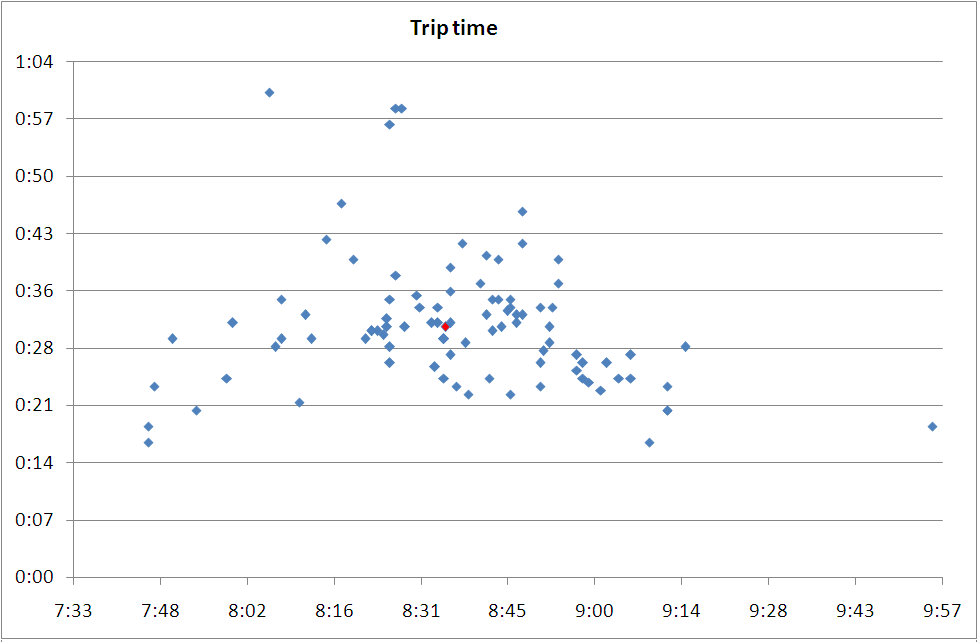


 The Blog by Javier