Tag Archives: Boeing

Airbus vs. Boeing, comparison of market forecasts (2013)

Last Tuesday, John Leahy, Airbus COO Customers, unveiled at a press conference in London the new figures of the 2013-32 Airbus’ Global Market Forecast (GMF, PDF 5.1MB).

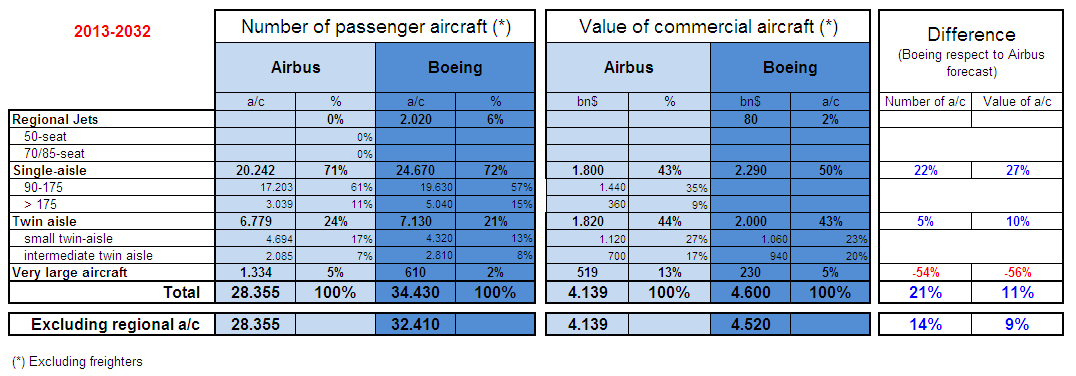
The last two years, I already published comparisons of both Airbus’ and Boeing’s forecasts (Current Market Outlook, CMO, PDF 3.0MB). You can find below the update of such comparison with the latest released figures from both companies.

Comparison of Airbus GMF and Boeing CMO 2013-2032.

Comparison of Airbus GMF and Boeing CMO 2013-2032.

Some comments about the comparison:

  • Boeing sees demand for 14% more passenger aircraft (excluding regional a/c, same proportion as last year) with a 9% more value (excluding freighters).
  • Boeing continues to play down A380 niche potential (54% less a/c than Airbus’ GMF), though for third year in a row it has slightly increased its Very Large market forecast, again by 20 a/c, or 3.4%.
  • On the other hand, Boeing forecasts about 350 twin-aisle and 4,400 single-aisle more than Airbus, clearly pointing to its point-to-point strategy versus the connecting mega-cities rationale presented by Airbus.
  • In terms of RPKs (“revenue passenger kilometer”), that is, the number of paying passenger by the distance they are transported, they see a similar future: Airbus forecasts for 2032 ~14 RPKs (in trillion) (a ~9% increase vs last year GMF) while Boeing forecasts 14.7 (also increased about 7%).

The main changes from last year’s forecasts are:

  • Both manufacturers have increased their passenger aircraft forecast, ~1,000 a/c Airbus and 1,400 a/c Boeing, bigger increase than last year’s change (500 a/c both).
    • In the case of Airbus it has again mainly increased the single aisle segment (700 a/c), probably reflecting the success of the A320neo launch.
    • In the case of Boeing, they decreased the twin aisle segment (80 a/c), but increased the single aisle in over 1,400 a/c.
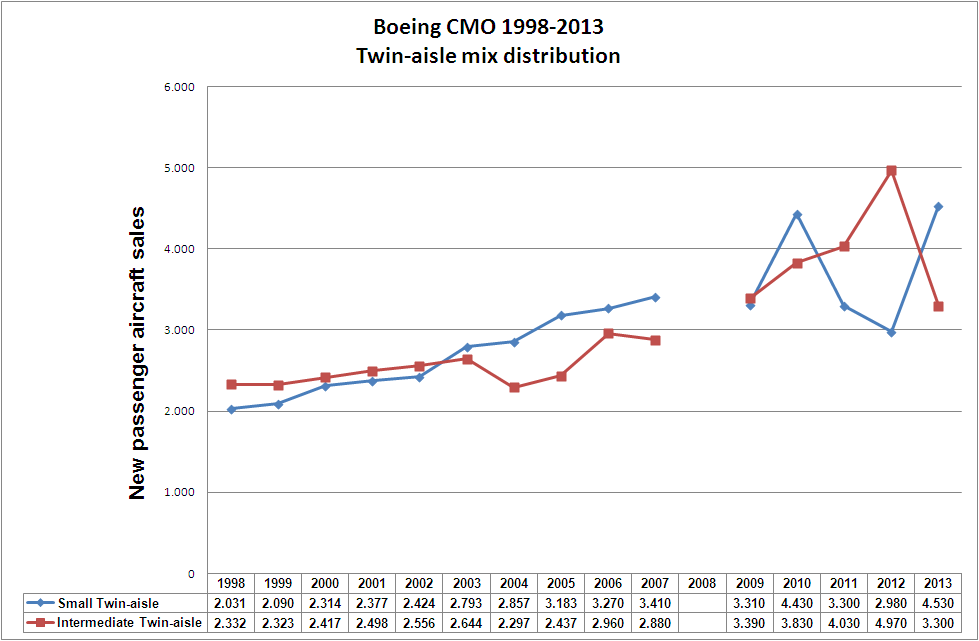
    • As I noted in a previous post, Boeing dramatically changed the twin-aisle mix, between small and intermediate. Now it has a mix closer to that of Airbus (60-70% of small twin-aisle).
  • Both manufacturers have increased the value of RPKs in 2032  (9% and 7%).
  • Both manufacturers have increased the volume (trn$) of the market in this 20 years, again 12% Airbus (to 4.1trn$) and 3% Boeing (to 4.5trn$) (excluding regionals and freighters).

Some catchy lines for those who have never seen these type of forecasts:

  • Passenger world traffic (RPK) will continue to grow about 4.7% per year (5.0% according to Boeing). This is, doubling every ~15 years.
  • Today there are about 16,100 passenger aircraft around the world (according to Airbus), this number will more than double in the next 20 years to above 33,600 a/c in 2032.
  • 2/3 of the population of the emerging countries will take a trip a year in 2032.
  • Domestic travel in China will be the largest traffic flow in 2032 with almost 1,400bn RPK, or 10% of the World’s traffic.
  • The A20 family: a take-off every 2.5 seconds, with 99.6% reliability.
Trips per capita vs. GDP per capita (source: Airbus GMF).

Trips per capita vs. GDP per capita (source: Airbus GMF).

As I do every year, I strongly recommend both documents (GMF and CMO) which provide a wealth of information of market dynamics. In case you find it tough, to read those kind of booklets, you may take a look at the video of the press conference, a great class on global economy, world aviation, forecasting, trend spotting (1h08’28”):

10 Comments

Filed under Aerospace & Defence

Tribute to Douglas Aircraft Company

Boeing announced this week that it will discontinue the producion of the C-17 Globemaster III in 2015. As an Airbus Military employee working for the A400M (a competitor of the C-17 in export markets), I take the announcement with some relief (if the production really comes to an end). On the other hand, as an aviation enthusiast I gave it another look.

As some media reported, the C-17 was the last aircraft assembly line of Boeing in Long Beach (California), this line shut down marks an end to an era. The C-17 is a legacy program from the former McDonnell Douglas which merged with Boeing in 1997. All the other McDonnell Douglas aircraft programmes which were manufactured in South California at the time of the merger were already stopped during the 5 years that followed the merger (including MD-80 variants, MD-90 and MD-11).

The activities of McDonnell Douglas in South California date back to those of the former Douglas Aircraft Company which merged with McDonnell Aircraft in 1967. All those MD-80/90/11 have as origin the DC-9 which first flew in 1965 and which together with its derivatives is still the 3rd most successful commercial airliner ever (only behind the 737 and A320 families).

I see the closure of the C-17 line as the end of Douglas heritage. In this post I just wanted to pay my small tribute to Douglas Aircraft Company one of the key companies in the history of aviation.

Douglas Aircraft Company

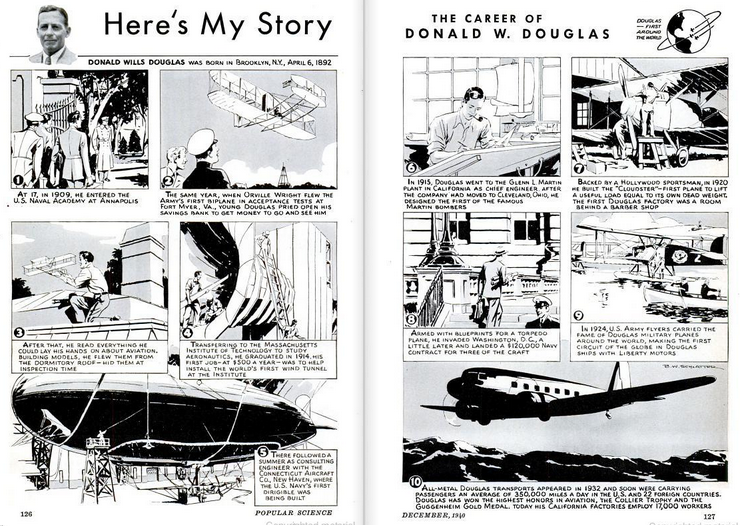
Douglas was incorporated in 1921, after Donald Douglas bought the stake from David R. Davis in the company that they had set up together the previous year. Prior to that Douglas, had studied in the MIT where he was the first ever to graduate with a Bachelor of Science in Aeronautical Engineering. Then he helped with the installation at the MIT of the World’s first wind tunnel. He went to work for the Navy and then for Glenn L. Martin Company (set up by Glenn L. Martin, an Iowan aviation pioneer, hall-of-famer of the Iowa Aviation Museum which we visited in 2011). At Martin he worked in the design of several bombers but he wanted to go to California from where his wife was. Thus he left the company in 1920 to move to Los Angeles where he first set Davis-Douglas Co. You can read about the life of Donald Douglas in the Wikipedia article, at Boeing site or better, in this excerpt from an issue of Popular Science magazine from 1940:

Douglas career (source: Popular Science magazine, October 1940).

Douglas career (source: Popular Science magazine, October 1940).

The last picture in the comic-like biography of Douglas above shows a Douglas Commercial DC-3.

Douglas Commercial DC-3

One simply cannot overstate the importance of the DC-3 in the history of aviation. The DC-3 came as an evolution of the DC-2, and with its improved range and payload capacity it revolutionized both commercial and military aviation. Hundreds of civil aircraft were produced, over 10,000 military versions. The military version C-47 Skytrain came to be one of the iconic aircraft of the World War II first and later of the Berlin Airlift (see this post I wrote about our visit to the Berlin Tempelhof Airport, where today a DC-4 is displayed).

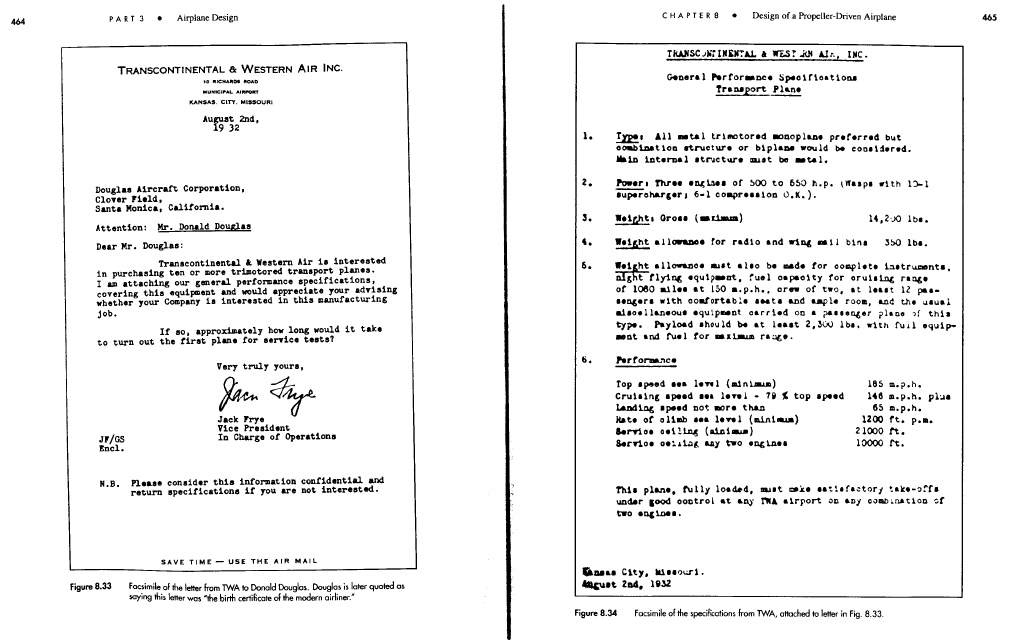
The Douglas Aircraft Company was mainly producing military aircraft until it received in 1932 a letter from Jack Frye, the VP Operations of the iconic airline Transcontinental & Western Air Inc., bettern known as TWA. Jack sent the same letter to 3 aircraft manufacturers (the others being Curtiss-Wright and Glenn Martin) inquiring whether they would be interested in producing an aircraft in response to TWA’s specifications. This came as a response to the launch by Boeing of the 247, which first 60 units were to be destined for its affiliated airline, Boeing Air Transport (both then part of United Aircraft and Transport Corporation). TWA feared that not having access to the 247 for the first years it would lag behind, and thus took the step forward of asking manufacturers to build the aircraft they needed.

John D. Anderson, the curator of aerodynamics at the National Space and Air Museum (see this post about our visit to NASM at Dulles) was also a professor of Aerospace Engineering in the University of Maryland. Among other books, professor Anderson has written “Aircraft Performance and Design (McGraw-Hill, 1999) a terrific book on aircraft design. The chapter 8 of the book describes the process of the Design of a Propeller-Driven Airplane. It includes as a design case study, the Douglas DC-3, 20-pages to delight yourself about history, aeronautics and engineering. It starts with a copy of the letter from Jack Frye and the specifications from TWA:

Letter from TWA to Douglas.

Letter from TWA to Douglas and specifications for a new airplane design.

The chapter describes the different discussions among Douglas’ senior engineers, exchanges with TWA, negotiations, etc. All the technologies employed in the aircraft were already existing in different models. The greatness of the project was in putting them together in one plane (the use of Northrop cantilevered wing, low-wing monoplane, retractable landing gear (to reduce drag), use of flaps (to allow low landing speeds – 65mph as per the spec), use of NACA cowlings to cover the engine…).

There was another great contribution to aeronautics of this development project and that was the one-engine-out performance, required in the specification; though the specification demanded a tri-motor which was able to take-off and cruise with any two engines. To that request, Douglas responded with a detailed analysis of safety in one-engine-out situations, which it presented at the UK’s Royal Aeronautical Society in the paper “The Development and Reliability of the Modern Multi-Engine Air Liner with Special Reference to Multi-Engine Airplanes after Engine Failure“.

The first test plane that came as a result was the DC-1, the production aircraft that followed the acceptance of the prototype was named the DC-2, and the DC-3 was an enlarged version that resulted from another request from American Airlines, which wished a version of the DC-2 capable to carry litters for overnight travel, that came to be the Douglas Sleeper Transport (DST). Douglas worked on that version but immediately saw that the potential of that enlarged version was not in the sleeper version but in having extra payload and comfort for seated passengers in comparison with other airplanes at the time. The DC-3 reduced direct operating costs (DOC) to 60% of those of the Boeing 247, thus converting it in a money maker for the airlines and allowing many more people to afford air travel.

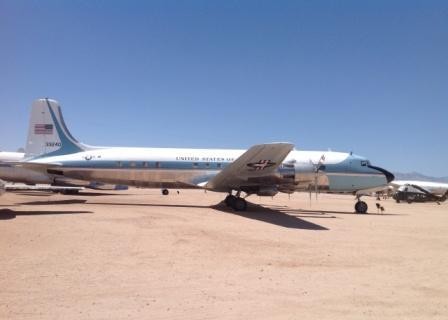
In the following decades Douglas positioned itself as the leading commercial airplane manufacturer until Boeing took this position around the 1960s. Several models came during those years: DC-4, DC-6 (which came to be the Air Force One during Kennedy and Johnson presidencies, see the picture below taken at the Pima Air and Space Museum), the mentioned DC-9 with all its later variants, etc.

DC-6 (VC-118), Air Force One during Kennedy presidency (at PImar Air and Space Museum).

DC-6 (VC-118), Air Force One during Kennedy presidency (at PImar Air and Space Museum).

Later on, financial struggles led to the consolidation first with McDonnell and then with Boeing. As my wife Luca mentioned, “this is what happens in any other industry to many other companies…” true, but this is the industry I like, and thus, I feel that it’s a pity that the long era of Douglas comes to an end. However, even if no more Douglas aircraft are going to come out of Santa Monica or Long Beach factories, there will always be something from the old Douglas in the current Boeing:

Logos from Douglas (prior to 1967) and Boeing (after 1997 merger).

Logos from Douglas (prior to 1967) and Boeing (after 1997 merger).

4 Comments

Filed under Aerospace & Defence

Unions, right-to-work and free-riders

Every now and then, followers of the aerospace industry read news about the relationships between Boeing and the unions. Recall the 8-week strike by the International Association of Machinists (IAM 751) in the fall of 2008, or the more recent negotiations with the Society of Professional Engineering Employees in Aerospace (SPEEA). See, for instance a recent article from Leeham News on the need for change in Washington state, “Right-to-Work, Creepy and Right-to-Worse in Washington State“.

Some months ago I was intrigued by what those terms meant in the American landscape, “right-to-work”, “unionized state”, “non-unionized state”, etc. Thus, I started looking for some definitions in the Wikipedia. And I found some of these terms misleading, or at least when seen from a European frame.

I initially thought that a non-unionized state might have some ban on unions, thus making it possibly more attractive for an employer if it deems it will have the higher hand in a negotiation. But no. There are indeed unions in non-unionized states. Let me just go through some passages taken from the Wikipedia trying to see the different terms:

Open shop: “An open shop is a place of employment at which one is not required to join or financially support a union (closed shop) as a condition of hiring or continued employment”.

Closed shop: “A pre-entry closed shop is a form of union security agreement under which the employer agrees to hire union members only, and employees must remain members of the union at all times in order to remain employed.” […]

“The Taft-Hartley Act outlawed the closed shop in the United States in 1947, but permits the union shop, except in those states that have passed right-to-work laws, in which case even the union shop is illegal. An employer may not lawfully agree with a union to hire only union members; it may, on the other hand, agree to require employees to join the union or pay the equivalent of union dues to it after a set period of time.”

Union shop: “A union shop is a form of a union security clause under which the employer agrees to hire either labor union members or nonmembers but all non-union employees must become union members within a specified period of time or lose their jobs.”

Right-to-work: “A “right-to-work” law is a statute in the United States that prohibits union security agreements, or agreements between labor unions and employers, that govern the extent to which an established union can require employees’ membership, payment of union dues, or fees as a condition of employment, either before or after hiring. “Right-to-work” laws do not, as the short phrase might suggest, aim to provide a general guarantee of employment to people seeking work, but rather are a government regulation of the contractual agreements between employers and labor unions that prevents them from excluding non-union workers”.

After I made this short review of those definitions, I got a complete different picture. Non-unionized states which I initially perceived as places with some intrinsic insecurity for the worker are simply having a  similar scheme than the one we have in Europe: shop-floor workers or engineers at Airbus are not required to join any union to get employment, nor are they forced to pay dues to union if contracted, though they may join one if they deem it in their interest.

I could even think of the union-states as an anachronism (forcing workers to join a union in order to work), however some of the reasons provided by opponents of the right-to-work law have sense:  free-riders would benefit from a collective bargaining agreement negotiated by a union without paying for that negotiation, the weakening of unions may lead to a race to the bottom, etc.

So far, I was never part of any union, thus I fall under the category of free rider, as I have and continue to benefit from social conditions negotiated by large unions.

Union affiliation

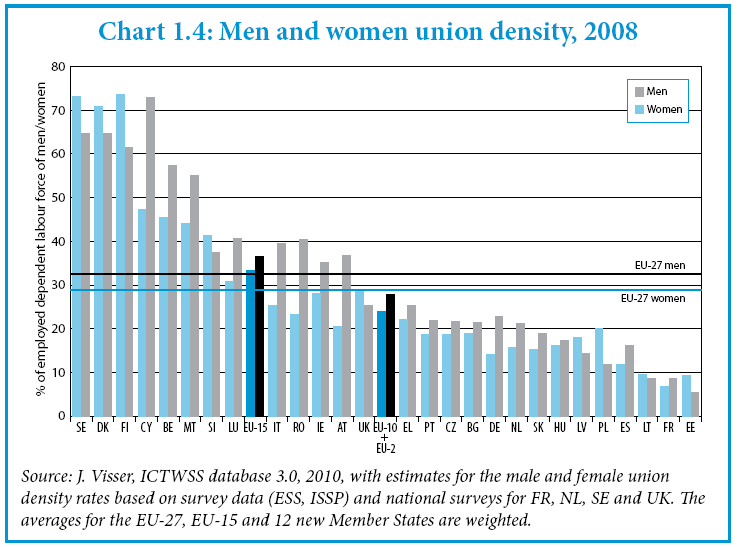
I found an interesting report prepared by the European Commission on “Industrial Relations in Europe (2010)” [PDF, 5MB]. Among the many sides of labour relations covered in the report, I found the graphic below with numbers about union affiliation rates in different European countries.

Union affiliation in Europe (source: European Commission).

Union affiliation in Europe (source: European Commission).

The figures in Spain and France, where I have worked so far, are around or below 10%. I found it in line with non-unionized states in the USA according to the Wikipedia: states without right-to-work laws have an affiliation generally above 10% (up to 25%) whereas states with such laws (thus similar to Spain or France) have lower figures of affiliation, less than 10% and down to 3.5% (with the main exception of Michigan).

Leave a comment

Filed under Aerospace & Defence

Hiroshima and the Enola Gay

Today, August 6th, in 1945 the Boeing B-29 Superfortress “Enola Gay” dropped over Hiroshima (Japan) the first nuclear bomb, “Little Boy“, used in combat. I guess you have had the chance to read about it in several places along the day. However, I thought of writing this post in order to connect several points related to the story, some of which I have only discovered quite recently…

Hiroshima

Luca and I, together with some friends visited Japan during the summer of 2008. A mandatory stop was Hiroshima. There we visited the Hiroshima Peace Site, museum and park.

You can spend several hours in the museum: from reading about the life in Hiroshima prior to the war, during the war and before the bombing, about the Manhattan Project, learning from specific cases of victims of the bomb, several testimonies, replicas from wounded people, etc. Some parts of the museum are truly shocking.

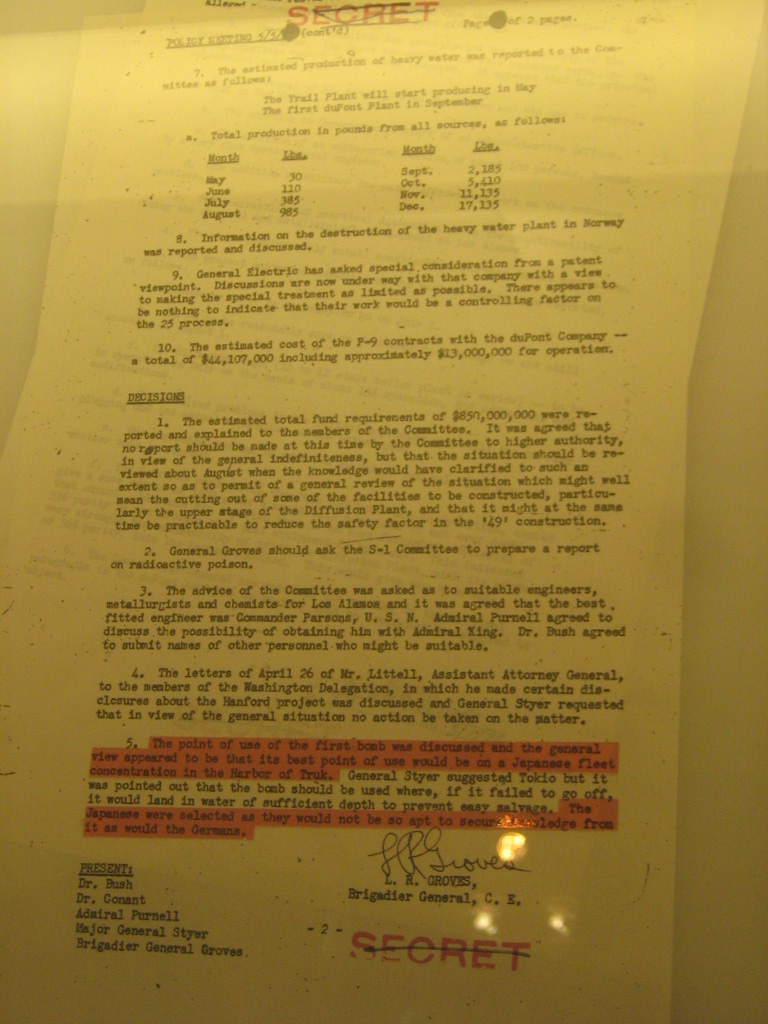
In the museum you could read several letters related to the Manhattan Project, for example these two from brigadier general Leslie Groves (in charge of the project) and Albert Einstein:
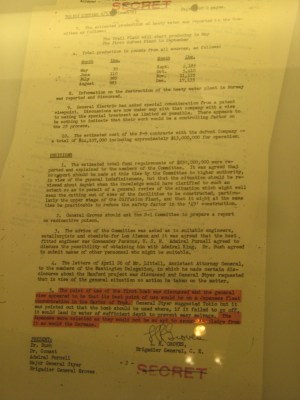
Letter from general Leslie Groves (Peace)

Letter from brigadier general Leslie Groves (Hiroshima Peace Memorial Museum).

Einstein’s letter to F.D. Roosevelt (Hiroshima Peace Memorial).

Some years ago, I read the book “The World as I see it“, from Albert Einstein in which he explained retrospectively his thoughts at the time of supporting the Manhattan Project. I already wrote a post about that book and recommend the reading of it.

In the Memorial Park, two things caught my attention: Genbaku Dome and the story of Sadako Sasaki.

Genbaku Dome

The dome (also called “A-dome”) was the only structure in the area which was left standing. This is because the explosion of the bomb happened at about 600m above the dome and about 150m away horizontally enabling the structure to stand the nearly vertical compression it suffered due to the blast.

The dome was initially scheduled to be demolished, but finally it was preserved, being today UNESCO World Heritage Site.

Genbaku Dome, Hiroshima.

Genbaku Dome, Hiroshima.

Sadako Sasaki

As I did in a post I wrote 3 years ago, in order to explain her story I will paste below an excerpt from Wikipedia‘s article on the history of origami (paper birds):

Legend says that anyone who folds one thousand paper cranes will have their heart’s desire come true. The origami crane has become a symbol of peace because of this legend, and because of a young Japanese girl namedSadako Sasaki. Sadako was exposed to the radiation of the atomic bombing of Hiroshima as an infant, and it took its inevitable toll on her health. She was then a hibakusha — an atom bomb survivor. By the time she was twelve in 1955, she was dying of leukemia. Hearing the legend, she decided to fold one thousand origami cranes so that she could live. However, when she saw that the other children in her ward were dying, she realized that she would not survive and wished instead for world peace and an end to suffering.   

A popular version of the tale is that Sadako folded 644 cranes before she died; her classmates then continued folding cranes in honor of their friend. She was buried with a wreath of 1,000 cranes to honor her dream. While her effort could not extend her life, it moved her friends to make a granite statue of Sadako in the Hiroshima Peace Park: a young girl standing with her hand outstretched, a paper crane flying from her fingertips. Every year the statue is adorned with thousands of wreaths of a thousand origami cranes.   

The tale of Sadako has been dramatized in many books and movies. In one version, Sadako wrote a haiku that translates into English as:   

I shall write peace upon your wings, and you shall fly around the world so that children will no longer have to die this way.

Hiroshima Peace Memorial park paper cranes.

In previous posts in the blog I explained how I have repeatedly encountered these paper birds around the world: in NY Saint Paul’s Chapel (close to World Trade Center zone zero), in Manzanar War Relocation Center (where Americans of Japanese origin were kept captive during WWII)…

Enola Gay

The “Enola Gay“, the Boeing B-29 Superfortress (named after the mother of the pilot Paul Tibbets) that dropped the bomb has become known worldwide. You can see the actual plane at the National Air and Space Museum in Dulles (Washington DC), where it is on exhibit. I wrote about that museum in this post, and you can see the airplane in the image below:

Boeing B-29 Superfortress “Enola Gay” at National Air and Space Museum (Washington DC).

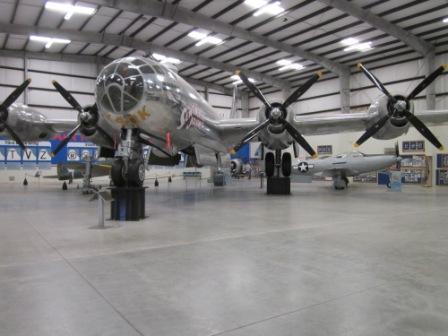
However, there are other aerospace museums where you can get closer to B-29 Superfortress aircraft, for example, the Pima Air and Space Museum in Tucson, Arizona, which we visited some months ago. There they had one B-29 on exhibit in one of its hangars:

Boeing B-29 Superfortress at Pima Air and Space Museum.

Boeing B-29 Superfortress at Pima Air and Space Museum (Tucson, AZ).

In the Pima museum, you could get really up close (not so in the NASM in Dulles) and you could get your head inside the bomb bay of the aircraft, the same bomb bay from which “Little Boy” was dropped from the “Enola Gay”:

Bomb bay of a B-29 Superfortress (at Pima Air and Space Museum, Tucson, AZ).

Bomb bay of a B-29 Superfortress (at Pima Air and Space Museum, Tucson, AZ).

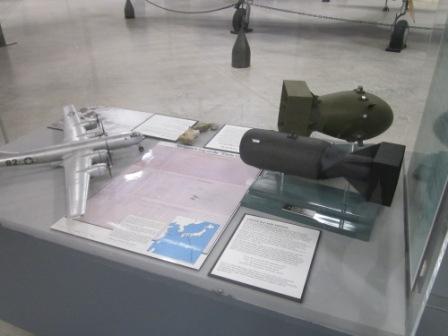
Close to this B-29, they displayed two replicas of the Enola Gay and the bomb, “Little Boy”:
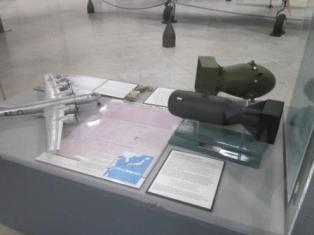
B-29 "Enola Gay" replica and "Little Boy" bomb replica (at Pima Air and Space Museum).

B-29 “Enola Gay” replica and “Little Boy” bomb replica (at Pima Air and Space Museum, Tucson, AZ).

And finally, you could see a replica of the Enola Gay’s Navigator’s Log. I was caught by surprise to find all this material at the museum. The original log, written by the navigator that day, Theodore “Dutch” Van Kirk, was sold in a public auction some years ago for over 350k$.

While at the museum, I took some minutes to watch the replica, the route the plane followed, the points of reference it used, the notes he made… and especially, the line in which Theodore, at 9:15am, noted “Bomb Away” (the 10th line of the second box) just before turning back over the port of the island of Omishima (which is wrongly reported in the log as “Mishima”).

Replica of Navigator's Log of the "Enola Gay" (at Pima Air and Space Museum).

Replica of Navigator’s Log of the “Enola Gay” (at Pima Air and Space Museum).

The picture above hasn’t got very good quality, but you can read an account of those moments in the following passage from the book “Japan 1945: From Operation Downfall to Hiroshima and Nagasaki” (by Clayton Chun):

Excerpt from "xxx" by Chun,

Excerpt from “Japan 1945: From Operation Downfall to Hiroshima and Nagasaki” by Clayton Chun.

***

It was a long post this time, but I think it was worthwhile to touch the story from the several points of view I have “experienced” it throughout these last years.

4 Comments

Filed under Aerospace & Defence, Travelling

A380 sales compared to 747 sales at program start

Some weeks ago, in a discussion with a colleague we tried to put into context whether the A380 sales were such a dismal or not.

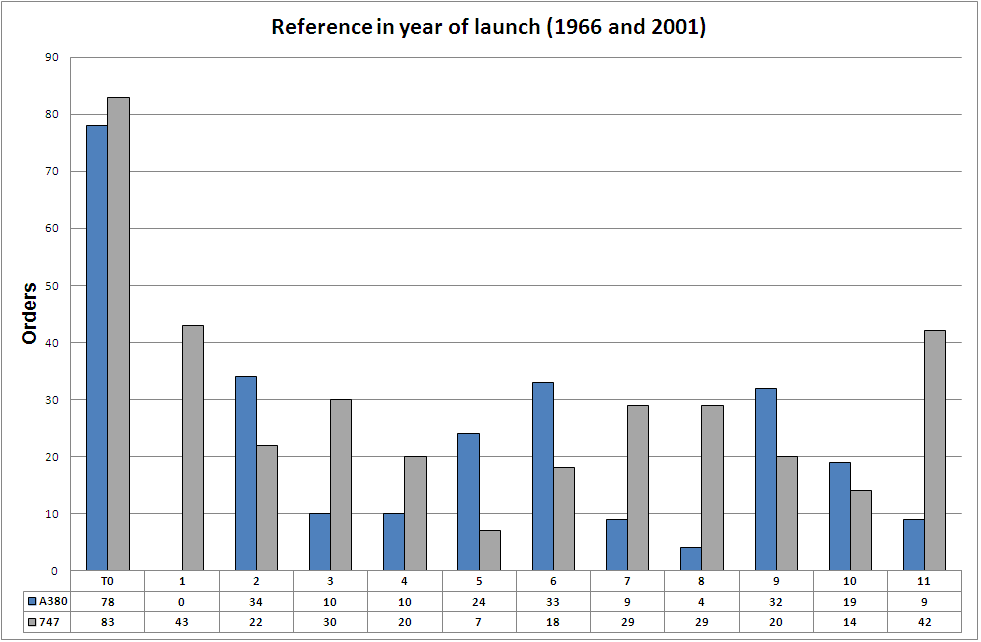
My colleague first plotted A380 orders since the program launch (2001) in comparison to those of the 747 (1966). I show below the result:

A380 and 747 orders referenced to the year of launch of each program.

A380 and 747 orders referenced to the year of launch of each program.

Both programs show an initial sales rush at the time of program launch. In both cases the rhythm of sales slowed down after the second year. In the first 11 years of program, each had managed:

  • A380: 262 orders.
  • 747: 357 orders.

Thus, we can see that the Boeing 747 was selling better already from the beginning of the program.

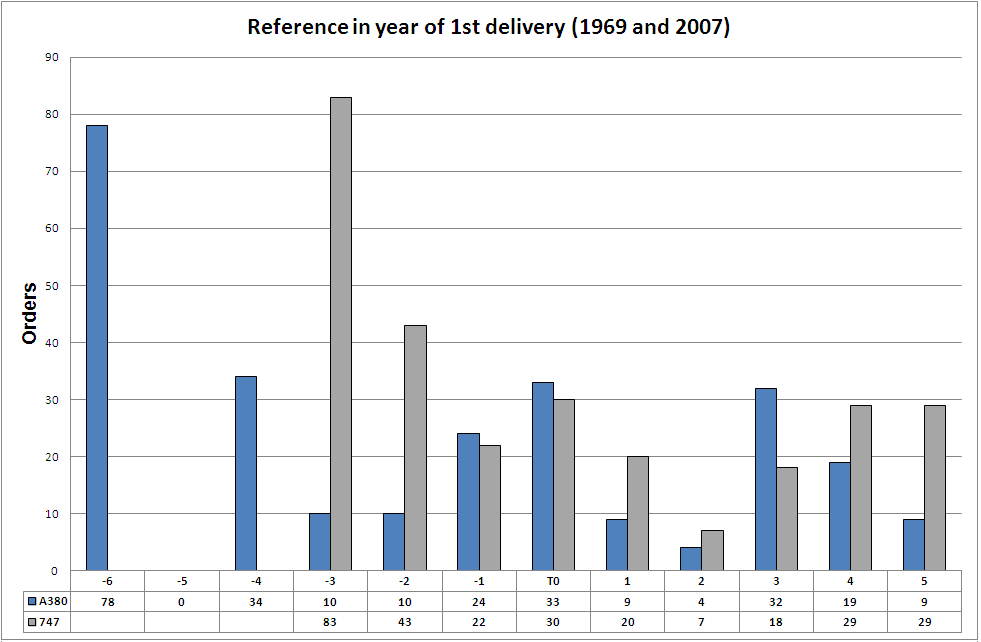
However, I wanted to make yet another comparison: aircraft orders taking as reference the year of first delivery, having heard so often the industry mantra that some potential customers would want to wait to see the aircraft in operation before placing orders. See below this second comparison:

A380 and 747 orders referenced to the year the 1st aircraft delivery of each program.

A380 and 747 orders referenced to the year the 1st aircraft delivery of each program.

In this case, and due to the shorter time to develop the Boeing 747 since program launch (1966), the difference in sales is narrowed:

  •  A380: 262 orders.
  • 747: 281 orders.

You can see that still, 5 years after the 1st delivery of each aircraft (2007 for the A380 and 1969 for the 747) Boeing had sold more aircraft, but with this reference the margin is lower, 19 aircraft.

Boeing 747. The Boeing 747 was the first wide-body in commercial aircraft history and still is the twin-aisle with the highest amount of aircraft sold (1,528 a/c as of today, probably to be soon overtaken by the 777) and delivered (1,464 a/c as of today). However, it has taken over 40 years to reach those numbers. The 1,000th unit sold was reached after 25 years of sales in 1990. The 1,000th unit delivered was also reached after 25 years of aircraft deliveries, in 1993.

Thus, in my opinion, when we want to measure the success of the A380 we cannot be distracted by the figures of other commercial aviation segments (single-aisle and small / intermediate twin-aisle) but we have to check what the 20-year forecasts for the Very Large Aircraft say:

  • ~1,300 aircraft according to Airbus GMF,
  • ~600 aircraft according to Boeing CMO,

and then see what could be expected market share for the A380 against those forecasts and whether it is getting the orders to reach it or not.

You can find orders and deliveries figures in both manufacturers websites or summarized here: A380 and 747.

5 Comments

Filed under Aerospace & Defence

Twin-aisle aircraft deliveries 20-year forecast

I read in the following article “Airbus seeks to increase Washington State supply business; aims for 13 A350s/mo” (from Leeham News) how from a presentation of a A350 supplier (ElectroImpact) at an aerospace suppliers event in Washington State, it was concluded that the Airbus aimed at building 13 A350s per month, as the mentioned supplier had built its factory with capacity to extend production rates up to those 13 aircraft.

This would be news because in its presentations Airbus talks about a production ramp-up up to 10 a/c per month (as does Boeing for the 787, which 10 aircraft/month should be reached by the end of 2013).

Having analyzed several times Airbus’ Global Market Forecast (GMF) and Boeing’s Current Market Outlook (CMO), I believe that those production rates of above 10 aircraft per month should be expected by industry followers just by seeing the numbers included in those forecasts.

In 2012, the GMF forecasted about 6,500 twin-aisle to be delivered in the next 20 years. The CMO indicated 7,210 aircraft. In 2013, Boeing CMO slightly reduced the figure to 7,130 a/c.

Comparison of Airbus GMF and Boeing CMO 2012-2031.

Thus, both companies expect between 6,500 to 7,200 twin-aisle passenger aircraft to be delivered in the following 20 years (excluding freighters, 747 and A380 – these 2 considered as Very Large Aircraft in the studies).

1st approach. If we were to take the mid-point of both forecasts, about 6,850 a/c, and simply divided by 20 years, we would reach to an average figure of 343 twin-aisle aircraft to be delivered per year between the 2 manufacturers, or 28 a/c per month. If Airbus wanted to maintain the long-term 50% market share, it would have to aim at delivering 14 a/c per month between all its twin-aisle products, which soon will be A330 and A350.

2nd approach. However, current twin-aisle production levels are in no way close to those 343 a/c per year. In 2012 there were 258 deliveries thanks to the introduction of 787s, but in the previous decade the average was about ~165 a/c per year. Thus, manufacturers must have a deliveries’ ramp up to accommodate those 6,850 in the next 20 years. Not knowing what that ramp-up is, I just linearized from where we are today and what is to be delivered.

I plotted in the graphic below all the deliveries of twin-aisle (excluding Very Large Aircraft) from the 1970s to 2012, and then what a forecast could be departing from 2012 deliveries’ figure to accommodate ~6,850 a/c in the next 20 years.

Taking a look at the graphic, one can already understand that if we take the GMF and CMO forecasts as good ones, the manufacturing rhythm will have to accelerate in the following years, especially in the second decade. In the late 2020s, over 400 twin-aisle would have to be delivered per year (over 33 per month), thus manufacturers will have to churn above 16 a/c per month each, that is the double of what they produced during the last decade.

Twin-aisle deliveries: historic series (1970s-2012) and forecast (excludes VLA -A380  & 747).

Twin-aisle deliveries: historic series (1970s-2012) and forecast (excludes VLA -A380 & 747).

Market shares. One could wonder whether this growth will favour more one company or the other. I compared market shares (excluding VLA):

  • in 2012: Boeing delivered 155 twin-aisle (26 767s, 83 777s, 46 787s) vs. Airbus 103 a/c (101 A330s, 2 A340s)… 60% / 40%.
  • in 2003-2012: Boeing delivered 839 twin aisle (148 767s, 642 777s, 49 787s) vs. Airbus 880 a/c (44 A300s, 687 A330s, 149 A340s)… 48% / 51%.
  • in 1993-2012: Boeing delivered 1,687 twin aisle (572 767s, 1,066 777s, 49 787s) vs. Airbus 1,521 a/c (175 A300s, 31 A310s, 938 A330s, 377 A340s)… 50% / 45%.

[The shares in the past decades include marginal deliveries from Ilyushin models and McDonnell Douglas models, which share I kept out of Boeing even after the merger in august 1997, these are ~30 a/c to be added to the 1,687]

Seeing that market shares have been fluctuating but always around 40-60% for each company, they could expect to have to at least deliver 40% of those 6,850 a/c in 20 years, or of those above 400 a/c in the late 2020s.

Backlog. Finally, just to see how the twin-aisle mix for each company is going to be, let’s look at the aircraft on order (backlog) that each company has as of today (end June 2013):

  • Airbus (43%):
    • A330: 260 a/c to be delivered.
    • A350: 678 a/c to be delivered.
  • Boeing (57%):
    • 767: 56 a/c to be delivered.
    • 777: 339 a/c to be delivered.
    • 787: 864 a/c to be delivered.

Thus, of the 6,850 twin-aisle to be delivered in the next 20 years, about 2,200 are already contracted as of today (plus the above 130 a/c delivered within the first half of 2013), thus 33% of those 6,850 a/c is more or less secured and among those the split is 57 / 43 for Boeing.

2 Comments

Filed under Aerospace & Defence

Boeing 787s parked in Paine Field

During our visit to Boeing wide-bodies final assembly lines in Everett, one thing was striking to the eye: the amount of Boeing 787s that were parked all around Paine Field. This is a view I was expecting to see since (a) at the time we travelled there (May 2013) the final fix to the 787’s batteries problem had not yet been approved by the Federal Aviation Administration (FAA) nor implemented in the already built aircraft, and (b) Boeing had kept churning 787s out of the assembly line thus provoking the mounting of them around the place.

See some of the pictures I took of them (not many pictures, nor very good ones as within the factory limits photo cameras were prohibited):

This slideshow requires JavaScript.

A collector’s gallery of a (luckily) rare event.

Leave a comment

Filed under Aerospace & Defence, Travelling

Commercial airplanes discounts review

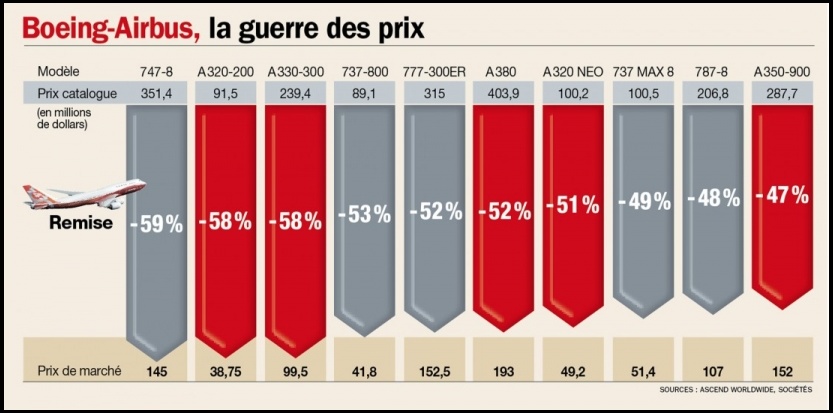
Last week, ahead of the start of the Le Bourget air show, the French portal Challenges.fr, published an article “Le vrai prix des avions d’Airbus et de Boeing” with an interesting graphic showing a comparison of the prices after discounts of commercial aircraft both of Boeing and Airbus.

Find the graphic below:

Commercial aircraft discounts according to "Challenges".

Commercial aircraft discounts according to “Challenges”.

In order to make the graphic, Challenges quotes as sources the consultants of “ASCEND Worldwide” (which has the industry-reference database of world commercial aircraft fleets) and unnamed companies (airlines such as American, Delta or Southwest, as per declaration of analysts quoted in the article).

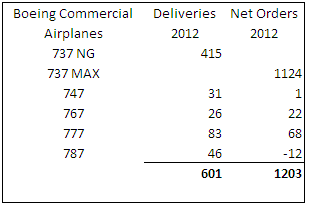
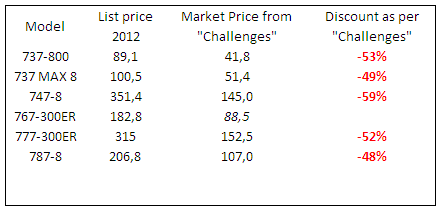
I have published in this blog yearly estimates for the average discount that Boeing applies to its aircraft. Find here the latest of that blog posts. In that post I arrived to an estimated average discount of 45%. Thus, when I read the article by Challenges I first thought “too high, to be average prices”. I thus run the reverse calculation: departing from Challengesmarket prices” I calculated what would have been Boeing Commercial’s 2012 revenues (1).

Boeing 2012 deliveries and net orders.

Boeing 2012 deliveries and net orders.

Boeing prices as per Challenges (767 added with the same discount as the 777-300ER).

Boeing prices as per Challenges (767 added with the same discount as the 777-300ER).

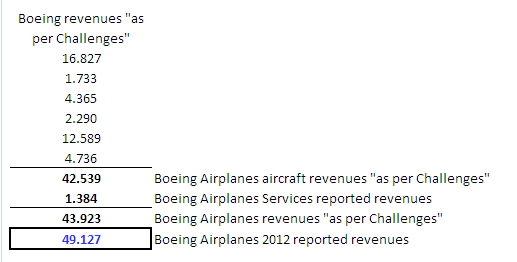
Boeing Airplanes revenues "as per Challenges".

Boeing Airplanes revenues “as per Challenges“.

Having run the numbers, I find the estimated value of 2012 revenues for Boeing Airplanes as too low (44bn$ vs. the reported 49bn$) using aircraft “market prices” as published by Challenges, as I first thought. I guess that the figures that Challenges published refer to the higher discounts having recently been applied, to the biggest customers making the biggest orders, such as those mentioned in the article (American, Delta or Southwest).

Thus, I would not take them as average or market price, those are the prices that a few can get.

(1) A couple of considerations must be made: Challenges does not publish any market price for 767s (the same discount of the 777-300ER was used), and does publish only one price of 737NGs or 777s; thus the result will not be very accurate.

4 Comments

Filed under Aerospace & Defence

Wide-body mix in 15 years of Boeing CMOs

A couple of days ago I wrote about the publishing by Boeing of its Current Market Outlook for 2013-2032. In that post I made a very brief review of it, and mentioned that I was puzzled by the change in the predicted mix of twin-aisle sales, between small and medium wide-bodies. To recall the numbers:

  • small wide-bodies: from 2,720 a/c in CMO2012 to 4,320 a/c in CMO2013, whereas,
  • medium wide-bodies: from 4,490 a/c in CMO2012 to 2,810 a/c in CMO2013.

Since I keep a collection of CMOs from years back, I decided to compare the figures of this wide-bodies mix along the last 15 years…

Twin-aisle mix distribution (Boeing CMO 1998-2013).

Twin-aisle mix distribution (Boeing CMO 1998-2013).

Seeing at the graphic (made using Boeing figures):

  • During the first 5 years (1998-2003) the trends are quite constant.,
  • From 2003 to 2007, the mix is reverted, possibly to favour the launch of the 787.
  • In 2008 the CMO did not provide the split.
  • From 2009 to 2013, you can see that both trends in the forecasts are erratic… why? Only Boeing knows.

9 Comments

Filed under Aerospace & Defence

Review of Boeing Current Market Outlook 2013

Last week, just ahead of Le Bourget air show, Boeing Commercial published its yearly update of the Current Market Outlook (CMO) for the next 20 years of commercial aircraft market (2013-2032).

I just compared the figures for passenger aircraft of the last two years’ CMOs:

CMO 2013 vs 2012 comparison.

CMO 2013 vs 2012 comparison.

Some comments to it:

  • You can see that the total number of new aircraft delivered has slightly increased from 33,060 to 34,430, a 4%, which is consistent with the constant 5% traffic increase that Boeing predicts.
  • The volume (Bn$) increases by a larger percentage, 9% (380 Bn$)… this is due mainly to the double increase in:
    • (1) single-aisle aircraft expected sales 6,2% (+1,430 aircraft), and
    • (2) the average price list with which the list is computed, another 6.3% (from 87.3m$ to 92.8m$)
  • I am puzzled to see the the sudden change in the predicted mix of twin-aisle sales, between small and medium wide-bodies…
    • small wide-bodies: from 2,720 a/c in CMO2012 to 4,320 a/c in CMO2013, whereas,
    • medium wide-bodies: from 4,490 a/c in CMO2012 to 2,810 a/c in CMO2013
    • as you can see the combined figure slightly changes (7,130 vs. 7,210), however the distribution among the two categories is drastically changed. Why is that? A question to Randy Tinseth that he did not address in his blog when the CMO was unveiled.

I would tend to think that the move is done to push some market development based on some models (787) instead of others (777), but given that it is precisely now when the upgraded versions of the 777 are supposed to be pushed into the market I fail to see the logic behind this.

Find below the nice infographic that the guys from Boeing have put up together:

Boeing Commercial Aviation Market Forecast 2013-2032 infographic.

As always, I recommend going through the CMO, as you can learn a lot about the business: from global numbers, to growth, traffic figures, fleet distributions, forecasts, etc… You may find the presentation [PDF, 9.6 MB], the booklet [PDF, 3.0 MB] and the file [XLS, 0.4 MB] with all the data.

For a comparison between this CMO and the respective Airbus’ GMF we will have to wait until after the summer, when Airbus publishes its update. Until then, find here the comparison based on 2012 market studies.

9 Comments

Filed under Aerospace & Defence