Gains with a negative performance?

I wrote some months ago a post in the blog where I showed how you lose money with swings in the market of the same percentage (e.g. -10% followed by +10% or vice versa).

In another post I explained how mutual open-ended funds define and calculate their performance based on the changes in net asset value per share.

In this post I wanted to point at some fine detail: a mutual fund may have a negative performance in a period of time (e.g. a year) yet have gained positive results during the same period. How is that possible?

As I mentioned in that previous post, the net asset value per share of a mutual fund rises and decreases as the aggregate share prices of the stocks in the portfolio rise or decrease. However, each time that there is an addition of capital, it is treated as an issue of new shares at the current price. It doesn’t matter whether those shares are issued to new or old “shareholders”. Depending on whether the net asset value has increased or decreased they are acquiring the new shares at a higher or lower price than they acquired the previous ones.

If it was the case of a company, we would say that shareholders would see their share diluted. In the case of a fund, the share of the ownership is also diluted, but that doesn’t mean a reduction in the net asset value per share, since with the new investment there is an increase of the assets of the fund (and the funds will be invested). Now, let’s see it the case with one example.

Take a fund with only one investor, A, who at the beginning of the year invested 10k€. That would be the assets of the fund at that moment. The net asset value per share could be defined as 100€, meaning that at that point there were 100 shares.

During the next months the market goes down and, along with the market, the fund’s assets. Let’s say that the reduction in value has been of 50% at half-way through the year. This means the assets of the fund would be 5,000€ (belonging to the sole investor, A). Since there were 100 shares, now the net asset value per share would be 50€.

At this low point, another investor, B, invests another 10k€ in the fund. Now, the 10,000€ would buy not 100 shares, but 200 at a price of 50€. The net asset value per share would remain unchanged at that moment, 50€. However, the assets of the fund would now be 15,000€. The total number of shares would be 300.

Imagine that during the second half of the year the performance of the fund is +50%. As I mentioned in the previous post, with consecutive market swings, -50% and then +50%, you lose. However, in this case there as been an investment in the low point and we’ll see what that means to the fund and each of the investors.

The +50% performance means to the fund an increase of its total assets up to 22,500€, or a net asset value per share of 75€ (for the same 300 shares). This is a +50% since mid-year, but a -25% from the beginning of the year. Quite a negative performance. However, the fund has received inflows of 20k€ along the year and has ended the year with +2,500€ of net gains!

For investor A: the year has meant the same -25% in both net assets and performance as he has lived through the whole period the big destruction of value in the first semester and the creation of value in the second, but, with the market swings of equal percentage value, he lost.

For investor B: the second semester has been great, as she has only lived the +50%, meaning a net gain of 5,000€.
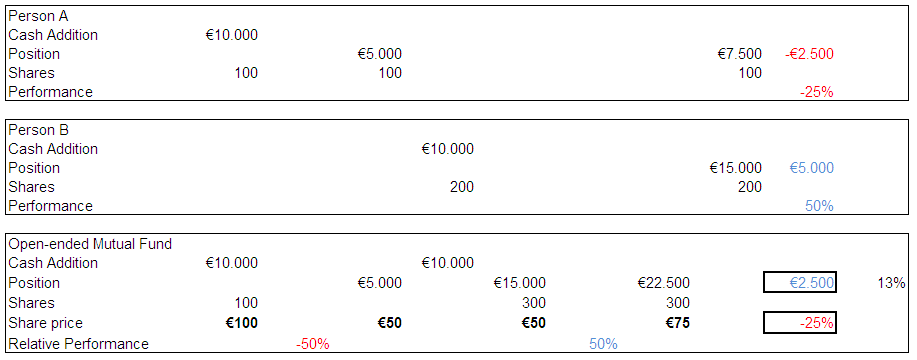
Performance of an investment fund.

The asset manager of the fund hasn’t been in the whole a better performer allocating assets than the market, and that is what the net asset value shows. The fund has only gained in absolute terms because there was an investment at the low point.

This is nothing more than one of the points the proponents of the technique Dollar Cost Averaging defend: to invest regularly the same amounts of money to take benefit of bear markets, when the fixed amount of money may afford more shares of a given stock. In that way you don’t need to time the market to benefit of low points.

Or in another way: “Be fearful when others are greedy, be greedy when others are fearful”, Warren Buffett.

Leave a comment

Filed under Investing

Which NGOs will I support in 2012?

Every January I take one afternoon to direct at least 0.7% of my personal net income to different NGOs. I already explained this in a post last year. In that post I also explained the origin of the figure, 0.7%.

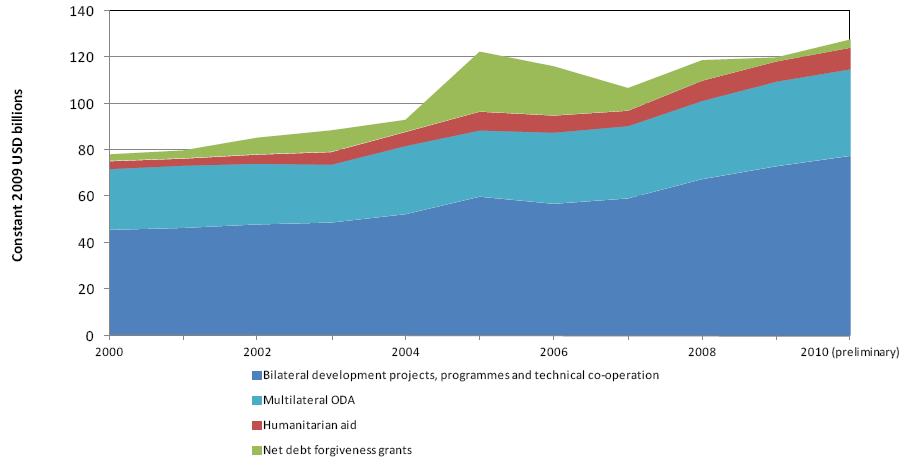
This year, I wondered how development aid was faring taking into account the crisis in which most of the big donor countries are in. You may check the figures at the extensive database of the OECD, or just to get the latest data on Official Development Aid you may check last year’s release announcing 2010 figures (or the report, PDF). The figures of 2011 won’t be released until April, but as far into the crisis as one year ago the fact was that development aid had actually increased, even if still far from the 0.7% committment.

Official Development Assistance in 2010 per country, source: OECD.

Evolution of Official Development Assistance through 2010, source: OECD.

Which NGOs will I support in 2012?

Last weekend I took sometime to make the numbers and select the different organizations. In previous years I directed 0.7% in January and along the year for different reasons I ended increasing this contribution. This year, I am directing already 0.9% of my income in January and again I expect that as the year goes by I will increase that figure. I take the Nordic OECD countries as an example and see the 0.7% as a minimum threshold, not as the maximum goal.

The organizations I have selected this time are:

  • Kiva: a micro lending portal, that I have talked about in the blog sometimes. I added some more funds.
  • Vittana: another micro lending portal, specialized on credits for education purposes, very similar to Kiva in its conception. I allocated some cash last year in it for the first time, and this year I have added more funds, to help some students study industrial engineering.
  • Médecins sans Frontières. I started donating cash to MSF in 2010, in 2011 I became member of the French branch. I renewed my membership.
  • Oxfam: a well-known NGO working “to find lasting solutions to poverty and injustice” to which I already contributed last year.
  • Anti-Slavery: an NGO which works to eliminate all forms of slavery around the world. I find that only the thought of people being slaves in 2012 simply devastating. I already directed some funds to this NGO last year and I was positively impressed to find information about its activities when we visited the Museum of London last year.
  • Fundación Hombres Nuevos: a Spanish NGO working in development projects in Bolivia. It was founded by Nicolás Castellanos who received the prize “Premio Príncipe de Asturias a la Concordia” in 1998 along with Vicente Ferrer or Muhammad Yunus (who later received the Nobel Peace Prize and is credited with the invention of micro credits).
  • Wikipedia: I guess this does not need any introduction, but I will make use of Wikipedia’s self-description: “Wikipedia is a multilingual, web-based, free-content encyclopedia project based on an openly editable model. The name “Wikipedia” is a portmanteau of the words wiki (a technology for creating collaborative websites, from the Hawaiian word wiki, meaning “quick”) and encyclopedia.” This is the first time that I collaborate in its sustaining.
  • Gapminder: in their words “a non-profit venture – a modern “museum” on the Internet – promoting sustainable global development and achievement of the United Nations Millennium Development Goals”, or better “Fighting the most devastating myths by building a fact-based world view that everyone understands”. If you have the chance, take a look at any of the videos of its founder, Hans Rosling, they are truly mind-blowing.

(Free material from http://www.gapminder.org – mind-blowing as I said)

Before ending this post, I wanted to make two reflections.

First, why do I or why do people/corporations make this kind of  contributions? Sometimes you hear criticism towards donations like “it’s for the tax deductions”, “it’s for marketing purposes”, “to show off”, etc. My personal view is that it doesn’t matter. It might be one or many of those reasons or none. What I believe is that the people in need do need the help and whatever the reason behind a contribution, it is welcomed. I do receive some tax deductions for the contributions for MSF and Oxfam as they’re based in France, not for the others. I also believe that the real contribution is the time dedicated by individuals working in cooperation, in the field, etc., in the end all what we give is a small percentage of our income / revenues.

Second, why do I write this post? Again, someone may think it’s show off. I’m fine with that. My goal is to get at least a reader to take a look at one of those NGOs, to think about dedicating her/his 0.7% to development aid… If I manage to do that, and I am sure I will (it worked in the past :-)), this post will be worth the time spent in writing it.

14 Comments

Filed under Helping others

Trickery, deception and women

CIA Manual of Trickery and Deception.

The official “C.I.A. Manual of Trickery and Deception“, by H. Keith Melton and Robert Wallace (248 pages), is a book based on a manual prepared by the former magician John Mulholland (1898-1970) and commissioned by the C.I.A. during the Cold War to equip its agents with undercover communication and deception techniques they might need in operations against the Soviet adversaries.

I received this manual as a gift from a close friend about two years ago. The first thing that one learns in it is the common and incorrect belief that “the hand is quicker than the eye“. As the magician explains:

“In fact, the hand is much slower than the eye, and for deceptive purposes, neither should move quickly. An illusion is primarily mental, not visual; when magicians and spies fool the minds of the audiences, eyes observe only what the performer intends.”

We should replace quick and clumsy movements that would attract attention by employing psychology, misdirection, and a natural sequence of steps to create an illusion.

A thing about the book that struck me was that, after some chapters explaining several tricks, the manual dedicates two chapters for special aspects of deception for women. That isn’t intended because women cannot perform certain tricks, but because performing some tricks in the same way a man would perform them might be suspicious and attract attention in some cases. I’ll share one example.

One of the tricks to pour some powder into another cup is by emptying the back of wooden pencil (where usually there is the small rubber) and fill it with powder. The pencil is kept in some pocket and brought into the scene with the excuse of scribbling anything or making some sketch in order to help yourself with an explanation. I found this very natural in me. Anytime I want to explain something I take a paper and a pen and draw something.

The book included a provision for women employing this trick. A woman would need to carry two pencils. One with the little hole with powder and another one untouched, apart from that the pencils shall be identical. Why is that? Not because the woman cannot draw a sketch or because she would need two pencils, but because if the woman was to be facing a man and she would use a pencil to sketch something as part of her explanation, it is very likely that the man would ask for that pencil in order to amend the woman’s sketch!! So the woman would need to have a second pencil to replace the first one before the man takes on the pencil with the little hole in order to avoid that he notices the trick.

Allow me not to explain more tricks in this post, otherwise I’ll lose the edge I currently have over you in our encounters, an edge that clearly you’ve failed to notice :-).

Finally, you may wonder why this friend chose this book as a gift. Me too.

1 Comment

Filed under Books

Savings and consultants

Last Friday, I wrote a post about a measure by the US DoD to produce efficiencies by publishing the actual cost of the preparation of each report and study in the front of each document.

As part of that same  “Defense Efficiencies Initiative” launched in 2010 by former Secretary of Defense Robert Gates, there were as well the following two:

“[…] immediately cut the dollars allocated to advisory studies by 25 percent.”

“[…] cut the size of the staff support contractor cadre by 10 percent per year for three years […]”

Another report (1) by the Congressional Research Service  [PDF, 86KB] assessing the efficiency of Gates’ initiatives found these ones as the ones with the higher potential savings for the DoD.

Nearly everyone working in a big corporation can sympathise with such initiatives, having sometimes wondered where is the added value of certain reports or the cost/benefit of shiny consultants’ teams brought in to solve an important issue based on noise-affected inputs received by insiders in too-short time to digest them only to produce yet another costly report and leave having created barely anything else but costly entropy.

A former colleague has a wall in his office covered by a collection of tens of leaflets from what he calls “strategic consultants”. I took on his habit of picking those leaflets, and even though I don’t collect them I do publish them in my Twitter account from time to time:

https://twitter.com/#!/javierirastorza/status/96623169644924928

https://twitter.com/#!/javierirastorza/status/131786083699662848

https://twitter.com/#!/javierirastorza/status/154655970201567232

That much for the perceived value of consultants.

(1) Cost of Congressional Research Service assessment not available.

4 Comments

Filed under Aerospace & Defence, Twitter & Media

Savings and reports

Yesterday I had a hilarious conversation with 3 work colleagues on the cost of several things: ranging from the cost of having 30 people enclosed in a day-long meeting to the cost impact of having the toilets of a whole office building not working for two days (cost measured by the extra time needed for fulfilling physiological needs).

This reminded me of the US Department of Defense’s “Defense Efficiencies Initiative” launched in 2010 by former Secretary of Defense Robert Gates.

One of the initiatives was to:

“[…] publish the actual cost of the preparation of each report and study prepared by DOD in the front of each document. “

See the implementation in the picture below:

Cost of DoD Strategic Management Plan FY 2012 - FY 2013: $169,010 (FY 11 dollars).

The cost of preparing the Department of Defense Strategic Management Plan FY 2012 – FY 2013 was $169,010. You may see the document here [PDF, 1.6MB] and judge by yourself whether you find it worthy of those 169k$.

Now, imagine if in the next crowded meeting you are attending the first slide of the first presentation said “Gentlemen, with this meeting today we’re consuming: xxk€”. The same applies for IT systems down, facilities not operating as they should, etc.

NOTE: Researching and writing this post took me about an hour. The cost of that hour? You name it 🙂

5 Comments

Filed under Aerospace & Defence

Course des Rois

Villemur-sur-Tarn is a small village by the river Tarn, about 40km North from Toulouse. Last Sunday I went there early in the morning to take part in the Course des Rois, a 10km race that was organized there.

Last time I ran a race in January it was in 2002, in Torrelodones, another “King’s Race”. I remember that a week before I had missed the 2001 San Silvestre due to a sprain in the ankle. By the time the race in Torrelodones came I could not rest anymore and I ran it with the bandage still on.

Villemur-sur-Tarn is close to the wine-region of Fronton, another village about 10km South from it. The first runners that were subscribed to the race received a bottle of red win. Yeah, I won something at a race! Even before starting!

After several pains in the Autumn, I went to the doctor and got an x-ray of the waist. It showed a difference in the length of the legs of ~7mm. Then I went to a podologue who made a couple of orthopedic soles for me. They partly correct that difference in length plus improve my stepping (I tend to supinate or under-pronate).

I started using the soles about two weeks ago. The podologue told me “start using them little by little, don’t go and run on them 15km at the first trial”. Well, I ran 7km. Then other 7km, etc… These days I am having pain in the left knee. I guess that it was not used to the level of effort it is required now. While it gets used to it, it hurts as hell every time I start running.

On Sunday, when I arrived to Villemur, I started warming up about 20 minutes before the start of the race. I almost couldn’t bend the knee. Then I was jogging very softly, and the pain was that that my body wanted me not to take part in the race. I felt like crying. Luckily I was alone in the race and didn’t have to talk to anyone in those moments. Only in my head I was thinking “it’s ok, some minutes of pain while warming up and then it’ll get better”.

It got better. During the 1st kilometre I could stand it so I continued with the same rhythm until km 2.5, when my body broke into sweating and I stopped feeling cold. From then on, feeling warm and more comfortable, I looked at the rest of the race with a more positive look.

I went along with some groups of runners until feeling comfortable with them and going ahead to catch another group. I repeated this process about 3-4 times, with a final increase in the pace at about km 7.5, when I tried to make it below 47′. In the end, I did 47’09”.

I’m very happy with the time. Had I launched the pace increase before I might have made it. This is nearly 1 minute faster than in Brax 6 months ago and some 20 seconds faster than the end of the half marathon of Toulouse last September. I’m training with more difficulty these days, but it seems that I haven’t lost punch for the races. This race also helps me to measure the level of fitness with the McMillan calculator I use, in order to estimate training paces.

You may want to see performance of the race measured by Garmin and the following pics:

This slideshow requires JavaScript.

10 Comments

Filed under Sports

San Silvestre 2011

Running the popular San Silvestre Vallecana is, no doubt, the best possible farewell event for the year.

Some of you may think that it is too cold, that running is too hard, that you are not prepared, that you would have a hard time running, etc. All that may be true and still you would enjoy it, laugh in it and want to come again. I have seen that once and again with family members and friends.

This time we run together with 6 other friends: Jaime, Nacho, Pablo, Kike, Jon and Gonzalo (for the last two I believe it was their first San Silvestre, it won’t be the last one). All of us had been training more or less during the year, and this year even though the pace we run (1h4’30”) was more or less the same as we did last year, we felt much better, we laughed more.

Jaime was running is 13th San Silvestre in a row. Impressive! I was doing my 11th (I missed three along these years). Pablo & Nacho must have done around 3-5, but they’ll complete many more.

Luca wants to spend next Christmas at some hot and sunny island somewhere (obviously Madrid & Vallecas don’t fit in that). I’d better find one island in which a San Silvestre race is organized, I don’t want to miss that :-).

You may find some data about the performance of the race in the Garmin record of it.

Enjoy the pictures:

This slideshow requires JavaScript.

Leave a comment

Filed under Sports

The Republic of Poyais

While I was in primary and high school, History never caught much my attention. And today is not otherwise in a broad sense, but I enjoy reading some historical notes on certain subjects.

I am reading these days the book “This Time is Different” (published in 2009), by Carmen Reinhart and Kenneth Rogoff (both Economics professors, the latter former economist at the IMF and member of the board of the Federal Reserve). As the description in Amazon says, the book is:

“[…] a comprehensive look at the varieties of financial crises, and guides us through eight astonishing centuries of government defaults, banking panics, and inflationary spikes–from medieval currency debasements to today’s subprime catastrophe. […]”

Being half way through it, I have had much fun with some anecdotes. I may write more about them in other posts, but in this one I want to focus in one I came across while reading the book (I have already shared it with some of you).

Let me take some excerpts from the Wikipedia:

Gregor MacGregor (24 December 1786 – 4 December 1845) was a Scottish soldier, adventurer, land speculator, and colonizer who fought in the South American struggle for independence. Upon his return to England in 1820, he claimed to be cacique of Poyais (also known as Principality of Poyais, Territory of Poyais, Republic of Poyais). Poyais was a fictional Central American country that MacGregor had invented which, with his help, drew investors and eventually colonists. […]

Gregor MacGregor went from Latin America to London, England, in 1820 and announced that he had been created cacique (highest authority or prince) of the Principality of Poyais, an independent nation on the Bay of Honduras. He claimed that native chieftan King George Frederic Augustus I of the Mosquito Shore and Nation had given him the territory of Poyais, 12,500 mile² (32,400 km²) of fertile land with untapped resources, a small number of settlers of British origin, and cooperative natives eager to please. He had created the beginnings of a country with civil service, army and democratic government. Now he needed settlers and investment and had come back to the United Kingdom to give people the opportunity.

At the time, British merchants were all too eager to enter the South American market that Spain had denied to them. The region had already become more promising in the wake of wars of South American independence, when the new governments of Colombia, Chile and Peru had issued bonds in London Royal Exchange to raise money. […]

In Edinburgh, MacGregor began to sell land rights for 3 shillings and 3 pence per acre (£0.16/acre or £40.15/km²). The average worker’s weekly wage at the time was about £1, which meant that the price was very generous. […] On 23 October 1822 MacGregor raised a loan with the total of £200,000 on behalf of the Poyais government. It was in the form of 2,000 bearer bonds worth £100 each. […]

You may read the rest of the story in the Wikipedia, but you can imagine it. Of course, Poyais defaulted on the debt issued, about 70 would-be settlers were sent to Latin America only to find that the wonderful Poyais did not exist. The group decided to come back to London. About 20 of them died in the trip and when they arrived to London about a year after departing MacGregor had already fled to France to proceed with similar schemes…

The Ponzi scheme of Madoff pales in the comparison to the one prepared by MacGregor. Beware when someone presents you with an opportunity too good to be true

2 Comments

Filed under Economy, Investing

Our investment fund in 2011

Luca and I have been investing together for 3 years. Last year I wrote a post in which I explained how we had adopted for our personal investments the same approach mutual open-ended funds have.

As I explained last year, we had to define a net asset value per share (valor liquidativo de la participación) at the beginning of the period. This net asset value per share rises and decreases as the aggregate share prices of the stocks in the portfolio rise or decrease. When an investment fund informs about its yearly results it is referring to the performance of this net asset value per share.

Each time that there is an addition of capital (new investments, in this case by Luca or me) it is treated as an issue of new shares to ourselves. It doesn’t matter that we are the only “shareholders”. Depending on whether the net asset value has increased or decreased we are acquiring the new shares at a higher or lower price than we acquired the previous ones. Exactly as it works in a fund.

And why do we go through all this hassle? So we can now handily compare how our investments fare in relation to broad market indexes or specific investment funds.

How did the year 2011 go?

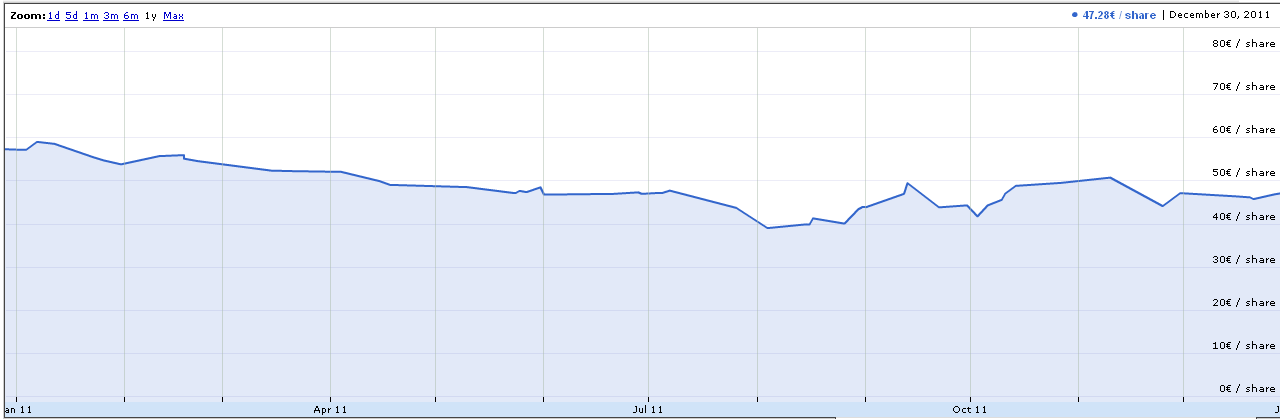
Let’s start with the humbling exercise :-). I had taken along the year above 50 samples, so we could get an idea of how the fund evolved. As you may see in the graphic below, the net asset value per share at the beginning of 2011 was 57.19€ while at the end it fell to 47.28€, that is -17.3%. This was the performance of the fund in 2011 (not good enough to sell subscriptions to the fund! :-)).

"J&L" investment fund 2011 performance (built in Google spreadsheet linked to Google Finance data, thanks to a friend's invaluable suggestion).

How does it compare with the main indexes?

  • S&P 500 ~ +0.07% (this is the target index)
  • Dow Jones ~ +5.5%
  • NASDAQ ~ -2.3%
  • IBEX 35 ~ -13.1% 
  • Euro Stoxx 50 ~ -18%

The gains of the fund since its creation in January 2009 have been+57.8%, with a compounded annual gain of +16.6% (remember this always refers to the net asset value per share – I will come back to this point in a future post, as cash gains or losses cannot be directly derived from the net asset value performance).

 Last year I introduced the comparison with the leading Spanish value investing fund, Bestinver (*). Let’s do the exercise again:

  • Bestinfond ~ -10.3%;
  • Bestinver Internacional ~ -10.1%;
  • Bestinver Bolsa ~ -12.7%.

All in all, 2011 hasn’t been a good year to present general results (for us, Bestinver or some indexes) however from the value investing perspective it hasn’t been that bad for buying (we performed 18 buy operations, while we only sold shares of 4 companies).

As any investment fund would do, prior to buying shares of a specific company we calculate the range in which we believe the target price shall be for us to sell the stock (and if the margin of safety is wide enough we buy). Taking the conservative values for each of the shares in our portfolio, we believe the target net asset value per share should be around 159€, thus having an estimated potential upside of about x3.3.

The latest factsheet of Bestinfond [PDF, November  2011] informed about a potential upside of x2.3. We may be optimistic; time will tell. And precisely that, time, being long-term value investors, we have plenty of :-).

I’ll keep you informed next year of this year’s results.

(*) Disclaimer: Since sometime in 2011, we have also positions in Bestinver, though I don’t get any fees for promoting it in the blog. (Our positions with Bestinver are excluded from the calculations of “J&L” fund to allow for clean comparisons).

NOTE: “J&L fund” numbers are pre-tax of capital gains realized, include dividends (twice taxed) and are net of transaction costs & brokerage commissions.

3 Comments

Filed under Investing

Summary of (my) 2011

Let me share with you a brief recap of my 2011 (as I already did last year).

If I then characterized 2010 as a learning year, I would say 2011 was a year on the run.

At the beginning of the year I set out my objectives for 2011, of which I have achieved 71.4% (just above my 70% target!). One of them was only to “become again a frequent runner”, for which I set up some modest steps, e.g., buy new running shoes, run 3 days before mid-January, run a 10k popular race before November, lose some 10kg by June… If there was a yearly objective which I widely met, it was this one:

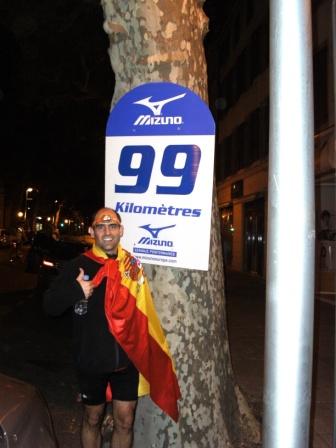
Último kilómetro de los 100km de Millau 2011.

Last kilometre at the ultramarathon "100km de Millau".

  • I ran over 170 days along the year, covering over 1,800 kilometres.
  • I took part in 11 popular races, including 6 of 10km, 2 half marathons, 1 marathon (42km) and 1 ultramarathon (100km). More races and more kilometres than ever before.
  • I found myself running in Granada, Villa del Río, Madrid, Torrelodones, Luarca, Rijswijk, Wijchen, Toulouse, Luz Saint Sauveur, Chicago, Washington DC, Des Moines, Montreal…

Learning. After taking some classes in Madrid, I continued studying French and now I feel more confident when facing shop attendants :-). I had to learn and continue to learn lots of new things every day at the new job where I landed about a year ago.

I still enjoy as learning moments the print weekly issues of The Economist or the monthly issues of Scientific American. I delivered the necessary speeches to become ACB within Toastmasters (though lately I’ve missed more meetings than I should). Finally, I read a dozen books along the year (a bit less than in previous years, though some in the new eReader!), being the ones I liked the most the following: first, second and third.

Investing & helping others. I set myself a high objective of saving and investing: I overachieved it by around 50%. I once mentioned it in Twitter: the best thing behind investing is the discipline of saving that is behind it. I not only dedicated a percentage of personal income to savings but as I announced in a post at the beginning of 2010, I directed a percentage to different charities. I initially set it out to be 0.7% of my income, but after raising some funds and contributing others to charities related to the races in which I am taking part, in the end this percentage has been well over 1% in 2011.

Travelling. We together visited Montreal, Ottawa, DC, Chicago, Omaha, and several places in the south of France and throughout Spain. The moment that I liked the most was attending the Berkshire Hathaway annual shareholders meeting, no doubt.

Javi 2.0. I continued to often write in this blog with some remarkable posts. I admit that my twitter account is one of my biggest sources of information / distraction.

Sports. Apart from the running, I recently re-started playing paddle with colleagues, became a kind of fan of the rugby local team, Stade Toulousain, had to subscribe to Canal + not to miss any of Real Madrid matches while living abroad.

Other reasons for joy have been:

  • our friends Teresa & Alberto, María & Óscar, Isa & Pedro got married,
  • we welcomed the newborns Mar, Hugo, Luis and Eneko, while another of our friends is pregnant today (that we know),
  • my sister Beatriz started working as an intern; my brother Jaime continued to enjoy his job in Airbus and moved to a new apartment; my mother Fidela continued to take several courses (and to give wonderful massages) and my father Juan Bautista finally and happily retired (after working for 43 years!).
  • Luca completed all the requirements to become a full-fledged lawyer, winning some court cases in the process.

To close the year, I started taking flight lessons, pursuing another childhood dream. This will allow me to continue learning and experiencing new things!

Now it’s time to update the objectives setting for 2012. This year the exercise will be easier as I already have the methodology and the habit. If the objectives are well chosen and challenging enough, next year’s account will be even shinier.

I wish you the same: a shinier 2012, enjoy it!

2 Comments

Filed under Personal development