Yesterday I posted the speech I gave at Rosemasters club last Saturday. As I mentioned there, on Saturday we celebrated the contests of the club.
This is a special occasion every year. Actually, there are two such special occasions in the year. In the spring we celebrate the speech contest and the evaluation contest, while in the fall we celebrate the humorous speech contest and the table topics contest (this last one is about improvisation).
Normally, in weekly meetings, members do not compete. The contrary, the atmosphere is relaxed and inviting you to speak in front of a friendly audience. As the mission of the clubs reads “The mission of a Toastmasters club is to provide a mutually supportive and positive learning environment in which every individual member has the opportunity to develop oral communication and leadership skills, which in turn foster self-confidence and personal growth.”
Nevertheless, some of our members (~5% of them) like to take the opportunity to compete, to prove themselves how they can improve and enjoy facing new and bigger audiences with every upper step of the competition. The competition also puts you an extra point of stress that it’s very good to learn how to handle it.
I have taken part in such contests, and even though I haven’t won, I can tell it’s a wonderful and unique experience. You really prepare and polish your speeches, paying attention to every detail. Then, the day of the contest is for you to enjoy it.
I remember when I competed in Lisbon in April 2009. It was a big auditorium, filled with about 100 people. They offered us to use a micro. I turned down the offer. I thought: “when am I going to have the chance to try if I can project my voice to the last corner of the room? And with such a friendly audience”. When the contest finished, I went to check with a woman sitting at the very back of the room whether she could hear me well. She could. That was my victory for that day.
I wanted to share with you in this post a speech I gave last Saturday at Rosemasters club contest. I was not contesting but a speech was needed for the evaluation contest, so I volunteered.
Why do I share this speech in particular? Not because it was especially good (nor especially bad), but because it has some insights that could help some of you in case you hadn’t reflected on them or made the numbers yourself.
I titled the speech “Snowball” but a more suitable title would have been “Snowball, or the beauty of compound interest”. Please, note that the metaphor of the snowball it’s not mine, so no need to praise my originality here. I borrowed it from Alison Schroeder’s biography of Warren Buffett “Snowball”, which I reviewed in other post in this blog (I take the opportunity to recommend the book again).
Below you can watch the video uploaded in Youtube (from the second 0:42 some helping hand lifts the camera, please be patient during those first seconds). Below the video I share the script of the speech so you can actually see the formula and the charts I showed. Reflect on it; it may help you a lot a long way down the road.
—–
Script:
“How many of you used to play with snow when you were a child?
Do you remember what the process you followed to build snowballs was? You started by making a small ball with your hands, like this. Then, you left it on the ground and let it roll over itself, so it was gaining more snowflakes and thus getting a bit bigger with every roll… for you it was a small effort, and after some time of rolling and rolling over, you easily could end up with big snowball like this.
It shows what is the future value (FV) of an investment’s present value (PV) that gains a fixed interest rate (i) for n periods.
To put it simple, it means that the interest that we earn over the investment in the first year, will enter the calculation in the second year. In a very similar way that small snowflakes are making the snowball bigger.
The importance of compound interest for our future.
Who is the younger member of the audience today? I will ask you one question, let me see if I get the answer I want.
Are you saving and investing with your retirement in mind? Do you have pension plan or fund?
An extremely important factor in this discussion is that time in the formula appears in the exponent. This means the longer the time period, the better. Or put it in another way, the sooner we start investing or saving, the better.
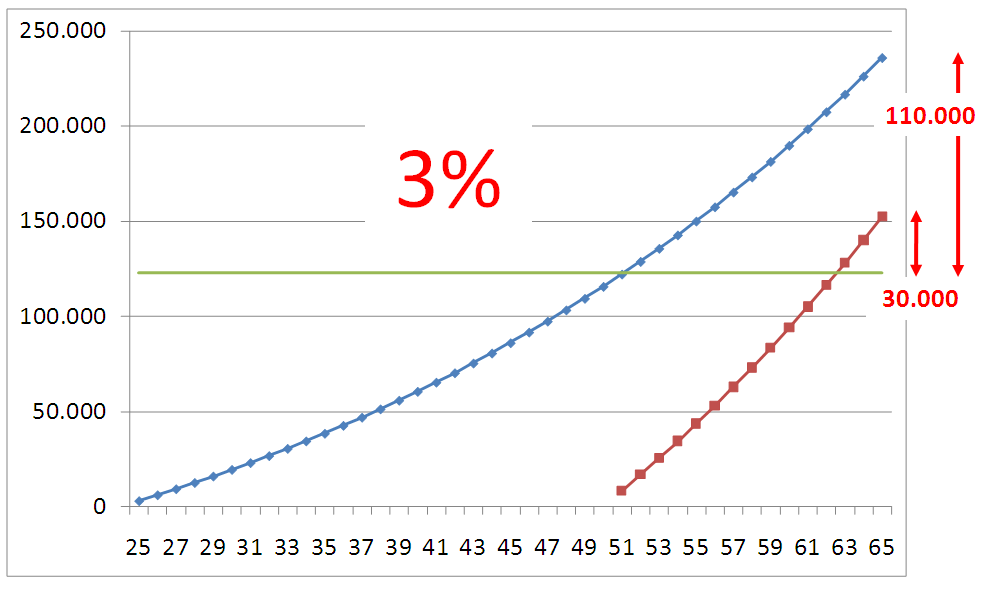
I made two quick calculations to show you. Imagine a 25 year old person who just started working. If he or she is able to save 250 euros per month, that is 3,000 euros per year, and puts it in a conservative fund which earns 3% a year… by the time he is 65 he will have around 230.000€. His yearly contribution would have been 123.000€. So another 110.000€ will have come from the interest. He will practically have doubled his money.
On the other hand, take a 50 year old person who never saved any money beforehand. He will have to save it in only the last 15 years of his working life. To make the comparison, I supposed that he contributed the same 123.000€ in those 15 years, for this he has to save 8.200 per year or 680€ per month… when he is 65 he will have 150.000€, having earned about 30.000€ from the interests, 4 times less!
Effect of a 3% compound interest over 40 years.
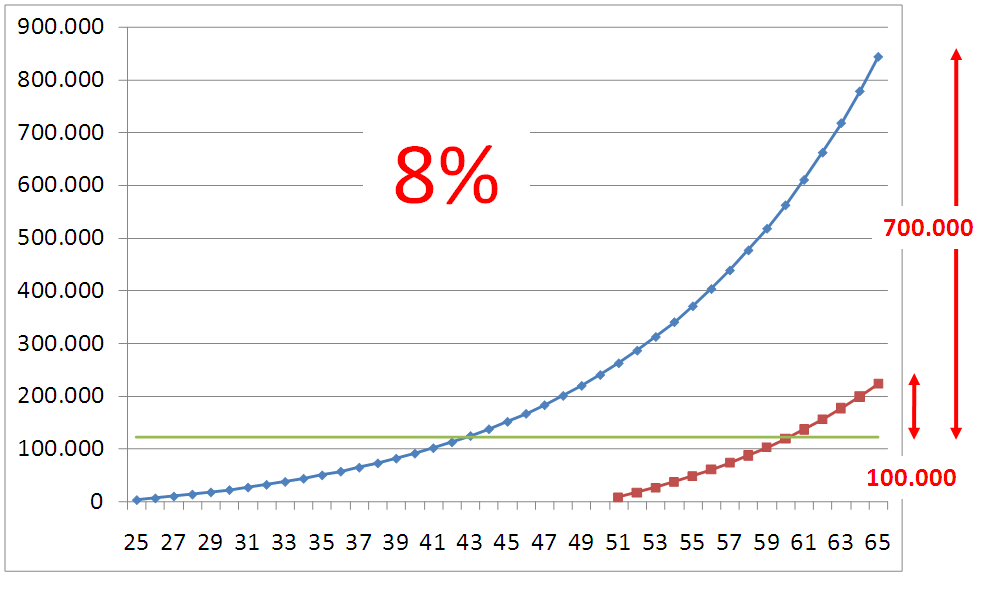
If the young person would invest in more volatile asset, for example the stock market, which historically earns about 8% every year, the new figures would be these ones.
840.000 – earning 720.000 from interests
222.000 – earning 100.000 from interests / 7 times less.
Effect of a 8% compound interest over 40 years.
Finally, with this discussion I wanted to explain little bit the compound interest, how it is making your savings grow, and even though at the beginning the growth seems very slow this is because the growth with time is exponential and we human beings are not very patient, thus it is important to start early saving small amounts, as snowflakes… in the end you will have a big snowball.
Start saving and see you at the retirement age.”
—–
Final comment: as you may have noticed there several passages when what I say differs from the script. I didn’t learn it by heart. During my first speeches in Toastmasters I tried to do so. Now I am departing from that approach. However, I do write the speech to give it a clear structure, to polish some parts, spot words I may have difficulty in pronouncing (so I can replace them for others) and count the amount of words so I am sure it fits in 5 to 7 minutes (often 7’30”… never more or fellow Toastmasters will start clapping).
Some days ago I tweeted about the swings of Mr. Market lately. The consideration of the stock market as Mr. Market is a metaphor that we owe it to Benjamin Graham.
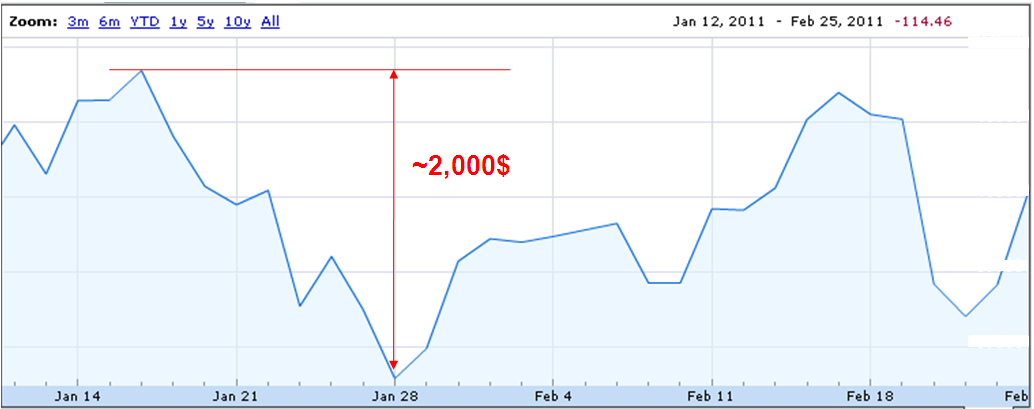
Since a picture is worth a thousand words, I wanted to share a snapshot of the swings of our “J&L” ( 😉 ) portfolio in the past few weeks. One could read the picture as “you have lost 114$ in the past weeks”. That same person on January 28th would have said “you’ve lost 2,000$ in the last 10 days”.
"Resist the human bias to act", Charlie T. Munger
In fact we have not lost a nickel in these weeks, since we haven’t sold any stock. I love a quote from Charlie T. Munger, Berkshire Hathaway vice chairman, which goes: “Resist the natural human bias to act”.
You actually don’t need to buy or sell stock when the market is in the mood. It is as easy as not doing it. You may buy only when you see a margin of safety and sell only when the stock has reached what you considered it to be at its intrinsic value.
You can see that in these 5 weeks we could have lost up to 2,000$ twice; we didn’t. The only tools we counted with: patience and not “listening to Mr. Market”.
Precisely today, it is published the letter of Warren Buffett to Berkshire shareholders. Whether you are planning to invest in stocks or only want to have a fun read, take a look at it.
I had just tweeted the previous day my bet on the competition:
I never get it right...
To reach to that conclusion I had done some numbers for fun on a late Friday afternoon some months ago in a similar fashion than the defence analyst Scott Hamilton showed in his blog. It is clear that I got it completely wrong.
As I have often told to my friends and colleagues, I am extremely bad with these predictions, as I was already mistaken when the JCA and the previous KC-X competitions were decided…
A note of humour: as my brother points out in fact I am very reliable, you just have to bet to the opposite option of my forecast.
Another colleague told us yesterday “you look like economists explaining your miscalculations…”, as someone put it “it is already hard to explain the past, it is even more difficult to predict the future”.
When I was in primary school I used to have a friend who had an impressive train model layout at home. Soon after, my parents gave me some very nice models that I still keep, though I do not play with them anymore and never continued to grow the layout nor purchased more train models.
Since I joined EADS I began collecting a few static models of aircraft: first an A380, then a Beluga, an A340-600, 2 A400M… Each time I stop at Schiphol airport with enough spare time I pay a visit to the model shop over there, so do I to Airbus online shop…
"Static" aircraft model collection at home... as of today.
However, few days ago, I found via Twitter a post in a blog that contained the following video of a model of an airport in Miniatur-Wonderland, Hamburg:
… if I take on this hobby it could be the beginning of my own end! What it’s sure is that whenever I go to Hamburg I’ll pay a visit to the place.
Probably you remember having seen in some magazines ads paid by airlines showing their luxury A380 cabins. Singapore Airlines was the first one in launching this kind of branding campaigns.
According to the definition by the Business Dictionary: “Branding aims to establish a significant and differentiated presence in the market that attracts and retains loyal customers.”
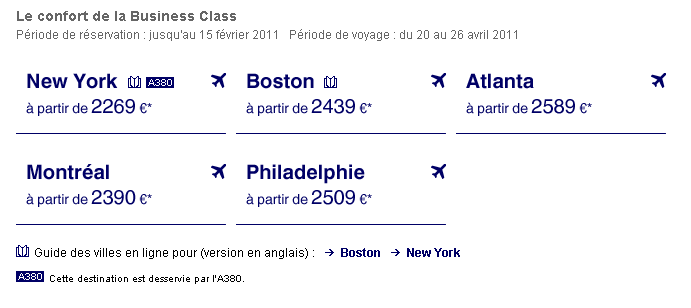
Few days ago, I received an email with publicity from a company that operates the A380. As you can see, they go a step beyond: they now use the A380 not only for branding but for advertising a concrete product, a specific flight. In one of the destinations offered you may see a label indicating that the flight is served by an A380.
Ad: flight served by an A380.
From the Wikipedia: “Advertisingis a form of communication intended to persuade an audience to purchase or take some action upon products, ideas, or services.”
If they use it there must be a reason behind. I have heard from colleagues that, in fact, the companies already operating it in some of their routes are noticing that repeatedly the connections offered by an A380 show higher passenger load factor or occupancy rates than the same connections when offered by a different aircraft.
I have never seen anything like this before. It could have happened when the B-747 entered into service in the 70’s, but I was not here then; I didn’t witness it. It doesn’t happen now; not with the 747 nor with other aircraft. I certainly do not base my buying decisions, when I have to flight within Europe, on whether the airline operates a B-737 or an A320 (maybe I should!). But exactly this is happening in the case of the A380. And airlines are profiting from it.
In a previous post I wrote about the difference in current forecasts for the A380 that Airbus and Boeing report (Boeing has steeply reduced its reported forecast in the past decade). If the appeal of the aircraft continues to bring customers in, we could have a reason to believe that in end the orders figure of A380 maybe rather high. Only time and the market will let us know.
In its website, Airbus dubs the A380 as game-changer. One could expect this when a company is talking about one of its products, however when others are basing its branding and advertising on it, we seem to be really facing a game-changer.
Yesterday I saw John Leahy, Airbus sales chief, in the corridors of the company for the first time since I arrived to Toulouse. At night, I found via Twitter this special report about him by Reuters.
The report is a very interesting piece, and reading in it about Jean Pierson reminded me of a very curious story I heard some years ago and I wanted to recall for you (this is the only reason for this post).
Pierson was the CEO of Airbus from 1985 to 1998. The story I am talking about appears described in the book “Boeing versus Airbus”, by John Newhouse (I haven’t yet read it but is in my wish list). Let me extract the summary that Reuters gave in this other article.
Pierson […] was at US Airways’ headquarters for what he thought would be a short meeting to tie up a 400-plane deal, the anecdote runs.
At the last minute, US Airways’ then-chairman Stephen Wolf started arguing for a 5 percent discount on the selling price.
“Pierson began slowly lowering his trousers and saying ‘I have nothing more to give.’ He then allowed the trousers to fall around his ankles,” says Newhouse in his book.
Wolf replied: “Pull up your pants. I don’t need any more money,” and the deal was signed, according to the book. The author says he got the story from Pierson himself, and it was confirmed by another person present.
Shortly afterward, US Airways announced the purchase of 124 single-aisle Airbus A320 family jets with options for 276 more, a stab into the heart of Boeing’s competing 737 program. It put the European company on track to overtake Boeing in global orders only two years later.
If the situation ever calls for me to drop my trousers I hope there is no one nearby with the intention of reporting it in a book :-).
Today it’s been a year since I started this blog. I wrote the first post on February 9th 2010, and went live a few days later. I had been musing the idea of starting it for some months plus some people close to me encouraged me to do so as well.
In the end I decided to give it a try. Initially, I took it as a learning process: It would force me to learn what that of blogging was, some etiquette about them, etc… Few days after the starting the blog I created my Twitter account and gave it a try with some other tools… still, there are many other tools and applications that I still have to learn and use.
During those days I had the simile in my head of our previous generation: some of them are not even using the internet for as little as 10% of the things we use it for (buying things, social media, reading the papers, watching videos, etc.). It all started because some years ago they did not push themselves to try it, when it was all starting. This was what moved me to start. Who knows how the Internet will evolve from now to 10 years time? But what it is sure is that it won’t go backwards, so we better do as much as we can not to stay behind.
I just finished reading the book “Todo va a cambiar”, by Enrique Dans (in Spanish; I may write about the book soon), in the last chapters you may read the following passage:
“¿Debe […] empezar un blog? La respuesta es clara y concisa: si no lo ha hecho hasta ahora, sí”
Starting the blog is relatively easy; you just need to follow the instructions of any of the free blogging services. Continuing with it is a bit more difficult. You need to be creative, think about more or less valuable ideas that you want to transmit: During this first year I have written 120 posts, about 10 per month or one every 3 days… behind some of them there are hours, of thought, of calculations, of editing. But it has always been fun (as my brother said “you started it because you wanted to preach freely”).
It is fun to think about ideas, that later may or may not be translated into a post, while you are travelling, reading the paper, watching a video, etc. It is fun to see the statistics (over 8,000 visits during this first year), make calculations with them (for an average of 22 visits/day), it is fun to read and reply to comments, and even better to see someone recommending one of your posts.
There are many, yes, many other very good reasons for writing a blog.
Since some months ago I follow in Twitter and read the blog of Connor Neill, a professor at IESE business school. I had the chance to attend a workshop/conference by him at the Toastmasters District 59 Fall conference in Barcelona last November where he spoke about leadership. One of the pieces of advice he gave was to write every day for some time, be it 5 minutes, 500 words…
You may find a very good post in his blog that describes very well that part of his presentation about the importance of writing, where he gives up to 20 “starting questions to use for reflection”.
Should you start a blog? The answer is clear and concise: if you haven’t done it yet, yes.
Some days ago, I attended for the first time a meeting of Rosemasters club in Toulouse. We were about 20 people attending. During the introduction round we discovered that there were 5 Airbus employees among us, which was 25% of us (plus 2 former employees). This could be expected given the importance of Airbus in the city of Toulouse… but, how important is it really?
I had read in some studies about the impact of air transport and aerospace industries in the economy of a given region; taking into account direct employment, indirect and induced. You may take a look at the report “The National Economic Impact of Civil Aviation” [PDF, 1.5MB] prepared by DRI•WEFA, to see some multipliers (Table 1 in page 8).
In the study, we can see that in the case of the USA, for every aerospace job there are 1.9 indirect jobs created and 1.5 induced jobs; thus one aerospace job creates 3.4 jobs.
If we use the same figures for the case of Toulouse:
Airbus and EADS employ over 21,000 people here;
there would be another 41,000 indirect (employment generated in the businesses that supply goods and services to the aerospace sector) and
32,000 induced jobs (employment in other sectors generated thanks to the income spent by direct and indirect aerospace-related employees) thanks to the activity of EADS in the region, in total ~73,000 extra jobs.
These together with the 21,000 jobs from EADS make up for a total of ~94,000 jobs.
Toulouse is a city of ~440,000 inhabitants, with 1.1 million living in the metropolitan area: ~9% of the population of the metropolitan area has a job created directly or indirectly thanks to EADS activity… if we talk about families, between 25-30% of the families depend on a job created directly or indirectly thanks to EADS activity.
No doubt, aerospace is a strategic sector for the region.
I recently read an article titled “Why don’t women run airlines?” I found the question interesting, because I have had some conversations about the number of women and especially in management positions within my company.
Surely there are a lot of issues and reasons behind (e.g. what is called “the glass ceiling”) that have been well-studied. When encountered with this question, I asked my senior peers within the department how many women were in their class at the university when studying aerospace engineering: the answer was one or none. That is the proportion of women that one could expect should be in the top management of the company now.
Luckily the trend now is changing, but still, in general, the aerospace sector is lacking women. I compiled some statistics:
Only 4% of flagship airlines had a woman as CEO (according to the study in the above-mentioned article).
19,627 women worked for EADS (16.5%) at the end of 2009 (17% in the case of Spain; 13.6% in the case of Airbus).
31.9% women out of the 39,469 students of the Universidad Politécnica de Madrid in the year 2004 (I found this information using the Wayback Machine as the university does not publish this anymore in its website).
The admissions of that year kept the same proportion, 32% women.
25.8% women out of the 1,983 students of my engineering school that same year (Escuela Técnica Superior de Ingenieros Aeronáuticos, now EIAE).
The admissions of that year had a higher proportion, 31.7% women (something is changing).
41 women out of 191 (21.5%) students graduated with me in November 2005.
The promotion of 2005, ideally should have started in September 2000. That year, there were admitted 117 women out of 368 students, or 31.8% (the year I started, 1999, the proportion was 25.2% women… though not published, I guess the share was lower in previous years).
The fact that women were 21.5% of graduates while being 25.8% of the population of the school may point at some of the other reasons, which I am not qualified to discuss.
Even if there was no discrimination, I believe it will take some years before 32% of EADS workforce and top management are women (~25 years? when the proportion of the students now in the university reaches all stages of the age pyramid of the company). I guess the same will apply for airlines.
I’m afraid it may never happen that 50% of the workforce in the company are women, probably not until 25 years later than we see such a proportion in the aerospace engineering schools… which 5 years ago was still 32%.