Where do they pay lower taxes?

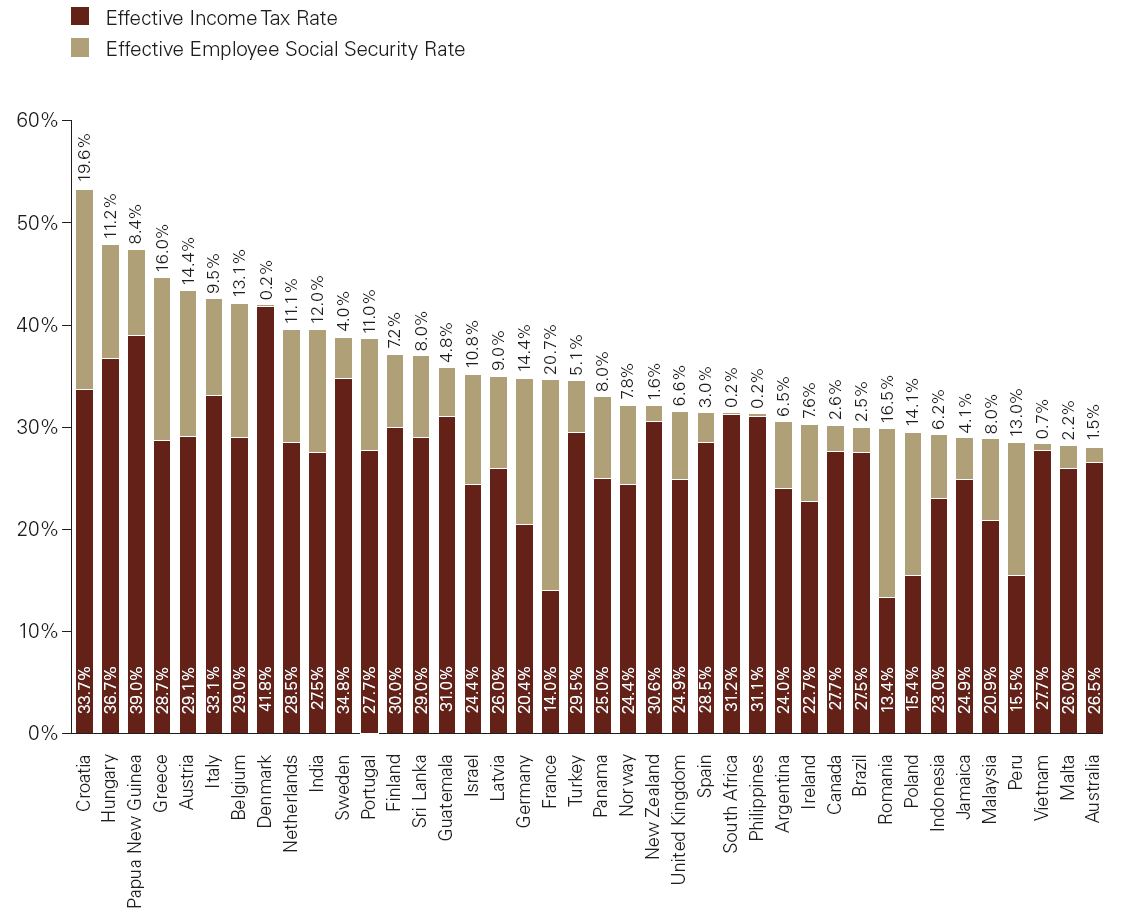
A friend posted in Facebook yesterday’s Daily chart from The Economist; she was very disappointed of finding Hungary such high in the ranking.

The chart comes from KPMG’s “Individual Income Tax and Social Security Rate Survey 2010”. I found it very interesting:

  • it contains several charts of rates of income tax and social security rates for different levels of income (high ones by the way),
  • coloured maps of the different regions in the world according to their level of taxation,
  • for some countries you may find graphics with the evolution of taxation levels with income,
  • capital gains tax, and
  • some country-specific information for several ones.


Effective Income Tax and Social Security rates.


What if you could pay Social Security in Philippines (0.2%) and Income Tax in Romania (13.4%)?

1 Comment

Filed under Economy

Mi adiós a Ibercaja

Llevaba tiempo queriendo cerrar una cuenta de Ibercaja por varios motivos: cobran por las tarjetas, cobran por las transferencias realizadas por internet, hace años me colaron un seguro de vida al pedir un crédito para irme de Erasmus, tiene pocas oficinas, etc.

Hasta ahora no había cerrado esa cuenta porque seguía pagando un préstamo, y no quería cancelar el préstamo porque al principal que me quedaba por pagar le podía sacar una rentabilidad mayor invirtiéndolo que el interés que me cobraba la caja. Pero en junio terminé de pagarlo.

Hace unos días transferí casi todo el dinero restante a ING. Pregunté si seguía necesitando la cuenta de Ibercaja asociada, y me confirmaron que no, que al tener la cuenta Nómina de ING con sus tarjetas (gratuitas) asociadas no era necesario. La comercial de ING me ofreció que ellos me realizaban la gestión de cerrar la cuenta de Ibercaja: “No, gracias, prefiero ir en persona”. Para eso había dejado 22,53€.

Esta mañana, antes de ir al trabajo, he pasado por la oficina más cercana (c/ Francisco Silvela, Madrid).

–  Hola, venía a ver cuánto dinero hay en la cuenta.

–  22,53€.

–  Perfecto, quería retirarlo.

–  ¿22 euros ó 22,53?

–  22,53€.

El hombre de la caja recoge el dinero, hasta el último céntimo y me lo da.

–  Tiene que firmar aquí.

–  Ahora quería cancelar esta tarjeta que me han enviado, que no he pedido ni activado y me dicen que me quieren cobrar 17€ ahora en octubre.

Comprueba unas cosas en el ordenador, me señala otros dos papeles donde debo firmar…

–  Y, por último, quería cerrar la cuenta.

[El orden de retirar primero el dinero, cancelar luego la tarjeta y por último cancelar la cuenta era premeditado: para evitarle la tentación de inventarse un “cargo por cancelación” dado que él vería que ya no quedaba dinero y para que fuese lo más parecido a una muerte anunciada]

–  … No puede ser, tiene que ir a su oficina (Las Rozas, a 22km de Madrid).

–  ¿Cómo que tengo que ir a un pueblo donde no vivo ahora para cerrar una cuenta? Deme una hoja de reclamación que voy a poner una queja.

–  Espere… voy a llamar a la oficina de Las Rozas a ver si me autorizan.

Esperamos a que llegue el fax… A quienes vivimos en Madrid, esto de tener que ir de Madrid a Las Rozas puede no parecer tan extraño, pero ¿si hubiese abierto la cuenta en Sevilla? Me parece estúpido pretender que cada persona haya de ir a cerrar una cuenta donde la abrió… En Ibercaja parecen serlo.

Llega el fax:

–  Usted tenía un seguro de vida… ¿relacionado con un préstamo?

–  Sí, me obligaron a abrirlo. No lo quiero.

–  Además, tiene una libreta.

–  No lo sé, si en algún momento la tuve no sé donde está.

–  Necesito que traiga la libreta, si no, no podemos cerrar la cuenta.

[Este fue el mejor momento… me costó no reírme: ¿qué debía pensar el cajero? “Si le retengo unos días hasta que encuentre la libreta, igual se lo piensa, recapacita y quiere volver a ser nuestro cliente”… esto es como entienden el servicio al cliente – ni que hablar de no cobrar por realizar transferencias, ni por las tarjetas, horarios de apertura, horarios de atención telefónica, etc.]

–  No me ha entendido: no tengo esa libreta ni se la voy a traer.

–  … Bueno, si un día la encuentra corte la banda magnética…

Firmé un último papel y salí del banco sonriente.

Aunque muy pocos, hay días en que el ir a un banco o caja puede hacer que tu día empiece de la forma más feliz.
30 Comments

Filed under Miscellanea

Learning while investing

During last days I had some fun learning different terms used in the shipping industry while investigating some possible investments. Let me share some of these examples:

Panamax”: this is a term for the size limits for ships traveling through the Panama Canal.

“Panamax is determined principally by the dimensions of the canal’s lock chambers, each of which is 110 ft (33.53 m) wide by 1,050 ft (320.04 m) long, and 85 ft (25.91 m) deep. The usable length of each lock chamber is 1,000 ft (304.8 m). The available water depth in the lock chambers varies, but the shallowest depth is at the south sill of the Pedro Miguel Locks and is 41.2 ft (12.56 m) at a Miraflores Lake level of 54 ft 6 in (16.61 m). The height of the Bridge of the Americas at Balboa is the limiting factor on a vessel’s overall height.”

(Did you ever have such an idea of the size of the Panama Canal?)

The two ships seen here seem almost to be touching the walls of the Miraflores Locks.

The same applies to the term “Suezmax”.

Another curious term is “Capesize“… which meaning by now you may already guess: “Capesize ships are cargo ships originally too large to transit the Suez Canal (i.e., larger than both Panamax and Suezmax vessels). To travel between oceans, such vessels used to have to pass either the Cape of Good Hope or Cape Horn. [I especially liked this last clarification] In effect Capesize reads as “unlimited”.” (Sure, once you have to travel around in the open ocean… you put the limit).

Lastly, “Deadweight tonnage”: this is “the sum of the weights of cargo, fuel, fresh water, ballast water, provisions, passengers, and crew.” It is curious that in the shipping industry this is also called “payload” according to the Wikipedia, while in the air cargo industry we refer by payload to just the weight of cargo / passengers…

Leave a comment

Filed under Education, Investing, Personal development

Is a hassle-free airport possible?

Some years ago on trip to India, I remember having passed through the security check just before getting into the airplane at Schiphol airport in Amsterdam. However in the subsequent flights I have taken from there I never saw this again… until last summer, on another trip to a non-Schengen destination, Tunisia.

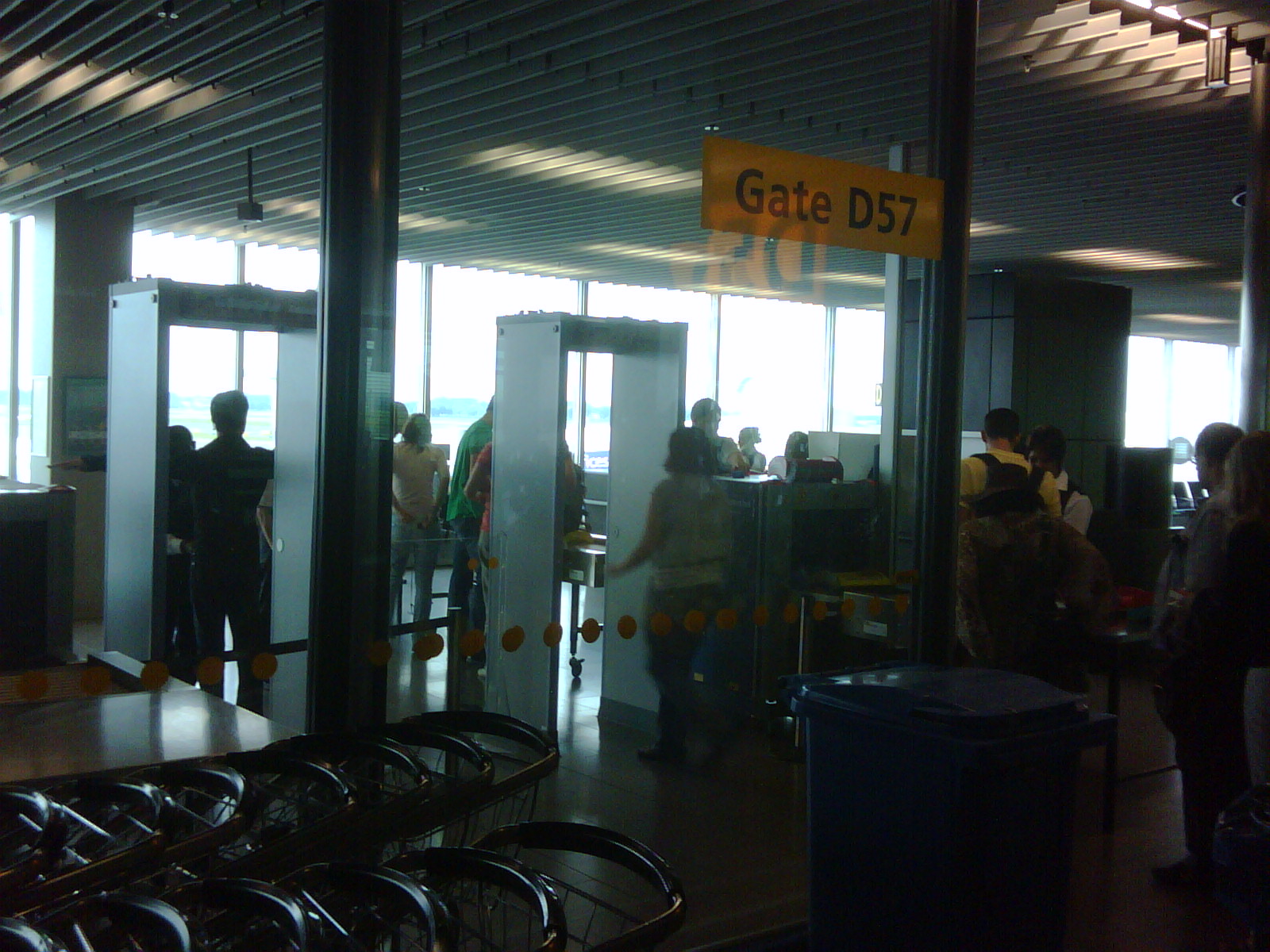
Here is the picture I took.

X-ray scanners and metal detectors at Schiphol, Amsterdam.

As you can see, in terminal 1 departures D of Schiphol airport, the security control is located just where each boarding gate is.

You can imagine how much this measure reduces the hassle passengers experience in airports. To take that flight, we arrived at the airport, dropped our luggage, showed our boarding pass and passport to an official (no long queue, no removing of personal belongings…), walked to our boarding gate and only there we made a small queue for the security control… The difference: that queue is composed of just the people who will come in your flight, you are seeing the airplane out there, there is no rush, they are seeing you, you are not missing the plane…

I tried to get the numbers from Madrid-Barajas airport but I did not find them (if any one has better estimates or a reliable source, please feel free to contribute), nevertheless, from having seen the different terminals I can figure out that:

  • It may have around 230 boarding gates among all the terminals (over 60 between T1, T2 and T3, around 90 in T4 and over 60 in T4S).
  • It may have no more 50 than x-ray scanners…

If you wanted to install 2 per boarding gate, you would need to invest in buying and staffing more than 4 times the number of x-ray scanners and metal detectors than the ones that there are now… It would be so easy… if just air traffic controllers did not suck up a whole 30% of AENA yearly costs [pdf, 741 Kb] (~1bn€)…

3 Comments

Filed under Aerospace & Defence

Studios are more profitable than flats

Two weeks ago I was having some drinks with a good friend of mine. Talking about books we were reading we ended up talking about investments.

He had the idea of buying a small studio in order to rent it, because the margin you could get in a small studio compared to its price was larger than if you did the same with a larger apartment.

I wanted to test the argument with idealista.com, the leading real state website in Spain. Apart from the many ways in which you can screen and sort out houses, the site has a very handy piece of information which is the average price per square meter of your selection either for rental or sale.

I restricted my searches to the district “Centro” in Madrid. I then looked for average prices of “studios” of “less than 60m2” and “flats” of “more than 80m2”, both for rental and for sale. The minimum sample of houses was 175 and the maximum over 700, so I believe they can be considered a good sample for this little study. I then looked for the averages:

  • Studio of less than 60m2:
    • Rental: ~17 €/m2 per month.
    • Sale:  ~4,287 €/m2.
  • Flat of more than 80m2:
    • Rental: ~13 €/m2 per month.
    • Sale:  ~4,295 €/m2.

As you can already see, the price per square meter is very slightly higher in the case of flats (~0.2%) while the price of rental is much higher in small studios (~31%).

What is the profitability of the case?

We can make the calculation with these per square prices. If you buy the small studio and put it for rent, you would earn from it 12 times 17€ per year (204€), this is 4.8% return on the asset, which in this case is a square meter valued at 4,287€. For the larger flat the earnings would be 3.6%. Thus, as my friend said renting small studios is a whole 31% more profitable than renting larger flats.

Paid by itself? My friend also mentioned that you could even get a mortgage that it was cheaper than the monthly rent and thus really not needing to dedicate ~100k€ to the purchase of the prize, but paying the flat simply with the monthly rent incomes.

That case also holds true with current low interest rates. I checked the case for a small studio of 25m2 and you could charge about 425 euros while the mortgage would be around 322 (25 years). This case would not be true anymore if you want to pay the studio in a shorter time, or interest rates rise.

This  case also excludes the extra costs that house ownership has (repairs, improvements in the building, idle time between renters…). So we should see the figure 4.8% as a ceiling.

I still would prefer investing in stocks, where returns have been higher throughout history and avoids you the hassle of dealing with the problems involved with real state…

1 Comment

Filed under Investing

Most common letters in English and Spanish are…

While reading a book last summer, one curiosity came into my mind: what was the frequency in which different letters appeared in a text.

So I decided to count them… not only that, but I also wanted to compare the results between Spanish and English language.

The texts I used are both from this blog, the latest one in English from yesterday’s post and one about housing in Spanish from four months ago.

Here is the graphic with the results:

Frequency of letters in English and Spanish.

Even though these are just two posts of my blog and thus not a statistically relevant sample to allow for any definite conclusion, these are the results that I got:

  • In English the most common letter is “e” (13.5%), while in Spanish is “a” (12.5%) closely followed by “e” (12.2%).
  • In Spanish vowels account for 46.3% of the speech while in English they are 39.9%; more consonants in English.
  • In English the most common consonant is “t” (9.8%… from “the”?) followed by “s”, while in Spanish is “s” (7.4%… “ser”?) followed by “n”.
  • The most striking differences I found were:
    • In Spanish we use “a” over 50% more often than in English.
    • Some of the consonants we use way more in Spanish than in English are “d” (“de”?), “l” (“la”, “el”?) and “q” (“que”?).
    • Some of the consonants that are used more in English than in Spanish: “h” (5 times more!… “the”?), “t” and “w” (practically not used in Spanish).

12 Comments

Filed under Personal development

The most profitable roulette

Last weekend I attended Riaza’s local festivities with some friends who have a house there. Riaza is a small and beautiful village in the province of Segovia famous for its main square.

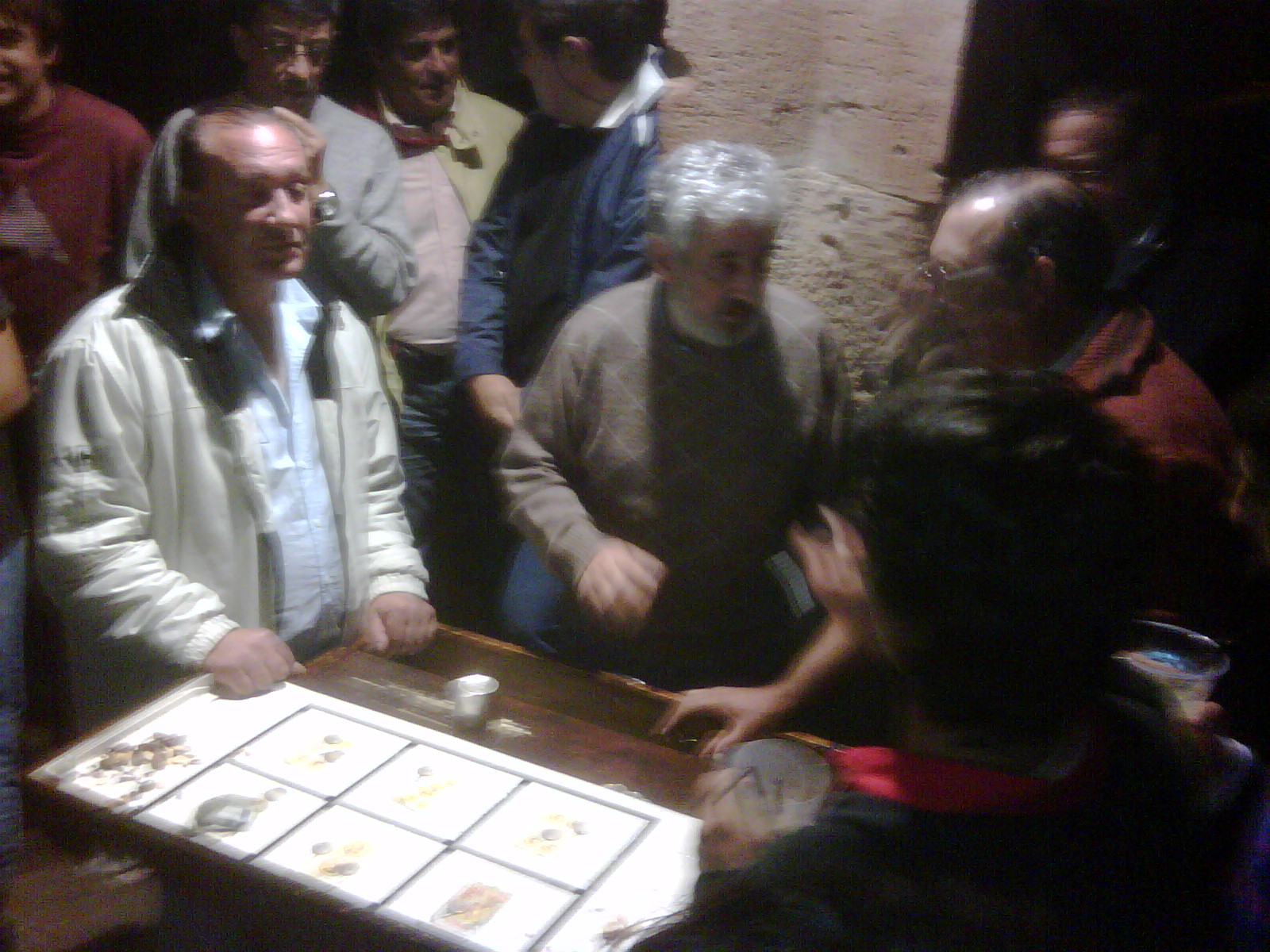
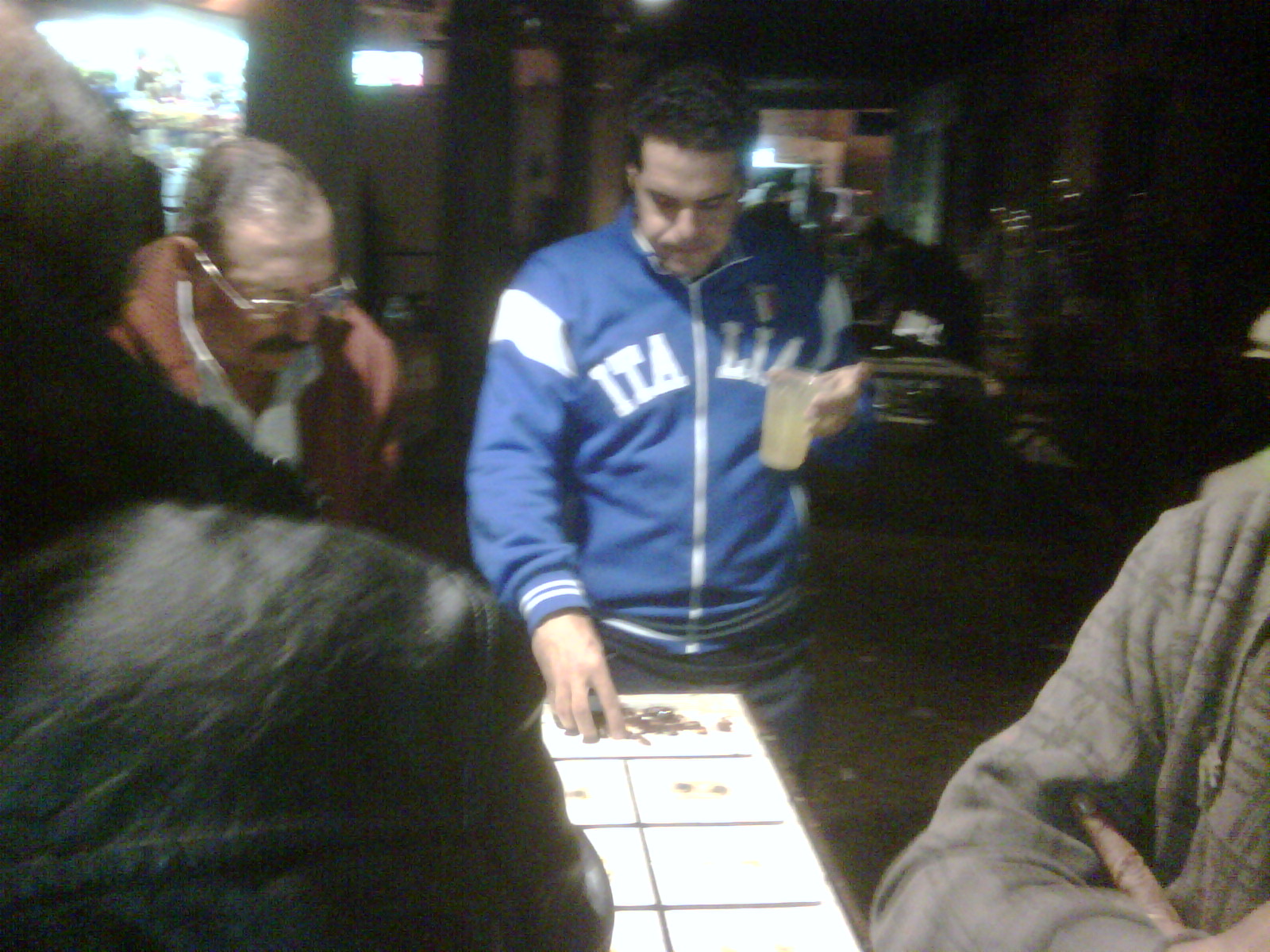
One of my friends raised to me the issue of a game being organized by some locals. It was a kind of casino roulette, but very much simplified…

Instead of 36 numbers plus zero, there were only six. Instead of using an actual roulette, they used just a six-sided die and small cup. Instead of casino coins, bets were placed directly with cash, starting from one euro. Instead of using a green clothed table they used a small wooden board with the images of 6 Spanish playing cards; with numbers 1 to 6.

Prize. We did not know how they came up with the amount of the prize, but it was perfectly established to maximize their benefits and attract as many players as possible. In case you bet for the right number, they gave you 4 times the amount you bet plus your stake, i.e., you bet 1 euro and are lucky, you then walk away with 5 euros.

If they had offered more money, the expected value for the organizers would have been zero or a loss. Have they offered less (e.g., to just double the bet) and not so many people would have been tempted by the game.

Offering 4 times the stake to the players, means  to them a mathematical expectation of -0,17 € for a one-euro bet. For the organizers means the opposite: a business with an expected profit of 17% of all the amounts at stake.

Compare this to the business of a casino with a French roulette, with 37 numbers, in which the expected profit for the casino is 2.7% (where the prize for hitting the number is 35 times the amount you bet). This local game is 6 times more profitable than the casino!

The next question is: how much money could they make out of it? I first saw them at 2:30 am of Sunday morning. At 3:30 am they were still there, though at 4:30 am they were not. Let me assume they hold the village-casino for about 8 hours a day (from 20 pm to 4 am, being conservative, i.e., assuming they are not out there during most of day time).

The highest amount we witnessed at the table at one single round was in excess of 40 € (including a 20€ note), but I assume they had some collaborators among the crowd. The lowest amounts were around 6-8 euro per round. Let’s assume the average to be around 10€ per round.

Each round we witnessed lasted very short time: less than a minute, though we did not measure it. Let’s assume there was exactly a minute, and that they kept that rhythm during the 8 hours…

  • They would have earned about 1.67€ per round.
  • About 100€ per hour (33€/hour per person, taking into account that they were three organizers).
  • 800€ per day.

By organizing the game for four or five days during the festivities they managed to take home their monthly salaries for the three of them out of this simple game.

Some times it is surprising how easy a business can be.

4 Comments

Filed under Investing, Miscellanea, Travelling

After the year 2015, there will be no airplane crashes

When I was writing in the previous post about Alberto Dubois idea of evolution being exponential I had in mind the book “Augustine’s Laws”, to which I have referred many times in this blog.

Today, I read a very good article in last week’s issue of The Economist, “Defence spending in a time of austerity”, which describes the current situation of defence budgets around the World and how it will affect many programmes…

The article itself is referring to the computing evolution depicted by Dubois and some other exponential trends identified by Augustine, such as the increased use of computer power and software.

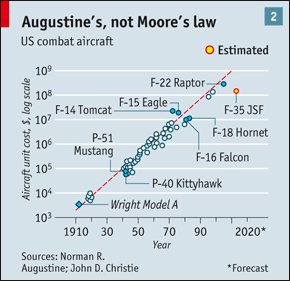
I especially liked the update of Augustine’s chart for the Law XVI which says:

“In the year 2054, the entire defence budget will purchase just one aircraft. This aircraft will have to be shared by the Air Force and Navy 3½ days each per week except for leap year, when it will be made available to the Marines for the extra day.”

Augustine's Law XVI chart, updated by The Economist.

Thus, in the last 25 years, since Augustine wrote his book, the business has not improved much. This situation provokes that different countries have to share weapons, e.g., C-17 transport aircraft (Strategic Aircraft Capability, operated for several countries from Hungary), SALIS (“Strategic Airlift Interim Solution”, chartering of ex-soviet An-124 to NATO countries)…

One of the most striking situations that may come to happen is that UK and France share two aircraft carriers. Carriers were considered essential to have control over oceans… however, if France is going to scale its fleet down to one single carrier: what would happen during the long months when it will be in overhaul?

Lately there have been much discussion about this sharing scheme, though it is still denied by officials. Consider that just back in 1940, the British Royal Navy destroyed much of the French fleet in the Operation Catapult.

Other interesting point is the trend towards using unmanned aircraft versus piloted ones. Already in the “Aircraft Investment Plan Fiscal Years (FY) 2011-2040” (PDF, 0.2MB) that the US Air Force submitted together with its FY11 budget request, it forecasted that the number of unmanned aircraft will almost triple in the next ten years, while the rest of fleets would be either just renewed or decreased.

Nevertheless, this may never come to happen if we take Augustine’s Law Number XIV:

“After the year 2015, there will be no airplane crashes. There will be no takeoffs either, because electronics will occupy 100 percent of every airplane’s weight”.

4 Comments

Filed under Aerospace & Defence

TEDxMadrid 2010

Last Saturday, a friend and I attended TEDxMadrid, an independently organized TED event in which several speakers presented some “ideas worth spreading” as the TED slogan goes.

The event took place in HUB Madrid, a “unique ecosystem designed to enable individuals ranging from corporate executives to community leaders, from policy-makers to entrepreneurs and freelance professionals to thrive. It is an office and events space where you can access social business ideas, innovation, knowledge, market opportunities, inspiration and experience” as they put it.

The event was streamed and the videos so far are available here. It was also funny to see the twitting activity that took place among the people being at the meeting (check #tedxmad, #tedxmadrid…).

A summary of each talk was made in the form of sketch boards by Puño & Gorriti that are available in flicker.

At the end of the event there was a short performance of impromptu theatre by “Impromadrid Teatro”, it was a funny experience. I have a friend who also has an impromptu theatre company in Madrid, “Impronta Compañía de Teatro Espontáneo”, I must go to one of their performances!

I still have to mentally “re-work” many of the things we heard and saw, and look for the many webs, books and ideas that were raised. Nevertheless, in this post I already wanted to share some thoughts that I took with me:

  • Slavery. It was commented by Antonella that in the last TED she learnt about “Free the Slaves”, an organization that liberates slaves around the world… slaves in the XXI century? We hear about women obliged to work as prostitutes or children working in some hidden factories… but when I heard the figure 27 million of them, I was shocked.
  • To be exponential in our thoughts. Alberto Dubois showed in his talk how evolution is exponential (human evolution, computing evolution, genome decoding evolution…) but we are normally linear in our thinking. We may apply the “exponential” way of thinking to many other fields, think of it.
  • BRINKs. We all have heard about the BRICs (the term coined by Goldman Sachs to refer to Brazil, Russia, India and China) or the PIGS (the term coined by Anglo-Saxon economists, used by FT, to refer to Portugal, Italy, Greece and Spain – lately Ireland and Great Britain as well), Alexander van de Putte introduced the BRINKs. This term refers to Brazil, Russia, Iraq, Nigeria and Kazakhstan, the countries which increased oil production will defer (once again) the estimates for the peak oil.

Finally, I wanted to thank C. Todd, Javier, Derek and Antonella for the great effort they have put into this event.

For those of you who could not attend this event but would have wished to do so, be aware that a similar event will take place in a month from now in Madrid, TEDxSol, on October 5th.

7 Comments

Filed under Education, Personal development, Twitter & Media

A ride into the Sahara (video)

During our holidays in Tunisia, we took a 2-days excursion to the South-West; into the Sahara. We had never been in a desert before.  We loved it.

In those two days we lived many new experiences. We felt like in a roller coaster. Yesterday, I posted a video about the amphitheater of El Djem. Today I am posting another video about some of the other things we did. I truly believe that it will give you a much better idea than a thousands words…

I chose UB-40 song “Higher Ground” for the sound track of the video because indeed this is what we listened during our ride in the Toyota Land Cruiser: plenty of UB-40 songs chosen by our Tunisian driver to our delight.

Regarding the cars, I would say that around 90% of those venturing into the desert were Toyota; the remainder, mainly Nissan. If you saw what they did to those cars… they must be reliable cars.

2 Comments

Filed under Movies, Travelling